About the Report
Base Year 2024Vietnam Steel Rebar Market Overview
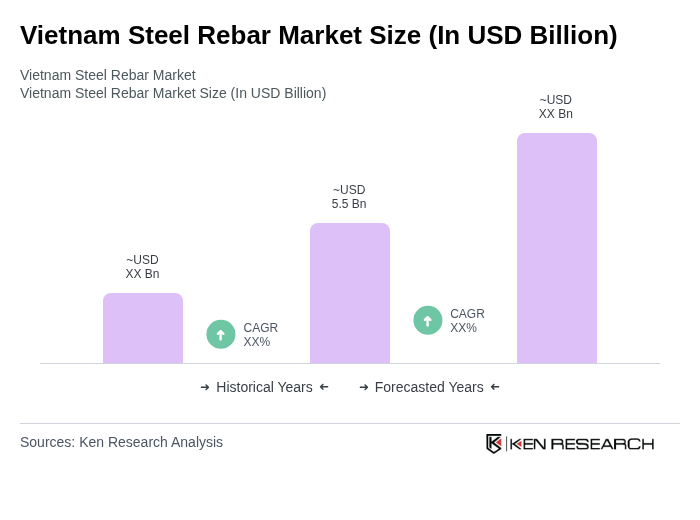
- The Vietnam Steel Rebar Market is valued at USD 5.5 billion, based on a five-year historical analysis. This growth is primarily driven by the booming construction sector, which is fueled by rapid urbanization and government infrastructure projects, including transport networks, industrial parks, and urban public works. The increasing demand for residential and commercial buildings has significantly contributed to the market's expansion, alongside rising investments in public infrastructure and industrial facilities such as factories and logistics hubs.
- Key cities such as Ho Chi Minh City, Hanoi, and Da Nang dominate the market due to their high levels of construction activity and urban development. These cities are experiencing significant population growth and economic development, leading to increased demand for steel rebar in various construction projects, including residential, commercial, industrial developments, and large-scale infrastructure such as metro lines, ring roads, ports, and airports.
- The Vietnamese government has strengthened technical regulations and standards governing the use of steel rebar in construction, particularly for public works, through instruments such as the National Technical Regulation on Steel for the Reinforcement of Concrete – QCVN 07:2011/BKHCN issued by the Ministry of Science and Technology, and updated construction standards under the Law on Construction and its guiding decrees. These provisions aim to enhance the safety and durability of infrastructure by requiring compliance with specified mechanical properties, quality testing, and certification for reinforcing steel used in structural concrete, forming part of a broader strategy to improve construction practices and promote more efficient use of materials.
Vietnam Steel Rebar Market Segmentation
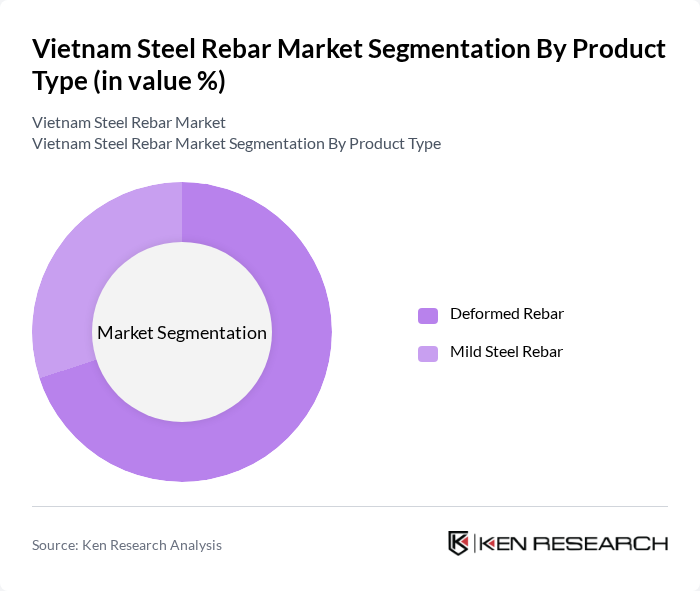
By Product Type:The market is segmented into Deformed Rebar and Mild Steel Rebar. Deformed rebar is widely used in construction due to its superior bonding properties with concrete and higher tensile strength, making it the preferred choice for high-strength and earthquake?resistant applications in high?rise buildings, bridges, and infrastructure. Mild steel rebar, while less commonly used for primary load?bearing structural elements, is favored for its cost-effectiveness and ease of bending and welding in non-critical or secondary applications such as light reinforcement, meshes, and ancillary components.
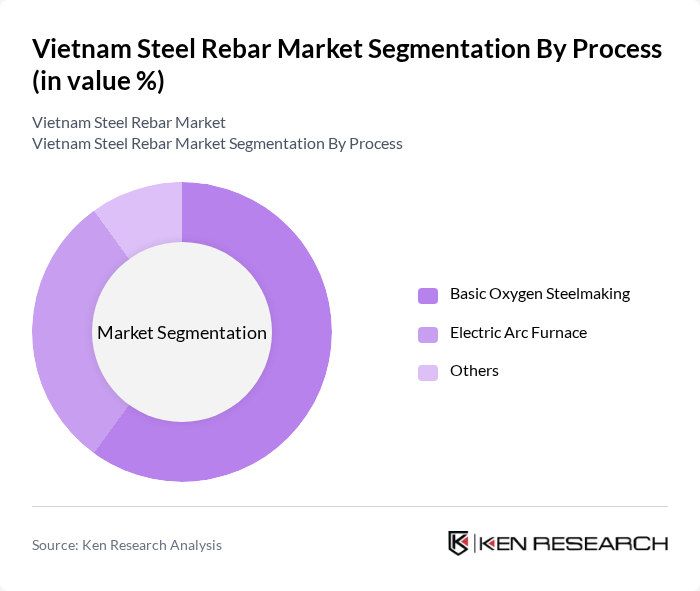
By Process:The market is categorized into Basic Oxygen Steelmaking, Electric Arc Furnace, and Others. Basic Oxygen Steelmaking is a key process in Vietnam’s integrated steel complexes, particularly for large-scale production of long products and rebar, due to its efficiency and ability to produce high-quality steel at competitive cost when using iron ore–based inputs. Electric Arc Furnace is gaining traction for its environmental benefits, lower direct carbon emissions per ton when using scrap, and flexibility in production scheduling, supporting mini-mills and regional long?product producers. Other methods, including induction furnaces and hybrid routes, are used for niche applications, smaller capacities, or specific product ranges where localized scrap availability and investment costs are key considerations.
Vietnam Steel Rebar Market Competitive Landscape
The Vietnam Steel Rebar Market is characterized by a dynamic mix of regional and international players. Leading participants such as Hoa Phat Group JSC, Pomina Steel Company Limited, Vietnam Steel Corporation (VNSTEEL), VAS Viet My Steel Co. Ltd., Southern Steel Company Ltd. (SSC), Thang Long Cement and Steel JSC, SMC Trading Investment Joint Stock Company, Tung Ho Vietnam Steel Co. Ltd., Formosa Ha Tinh Steel Corporation, Vietnam-Italy Steel Joint Stock Company (VISCO), Hoa Sen Group, Nam Kim Steel Joint Stock Company, Ton Dong A Corporation, Shengli Vietnam Special Steel Co. Ltd., and other emerging local players contribute to innovation, geographic expansion, and service delivery in this space.
Vietnam Steel Rebar Market Industry Analysis
Growth Drivers
- Increasing Infrastructure Development:Vietnam's government allocated approximately $25 billion for infrastructure projects in future, focusing on transportation and urban development. This investment is expected to create a demand for steel rebar, as major projects like the North-South Expressway and urban metro systems require substantial quantities of rebar. The construction of new roads and bridges is projected to increase rebar consumption by 18% annually, significantly boosting the market.
- Urbanization and Population Growth:Vietnam's urban population is projected to reach 45% in future, up from 37% in 2020, according to the World Bank. This rapid urbanization drives the need for residential and commercial buildings, leading to a surge in rebar demand. The construction of over 1 million new housing units is anticipated, which will require approximately 1.8 million tons of rebar, further stimulating market growth in the region.
- Government Investment in Construction:The Vietnamese government has committed to investing $12 billion in the construction sector in future, focusing on public works and housing projects. This investment is expected to create a robust demand for steel rebar, as it is a critical component in construction. The government's push for affordable housing will likely increase rebar consumption by 22% in the next year, positively impacting the market.
Market Challenges
- Fluctuating Raw Material Prices:The steel industry faces challenges due to volatile raw material prices, particularly iron ore and scrap metal. In recent periods, iron ore prices fluctuated between $95 and $135 per ton, impacting production costs for rebar manufacturers. This volatility can lead to unpredictable pricing for consumers and may hinder investment in new projects, creating uncertainty in the market.
- Environmental Regulations:Stricter environmental regulations in Vietnam are posing challenges for steel rebar manufacturers. The government aims to reduce carbon emissions by 32% by 2030, which may require significant investments in cleaner technologies. Compliance with these regulations could increase production costs by up to 18%, potentially leading to higher prices for consumers and reduced competitiveness in the market.
Vietnam Steel Rebar Market Future Outlook
The Vietnam steel rebar market is poised for significant growth, driven by ongoing infrastructure projects and urbanization trends. As the government continues to invest heavily in construction, the demand for high-quality rebar will increase. Additionally, advancements in production technologies and a focus on sustainability will shape the market landscape. Companies that adapt to these trends and invest in innovative practices are likely to gain a competitive edge in the evolving market environment.
Market Opportunities
- Expansion of Renewable Energy Projects:The Vietnamese government plans to invest $7 billion in renewable energy projects in future, creating opportunities for rebar manufacturers. These projects, including wind and solar farms, require substantial amounts of rebar for structural support, potentially increasing demand by 12% in the coming years.
- Technological Advancements in Production:The adoption of smart manufacturing techniques is expected to enhance production efficiency in the steel rebar sector. By implementing automation and data analytics, manufacturers can reduce costs by up to 25%, allowing them to offer competitive pricing and improve profit margins, thus capturing a larger market share.
Scope of the Report
| Segment | Sub-Segments |
|---|---|
| By Product Type | Deformed Rebar Mild Steel Rebar |
| By Process | Basic Oxygen Steelmaking Electric Arc Furnace Others |
| By Finishing Type | Epoxy Coated Black |
| By End Use | Residential Commercial Industrial |
| By Region | Northern Vietnam Central Vietnam Southern Vietnam |
Key Target Audience
Investors and Venture Capitalist Firms
Government and Regulatory Bodies (e.g., Ministry of Industry and Trade, Ministry of Construction)
Manufacturers and Producers
Distributors and Retailers
Construction Companies
Real Estate Developers
Industry Associations (e.g., Vietnam Steel Association)
Financial Institutions
Players Mentioned in the Report:
Hoa Phat Group JSC
Pomina Steel Company Limited
Vietnam Steel Corporation (VNSTEEL)
VAS Viet My Steel Co. Ltd.
Southern Steel Company Ltd. (SSC)
Thang Long Cement and Steel JSC
SMC Trading Investment Joint Stock Company
Tung Ho Vietnam Steel Co. Ltd.
Formosa Ha Tinh Steel Corporation
Vietnam-Italy Steel Joint Stock Company (VISCO)
Hoa Sen Group
Nam Kim Steel Joint Stock Company
Ton Dong A Corporation
Shengli Vietnam Special Steel Co. Ltd.
Other Emerging Local Players
Table of Contents
Market Assessment Phase
1. Executive Summary and Approach
2. Vietnam Steel Rebar Market Overview
2.1 Key Insights and Strategic Recommendations
2.2 Vietnam Steel Rebar Market Overview
2.3 Definition and Scope
2.4 Evolution of Market Ecosystem
2.5 Timeline of Key Regulatory Milestones
2.6 Value Chain & Stakeholder Mapping
2.7 Business Cycle Analysis
2.8 Policy & Incentive Landscape
3. Vietnam Steel Rebar Market Analysis
3.1 Growth Drivers
3.1.1 Increasing Infrastructure Development
3.1.2 Urbanization and Population Growth
3.1.3 Government Investment in Construction
3.1.4 Rising Demand from the Real Estate Sector
3.2 Market Challenges
3.2.1 Fluctuating Raw Material Prices
3.2.2 Environmental Regulations
3.2.3 Competition from Alternative Materials
3.2.4 Supply Chain Disruptions
3.3 Market Opportunities
3.3.1 Expansion of Renewable Energy Projects
3.3.2 Technological Advancements in Production
3.3.3 Export Potential to Neighboring Countries
3.3.4 Government Incentives for Sustainable Practices
3.4 Market Trends
3.4.1 Shift Towards High-Strength Rebar
3.4.2 Adoption of Smart Manufacturing Techniques
3.4.3 Increased Focus on Sustainability
3.4.4 Growth of Prefabricated Construction
3.5 Government Regulation
3.5.1 Standards for Steel Quality
3.5.2 Environmental Compliance Regulations
3.5.3 Import Tariffs on Steel Products
3.5.4 Safety Regulations in Construction
4. SWOT Analysis
5. Stakeholder Analysis
6. Porter's Five Forces Analysis
7. Vietnam Steel Rebar Market Market Size, 2019-2024
7.1 By Value
7.2 By Volume
7.3 By Average Selling Price
8. Vietnam Steel Rebar Market Segmentation
8.1 By Product Type
8.1.1 Deformed Rebar
8.1.2 Mild Steel Rebar
8.2 By Process
8.2.1 Basic Oxygen Steelmaking
8.2.2 Electric Arc Furnace
8.2.3 Others
8.3 By Finishing Type
8.3.1 Epoxy
8.3.2 Coated
8.3.3 Black
8.4 By End Use
8.4.1 Residential
8.4.2 Commercial
8.4.3 Industrial
8.5 By Region
8.5.1 Northern Vietnam
8.5.2 Central Vietnam
8.5.3 Southern Vietnam
9. Vietnam Steel Rebar Market Competitive Analysis
9.1 Market Share of Key Players
9.2 Cross Comparison of Key Players
9.2.1 Company Name
9.2.2 Group Size (Large, Medium, or Small as per industry convention)
9.2.3 Vietnam Steel Rebar Revenue (USD)
9.2.4 Vietnam Steel Rebar Volume Sold (Tons)
9.2.5 Revenue CAGR in Vietnam Steel Rebar Market (%)
9.2.6 EBITDA Margin (%)
9.2.7 Capacity (Tons/Year)
9.2.8 Capacity Utilization Rate (%)
9.2.9 Market Share by Volume (%)
9.2.10 Market Share by Value (%)
9.2.11 Average Realized Price (USD/Ton)
9.2.12 Export Share of Sales (%)
9.2.13 Capital Expenditure on Rebar Operations (USD)
9.2.14 R&D Spend as % of Revenue
9.2.15 Return on Capital Employed (ROCE, %)
9.3 SWOT Analysis of Top Players
9.4 Pricing Analysis
9.5 Detailed Profile of Major Companies
9.5.1 Hoa Phat Group JSC
9.5.2 Pomina Steel Company Limited
9.5.3 Vietnam Steel Corporation (VNSTEEL)
9.5.4 VAS Viet My Steel Co. Ltd.
9.5.5 Southern Steel Company Ltd. (SSC)
9.5.6 Thang Long Cement and Steel JSC
9.5.7 SMC Trading Investment Joint Stock Company
9.5.8 Tung Ho Vietnam Steel Co. Ltd.
9.5.9 Formosa Ha Tinh Steel Corporation
9.5.10 Vietnam-Italy Steel Joint Stock Company (VISCO)
9.5.11 Hoa Sen Group
9.5.12 Nam Kim Steel Joint Stock Company
9.5.13 Ton Dong A Corporation
9.5.14 Shengli Vietnam Special Steel Co. Ltd.
9.5.15 Other Emerging Local Players
10. Vietnam Steel Rebar Market End-User Analysis
10.1 Procurement Behavior of Key Ministries
10.1.1 Ministry of Construction
10.1.2 Ministry of Transport
10.1.3 Ministry of Industry and Trade
10.1.4 Others
10.2 Corporate Spend on Infrastructure & Energy
10.2.1 Major Infrastructure Projects
10.2.2 Corporate Investments in Construction
10.2.3 Energy Sector Investments
10.2.4 Others
10.3 Pain Point Analysis by End-User Category
10.3.1 Residential Sector
10.3.2 Commercial Sector
10.3.3 Industrial Sector
10.3.4 Government Projects
10.4 User Readiness for Adoption
10.4.1 Awareness of New Technologies
10.4.2 Training and Skill Development
10.4.3 Financial Readiness
10.4.4 Others
10.5 Post-Deployment ROI and Use Case Expansion
10.5.1 ROI Measurement Techniques
10.5.2 Case Studies of Successful Deployments
10.5.3 Expansion Opportunities
10.5.4 Others
11. Vietnam Steel Rebar Market Future Size, 2025-2030
11.1 By Value
11.2 By Volume
11.3 By Average Selling Price
Go-To-Market Strategy Phase
1. Whitespace Analysis + Business Model Canvas
1.1 Market Gaps Identification
1.2 Business Model Development
2. Marketing and Positioning Recommendations
2.1 Branding Strategies
2.2 Product USPs
3. Distribution Plan
3.1 Urban Retail Strategies
3.2 Rural NGO Tie-Ups
4. Channel & Pricing Gaps
4.1 Underserved Routes
4.2 Pricing Bands
5. Unmet Demand & Latent Needs
5.1 Category Gaps
5.2 Consumer Segments
6. Customer Relationship
6.1 Loyalty Programs
6.2 After-Sales Service
7. Value Proposition
7.1 Sustainability Initiatives
7.2 Integrated Supply Chains
8. Key Activities
8.1 Regulatory Compliance
8.2 Branding Efforts
8.3 Distribution Setup
9. Entry Strategy Evaluation
9.1 Domestic Market Entry Strategy
9.1.1 Product Mix
9.1.2 Pricing Band
9.1.3 Packaging
9.2 Export Entry Strategy
9.2.1 Target Countries
9.2.2 Compliance Roadmap
10. Entry Mode Assessment
10.1 Joint Ventures
10.2 Greenfield Investments
10.3 Mergers & Acquisitions
10.4 Distributor Model
11. Capital and Timeline Estimation
11.1 Capital Requirements
11.2 Timelines
12. Control vs Risk Trade-Off
12.1 Ownership vs Partnerships
13. Profitability Outlook
13.1 Breakeven Analysis
13.2 Long-Term Sustainability
14. Potential Partner List
14.1 Distributors
14.2 Joint Ventures
14.3 Acquisition Targets
15. Execution Roadmap
15.1 Phased Plan for Market Entry
15.1.1 Market Setup
15.1.2 Market Entry
15.1.3 Growth Acceleration
15.1.4 Scale & Stabilize
15.2 Key Activities and Milestones
15.2.1 Activity Planning
15.2.2 Milestone Tracking
Research Methodology
Phase 1: Approach1
Desk Research
- Analysis of industry reports from the Vietnam Steel Association and relevant government publications
- Review of trade statistics and import/export data from the General Department of Customs
- Examination of market trends and forecasts from academic journals and industry white papers
Primary Research
- Interviews with key stakeholders in the steel rebar supply chain, including manufacturers and distributors
- Surveys conducted with construction firms to understand demand dynamics and purchasing behavior
- Field visits to steel production facilities to gather insights on operational capacities and challenges
Validation & Triangulation
- Cross-validation of findings through comparison with historical market data and growth rates
- Triangulation of insights from primary interviews with secondary data sources
- Sanity checks performed by consulting industry experts and analysts for accuracy
Phase 2: Market Size Estimation1
Top-down Assessment
- Estimation of total market size based on national construction spending and infrastructure projects
- Segmentation of the market by end-user industries such as residential, commercial, and industrial construction
- Incorporation of government initiatives and policies promoting infrastructure development
Bottom-up Modeling
- Collection of production volume data from major steel rebar manufacturers in Vietnam
- Analysis of pricing trends and cost structures within the steel rebar market
- Calculation of market size based on production volume multiplied by average selling price
Forecasting & Scenario Analysis
- Utilization of econometric models to project future demand based on GDP growth and construction activity
- Scenario analysis considering factors such as regulatory changes and raw material price fluctuations
- Development of multiple forecasts (baseline, optimistic, and pessimistic) through 2030
Phase 3: CATI Sample Composition1
| Scope Item/Segment | Sample Size | Target Respondent Profiles |
|---|---|---|
| Construction Sector Demand Analysis | 120 | Project Managers, Procurement Officers |
| Manufacturing Insights on Steel Rebar | 90 | Production Managers, Quality Control Supervisors |
| Distribution Channel Effectiveness | 70 | Logistics Coordinators, Sales Managers |
| Market Trends and Consumer Preferences | 100 | Architects, Civil Engineers |
| Regulatory Impact Assessment | 60 | Policy Makers, Industry Analysts |
Frequently Asked Questions
What is the current value of the Vietnam Steel Rebar Market?
The Vietnam Steel Rebar Market is valued at approximately USD 5.5 billion, driven by the booming construction sector, rapid urbanization, and significant government infrastructure projects, including transport networks and urban public works.
What factors are driving growth in the Vietnam Steel Rebar Market?
Which cities are the main contributors to the Vietnam Steel Rebar Market?
What are the main product types in the Vietnam Steel Rebar Market?
Other Regional/Country Reports
Other Adjacent Reports
Philippines Steel Pipe Market
Germany Wire Rod Market
Egypt Infrastructure Development Market
APAC Renewable Energy Market Size, Share & Forecast, By Energy Source, Application & Project Scale, 2025-2032South Korea Building Construction Market
Egypt Steel Manufacturing Market
Why Buy From Us?

What makes us stand out is that our consultants follow Robust, Refine and Result (RRR) methodology. Robust for clear definitions, approaches and sanity checking, Refine for differentiating respondents' facts and opinions, and Result for presenting data with story.

We have set a benchmark in the industry by offering our clients with syndicated and customized market research reports featuring coverage of entire market as well as meticulous research and analyst insights.

While we don't replace traditional research, we flip the method upside down. Our dual approach of Top Bottom & Bottom Top ensures quality deliverable by not just verifying company fundamentals but also looking at the sector and macroeconomic factors.

With one step in the future, our research team constantly tries to show you the bigger picture. We help with some of the tough questions you may encounter along the way: How is the industry positioned? Best marketing channel? KPI's of competitors? By aligning every element, we help maximize success.

Our report gives you instant access to the answers and sources that other companies might choose to hide. We elaborate each steps of research methodology we have used and showcase you the sample size to earn your trust.

If you need any support, we are here! We pride ourselves on universe strength, data quality, and quick, friendly, and professional service.