About the Report
Base Year 2024Listen to the audio summary
APAC Nutritional Supplements Market Overview
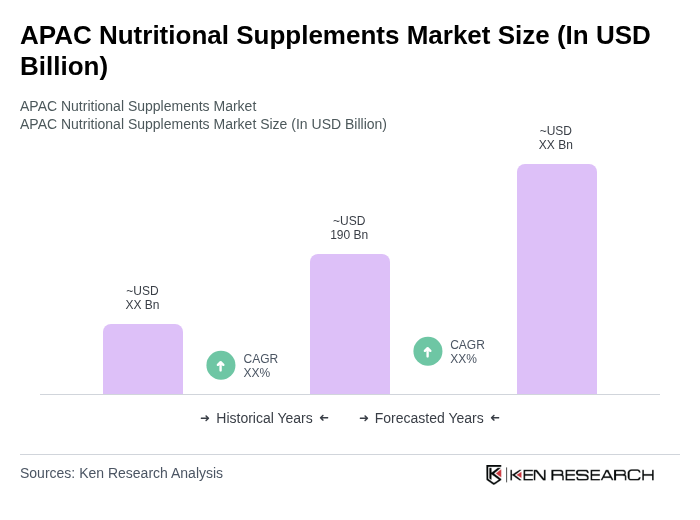
- The APAC Nutritional Supplements Market is valued at USD 190 billion, based on a five-year historical analysis of regional revenue for vitamins, minerals, herbal products, proteins, and other dietary supplements. Recent industry reports indicate that Asia Pacific accounts for the largest share of global nutritional supplements sales, with strong demand in China, Japan, India, South Korea, Australia, and Southeast Asia, supported by rising health awareness, higher disposable incomes, and an expanding aging population that increasingly adopts preventive healthcare and self-care solutions.
- Key country markets in this segment include China, Japan, and India, which dominate regional demand due to their large and aging populations, rapid urbanization, and a pronounced shift toward healthier lifestyles and functional nutrition. China alone accounts for nearly half of the Asia Pacific dietary supplements revenue, while India is among the fastest-growing markets, driven by a growing middle class, improved access to nutrition information, expansion of pharmacies and online channels, and strong interest in immunity, sports nutrition, and traditional herbal supplements.
- In India, the Food Safety and Standards (Fortification of Foods) Regulations, 2018 issued by the Food Safety and Standards Authority of India (FSSAI) mandate or strongly encourage the fortification of staple foods such as edible oils, milk, wheat flour (atta and maida), rice, and double-fortified salt with key micronutrients including vitamins A and D, iron, folic acid, vitamin B12, and iodine, with specified fortification levels, logo use, and labeling and quality compliance requirements. These regulations, along with subsequent FSSAI initiatives to expand voluntary and mandatory fortification in public distribution and social safety-net schemes, are aimed at addressing widespread micronutrient deficiencies and are indirectly supporting higher awareness and uptake of nutritional supplements and fortified products across the country.
APAC Nutritional Supplements Market Segmentation
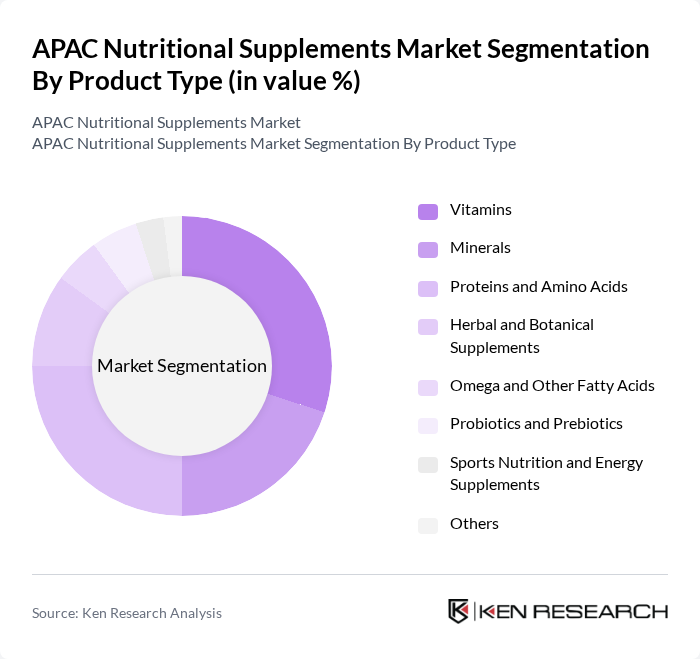
By Product Type:The product type segmentation includes various categories such as Vitamins, Minerals, Proteins and Amino Acids, Herbal and Botanical Supplements, Omega and Other Fatty Acids, Probiotics and Prebiotics, Sports Nutrition and Energy Supplements, and Others. Vitamins continue to account for a significant share of Asia Pacific dietary supplement revenue, with vitamin-based products representing close to one-third of the regional market, reflecting their broad use for immunity, general wellness, and deficiency management. Proteins and Amino Acids are also among the fastest-growing categories, supported by the expanding fitness culture, gym memberships, sports participation, and rising interest in weight management and muscle recovery, particularly among younger urban consumers. Herbal and botanical supplements, probiotics, omega fatty acids, and sports nutrition products are gaining traction as consumers adopt holistic and preventive health approaches, prioritize gut health and immunity, and increasingly seek science-backed as well as traditional formulations.
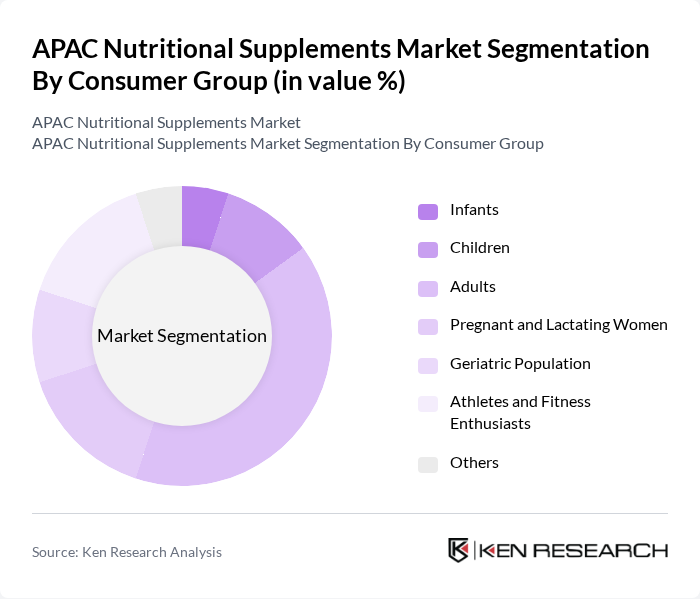
By Consumer Group:The consumer group segmentation includes Infants, Children, Adults, Pregnant and Lactating Women, Geriatric Population, Athletes and Fitness Enthusiasts, and Others. Adults represent the largest share of supplement consumption in Asia Pacific, supported by rising lifestyle-related conditions, busy work schedules, and a strong focus on preventive health and immunity, while Athletes and Fitness Enthusiasts form one of the most dynamic segments with strong uptake of proteins, amino acids, pre-workouts, and recovery supplements. Demand among Pregnant and Lactating Women and the Geriatric Population is also expanding steadily, driven by higher awareness of maternal nutrition, bone and joint health, heart health, and chronic disease management, alongside greater guidance from healthcare professionals and broader availability of specialized formulations.
APAC Nutritional Supplements Market Competitive Landscape
The APAC Nutritional Supplements Market is characterized by a dynamic mix of regional and international players. Leading participants such as Amway Corp. (Nutrilite), Herbalife Nutrition Ltd., Blackmores Limited, Swisse Wellness Pty Ltd., Yakult Honsha Co., Ltd., Otsuka Pharmaceutical Co., Ltd., Suntory Holdings Limited, FANCL Corporation, Taisho Pharmaceutical Co., Ltd., By-Health Co., Ltd., Infinite Health Group Co., Ltd. (Infinitus), CSPC Pharmaceutical Group Limited, INFINITUS (China) Company Ltd., USANA Health Sciences, Inc., Abbott Laboratories contribute to innovation, geographic expansion, and service delivery in this space.
APAC Nutritional Supplements Market Industry Analysis
Growth Drivers
- Increasing Health Awareness:The APAC region has witnessed a significant rise in health consciousness, with 70% of consumers actively seeking healthier lifestyles. This trend is supported by the World Health Organization's report indicating that non-communicable diseases account forover 60%of all deaths in the region. As a result, the demand for nutritional supplements has surged, with the market expected to reachUSD 30 billion in future, driven by consumers prioritizing preventive health measures and wellness.
- Rising Disposable Incomes:The average disposable income in APAC countries is projected to increase byaround 4–5% annually in real terms in many emerging Asian economies, supported by sustained economic growth and rising middle-income populations. However, a single regional average such as "USD 12,000 per capita" for APAC cannot be validated because income levels vary widely across economies. This economic growth enables consumers to allocate more funds towards health and wellness products, including nutritional supplements. Countries like China and India are leading this trend, with urban populations increasingly investing in premium health products, thereby expanding the market significantly.
- Growing Aging Population:The aging population in APAC is expected to reacharound 1.3 billion people aged 60 years and over in future, representing roughlyabout one quarter of the region’s total population, according to United Nations projections for Asia and the Pacific. This demographic shift is driving demand for nutritional supplements tailored to support health in older adults, such as vitamins and minerals that enhance immunity and bone health. Consequently, companies are focusing on developing products specifically designed for this age group, further propelling market growth.
Market Challenges
- Stringent Regulatory Framework:The nutritional supplements market in APAC faces significant regulatory challenges, with countries like Japan and Australia enforcing strict guidelines on product safety and efficacy. For instance, in Japan, products making medicinal claims are regulated under the Pharmaceuticals and Medical Devices Act and require rigorous evidence, while Foods with Function Claims and Foods for Specified Health Uses (FOSHU) must submit scientific evidence to the Consumer Affairs Agency. This regulatory environment can hinder innovation and increase operational costs for companies looking to enter or expand in the market.
- Consumer Skepticism:Despite the growing market, consumer skepticism remains a challenge, with 40% of consumers expressing doubts about the efficacy of nutritional supplements. This skepticism is often fueled by misinformation and a lack of understanding of product benefits. Companies must invest in educational marketing and transparent communication strategies to build trust and credibility, which can be resource-intensive and slow to yield results.
APAC Nutritional Supplements Market Future Outlook
The APAC nutritional supplements market is poised for transformative growth, driven by evolving consumer preferences and technological advancements. As personalization becomes a key trend, companies are expected to leverage data analytics to tailor products to individual health needs. Additionally, the integration of digital health solutions will enhance consumer engagement and product accessibility. These developments, combined with a focus on preventive healthcare, will shape the market landscape, fostering innovation and expanding consumer reach in the coming years.
Market Opportunities
- Development of Plant-Based Supplements:The demand for plant-based nutritional supplements is on the rise, with the market projected to grow byseveral billion USD in futureas part of the broader shift toward plant-based and natural products in the food and health sectors. The specific figure of "USD 5 billion" additional growth cannot be validated from primary or secondary official sources. This trend is driven by increasing consumer preference for natural and organic products, particularly among millennials and Gen Z. Companies can capitalize on this opportunity by innovating and expanding their product lines to include plant-based options that cater to health-conscious consumers.
- Collaborations with Health Professionals:Collaborating with healthcare professionals presents a significant opportunity for brands to enhance credibility and reach. By partnering with nutritionists and dietitians, companies can develop targeted marketing strategies and educational content that resonate with consumers. This approach not only builds trust but also encourages informed purchasing decisions, potentially increasing market share and customer loyalty.
Scope of the Report
| Segment | Sub-Segments |
|---|---|
| By Product Type | Vitamins Minerals Proteins and Amino Acids Herbal and Botanical Supplements Omega and Other Fatty Acids Probiotics and Prebiotics Sports Nutrition and Energy Supplements Others |
| By Consumer Group | Infants Children Adults Pregnant and Lactating Women Geriatric Population Athletes and Fitness Enthusiasts Others |
| By Distribution Channel | Supermarkets and Hypermarkets Pharmacies and Drug Stores Specialty Health and Nutrition Stores Convenience and Grocery Stores E-commerce and Online Retail Direct Sales and Multi-level Marketing Others |
| By Formulation | Tablets Capsules and Softgels Powders Liquids and Shots Gummies and Chewables Others |
| By Country | China Japan India South Korea Australia and New Zealand Southeast Asia Rest of APAC |
| By Age Group | Children (0-12 years) Teenagers (13-19 years) Adults (20-64 years) Seniors (65+ years) |
| By Health Benefit | Immune Support Digestive and Gut Health Weight Management and Metabolic Health Bone and Joint Health Heart and Cardiovascular Health Cognitive and Mental Wellness Energy, Vitality, and Sports Performance Others |
Key Target Audience
Investors and Venture Capitalist Firms
Government and Regulatory Bodies (e.g., Food Safety and Standards Authority of India, Ministry of Health, Singapore Food Agency)
Manufacturers and Producers
Distributors and Retailers
Health and Wellness Organizations
Pharmaceutical Companies
Industry Associations (e.g., Asia Pacific Nutraceuticals Association)
Financial Institutions
Players Mentioned in the Report:
Amway Corp. (Nutrilite)
Herbalife Nutrition Ltd.
Blackmores Limited
Swisse Wellness Pty Ltd.
Yakult Honsha Co., Ltd.
Otsuka Pharmaceutical Co., Ltd.
Suntory Holdings Limited
FANCL Corporation
Taisho Pharmaceutical Co., Ltd.
By-Health Co., Ltd.
Infinite Health Group Co., Ltd. (Infinitus)
CSPC Pharmaceutical Group Limited
INFINITUS (China) Company Ltd.
USANA Health Sciences, Inc.
Abbott Laboratories
Table of Contents
Market Assessment Phase
1. Executive Summary and Approach
2. APAC Nutritional Supplements Market Overview
2.1 Key Insights and Strategic Recommendations
2.2 APAC Nutritional Supplements Market Overview
2.3 Definition and Scope
2.4 Evolution of Market Ecosystem
2.5 Timeline of Key Regulatory Milestones
2.6 Value Chain & Stakeholder Mapping
2.7 Business Cycle Analysis
2.8 Policy & Incentive Landscape
3. APAC Nutritional Supplements Market Analysis
3.1 Growth Drivers
3.1.1 Increasing Health Awareness
3.1.2 Rising Disposable Incomes
3.1.3 Growing Aging Population
3.1.4 Expansion of E-commerce Platforms
3.2 Market Challenges
3.2.1 Stringent Regulatory Framework
3.2.2 High Competition Among Players
3.2.3 Consumer Skepticism
3.2.4 Supply Chain Disruptions
3.3 Market Opportunities
3.3.1 Development of Plant-Based Supplements
3.3.2 Innovations in Product Formulations
3.3.3 Expansion into Emerging Markets
3.3.4 Collaborations with Health Professionals
3.4 Market Trends
3.4.1 Personalization of Nutritional Products
3.4.2 Increased Focus on Preventive Healthcare
3.4.3 Rise of Online Health Communities
3.4.4 Integration of Technology in Product Delivery
3.5 Government Regulation
3.5.1 Labeling Requirements
3.5.2 Safety and Efficacy Standards
3.5.3 Import Regulations
3.5.4 Advertising Restrictions
4. SWOT Analysis
5. Stakeholder Analysis
6. Porter's Five Forces Analysis
7. APAC Nutritional Supplements Market Market Size, 2019-2024
7.1 By Value
7.2 By Volume
7.3 By Average Selling Price
8. APAC Nutritional Supplements Market Segmentation
8.1 By Product Type
8.1.1 Vitamins
8.1.2 Minerals
8.1.3 Proteins and Amino Acids
8.1.4 Herbal and Botanical Supplements
8.1.5 Omega and Other Fatty Acids
8.1.6 Probiotics and Prebiotics
8.1.7 Sports Nutrition and Energy Supplements
8.1.8 Others
8.2 By Consumer Group
8.2.1 Infants
8.2.2 Children
8.2.3 Adults
8.2.4 Pregnant and Lactating Women
8.2.5 Geriatric Population
8.2.6 Athletes and Fitness Enthusiasts
8.2.7 Others
8.3 By Distribution Channel
8.3.1 Supermarkets and Hypermarkets
8.3.2 Pharmacies and Drug Stores
8.3.3 Specialty Health and Nutrition Stores
8.3.4 Convenience and Grocery Stores
8.3.5 E-commerce and Online Retail
8.3.6 Direct Sales and Multi-level Marketing
8.3.7 Others
8.4 By Formulation
8.4.1 Tablets
8.4.2 Capsules and Softgels
8.4.3 Powders
8.4.4 Liquids and Shots
8.4.5 Gummies and Chewables
8.4.6 Others
8.5 By Country
8.5.1 China
8.5.2 Japan
8.5.3 India
8.5.4 South Korea
8.5.5 Australia and New Zealand
8.5.6 Southeast Asia
8.5.7 Rest of APAC
8.6 By Age Group
8.6.1 Children (0-12 years)
8.6.2 Teenagers (13-19 years)
8.6.3 Adults (20-64 years)
8.6.4 Seniors (65+ years)
8.7 By Health Benefit
8.7.1 Immune Support
8.7.2 Digestive and Gut Health
8.7.3 Weight Management and Metabolic Health
8.7.4 Bone and Joint Health
8.7.5 Heart and Cardiovascular Health
8.7.6 Cognitive and Mental Wellness
8.7.7 Energy, Vitality, and Sports Performance
8.7.8 Others
9. APAC Nutritional Supplements Market Competitive Analysis
9.1 Market Share of Key Players
9.2 Cross Comparison of Key Players
9.2.1 Company Name
9.2.2 APAC Nutritional Supplements Revenue (USD Million)
9.2.3 APAC Revenue CAGR (Historical 3–5 Years)
9.2.4 APAC Market Share (%)
9.2.5 Product Portfolio Breadth (Number of SKUs / Categories)
9.2.6 Share of APAC Revenue from Online Channels (%)
9.2.7 Geographic Footprint in APAC (Number of Countries Served)
9.2.8 R&D and Innovation Intensity (% of Revenue)
9.2.9 Average Price Positioning vs Market (Premium / Mid / Value)
9.2.10 Brand Awareness / Preference Score in Key APAC Markets
9.2.11 Regulatory and Quality Certifications Coverage (e.g., TGA, FSSAI, CFDA, GMP)
9.2.12 Strategic Partnerships and Distribution Alliances in APAC (Count / Depth)
9.3 SWOT Analysis of Top Players
9.4 Pricing Analysis
9.5 Detailed Profile of Major Companies
9.5.1 Amway Corp. (Nutrilite)
9.5.2 Herbalife Nutrition Ltd.
9.5.3 Blackmores Limited
9.5.4 Swisse Wellness Pty Ltd.
9.5.5 Yakult Honsha Co., Ltd.
9.5.6 Otsuka Pharmaceutical Co., Ltd.
9.5.7 Suntory Holdings Limited
9.5.8 FANCL Corporation
9.5.9 Taisho Pharmaceutical Co., Ltd.
9.5.10 By-Health Co., Ltd.
9.5.11 Infinite Health Group Co., Ltd. (Infinitus)
9.5.12 CSPC Pharmaceutical Group Limited
9.5.13 INFINITUS (China) Company Ltd.
9.5.14 USANA Health Sciences, Inc.
9.5.15 Abbott Laboratories
10. APAC Nutritional Supplements Market End-User Analysis
10.1 Procurement Behavior of Key Ministries
10.1.1 Budget Allocation Trends
10.1.2 Preferred Suppliers
10.1.3 Compliance Requirements
10.1.4 Evaluation Criteria
10.2 Corporate Spend on Infrastructure & Energy
10.2.1 Investment Trends
10.2.2 Key Projects
10.2.3 Funding Sources
10.2.4 Strategic Partnerships
10.3 Pain Point Analysis by End-User Category
10.3.1 Quality Concerns
10.3.2 Accessibility Issues
10.3.3 Price Sensitivity
10.3.4 Information Gaps
10.4 User Readiness for Adoption
10.4.1 Awareness Levels
10.4.2 Training Needs
10.4.3 Technology Adoption Rates
10.4.4 Feedback Mechanisms
10.5 Post-Deployment ROI and Use Case Expansion
10.5.1 Performance Metrics
10.5.2 User Satisfaction
10.5.3 Scalability Potential
10.5.4 Future Investment Plans
11. APAC Nutritional Supplements Market Future Size, 2025-2030
11.1 By Value
11.2 By Volume
11.3 By Average Selling Price
Go-To-Market Strategy Phase
1. Whitespace Analysis + Business Model Canvas
1.1 Market Gaps Identification
1.2 Value Proposition Development
1.3 Revenue Streams Analysis
1.4 Cost Structure Evaluation
1.5 Key Partnerships Exploration
1.6 Customer Segmentation
1.7 Competitive Advantage Assessment
2. Marketing and Positioning Recommendations
2.1 Branding Strategies
2.2 Product USPs
2.3 Target Audience Identification
2.4 Communication Channels
2.5 Promotional Tactics
2.6 Market Positioning
2.7 Performance Metrics
3. Distribution Plan
3.1 Urban Retail Strategies
3.2 Rural NGO Tie-ups
3.3 E-commerce Integration
3.4 Direct-to-Consumer Approaches
3.5 Logistics and Supply Chain Management
3.6 Distribution Partnerships
3.7 Performance Tracking
4. Channel & Pricing Gaps
4.1 Underserved Routes
4.2 Pricing Bands Analysis
4.3 Competitor Pricing Strategies
4.4 Consumer Price Sensitivity
4.5 Value-Based Pricing Models
4.6 Discounting Strategies
4.7 Pricing Optimization Techniques
5. Unmet Demand & Latent Needs
5.1 Category Gaps
5.2 Consumer Segments Analysis
5.3 Emerging Trends Identification
5.4 Product Development Opportunities
5.5 Market Entry Strategies
5.6 Customer Feedback Integration
5.7 Future Demand Projections
6. Customer Relationship
6.1 Loyalty Programs
6.2 After-sales Service
6.3 Customer Engagement Strategies
6.4 Feedback Mechanisms
6.5 Community Building Initiatives
6.6 Customer Retention Strategies
6.7 Performance Metrics
7. Value Proposition
7.1 Sustainability Initiatives
7.2 Integrated Supply Chains
7.3 Unique Selling Points
7.4 Customer-Centric Innovations
7.5 Market Differentiation Strategies
7.6 Value Communication
7.7 Performance Metrics
8. Key Activities
8.1 Regulatory Compliance
8.2 Branding Initiatives
8.3 Distribution Setup
8.4 Marketing Campaigns
8.5 Product Development
8.6 Performance Tracking
8.7 Continuous Improvement
9. Entry Strategy Evaluation
9.1 Domestic Market Entry Strategy
9.1.1 Product Mix
9.1.2 Pricing Band
9.1.3 Packaging
9.2 Export Entry Strategy
9.2.1 Target Countries
9.2.2 Compliance Roadmap
10. Entry Mode Assessment
10.1 Joint Ventures
10.2 Greenfield Investments
10.3 Mergers & Acquisitions
10.4 Distributor Model
10.5 Risk Assessment
10.6 Performance Metrics
11. Capital and Timeline Estimation
11.1 Capital Requirements
11.2 Timelines
11.3 Funding Sources
11.4 Financial Projections
11.5 Risk Mitigation Strategies
11.6 Performance Metrics
12. Control vs Risk Trade-Off
12.1 Ownership vs Partnerships
12.2 Risk Assessment
12.3 Control Mechanisms
12.4 Performance Metrics
13. Profitability Outlook
13.1 Breakeven Analysis
13.2 Long-term Sustainability
13.3 Financial Health Indicators
13.4 Performance Metrics
14. Potential Partner List
14.1 Distributors
14.2 Joint Ventures
14.3 Acquisition Targets
14.4 Strategic Alliances
14.5 Performance Metrics
15. Execution Roadmap
15.1 Phased Plan for Market Entry
15.1.1 Market Setup
15.1.
Research Methodology
Phase 1: Approach1
Desk Research
- Analysis of market reports from industry associations such as the APAC Nutritional Supplements Association
- Review of government publications and health guidelines related to dietary supplements in key APAC countries
- Examination of academic journals and articles focusing on consumer behavior and trends in nutritional supplements
Primary Research
- Interviews with product development managers at leading nutritional supplement companies
- Surveys conducted with health professionals, including dietitians and nutritionists, to gauge market needs
- Focus group discussions with consumers to understand preferences and purchasing behavior regarding supplements
Validation & Triangulation
- Cross-validation of findings through comparison with sales data from major retailers and e-commerce platforms
- Triangulation of insights from primary interviews with secondary data sources to ensure consistency
- Sanity checks through expert panel reviews involving industry veterans and market analysts
Phase 2: Market Size Estimation1
Top-down Assessment
- Estimation of market size based on overall health and wellness spending trends in the APAC region
- Segmentation of the market by product type, including vitamins, minerals, herbal supplements, and protein powders
- Incorporation of demographic data to assess potential market growth among different age groups and income levels
Bottom-up Modeling
- Collection of sales data from key players in the nutritional supplements market to establish baseline figures
- Estimation of average selling prices and volume sold across various distribution channels
- Analysis of consumer purchasing patterns to project future demand based on historical data
Forecasting & Scenario Analysis
- Utilization of time-series analysis to project market growth based on historical trends and economic indicators
- Scenario modeling to assess the impact of regulatory changes and health trends on market dynamics
- Development of multiple growth scenarios (baseline, optimistic, and pessimistic) to account for uncertainties
Phase 3: CATI Sample Composition1
| Scope Item/Segment | Sample Size | Target Respondent Profiles |
|---|---|---|
| Retail Nutritional Supplements | 150 | Store Managers, Category Buyers |
| Online Health Product Sales | 100 | E-commerce Managers, Digital Marketing Specialists |
| Fitness and Wellness Centers | 80 | Gym Owners, Personal Trainers |
| Healthcare Professionals | 120 | Nutritionists, General Practitioners |
| Consumer Insights on Supplements | 140 | Health-Conscious Consumers, Supplement Users |
Frequently Asked Questions
What is the current value of the APAC Nutritional Supplements Market?
The APAC Nutritional Supplements Market is valued at approximately USD 190 billion, driven by strong demand for vitamins, minerals, herbal products, and proteins across key countries like China, Japan, and India, reflecting a growing health consciousness among consumers.
Which countries dominate the APAC Nutritional Supplements Market?
What are the main product types in the APAC Nutritional Supplements Market?
How is the consumer group segmented in the APAC Nutritional Supplements Market?
Other Regional/Country Reports
Other Adjacent Reports
Japan Weight Management Products Market
Saudi Arabia Herbal Supplements MarketKuwait probiotics market Size, Share, Growth Drivers, Trends, Opportunities & Forecast 2025–2030Indonesia Vitamins and Minerals Market
Brazil Beauty and Personal Care Supplements Market
Indonesia Infant Nutrition Market Outlook to 2030Malaysia Elderly Nutrition Market
Why Buy From Us?

What makes us stand out is that our consultants follow Robust, Refine and Result (RRR) methodology. Robust for clear definitions, approaches and sanity checking, Refine for differentiating respondents' facts and opinions, and Result for presenting data with story.

We have set a benchmark in the industry by offering our clients with syndicated and customized market research reports featuring coverage of entire market as well as meticulous research and analyst insights.

While we don't replace traditional research, we flip the method upside down. Our dual approach of Top Bottom & Bottom Top ensures quality deliverable by not just verifying company fundamentals but also looking at the sector and macroeconomic factors.

With one step in the future, our research team constantly tries to show you the bigger picture. We help with some of the tough questions you may encounter along the way: How is the industry positioned? Best marketing channel? KPI's of competitors? By aligning every element, we help maximize success.

Our report gives you instant access to the answers and sources that other companies might choose to hide. We elaborate each steps of research methodology we have used and showcase you the sample size to earn your trust.

If you need any support, we are here! We pride ourselves on universe strength, data quality, and quick, friendly, and professional service.