Argentina Freight Market

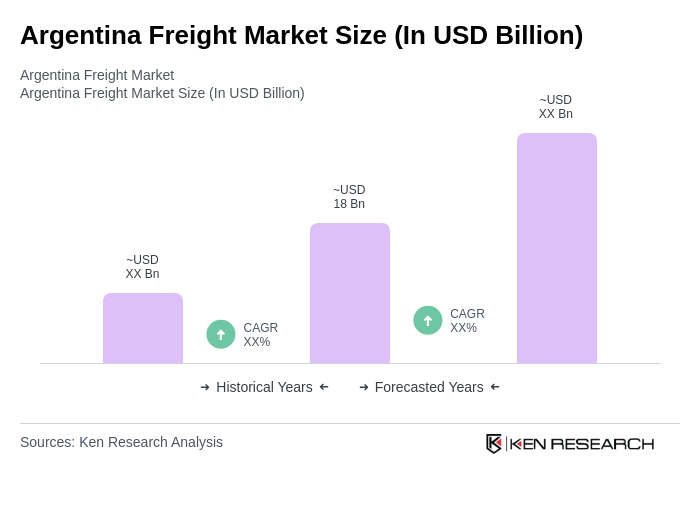
Argentina freight market, worth USD 18 Bn, grows via e-commerce surge and agricultural exports. Key regions: Buenos Aires, Córdoba. Future outlook emphasizes digital solutions and sustainability.

Region:Central and South America

Author(s):Dev

Product Code:KRAA0437

Pages:96

Published On:August 2025
About the Report

Base Year 2024

Argentina Freight Market Overview

  • The Argentina Freight Market is valued at approximately USD 18 billion, based on a five-year historical analysis. This growth is primarily driven by the increasing demand for logistics services due to the expansion of e-commerce, agricultural exports, and industrial production. The market has seen a significant rise in freight volumes, particularly in road and rail transport, as businesses seek efficient and cost-effective solutions for their supply chains .
  • Key regions in this market include Buenos Aires, Córdoba, and Santa Fe, which dominate due to their strategic locations, robust infrastructure, and high levels of industrial activity. Buenos Aires, as the capital, serves as a major logistics hub, while Córdoba and Santa Fe are critical for agricultural exports, contributing to the overall growth of the freight market in Argentina .
  • In 2023, the Argentine government advanced regulatory initiatives aimed at enhancing the efficiency of freight transport. These include mandates for the use of digital platforms for shipment tracking, expected to improve transparency and reduce delays in the supply chain. The initiative is part of a broader strategy to modernize the logistics sector and promote sustainable practices .
Argentina Freight Market Size

Argentina Freight Market Segmentation

By Type:The freight market can be segmented into Road Freight, Rail Freight, Air Freight, Sea Freight, Intermodal Freight, Bulk Freight, Container Freight, and Courier & Express Services. Each of these segments plays a crucial role in the overall logistics ecosystem, catering to different transportation needs and customer preferences. Road freight remains the dominant mode, driven by Argentina’s extensive road network and the need for flexible, last-mile delivery solutions. Rail freight is significant for bulk commodities, particularly agricultural exports, while air and sea freight support international trade and time-sensitive shipments. Intermodal and container freight are growing in importance as supply chains seek greater efficiency and integration .
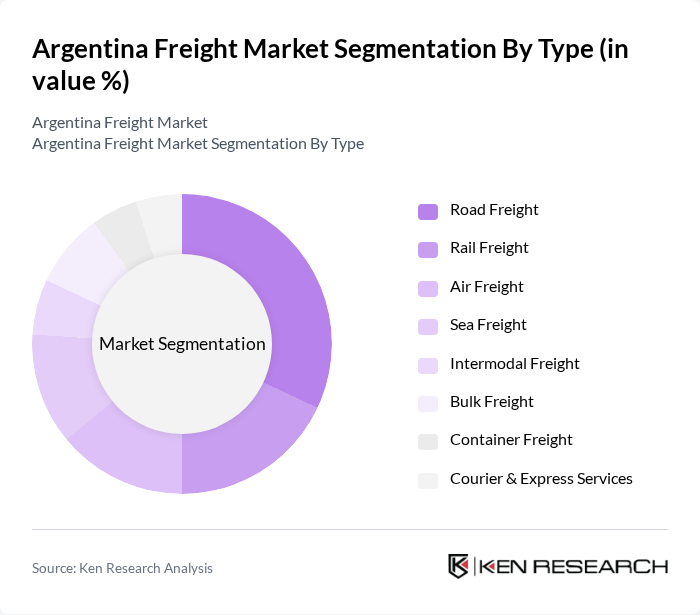
Argentina Freight Market segmentation by Type.

By End-User:The freight market is also segmented by end-users, which include Agriculture, Manufacturing, Retail & E-commerce, Construction, Automotive, Pharmaceuticals & Healthcare, Food and Beverage, Chemicals, and Others. Each sector has unique logistics requirements, influencing the choice of freight services. Agriculture and manufacturing are the largest end-users, reflecting Argentina’s export orientation and industrial base. Retail and e-commerce are rapidly expanding, driving demand for express and last-mile logistics. The food and beverage, automotive, and pharmaceutical sectors require specialized handling and temperature-controlled logistics .
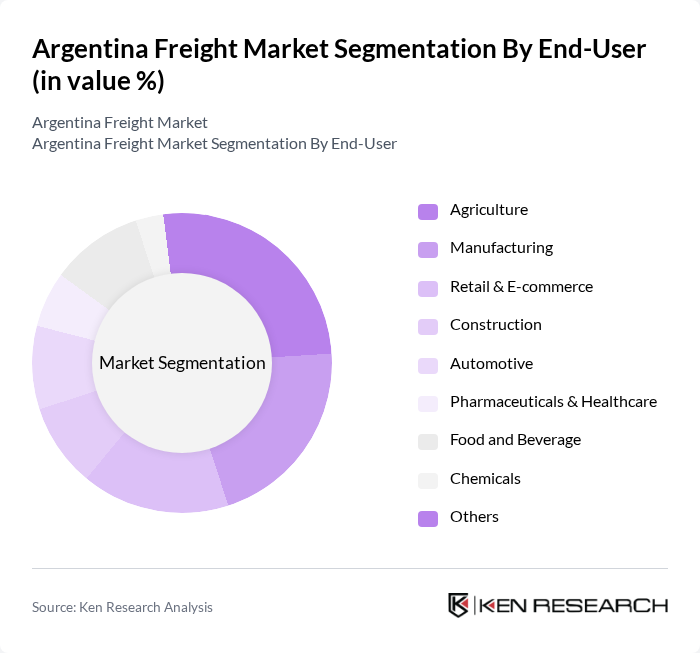
Argentina Freight Market segmentation by End-User.

Argentina Freight Market Competitive Landscape

The Argentina Freight Market is characterized by a dynamic mix of regional and international players. Leading participants such as Andreani Logística, TASA Logística, DHL Express Argentina, DB Schenker Argentina, Rivas S.A., Transporte Fríos del Norte, Logística Urbana S.A., Avancargo, Kuehne + Nagel Argentina, FedEx Argentina, TGS (Transportadora de Gas del Sur) Logistics, Transfarmaco S.A., Clover Logística, DSV Argentina, Transporte Cruz del Sur contribute to innovation, geographic expansion, and service delivery in this space .

Andreani Logística

1945

Buenos Aires, Argentina

TASA Logística

1936

Buenos Aires, Argentina

DHL Express Argentina

1977

Buenos Aires, Argentina

DB Schenker Argentina

2006

Buenos Aires, Argentina

Rivas S.A.

1978

Santa Fe, Argentina

Company

Establishment Year

Headquarters

Group Size (Large, Medium, or Small as per industry convention)

Revenue (USD, latest fiscal year)

Revenue Growth Rate (%)

Market Share (%)

Fleet Size (Number of Vehicles/Units)

Average Delivery Time (Domestic, in days)

Argentina Freight Market Industry Analysis

Growth Drivers

  • Increased E-commerce Demand:The surge in e-commerce has significantly impacted the freight market, with online sales in Argentina projected to reach ARS 1.5 trillion in future. This growth is driven by a 30% increase in internet penetration, reaching approximately 88% of the population. Consequently, logistics providers are adapting to meet the rising demand for efficient delivery services, particularly in urban areas, where last-mile delivery solutions are becoming essential for customer satisfaction and operational efficiency.
  • Infrastructure Development Initiatives:The Argentine government has allocated ARS 200 billion for infrastructure projects in future, focusing on improving road and rail networks. These initiatives aim to enhance connectivity and reduce transportation times, which are critical for the freight sector. Improved infrastructure is expected to facilitate smoother logistics operations, thereby attracting more investments and boosting the overall efficiency of freight transport across the country.
  • Expansion of Agricultural Exports:Argentina's agricultural sector is a cornerstone of its economy, with exports projected to reach USD 39 billion in future. The demand for agricultural products, particularly soybeans and beef, is driving the need for efficient freight solutions. This growth is supported by increased global demand, particularly from Asia, necessitating robust logistics networks to ensure timely delivery and maintain product quality during transport.

Market Challenges

  • Regulatory Compliance Issues:The freight industry in Argentina faces significant regulatory hurdles, with over 200 regulations impacting operations. Compliance with these regulations can lead to increased operational costs, estimated at ARS 50 billion annually. Additionally, the complexity of navigating these regulations can deter new entrants, limiting competition and innovation within the market, ultimately affecting service quality and pricing.
  • High Fuel Costs:Fuel prices in Argentina have surged, with diesel prices reaching ARS 1,000 per liter in future. This increase poses a substantial challenge for freight operators, as fuel costs account for approximately 30% of total logistics expenses. The volatility in fuel prices can lead to unpredictable operational costs, forcing companies to either absorb these costs or pass them on to consumers, impacting overall market competitiveness.

Argentina Freight Market Future Outlook

The Argentina freight market is poised for transformation, driven by technological advancements and evolving consumer preferences. The integration of digital solutions in logistics management is expected to streamline operations, enhancing efficiency and reducing costs. Additionally, the growing emphasis on sustainability will likely push companies to adopt greener practices, aligning with global trends. As infrastructure improvements continue, the market will become more competitive, fostering innovation and attracting investments that will shape the future landscape of freight transport in Argentina.

Market Opportunities

  • Growth in Cold Chain Logistics:The demand for cold chain logistics is expected to rise, driven by the increasing need for temperature-sensitive goods. With the market projected to grow by ARS 30 billion in future, companies investing in cold storage and transportation solutions will benefit from enhanced service offerings and improved product quality, catering to sectors like pharmaceuticals and perishable goods.
  • Investment in Smart Logistics Solutions:The adoption of smart logistics technologies, such as IoT and AI, is anticipated to revolutionize freight operations. With an estimated investment of ARS 15 billion in future, companies leveraging these technologies can optimize routes, reduce costs, and improve customer service, positioning themselves competitively in a rapidly evolving market landscape.

Scope of the Report

SegmentSub-Segments
By Type

Road Freight

Rail Freight

Air Freight

Sea Freight

Intermodal Freight

Bulk Freight

Container Freight

Courier & Express Services

By End-User

Agriculture

Manufacturing

Retail & E-commerce

Construction

Automotive

Pharmaceuticals & Healthcare

Food and Beverage

Chemicals

Others

By Region

Buenos Aires

Córdoba

Santa Fe

Mendoza

Tucumán

Entre Ríos

Salta

Rosario

Others

By Service Type

Full Truck Load (FTL)

Less Than Truck Load (LTL)

Dedicated Freight Services

Expedited Freight Services

Freight Forwarding Services

Warehousing and Distribution

Customs Brokerage

Temperature-Controlled Logistics

Others

By Delivery Mode

Standard Delivery

Express Delivery

Scheduled Delivery

Same-Day Delivery

Next-Day Delivery

Scheduled Freight Services

On-Demand Delivery

Others

By Freight Class

Class 50

Class 55

Class 60

Class 65

Class 70

Class 77

Class 85

Others

By Payment Method

Prepaid

Collect

Credit Terms

Cash on Delivery

Digital Payments

Bank Transfers

Others

Key Target Audience

Investors and Venture Capitalist Firms

Government and Regulatory Bodies (e.g., Ministry of Transport, National Customs Administration)

Logistics and Freight Forwarding Companies

Shipping and Maritime Operators

Infrastructure Development Agencies

Importers and Exporters

Freight Technology Solution Providers

Trade Associations and Chambers of Commerce

Players Mentioned in the Report:

Andreani Logistica

TASA Logistica

DHL Express Argentina

DB Schenker Argentina

Rivas S.A.

Transporte Frios del Norte

Logistica Urbana S.A.

Avancargo

Kuehne + Nagel Argentina

FedEx Argentina

TGS (Transportadora de Gas del Sur) Logistics

Transfarmaco S.A.

Clover Logistica

DSV Argentina

Transporte Cruz del Sur

Table of Contents

Market Assessment Phase

1. Executive Summary and Approach


2. Argentina Freight Market Overview

2.1 Key Insights and Strategic Recommendations

2.2 Argentina Freight Market Overview

2.3 Definition and Scope

2.4 Evolution of Market Ecosystem

2.5 Timeline of Key Regulatory Milestones

2.6 Value Chain & Stakeholder Mapping

2.7 Business Cycle Analysis

2.8 Policy & Incentive Landscape


3. Argentina Freight Market Analysis

3.1 Growth Drivers

3.1.1 Increased E-commerce Demand
3.1.2 Infrastructure Development Initiatives
3.1.3 Expansion of Agricultural Exports
3.1.4 Technological Advancements in Logistics

3.2 Market Challenges

3.2.1 Regulatory Compliance Issues
3.2.2 High Fuel Costs
3.2.3 Infrastructure Limitations
3.2.4 Economic Instability

3.3 Market Opportunities

3.3.1 Growth in Cold Chain Logistics
3.3.2 Investment in Smart Logistics Solutions
3.3.3 Expansion of Multimodal Transport
3.3.4 Increasing Demand for Sustainable Practices

3.4 Market Trends

3.4.1 Digital Transformation in Freight Management
3.4.2 Rise of Last-Mile Delivery Services
3.4.3 Adoption of Green Logistics
3.4.4 Integration of AI and Big Data Analytics

3.5 Government Regulation

3.5.1 Freight Transport Licensing Requirements
3.5.2 Environmental Regulations for Transport
3.5.3 Safety Standards for Freight Operations
3.5.4 Tax Incentives for Logistics Investments

4. SWOT Analysis


5. Stakeholder Analysis


6. Porter's Five Forces Analysis


7. Argentina Freight Market Market Size, 2019-2024

7.1 By Value

7.2 By Volume

7.3 By Average Selling Price


8. Argentina Freight Market Segmentation

8.1 By Type

8.1.1 Road Freight
8.1.2 Rail Freight
8.1.3 Air Freight
8.1.4 Sea Freight
8.1.5 Intermodal Freight
8.1.6 Bulk Freight
8.1.7 Container Freight
8.1.8 Courier & Express Services

8.2 By End-User

8.2.1 Agriculture
8.2.2 Manufacturing
8.2.3 Retail & E-commerce
8.2.4 Construction
8.2.5 Automotive
8.2.6 Pharmaceuticals & Healthcare
8.2.7 Food and Beverage
8.2.8 Chemicals
8.2.9 Others

8.3 By Region

8.3.1 Buenos Aires
8.3.2 Córdoba
8.3.3 Santa Fe
8.3.4 Mendoza
8.3.5 Tucumán
8.3.6 Entre Ríos
8.3.7 Salta
8.3.8 Rosario
8.3.9 Others

8.4 By Service Type

8.4.1 Full Truck Load (FTL)
8.4.2 Less Than Truck Load (LTL)
8.4.3 Dedicated Freight Services
8.4.4 Expedited Freight Services
8.4.5 Freight Forwarding Services
8.4.6 Warehousing and Distribution
8.4.7 Customs Brokerage
8.4.8 Temperature-Controlled Logistics
8.4.9 Others

8.5 By Delivery Mode

8.5.1 Standard Delivery
8.5.2 Express Delivery
8.5.3 Scheduled Delivery
8.5.4 Same-Day Delivery
8.5.5 Next-Day Delivery
8.5.6 Scheduled Freight Services
8.5.7 On-Demand Delivery
8.5.8 Others

8.6 By Freight Class

8.6.1 Class 50
8.6.2 Class 55
8.6.3 Class 60
8.6.4 Class 65
8.6.5 Class 70
8.6.6 Class 77
8.6.7 Class 85
8.6.8 Others

8.7 By Payment Method

8.7.1 Prepaid
8.7.2 Collect
8.7.3 Credit Terms
8.7.4 Cash on Delivery
8.7.5 Digital Payments
8.7.6 Bank Transfers
8.7.7 Others

9. Argentina Freight Market Competitive Analysis

9.1 Market Share of Key Players

9.2 Cross Comparison of Key Players

9.2.1 Company Name
9.2.2 Group Size (Large, Medium, or Small as per industry convention)
9.2.3 Revenue (USD, latest fiscal year)
9.2.4 Revenue Growth Rate (%)
9.2.5 Market Share (%)
9.2.6 Fleet Size (Number of Vehicles/Units)
9.2.7 Average Delivery Time (Domestic, in days)
9.2.8 On-Time Delivery Rate (%)
9.2.9 Fleet Utilization Rate (%)
9.2.10 Customer Retention Rate (%)
9.2.11 Number of Warehouses/Distribution Centers
9.2.12 Geographic Coverage (Number of Provinces/Regions)
9.2.13 Technology Adoption (e.g., real-time tracking, digital platforms)
9.2.14 Sustainability Initiatives (e.g., % of green vehicles, CO2 reduction)
9.2.15 Customer Satisfaction Score (NPS or equivalent)

9.3 SWOT Analysis of Top Players

9.4 Pricing Analysis

9.5 Detailed Profile of Major Companies

9.5.1 Andreani Logística
9.5.2 TASA Logística
9.5.3 DHL Express Argentina
9.5.4 DB Schenker Argentina
9.5.5 Rivas S.A.
9.5.6 Transporte Fríos del Norte
9.5.7 Logística Urbana S.A.
9.5.8 Avancargo
9.5.9 Kuehne + Nagel Argentina
9.5.10 FedEx Argentina
9.5.11 TGS (Transportadora de Gas del Sur) Logistics
9.5.12 Transfarmaco S.A.
9.5.13 Clover Logística
9.5.14 DSV Argentina
9.5.15 Transporte Cruz del Sur

10. Argentina Freight Market End-User Analysis

10.1 Procurement Behavior of Key Ministries

10.1.1 Ministry of Transport
10.1.2 Ministry of Agriculture
10.1.3 Ministry of Industry
10.1.4 Ministry of Commerce
10.1.5 Ministry of Environment

10.2 Corporate Spend on Infrastructure & Energy

10.2.1 Investment in Road Infrastructure
10.2.2 Investment in Rail Infrastructure
10.2.3 Investment in Port Facilities
10.2.4 Investment in Logistics Technology

10.3 Pain Point Analysis by End-User Category

10.3.1 Delays in Delivery
10.3.2 High Transportation Costs
10.3.3 Lack of Transparency
10.3.4 Regulatory Compliance Issues

10.4 User Readiness for Adoption

10.4.1 Technology Adoption Levels
10.4.2 Training and Skill Development Needs
10.4.3 Infrastructure Readiness

10.5 Post-Deployment ROI and Use Case Expansion

10.5.1 Cost Savings Analysis
10.5.2 Efficiency Gains
10.5.3 Scalability of Solutions
10.5.4 Customer Feedback and Adaptation

11. Argentina Freight Market Future Size, 2025-2030

11.1 By Value

11.2 By Volume

11.3 By Average Selling Price


Go-To-Market Strategy Phase

1. Whitespace Analysis + Business Model Canvas

1.1 Market Gaps Identification

1.2 Value Proposition Development

1.3 Revenue Streams Analysis

1.4 Cost Structure Evaluation

1.5 Key Partnerships Exploration

1.6 Customer Segmentation

1.7 Channels of Distribution

1.8 Customer Relationships


2. Marketing and Positioning Recommendations

2.1 Branding Strategies

2.2 Product USPs

2.3 Target Market Identification

2.4 Communication Strategy

2.5 Digital Marketing Approaches

2.6 Trade Show Participation

2.7 Customer Engagement Tactics

2.8 Feedback Mechanisms


3. Distribution Plan

3.1 Urban Retail Strategies

3.2 Rural NGO Tie-Ups

3.3 Direct Sales Channels

3.4 Third-Party Logistics Partnerships

3.5 E-commerce Integration

3.6 Inventory Management Solutions

3.7 Last-Mile Delivery Solutions

3.8 Performance Metrics


4. Channel & Pricing Gaps

4.1 Underserved Routes

4.2 Pricing Bands Analysis

4.3 Competitor Pricing Strategies

4.4 Customer Willingness to Pay

4.5 Dynamic Pricing Models

4.6 Price Sensitivity Analysis

4.7 Bundling Opportunities

4.8 Pricing Communication


5. Unmet Demand & Latent Needs

5.1 Category Gaps

5.2 Consumer Segments

5.3 Emerging Trends

5.4 Customer Pain Points

5.5 Market Research Insights

5.6 Product Development Opportunities

5.7 Service Enhancement Areas

5.8 Future Demand Projections


6. Customer Relationship

6.1 Loyalty Programs

6.2 After-sales Service

6.3 Customer Feedback Loops

6.4 Relationship Management Tools

6.5 Customer Education Initiatives

6.6 Community Engagement

6.7 Personalization Strategies

6.8 Retention Strategies


7. Value Proposition

7.1 Sustainability Initiatives

7.2 Integrated Supply Chains

7.3 Cost Efficiency

7.4 Quality Assurance

7.5 Customer-Centric Solutions

7.6 Innovation in Services

7.7 Flexibility and Scalability

7.8 Competitive Differentiation


8. Key Activities

8.1 Regulatory Compliance

8.2 Branding Initiatives

8.3 Distribution Setup

8.4 Training and Development

8.5 Technology Implementation

8.6 Performance Monitoring

8.7 Stakeholder Engagement

8.8 Risk Management


9. Entry Strategy Evaluation

9.1 Domestic Market Entry Strategy

9.1.1 Product Mix
9.1.2 Pricing Band
9.1.3 Packaging

9.2 Export Entry Strategy

9.2.1 Target Countries
9.2.2 Compliance Roadmap

10. Entry Mode Assessment

10.1 Joint Ventures

10.2 Greenfield Investments

10.3 Mergers & Acquisitions

10.4 Distributor Model

10.5 Risk Assessment

10.6 Control Considerations

10.7 Partnership Opportunities

10.8 Market Adaptation Strategies


11. Capital and Timeline Estimation

11.1 Capital Requirements

11.2 Timelines

11.3 Funding Sources

11.4 Financial Projections

11.5 Investment Phases

11.6 Cost-Benefit Analysis

11.7 Resource Allocation


Research Methodology

ApproachModellingSample

Phase 1: Approach1

Desk Research

  • Analysis of national freight statistics from the Argentine Ministry of Transport
  • Review of industry reports from logistics associations and trade bodies
  • Examination of economic indicators and trade agreements impacting freight movement

Primary Research

  • Interviews with logistics managers at major freight companies operating in Argentina
  • Surveys with shippers and freight forwarders to understand market dynamics
  • Field visits to key transportation hubs and ports to gather firsthand insights

Validation & Triangulation

  • Cross-validation of findings with historical freight volume data and trends
  • Triangulation of insights from primary interviews with secondary data sources
  • Sanity checks through expert panels comprising industry veterans and analysts

Phase 2: Market Size Estimation1

Top-down Assessment

  • Estimation of total freight market size based on GDP contribution from logistics
  • Segmentation by freight type (road, rail, air, and maritime) and end-user industries
  • Incorporation of government infrastructure investment plans and their impact on freight

Bottom-up Modeling

  • Collection of operational data from leading freight companies to establish benchmarks
  • Cost analysis based on service pricing across different freight modes
  • Volume and cost calculations based on historical shipping patterns and forecasts

Forecasting & Scenario Analysis

  • Multi-variable regression analysis incorporating economic growth and trade volume changes
  • Scenario modeling based on potential regulatory changes and environmental policies
  • Development of baseline, optimistic, and pessimistic forecasts through 2030

Phase 3: CATI Sample Composition1

Scope Item/SegmentSample SizeTarget Respondent Profiles
Road Freight Operations100Logistics Coordinators, Fleet Managers
Rail Freight Services60Operations Directors, Rail Network Planners
Maritime Freight Handling50Port Authorities, Shipping Line Executives
Air Cargo Logistics40Air Freight Managers, Customs Brokers
Intermodal Freight Solutions45Supply Chain Analysts, Intermodal Operations Managers

Frequently Asked Questions

What is the current value of the Argentina Freight Market?

The Argentina Freight Market is valued at approximately USD 18 billion, driven by the growth in logistics services due to e-commerce expansion, agricultural exports, and industrial production. This valuation reflects a five-year historical analysis of the market.

Which regions are key players in the Argentina Freight Market?

What are the main types of freight services in Argentina?

How is the Argentina Freight Market affected by e-commerce?

Why Buy From Us?

Refine Robust Result (RRR) Framework

What makes us stand out is that our consultants follow Robust, Refine and Result (RRR) methodology. Robust for clear definitions, approaches and sanity checking, Refine for differentiating respondents' facts and opinions, and Result for presenting data with story.

Our Reach Is Unmatched

We have set a benchmark in the industry by offering our clients with syndicated and customized market research reports featuring coverage of entire market as well as meticulous research and analyst insights.

Shifting the Research Paradigm

While we don't replace traditional research, we flip the method upside down. Our dual approach of Top Bottom & Bottom Top ensures quality deliverable by not just verifying company fundamentals but also looking at the sector and macroeconomic factors.

More Insights-Better Decisions

With one step in the future, our research team constantly tries to show you the bigger picture. We help with some of the tough questions you may encounter along the way: How is the industry positioned? Best marketing channel? KPI's of competitors? By aligning every element, we help maximize success.

Transparency and Trust

Our report gives you instant access to the answers and sources that other companies might choose to hide. We elaborate each steps of research methodology we have used and showcase you the sample size to earn your trust.

Round the Clock Support

If you need any support, we are here! We pride ourselves on universe strength, data quality, and quick, friendly, and professional service.

Why Clients Choose Us?

400000+
Reports in repository
150+
Consulting projects a year
100+
Analysts
8000+
Client Queries in 2022








