About the Report
Base Year 2024Listen to the audio summary
Qatar Freight Market Overview
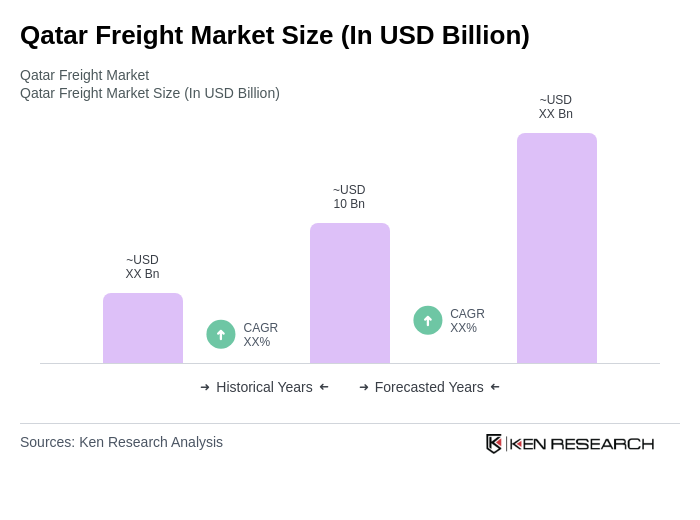
- The Qatar Freight Market is valued at USD 10 billion, based on a five-year historical analysis. This growth is primarily driven by the country's strategic location as a logistics hub, increased trade activities, and significant investments in infrastructure development, including the expansion of Hamad Port and the enhancement of road networks. Major projects such as the Al Ebb and Leabaib infrastructure initiative and ongoing upgrades to Hamad International Airport have further strengthened Qatar’s logistics capabilities, supporting robust throughput across sea, air, and warehousing segments .
- Key players in this market includeDoha, which serves as the primary logistics and transportation center due to its advanced infrastructure and connectivity. Additionally, cities likeUmm SalalandBu Fasseela Warehousing Parkare emerging as significant contributors to the freight market, driven by ongoing urban development, industrial projects, and the expansion of warehousing capacity to support growing import and export volumes .
- In 2023, the Qatari government implemented theMinisterial Decision No. 9 of 2023 on the Regulation of Freight Transport by Road, issued by the Ministry of Transport. This regulation mandates the adoption of digital tracking systems for all freight shipments, requiring licensed operators to equip vehicles with approved GPS tracking devices, maintain real-time data sharing with the National Transport Monitoring Center, and comply with operational safety and reporting standards .
Qatar Freight Market Segmentation
By Type:The freight market can be segmented into various types, includingRoad Freight,Air Freight,Sea Freight,Rail Freight,Courier, Express, and Parcel (CEP),Freight Forwarding,Warehousing and Storage, andOthers. Each of these segments plays a crucial role in the overall logistics ecosystem, catering to different transportation needs and customer preferences. Road and sea freight remain dominant due to Qatar’s geographic positioning and the scale of bulk trade, while air freight and CEP segments are experiencing rapid growth, driven by e-commerce expansion and demand for time-sensitive deliveries. Warehousing and storage are expanding to support increased throughput, especially for temperature-controlled goods .

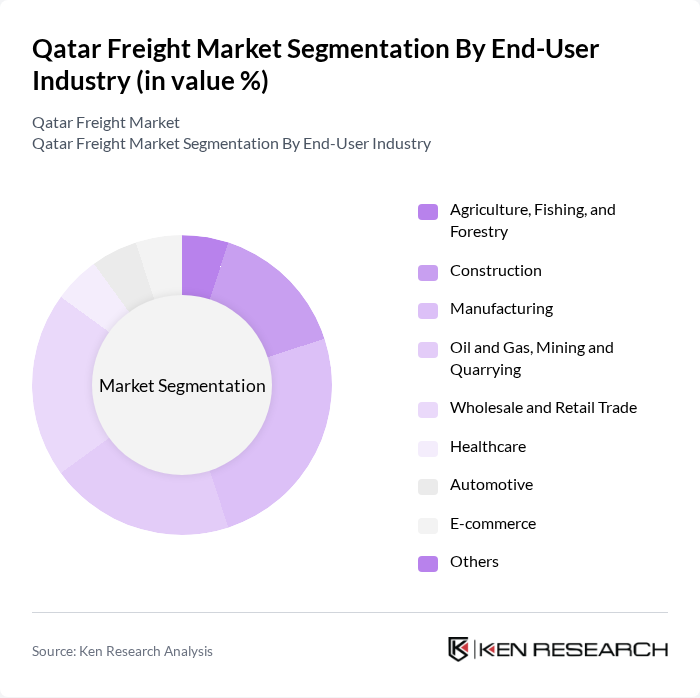
By End-User Industry:The freight market is also segmented by end-user industries, includingAgriculture, Fishing, and Forestry;Construction;Manufacturing;Oil and Gas, Mining and Quarrying;Wholesale and Retail Trade;Healthcare;Automotive;E-commerce; andOthers. Each industry has unique logistics requirements that influence the demand for various freight services. The manufacturing, oil and gas, and construction sectors are the largest contributors, while e-commerce and healthcare are driving demand for specialized and time-sensitive logistics solutions .
Qatar Freight Market Competitive Landscape
The Qatar Freight Market is characterized by a dynamic mix of regional and international players. Leading participants such as Qatar Airways Cargo, Gulf Warehousing Company (GWC), Milaha (Qatar Navigation Q.P.S.C.), Nakilat (Qatar Gas Transport Company Limited), Aero Freight, Agility Logistics, DHL Global Forwarding, DB Schenker, Kuehne + Nagel, CEVA Logistics, FedEx Express, UPS Supply Chain Solutions, Aramex, Maersk Qatar, MSC Mediterranean Shipping Company contribute to innovation, geographic expansion, and service delivery in this space.
Qatar Freight Market Industry Analysis
Growth Drivers
- Increasing Trade Activities:Qatar's trade activities have surged, with total trade reaching approximately QAR 1.2 trillion, driven by a 15% increase in exports. The country's strategic initiatives, including the Qatar National Vision 2030, aim to diversify the economy and enhance trade relations. This growth is supported by the establishment of new trade agreements, which are projected to further boost trade volumes by 20% in future, enhancing the freight market's capacity and demand.
- Infrastructure Development:Qatar has invested over QAR 300 billion in infrastructure projects, including the expansion of Hamad International Airport and the development of the Doha Port. These projects are expected to increase cargo capacity by 30% in future, facilitating smoother logistics operations. Additionally, the ongoing construction of the Qatar Rail project will enhance connectivity, reducing transit times and operational costs, thereby driving growth in the freight sector significantly.
- Technological Advancements:The adoption of advanced technologies in logistics, such as IoT and blockchain, is transforming Qatar's freight market. Investments in logistics technology reached QAR 1 billion, with expectations to double in future. These technologies improve supply chain transparency and efficiency, reducing operational costs by up to 25%. As companies increasingly embrace digital solutions, the freight market is poised for substantial growth, enhancing competitiveness in the region.
Market Challenges
- Regulatory Compliance Issues:The freight industry in Qatar faces significant regulatory compliance challenges, with over 50% of logistics companies reporting difficulties in adhering to customs regulations. The complexity of these regulations can lead to delays and increased costs, impacting overall efficiency. Compliance-related issues resulted in an estimated QAR 200 million in losses for the sector, highlighting the need for streamlined processes and better regulatory frameworks to support growth.
- Competition from Regional Markets:Qatar's freight market is increasingly challenged by competition from neighboring countries, particularly the UAE, which has a more established logistics infrastructure. The UAE's logistics sector generated QAR 150 billion, compared to Qatar's QAR 50 billion. This disparity in market size and infrastructure development poses a significant challenge for Qatar, necessitating strategic initiatives to enhance its competitive edge and attract more logistics investments.
Qatar Freight Market Future Outlook
The future of Qatar's freight market appears promising, driven by ongoing investments in infrastructure and technology. As the country continues to enhance its logistics capabilities, the integration of smart logistics solutions will likely streamline operations and improve efficiency. Additionally, the expansion of trade agreements and the establishment of free trade zones are expected to attract foreign investments, further bolstering the market. Overall, these developments will position Qatar as a key logistics hub in the region, fostering sustainable growth.
Market Opportunities
- Expansion of Logistics Services:The growing demand for logistics services presents a significant opportunity for market players. With the logistics sector projected to grow by QAR 10 billion in future, companies can capitalize on this trend by diversifying service offerings and enhancing operational capabilities to meet evolving customer needs.
- Development of Free Trade Zones:The establishment of free trade zones in Qatar is expected to attract foreign direct investment, with an estimated QAR 5 billion influx anticipated in future. These zones will facilitate easier trade and logistics operations, providing businesses with tax incentives and streamlined customs processes, thereby enhancing the overall freight market landscape.
Scope of the Report
| Segment | Sub-Segments |
|---|---|
| By Type | Road Freight Air Freight Sea Freight Rail Freight Courier, Express, and Parcel (CEP) Freight Forwarding Warehousing and Storage Others |
| By End-User Industry | Agriculture, Fishing, and Forestry Construction Manufacturing Oil and Gas, Mining and Quarrying Wholesale and Retail Trade Healthcare Automotive E-commerce Others |
| By Logistics Function | Courier, Express, and Parcel (CEP) Freight Forwarding Freight Transport Warehousing and Storage Other Services |
| By Mode of Transport | Air Sea and Inland Waterways Road Pipelines Rail Others |
| By Temperature Control | Non-Temperature Controlled Temperature Controlled Others |
| By Destination Type | Domestic International Regional Others |
Key Target Audience
Investors and Venture Capitalist Firms
Government and Regulatory Bodies (e.g., Qatar Ministry of Transport and Communications)
Logistics and Freight Forwarding Companies
Shipping and Maritime Operators
Air Cargo Carriers
Customs and Border Control Agencies (e.g., Qatar Customs)
Infrastructure Development Firms
Real Estate Developers in Logistics and Warehousing
Players Mentioned in the Report:
Qatar Airways Cargo
Gulf Warehousing Company (GWC)
Milaha (Qatar Navigation Q.P.S.C.)
Nakilat (Qatar Gas Transport Company Limited)
Aero Freight
Agility Logistics
DHL Global Forwarding
DB Schenker
Kuehne + Nagel
CEVA Logistics
FedEx Express
UPS Supply Chain Solutions
Aramex
Maersk Qatar
MSC Mediterranean Shipping Company
Table of Contents
Market Assessment Phase
1. Executive Summary and Approach
2. Qatar Freight Market Overview
2.1 Key Insights and Strategic Recommendations
2.2 Qatar Freight Market Overview
2.3 Definition and Scope
2.4 Evolution of Market Ecosystem
2.5 Timeline of Key Regulatory Milestones
2.6 Value Chain & Stakeholder Mapping
2.7 Business Cycle Analysis
2.8 Policy & Incentive Landscape
3. Qatar Freight Market Analysis
3.1 Growth Drivers
3.1.1 Increasing Trade Activities
3.1.2 Infrastructure Development
3.1.3 Technological Advancements
3.1.4 Strategic Location of Qatar
3.2 Market Challenges
3.2.1 Regulatory Compliance Issues
3.2.2 Competition from Regional Markets
3.2.3 Infrastructure Limitations
3.2.4 Fluctuating Fuel Prices
3.3 Market Opportunities
3.3.1 Expansion of Logistics Services
3.3.2 E-commerce Growth
3.3.3 Investment in Smart Logistics
3.3.4 Development of Free Trade Zones
3.4 Market Trends
3.4.1 Digital Transformation in Logistics
3.4.2 Sustainability Initiatives
3.4.3 Increased Demand for Cold Chain Logistics
3.4.4 Integration of AI and Automation
3.5 Government Regulation
3.5.1 Customs Regulations
3.5.2 Environmental Compliance Standards
3.5.3 Transportation Safety Regulations
3.5.4 Trade Agreements and Tariffs
4. SWOT Analysis
5. Stakeholder Analysis
6. Porter's Five Forces Analysis
7. Qatar Freight Market Market Size, 2019-2024
7.1 By Value
7.2 By Volume
7.3 By Average Selling Price
8. Qatar Freight Market Segmentation
8.1 By Type
8.1.1 Road Freight
8.1.2 Air Freight
8.1.3 Sea Freight
8.1.4 Rail Freight
8.1.5 Courier, Express, and Parcel (CEP)
8.1.6 Freight Forwarding
8.1.7 Warehousing and Storage
8.1.8 Others
8.2 By End-User Industry
8.2.1 Agriculture, Fishing, and Forestry
8.2.2 Construction
8.2.3 Manufacturing
8.2.4 Oil and Gas, Mining and Quarrying
8.2.5 Wholesale and Retail Trade
8.2.6 Healthcare
8.2.7 Automotive
8.2.8 E-commerce
8.2.9 Others
8.3 By Logistics Function
8.3.1 Courier, Express, and Parcel (CEP)
8.3.2 Freight Forwarding
8.3.3 Freight Transport
8.3.4 Warehousing and Storage
8.3.5 Other Services
8.4 By Mode of Transport
8.4.1 Air
8.4.2 Sea and Inland Waterways
8.4.3 Road
8.4.4 Pipelines
8.4.5 Rail
8.4.6 Others
8.5 By Temperature Control
8.5.1 Non-Temperature Controlled
8.5.2 Temperature Controlled
8.5.3 Others
8.6 By Destination Type
8.6.1 Domestic
8.6.2 International
8.6.3 Regional
8.6.4 Others
9. Qatar Freight Market Competitive Analysis
9.1 Market Share of Key Players
9.2 KPIs for Cross Comparison of Key Players
9.2.1 Total Freight Volume Handled (tons/year)
9.2.2 Revenue (USD, QAR)
9.2.3 Revenue Growth Rate (%)
9.2.4 Market Share (%)
9.2.5 Average Delivery Time (hours/days)
9.2.6 Fleet Size and Utilization Rate (%)
9.2.7 On-Time Delivery Rate (%)
9.2.8 Customer Retention Rate (%)
9.2.9 Number of Warehousing Facilities
9.2.10 Network Coverage (Domestic/International Destinations)
9.2.11 Customer Satisfaction Score (NPS or equivalent)
9.2.12 EBITDA Margin (%)
9.2.13 Digitalization Level (e.g., % shipments tracked online)
9.3 SWOT Analysis of Top Players
9.4 Pricing Analysis
9.5 List of Major Companies
9.5.1 Qatar Airways Cargo
9.5.2 Gulf Warehousing Company (GWC)
9.5.3 Milaha (Qatar Navigation Q.P.S.C.)
9.5.4 Nakilat (Qatar Gas Transport Company Limited)
9.5.5 Aero Freight
9.5.6 Agility Logistics
9.5.7 DHL Global Forwarding
9.5.8 DB Schenker
9.5.9 Kuehne + Nagel
9.5.10 CEVA Logistics
9.5.11 FedEx Express
9.5.12 UPS Supply Chain Solutions
9.5.13 Aramex
9.5.14 Maersk Qatar
9.5.15 MSC Mediterranean Shipping Company
10. Qatar Freight Market End-User Analysis
10.1 Procurement Behavior of Key Ministries
10.1.1 Ministry of Transport and Communications
10.1.2 Ministry of Economy and Commerce
10.1.3 Ministry of Municipality and Environment
10.2 Corporate Spend on Infrastructure & Energy
10.2.1 Investment in Transportation Infrastructure
10.2.2 Budget Allocation for Logistics Services
10.2.3 Expenditure on Supply Chain Management
10.3 Pain Point Analysis by End-User Category
10.3.1 Delays in Customs Clearance
10.3.2 High Transportation Costs
10.3.3 Limited Availability of Specialized Services
10.4 User Readiness for Adoption
10.4.1 Awareness of Digital Solutions
10.4.2 Willingness to Invest in Technology
10.4.3 Training and Skill Development Needs
10.5 Post-Deployment ROI and Use Case Expansion
10.5.1 Measurement of Cost Savings
10.5.2 Evaluation of Service Quality Improvements
10.5.3 Potential for Service Diversification
11. Qatar Freight Market Future Size, 2025-2030
11.1 By Value
11.2 By Volume
11.3 By Average Selling Price
Go-To-Market Strategy Phase
1. Whitespace Analysis + Business Model Canvas
1.1 Market Gaps Identification
1.2 Value Proposition Development
1.3 Revenue Streams Analysis
1.4 Cost Structure Evaluation
1.5 Key Partnerships Exploration
1.6 Customer Segmentation
1.7 Channels of Distribution
2. Marketing and Positioning Recommendations
2.1 Branding Strategies
2.2 Product USPs
2.3 Target Market Identification
2.4 Communication Strategy
2.5 Digital Marketing Approaches
3. Distribution Plan
3.1 Urban Retail Strategies
3.2 Rural NGO Tie-ups
3.3 Logistics Partnerships
3.4 Distribution Channel Optimization
4. Channel & Pricing Gaps
4.1 Underserved Routes
4.2 Pricing Bands Analysis
4.3 Competitive Pricing Strategies
5. Unmet Demand & Latent Needs
5.1 Category Gaps Identification
5.2 Consumer Segments Analysis
5.3 Emerging Trends Exploration
6. Customer Relationship
6.1 Loyalty Programs
6.2 After-sales Service Enhancements
6.3 Customer Feedback Mechanisms
7. Value Proposition
7.1 Sustainability Initiatives
7.2 Integrated Supply Chains
7.3 Customer-Centric Solutions
8. Key Activities
8.1 Regulatory Compliance
8.2 Branding Efforts
8.3 Distribution Setup
9. Entry Strategy Evaluation
9.1 Domestic Market Entry Strategy
9.1.1 Product Mix Considerations
9.1.2 Pricing Band Strategy
9.1.3 Packaging Options
9.2 Export Entry Strategy
9.2.1 Target Countries Identification
9.2.2 Compliance Roadmap Development
10. Entry Mode Assessment
10.1 Joint Ventures
10.2 Greenfield Investments
10.3 Mergers & Acquisitions
10.4 Distributor Model Evaluation
11. Capital and Timeline Estimation
11.1 Capital Requirements Analysis
11.2 Timelines for Implementation
12. Control vs Risk Trade-Off
12.1 Ownership vs Partnerships
12.2 Risk Management Strategies
13. Profitability Outlook
13.1 Breakeven Analysis
13.2 Long-term Sustainability Strategies
14. Potential Partner List
14.1 Distributors
14.2 Joint Ventures
14.3 Acquisition Targets
15. Execution Roadmap
15.1 Phased Plan for Market Entry
15.1.1 Market Setup
15.1.2 Market Entry
15.1.3 Growth Acceleration
15.1.4 Scale & Stabilize
15.2 Key Activities and Milestones
15.2.1 Activity Planning
15.2.2 Milestone Tracking
Research Methodology
Phase 1: Approach1
Desk Research
- Analysis of trade statistics from Qatar's Ministry of Transport and Communications
- Review of logistics and freight reports published by Qatar Chamber of Commerce
- Examination of government publications on infrastructure development and investment plans
Primary Research
- Interviews with logistics managers at major freight forwarding companies in Qatar
- Surveys with customs officials to understand regulatory impacts on freight operations
- Field interviews with warehouse operators to assess storage and handling practices
Validation & Triangulation
- Cross-validation of findings through multiple data sources including trade volumes and economic indicators
- Triangulation of insights from industry experts and market reports
- Sanity checks through feedback from a panel of logistics and supply chain experts
Phase 2: Market Size Estimation1
Top-down Assessment
- Estimation of total freight market size based on national GDP and trade growth rates
- Segmentation of the market by freight type (air, sea, land) and end-user industries
- Incorporation of government initiatives aimed at enhancing logistics efficiency
Bottom-up Modeling
- Collection of operational data from leading freight companies to establish volume benchmarks
- Cost analysis based on service pricing across different freight modes
- Calculation of market size using volume and cost metrics for each freight segment
Forecasting & Scenario Analysis
- Utilization of time series analysis to project future freight volumes based on historical data
- Scenario modeling considering factors such as economic fluctuations and trade agreements
- Development of baseline, optimistic, and pessimistic forecasts through 2030
Phase 3: CATI Sample Composition1
| Scope Item/Segment | Sample Size | Target Respondent Profiles |
|---|---|---|
| Air Freight Operations | 45 | Airline Cargo Managers, Freight Forwarding Executives |
| Maritime Freight Services | 40 | Port Authority Officials, Shipping Line Managers |
| Land Transportation Logistics | 40 | Logistics Coordinators, Fleet Managers |
| Customs and Regulatory Compliance | 40 | Customs Brokers, Compliance Officers |
| Warehouse and Distribution Management | 40 | Warehouse Managers, Supply Chain Analysts |
Frequently Asked Questions
What is the current value of the Qatar Freight Market?
The Qatar Freight Market is valued at approximately USD 10 billion, driven by increased trade activities, strategic investments in infrastructure, and the country's position as a logistics hub. This valuation reflects a robust growth trajectory over the past five years.
What are the main drivers of growth in the Qatar Freight Market?
Which cities are significant contributors to the Qatar Freight Market?
What regulations govern freight transport in Qatar?
Why Buy From Us?

What makes us stand out is that our consultants follow Robust, Refine and Result (RRR) methodology. Robust for clear definitions, approaches and sanity checking, Refine for differentiating respondents' facts and opinions, and Result for presenting data with story.

We have set a benchmark in the industry by offering our clients with syndicated and customized market research reports featuring coverage of entire market as well as meticulous research and analyst insights.

While we don't replace traditional research, we flip the method upside down. Our dual approach of Top Bottom & Bottom Top ensures quality deliverable by not just verifying company fundamentals but also looking at the sector and macroeconomic factors.

With one step in the future, our research team constantly tries to show you the bigger picture. We help with some of the tough questions you may encounter along the way: How is the industry positioned? Best marketing channel? KPI's of competitors? By aligning every element, we help maximize success.

Our report gives you instant access to the answers and sources that other companies might choose to hide. We elaborate each steps of research methodology we have used and showcase you the sample size to earn your trust.

If you need any support, we are here! We pride ourselves on universe strength, data quality, and quick, friendly, and professional service.