About the Report
Base Year 2024Australia Industrial Fasteners Market Overview
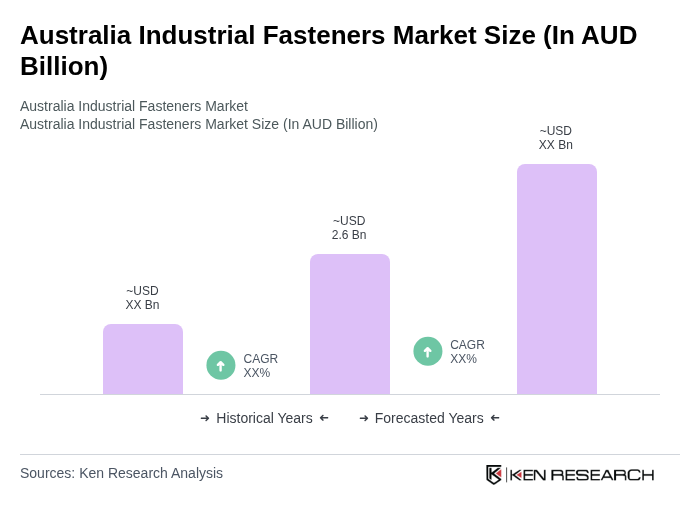
- The Australia Industrial Fasteners Market is valued at approximately AUD 2.6 billion, based on a five-year historical analysis. This growth is primarily driven by increasing demand from the construction, automotive, mining, and industrial machinery sectors, alongside a rise in public infrastructure projects across the country. The market has seen a steady increase in consumption supported by urbanization, industrialization, and strong residential and commercial building activity.
- Key regions dominating the market include New South Wales and Victoria, primarily due to their robust industrial bases, high population concentration, and significant construction and infrastructure activities. These areas are home to major manufacturing hubs and a high concentration of transport, residential, and commercial projects, which contribute strongly to the demand for industrial fasteners.
- The National Construction Code (NCC), as adopted and updated through the National Construction Code 2022 issued by the Australian Building Codes Board, sets mandatory performance and deemed-to-satisfy requirements for building materials and structural connections, including the use of compliant fasteners. These provisions aim to enhance structural safety, fire performance, and durability, and are complemented in practice by product standards such as AS 5216 for design of post-installed and cast-in fastenings to concrete, influencing the types, testing, and specifications of fasteners used in Australian construction projects.
Australia Industrial Fasteners Market Segmentation
By Product:The product segmentation of the market includes various types of fasteners that cater to different industrial needs. The key subsegments are Externally Threaded Fasteners, Internally Threaded Fasteners, Non-Threaded Fasteners, and Aerospace Grade Fasteners. Each of these subsegments serves specific applications across industries, with varying demand based on the requirements of different sectors.
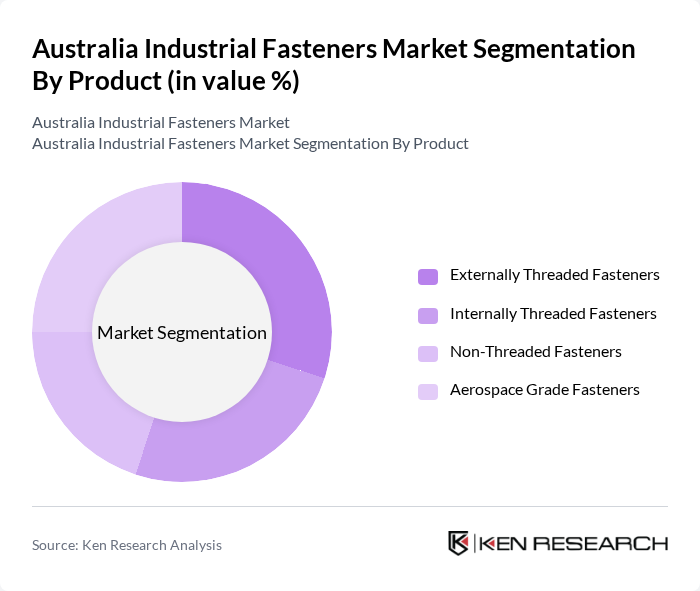
The Externally Threaded Fasteners subsegment is currently dominating the market due to their extensive use in construction, automotive, mining, and general industrial applications, aligning with research that identifies externally threaded fasteners as the leading product category in Australia and New Zealand. These fasteners are preferred for their ease of installation, mechanical strength, and reliability in securing components. The growing trend towards modular and prefabricated construction, as well as higher specifications for corrosion-resistant and high-strength assemblies, further boosts demand for these fasteners.
By Type:The market can also be segmented by type, which includes Bolts, Nuts, Screws, Washers, Rivets, Anchors and Studs, and Others. Each type serves distinct functions and is utilized across various applications, contributing to the overall market dynamics.
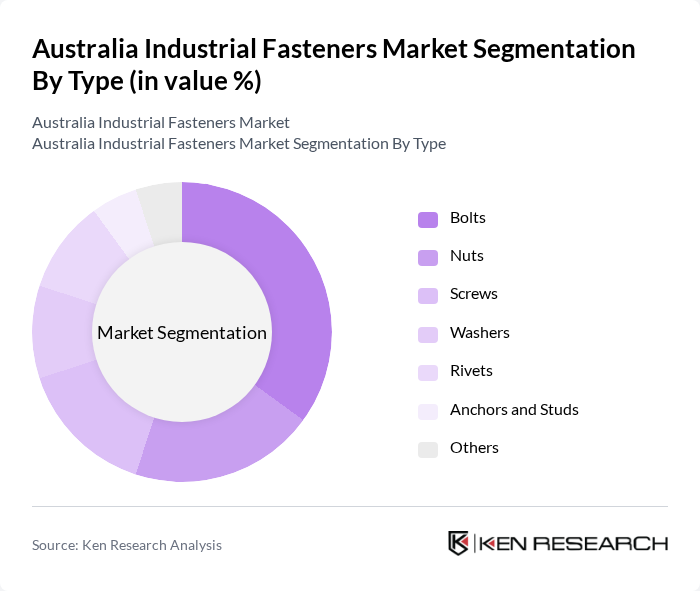
Among the types, Bolts are leading the market due to their versatility and critical role in structural steelwork, machinery assembly, and automotive components, consistent with broader findings that threaded fasteners account for the largest share of industrial fastener demand. The increasing complexity of modern structures and machinery necessitates the use of high-strength, fatigue-resistant bolts, often with protective coatings or stainless and alloy steels to meet durability and corrosion-resistance requirements. This trend is further supported by advancements in bolt and threaded fastener manufacturing technologies, including automated production, improved heat treatment, and precision cold-forming, enhancing their performance and reliability in demanding environments.
Australia Industrial Fasteners Market Competitive Landscape
The Australia Industrial Fasteners Market is characterized by a dynamic mix of regional and international players. Leading participants such as Australian Industrial Fasteners, Australian Anchor & Fixing (AAF Fasteners), BSC Industrial, Techsupply, Allfasteners Australia, Hobson Engineering, Boltmasters, Rudd Industrial & Farm Supplies, Blackwoods, Total Fasteners, Würth Australia, Coventry Group (Konnect Fastening Systems), Sydney Fasteners, Allthread Industries, Bremick Fasteners contribute to innovation, geographic expansion, and service delivery in this space.
Australia Industrial Fasteners Market Industry Analysis
Growth Drivers
- Increasing Demand from Construction and Manufacturing Sectors:The construction sector in Australia is projected to reach AUD 360 billion in future, driven by a surge in residential and commercial projects. This growth is complemented by the manufacturing sector, which contributes approximately AUD 100 billion to the economy. As these sectors expand, the demand for industrial fasteners, essential for structural integrity, is expected to rise significantly, creating a robust market environment.
- Technological Advancements in Fastener Production:The Australian fastener industry is witnessing a shift towards advanced manufacturing technologies, including automation and 3D printing. In future, investments in these technologies are expected to exceed AUD 50 million, enhancing production efficiency and reducing lead times. This technological evolution not only improves product quality but also enables manufacturers to meet the increasing customization demands from various industries, further driving market growth.
- Rising Infrastructure Projects and Government Initiatives:The Australian government has allocated AUD 110 billion for infrastructure projects over the next decade, focusing on transportation, energy, and urban development. This investment is anticipated to create a substantial demand for industrial fasteners, as they are critical components in construction and infrastructure development. The government's commitment to enhancing infrastructure will significantly bolster the fasteners market, providing a stable growth trajectory.
Market Challenges
- Fluctuating Raw Material Prices:The industrial fasteners market in Australia faces challenges due to volatile raw material prices, particularly steel and aluminum, which constitute over 70% of fastener production costs. In future, steel prices are projected to fluctuate between AUD 800 to AUD 1,000 per ton, impacting profit margins for manufacturers. This instability can hinder production planning and lead to increased costs for end-users, posing a significant challenge to market growth.
- Competition from Low-Cost Imports:The influx of low-cost fasteners from countries like China and India poses a significant challenge to Australian manufacturers. In future, imports are expected to account for approximately 40% of the market share, driven by competitive pricing. This competition pressures local manufacturers to lower prices, potentially compromising quality and innovation. Addressing this challenge is crucial for sustaining the domestic fasteners market.
Australia Industrial Fasteners Market Future Outlook
The future of the Australia industrial fasteners market appears promising, driven by ongoing investments in infrastructure and technological advancements. As the construction and manufacturing sectors continue to expand, the demand for high-quality fasteners will likely increase. Additionally, the shift towards sustainable practices and eco-friendly materials is expected to shape product development. Companies that adapt to these trends and invest in innovation will be well-positioned to capitalize on emerging opportunities in the market.
Market Opportunities
- Expansion into Emerging Markets:Australian fastener manufacturers have the opportunity to expand into emerging markets in Southeast Asia, where industrial growth is accelerating. With a projected market growth rate of 6% annually, these regions present significant potential for Australian firms to increase their export volumes and diversify their customer base, enhancing overall market presence.
- Development of Eco-Friendly Fasteners:The growing emphasis on sustainability presents an opportunity for the development of eco-friendly fasteners made from recycled materials. As environmental regulations tighten, manufacturers that innovate in this area can capture a niche market, appealing to environmentally conscious consumers and businesses, thus driving sales and enhancing brand reputation.
Scope of the Report
| Segment | Sub-Segments |
|---|---|
| By Product | Externally Threaded Fasteners Internally Threaded Fasteners Non-Threaded Fasteners Aerospace Grade Fasteners |
| By Type | Bolts Nuts Screws Washers Rivets Anchors and Studs Others |
| By Application | Building & Construction Automotive Aerospace & Defense Industrial Machinery & Equipment Energy, Mining & Oil and Gas Electrical & Electronics Furniture, Appliances & Others |
| By Material | Carbon Steel Alloy Steel Stainless Steel Aluminum Non-ferrous Alloys (Copper, Brass, Titanium, etc.) Plastic / Composite Others |
| By Coating / Finish | Zinc-Plated Hot-Dip Galvanized Electroplated (Nickel, Chrome, etc.) Black Oxide Organic / Specialty Coatings Others |
| By Distribution Channel | Direct Sales (OEM & Project Supply) Industrial Distributors Retail & Trade Stores Online / E-commerce Others |
| By Region | New South Wales Victoria Queensland Western Australia South Australia Tasmania, ACT & Northern Territory |
Key Target Audience
Investors and Venture Capitalist Firms
Government and Regulatory Bodies (e.g., Australian Competition and Consumer Commission, Safe Work Australia)
Manufacturers and Producers
Distributors and Retailers
Construction and Infrastructure Companies
Aerospace and Automotive Industries
Industry Associations (e.g., Australian Industry Group)
Financial Institutions
Players Mentioned in the Report:
Australian Industrial Fasteners
Australian Anchor & Fixing (AAF Fasteners)
BSC Industrial
Techsupply
Allfasteners Australia
Hobson Engineering
Boltmasters
Rudd Industrial & Farm Supplies
Blackwoods
Total Fasteners
Wurth Australia
Coventry Group (Konnect Fastening Systems)
Sydney Fasteners
Allthread Industries
Bremick Fasteners
Table of Contents
Market Assessment Phase
1. Executive Summary and Approach
2. Australia Industrial Fasteners Market Overview
2.1 Key Insights and Strategic Recommendations
2.2 Australia Industrial Fasteners Market Overview
2.3 Definition and Scope
2.4 Evolution of Market Ecosystem
2.5 Timeline of Key Regulatory Milestones
2.6 Value Chain & Stakeholder Mapping
2.7 Business Cycle Analysis
2.8 Policy & Incentive Landscape
3. Australia Industrial Fasteners Market Analysis
3.1 Growth Drivers
3.1.1 Increasing demand from construction and manufacturing sectors
3.1.2 Technological advancements in fastener production
3.1.3 Rising infrastructure projects and government initiatives
3.1.4 Growth in automotive and aerospace industries
3.2 Market Challenges
3.2.1 Fluctuating raw material prices
3.2.2 Stringent regulatory requirements
3.2.3 Competition from low-cost imports
3.2.4 Supply chain disruptions
3.3 Market Opportunities
3.3.1 Expansion into emerging markets
3.3.2 Development of eco-friendly fasteners
3.3.3 Strategic partnerships and collaborations
3.3.4 Adoption of automation in manufacturing processes
3.4 Market Trends
3.4.1 Increasing use of lightweight materials
3.4.2 Growth in online sales channels
3.4.3 Customization and personalization of fasteners
3.4.4 Focus on sustainability and recycling
3.5 Government Regulation
3.5.1 Compliance with Australian Standards (AS)
3.5.2 Environmental regulations on manufacturing
3.5.3 Safety regulations in construction
3.5.4 Import tariffs and trade policies
4. SWOT Analysis
5. Stakeholder Analysis
6. Porter's Five Forces Analysis
7. Australia Industrial Fasteners Market Market Size, 2019-2024
7.1 By Value
7.2 By Volume
7.3 By Average Selling Price
8. Australia Industrial Fasteners Market Segmentation
8.1 By Product
8.1.1 Externally Threaded Fasteners
8.1.2 Internally Threaded Fasteners
8.1.3 Non-Threaded Fasteners
8.1.4 Aerospace Grade Fasteners
8.2 By Type
8.2.1 Bolts
8.2.2 Nuts
8.2.3 Screws
8.2.4 Washers
8.2.5 Rivets
8.2.6 Anchors and Studs
8.2.7 Others
8.3 By Application
8.3.1 Building & Construction
8.3.2 Automotive
8.3.3 Aerospace & Defense
8.3.4 Industrial Machinery & Equipment
8.3.5 Energy, Mining & Oil and Gas
8.3.6 Electrical & Electronics
8.3.7 Furniture, Appliances & Others
8.4 By Material
8.4.1 Carbon Steel
8.4.2 Alloy Steel
8.4.3 Stainless Steel
8.4.4 Aluminum
8.4.5 Non-ferrous Alloys (Copper, Brass, Titanium, etc.)
8.4.6 Plastic / Composite
8.4.7 Others
8.5 By Coating / Finish
8.5.1 Zinc-Plated
8.5.2 Hot-Dip Galvanized
8.5.3 Electroplated (Nickel, Chrome, etc.)
8.5.4 Black Oxide
8.5.5 Organic / Specialty Coatings
8.5.6 Others
8.6 By Distribution Channel
8.6.1 Direct Sales (OEM & Project Supply)
8.6.2 Industrial Distributors
8.6.3 Retail & Trade Stores
8.6.4 Online / E-commerce
8.6.5 Others
8.7 By Region
8.7.1 New South Wales
8.7.2 Victoria
8.7.3 Queensland
8.7.4 Western Australia
8.7.5 South Australia
8.7.6 Tasmania, ACT & Northern Territory
9. Australia Industrial Fasteners Market Competitive Analysis
9.1 Market Share of Key Players
9.2 Cross Comparison of Key Players
9.2.1 Company Name
9.2.2 Group Size (Large, Medium, or Small as per industry convention)
9.2.3 Australia Industrial Fasteners Revenue (AUD Mn)
9.2.4 Australia Industrial Fasteners Revenue CAGR, 2019–2024 (%)
9.2.5 EBITDA Margin from Fasteners Business (%)
9.2.6 Market Share in Australia Industrial Fasteners Market (%)
9.2.7 Share of Revenue from Top 3 End-Use Sectors (%)
9.2.8 Average Realization per Tonne (AUD/tonne)
9.2.9 Capacity Utilization Rate (%)
9.2.10 R&D / Innovation Spend as % of Revenue (%)
9.2.11 Capex Intensity (Capex as % of Revenue, Last 3 Years)
9.2.12 Working Capital Cycle (Days)
9.2.13 Customer Retention Rate (%)
9.2.14 On-time Delivery Performance (%)
9.2.15 Australia Coverage – Number of Distribution / Warehouse Locations
9.3 SWOT Analysis of Top Players
9.4 Pricing Analysis
9.5 Detailed Profile of Major Companies
9.5.1 Australian Industrial Fasteners
9.5.2 Australian Anchor & Fixing (AAF Fasteners)
9.5.3 BSC Industrial
9.5.4 Techsupply
9.5.5 Allfasteners Australia
9.5.6 Hobson Engineering
9.5.7 Boltmasters
9.5.8 Rudd Industrial & Farm Supplies
9.5.9 Blackwoods
9.5.10 Total Fasteners
9.5.11 Würth Australia
9.5.12 Coventry Group (Konnect Fastening Systems)
9.5.13 Sydney Fasteners
9.5.14 Allthread Industries
9.5.15 Bremick Fasteners
10. Australia Industrial Fasteners Market End-User Analysis
10.1 Procurement Behavior of Key Ministries
10.1.1 Government procurement policies
10.1.2 Budget allocation for infrastructure projects
10.1.3 Supplier selection criteria
10.1.4 Contract management practices
10.2 Corporate Spend on Infrastructure & Energy
10.2.1 Investment trends in infrastructure
10.2.2 Corporate budgets for energy projects
10.2.3 Spending on maintenance and upgrades
10.2.4 Impact of economic conditions on spending
10.3 Pain Point Analysis by End-User Category
10.3.1 Quality assurance issues
10.3.2 Supply chain reliability
10.3.3 Cost management challenges
10.3.4 Technical support needs
10.4 User Readiness for Adoption
10.4.1 Awareness of new technologies
10.4.2 Training and skill development
10.4.3 Financial readiness for investment
10.4.4 Infrastructure readiness
10.5 Post-Deployment ROI and Use Case Expansion
10.5.1 Measurement of ROI
10.5.2 Case studies of successful implementations
10.5.3 Opportunities for scaling
10.5.4 Feedback mechanisms for improvement
11. Australia Industrial Fasteners Market Future Size, 2025-2030
11.1 By Value
11.2 By Volume
11.3 By Average Selling Price
Go-To-Market Strategy Phase
1. Whitespace Analysis + Business Model Canvas
1.1 Market gaps identification
1.2 Value proposition development
1.3 Revenue model exploration
1.4 Customer segmentation analysis
1.5 Competitive landscape overview
1.6 Key partnerships identification
1.7 Operational framework design
2. Marketing and Positioning Recommendations
2.1 Branding strategies
2.2 Product USPs
2.3 Target audience definition
2.4 Marketing channels selection
2.5 Messaging and communication strategy
2.6 Performance metrics establishment
2.7 Budget allocation for marketing
3. Distribution Plan
3.1 Urban retail strategy
3.2 Rural NGO tie-ups
3.3 E-commerce integration
3.4 Logistics and supply chain management
3.5 Distribution partnerships
3.6 Inventory management practices
3.7 Customer service and support
4. Channel & Pricing Gaps
4.1 Underserved routes analysis
4.2 Pricing bands evaluation
4.3 Competitor pricing comparison
4.4 Customer willingness to pay
4.5 Pricing strategy recommendations
4.6 Discount and promotion strategies
4.7 Long-term pricing sustainability
5. Unmet Demand & Latent Needs
5.1 Category gaps identification
5.2 Consumer segments analysis
5.3 Product development opportunities
5.4 Market entry barriers
5.5 Customer feedback incorporation
5.6 Future trends anticipation
5.7 Strategic recommendations
6. Customer Relationship
6.1 Loyalty programs design
6.2 After-sales service enhancement
6.3 Customer engagement strategies
6.4 Feedback collection methods
6.5 Relationship management tools
6.6 Customer satisfaction measurement
6.7 Retention strategies
7. Value Proposition
7.1 Sustainability initiatives
7.2 Integrated supply chains
7.3 Cost-benefit analysis
7.4 Unique selling points
7.5 Customer-centric approach
7.6 Competitive advantages
7.7 Long-term value creation
8. Key Activities
8.1 Regulatory compliance
8.2 Branding initiatives
8.3 Distribution setup
8.4 Market research activities
8.5 Training and development programs
8.6 Performance monitoring
8.7 Stakeholder engagement
9. Entry Strategy Evaluation
9.1 Domestic Market Entry Strategy
9.1.1 Product mix considerations
9.1.2 Pricing band analysis
9.1.3 Packaging strategies
9.2 Export Entry Strategy
9.2.1 Target countries identification
9.2.2 Compliance roadmap development
10. Entry Mode Assessment
10.1 Joint Ventures
10.2 Greenfield investments
10.3 Mergers & Acquisitions
10.4 Distributor Model evaluation
10.5 Risk assessment
10.6 Strategic fit analysis
10.7 Long-term partnership considerations
11. Capital and Timeline Estimation
11.1 Capital requirements analysis
11.2 Timelines for market entry
11.3 Financial projections
11.4 Funding sources identification
11.5 Budget allocation strategies
11.6 Risk management planning
11.7 Milestone tracking
12. Control vs Risk Trade-Off
12.1 Ownership considerations
12.2 Partnership dynamics
12.3 Risk mitigation strategies
12.4 Control mechanisms
12.5 Long-term sustainability planning
12.6 Stakeholder alignment
12.7 Performance evaluation
13. Profitability Outlook
13.1 Breakeven analysis
13.2 Long-term sustainability strategies
13.3 Profit margin optimization
13.4 Revenue diversification
13.5 Cost control measures
13.6 Financial health monitoring
13.7 Strategic growth planning
14. Potential Partner List
14.1 Distributors identification
14.2 Joint Ventures opportunities
14.3 Acquisition targets
14.4 Strategic alliances
14.5 Partnership evaluation criteria
14.6 Long-term collaboration strategies
14.7 Risk assessment of partnerships
15. Execution Roadmap
15.1 Phased Plan for Market Entry
15.1.1 Market Setup
15.1.2 Market Entry
15.1.3 Growth Acceleration
15.1.4 Scale & Stabilize
15.2 Key Activities and Milestones
15.2.1 Activity planning
15.2.2 Milestone tracking
15.2.3 Performance evaluation
Research Methodology
Phase 1: Approach1
Desk Research
- Analysis of industry reports from Australian manufacturing associations and trade bodies
- Review of government publications and statistics on industrial fasteners production and consumption
- Examination of market trends and forecasts from relevant academic journals and market research publications
Primary Research
- Interviews with key stakeholders in the industrial fasteners supply chain, including manufacturers and distributors
- Surveys conducted with end-users across various sectors such as construction, automotive, and aerospace
- Field visits to manufacturing facilities to gather insights on production processes and capacity
Validation & Triangulation
- Cross-validation of data through multiple sources, including trade publications and industry expert opinions
- Triangulation of findings from primary interviews with secondary data to ensure consistency
- Sanity checks through expert panel reviews to validate assumptions and findings
Phase 2: Market Size Estimation1
Top-down Assessment
- Estimation of market size based on national industrial output and fastener consumption rates
- Segmentation of the market by end-user industries and product types
- Incorporation of macroeconomic indicators such as GDP growth and manufacturing output trends
Bottom-up Modeling
- Collection of sales data from leading fastener manufacturers and distributors in Australia
- Estimation of market share based on production capacity and sales volume
- Analysis of pricing strategies and average selling prices across different fastener categories
Forecasting & Scenario Analysis
- Development of forecasting models using historical data and market growth drivers
- Scenario analysis based on potential regulatory changes and shifts in consumer demand
- Creation of baseline, optimistic, and pessimistic forecasts through 2030
Phase 3: CATI Sample Composition1
| Scope Item/Segment | Sample Size | Target Respondent Profiles |
|---|---|---|
| Construction Industry Fastener Usage | 100 | Project Managers, Procurement Officers |
| Automotive Fastener Applications | 80 | Manufacturing Engineers, Quality Control Managers |
| Aerospace Fastener Standards | 60 | Compliance Officers, Aerospace Engineers |
| General Manufacturing Fastener Needs | 90 | Operations Managers, Supply Chain Coordinators |
| Retail Fastener Distribution | 70 | Retail Managers, Inventory Specialists |
Frequently Asked Questions
What is the current value of the Australia Industrial Fasteners Market?
The Australia Industrial Fasteners Market is valued at approximately AUD 2.6 billion, driven by demand from sectors such as construction, automotive, mining, and industrial machinery, alongside public infrastructure projects across the country.
Which regions dominate the Australia Industrial Fasteners Market?
What are the key product segments in the Australia Industrial Fasteners Market?
What types of fasteners are most commonly used in Australia?
Other Regional/Country Reports
Other Adjacent Reports
Brazil Automotive Components Market
Global Mining Equipment MarketVietnam Industrial Machinery Market
Qatar Steel Products Market
South Africa Metal Fabrication Market
Indonesia Aerospace Components Market
Egypt Infrastructure Development Market
Mexico Building Hardware Market
Kuwait Manufacturing Tools Market
Why Buy From Us?

What makes us stand out is that our consultants follow Robust, Refine and Result (RRR) methodology. Robust for clear definitions, approaches and sanity checking, Refine for differentiating respondents' facts and opinions, and Result for presenting data with story.

We have set a benchmark in the industry by offering our clients with syndicated and customized market research reports featuring coverage of entire market as well as meticulous research and analyst insights.

While we don't replace traditional research, we flip the method upside down. Our dual approach of Top Bottom & Bottom Top ensures quality deliverable by not just verifying company fundamentals but also looking at the sector and macroeconomic factors.

With one step in the future, our research team constantly tries to show you the bigger picture. We help with some of the tough questions you may encounter along the way: How is the industry positioned? Best marketing channel? KPI's of competitors? By aligning every element, we help maximize success.

Our report gives you instant access to the answers and sources that other companies might choose to hide. We elaborate each steps of research methodology we have used and showcase you the sample size to earn your trust.

If you need any support, we are here! We pride ourselves on universe strength, data quality, and quick, friendly, and professional service.