About the Report
Base Year 2024Australia Wind Energy Market Overview
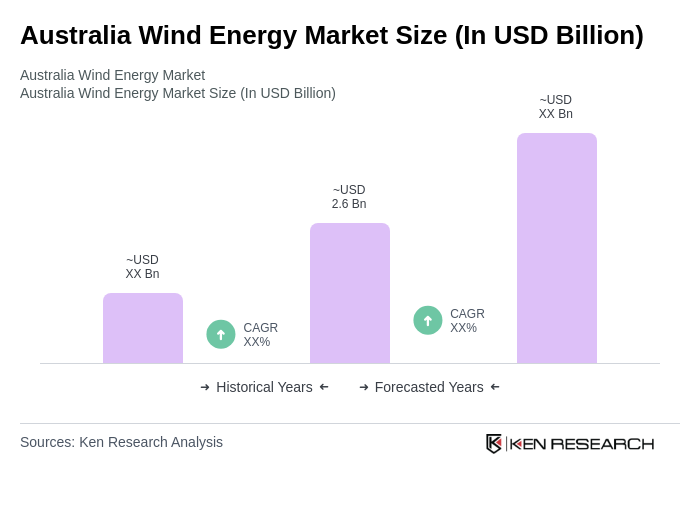
- The Australia Wind Energy Market is valued at USD 2.6 billion, based on a five-year historical analysis. This growth is primarily driven by the increasing demand for renewable energy sources, government initiatives promoting clean energy, and advancements in wind turbine technology; recent market studies highlight strong policy support, declining technology costs, and efficiency gains as core drivers. The market has seen significant investments in onshore wind projects, while offshore wind is progressing through declared offshore wind zones and early-stage developments, contributing to its expansion.
- Key players in this market include New South Wales, Victoria, and Queensland, which dominate due to their favorable wind conditions, supportive government policies, and established infrastructure for renewable energy projects. Public procurement programs and transmission investments in these states have positioned them as hubs attracting domestic and international capital for wind development.
- In 2023, the Australian government continued the Renewable Energy Target (RET) framework, under which the Large-scale Renewable Energy Target mandates 33,000 GWh of electricity from renewable sources; the statutory target level was set legislatively and has guided investment into wind and other renewables. The RET architecture and complementary state targets aim to accelerate the transition to a low?carbon economy and enhance energy security, thereby fostering growth in the wind energy sector.
Australia Wind Energy Market Segmentation
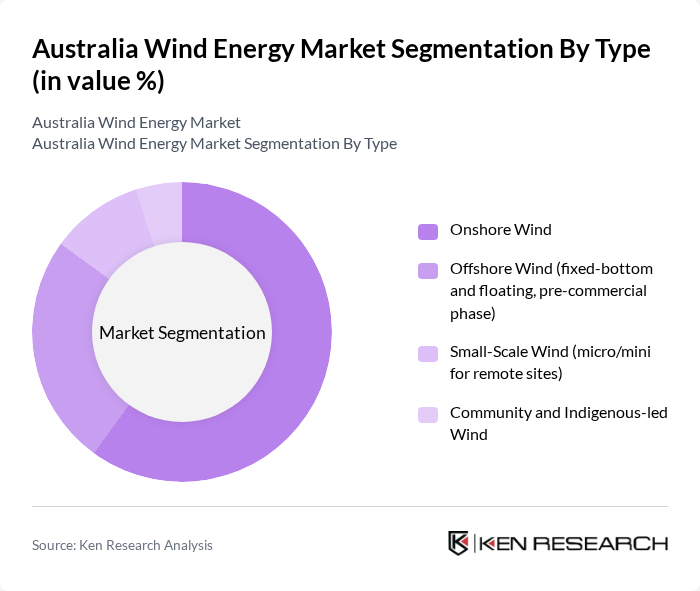
By Type:The wind energy market can be segmented into various types, including onshore wind, offshore wind (both fixed-bottom and floating), small-scale wind, and community and indigenous-led wind projects. Each type serves different market needs and consumer preferences, with onshore wind being the most prevalent due to its established technology and lower costs; current Australian market activity remains predominantly onshore, while offshore wind is in pre-commercial and permitting phases.
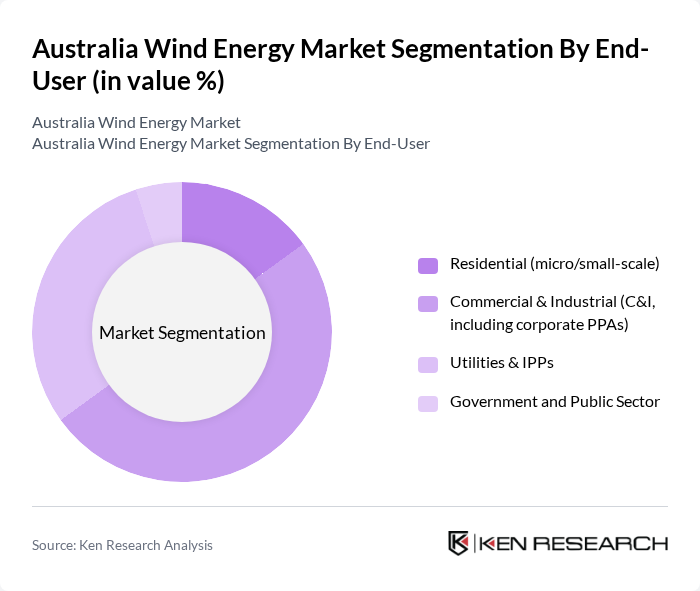
By End-User:The end-user segmentation includes residential, commercial & industrial (C&I), utilities & independent power producers (IPPs), and government and public sector entities. Each segment has unique energy needs, with the commercial and industrial sector showing significant growth due to increasing corporate commitments to sustainability and renewable energy procurement, including corporate PPAs supporting new wind capacity.
Australia Wind Energy Market Competitive Landscape
The Australia Wind Energy Market is characterized by a dynamic mix of regional and international players. Leading participants such as Vestas Wind Systems A/S, Siemens Gamesa Renewable Energy S.A. (Siemens Energy), GE Vernova (formerly GE Renewable Energy), Goldwind Australia, Nordex SE, Acciona Energía, Iberdrola Australia (formerly Infigen Energy), Clean Energy Finance Corporation (CEFC), ENGIE Australia & New Zealand, Origin Energy, AGL Energy, Tilt Renewables (owned by Powering Australian Renewables & Mercury NZ), RATCH-Australia Corporation, Neoen, CS Energy contribute to innovation, geographic expansion, and service delivery in this space. Recent market insights also underscore growing pairing of wind with large-scale batteries to improve grid firmness and reduce curtailment risk, supporting bankability of new projects.
Australia Wind Energy Market Industry Analysis
Growth Drivers
- Increasing Demand for Renewable Energy:The Australian energy market is witnessing a significant shift towards renewable sources, with wind energy contributing approximatelyaround one-third of total renewable generationin the National Electricity Market in recent periods. The Australian Energy Market Operator (AEMO) reported that wind energy generation reachedover 25,000 GWhin the most recent national snapshot, driven by a growing public demand for cleaner energy solutions. This trend is expected to continue as Australia aims to meet its commitment to reduce greenhouse gas emissions by43 percentin future, further boosting wind energy adoption.
- Government Incentives and Subsidies:The Australian government has implemented various incentives to promote wind energy, including the Renewable Energy Target (RET), which mandates that33,000 GWhof electricity must come from renewable sources annually under the Large-scale Renewable Energy Target policy settings. In future, the government allocatedAUD 1.5 billionfor renewable energy projects, with a significant portion directed towards wind energy. These financial incentives are crucial in reducing the cost burden on developers and encouraging investment in new wind projects across the country.
- Technological Advancements in Wind Turbines:The wind energy sector in Australia is benefiting from rapid technological advancements, particularly in turbine efficiency and capacity. Modern wind turbines now have capacities exceeding3–6 MW, with some reaching up toabove 10 MW. This increase in capacity has led to a20 percent reductionin the cost of wind energy generation over the past five years, according to the Clean Energy Council. Enhanced turbine technology is making wind energy more competitive against traditional energy sources, driving further market growth.
Market Challenges
- High Initial Capital Investment:One of the primary challenges facing the wind energy market in Australia is the high initial capital investment required for project development. On average, the cost to install a wind farm is aroundAUD 1–2 million per MW. This translates to a total investment of approximatelyAUD 100–200 millionfor a 100 MW wind farm. Such substantial upfront costs can deter potential investors, particularly in a competitive energy market where financing options may be limited.
- Regulatory Hurdles:The wind energy sector in Australia faces significant regulatory challenges that can delay project approvals. The process for obtaining necessary permits and conducting environmental assessments can take several years, with some projects experiencing delays of up to24 months. According to the Australian Renewable Energy Agency (ARENA), these regulatory hurdles can increase project costs by15–20 percent, making it difficult for developers to maintain financial viability and meet market demands.
Australia Wind Energy Market Future Outlook
The future of the wind energy market in Australia appears promising, driven by increasing investments in renewable technologies and supportive government policies. As the country aims for a net-zero emissions target in future, wind energy is expected to play a pivotal role in achieving this goal. The expansion of offshore wind projects and advancements in energy storage technologies will likely enhance grid reliability and efficiency, positioning Australia as a leader in renewable energy innovation and sustainability.
Market Opportunities
- Expansion of Offshore Wind Projects:Australia has significant potential for offshore wind energy, with estimates suggesting that the country could generateover 200,000 GWhannually from offshore sources. The government is currently exploring regulatory frameworks to facilitate the development of these projects, which could attract substantial investment and create thousands of jobs in coastal regions.
- Technological Innovations in Energy Storage:The integration of advanced energy storage solutions is a key opportunity for the wind energy market. With the Australian Energy Market Operator forecasting a50 percent increasein energy storage capacity in future, innovations in battery technology can enhance the reliability of wind energy, allowing for better management of supply and demand fluctuations, thus improving overall grid stability.
Scope of the Report
| Segment | Sub-Segments |
|---|---|
| By Type | Onshore Wind Offshore Wind (fixed-bottom and floating, pre-commercial phase) Small-Scale Wind (micro/mini for remote sites) Community and Indigenous-led Wind |
| By End-User | Residential (micro/small-scale) Commercial & Industrial (C&I, including corporate PPAs) Utilities & IPPs Government and Public Sector |
| By Application | Utility-Scale Grid-Connected Distributed Generation (behind-the-meter) Off-Grid & Remote/Islanded Systems Hybrid Projects (wind + solar + storage) |
| By Investment Source | Domestic Private Capital Foreign Direct Investment (FDI) Public-Private Partnerships (PPP) Government Funding/Grants (e.g., ARENA, CEFC) |
| By Policy Support | Large-scale Generation Certificates (LGCs)/RECs State Renewable Energy Targets & Reverse Auctions Tax Incentives/Accelerated Depreciation Grid Access & Connection Reforms |
| By Technology | Horizontal Axis Wind Turbines (HAWT) Vertical Axis Wind Turbines (VAWT) Floating and Fixed-Bottom Foundations (offshore) Digital O&M/SCADA and Condition Monitoring |
| By Distribution Mode | Direct EPC/Developer Sales OEM Direct Supply Dealers/Distributors (small wind) Power Purchase Agreements (PPAs and CfDs) |
Key Target Audience
Investors and Venture Capitalist Firms
Government and Regulatory Bodies (e.g., Clean Energy Regulator, Australian Energy Market Operator)
Wind Turbine Manufacturers
Energy Utilities and Power Producers
Project Developers and Operators
Environmental NGOs and Advocacy Groups
Energy Policy Makers
Insurance Companies and Risk Assessment Firms
Players Mentioned in the Report:
Vestas Wind Systems A/S
Siemens Gamesa Renewable Energy S.A. (Siemens Energy)
GE Vernova (formerly GE Renewable Energy)
Goldwind Australia
Nordex SE
Acciona Energia
Iberdrola Australia (formerly Infigen Energy)
Clean Energy Finance Corporation (CEFC)
ENGIE Australia & New Zealand
Origin Energy
AGL Energy
Tilt Renewables (owned by Powering Australian Renewables & Mercury NZ)
RATCH-Australia Corporation
Neoen
CS Energy
Table of Contents
Market Assessment Phase
1. Executive Summary and Approach
2. Australia Wind Energy Market Overview
2.1 Key Insights and Strategic Recommendations
2.2 Australia Wind Energy Market Overview
2.3 Definition and Scope
2.4 Evolution of Market Ecosystem
2.5 Timeline of Key Regulatory Milestones
2.6 Value Chain & Stakeholder Mapping
2.7 Business Cycle Analysis
2.8 Policy & Incentive Landscape
3. Australia Wind Energy Market Analysis
3.1 Growth Drivers
3.1.1 Increasing Demand for Renewable Energy
3.1.2 Government Incentives and Subsidies
3.1.3 Technological Advancements in Wind Turbines
3.1.4 Rising Environmental Awareness
3.2 Market Challenges
3.2.1 High Initial Capital Investment
3.2.2 Regulatory Hurdles
3.2.3 Competition from Other Renewable Sources
3.2.4 Grid Integration Issues
3.3 Market Opportunities
3.3.1 Expansion of Offshore Wind Projects
3.3.2 Technological Innovations in Energy Storage
3.3.3 Partnerships with Local Governments
3.3.4 Increasing Corporate Sustainability Initiatives
3.4 Market Trends
3.4.1 Growth of Community Wind Projects
3.4.2 Integration of AI in Wind Farm Management
3.4.3 Focus on Hybrid Energy Systems
3.4.4 Shift Towards Decentralized Energy Production
3.5 Government Regulation
3.5.1 Renewable Energy Target (RET)
3.5.2 National Wind Farm Guidelines
3.5.3 Environmental Impact Assessments
3.5.4 Feed-in Tariffs for Wind Energy
4. SWOT Analysis
5. Stakeholder Analysis
6. Porter's Five Forces Analysis
7. Australia Wind Energy Market Market Size, 2019-2024
7.1 By Value
7.2 By Volume
7.3 By Average Selling Price
8. Australia Wind Energy Market Segmentation
8.1 By Type
8.1.1 Onshore Wind
8.1.2 Offshore Wind (fixed-bottom and floating, pre-commercial phase)
8.1.3 Small-Scale Wind (micro/mini for remote sites)
8.1.4 Community and Indigenous-led Wind
8.2 By End-User
8.2.1 Residential (micro/small-scale)
8.2.2 Commercial & Industrial (C&I, including corporate PPAs)
8.2.3 Utilities & IPPs
8.2.4 Government and Public Sector
8.3 By Application
8.3.1 Utility-Scale Grid-Connected
8.3.2 Distributed Generation (behind-the-meter)
8.3.3 Off-Grid & Remote/Islanded Systems
8.3.4 Hybrid Projects (wind + solar + storage)
8.4 By Investment Source
8.4.1 Domestic Private Capital
8.4.2 Foreign Direct Investment (FDI)
8.4.3 Public-Private Partnerships (PPP)
8.4.4 Government Funding/Grants (e.g., ARENA, CEFC)
8.5 By Policy Support
8.5.1 Large-scale Generation Certificates (LGCs)/RECs
8.5.2 State Renewable Energy Targets & Reverse Auctions
8.5.3 Tax Incentives/Accelerated Depreciation
8.5.4 Grid Access & Connection Reforms
8.6 By Technology
8.6.1 Horizontal Axis Wind Turbines (HAWT)
8.6.2 Vertical Axis Wind Turbines (VAWT)
8.6.3 Floating and Fixed-Bottom Foundations (offshore)
8.6.4 Digital O&M/SCADA and Condition Monitoring
8.7 By Distribution Mode
8.7.1 Direct EPC/Developer Sales
8.7.2 OEM Direct Supply
8.7.3 Dealers/Distributors (small wind)
8.7.4 Power Purchase Agreements (PPAs and CfDs)
9. Australia Wind Energy Market Competitive Analysis
9.1 Market Share of Key Players
9.2 Cross Comparison of Key Players
9.2.1 Company Name
9.2.2 Installed Capacity in Australia (MW) and Project Pipeline (MW)
9.2.3 Annual Capacity Additions (MW/year)
9.2.4 Capacity Factor (%) and Turbine Fleet Mix
9.2.5 Average PPA Price Range (AUD/MWh) for Recent Deals
9.2.6 Construction Lead Time and COD Hit Rate
9.2.7 Grid Connection Success Rate and Curtailment (% of output)
9.2.8 O&M Availability (%) and Unplanned Outage Rate
9.2.9 LCOE (AUD/MWh) Band and Capex per MW (AUDm/MW)
9.2.10 Debt/Equity Mix and Cost of Capital (WACC) for Australian projects
9.3 SWOT Analysis of Top Players
9.4 Pricing Analysis
9.5 Detailed Profile of Major Companies
9.5.1 Vestas Wind Systems A/S
9.5.2 Siemens Gamesa Renewable Energy S.A. (Siemens Energy)
9.5.3 GE Vernova (formerly GE Renewable Energy)
9.5.4 Goldwind Australia
9.5.5 Nordex SE
9.5.6 Acciona Energía
9.5.7 Iberdrola Australia (formerly Infigen Energy)
9.5.8 Clean Energy Finance Corporation (CEFC)
9.5.9 ENGIE Australia & New Zealand
9.5.10 Origin Energy
9.5.11 AGL Energy
9.5.12 Tilt Renewables (owned by Powering Australian Renewables & Mercury NZ)
9.5.13 RATCH-Australia Corporation
9.5.14 Neoen
9.5.15 CS Energy
10. Australia Wind Energy Market End-User Analysis
10.1 Procurement Behavior of Key Ministries
10.1.1 Government Procurement Policies
10.1.2 Budget Allocations for Renewable Energy
10.1.3 Collaboration with Private Sector
10.2 Corporate Spend on Infrastructure & Energy
10.2.1 Investment Trends in Renewable Energy
10.2.2 Corporate Sustainability Goals
10.2.3 Energy Efficiency Initiatives
10.3 Pain Point Analysis by End-User Category
10.3.1 Cost of Energy
10.3.2 Reliability of Supply
10.3.3 Regulatory Compliance
10.4 User Readiness for Adoption
10.4.1 Awareness of Wind Energy Benefits
10.4.2 Financial Incentives
10.4.3 Technical Support Availability
10.5 Post-Deployment ROI and Use Case Expansion
10.5.1 Performance Metrics
10.5.2 Case Studies of Successful Deployments
10.5.3 Future Expansion Plans
11. Australia Wind Energy Market Future Size, 2025-2030
11.1 By Value
11.2 By Volume
11.3 By Average Selling Price
Go-To-Market Strategy Phase
1. Whitespace Analysis + Business Model Canvas
1.1 Market Gaps Identification
1.2 Business Model Framework
2. Marketing and Positioning Recommendations
2.1 Branding Strategies
2.2 Product USPs
3. Distribution Plan
3.1 Urban Retail vs Rural NGO Tie-ups
4. Channel & Pricing Gaps
4.1 Underserved Routes
4.2 Pricing Bands
5. Unmet Demand & Latent Needs
5.1 Category Gaps
5.2 Consumer Segments
6. Customer Relationship
6.1 Loyalty Programs
6.2 After-sales Service
7. Value Proposition
7.1 Sustainability
7.2 Integrated Supply Chains
8. Key Activities
8.1 Regulatory Compliance
8.2 Branding
8.3 Distribution Setup
9. Entry Strategy Evaluation
9.1 Domestic Market Entry Strategy
9.1.1 Product Mix
9.1.2 Pricing Band
9.1.3 Packaging
9.2 Export Entry Strategy
9.2.1 Target Countries
9.2.2 Compliance Roadmap
10. Entry Mode Assessment
10.1 Joint Ventures
10.2 Greenfield Investments
10.3 Mergers & Acquisitions
10.4 Distributor Model
11. Capital and Timeline Estimation
11.1 Capital Requirements
11.2 Timelines
12. Control vs Risk Trade-Off
12.1 Ownership vs Partnerships
13. Profitability Outlook
13.1 Breakeven Analysis
13.2 Long-term Sustainability
14. Potential Partner List
14.1 Distributors
14.2 Joint Ventures
14.3 Acquisition Targets
15. Execution Roadmap
15.1 Phased Plan for Market Entry
15.1.1 Market Setup
15.1.2 Market Entry
15.1.3 Growth Acceleration
15.1.4 Scale & Stabilize
15.2 Key Activities and Milestones
15.2.1 Milestone Planning
15.2.2 Activity Tracking
Research Methodology
Phase 1: Approach1
Desk Research
- Analysis of government reports and publications from the Australian Renewable Energy Agency (ARENA)
- Review of industry reports from the Clean Energy Council and other relevant organizations
- Examination of academic journals and white papers focusing on wind energy technology and market trends
Primary Research
- Interviews with key stakeholders in the wind energy sector, including project developers and utility executives
- Surveys targeting engineers and technical experts involved in wind turbine manufacturing and installation
- Field interviews with policymakers and regulatory bodies overseeing renewable energy initiatives
Validation & Triangulation
- Cross-validation of data through multiple sources, including market reports and expert opinions
- Triangulation of findings from primary interviews with secondary data trends
- Sanity checks conducted through expert panel discussions to ensure data accuracy
Phase 2: Market Size Estimation1
Top-down Assessment
- Estimation of total wind energy capacity based on national energy consumption statistics
- Segmentation of the market by state and territory, considering local policies and incentives
- Incorporation of future government targets for renewable energy generation
Bottom-up Modeling
- Collection of data on installed capacity from major wind farm operators in Australia
- Cost analysis of wind energy projects, including capital expenditure and operational costs
- Volume estimates based on projected energy output and market demand forecasts
Forecasting & Scenario Analysis
- Multi-variable regression analysis incorporating factors such as technological advancements and policy changes
- Scenario modeling based on varying levels of investment and regulatory support for wind energy
- Development of baseline, optimistic, and pessimistic forecasts through 2030
Phase 3: CATI Sample Composition1
| Scope Item/Segment | Sample Size | Target Respondent Profiles |
|---|---|---|
| Wind Farm Operators | 90 | Project Managers, Operations Directors |
| Regulatory Bodies | 50 | Policy Analysts, Energy Regulators |
| Wind Turbine Manufacturers | 70 | Product Development Engineers, Sales Managers |
| Energy Consultants | 60 | Market Analysts, Sustainability Advisors |
| Investors in Renewable Energy | 40 | Investment Analysts, Portfolio Managers |
Frequently Asked Questions
What is the current value of the Australia Wind Energy Market?
The Australia Wind Energy Market is valued at approximately USD 2.6 billion, driven by increasing demand for renewable energy, government initiatives, and advancements in wind turbine technology. This market is expected to continue growing as investments in wind projects increase.
What are the main drivers of growth in the Australia Wind Energy Market?
Which states are leading in the Australia Wind Energy Market?
What role does the Renewable Energy Target (RET) play in the wind energy sector?
Why Buy From Us?

What makes us stand out is that our consultants follow Robust, Refine and Result (RRR) methodology. Robust for clear definitions, approaches and sanity checking, Refine for differentiating respondents' facts and opinions, and Result for presenting data with story.

We have set a benchmark in the industry by offering our clients with syndicated and customized market research reports featuring coverage of entire market as well as meticulous research and analyst insights.

While we don't replace traditional research, we flip the method upside down. Our dual approach of Top Bottom & Bottom Top ensures quality deliverable by not just verifying company fundamentals but also looking at the sector and macroeconomic factors.

With one step in the future, our research team constantly tries to show you the bigger picture. We help with some of the tough questions you may encounter along the way: How is the industry positioned? Best marketing channel? KPI's of competitors? By aligning every element, we help maximize success.

Our report gives you instant access to the answers and sources that other companies might choose to hide. We elaborate each steps of research methodology we have used and showcase you the sample size to earn your trust.

If you need any support, we are here! We pride ourselves on universe strength, data quality, and quick, friendly, and professional service.