Ken Research Logo

Bahrain Pacific Prebiotics Market Report Size, Share, Growth Drivers, Trends, Opportunities & Forecast 2025–2030

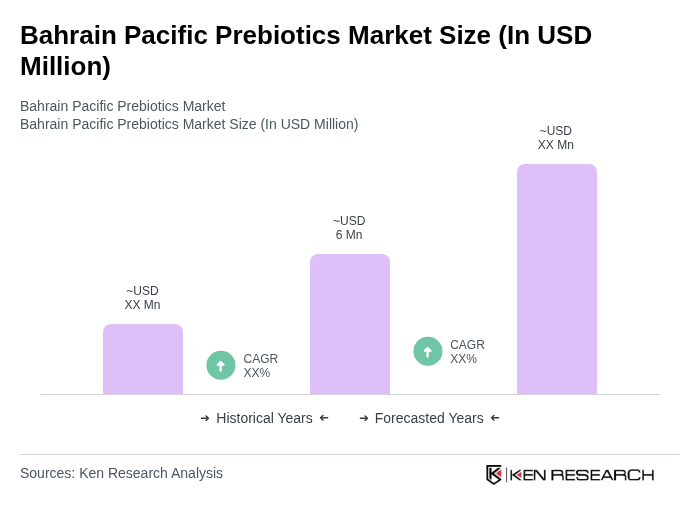
Bahrain Pacific Prebiotics Market is worth USD 6 million, fueled by rising health consciousness, functional foods, and supplements, with Inulin leading types.

Region:Middle East

Author(s):Shubham

Product Code:KRAD5421

Pages:86

Published On:December 2025
About the Report

Base Year 2024

Bahrain Pacific Prebiotics Market Overview

  • The Bahrain Pacific Prebiotics Market is valued at USD 6 million, based on a five-year historical analysis and regional allocation of the Middle East prebiotics market, where the region is estimated in the low hundreds of millions of USD and Bahrain accounts for a small but growing share. This growth is primarily driven by increasing consumer awareness of gut health, the rising demand for functional foods, and the expansion of the dietary supplements sector. The market is also supported by a growing trend towards natural and organic products, which has led to a surge in the use of prebiotics in various food and beverage applications, in line with global prebiotics trends favoring fiber-based ingredients such as inulin and oligosaccharides in dairy, bakery, beverages, and nutritional products.
  • Key players in this market include Bahrain, Saudi Arabia, and the United Arab Emirates as part of the wider Gulf Cooperation Council, which collectively represents a key demand cluster for prebiotic ingredients within the Middle East. These countries dominate the regional prebiotics landscape due to their advanced food processing industries, high disposable incomes, and a growing health-conscious population that is increasingly adopting functional foods, fortified dairy, and dietary supplements. The presence of established international ingredient manufacturers supplying into GCC markets and a robust distribution network for specialty food and nutraceutical ingredients further enhance their market position, making them significant contributors to the regional prebiotics market.
  • In 2023, Bahrain's government strengthened its food safety and nutrition framework through instruments such as the Bahrain Food Safety Law issued by the National Food Security Committee and implemented via the Bahrain Food and Drug Authority, which sets compositional and labeling requirements for functional and fortified foods, including products containing dietary fibers and prebiotic ingredients. Under this framework and the Gulf Standardization Organization’s harmonized food standards adopted by Bahrain, prebiotic-containing foods must comply with ingredient purity, maximum and minimum usage levels for added fibers, and accurate nutrition and health-related labeling, alongside facility licensing and regular inspection obligations for food and beverage manufacturers. These regulatory measures, together with Bahrain’s broader national nutrition and noncommunicable disease strategies that encourage reformulation toward higher-fiber, lower-sugar products, indirectly support the uptake of prebiotic ingredients in the market by guiding manufacturers toward healthier product profiles.
Bahrain Pacific Prebiotics Market Size

Bahrain Pacific Prebiotics Market Segmentation

By Type:The market is segmented into various types of prebiotics, including Inulin, Fructo-oligosaccharides (FOS), Galacto-oligosaccharides (GOS), Mannan-oligosaccharides (MOS), and Other Prebiotic Fibers (including resistant starch, polydextrose). This structure is consistent with global and regional prebiotic ingredient classifications, where inulin and fructo?oligosaccharides represent the largest share, followed by GOS and MOS used in both human and animal nutrition. Among these, Inulin is the leading sub-segment due to its widespread application in food and beverage products, particularly in dairy and bakery items, and its strong presence in global prebiotic ingredient portfolios. The increasing consumer preference for natural ingredients and the health benefits associated with Inulin, such as improved digestive health, enhanced mineral absorption, and its use as a fat and sugar replacer to support clean-label and reduced-sugar formulations, contribute to its dominance in the market.
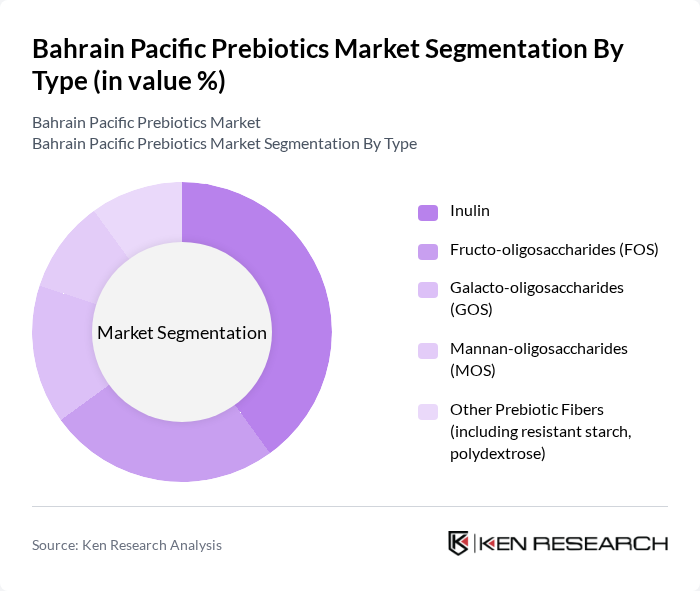
Bahrain Pacific Prebiotics Market segmentation by Type.

By End-User Industry:The prebiotics market is segmented by end-user industries, including Food & Beverage Manufacturers (dairy, bakery, beverages), Dietary Supplement & Nutraceutical Manufacturers, Pharmaceutical & Clinical Nutrition Companies, Animal Nutrition & Feed Producers, and Others (including specialty ingredient blenders). This segmentation aligns with broader Middle East and global prebiotic usage patterns, where food and beverages, especially dairy, bakery, beverages, and infant nutrition, represent the largest application area. The Food & Beverage Manufacturers segment holds the largest share, driven by the increasing incorporation of prebiotics in various food products to enhance health benefits and meet consumer demand for functional foods and fiber-enriched offerings. The trend towards healthier eating habits, rising purchases of vitamins, minerals, and other OTC health products in Bahrain, and the growing popularity of probiotic and prebiotic combinations in yogurts, drinks, and supplements further bolster this segment's growth.
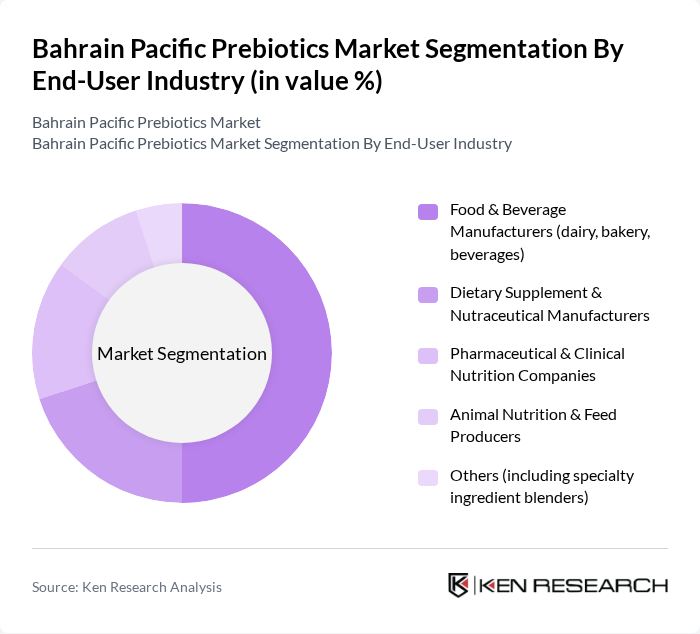
Bahrain Pacific Prebiotics Market segmentation by End-User Industry.

Bahrain Pacific Prebiotics Market Competitive Landscape

The Bahrain Pacific Prebiotics Market is characterized by a dynamic mix of regional and international players. Leading participants such as FrieslandCampina Ingredients, BENEO GmbH, Sensus (Royal Cosun), Ingredion Incorporated, Tate & Lyle PLC, Kerry Group plc, Cargill, Incorporated, Nexira, Roquette Frères, Fonterra Co?operative Group Limited, Taiyo Kagaku Co., Ltd., Yakult Honsha Co., Ltd. (prebiotic-containing synbiotic products), CHP Group (Bimuno), Tereos S.A., Cosucra Groupe Warcoing S.A. contribute to innovation, geographic expansion, and service delivery in this space, reflecting the global prebiotics supply base that serves the Middle East and GCC markets through specialized inulin, FOS, GOS, and other fiber ingredient portfolios.

FrieslandCampina Ingredients

2009

Amersfoort, Netherlands

BENEO GmbH

2007

Mannheim, Germany

Sensus (Royal Cosun)

1998

Roosendaal, Netherlands

Ingredion Incorporated

1906

Westchester, Illinois, USA

Tate & Lyle PLC

1921

London, United Kingdom

Company

Establishment Year

Headquarters

Group Size (global classification: Large, Medium, Small)

Revenue from Prebiotics in Bahrain/GCC (USD million)

Revenue Growth Rate in Bahrain/GCC Prebiotics (%)

Market Share in Bahrain Prebiotic Ingredients Market (%)

Number of Prebiotic Ingredients/Formats Offered (portfolio breadth)

Share of Revenue from Functional Foods & Beverages vs Supplements (%)

Bahrain Pacific Prebiotics Market Industry Analysis

Growth Drivers

  • Increasing Health Awareness:The health consciousness among Bahrain's population is rising, with 68% of adults actively seeking healthier food options. This trend is supported by the World Health Organization's report indicating that 60% of the population is aware of the benefits of prebiotics. As a result, the demand for prebiotic products is expected to increase, driven by consumers prioritizing gut health and overall wellness, which is projected to boost market growth significantly.
  • Rising Demand for Functional Foods:The functional food market in Bahrain is projected to reach $150 million in future, with prebiotics playing a crucial role. A survey by the Bahrain Food Safety Authority revealed that 45% of consumers are incorporating functional foods into their diets. This growing demand is fueled by the increasing awareness of the health benefits associated with prebiotics, such as improved digestion and enhanced immune function, further driving market expansion.
  • Growth in the Dietary Supplements Sector:The dietary supplements market in Bahrain is expected to grow to $80 million in future, with prebiotics being a significant contributor. According to the Bahrain Chamber of Commerce, 55% of consumers are now using dietary supplements regularly. This growth is attributed to the increasing focus on preventive healthcare and the rising prevalence of lifestyle-related diseases, which is driving the demand for prebiotic supplements in the region.

Market Challenges

  • Regulatory Compliance Issues:The prebiotics market in Bahrain faces significant regulatory hurdles, with over 30% of companies reporting difficulties in meeting local food safety standards. The Bahrain Food Safety Authority has stringent regulations that require extensive testing and documentation, which can delay product launches. This regulatory environment poses a challenge for new entrants and existing companies looking to innovate within the market.
  • High Competition from Alternatives:The prebiotics market is increasingly competitive, with over 200 brands offering alternative health products. A report from the Bahrain Economic Development Board indicates that 40% of consumers prefer alternatives like probiotics and fiber supplements. This competition can dilute market share for prebiotic products, making it essential for companies to differentiate their offerings through quality and marketing strategies to maintain consumer interest.

Bahrain Pacific Prebiotics Market Future Outlook

The future of the Bahrain Pacific prebiotics market appears promising, driven by increasing health awareness and a growing preference for functional foods. Innovations in product formulations and the rise of e-commerce platforms are expected to enhance accessibility and consumer engagement. Additionally, the trend towards personalized nutrition is likely to create new opportunities for tailored prebiotic products, allowing companies to cater to specific health needs and preferences, thus expanding their market reach.

Market Opportunities

  • Innovations in Product Development:There is a significant opportunity for companies to innovate prebiotic formulations, with 25% of consumers expressing interest in new flavors and delivery formats. By investing in research and development, brands can create unique products that cater to evolving consumer preferences, potentially increasing market share and customer loyalty.
  • Collaborations with Health Professionals:Partnering with healthcare providers can enhance credibility and consumer trust in prebiotic products. A study by the Bahrain Medical Association found that 70% of consumers are more likely to purchase products recommended by health professionals. Such collaborations can lead to increased awareness and sales, positioning brands favorably in a competitive market.

Scope of the Report

SegmentSub-Segments
By Type

Inulin

Fructo-oligosaccharides (FOS)

Galacto-oligosaccharides (GOS)

Mannan-oligosaccharides (MOS)

Other Prebiotic Fibers (including resistant starch, polydextrose)

By End-User Industry

Food & Beverage Manufacturers (dairy, bakery, beverages)

Dietary Supplement & Nutraceutical Manufacturers

Pharmaceutical & Clinical Nutrition Companies

Animal Nutrition & Feed Producers

Others (including specialty ingredient blenders)

By Distribution Channel

Business-to-Business (B2B) Ingredient Supply

Direct Sales to Manufacturers

Distributors & Importers

Online Ingredient Marketplaces

Others

By Formulation

Powder

Liquid/Syrup

Granules

Microencapsulated Forms

Others

By Application

Functional Foods & Beverages

Dietary Supplements

Clinical & Infant Nutrition

Animal Nutrition

Others

By Age Group

Infant & Early Childhood Nutrition

Children’s Health

Adult Wellness

Senior Health

Others

By Region

Northern Governorate

Southern Governorate

Capital Governorate

Muharraq Governorate

Others

Key Target Audience

Investors and Venture Capitalist Firms

Government and Regulatory Bodies (e.g., Bahrain Food Safety Authority, Ministry of Health)

Manufacturers and Producers of Prebiotics

Distributors and Retailers of Health Products

Food and Beverage Companies

Health and Wellness Brands

Pharmaceutical Companies

Importers and Exporters of Nutraceuticals

Players Mentioned in the Report:

FrieslandCampina Ingredients

BENEO GmbH

Sensus (Royal Cosun)

Ingredion Incorporated

Tate & Lyle PLC

Kerry Group plc

Cargill, Incorporated

Nexira

Roquette Freres

Fonterra Cooperative Group Limited

Taiyo Kagaku Co., Ltd.

Yakult Honsha Co., Ltd. (prebiotic-containing synbiotic products)

CHP Group (Bimuno)

Tereos S.A.

Cosucra Groupe Warcoing S.A.

Table of Contents

Market Assessment Phase

1. Executive Summary and Approach


2. Bahrain Pacific Prebiotics Market Overview

2.1 Key Insights and Strategic Recommendations

2.2 Bahrain Pacific Prebiotics Market Overview

2.3 Definition and Scope

2.4 Evolution of Market Ecosystem

2.5 Timeline of Key Regulatory Milestones

2.6 Value Chain & Stakeholder Mapping

2.7 Business Cycle Analysis

2.8 Policy & Incentive Landscape


3. Bahrain Pacific Prebiotics Market Analysis

3.1 Growth Drivers

3.1.1 Increasing Health Awareness
3.1.2 Rising Demand for Functional Foods
3.1.3 Growth in the Dietary Supplements Sector
3.1.4 Expansion of E-commerce Platforms

3.2 Market Challenges

3.2.1 Regulatory Compliance Issues
3.2.2 High Competition from Alternatives
3.2.3 Limited Consumer Awareness
3.2.4 Supply Chain Disruptions

3.3 Market Opportunities

3.3.1 Innovations in Product Development
3.3.2 Collaborations with Health Professionals
3.3.3 Expansion into Emerging Markets
3.3.4 Increasing Online Marketing Strategies

3.4 Market Trends

3.4.1 Shift Towards Plant-Based Ingredients
3.4.2 Growing Popularity of Personalized Nutrition
3.4.3 Rise in Subscription-Based Models
3.4.4 Focus on Sustainable Sourcing

3.5 Government Regulation

3.5.1 Food Safety Standards
3.5.2 Labeling Requirements
3.5.3 Import Regulations
3.5.4 Health Claims Regulations

4. SWOT Analysis


5. Stakeholder Analysis


6. Porter's Five Forces Analysis


7. Bahrain Pacific Prebiotics Market Market Size, 2019-2024

7.1 By Value

7.2 By Volume

7.3 By Average Selling Price


8. Bahrain Pacific Prebiotics Market Segmentation

8.1 By Type

8.1.1 Inulin
8.1.2 Fructo-oligosaccharides (FOS)
8.1.3 Galacto-oligosaccharides (GOS)
8.1.4 Mannan-oligosaccharides (MOS)
8.1.5 Other Prebiotic Fibers (including resistant starch, polydextrose)

8.2 By End-User Industry

8.2.1 Food & Beverage Manufacturers (dairy, bakery, beverages)
8.2.2 Dietary Supplement & Nutraceutical Manufacturers
8.2.3 Pharmaceutical & Clinical Nutrition Companies
8.2.4 Animal Nutrition & Feed Producers
8.2.5 Others (including specialty ingredient blenders)

8.3 By Distribution Channel

8.3.1 Business-to-Business (B2B) Ingredient Supply
8.3.2 Direct Sales to Manufacturers
8.3.3 Distributors & Importers
8.3.4 Online Ingredient Marketplaces
8.3.5 Others

8.4 By Formulation

8.4.1 Powder
8.4.2 Liquid/Syrup
8.4.3 Granules
8.4.4 Microencapsulated Forms
8.4.5 Others

8.5 By Application

8.5.1 Functional Foods & Beverages
8.5.2 Dietary Supplements
8.5.3 Clinical & Infant Nutrition
8.5.4 Animal Nutrition
8.5.5 Others

8.6 By Age Group

8.6.1 Infant & Early Childhood Nutrition
8.6.2 Children’s Health
8.6.3 Adult Wellness
8.6.4 Senior Health
8.6.5 Others

8.7 By Region

8.7.1 Northern Governorate
8.7.2 Southern Governorate
8.7.3 Capital Governorate
8.7.4 Muharraq Governorate
8.7.5 Others

9. Bahrain Pacific Prebiotics Market Competitive Analysis

9.1 Market Share of Key Players

9.2 Cross Comparison of Key Players

9.2.1 Company Name
9.2.2 Group Size (global classification: Large, Medium, Small)
9.2.3 Revenue from Prebiotics in Bahrain/GCC (USD million)
9.2.4 Revenue Growth Rate in Bahrain/GCC Prebiotics (%)
9.2.5 Market Share in Bahrain Prebiotic Ingredients Market (%)
9.2.6 Number of Prebiotic Ingredients/Formats Offered (portfolio breadth)
9.2.7 Share of Revenue from Functional Foods & Beverages vs Supplements (%)
9.2.8 Average Selling Price Positioning (economy/mid-premium/premium)
9.2.9 Number of Local Partnerships/Distributors in Bahrain
9.2.10 Regulatory Compliance & Certification Score (GCC/Bahrain approvals)
9.2.11 R&D and Innovation Intensity (R&D spend as % of prebiotic sales)
9.2.12 Digital & E-commerce Penetration (share of sales supported via online channels)

9.3 SWOT Analysis of Top Players

9.4 Pricing Analysis

9.5 Detailed Profile of Major Companies

9.5.1 FrieslandCampina Ingredients
9.5.2 BENEO GmbH
9.5.3 Sensus (Royal Cosun)
9.5.4 Ingredion Incorporated
9.5.5 Tate & Lyle PLC
9.5.6 Kerry Group plc
9.5.7 Cargill, Incorporated
9.5.8 Nexira
9.5.9 Roquette Frères
9.5.10 Fonterra Co?operative Group Limited
9.5.11 Taiyo Kagaku Co., Ltd.
9.5.12 Yakult Honsha Co., Ltd. (prebiotic-containing synbiotic products)
9.5.13 CHP Group (Bimuno)
9.5.14 Tereos S.A.
9.5.15 Cosucra Groupe Warcoing S.A.

10. Bahrain Pacific Prebiotics Market End-User Analysis

10.1 Procurement Behavior of Key Ministries

10.1.1 Ministry of Health
10.1.2 Ministry of Industry and Commerce
10.1.3 Ministry of Education
10.1.4 Others

10.2 Corporate Spend on Infrastructure & Energy

10.2.1 Investment in Health Initiatives
10.2.2 Funding for Nutritional Programs
10.2.3 Corporate Wellness Programs
10.2.4 Others

10.3 Pain Point Analysis by End-User Category

10.3.1 Health Concerns
10.3.2 Cost Constraints
10.3.3 Product Availability
10.3.4 Others

10.4 User Readiness for Adoption

10.4.1 Awareness Levels
10.4.2 Accessibility of Products
10.4.3 Education on Benefits
10.4.4 Others

10.5 Post-Deployment ROI and Use Case Expansion

10.5.1 Measurement of Health Outcomes
10.5.2 Cost Savings Analysis
10.5.3 User Feedback Mechanisms
10.5.4 Others

11. Bahrain Pacific Prebiotics Market Future Size, 2025-2030

11.1 By Value

11.2 By Volume

11.3 By Average Selling Price


Go-To-Market Strategy Phase

1. Whitespace Analysis + Business Model Canvas

1.1 Market Gaps Identification

1.2 Business Model Framework


2. Marketing and Positioning Recommendations

2.1 Branding Strategies

2.2 Product USPs


3. Distribution Plan

3.1 Urban Retail Strategies

3.2 Rural NGO Tie-ups


4. Channel & Pricing Gaps

4.1 Underserved Routes

4.2 Pricing Bands


5. Unmet Demand & Latent Needs

5.1 Category Gaps

5.2 Consumer Segments


6. Customer Relationship

6.1 Loyalty Programs

6.2 After-sales Service


7. Value Proposition

7.1 Sustainability

7.2 Integrated Supply Chains


8. Key Activities

8.1 Regulatory Compliance

8.2 Branding

8.3 Distribution Setup


9. Entry Strategy Evaluation

9.1 Domestic Market Entry Strategy

9.1.1 Product Mix
9.1.2 Pricing Band
9.1.3 Packaging

9.2 Export Entry Strategy

9.2.1 Target Countries
9.2.2 Compliance Roadmap

10. Entry Mode Assessment

10.1 JV

10.2 Greenfield

10.3 M&A

10.4 Distributor Model


11. Capital and Timeline Estimation

11.1 Capital Requirements

11.2 Timelines


12. Control vs Risk Trade-Off

12.1 Ownership vs Partnerships


13. Profitability Outlook

13.1 Breakeven Analysis

13.2 Long-term Sustainability


14. Potential Partner List

14.1 Distributors

14.2 JVs

14.3 Acquisition Targets


15. Execution Roadmap

15.1 Phased Plan for Market Entry

15.1.1 Market Setup
15.1.2 Market Entry
15.1.3 Growth Acceleration
15.1.4 Scale & Stabilize

15.2 Key Activities and Milestones

15.2.1 Milestone Planning
15.2.2 Activity Tracking

Research Methodology

ApproachModellingSample

Phase 1: Approach1

Desk Research

  • Analysis of industry reports from local and international market research firms
  • Review of government publications and trade statistics related to prebiotics
  • Examination of academic journals and white papers on prebiotic applications and trends

Primary Research

  • Interviews with key opinion leaders in the food and beverage industry
  • Surveys targeting nutritionists and dietitians regarding consumer preferences
  • Field interviews with manufacturers of prebiotic products in Bahrain

Validation & Triangulation

  • Cross-validation of data from multiple sources to ensure accuracy
  • Triangulation of findings from desk research and primary interviews
  • Sanity checks through expert panel discussions and feedback sessions

Phase 2: Market Size Estimation1

Top-down Assessment

  • Estimation of market size based on national health and wellness spending
  • Segmentation by product type, including inulin, oligofructose, and others
  • Incorporation of demographic trends influencing prebiotic consumption

Bottom-up Modeling

  • Volume estimates derived from sales data of leading prebiotic brands
  • Cost analysis based on production and distribution expenses
  • Calculation of market size using unit sales multiplied by average selling price

Forecasting & Scenario Analysis

  • Multi-variable forecasting considering health trends and dietary shifts
  • Scenario planning based on regulatory changes and market entry of new products
  • Development of baseline, optimistic, and pessimistic market growth projections

Phase 3: CATI Sample Composition1

Scope Item/SegmentSample SizeTarget Respondent Profiles
Food and Beverage Manufacturers60Product Development Managers, Quality Assurance Specialists
Health and Wellness Retailers50Store Managers, Category Buyers
Nutritionists and Dietitians40Registered Dietitians, Health Coaches
Consumers of Functional Foods100Health-Conscious Consumers, Fitness Enthusiasts
Regulatory Bodies and Health Organizations40Policy Makers, Health Advocates

Frequently Asked Questions

What is the current value of the Bahrain Pacific Prebiotics Market?

The Bahrain Pacific Prebiotics Market is valued at approximately USD 6 million, reflecting a growing share within the broader Middle East prebiotics market, which is estimated in the low hundreds of millions of USD.

What factors are driving the growth of the prebiotics market in Bahrain?

Which types of prebiotics are most popular in Bahrain?

How is the regulatory environment affecting the prebiotics market in Bahrain?

Other Regional/Country Reports

Indonesia Pacific Prebiotics Market

Malaysia Pacific Prebiotics Market

KSA Pacific Prebiotics Market

APAC Pacific Prebiotics Market

SEA Pacific Prebiotics Market

Vietnam Pacific Prebiotics Market

Why Buy From Us?

Refine Robust Result (RRR) Framework

What makes us stand out is that our consultants follow Robust, Refine and Result (RRR) methodology. Robust for clear definitions, approaches and sanity checking, Refine for differentiating respondents' facts and opinions, and Result for presenting data with story.

Our Reach Is Unmatched

We have set a benchmark in the industry by offering our clients with syndicated and customized market research reports featuring coverage of entire market as well as meticulous research and analyst insights.

Shifting the Research Paradigm

While we don't replace traditional research, we flip the method upside down. Our dual approach of Top Bottom & Bottom Top ensures quality deliverable by not just verifying company fundamentals but also looking at the sector and macroeconomic factors.

More Insights-Better Decisions

With one step in the future, our research team constantly tries to show you the bigger picture. We help with some of the tough questions you may encounter along the way: How is the industry positioned? Best marketing channel? KPI's of competitors? By aligning every element, we help maximize success.

Transparency and Trust

Our report gives you instant access to the answers and sources that other companies might choose to hide. We elaborate each steps of research methodology we have used and showcase you the sample size to earn your trust.

Round the Clock Support

If you need any support, we are here! We pride ourselves on universe strength, data quality, and quick, friendly, and professional service.

Why Clients Choose Us?

400000+
Reports in repository
150+
Consulting projects a year
100+
Analysts
8000+
Client Queries in 2022








