Bahrain Piperazine Market Report Size Share Growth Drivers Trends Opportunities & Forecast 2025–2030

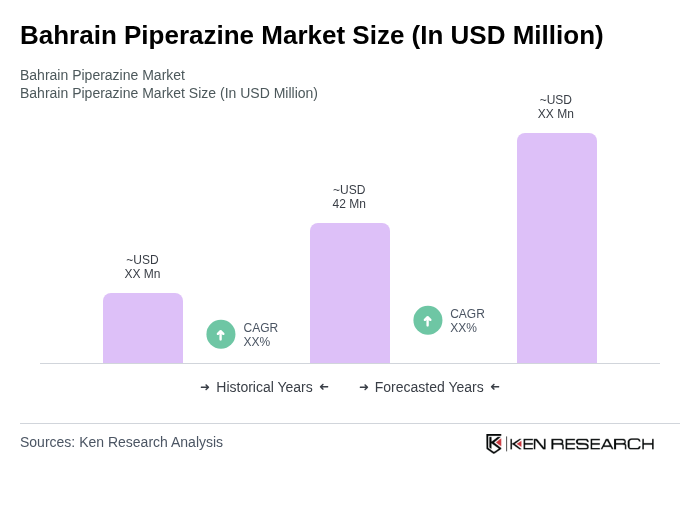
The Bahrain piperazine market, worth USD 42 million, is growing due to rising pharmaceutical applications, industrial uses, and government initiatives for chemical production.

Region:Middle East

Author(s):Dev

Product Code:KRAB1841

Pages:97

Published On:January 2026
About the Report

Base Year 2024

Bahrain Piperazine Market Overview

  • The Bahrain Piperazine Market is valued at USD 42 million, based on a five-year historical analysis, aligned with the valuation reported for Bahrain’s hydroxy ethoxy ethyl piperazine segment and the country’s role as a niche but growing piperazine consumer within the Middle East. This growth is primarily driven by the increasing demand for piperazine in pharmaceutical applications, particularly as an intermediate in the production of active pharmaceutical ingredients (APIs), consistent with global piperazine usage patterns in antiparasitic drugs, other pharmaceuticals, and specialty intermediates. The rise in healthcare expenditure in Bahrain and the expansion of the domestic and GCC-oriented pharmaceutical and biotech sector, supported by government initiatives to develop life sciences and attract pharma investment, have significantly contributed to this market's growth.
  • Key hubs relevant to this market include the Capital Governorate, which concentrates healthcare services, pharma trading houses, and chemical distributors, and the Southern Governorate, which is known for large-scale industrial activities within areas such as the Bahrain International Investment Park and petrochemical-related facilities. The concentration of industrial zones, chemical handling infrastructure, and research and academic institutions across these governorates supports demand for pharmaceutical- and industrial-grade piperazine, fosters product testing and application development, and enhances the regional supply chain.
  • In 2023, Bahrain continued strengthening regulations to enhance the safety and quality standards of chemical manufacturing and handling, including substances such as piperazine. The key framework is the Ministerial Order No. 7 of 2013 Issuing the System for the Registration of Chemical Substances, issued by the Supreme Council for the Environment, which establishes requirements for notification, risk assessment, classification, labelling, and safe handling of chemicals placed on the Bahraini market. In parallel, manufacturers and importers are required in practice to comply with international safety and quality standards, and leading suppliers to Bahrain typically maintain certifications such as ISO 9001 for quality management and adhere to REACH-aligned classification and safety data for piperazine supplied from the European Union and other compliant jurisdictions.
Bahrain Piperazine Market Size

Bahrain Piperazine Market Segmentation

By Grade:The market is segmented into Pharma Grade, Industrial Grade, Research Grade / High-Purity, and Others, which is consistent with global piperazine grading practices. The Pharma Grade segment is the most significant due to its extensive use in the pharmaceutical industry for producing APIs and high-purity intermediates, aligned with the dominance of pharmaceutical and biotech manufacturers as key end-users in Bahrain. The Industrial Grade segment follows, driven by its applications in gas treatment, corrosion inhibition, and other process chemicals in petrochemical and industrial operations, reflecting broader regional usage in the GCC. Research Grade / High-Purity is gaining traction due to increasing research activities in chemical synthesis, formulation development, and analytical work across regional academic institutions, CROs, and specialty chemical labs that require high-purity piperazine derivatives.
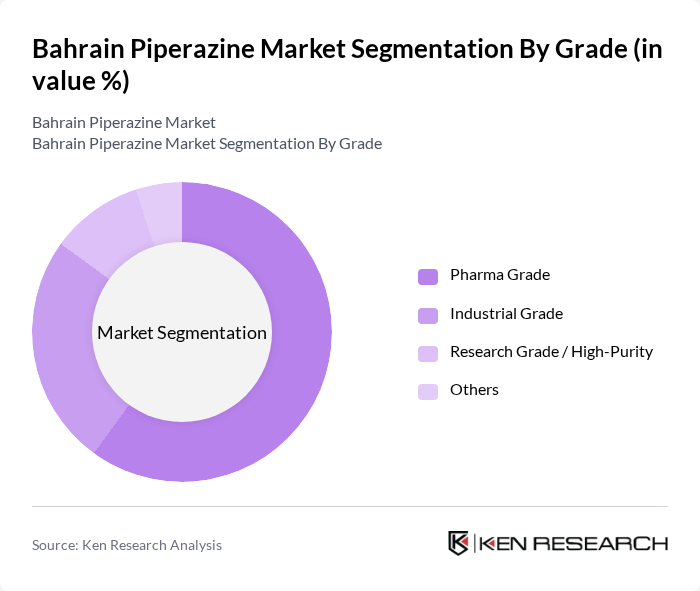
Bahrain Piperazine Market segmentation by Grade.

By Source:The market is categorized into Synthetic, Natural / Bio-based, Blends, and Others. The Synthetic segment dominates the market due to the cost-effectiveness, established large-scale manufacturing routes (such as from ethylenediamine), and consistent quality of synthetic piperazine used across pharmaceuticals, agrochemicals, and gas treatment. Natural / Bio-based sources are emerging as consumers and downstream industries increasingly prefer sustainable and bio-based intermediates, in line with global trends toward green chemistry and bio-based piperazine derivatives. Blends are utilized for specific applications requiring tailored properties, such as formulated corrosion inhibitors, solvent systems, or customized intermediates where piperazine is combined with other amines or functional additives.
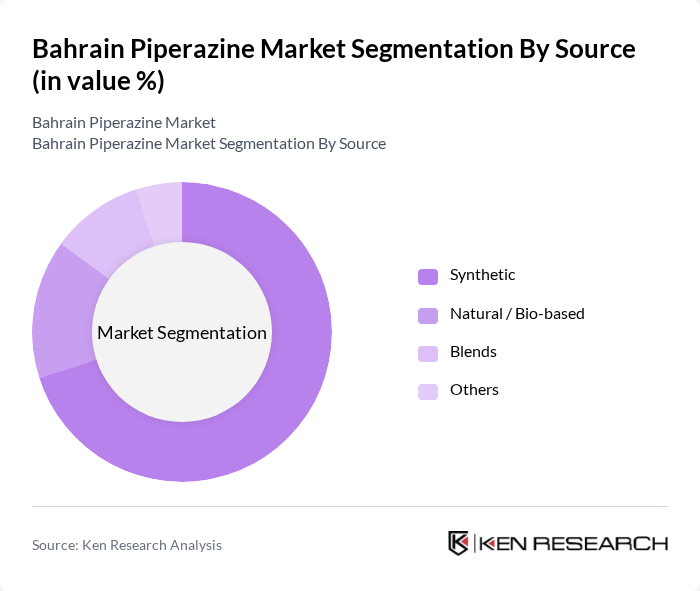
Bahrain Piperazine Market segmentation by Source.

Bahrain Piperazine Market Competitive Landscape

The Bahrain Piperazine Market is characterized by a dynamic mix of regional and international players. Leading participants such as BASF SE, Huntsman Corporation, Dow Inc., Evonik Industries AG, Nouryon, Adani Pharmachem Private Limited, Delamine B.V., Balaji Amines Ltd., SABIC (Saudi Basic Industries Corporation), Tosoh Corporation, Diamines and Chemicals Ltd., Hebei Hejia Pharmaceutical Group, Aarti Industries Ltd., Local & Regional Distributors in Bahrain, Other Emerging Piperazine Suppliers contribute to innovation, geographic expansion, and service delivery in this space.

BASF SE

1865

Ludwigshafen, Germany

Huntsman Corporation

1970

The Woodlands, USA

Dow Inc.

1897

Midland, USA

Evonik Industries AG

2007

Essen, Germany

Nouryon

2018

Amsterdam, Netherlands

Company

Establishment Year

Headquarters

Global Revenue from Piperazine (USD Mn)

Estimated Bahrain Revenue from Piperazine (USD Mn)

Volume Supplied to Bahrain (Tonnes per Year)

CAGR of Piperazine Revenue (Last 3–5 Years)

EBITDA Margin for Piperazine Portfolio (%)

Market Share in Bahrain Piperazine Market (%)

Bahrain Piperazine Market Industry Analysis

Growth Drivers

  • Increasing Demand in Pharmaceuticals:The pharmaceutical sector in Bahrain is projected to reach a value of approximately $1.5 billion, driven by the rising prevalence of chronic diseases. Piperazine, a key compound in various medications, is witnessing heightened demand, particularly in the production of anti-parasitic and anti-anxiety drugs. This growth is supported by the increasing healthcare expenditure, which is expected to rise to 5.0% of GDP, emphasizing the need for effective pharmaceutical solutions.
  • Expansion of Chemical Manufacturing:Bahrain's chemical manufacturing sector is anticipated to grow significantly, with an expected output increase of 20%. This expansion is fueled by investments in infrastructure and technology, enhancing production capabilities. Piperazine's versatility in applications, including its use in the synthesis of specialty chemicals, positions it favorably within this expanding market. The government's focus on diversifying the economy further supports this growth trajectory, creating a robust environment for chemical production.
  • Government Initiatives for Chemical Production:The Bahraini government has launched several initiatives aimed at boosting local chemical production, with a target of increasing domestic output by 25%. These initiatives include financial incentives for manufacturers and streamlined regulatory processes. Such support is crucial for piperazine producers, as it encourages investment in local facilities and technology upgrades, ultimately enhancing competitiveness in both local and export markets.

Market Challenges

  • Regulatory Compliance Issues:Navigating the complex regulatory landscape in Bahrain poses significant challenges for piperazine manufacturers. Compliance with stringent chemical safety regulations and environmental standards can incur costs exceeding $600,000 annually for mid-sized companies. These financial burdens can hinder operational efficiency and limit the ability to invest in innovation, ultimately affecting market competitiveness and growth potential.
  • Fluctuating Raw Material Prices:The volatility in raw material prices, particularly for petrochemicals, has been a persistent challenge for the piperazine market. Recently, prices for key inputs surged by 35%, impacting production costs significantly. This fluctuation can lead to unpredictable profit margins, making it difficult for manufacturers to maintain stable pricing strategies and manage operational budgets effectively, thereby affecting overall market stability.

Bahrain Piperazine Market Future Outlook

The future of the Bahrain piperazine market appears promising, driven by increasing investments in research and development, particularly in sustainable production methods. As the global demand for eco-friendly chemicals rises, local manufacturers are likely to adapt their processes to meet these standards. Additionally, strategic partnerships with international firms could enhance technological capabilities, fostering innovation and expanding market reach. This collaborative approach may position Bahrain as a competitive player in the regional chemical landscape, attracting further investment and growth opportunities.

Market Opportunities

  • Growth in Export Markets:The potential for expanding into export markets is significant, with regional demand for piperazine expected to increase by 30%. Bahrain's strategic location and trade agreements facilitate access to neighboring markets, providing local manufacturers with opportunities to enhance their export capabilities and diversify revenue streams.
  • Technological Advancements in Production:Investing in advanced production technologies can lead to increased efficiency and reduced environmental impact. With an estimated $250 million earmarked for technological upgrades in the chemical sector, piperazine producers can leverage these advancements to improve product quality and reduce costs, positioning themselves favorably in a competitive market.

Scope of the Report

SegmentSub-Segments
By Grade

Pharma Grade

Industrial Grade

Research Grade / High-Purity

Others

By Source

Synthetic

Natural / Bio-based

Blends

Others

By Application

Active Pharmaceutical Ingredient (API) Intermediates

Corrosion Inhibitors & Process Chemicals

Polymers, Resins & Curing Agents

Water Treatment & Gas Sweetening

Others

By End-Use Industry

Pharmaceutical & Biotech Manufacturers

Specialty & Fine Chemical Producers

Oil & Gas and Petrochemical Sector

Water Treatment & Utilities

Others

By Distribution Channel

Direct Sales to Industrial End-Users

Local Chemical Distributors & Traders

Regional (GCC) Specialty Chemical Distributors

Online and E-Procurement Platforms

Others

By Geography

Northern Governorate

Southern Governorate

Capital Governorate

Muharraq Governorate

Others

By Customer Type

Large Enterprises (Refining, Petrochemicals, Pharma)

Small & Medium Enterprises (SMEs)

Government & Public Sector Entities

Research & Academic Institutions

Others

Key Target Audience

Investors and Venture Capitalist Firms

Government and Regulatory Bodies (e.g., Bahrain Ministry of Health, Bahrain Economic Development Board)

Manufacturers and Producers

Distributors and Retailers

Pharmaceutical Companies

Chemical Suppliers

Industry Associations (e.g., Bahrain Chamber of Commerce and Industry)

Financial Institutions

Players Mentioned in the Report:

BASF SE

Huntsman Corporation

Dow Inc.

Evonik Industries AG

Nouryon

Adani Pharmachem Private Limited

Delamine B.V.

Balaji Amines Ltd.

SABIC (Saudi Basic Industries Corporation)

Tosoh Corporation

Diamines and Chemicals Ltd.

Hebei Hejia Pharmaceutical Group

Aarti Industries Ltd.

Local & Regional Distributors in Bahrain

Other Emerging Piperazine Suppliers

Table of Contents

Market Assessment Phase

1. Executive Summary and Approach


2. Bahrain Piperazine Market Overview

2.1 Key Insights and Strategic Recommendations

2.2 Bahrain Piperazine Market Overview

2.3 Definition and Scope

2.4 Evolution of Market Ecosystem

2.5 Timeline of Key Regulatory Milestones

2.6 Value Chain & Stakeholder Mapping

2.7 Business Cycle Analysis

2.8 Policy & Incentive Landscape


3. Bahrain Piperazine Market Analysis

3.1 Growth Drivers

3.1.1 Increasing Demand in Pharmaceuticals
3.1.2 Expansion of Chemical Manufacturing
3.1.3 Rising Awareness of Health and Safety Standards
3.1.4 Government Initiatives for Chemical Production

3.2 Market Challenges

3.2.1 Regulatory Compliance Issues
3.2.2 Fluctuating Raw Material Prices
3.2.3 Limited Local Production Capacity
3.2.4 Competition from Imported Products

3.3 Market Opportunities

3.3.1 Growth in Export Markets
3.3.2 Technological Advancements in Production
3.3.3 Strategic Partnerships with Local Industries
3.3.4 Increasing Investment in R&D

3.4 Market Trends

3.4.1 Shift Towards Sustainable Production Practices
3.4.2 Increasing Use of Piperazine in Agrochemicals
3.4.3 Development of Specialty Chemicals
3.4.4 Growing Focus on Quality Assurance

3.5 Government Regulation

3.5.1 Chemical Safety Regulations
3.5.2 Environmental Protection Standards
3.5.3 Import and Export Licensing Requirements
3.5.4 Local Content Regulations

4. SWOT Analysis


5. Stakeholder Analysis


6. Porter's Five Forces Analysis


7. Bahrain Piperazine Market Market Size, 2019-2024

7.1 By Value

7.2 By Volume

7.3 By Average Selling Price


8. Bahrain Piperazine Market Segmentation

8.1 By Grade

8.1.1 Pharma Grade
8.1.2 Industrial Grade
8.1.3 Research Grade / High-Purity
8.1.4 Others

8.2 By Source

8.2.1 Synthetic
8.2.2 Natural / Bio-based
8.2.3 Blends
8.2.4 Others

8.3 By Application

8.3.1 Active Pharmaceutical Ingredient (API) Intermediates
8.3.2 Corrosion Inhibitors & Process Chemicals
8.3.3 Polymers, Resins & Curing Agents
8.3.4 Water Treatment & Gas Sweetening
8.3.5 Others

8.4 By End-Use Industry

8.4.1 Pharmaceutical & Biotech Manufacturers
8.4.2 Specialty & Fine Chemical Producers
8.4.3 Oil & Gas and Petrochemical Sector
8.4.4 Water Treatment & Utilities
8.4.5 Others

8.5 By Distribution Channel

8.5.1 Direct Sales to Industrial End-Users
8.5.2 Local Chemical Distributors & Traders
8.5.3 Regional (GCC) Specialty Chemical Distributors
8.5.4 Online and E-Procurement Platforms
8.5.5 Others

8.6 By Geography

8.6.1 Northern Governorate
8.6.2 Southern Governorate
8.6.3 Capital Governorate
8.6.4 Muharraq Governorate
8.6.5 Others

8.7 By Customer Type

8.7.1 Large Enterprises (Refining, Petrochemicals, Pharma)
8.7.2 Small & Medium Enterprises (SMEs)
8.7.3 Government & Public Sector Entities
8.7.4 Research & Academic Institutions
8.7.5 Others

9. Bahrain Piperazine Market Competitive Analysis

9.1 Market Share of Key Players

9.2 Cross Comparison of Key Players

9.2.1 Company Name
9.2.2 Global Revenue from Piperazine (USD Mn)
9.2.3 Estimated Bahrain Revenue from Piperazine (USD Mn)
9.2.4 Volume Supplied to Bahrain (Tonnes per Year)
9.2.5 CAGR of Piperazine Revenue (Last 3–5 Years)
9.2.6 EBITDA Margin for Piperazine Portfolio (%)
9.2.7 Market Share in Bahrain Piperazine Market (%)
9.2.8 Product Portfolio Breadth (Grades / Purity Levels)
9.2.9 Compliance Coverage (GMP, ISO, REACH, GHS)
9.2.10 Average Selling Price in Bahrain (USD/kg)
9.2.11 Distribution Footprint in Bahrain (Local Entity / Distributor / Import-Based)
9.2.12 R&D Intensity (% of Sales)
9.2.13 Key Strategic Partnerships in GCC

9.3 SWOT Analysis of Top Players

9.4 Pricing Analysis

9.5 Detailed Profile of Major Companies

9.5.1 BASF SE
9.5.2 Huntsman Corporation
9.5.3 Dow Inc.
9.5.4 Evonik Industries AG
9.5.5 Nouryon
9.5.6 Adani Pharmachem Private Limited
9.5.7 Delamine B.V.
9.5.8 Balaji Amines Ltd.
9.5.9 SABIC (Saudi Basic Industries Corporation)
9.5.10 Tosoh Corporation
9.5.11 Diamines and Chemicals Ltd.
9.5.12 Hebei Hejia Pharmaceutical Group
9.5.13 Aarti Industries Ltd.
9.5.14 Local & Regional Distributors in Bahrain
9.5.15 Other Emerging Piperazine Suppliers

10. Bahrain Piperazine Market End-User Analysis

10.1 Procurement Behavior of Key Ministries

10.1.1 Ministry of Health
10.1.2 Ministry of Industry and Commerce
10.1.3 Ministry of Agriculture
10.1.4 Others

10.2 Corporate Spend on Infrastructure & Energy

10.2.1 Pharmaceutical Sector
10.2.2 Agricultural Sector
10.2.3 Chemical Manufacturing Sector
10.2.4 Others

10.3 Pain Point Analysis by End-User Category

10.3.1 Pharmaceutical Companies
10.3.2 Agricultural Producers
10.3.3 Chemical Manufacturers
10.3.4 Others

10.4 User Readiness for Adoption

10.4.1 Pharmaceutical Industry
10.4.2 Agricultural Sector
10.4.3 Chemical Sector
10.4.4 Others

10.5 Post-Deployment ROI and Use Case Expansion

10.5.1 Pharmaceutical Applications
10.5.2 Agricultural Applications
10.5.3 Industrial Applications
10.5.4 Others

11. Bahrain Piperazine Market Future Size, 2025-2030

11.1 By Value

11.2 By Volume

11.3 By Average Selling Price


Go-To-Market Strategy Phase

1. Whitespace Analysis + Business Model Canvas

1.1 Market Gaps Identification

1.2 Business Model Development


2. Marketing and Positioning Recommendations

2.1 Branding Strategies

2.2 Product USPs


3. Distribution Plan

3.1 Urban Retail Strategies

3.2 Rural NGO Tie-ups


4. Channel & Pricing Gaps

4.1 Underserved Routes

4.2 Pricing Bands


5. Unmet Demand & Latent Needs

5.1 Category Gaps

5.2 Consumer Segments


6. Customer Relationship

6.1 Loyalty Programs

6.2 After-sales Service


7. Value Proposition

7.1 Sustainability Initiatives

7.2 Integrated Supply Chains


8. Key Activities

8.1 Regulatory Compliance

8.2 Branding Efforts

8.3 Distribution Setup


9. Entry Strategy Evaluation

9.1 Domestic Market Entry Strategy

9.1.1 Product Mix
9.1.2 Pricing Band
9.1.3 Packaging Strategies

9.2 Export Entry Strategy

9.2.1 Target Countries
9.2.2 Compliance Roadmap

10. Entry Mode Assessment

10.1 Joint Ventures

10.2 Greenfield Investments

10.3 Mergers & Acquisitions

10.4 Distributor Model


11. Capital and Timeline Estimation

11.1 Capital Requirements

11.2 Timelines


12. Control vs Risk Trade-Off

12.1 Ownership vs Partnerships


13. Profitability Outlook

13.1 Breakeven Analysis

13.2 Long-term Sustainability


14. Potential Partner List

14.1 Distributors

14.2 Joint Ventures

14.3 Acquisition Targets


15. Execution Roadmap

15.1 Phased Plan for Market Entry

15.1.1 Market Setup
15.1.2 Market Entry
15.1.3 Growth Acceleration
15.1.4 Scale & Stabilize

15.2 Key Activities and Milestones

15.2.1 Activity Planning
15.2.2 Milestone Tracking

Research Methodology

ApproachModellingSample

Phase 1: Approach1

Desk Research

  • Analysis of industry reports from chemical associations and trade publications
  • Review of market statistics from Bahrain's National Bureau of Statistics
  • Examination of academic journals and white papers on piperazine applications

Primary Research

  • Interviews with key stakeholders in the pharmaceutical and agrochemical sectors
  • Surveys targeting chemical distributors and manufacturers in Bahrain
  • Field visits to production facilities to gather firsthand insights

Validation & Triangulation

  • Cross-referencing data from multiple industry sources for accuracy
  • Engaging with industry experts for qualitative insights and validation
  • Sanity checks through comparison with historical market trends

Phase 2: Market Size Estimation1

Top-down Assessment

  • Estimation of market size based on national chemical production statistics
  • Segmentation by end-use industries such as pharmaceuticals and agriculture
  • Incorporation of import/export data to assess market dynamics

Bottom-up Modeling

  • Volume estimates derived from production capacities of local manufacturers
  • Cost analysis based on pricing strategies of key market players
  • Calculation of market size using sales volume and average selling price

Forecasting & Scenario Analysis

  • Utilization of time series analysis to project future market trends
  • Scenario modeling based on regulatory changes and market demand shifts
  • Development of best-case, worst-case, and most-likely forecasts through 2030

Phase 3: CATI Sample Composition1

Scope Item/SegmentSample SizeTarget Respondent Profiles
Pharmaceutical Applications of Piperazine100R&D Managers, Product Development Scientists
Agrochemical Uses of Piperazine80Product Managers, Regulatory Affairs Specialists
Industrial Chemical Manufacturing70Operations Managers, Quality Control Supervisors
Market Trends and Consumer Insights90Market Analysts, Business Development Executives
Distribution and Supply Chain Dynamics60Logistics Coordinators, Supply Chain Managers

Frequently Asked Questions

What is the current value of the Bahrain Piperazine Market?

The Bahrain Piperazine Market is valued at approximately USD 42 million, reflecting its growth as a niche consumer of piperazine within the Middle East, particularly driven by pharmaceutical applications and increasing healthcare expenditure.

What are the main applications of piperazine in Bahrain?

Which governorates in Bahrain are key hubs for the piperazine market?

What regulatory framework governs the piperazine market in Bahrain?

Other Regional/Country Reports

Indonesia Piperazine Market Report Size Share Growth Drivers Trends Opportunities & Forecast 2025–2030

Malaysia Piperazine Market Report Size Share Growth Drivers Trends Opportunities & Forecast 2025–2030

KSA Piperazine Market Report Size Share Growth Drivers Trends Opportunities & Forecast 2025–2030

APAC Piperazine Market Report Size Share Growth Drivers Trends Opportunities & Forecast 2025–2030

SEA Piperazine Market Report Size Share Growth Drivers Trends Opportunities & Forecast 2025–2030

Vietnam Piperazine Market Report Size Share Growth Drivers Trends Opportunities & Forecast 2025–2030

Why Buy From Us?

Refine Robust Result (RRR) Framework

What makes us stand out is that our consultants follow Robust, Refine and Result (RRR) methodology. Robust for clear definitions, approaches and sanity checking, Refine for differentiating respondents' facts and opinions, and Result for presenting data with story.

Our Reach Is Unmatched

We have set a benchmark in the industry by offering our clients with syndicated and customized market research reports featuring coverage of entire market as well as meticulous research and analyst insights.

Shifting the Research Paradigm

While we don't replace traditional research, we flip the method upside down. Our dual approach of Top Bottom & Bottom Top ensures quality deliverable by not just verifying company fundamentals but also looking at the sector and macroeconomic factors.

More Insights-Better Decisions

With one step in the future, our research team constantly tries to show you the bigger picture. We help with some of the tough questions you may encounter along the way: How is the industry positioned? Best marketing channel? KPI's of competitors? By aligning every element, we help maximize success.

Transparency and Trust

Our report gives you instant access to the answers and sources that other companies might choose to hide. We elaborate each steps of research methodology we have used and showcase you the sample size to earn your trust.

Round the Clock Support

If you need any support, we are here! We pride ourselves on universe strength, data quality, and quick, friendly, and professional service.

Why Clients Choose Us?

400000+
Reports in repository
150+
Consulting projects a year
100+
Analysts
8000+
Client Queries in 2022








