About the Report
Base Year 2024Egypt Furniture and Modular Interiors Market Overview
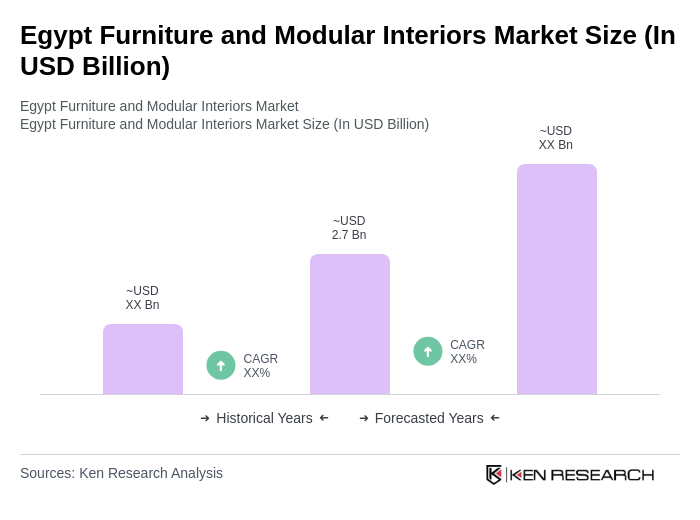
- The Egypt Furniture and Modular Interiors Market is valued at USD 2.7 billion, based on a five-year historical analysis. Growth is driven by increasing urbanization, rising disposable incomes, and a strong demand for modern and modular furniture solutions. The market is witnessing a shift towards customization, multifunctionality, and eco-friendly materials, reflecting evolving consumer preferences and lifestyle trends. The expanding real estate sector and the rise of e-commerce platforms are further accelerating market growth, as consumers seek convenient access to a broader range of furniture products .
- Cairo and Alexandria remain the dominant cities in the Egypt Furniture and Modular Interiors Market, attributed to their large populations and vibrant economic activities. Cairo, as the capital, serves as the primary commercial hub with a high density of furniture retailers and manufacturers. Alexandria leverages its strategic port location to facilitate the import of raw materials and finished goods, supporting both local manufacturing and distribution .
- The “Environmental Protection Law No. 4 of 1994,” as amended by Law No. 9 of 2009 and enforced by the Egyptian Environmental Affairs Agency (EEAA), requires industrial sectors, including furniture manufacturing, to comply with environmental standards for sustainable production. This regulation mandates the adoption of eco-friendly processes, waste management, and the use of sustainable materials, encouraging green technologies and reducing environmental impact in the furniture industry .
Egypt Furniture and Modular Interiors Market Segmentation
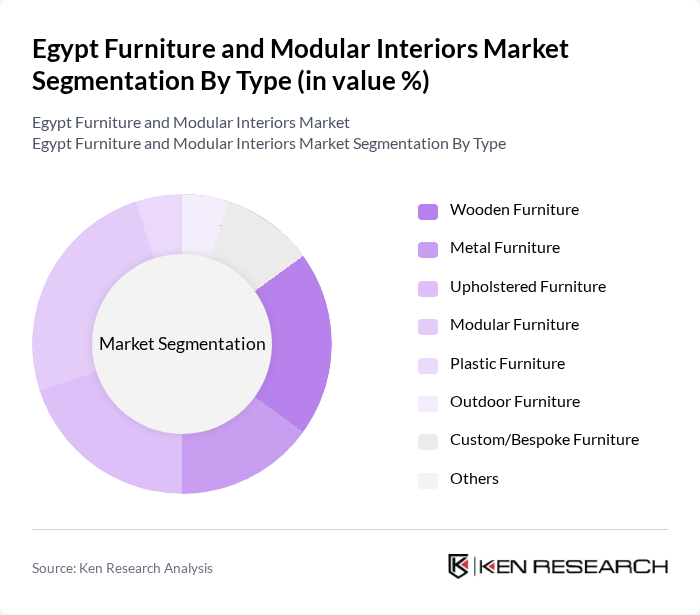
By Type:The market is segmented into wooden, metal, upholstered, modular, plastic, outdoor, custom/bespoke, and others. Wooden furniture remains the most dominant segment, valued for its traditional appeal and durability. Modular furniture is rapidly gaining traction due to its versatility, space-saving features, and adaptability to modern urban living. Consumer preferences are increasingly shifting towards multifunctional, aesthetically pleasing, and sustainable furniture, with a notable rise in demand for eco-friendly materials and customizable solutions .
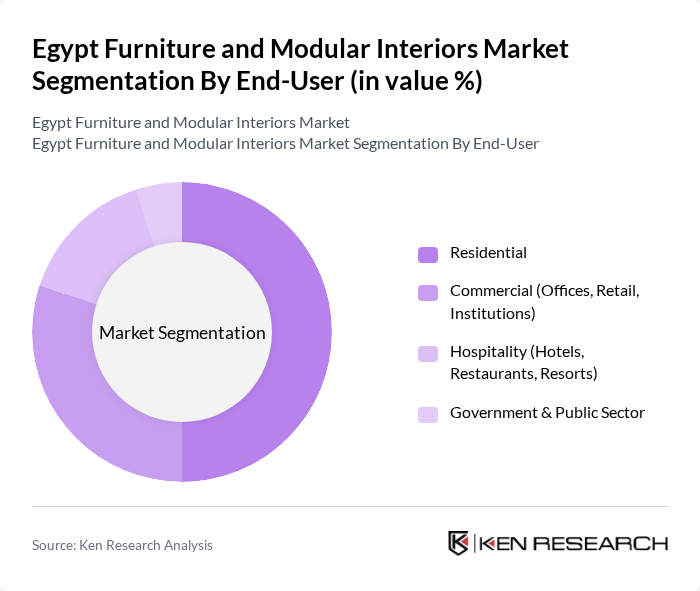
By End-User:The end-user segmentation includes residential, commercial, hospitality, and government/public sector. The residential segment dominates, driven by increasing home ownership, urban housing developments, and renovation activities. The commercial segment is significant, supported by the expansion of office spaces, retail outlets, and institutional projects. Trends indicate rising demand for stylish, functional, and ergonomic furniture in both residential and commercial applications, with a growing emphasis on sustainability and space optimization .
Egypt Furniture and Modular Interiors Market Competitive Landscape
The Egypt Furniture and Modular Interiors Market is characterized by a dynamic mix of regional and international players. Leading participants such as IKEA Egypt, Mobica, Elhelow Group, Damietta Furniture City (DFC), El-Masria Furniture, El Dawlia Furniture, El Shamsi Furniture, El Araby Furniture, Habitat Egypt, In&Out Furniture, American Furniture, La Roche Egypt, El Maleka Furniture, El Fath Furniture, Al-Masriah Modular Interiors contribute to innovation, geographic expansion, and service delivery in this space.
Egypt Furniture and Modular Interiors Market Industry Analysis
Growth Drivers
- Increasing Urbanization:Egypt's urban population is projected to reach 45% in the future, up from 43% in 2020, according to the World Bank. This rapid urbanization drives demand for furniture and modular interiors as new residential and commercial spaces emerge. The urban housing sector is expected to see an increase of approximately 500,000 units annually, creating a significant market for furniture manufacturers to cater to diverse consumer needs in urban settings.
- Rising Disposable Incomes:The average disposable income in Egypt is anticipated to rise to EGP 20,000 per capita in the future, reflecting a growth of 5% from previous levels. This increase in disposable income allows consumers to invest more in home furnishings and modular solutions, leading to a surge in demand for quality furniture. As consumers prioritize aesthetics and functionality, manufacturers are likely to benefit from this trend, enhancing their product offerings to meet evolving preferences.
- Growth in Real Estate Sector:The Egyptian real estate sector is projected to grow by 5% annually, driven by government initiatives and foreign investments. With over 500,000 housing units planned for completion in the future, the demand for furniture and modular interiors is expected to rise significantly. This growth is supported by the government's Vision 2030 initiative, which aims to boost urban development and infrastructure, creating a favorable environment for furniture manufacturers to thrive.
Market Challenges
- Economic Instability:Egypt's economy faces challenges, including inflation rates projected to reach 30% in the future, impacting consumer purchasing power. This economic instability can lead to reduced spending on non-essential items like furniture. Additionally, fluctuations in the currency exchange rate may affect the cost of imported raw materials, further complicating the operational landscape for local manufacturers and potentially leading to higher retail prices.
- Supply Chain Disruptions:The ongoing global supply chain disruptions have significantly impacted the furniture industry in Egypt. With shipping delays and increased freight costs, manufacturers are struggling to maintain inventory levels. Reports indicate that lead times for raw materials have increased by 20%, affecting production schedules and delivery timelines. This challenge can hinder the ability of local manufacturers to meet growing consumer demand effectively.
Egypt Furniture and Modular Interiors Market Future Outlook
The future of the Egypt furniture and modular interiors market appears promising, driven by urbanization and rising incomes. As consumers increasingly seek innovative and customizable solutions, manufacturers are likely to invest in technology and design. Additionally, the integration of smart furniture features is expected to gain traction, aligning with global trends. The government's support for local manufacturing will further enhance competitiveness, positioning the market for sustainable growth in the coming years.
Market Opportunities
- Expansion of E-commerce Platforms:The growth of e-commerce in Egypt, with online sales projected to reach EGP 10 billion in the future, presents a significant opportunity for furniture retailers. By leveraging digital platforms, manufacturers can reach a broader audience, streamline sales processes, and enhance customer engagement, ultimately driving revenue growth in a competitive market.
- Sustainable Furniture Trends:The increasing consumer preference for sustainable products is creating opportunities for manufacturers to innovate. With 40% of consumers willing to pay more for eco-friendly furniture, companies that adopt sustainable practices and materials can differentiate themselves in the market. This trend not only meets consumer demand but also aligns with global sustainability goals, enhancing brand reputation.
Scope of the Report
| Segment | Sub-Segments |
|---|---|
| By Type | Wooden Furniture Metal Furniture Upholstered Furniture Modular Furniture Plastic Furniture Outdoor Furniture Custom/Bespoke Furniture Others |
| By End-User | Residential Commercial (Offices, Retail, Institutions) Hospitality (Hotels, Restaurants, Resorts) Government & Public Sector |
| By Distribution Channel | Online Retail/E-commerce Offline Retail (Furniture Stores, Hypermarkets) Direct Sales (B2B, Project Sales) Showrooms & Experience Centers |
| By Price Range | Budget Mid-Range Premium/Luxury |
| By Material | Wood Metal Plastic Fabric/Upholstery Glass & Others |
| By Design Style | Contemporary/Modern Traditional/Classic Industrial Minimalist Other Styles |
| By Application | Living Room Bedroom Kitchen & Dining Office Setup Outdoor Spaces Event Furnishing Home Decor & Accessories |
Key Target Audience
Investors and Venture Capitalist Firms
Government and Regulatory Bodies (e.g., Ministry of Trade and Industry, Egyptian Furniture Export Council)
Manufacturers and Producers
Distributors and Retailers
Interior Designers and Architects
Real Estate Developers
Home Improvement and Renovation Companies
Financial Institutions
Players Mentioned in the Report:
IKEA Egypt
Mobica
Elhelow Group
Damietta Furniture City (DFC)
El-Masria Furniture
El Dawlia Furniture
El Shamsi Furniture
El Araby Furniture
Habitat Egypt
In&Out Furniture
American Furniture
La Roche Egypt
El Maleka Furniture
El Fath Furniture
Al-Masriah Modular Interiors
Table of Contents
Go-To-Market Strategy Phase
1. Whitespace Analysis + Business Model Canvas
1.1 Market Gaps Identification
1.2 Business Model Framework
2. Marketing and Positioning Recommendations
2.1 Branding Strategies
2.2 Product USPs
3. Distribution Plan
3.1 Urban Retail vs Rural NGO Tie-ups
4. Channel & Pricing Gaps
4.1 Underserved Routes
4.2 Pricing Bands
5. Unmet Demand & Latent Needs
5.1 Category Gaps
5.2 Consumer Segments
6. Customer Relationship
6.1 Loyalty Programs
6.2 After-sales Service
7. Value Proposition
7.1 Sustainability
7.2 Integrated Supply Chains
8. Key Activities
8.1 Regulatory Compliance
8.2 Branding
8.3 Distribution Setup
9. Entry Strategy Evaluation
9.1 Domestic Market Entry Strategy
9.1.1 Product Mix
9.1.2 Pricing Band
9.1.3 Packaging
9.2 Export Entry Strategy
9.2.1 Target Countries
9.2.2 Compliance Roadmap
10. Entry Mode Assessment
10.1 JV
10.2 Greenfield
10.3 M&A
10.4 Distributor Model
11. Capital and Timeline Estimation
11.1 Capital Requirements
11.2 Timelines
12. Control vs Risk Trade-Off
12.1 Ownership vs Partnerships
13. Profitability Outlook
13.1 Breakeven Analysis
13.2 Long-term Sustainability
14. Potential Partner List
14.1 Distributors
14.2 JVs
14.3 Acquisition Targets
15. Execution Roadmap
15.1 Phased Plan for Market Entry
15.1.1 Market Setup
15.1.2 Market Entry
15.1.3 Growth Acceleration
15.1.4 Scale & Stabilize
15.2 Key Activities and Milestones
15.2.1 Milestone Tracking
15.2.2 Activity Scheduling
Research Methodology
Phase 1: Approach1
Desk Research
- Analysis of industry reports from local and international market research firms
- Review of government publications and trade statistics related to furniture manufacturing and sales
- Examination of academic journals and articles focusing on consumer behavior in the Egyptian furniture market
Primary Research
- Interviews with key stakeholders including manufacturers, retailers, and interior designers
- Surveys targeting consumers to understand preferences and purchasing behavior in modular interiors
- Focus group discussions with end-users to gather qualitative insights on design trends and functionality
Validation & Triangulation
- Cross-validation of findings through multiple data sources including sales data and consumer feedback
- Triangulation of insights from primary interviews with secondary data trends
- Sanity checks conducted through expert panel reviews comprising industry veterans and market analysts
Phase 2: Market Size Estimation1
Top-down Assessment
- Estimation of market size based on national furniture sales data and growth rates
- Segmentation of the market by product type, including modular furniture and traditional designs
- Incorporation of macroeconomic indicators such as GDP growth and urbanization rates affecting furniture demand
Bottom-up Modeling
- Collection of sales volume data from leading furniture manufacturers and retailers
- Analysis of pricing strategies and average transaction values across different market segments
- Estimation of market share distribution among various product categories and brands
Forecasting & Scenario Analysis
- Development of forecasting models based on historical sales data and market trends
- Scenario analysis considering factors such as economic fluctuations and changes in consumer preferences
- Projections for market growth through 2030 under different economic and regulatory scenarios
Phase 3: CATI Sample Composition1
| Scope Item/Segment | Sample Size | Target Respondent Profiles |
|---|---|---|
| Residential Furniture Purchases | 120 | Homeowners, Interior Designers |
| Commercial Modular Interiors | 60 | Office Managers, Facility Coordinators |
| Consumer Preferences in Furniture Design | 90 | General Consumers, Trend Analysts |
| Retail Furniture Sales Insights | 50 | Retail Managers, Sales Executives |
| Market Trends in Modular Furniture | 40 | Product Designers, Market Researchers |
Frequently Asked Questions
1. What is the current value of the Egypt Furniture and Modular Interiors Market?
The Egypt Furniture and Modular Interiors Market is valued at approximately USD 2.7 billion, reflecting a robust growth trajectory driven by urbanization, rising disposable incomes, and increasing demand for modern and modular furniture solutions.
2. Which cities dominate the Egypt Furniture and Modular Interiors Market?
3. What are the key growth drivers for the Egypt Furniture Market?
4. What challenges does the Egypt Furniture Market face?
Other Regional/Country Reports
Other Adjacent Reports
South Korea Home Decor and Accessories Market
Philippines Real Estate Development Market
India Construction Materials Market Size, Share & Forecast, By Material Type, Application & End User, 2026-2031Mexico Woodworking and Carpentry Market
Oman Upholstery and Textiles Market
Global Lighting Fixtures Market Size, Share, Growth Drivers, Trends, Opportunities & Forecast 2025–2030Mexico Kitchen and Bathroom Fixtures MarketIndia Office Furniture Market Size, Share & Forecast, By Product Type, End-Use Industry & Sales Channel, 2026-2031South Korea Sustainable Materials Market
Why Buy From Us?

What makes us stand out is that our consultants follow Robust, Refine and Result (RRR) methodology. Robust for clear definitions, approaches and sanity checking, Refine for differentiating respondents' facts and opinions, and Result for presenting data with story.

We have set a benchmark in the industry by offering our clients with syndicated and customized market research reports featuring coverage of entire market as well as meticulous research and analyst insights.

While we don't replace traditional research, we flip the method upside down. Our dual approach of Top Bottom & Bottom Top ensures quality deliverable by not just verifying company fundamentals but also looking at the sector and macroeconomic factors.

With one step in the future, our research team constantly tries to show you the bigger picture. We help with some of the tough questions you may encounter along the way: How is the industry positioned? Best marketing channel? KPI's of competitors? By aligning every element, we help maximize success.

Our report gives you instant access to the answers and sources that other companies might choose to hide. We elaborate each steps of research methodology we have used and showcase you the sample size to earn your trust.

If you need any support, we are here! We pride ourselves on universe strength, data quality, and quick, friendly, and professional service.