Indonesia Flat Flexible Cables Market Report Size Share Growth Drivers Trends Opportunities & Forecast 2025–2030

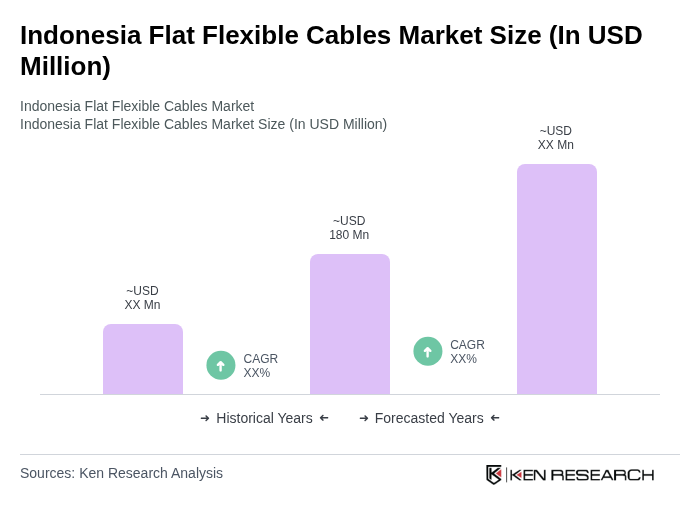
Indonesia Flat Flexible Cables Market, valued at USD 180 million, is growing due to rising needs in consumer electronics, automotive sectors, and industrial applications amid urbanization.

Region:Asia

Author(s):Geetanshi

Product Code:KRAA4037

Pages:83

Published On:January 2026
About the Report

Base Year 2024

Indonesia Flat Flexible Cables Market Overview

  • The Indonesia Flat Flexible Cables Market is valued at USD 180 million, based on a five-year historical analysis and Indonesia’s share within the Asia Pacific and global flat flexible cable market. This growth is primarily driven by the increasing demand for flexible interconnect solutions in consumer electronics, automotive electronics, and industrial automation, in line with broader growth in Indonesia’s cable assemblies and electronics manufacturing sectors. The rise in urbanization, data center and telecom infrastructure, and infrastructure development has further fueled the need for compact, reliable wiring solutions, making flat flexible cables a preferred choice for manufacturers in compact devices, displays, and control systems.
  • Key cities such as Jakarta, Surabaya, and Bandung dominate the market due to their robust industrial base, concentration of electronics manufacturing, and high consumer demand. Jakarta, being the capital, serves as a hub for electronics, automotive, and telecom industries, while Surabaya and Bandung contribute significantly to manufacturing, components assembly, and technology sectors, in line with the broader clustering of Indonesia’s cable assemblies and electronics production in major urban and industrial corridors. This concentration of industries in these urban areas drives the demand for flat flexible cables in devices, harnesses, and control modules, enhancing market growth.
  • In 2023, the Indonesian government continued to strengthen regulations on electrical safety and product conformity, and flat flexible cables used in buildings and equipment must comply with national standards and certification requirements. The key binding instrument is the Indonesian National Standard for electrical cables and accessories, including low-voltage and installation cables, which is implemented through the SNI (Standar Nasional Indonesia) scheme and mandatory product certification under regulations such as the Regulation of the Minister of Industry of the Republic of Indonesia Number 25/M-IND/PER/4/2014 concerning the Enforcement of the Indonesian National Standard (SNI) for Electric Cables Compulsorily, and its subsequent updates. These rules require manufacturers and importers to obtain SNI certification, ensure labeling, and meet safety and performance requirements for cables used in residential, commercial, and industrial installations, which supports the use of certified, high-quality flat flexible cables to reduce electrical hazards and improve overall safety.
Indonesia Flat Flexible Cables Market Size

Indonesia Flat Flexible Cables Market Segmentation

By Cable Type:

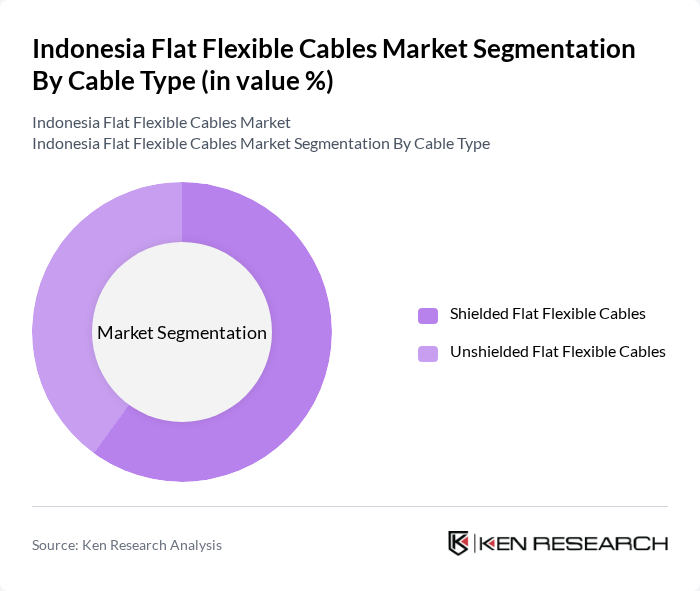
Indonesia Flat Flexible Cables Market segmentation by Cable Type.

The cable type segmentation includes Shielded Flat Flexible Cables and Unshielded Flat Flexible Cables. Shielded cables are gaining traction due to their ability to minimize electromagnetic interference, making them suitable for sensitive applications in consumer electronics, infotainment systems, medical imaging equipment, and industrial control electronics where signal integrity is critical. Unshielded cables, while less expensive and easier to terminate, are widely used in less noise-sensitive applications such as basic home appliances, office equipment, and internal connections in devices where electromagnetic exposure is limited. As manufacturers increasingly prioritize device miniaturization, higher data rates, and compliance with electromagnetic compatibility requirements, the demand for shielded flat flexible cables is rising, leading to a growing market share for this subsegment in Indonesia in line with global trends.

By Application:
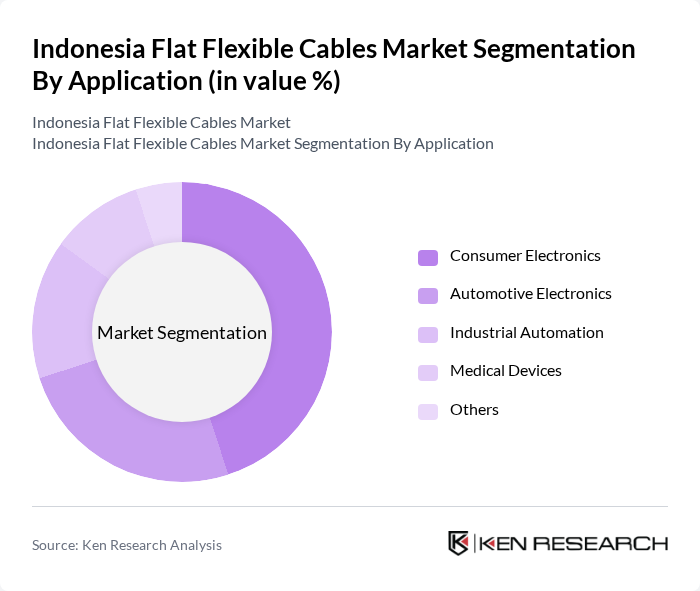
Indonesia Flat Flexible Cables Market segmentation by Application.

This segmentation includes Consumer Electronics, Automotive Electronics, Industrial Automation, Medical Devices, and Others. The Consumer Electronics segment is the largest, consistent with global patterns where consumer electronics account for the leading share of flat flexible cable demand due to their extensive use in smartphones, laptops, tablets, wearables, TVs, and gaming consoles. The segment is driven by rising adoption of smart devices, smart TVs, and home automation systems in Indonesia, supported by expanding middle-class consumption and local electronics assembly. Automotive Electronics is also witnessing significant growth due to the rise of electronic content per vehicle, adoption of advanced driver assistance, infotainment, and the gradual penetration of hybrid and electric vehicles, where flat flexible cables are used in battery management, displays, and control units. The demand for flat flexible cables in industrial automation is increasing as manufacturers invest in robotics, motion control, and smart factory solutions requiring compact, flexible interconnects within machines and control panels. In medical devices, flat flexible cables are increasingly used in diagnostic imaging systems, patient monitoring equipment, and portable medical electronics due to their flexibility and reliability, while the Others category covers applications in telecommunications, data centers, and domestic appliances.

Indonesia Flat Flexible Cables Market Competitive Landscape

The Indonesia Flat Flexible Cables Market is characterized by a dynamic mix of regional and international players. Leading participants such as PT Kabelindo Murni Tbk, PT Sumi Indo Kabel Tbk, PT Voksel Electric Tbk, PT Supreme Cable Manufacturing & Commerce Tbk (PT KMI Wire and Cable Tbk), PT Jembo Cable Company Tbk, PT Tranka Kabel, PT Schneider Electric Indonesia, PT Prysmian Cables Indonesia, PT PLN (Persero), PT Siemens Indonesia, PT Panasonic Manufacturing Indonesia, PT LG Electronics Indonesia, PT Samsung Electronics Indonesia, PT Indolakto (Representative Electronics OEM User), Other Emerging Local FFC Manufacturers contribute to innovation, geographic expansion, and service delivery in this space, supported by broader growth in Indonesia’s cable assemblies and electronics markets.

PT Kabelindo Murni Tbk

1972

Jakarta, Indonesia

PT Sumi Indo Kabel Tbk

1981

Jakarta, Indonesia

PT Voksel Electric Tbk

1971

Bogor, Indonesia

PT Supreme Cable Manufacturing & Commerce Tbk

1972

Jakarta, Indonesia

PT Jembo Cable Company Tbk

1973

Tangerang, Indonesia

Company

Establishment Year

Headquarters

Group Size (Large, Medium, or Small as per industry convention)

Indonesia FFC Revenue (USD, latest FY)

3-Year Revenue CAGR (%)

Indonesia FFC Market Share (%)

EBITDA Margin (%)

R&D Intensity (% of Revenue)

Indonesia Flat Flexible Cables Market Industry Analysis

Growth Drivers

  • Increasing Demand for Energy Efficient Solutions:The Indonesian government aims to reduce energy consumption by 20% in the near future, driving demand for energy-efficient products, including flat flexible cables. The energy-efficient cable market is projected to grow significantly, with an estimated value of IDR 1.5 trillion (approximately USD 100 million) in the near future. This shift is supported by rising electricity costs, which increased by 10% recently, prompting consumers and businesses to seek cost-effective solutions.
  • Expansion of the Construction Sector:Indonesia's construction sector is projected to grow by 6.5% in the near future, fueled by government infrastructure projects worth IDR 400 trillion (approximately USD 27 billion). This growth is expected to increase the demand for flat flexible cables, which are essential for modern electrical installations. The construction of new residential and commercial buildings, alongside urban development initiatives, will further drive the need for these cables, enhancing market opportunities.
  • Government Initiatives for Infrastructure Development:The Indonesian government has allocated IDR 500 trillion (approximately USD 34 billion) for infrastructure development in the near future, focusing on transportation, energy, and telecommunications. This investment is expected to boost the demand for flat flexible cables, which are crucial for efficient electrical systems in new infrastructure projects. The government's commitment to improving connectivity and energy access will significantly impact the market's growth trajectory.

Market Challenges

  • Intense Competition from Local and International Players:The Indonesian flat flexible cables market faces intense competition, with over 50 local and international manufacturers vying for market share. This saturation leads to price wars, reducing profit margins for companies. Recently, the average selling price of flat flexible cables dropped by 15%, making it challenging for new entrants to establish a foothold while maintaining quality standards.
  • Fluctuating Raw Material Prices:The prices of key raw materials for flat flexible cables, such as copper and PVC, have experienced significant volatility. Recently, copper prices surged by 25% due to supply chain disruptions, impacting production costs. This fluctuation poses a challenge for manufacturers, as they struggle to maintain competitive pricing while ensuring quality, potentially leading to increased costs for consumers and reduced market growth.

Indonesia Flat Flexible Cables Market Future Outlook

The future of the Indonesia flat flexible cables market appears promising, driven by technological advancements and a growing emphasis on sustainability. As the demand for smart home technologies increases, manufacturers are likely to innovate and develop more efficient cable solutions. Additionally, the government's commitment to renewable energy projects will create new avenues for growth, particularly in sectors like solar and wind energy, which require specialized cable applications to support their infrastructure.

Market Opportunities

  • Growth in Smart Home Technologies:The smart home market in Indonesia is expected to reach IDR 10 trillion (approximately USD 670 million) in the near future. This growth presents an opportunity for flat flexible cables, which are essential for connecting smart devices. As consumers increasingly adopt automation and IoT solutions, the demand for specialized cables will rise, providing manufacturers with a lucrative market segment to target.
  • Increasing Investment in Renewable Energy Projects:Indonesia's renewable energy sector is projected to attract IDR 200 trillion (approximately USD 13.4 billion) in investments in the near future. This influx of capital will drive the demand for flat flexible cables, particularly in solar and wind energy applications. As the country aims for a 23% share of renewable energy in its energy mix in the near future, manufacturers can capitalize on this trend by developing tailored cable solutions for these projects.

Scope of the Report

SegmentSub-Segments
By Cable Type

Shielded Flat Flexible Cables

Unshielded Flat Flexible Cables

By Application

Consumer Electronics

Automotive Electronics

Industrial Automation

Medical Devices

Others

By End-User

Electronics Manufacturers

Automotive OEMs

Industrial Equipment Manufacturers

Medical Device Manufacturers

Others

By Conductor Material

Copper

Others

By Pitch Size

? 0.50 mm

–1.00 mm

> 1.00 mm

By Cable Length

Short Length Cables

Medium Length Cables

Long Length Cables

By Region

Java

Sumatra

Kalimantan

Sulawesi

Others

Key Target Audience

Investors and Venture Capitalist Firms

Government and Regulatory Bodies (e.g., Ministry of Industry, Ministry of Trade)

Manufacturers and Producers

Distributors and Retailers

Electrical and Electronics Companies

Construction and Infrastructure Firms

Telecommunications Providers

Energy and Utility Companies

Players Mentioned in the Report:

PT Kabelindo Murni Tbk

PT Sumi Indo Kabel Tbk

PT Voksel Electric Tbk

PT Supreme Cable Manufacturing & Commerce Tbk (PT KMI Wire and Cable Tbk)

PT Jembo Cable Company Tbk

PT Tranka Kabel

PT Schneider Electric Indonesia

PT Prysmian Cables Indonesia

PT PLN (Persero)

PT Siemens Indonesia

PT Panasonic Manufacturing Indonesia

PT LG Electronics Indonesia

PT Samsung Electronics Indonesia

PT Indolakto (Representative Electronics OEM User)

Other Emerging Local FFC Manufacturers

Table of Contents

Market Assessment Phase

1. Executive Summary and Approach


2. Indonesia Flat Flexible Cables Market Overview

2.1 Key Insights and Strategic Recommendations

2.2 Indonesia Flat Flexible Cables Market Overview

2.3 Definition and Scope

2.4 Evolution of Market Ecosystem

2.5 Timeline of Key Regulatory Milestones

2.6 Value Chain & Stakeholder Mapping

2.7 Business Cycle Analysis

2.8 Policy & Incentive Landscape


3. Indonesia Flat Flexible Cables Market Analysis

3.1 Growth Drivers

3.1.1 Increasing Demand for Energy Efficient Solutions
3.1.2 Expansion of the Construction Sector
3.1.3 Government Initiatives for Infrastructure Development
3.1.4 Rising Adoption of Renewable Energy Sources

3.2 Market Challenges

3.2.1 Intense Competition from Local and International Players
3.2.2 Fluctuating Raw Material Prices
3.2.3 Regulatory Compliance and Standards
3.2.4 Limited Awareness of Flat Flexible Cables

3.3 Market Opportunities

3.3.1 Growth in Smart Home Technologies
3.3.2 Increasing Investment in Renewable Energy Projects
3.3.3 Development of New Applications in Various Industries
3.3.4 Expansion into Emerging Markets

3.4 Market Trends

3.4.1 Shift Towards Sustainable and Eco-Friendly Products
3.4.2 Technological Advancements in Cable Manufacturing
3.4.3 Increasing Use of Automation in Manufacturing Processes
3.4.4 Growing Demand for Customizable Cable Solutions

3.5 Government Regulation

3.5.1 Implementation of Safety Standards for Electrical Products
3.5.2 Incentives for Renewable Energy Projects
3.5.3 Regulations on Waste Management and Recycling
3.5.4 Compliance Requirements for Importing Electrical Goods

4. SWOT Analysis


5. Stakeholder Analysis


6. Porter's Five Forces Analysis


7. Indonesia Flat Flexible Cables Market Market Size, 2019-2024

7.1 By Value

7.2 By Volume

7.3 By Average Selling Price


8. Indonesia Flat Flexible Cables Market Segmentation

8.1 By Cable Type

8.1.1 Shielded Flat Flexible Cables
8.1.2 Unshielded Flat Flexible Cables

8.2 By Application

8.2.1 Consumer Electronics
8.2.2 Automotive Electronics
8.2.3 Industrial Automation
8.2.4 Medical Devices
8.2.5 Others

8.3 By End-User

8.3.1 Electronics Manufacturers
8.3.2 Automotive OEMs
8.3.3 Industrial Equipment Manufacturers
8.3.4 Medical Device Manufacturers
8.3.5 Others

8.4 By Conductor Material

8.4.1 Copper
8.4.2 Others

8.5 By Pitch Size

8.5.1 ? 0.50 mm
8.5.2 0.51–1.00 mm
8.5.3 > 1.00 mm

8.6 By Cable Length

8.6.1 Short Length Cables
8.6.2 Medium Length Cables
8.6.3 Long Length Cables

8.7 By Region

8.7.1 Java
8.7.2 Sumatra
8.7.3 Kalimantan
8.7.4 Sulawesi
8.7.5 Others

9. Indonesia Flat Flexible Cables Market Competitive Analysis

9.1 Market Share of Key Players

9.2 Cross Comparison of Key Players

9.2.1 Company Name
9.2.2 Group Size (Large, Medium, or Small as per industry convention)
9.2.3 Indonesia FFC Revenue (USD, latest FY)
9.2.4 3-Year Revenue CAGR (%)
9.2.5 Indonesia FFC Market Share (%)
9.2.6 EBITDA Margin (%)
9.2.7 R&D Intensity (% of Revenue)
9.2.8 Capex-to-Sales Ratio (%)
9.2.9 Customer Concentration (Top 5 % of Revenue)
9.2.10 Order Backlog / Book-to-Bill Ratio
9.2.11 Channel / Distribution Coverage Index
9.2.12 On-time Delivery Rate (%)
9.2.13 Defect Rate / Returns (% of Shipments)
9.2.14 Average Selling Price Positioning vs Market
9.2.15 Installed Production Capacity (km/year)

9.3 SWOT Analysis of Top Players

9.4 Pricing Analysis

9.5 Detailed Profile of Major Companies

9.5.1 PT Kabelindo Murni Tbk
9.5.2 PT Sumi Indo Kabel Tbk
9.5.3 PT Voksel Electric Tbk
9.5.4 PT Supreme Cable Manufacturing & Commerce Tbk (PT KMI Wire and Cable Tbk)
9.5.5 PT Jembo Cable Company Tbk
9.5.6 PT Tranka Kabel
9.5.7 PT Schneider Electric Indonesia
9.5.8 PT Prysmian Cables Indonesia
9.5.9 PT PLN (Persero)
9.5.10 PT Siemens Indonesia
9.5.11 PT Panasonic Manufacturing Indonesia
9.5.12 PT LG Electronics Indonesia
9.5.13 PT Samsung Electronics Indonesia
9.5.14 PT Indolakto (Representative Electronics OEM User)
9.5.15 Other Emerging Local FFC Manufacturers

10. Indonesia Flat Flexible Cables Market End-User Analysis

10.1 Procurement Behavior of Key Ministries

10.1.1 Ministry of Energy and Mineral Resources
10.1.2 Ministry of Public Works and Housing
10.1.3 Ministry of Industry
10.1.4 Others

10.2 Corporate Spend on Infrastructure & Energy

10.2.1 Investment Trends in Infrastructure Projects
10.2.2 Corporate Budget Allocations for Energy Solutions
10.2.3 Partnerships with Energy Providers
10.2.4 Others

10.3 Pain Point Analysis by End-User Category

10.3.1 Residential Users
10.3.2 Commercial Users
10.3.3 Industrial Users
10.3.4 Government & Utilities

10.4 User Readiness for Adoption

10.4.1 Awareness of Flat Flexible Cables
10.4.2 Training and Support Needs
10.4.3 Financial Readiness
10.4.4 Others

10.5 Post-Deployment ROI and Use Case Expansion

10.5.1 Measurement of ROI
10.5.2 Case Studies of Successful Implementations
10.5.3 Future Use Case Opportunities
10.5.4 Others

11. Indonesia Flat Flexible Cables Market Future Size, 2025-2030

11.1 By Value

11.2 By Volume

11.3 By Average Selling Price


Go-To-Market Strategy Phase

1. Whitespace Analysis + Business Model Canvas

1.1 Market Gaps Identification

1.2 Business Model Development


2. Marketing and Positioning Recommendations

2.1 Branding Strategies

2.2 Product USPs


3. Distribution Plan

3.1 Urban Retail Strategies

3.2 Rural NGO Tie-ups


4. Channel & Pricing Gaps

4.1 Underserved Routes

4.2 Pricing Bands


5. Unmet Demand & Latent Needs

5.1 Category Gaps

5.2 Consumer Segments


6. Customer Relationship

6.1 Loyalty Programs

6.2 After-sales Service


7. Value Proposition

7.1 Sustainability Initiatives

7.2 Integrated Supply Chains


8. Key Activities

8.1 Regulatory Compliance

8.2 Branding Efforts

8.3 Distribution Setup


9. Entry Strategy Evaluation

9.1 Domestic Market Entry Strategy

9.1.1 Product Mix
9.1.2 Pricing Band
9.1.3 Packaging

9.2 Export Entry Strategy

9.2.1 Target Countries
9.2.2 Compliance Roadmap

10. Entry Mode Assessment

10.1 Joint Ventures

10.2 Greenfield Investments

10.3 Mergers & Acquisitions

10.4 Distributor Model


11. Capital and Timeline Estimation

11.1 Capital Requirements

11.2 Timelines


12. Control vs Risk Trade-Off

12.1 Ownership vs Partnerships


13. Profitability Outlook

13.1 Breakeven Analysis

13.2 Long-term Sustainability


14. Potential Partner List

14.1 Distributors

14.2 Joint Ventures

14.3 Acquisition Targets


15. Execution Roadmap

15.1 Phased Plan for Market Entry

15.1.1 Market Setup
15.1.2 Market Entry
15.1.3 Growth Acceleration
15.1.4 Scale & Stabilize

15.2 Key Activities and Milestones

15.2.1 Milestone Planning
15.2.2 Activity Tracking

Research Methodology

ApproachModellingSample

Phase 1: Approach1

Desk Research

  • Industry reports from the Indonesian Electrical and Electronics Association
  • Market analysis publications from government agencies and trade organizations
  • Statistical data from the Central Bureau of Statistics of Indonesia

Primary Research

  • Interviews with key stakeholders in the flat flexible cable manufacturing sector
  • Surveys conducted with electrical engineers and project managers in construction
  • Field visits to manufacturing plants and distribution centers

Validation & Triangulation

  • Cross-validation of findings through multiple industry expert interviews
  • Triangulation of data from trade publications, market reports, and expert insights
  • Sanity checks through feedback from focus groups comprising industry professionals

Phase 2: Market Size Estimation1

Top-down Assessment

  • Analysis of national electrical infrastructure spending and its impact on cable demand
  • Segmentation of the market by application areas such as automotive, construction, and consumer electronics
  • Incorporation of government initiatives promoting renewable energy and electrical safety standards

Bottom-up Modeling

  • Volume estimates based on production capacities of leading flat flexible cable manufacturers
  • Cost analysis derived from raw material prices and manufacturing processes
  • Estimation of market share based on sales data from key distributors and retailers

Forecasting & Scenario Analysis

  • Multi-variable forecasting using economic indicators and industry growth rates
  • Scenario planning based on potential regulatory changes and technological advancements
  • Development of baseline, optimistic, and pessimistic market growth projections through 2030

Phase 3: CATI Sample Composition1

Scope Item/SegmentSample SizeTarget Respondent Profiles
Construction Industry Applications100Project Managers, Electrical Engineers
Automotive Sector Usage80Procurement Managers, Design Engineers
Consumer Electronics Manufacturing70Product Development Managers, Quality Assurance Specialists
Renewable Energy Projects60Project Coordinators, Sustainability Officers
Telecommunications Infrastructure90Network Engineers, Operations Managers

Frequently Asked Questions

What is the current value of the Indonesia Flat Flexible Cables Market?

The Indonesia Flat Flexible Cables Market is valued at approximately USD 180 million, reflecting a robust growth trajectory driven by increasing demand in consumer electronics, automotive, and industrial automation sectors.

What factors are driving the growth of the flat flexible cables market in Indonesia?

Which cities are the main hubs for the flat flexible cables market in Indonesia?

What are the main types of flat flexible cables available in Indonesia?

Other Adjacent Reports

Why Buy From Us?

Refine Robust Result (RRR) Framework

What makes us stand out is that our consultants follow Robust, Refine and Result (RRR) methodology. Robust for clear definitions, approaches and sanity checking, Refine for differentiating respondents' facts and opinions, and Result for presenting data with story.

Our Reach Is Unmatched

We have set a benchmark in the industry by offering our clients with syndicated and customized market research reports featuring coverage of entire market as well as meticulous research and analyst insights.

Shifting the Research Paradigm

While we don't replace traditional research, we flip the method upside down. Our dual approach of Top Bottom & Bottom Top ensures quality deliverable by not just verifying company fundamentals but also looking at the sector and macroeconomic factors.

More Insights-Better Decisions

With one step in the future, our research team constantly tries to show you the bigger picture. We help with some of the tough questions you may encounter along the way: How is the industry positioned? Best marketing channel? KPI's of competitors? By aligning every element, we help maximize success.

Transparency and Trust

Our report gives you instant access to the answers and sources that other companies might choose to hide. We elaborate each steps of research methodology we have used and showcase you the sample size to earn your trust.

Round the Clock Support

If you need any support, we are here! We pride ourselves on universe strength, data quality, and quick, friendly, and professional service.

Why Clients Choose Us?

400000+
Reports in repository
150+
Consulting projects a year
100+
Analysts
8000+
Client Queries in 2022