About the Report
Base Year 2024Indonesia Flexible Polyethylene PE Market Overview
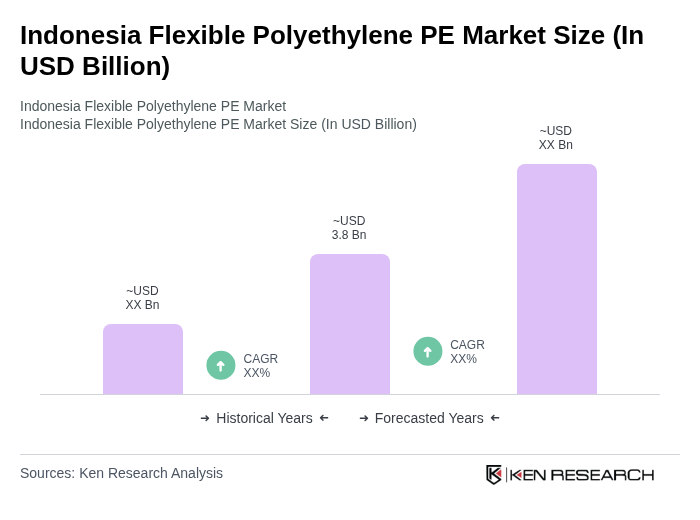
- The Indonesia Flexible Polyethylene PE Market is valued at USD 3.8 billion, based on a five-year analysis of Indonesia’s flexible plastic packaging and polyethylene markets and the share of PE within flexible formats. This growth is primarily driven by the increasing demand for flexible packaging solutions across food and beverage, healthcare, and consumer goods, supported by rising urbanization, higher disposable incomes, and modern retail expansion. The rapid rise in e-commerce and organized retail is further accelerating demand for lightweight, durable, and cost-effective packaging, contributing to market expansion.
- Key regions dominating the market include Java and Sumatra, where industrial activities and urbanization are at their peak. Java, being the most populous island, has a high concentration of manufacturing facilities, FMCG producers, and consumer markets, making it the primary hub for flexible plastic packaging demand. Sumatra’s strong agricultural base and food processing activities, particularly in palm oil, rubber, and plantation crops, drive demand for flexible polyethylene-based packaging for bulk and retail food products.
- Indonesia’s policy push to reduce plastic waste and increase recyclability is shaping the flexible polyethylene market, with producers progressively aligning their portfolios to more recyclable mono-material PE structures, higher recycled content, and improved collection and recycling systems in line with national waste reduction targets under the Presidential Regulation No. 97 of 2017 on National Policy and Strategy for Household Waste and Household-like Waste Management, and downstream obligations introduced by the Extended Producer Responsibility roadmap of the Ministry of Environment and Forestry.
Indonesia Flexible Polyethylene PE Market Segmentation
By PE Type:The flexible polyethylene market can be segmented into four main types: Low-Density Polyethylene (LDPE) Films, Linear Low-Density Polyethylene (LLDPE) Films, High-Density Polyethylene (HDPE) Films, and Metallocene PE and Specialty PE Grades. Each type serves different applications and industries, with varying properties that cater to specific needs.
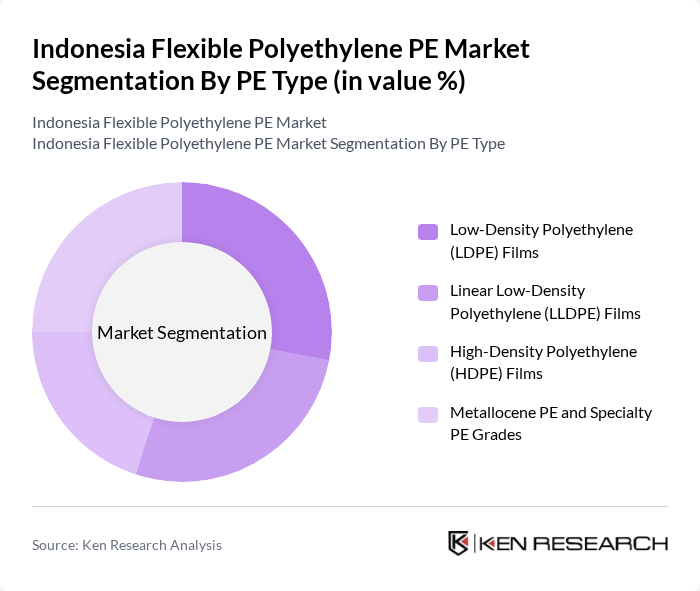
The Low-Density Polyethylene (LDPE) Films segment is currently one of the leading segments in flexible PE due to its versatility and widespread use in primary and secondary packaging for food, retail, and industrial products. LDPE is favored for its flexibility, sealability, clarity, and moisture resistance, making it suitable for food packaging, carrier bags, and wraps, while LLDPE is increasingly used in blends to improve toughness and downgauging. The growing trend towards convenience packaging, smaller pack sizes, and high-speed form-fill-seal operations in Indonesia continues to support strong demand for LDPE and LLDPE films in the flexible polyethylene market.
By Application:The flexible polyethylene market is segmented by application into Food & Beverage Flexible Packaging, Consumer Goods & Personal Care Packaging, Industrial & Agricultural Films, and Building & Construction Films and Liners. Each application area has unique requirements and growth drivers.
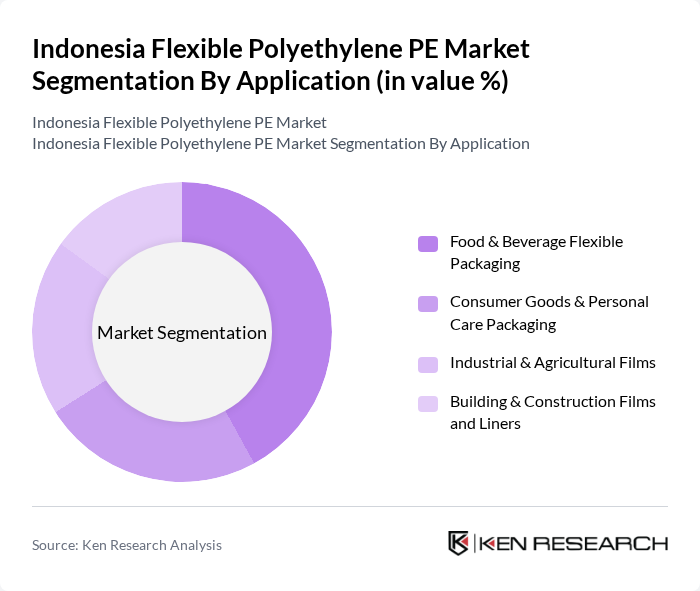
The Food & Beverage Flexible Packaging segment is the largest application area, reflecting the dominant role of packaged foods, snacks, instant noodles, and beverages in Indonesia’s consumption basket and the high share of prepared foods in household food expenditure. Rising demand for convenience foods, on-the-go formats, and modern retail channels has increased the need for high-barrier, multilayer PE-based films that preserve freshness, ensure food safety, and extend shelf life. This trend, together with the expansion of cold chain, e-grocery, and quick-commerce, is expected to maintain the strong position of food and beverage flexible packaging in the flexible polyethylene market.
Indonesia Flexible Polyethylene PE Market Competitive Landscape
The Indonesia Flexible Polyethylene PE Market is characterized by a dynamic mix of regional and international players. Leading participants such as PT Chandra Asri Petrochemical Tbk, PT Lotte Chemical Titan Nusantara, PT Polytama Propindo, PT Pertamina (Persero), PT Pupuk Kaltim, PT Asahimas Chemical, PT Trinseo Materials Indonesia, PT Argha Karya Prima Industry Tbk, PT Indopoly Swakarsa Industry Tbk, PT Trias Sentosa Tbk, PT Duta Plasindo, PT Tunas Megah Plastic, PT Supernova Flexible Packaging, PT Siantar Top Tbk (Packaging Division), Other Notable Local Converters and Compounders contribute to innovation, geographic expansion, and service delivery in this space.
Indonesia Flexible Polyethylene PE Market Industry Analysis
Growth Drivers
- Increasing Demand from Packaging Industry:The packaging industry in Indonesia is projected to reach a value of IDR 70 trillion in future, driven by a growing population and urbanization. Flexible polyethylene (PE) is favored for its lightweight and durable properties, making it ideal for food and consumer goods packaging. The rise in disposable income, which is expected to increase by 6% annually, further fuels demand for packaged products, thereby enhancing the flexible PE market's growth prospects.
- Growth in Construction Sector:Indonesia's construction sector is anticipated to grow by 7% in future, supported by government infrastructure projects worth IDR 500 trillion. Flexible PE is increasingly used in construction applications, such as vapor barriers and insulation materials, due to its moisture resistance and durability. The government's focus on improving urban infrastructure and housing development is expected to significantly boost the demand for flexible PE products in the construction industry.
- Expansion of E-commerce:The e-commerce sector in Indonesia is projected to reach IDR 250 trillion in future, with a compound annual growth rate of 25%. This rapid growth is driving the demand for flexible PE packaging solutions, as online retailers seek cost-effective and protective packaging options for shipping. The increasing consumer preference for online shopping, coupled with the rise of small and medium enterprises, is expected to further enhance the flexible PE market's growth in the coming years.
Market Challenges
- Environmental Concerns and Regulations:The Indonesian government is implementing stricter regulations on plastic waste management, with a target to reduce plastic waste by 40% in future. This poses a challenge for the flexible PE market, as manufacturers must adapt to new compliance requirements and invest in sustainable practices. The rising public awareness regarding environmental issues is also pressuring companies to innovate and reduce their plastic footprint, impacting production costs and market dynamics.
- Volatility in Raw Material Prices:The prices of raw materials for flexible PE production, such as ethylene, have shown significant volatility, with fluctuations of up to 20% in the past year. This instability can adversely affect profit margins for manufacturers, making it difficult to maintain competitive pricing. Additionally, geopolitical factors and supply chain disruptions can further exacerbate these price fluctuations, creating uncertainty in the market and challenging operational planning for producers.
Indonesia Flexible Polyethylene PE Market Future Outlook
The future of the flexible polyethylene market in Indonesia appears promising, driven by increasing consumer demand for sustainable packaging solutions and advancements in manufacturing technologies. As the government emphasizes environmental sustainability, companies are likely to invest in innovative recycling technologies and biodegradable products. Furthermore, the expansion of e-commerce and online retailing will continue to create new opportunities for flexible PE applications, ensuring that the market remains dynamic and responsive to changing consumer preferences and regulatory landscapes.
Market Opportunities
- Innovations in Recycling Technologies:The development of advanced recycling technologies presents a significant opportunity for the flexible PE market. By investing in these technologies, companies can enhance their sustainability efforts and reduce waste, potentially increasing their market share among environmentally conscious consumers. This shift could lead to a more circular economy, benefiting both manufacturers and the environment.
- Development of Biodegradable PE Products:The growing demand for biodegradable alternatives offers a lucrative opportunity for manufacturers in the flexible PE market. By developing and marketing biodegradable PE products, companies can cater to the increasing consumer preference for sustainable options. This innovation not only aligns with regulatory trends but also positions companies favorably in a competitive market focused on environmental responsibility.
Scope of the Report
| Segment | Sub-Segments |
|---|---|
| By PE Type | Low-Density Polyethylene (LDPE) Films Linear Low-Density Polyethylene (LLDPE) Films High-Density Polyethylene (HDPE) Films Metallocene PE and Specialty PE Grades |
| By Application | Food & Beverage Flexible Packaging Consumer Goods & Personal Care Packaging Industrial & Agricultural Films Building & Construction Films and Liners |
| By Product Format | Films and Wraps Bags, Pouches, and Liners Shrink and Stretch Films Other Flexible PE Formats |
| By Processing Technology | Blown Film Cast Film Extrusion Coating & Lamination Other Conversion Technologies |
| By End-Use Industry | Food Beverage Healthcare & Pharmaceutical Household, Personal Care & Consumer Goods Agriculture & Horticulture Industrial, Chemical & Other End Uses |
| By Geography | Java Sumatra Kalimantan Sulawesi, Bali, Nusa Tenggara & Other Regions |
| By Sustainability Profile | Virgin Conventional PE Mechanically Recycled PE Content Chemically Recycled / Circular PE Bio-based and Compostable PE Alternatives |
Key Target Audience
Investors and Venture Capitalist Firms
Government and Regulatory Bodies (e.g., Ministry of Industry, Ministry of Environment and Forestry)
Manufacturers and Producers
Distributors and Retailers
Packaging Companies
Construction and Building Material Suppliers
Recycling and Waste Management Firms
Trade Associations and Industry Groups
Players Mentioned in the Report:
PT Chandra Asri Petrochemical Tbk
PT Lotte Chemical Titan Nusantara
PT Polytama Propindo
PT Pertamina (Persero)
PT Pupuk Kaltim
PT Asahimas Chemical
PT Trinseo Materials Indonesia
PT Argha Karya Prima Industry Tbk
PT Indopoly Swakarsa Industry Tbk
PT Trias Sentosa Tbk
PT Duta Plasindo
PT Tunas Megah Plastic
PT Supernova Flexible Packaging
PT Siantar Top Tbk (Packaging Division)
Other Notable Local Converters and Compounders
Table of Contents
Market Assessment Phase
1. Executive Summary and Approach
2. Indonesia Flexible Polyethylene PE Market Overview
2.1 Key Insights and Strategic Recommendations
2.2 Indonesia Flexible Polyethylene PE Market Overview
2.3 Definition and Scope
2.4 Evolution of Market Ecosystem
2.5 Timeline of Key Regulatory Milestones
2.6 Value Chain & Stakeholder Mapping
2.7 Business Cycle Analysis
2.8 Policy & Incentive Landscape
3. Indonesia Flexible Polyethylene PE Market Analysis
3.1 Growth Drivers
3.1.1 Increasing Demand from Packaging Industry
3.1.2 Growth in Construction Sector
3.1.3 Rising Consumer Goods Production
3.1.4 Expansion of E-commerce
3.2 Market Challenges
3.2.1 Environmental Concerns and Regulations
3.2.2 Volatility in Raw Material Prices
3.2.3 Competition from Alternative Materials
3.2.4 Supply Chain Disruptions
3.3 Market Opportunities
3.3.1 Innovations in Recycling Technologies
3.3.2 Expansion into Emerging Markets
3.3.3 Development of Biodegradable PE Products
3.3.4 Strategic Partnerships with Local Manufacturers
3.4 Market Trends
3.4.1 Shift Towards Sustainable Packaging Solutions
3.4.2 Increasing Use of Smart Packaging
3.4.3 Growth of Online Retailing
3.4.4 Adoption of Advanced Manufacturing Technologies
3.5 Government Regulation
3.5.1 Plastic Waste Management Policies
3.5.2 Import Tariffs on Raw Materials
3.5.3 Standards for Product Safety and Quality
3.5.4 Incentives for Sustainable Practices
4. SWOT Analysis
5. Stakeholder Analysis
6. Porter's Five Forces Analysis
7. Indonesia Flexible Polyethylene PE Market Market Size, 2019-2024
7.1 By Value
7.2 By Volume
7.3 By Average Selling Price
8. Indonesia Flexible Polyethylene PE Market Segmentation
8.1 By PE Type
8.1.1 Low-Density Polyethylene (LDPE) Films
8.1.2 Linear Low-Density Polyethylene (LLDPE) Films
8.1.3 High-Density Polyethylene (HDPE) Films
8.1.4 Metallocene PE and Specialty PE Grades
8.2 By Application
8.2.1 Food & Beverage Flexible Packaging
8.2.2 Consumer Goods & Personal Care Packaging
8.2.3 Industrial & Agricultural Films
8.2.4 Building & Construction Films and Liners
8.3 By Product Format
8.3.1 Films and Wraps
8.3.2 Bags, Pouches, and Liners
8.3.3 Shrink and Stretch Films
8.3.4 Other Flexible PE Formats
8.4 By Processing Technology
8.4.1 Blown Film
8.4.2 Cast Film
8.4.3 Extrusion Coating & Lamination
8.4.4 Other Conversion Technologies
8.5 By End-Use Industry
8.5.1 Food
8.5.2 Beverage
8.5.3 Healthcare & Pharmaceutical
8.5.4 Household, Personal Care & Consumer Goods
8.5.5 Agriculture & Horticulture
8.5.6 Industrial, Chemical & Other End Uses
8.6 By Geography
8.6.1 Java
8.6.2 Sumatra
8.6.3 Kalimantan
8.6.4 Sulawesi, Bali, Nusa Tenggara & Other Regions
8.7 By Sustainability Profile
8.7.1 Virgin Conventional PE
8.7.2 Mechanically Recycled PE Content
8.7.3 Chemically Recycled / Circular PE
8.7.4 Bio-based and Compostable PE Alternatives
9. Indonesia Flexible Polyethylene PE Market Competitive Analysis
9.1 Market Share of Key Players
9.2 Cross Comparison of Key Players
9.2.1 Company Name
9.2.2 Group Size (Large, Medium, or Small as per industry convention)
9.2.3 Indonesia Flexible PE Revenue (USD Million)
9.2.4 Indonesia Flexible PE Volume Sold (KT)
9.2.5 3-year CAGR in Indonesia Flexible PE Revenue
9.2.6 EBITDA Margin from Flexible PE Business (%)
9.2.7 Market Share in Indonesia Flexible PE Segment (%)
9.2.8 Capacity Utilization Rate (%)
9.2.9 Capex Intensity (% of Revenue)
9.2.10 R&D Spend (% of Revenue)
9.2.11 Share of Recycled / Sustainable PE in Portfolio (%)
9.2.12 Average Realized Price per Tonne (USD/tonne)
9.3 SWOT Analysis of Top Players
9.4 Pricing Analysis
9.5 Detailed Profile of Major Companies
9.5.1 PT Chandra Asri Petrochemical Tbk
9.5.2 PT Lotte Chemical Titan Nusantara
9.5.3 PT Polytama Propindo
9.5.4 PT Pertamina (Persero)
9.5.5 PT Pupuk Kaltim
9.5.6 PT Asahimas Chemical
9.5.7 PT Trinseo Materials Indonesia
9.5.8 PT Argha Karya Prima Industry Tbk
9.5.9 PT Indopoly Swakarsa Industry Tbk
9.5.10 PT Trias Sentosa Tbk
9.5.11 PT Duta Plasindo
9.5.12 PT Tunas Megah Plastic
9.5.13 PT Supernova Flexible Packaging
9.5.14 PT Siantar Top Tbk (Packaging Division)
9.5.15 Other Notable Local Converters and Compounders
10. Indonesia Flexible Polyethylene PE Market End-User Analysis
10.1 Procurement Behavior of Key Ministries
10.1.1 Ministry of Industry
10.1.2 Ministry of Trade
10.1.3 Ministry of Environment and Forestry
10.1.4 Others
10.2 Corporate Spend on Infrastructure & Energy
10.2.1 Investment Trends
10.2.2 Budget Allocations
10.2.3 Project Prioritization
10.2.4 Others
10.3 Pain Point Analysis by End-User Category
10.3.1 Packaging Sector
10.3.2 Construction Sector
10.3.3 Consumer Goods Sector
10.3.4 Others
10.4 User Readiness for Adoption
10.4.1 Awareness Levels
10.4.2 Training Needs
10.4.3 Infrastructure Readiness
10.4.4 Others
10.5 Post-Deployment ROI and Use Case Expansion
10.5.1 ROI Measurement Techniques
10.5.2 Case Studies
10.5.3 Future Use Cases
10.5.4 Others
11. Indonesia Flexible Polyethylene PE Market Future Size, 2025-2030
11.1 By Value
11.2 By Volume
11.3 By Average Selling Price
Go-To-Market Strategy Phase
1. Whitespace Analysis + Business Model Canvas
1.1 Market Gaps Identification
1.2 Business Model Development
2. Marketing and Positioning Recommendations
2.1 Branding Strategies
2.2 Product USPs
3. Distribution Plan
3.1 Urban Retail Strategies
3.2 Rural NGO Tie-ups
4. Channel & Pricing Gaps
4.1 Underserved Routes
4.2 Pricing Bands
5. Unmet Demand & Latent Needs
5.1 Category Gaps
5.2 Consumer Segments
6. Customer Relationship
6.1 Loyalty Programs
6.2 After-sales Service
7. Value Proposition
7.1 Sustainability Initiatives
7.2 Integrated Supply Chains
8. Key Activities
8.1 Regulatory Compliance
8.2 Branding Efforts
8.3 Distribution Setup
9. Entry Strategy Evaluation
9.1 Domestic Market Entry Strategy
9.1.1 Product Mix
9.1.2 Pricing Band
9.1.3 Packaging Considerations
9.2 Export Entry Strategy
9.2.1 Target Countries
9.2.2 Compliance Roadmap
10. Entry Mode Assessment
10.1 Joint Ventures
10.2 Greenfield Investments
10.3 Mergers & Acquisitions
10.4 Distributor Model
11. Capital and Timeline Estimation
11.1 Capital Requirements
11.2 Timelines
12. Control vs Risk Trade-Off
12.1 Ownership vs Partnerships
13. Profitability Outlook
13.1 Breakeven Analysis
13.2 Long-term Sustainability
14. Potential Partner List
14.1 Distributors
14.2 Joint Ventures
14.3 Acquisition Targets
15. Execution Roadmap
15.1 Phased Plan for Market Entry
15.1.1 Market Setup
15.1.2 Market Entry
15.1.3 Growth Acceleration
15.1.4 Scale & Stabilize
15.2 Key Activities and Milestones
15.2.1 Milestone Planning
15.2.2 Activity Tracking
Research Methodology
Phase 1: Approach1
Desk Research
- Analysis of industry reports from the Indonesian Plastics Industry Association
- Review of trade statistics from the Central Bureau of Statistics (BPS) of Indonesia
- Examination of market trends and forecasts from government publications and trade journals
Primary Research
- Interviews with key stakeholders in the polyethylene supply chain, including manufacturers and distributors
- Surveys conducted with end-users in sectors such as packaging, automotive, and construction
- Field visits to production facilities to gather insights on operational practices and capacity
Validation & Triangulation
- Cross-validation of findings through multiple data sources, including trade associations and market reports
- Triangulation of qualitative insights from interviews with quantitative data from surveys
- Sanity checks performed by industry experts to ensure data reliability and accuracy
Phase 2: Market Size Estimation1
Top-down Assessment
- Estimation of total market size based on national consumption data for polyethylene products
- Segmentation of the market by application areas such as packaging, agriculture, and consumer goods
- Incorporation of growth rates from historical data and projected economic indicators
Bottom-up Modeling
- Collection of production volume data from leading polyethylene manufacturers in Indonesia
- Analysis of pricing trends and cost structures within the polyethylene market
- Estimation of market size based on production capacity and utilization rates
Forecasting & Scenario Analysis
- Development of forecasting models using historical growth patterns and market drivers
- Scenario analysis based on potential regulatory changes and environmental policies
- Creation of multiple market outlooks, including conservative, moderate, and aggressive growth scenarios through 2030
Phase 3: CATI Sample Composition1
| Scope Item/Segment | Sample Size | Target Respondent Profiles |
|---|---|---|
| Packaging Industry Stakeholders | 120 | Production Managers, Procurement Specialists |
| Agricultural Applications | 80 | Farm Managers, Supply Chain Coordinators |
| Construction Sector Users | 70 | Project Managers, Material Suppliers |
| Consumer Goods Manufacturers | 60 | Product Development Managers, Quality Assurance Leads |
| Recycling and Sustainability Initiatives | 50 | Sustainability Managers, Environmental Compliance Officers |
Frequently Asked Questions
What is the current value of the Indonesia Flexible Polyethylene PE Market?
The Indonesia Flexible Polyethylene PE Market is valued at approximately USD 3.8 billion, driven by the increasing demand for flexible packaging solutions across various sectors, including food and beverage, healthcare, and consumer goods.
What factors are driving the growth of the Flexible Polyethylene PE Market in Indonesia?
Which regions in Indonesia dominate the Flexible Polyethylene PE Market?
What types of Flexible Polyethylene are available in the Indonesian market?
Other Regional/Country Reports
Other Adjacent Reports
Qatar Plastic Films Market
Kuwait Polypropylene MarketSouth Korea PET Packaging Market
KSA food packaging market size, share, growth drivers, trends, opportunities & forecast 2025–2030India Beverage Packaging Market Size, Share & Forecast, By Material, Packaging Format, Beverage Type & Distribution Channel, 2026-2031Saudi Arabia agricultural films market Size, Share, Growth Drivers, Trends, Opportunities & Forecast 2025–2030Global Construction Films Market Size, Share, Growth Drivers, Trends, Opportunities & Forecast 2025–2030Qatar Recycled Plastics Market Report Size Share Growth Drivers Trends Opportunities & Forecast 2025–2030Bahrain Bioplastics Market Report Size Share Growth Drivers Trends Opportunities & Forecast 2025–2030Why Buy From Us?

What makes us stand out is that our consultants follow Robust, Refine and Result (RRR) methodology. Robust for clear definitions, approaches and sanity checking, Refine for differentiating respondents' facts and opinions, and Result for presenting data with story.

We have set a benchmark in the industry by offering our clients with syndicated and customized market research reports featuring coverage of entire market as well as meticulous research and analyst insights.

While we don't replace traditional research, we flip the method upside down. Our dual approach of Top Bottom & Bottom Top ensures quality deliverable by not just verifying company fundamentals but also looking at the sector and macroeconomic factors.

With one step in the future, our research team constantly tries to show you the bigger picture. We help with some of the tough questions you may encounter along the way: How is the industry positioned? Best marketing channel? KPI's of competitors? By aligning every element, we help maximize success.

Our report gives you instant access to the answers and sources that other companies might choose to hide. We elaborate each steps of research methodology we have used and showcase you the sample size to earn your trust.

If you need any support, we are here! We pride ourselves on universe strength, data quality, and quick, friendly, and professional service.