Indonesia Intermediate Bulk Container Liner Market Report Size Share Growth Drivers Trends Opportunities & Forecast 2025–2030

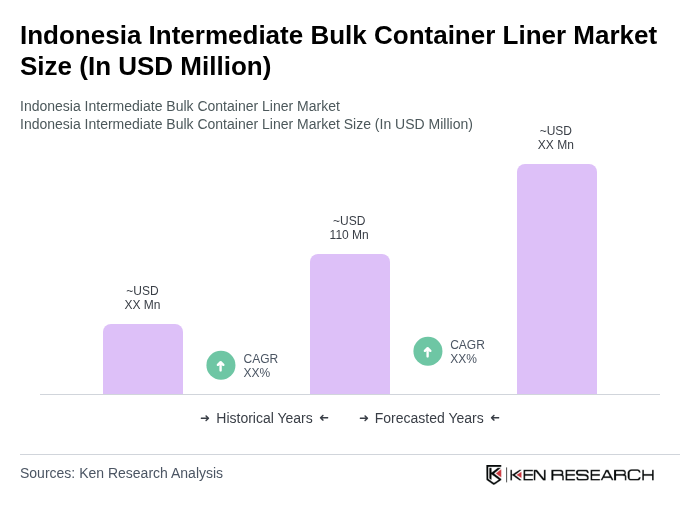
Indonesia Intermediate Bulk Container Liner Market reaches USD 110 Mn, led by food & beverage sector, with key trends in sustainable liners and regulatory compliance for safe bulk transportation.

Region:Asia

Author(s):Geetanshi

Product Code:KRAA4243

Pages:87

Published On:January 2026
About the Report

Base Year 2024

Indonesia Intermediate Bulk Container Liner Market Overview

  • The Indonesia Intermediate Bulk Container Liner Market is valued at USD 110 million, based on a five-year historical analysis and benchmarking against the global intermediate bulk container liner market size and Indonesia’s share of regional industrial packaging demand. This growth is primarily driven by the increasing demand for efficient bulk transportation solutions across various industries, including food and beverage, chemicals, and pharmaceuticals, as intermediate bulk containers gain traction within Indonesia’s broader industrial packaging market. The rising trend of sustainable packaging and the need for cost-effective logistics solutions further contribute to the market's expansion, supported by growing use of reusable IBCs, recycled-content components, and liners designed to reduce cleaning, downtime, and product waste.
  • Key cities such as Jakarta, Surabaya, and Bandung dominate the market due to their strategic locations, robust industrial base, and extensive transportation networks. Jakarta, being the capital, serves as a major hub for trade and commerce, while Surabaya and Bandung support significant manufacturing activities, including chemicals, food processing, and pharmaceuticals, making them critical players in the intermediate bulk container and liner demand ecosystem.
  • In 2023, the Indonesian government implemented regulations aimed at enhancing the safety and quality standards of packaging materials, including intermediate bulk containers. A key framework is the Indonesian National Standard SNI 19-4832 on packaging and transport of dangerous goods, together with its alignment to UN Recommendations on the Transport of Dangerous Goods and related Ministry of Transportation regulations, which mandate performance-tested packaging, proper labeling, and conformity to international safety standards for industrial containers and their accessories. This regulatory environment requires that packaging used for chemicals, hazardous liquids, and sensitive food or pharmaceutical inputs, including IBCs fitted with liners, complies with stringent quality checks, thereby promoting consumer safety and environmental sustainability.
Indonesia Intermediate Bulk Container Liner Market Size

Indonesia Intermediate Bulk Container Liner Market Segmentation

By Liner Type:

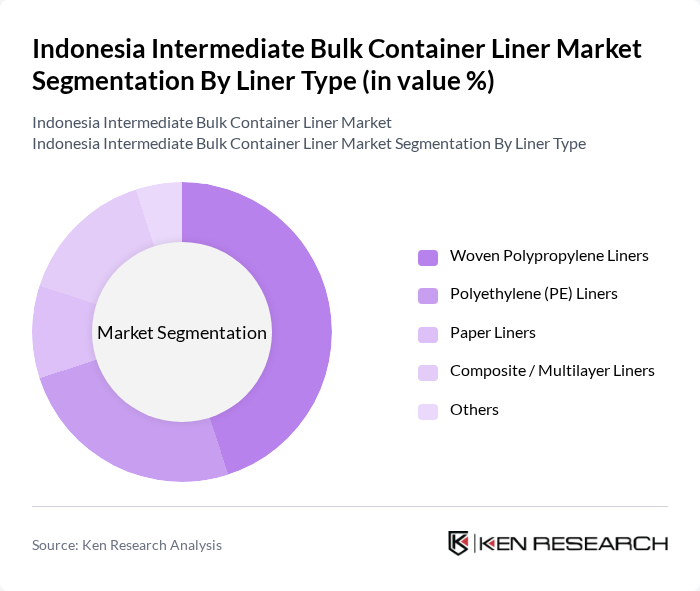
Indonesia Intermediate Bulk Container Liner Market segmentation by Liner Type.

The liner type segmentation includes Woven Polypropylene Liners, Polyethylene (PE) Liners, Paper Liners, Composite / Multilayer Liners, and Others. Among these, Woven Polypropylene Liners dominate the market due to their durability, lightweight nature, and cost-effectiveness, making them ideal for transporting a variety of bulk materials, particularly liquid chemicals, food ingredients, and industrial liquids. The increasing preference for sustainable packaging solutions has also led to a rise in the adoption of Composite / Multilayer Liners, which offer enhanced protection, oxygen and moisture barrier properties, and compatibility with aseptic and high-purity applications in food and beverage and pharmaceuticals. Consumer behavior trends indicate a growing demand for liners that provide both functionality and environmental benefits, such as recyclability, reduced product contamination, and improved handling safety.

By End-User Industry:
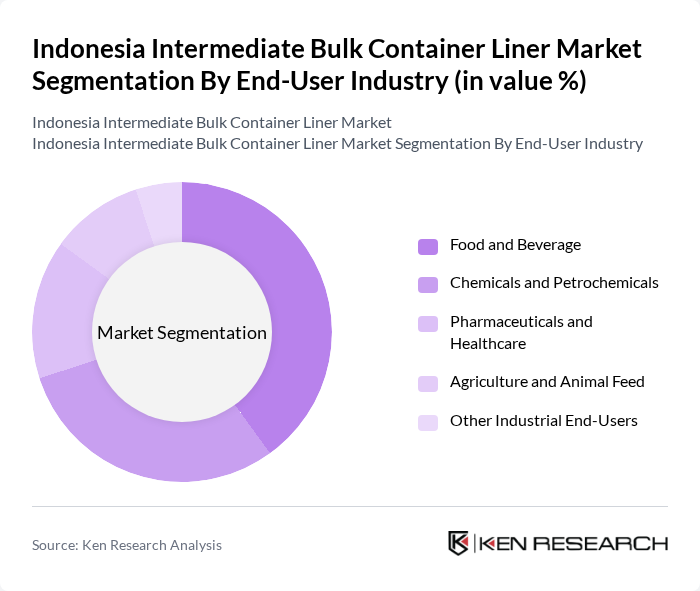
Indonesia Intermediate Bulk Container Liner Market segmentation by End-User Industry.

The end-user industry segmentation comprises Food and Beverage, Chemicals and Petrochemicals, Pharmaceuticals and Healthcare, Agriculture and Animal Feed, and Other Industrial End-Users. The Food and Beverage sector leads the market, driven by the increasing demand for packaged food products and beverages and the need for hygienic, contamination-free bulk transfer of liquid ingredients, concentrates, edible oils, and syrups. The Chemicals and Petrochemicals industry follows closely, as the need for safe and efficient transportation of hazardous and corrosive materials continues to rise and IBCs with liners are increasingly adopted for industrial liquids. Additionally, the Pharmaceuticals and Healthcare sector is witnessing growth due to stringent regulations on packaging and transportation, emphasizing the importance of quality, cleanliness, and trackable bulk packaging for active ingredients and high-purity intermediates in this industry.

Indonesia Intermediate Bulk Container Liner Market Competitive Landscape

The Indonesia Intermediate Bulk Container Liner Market is characterized by a dynamic mix of regional and international players. Leading participants such as Schütz GmbH & Co. KGaA, Mauser Packaging Solutions, Greif, Inc., Berry Global Group, Inc., Hoover Ferguson Group, Inc., Time Technoplast Ltd., CDF Corporation, DS Smith plc, Mondi plc, Brambles Limited (CHEP), JSA Linfo Sakti, PT Megalopolis Manunggal Industrial Development (MMID) Logistics & Ta??mac?l?k, Local Contract Converters and OEM Partners, TPL Plastech Ltd., Other Emerging Regional Players contribute to innovation, geographic expansion, and service delivery in this space, with a focus on durable liners compatible with composite IBCs, food-grade and pharma-grade solutions, and customized liners for hazardous and industrial liquids.

Schütz GmbH & Co. KGaA

1958

Selters, Germany

Mauser Packaging Solutions

1896

Bruehl, Germany

Greif, Inc.

1877

Delaware, USA

Berry Global Group, Inc.

1967

Evansville, Indiana, USA

Hoover Ferguson Group, Inc.

1946

Houston, Texas, USA

Company

Establishment Year

Headquarters

Indonesia IBC Liner Revenue (USD Million)

3-Year Revenue CAGR (%)

Indonesia Market Share (%)

Installed Liner Capacity (Million Units / Year)

Capacity Utilization Rate (%)

EBITDA Margin (%)

Indonesia Intermediate Bulk Container Liner Market Industry Analysis

Growth Drivers

  • Increasing Demand for Bulk Transportation:The Indonesian logistics sector is projected to grow significantly, with the volume of goods transported by road expected to reach 1.6 billion tons in future. This surge in demand for bulk transportation is driven by the country's expanding industrial base, particularly in sectors like chemicals and agriculture, which rely heavily on intermediate bulk containers (IBCs) for efficient logistics. The government's focus on enhancing transportation infrastructure further supports this growth.
  • Expansion of the Food and Beverage Industry:Indonesia's food and beverage industry is anticipated to reach a market value of approximately $210 billion in future, driven by rising consumer demand and urbanization. This growth necessitates efficient bulk packaging solutions, such as intermediate bulk containers, to ensure safe and cost-effective transportation of products. The increasing focus on food safety and quality standards also propels the demand for reliable packaging solutions in this sector.
  • Rising E-commerce Activities:E-commerce in Indonesia is expected to grow to $140 billion in future, fueled by increased internet penetration and mobile usage. This growth in online retailing drives the need for efficient logistics solutions, including intermediate bulk containers, to handle bulk shipments of goods. The rise of e-commerce platforms encourages businesses to adopt IBCs for their ability to streamline supply chains and reduce shipping costs, thus enhancing overall operational efficiency.

Market Challenges

  • High Initial Investment Costs:The adoption of intermediate bulk containers often requires significant upfront investment, which can be a barrier for small and medium-sized enterprises (SMEs) in Indonesia. The average cost of a new IBC can range from $350 to $1,200, depending on the material and design. This financial burden can deter businesses from transitioning to bulk packaging solutions, limiting market growth and innovation in the sector.
  • Regulatory Compliance Issues:Navigating the complex regulatory landscape in Indonesia poses a challenge for companies in the intermediate bulk container market. Compliance with local and international standards, such as safety and environmental regulations, can be cumbersome and costly. For instance, adherence to the Indonesian National Standard (SNI) for packaging materials requires rigorous testing and certification, which can delay product launches and increase operational costs for manufacturers.

Indonesia Intermediate Bulk Container Liner Market Future Outlook

The future of the Indonesia intermediate bulk container market appears promising, driven by ongoing industrialization and a growing emphasis on sustainability. As businesses increasingly adopt eco-friendly practices, the demand for innovative packaging solutions that minimize environmental impact is expected to rise. Additionally, advancements in technology, such as smart containers equipped with tracking systems, will enhance supply chain efficiency. These trends indicate a shift towards more sustainable and efficient logistics practices, positioning the market for significant growth in future.

Market Opportunities

  • Growth in Export Markets:Indonesia's export market is projected to reach $220 billion in future, creating substantial opportunities for intermediate bulk container manufacturers. As industries like palm oil and textiles expand, the demand for efficient bulk packaging solutions will increase, allowing companies to capitalize on international trade opportunities and enhance their competitive edge.
  • Technological Advancements in Container Design:Innovations in container design, such as lightweight materials and enhanced durability, present significant opportunities for market players. The introduction of smart IBCs with integrated sensors for monitoring temperature and humidity can improve product safety and quality during transport, appealing to industries that prioritize compliance and efficiency in their supply chains.

Scope of the Report

SegmentSub-Segments
By Liner Type

Woven Polypropylene Liners

Polyethylene (PE) Liners

Paper Liners

Composite / Multilayer Liners

Others

By End-User Industry

Food and Beverage

Chemicals and Petrochemicals

Pharmaceuticals and Healthcare

Agriculture and Animal Feed

Other Industrial End-Users

By Material Type

Polyethylene (PE)

Polypropylene (PP)

Nylon

Polyethylene Terephthalate (PET)

Composite Materials

By Capacity

Less than 500 Liters

to 1,000 Liters

,000 to 2,000 Liters

More than 2,000 Liters

By Application

Bulk Transportation

Storage Solutions

Export Packaging

Others

By Region

Java

Sumatra

Kalimantan

Sulawesi

Others

Key Target Audience

Investors and Venture Capitalist Firms

Government and Regulatory Bodies (e.g., Ministry of Trade, Ministry of Transportation)

Manufacturers and Producers of Intermediate Bulk Containers

Logistics and Supply Chain Companies

Importers and Exporters of Goods

Environmental Agencies (e.g., Ministry of Environment and Forestry)

Industry Associations (e.g., Indonesian Logistics and Forwarders Association)

Financial Institutions and Banks

Players Mentioned in the Report:

Schutz GmbH & Co. KGaA

Mauser Packaging Solutions

Greif, Inc.

Berry Global Group, Inc.

Hoover Ferguson Group, Inc.

Time Technoplast Ltd.

CDF Corporation

DS Smith plc

Mondi plc

Brambles Limited (CHEP)

JSA Linfo Sakti

PT Megalopolis Manunggal Industrial Development (MMID) Logistics & Tasmaclk

Local Contract Converters and OEM Partners

TPL Plastech Ltd.

Other Emerging Regional Players

Table of Contents

Market Assessment Phase

1. Executive Summary and Approach


2. Indonesia Intermediate Bulk Container Liner Market Overview

2.1 Key Insights and Strategic Recommendations

2.2 Indonesia Intermediate Bulk Container Liner Market Overview

2.3 Definition and Scope

2.4 Evolution of Market Ecosystem

2.5 Timeline of Key Regulatory Milestones

2.6 Value Chain & Stakeholder Mapping

2.7 Business Cycle Analysis

2.8 Policy & Incentive Landscape


3. Indonesia Intermediate Bulk Container Liner Market Analysis

3.1 Growth Drivers

3.1.1 Increasing Demand for Bulk Transportation
3.1.2 Expansion of the Food and Beverage Industry
3.1.3 Rising E-commerce Activities
3.1.4 Government Initiatives for Infrastructure Development

3.2 Market Challenges

3.2.1 High Initial Investment Costs
3.2.2 Regulatory Compliance Issues
3.2.3 Competition from Alternative Packaging Solutions
3.2.4 Fluctuating Raw Material Prices

3.3 Market Opportunities

3.3.1 Growth in Export Markets
3.3.2 Technological Advancements in Container Design
3.3.3 Increasing Focus on Sustainable Packaging
3.3.4 Partnerships with Logistics Providers

3.4 Market Trends

3.4.1 Shift Towards Eco-friendly Materials
3.4.2 Customization of Container Solutions
3.4.3 Digitalization in Supply Chain Management
3.4.4 Growth of the Circular Economy

3.5 Government Regulation

3.5.1 Import and Export Regulations
3.5.2 Environmental Compliance Standards
3.5.3 Safety Regulations for Transportation
3.5.4 Incentives for Sustainable Practices

4. SWOT Analysis


5. Stakeholder Analysis


6. Porter's Five Forces Analysis


7. Indonesia Intermediate Bulk Container Liner Market Market Size, 2019-2024

7.1 By Value

7.2 By Volume

7.3 By Average Selling Price


8. Indonesia Intermediate Bulk Container Liner Market Segmentation

8.1 By Liner Type

8.1.1 Woven Polypropylene Liners
8.1.2 Polyethylene (PE) Liners
8.1.3 Paper Liners
8.1.4 Composite / Multilayer Liners
8.1.5 Others

8.2 By End-User Industry

8.2.1 Food and Beverage
8.2.2 Chemicals and Petrochemicals
8.2.3 Pharmaceuticals and Healthcare
8.2.4 Agriculture and Animal Feed
8.2.5 Other Industrial End-Users

8.3 By Material Type

8.3.1 Polyethylene (PE)
8.3.2 Polypropylene (PP)
8.3.3 Nylon
8.3.4 Polyethylene Terephthalate (PET)
8.3.5 Composite Materials

8.4 By Capacity

8.4.1 Less than 500 Liters
8.4.2 500 to 1,000 Liters
8.4.3 1,000 to 2,000 Liters
8.4.4 More than 2,000 Liters

8.5 By Application

8.5.1 Bulk Transportation
8.5.2 Storage Solutions
8.5.3 Export Packaging
8.5.4 Others

8.6 By Region

8.6.1 Java
8.6.2 Sumatra
8.6.3 Kalimantan
8.6.4 Sulawesi
8.6.5 Others

9. Indonesia Intermediate Bulk Container Liner Market Competitive Analysis

9.1 Market Share of Key Players

9.2 Cross Comparison of Key Players

9.2.1 Company Name
9.2.2 Indonesia IBC Liner Revenue (USD Million)
9.2.3 3-Year Revenue CAGR (%)
9.2.4 Indonesia Market Share (%)
9.2.5 Installed Liner Capacity (Million Units / Year)
9.2.6 Capacity Utilization Rate (%)
9.2.7 EBITDA Margin (%)
9.2.8 Average Realized Price per Unit (USD)
9.2.9 R&D Spend as % of Sales
9.2.10 On-time Delivery Rate (%)
9.2.11 Customer Retention Rate (%)
9.2.12 Number of Key Strategic Accounts in Indonesia

9.3 SWOT Analysis of Top Players

9.4 Pricing Analysis

9.5 Detailed Profile of Major Companies

9.5.1 Schütz GmbH & Co. KGaA
9.5.2 Mauser Packaging Solutions
9.5.3 Greif, Inc.
9.5.4 Berry Global Group, Inc.
9.5.5 Hoover Ferguson Group, Inc.
9.5.6 Time Technoplast Ltd.
9.5.7 CDF Corporation
9.5.8 DS Smith plc
9.5.9 Mondi plc
9.5.10 Brambles Limited (CHEP)
9.5.11 JSA Linfo Sakti
9.5.12 PT Megalopolis Manunggal Industrial Development (MMID) Logistics & Ta??mac?l?k
9.5.13 Local Contract Converters and OEM Partners
9.5.14 TPL Plastech Ltd.
9.5.15 Other Emerging Regional Players

10. Indonesia Intermediate Bulk Container Liner Market End-User Analysis

10.1 Procurement Behavior of Key Ministries

10.1.1 Key Procurement Processes
10.1.2 Budget Allocation Trends
10.1.3 Supplier Selection Criteria
10.1.4 Contract Management Practices

10.2 Corporate Spend on Infrastructure & Energy

10.2.1 Investment Trends in Infrastructure
10.2.2 Energy Consumption Patterns
10.2.3 Budgeting for Container Solutions
10.2.4 Future Spending Projections

10.3 Pain Point Analysis by End-User Category

10.3.1 Challenges in Supply Chain Management
10.3.2 Quality Assurance Issues
10.3.3 Cost Management Concerns
10.3.4 Regulatory Compliance Difficulties

10.4 User Readiness for Adoption

10.4.1 Awareness of IBC Solutions
10.4.2 Training and Support Needs
10.4.3 Adoption Barriers
10.4.4 Feedback Mechanisms

10.5 Post-Deployment ROI and Use Case Expansion

10.5.1 Measurement of ROI
10.5.2 Case Studies of Successful Implementations
10.5.3 Expansion Opportunities
10.5.4 Long-term Benefits Analysis

11. Indonesia Intermediate Bulk Container Liner Market Future Size, 2025-2030

11.1 By Value

11.2 By Volume

11.3 By Average Selling Price


Go-To-Market Strategy Phase

1. Whitespace Analysis + Business Model Canvas

1.1 Market Gaps Identification

1.2 Business Model Development


2. Marketing and Positioning Recommendations

2.1 Branding Strategies

2.2 Product USPs


3. Distribution Plan

3.1 Urban Retail Strategies

3.2 Rural NGO Tie-ups


4. Channel & Pricing Gaps

4.1 Underserved Routes

4.2 Pricing Bands Analysis


5. Unmet Demand & Latent Needs

5.1 Category Gaps

5.2 Consumer Segments


6. Customer Relationship

6.1 Loyalty Programs

6.2 After-sales Service


7. Value Proposition

7.1 Sustainability Initiatives

7.2 Integrated Supply Chains


8. Key Activities

8.1 Regulatory Compliance

8.2 Branding Efforts

8.3 Distribution Setup


9. Entry Strategy Evaluation

9.1 Domestic Market Entry Strategy

9.1.1 Product Mix Considerations
9.1.2 Pricing Band Strategy
9.1.3 Packaging Solutions

9.2 Export Entry Strategy

9.2.1 Target Countries Identification
9.2.2 Compliance Roadmap Development

10. Entry Mode Assessment

10.1 Joint Ventures

10.2 Greenfield Investments

10.3 Mergers & Acquisitions

10.4 Distributor Model Evaluation


11. Capital and Timeline Estimation

11.1 Capital Requirements

11.2 Timelines for Implementation


12. Control vs Risk Trade-Off

12.1 Ownership Considerations

12.2 Partnerships Evaluation


13. Profitability Outlook

13.1 Breakeven Analysis

13.2 Long-term Sustainability Assessment


14. Potential Partner List

14.1 Distributors

14.2 Joint Ventures

14.3 Acquisition Targets


15. Execution Roadmap

15.1 Phased Plan for Market Entry

15.1.1 Market Setup
15.1.2 Market Entry
15.1.3 Growth Acceleration
15.1.4 Scale & Stabilize

15.2 Key Activities and Milestones

15.2.1 Milestone Planning
15.2.2 Activity Tracking

Research Methodology

ApproachModellingSample

Phase 1: Approach1

Desk Research

  • Industry reports from Indonesian logistics and shipping associations
  • Government publications on trade and transportation statistics
  • Market analysis from international trade organizations focusing on bulk container usage

Primary Research

  • Interviews with logistics managers at major shipping companies operating in Indonesia
  • Surveys with manufacturers utilizing intermediate bulk containers across various sectors
  • Field interviews with port authorities and customs officials regarding container handling

Validation & Triangulation

  • Cross-validation of data from multiple industry sources and reports
  • Triangulation of findings from primary interviews with secondary data insights
  • Sanity checks through expert panels comprising industry veterans and analysts

Phase 2: Market Size Estimation1

Top-down Assessment

  • Analysis of national logistics expenditure and its correlation with bulk container usage
  • Segmentation of the market by end-user industries such as food, chemicals, and pharmaceuticals
  • Incorporation of government initiatives promoting sustainable packaging solutions

Bottom-up Modeling

  • Volume estimates based on container usage data from leading manufacturers
  • Cost analysis derived from pricing models of intermediate bulk containers
  • Calculation of market size based on projected growth rates and industry trends

Forecasting & Scenario Analysis

  • Multi-variable regression analysis considering economic growth and trade policies
  • Scenario planning based on potential regulatory changes affecting container usage
  • Development of baseline, optimistic, and pessimistic forecasts through 2030

Phase 3: CATI Sample Composition1

Scope Item/SegmentSample SizeTarget Respondent Profiles
Food and Beverage Sector100Supply Chain Managers, Quality Assurance Officers
Chemicals and Petrochemicals80Procurement Managers, Operations Directors
Pharmaceuticals and Healthcare70Logistics Coordinators, Regulatory Affairs Managers
Construction Materials60Warehouse Managers, Project Managers
Consumer Goods90Distribution Managers, Product Managers

Frequently Asked Questions

What is the current value of the Indonesia Intermediate Bulk Container Liner Market?

The Indonesia Intermediate Bulk Container Liner Market is valued at approximately USD 110 million, reflecting a significant growth trajectory driven by increasing demand for efficient bulk transportation solutions across various industries, including food and beverage, chemicals, and pharmaceuticals.

What factors are driving the growth of the Indonesia Intermediate Bulk Container Liner Market?

Which cities are the main hubs for the Intermediate Bulk Container Liner Market in Indonesia?

What are the main types of liners used in the Indonesia Intermediate Bulk Container Market?

Why Buy From Us?

Refine Robust Result (RRR) Framework

What makes us stand out is that our consultants follow Robust, Refine and Result (RRR) methodology. Robust for clear definitions, approaches and sanity checking, Refine for differentiating respondents' facts and opinions, and Result for presenting data with story.

Our Reach Is Unmatched

We have set a benchmark in the industry by offering our clients with syndicated and customized market research reports featuring coverage of entire market as well as meticulous research and analyst insights.

Shifting the Research Paradigm

While we don't replace traditional research, we flip the method upside down. Our dual approach of Top Bottom & Bottom Top ensures quality deliverable by not just verifying company fundamentals but also looking at the sector and macroeconomic factors.

More Insights-Better Decisions

With one step in the future, our research team constantly tries to show you the bigger picture. We help with some of the tough questions you may encounter along the way: How is the industry positioned? Best marketing channel? KPI's of competitors? By aligning every element, we help maximize success.

Transparency and Trust

Our report gives you instant access to the answers and sources that other companies might choose to hide. We elaborate each steps of research methodology we have used and showcase you the sample size to earn your trust.

Round the Clock Support

If you need any support, we are here! We pride ourselves on universe strength, data quality, and quick, friendly, and professional service.

Why Clients Choose Us?

400000+
Reports in repository
150+
Consulting projects a year
100+
Analysts
8000+
Client Queries in 2022