About the Report
Base Year 2022KSA Automotive Market Overview
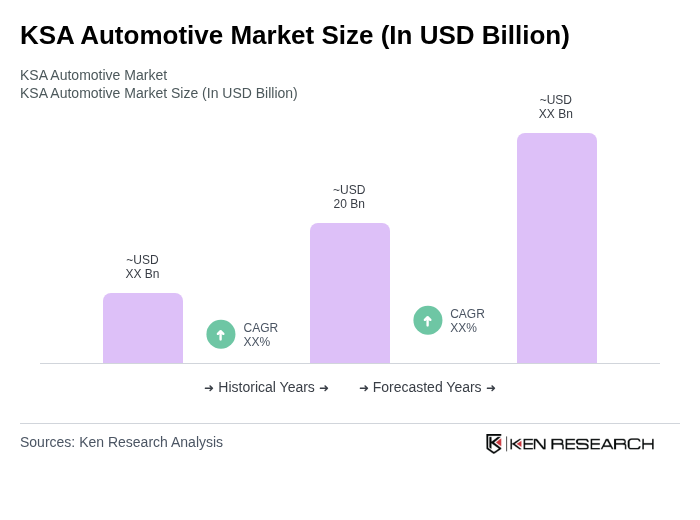
- The KSA Automotive Market is valued at USD 20 billion, based on a five-year historical analysis. This growth is primarily driven by increasing consumer demand, urbanization, and government initiatives aimed at enhancing the automotive sector. The market has seen a significant rise in vehicle sales, particularly in the passenger and commercial vehicle segments, as the population continues to grow and disposable incomes rise. Additional growth drivers include the expansion of local automotive manufacturing under Vision 2030, the entry of new global brands, and the easing of restrictions on female drivers, which has expanded the consumer base and accelerated vehicle ownership rates.
- Key cities such as Riyadh, Jeddah, and Dammam dominate the KSA automotive market due to their large populations, economic activities, and infrastructure development. Riyadh, as the capital, serves as a central hub for automotive sales and services, while Jeddah and Dammam benefit from their strategic locations as major ports, facilitating vehicle imports and distribution.
- In 2023, the Saudi government implemented the Technical Regulation for Fuel Economy (Corporate Average Fuel Economy, or CAFE) for Light Vehicles, issued by the Saudi Standards, Metrology and Quality Organization (SASO) in 2023. This regulation mandates that all new vehicles sold in the country must comply with specific environmental and fuel economy standards, aiming to reduce emissions and promote the adoption of electric vehicles. The regulation supports the Vision 2030 goals to diversify the economy and enhance sustainability in the automotive sector by setting minimum fuel efficiency thresholds and requiring manufacturers to report compliance data annually.
KSA Automotive Market Segmentation
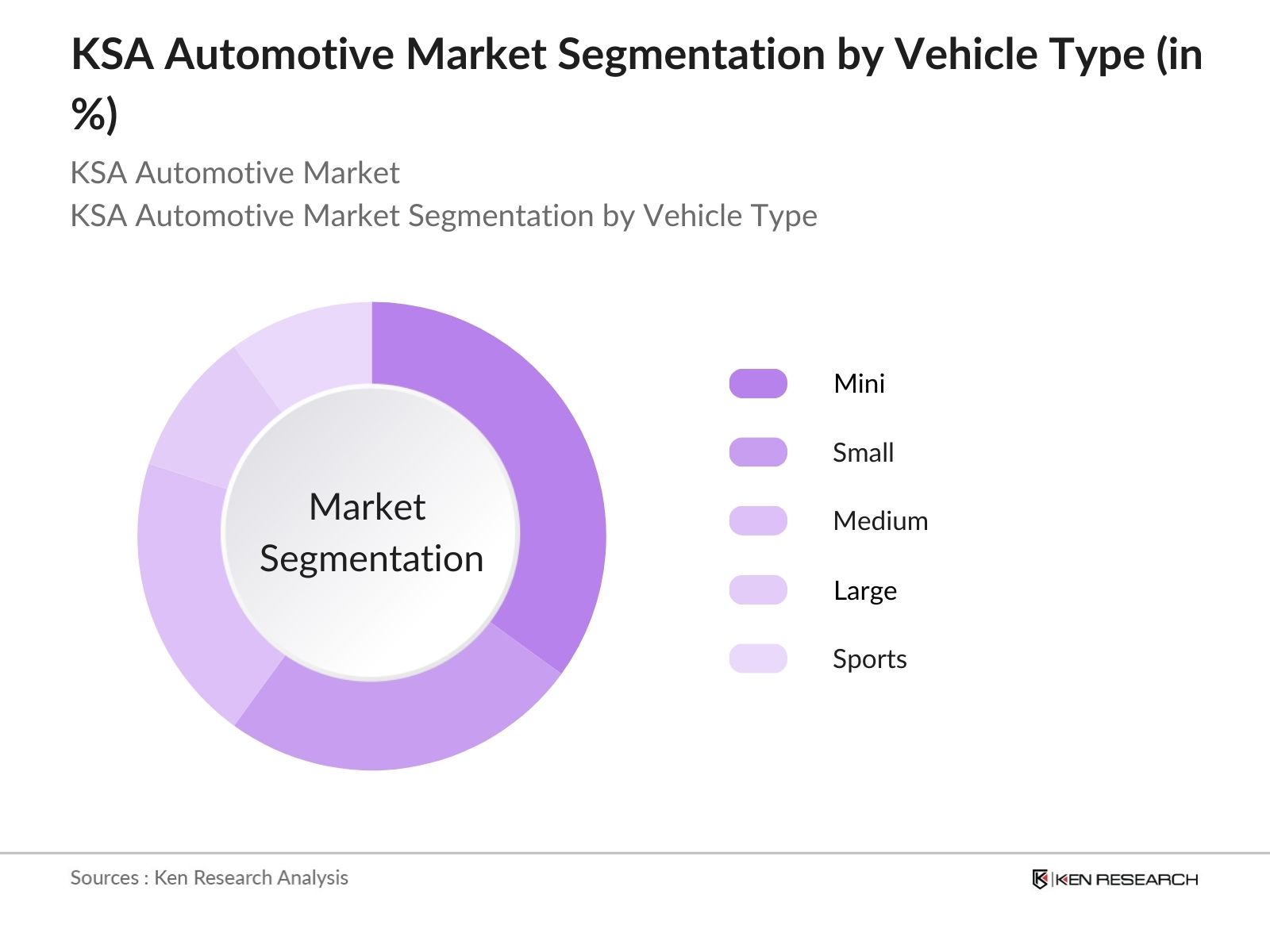
By Vehicle Type:The KSA automotive market is segmented into Mini, Small, Medium, Large, and Sports vehicles. Large SUVs and crossovers dominate the market due to rising demand for family-friendly, spacious vehicles suitable for long-distance and intercity travel. Small vehicles are the fastest-growing segment, driven by affordability and urban mobility preferences. Medium-sized cars maintain steady growth, while Mini and Sports segments are declining as consumers gravitate towards more feature-rich mainstream models offering better value, especially from Chinese manufacturers.
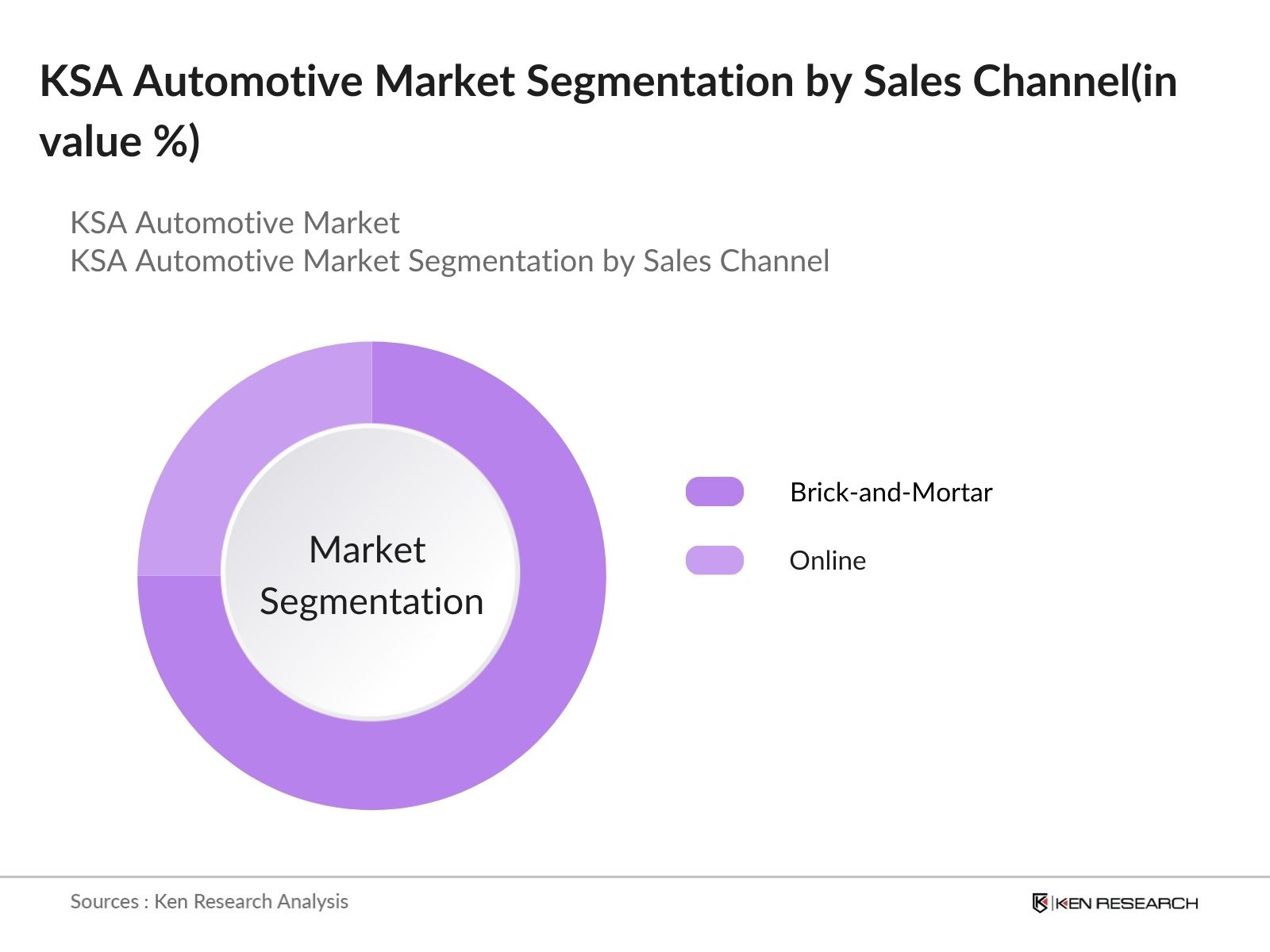
By Sales Channel:The sales channel segmentation includes Brick-and-Mortar and Online platforms. Brick-and-mortar remains the dominant sales channel, supported by physical inspections, trust in offline dealerships, and after-sales service. However, online sales are expanding rapidly, fueled by Vision 2030’s digital ambitions, increasing internet penetration, and growing consumer preference for convenient and seamless e-commerce journeys. The online segment is expected to grow at a faster pace, gradually reshaping the automotive retail landscape in KSA toward a more omni-channel experience????.
KSA Automotive Market Competitive Landscape
The KSA Automotive Market is characterized by a dynamic mix of regional and international players. Leading participants such as Toyota Motor Corporation, Hyundai Motor Company, Kia Corporation, Isuzu, and Changan contribute to innovation, geographic expansion, and service delivery in this space.
KSA Automotive Market Industry Analysis
Growth Drivers
- Increasing Demand for Premium & Tech-Led Vehicles:Affluence is reshaping automotive demand in KSA, with millionaire households growing 2.5x since 2019 and projected to reach 0.38 million by 2025. This wealth expansion is fueling interest in premium models with ADAS, comfort features, and bundled warranty packages. Metro buyers are opting for luxury brands like Lexus, Genesis, and BMW, while urbanization and shorter replacement cycles (5–6 years) are accelerating new car adoption in Tier-1 cities.
- Acceleration of Electrification Through Hybrids & EV Infrastructure:EV share in KSA is forecast to surge from ~7.5% in 2024 to 31% by 2030, driven by hybrid adoption, policy mandates, and charging networks. Vision 2030 targets 30% electric fleet, while 5,000+ fast chargers are being deployed across malls and airports. Domestic assembly by Lucid and Hyundai-PIF JV, along with government support, is reducing costs and building a local EV ecosystem—shifting the fuel mix structurally.
- Digital Retail & Smart Connectivity Transform Buying Behavior:Internet penetration reached ~99% by 2024, enabling online car discovery, paperless e-payments, and faster financing (down to 24 hours). Over 25% of new cars now have OTA/telematics, enabling predictive servicing and smart maintenance. Digital-first outlets and fintech-backed EMI approvals are transforming EV perception in Tier-2 cities, while data-driven tools help dealers optimize parts, warranties, and upsell services efficiently.
Market Challenges
- Regulatory Friction Slowing Import Clearances:Foreign OEMs in KSA face regulatory delays due to SASO/SABER conformity requirements and the mandatory Certificates of Conformity (CoC). These approvals—especially if not pre-coordinated—can stall distribution, complicate launch timelines, and impact model availability. Without pre-registration and accredited compliance channels, clearance timelines for new vehicle imports may be extended, affecting market responsiveness and dealer inventory planning.
- Retail Financing Bottlenecks for Mid-Income Buyers:SAMA’s Responsible Lending and Debt-Burden Ratio (DBR) guidelines impose stricter checks on affordability, limiting access to vehicle loans for price-sensitive segments. Longer approval cycles for credit and income verification can delay purchases, particularly for salaried buyers. These barriers reduce transaction velocity, making it harder for automakers and dealers to convert demand into sales quickly, thereby slowing market momentum.
KSA Automotive Market Future Outlook
The KSA automotive market is poised for transformative growth, driven by increasing consumer demand and government support for local manufacturing. As infrastructure projects progress, vehicle ownership is expected to rise, while the shift towards electric vehicles will reshape the market landscape. In future, the integration of advanced technologies in vehicles will enhance user experience, and the expansion of e-commerce logistics will create new demand for commercial vehicles, further stimulating market dynamics.
Market Opportunities
- EV Integration Aligned with Urban and Industrial Corridor Growth:As Riyadh and Dammam expand through residential and industrial projects, there's growing potential to deploy electric vehicles tailored to premium, executive, and utility segments. The rise of mixed-use zones like Diriyah Gate and ongoing Aramco/SABIC expansions can accelerate EV adoption in premium SUVs, sedans, and staff mobility fleets—creating demand for EV charging, maintenance hubs, and energy-efficient transit models.
- Smart Mobility Demand Rising from Tourism and Transit Zones:Cities like Makkah, Madinah, and Jeddah are experiencing upgrades in airport, hotel, and intercity infrastructure—driving demand for connected vehicles, fleet-based services, and real-time routing platforms. Smart mobility solutions catering to religious tourism, hotel transfers, and shuttle services will benefit from investments in MaaS (Mobility-as-a-Service) and telematics, positioning tech-driven automotive offerings at the forefront of future urban transport.
Scope of the Report
| Segment | Sub-Segments |
|---|---|
| By Vehicle Type | Mini Small Medium Large Sports |
| By Sales Channel | Brick-and-Mortar Online |
| By Retailer | Franchised Independent |
| By Brand Type | Legacy Emerging Premium |
| By Technology | Manual Automatic |
| By Propulsion Type | Petrol Diesel PHV EV |
| By Customer Segment | Retail Corporate |
| By Region | Central Western Eastern Northern Southern |
Key Target Audience
Investors and Venture Capitalist Firms
Government and Regulatory Bodies (e.g., Saudi Ministry of Industry and Mineral Resources, Saudi Arabian Standards Organization)
Automobile Manufacturers and Producers
Automotive Parts Suppliers
Distributors and Retailers
Technology Providers (e.g., Electric Vehicle Technology Firms)
Industry Associations (e.g., Saudi Automotive Association)
Financial Institutions (e.g., Saudi Investment Bank)
Players Mentioned in the Report:
Toyota Motor Corporation
Hyundai Motor Company
Kia Corporation
Isuzu
Changan
Geely
MG (Morris Garages)
Table of Contents
Market Assessment Phase
1. Executive Summary
1.1Executive Summary: KSA Automotive Market
2. Market Overview of KSA Automotive Market
2.1Ecosystem of KSA Automotive Market
2.2Business Cycle and Evolution
3. Market Size and Segmentation of KSA Automotive Market
3.1Market Size of KSA Automotive Market by Sales Volume, CY’2019–CY’2024–CY’2030F
3.2Market Size of KSA Automotive Market by Value, CY’2019–CY’2024–CY’2030F
3.3Market Size of KSA Automotive Market by Vehicle Type, CY’2019–CY’2024–CY’2030F
3.4Market Size of KSA Automotive Market by Sales Channel, CY’2019–CY’2024–CY’2030F
3.5Market Size of KSA Automotive Market by Retailer Type, CY’2019–CY’2024–CY’2030F
3.6Market Size of KSA Automotive Market by Brand Type, CY’2019–CY’2024–CY’2030F
3.7Market Size of KSA Automotive Market by Technology Type, CY’2019–CY’2024–CY’2030F
3.8Market Size of KSA Automotive Market by Propulsion Type, CY’2019–CY’2024–CY’2030F
3.9Market Size of KSA Automotive Market by Customer Segment, CY’2019–CY’2024–CY’2030F
3.10Market Size of KSA Automotive Market by Region, CY’2019–CY’2024–CY’2030F
4. Industrial Analysis of KSA Automotive Market
4.1Market Trends & Drivers of KSA Automotive Market
4.2Challenges & Mitigants in KSA Automotive Market
4.3Porter’s Five Forces – KSA Automotive Market
4.4Key Policies Shaping the KSA Automotive Market
5. Demand Side Analysis of KSA Automotive Market
5.1City Wise Assessment of KSA Automotive Market
5.2Price Sensitivity & Perceived Quality in the KSA Auto Market
5.3Delivery Time & Availability Impact in the KSA Auto Market
6. Competition Framework of KSA Automotive Market
6.1KSA Automotive Market Landscape
6.2KSA Automotive Market Competitive Benchmarking
6.3Financing & Leasing Trends of OEMs in KSA
6.4Chinese OEM Market Penetration Strategies
6.5Incumbent Response to Chinese OEM Entry in the KSA Auto Market
6.6Spare Parts and Interchangeability in the KSA Auto Market
7. Analyst Recommendations
7.1Analyst Recommendations
8. Research Methodology
8.1Market Definition & Assumptions
8.2Abbreviations
8.3Market Research Approach
8.4Consolidated Research Approach
8.5Sample Size Inclusion
8.6Limitation & Conclusion
8.7Disclaimer
Research Methodology
Phase 1: Approach1
Desk Research
- Analysis of automotive industry reports from KSA government agencies and trade associations
- Review of market trends and forecasts from reputable automotive market research publications
- Examination of consumer behavior studies and demographic data from national statistics offices
Primary Research
- Interviews with key stakeholders in the automotive supply chain, including manufacturers and distributors
- Surveys targeting automotive consumers to understand preferences and purchasing behavior
- Focus groups with automotive industry experts to gather insights on market dynamics and future trends
Validation & Triangulation
- Cross-validation of findings through multiple data sources, including sales data and consumer feedback
- Triangulation of insights from primary interviews with secondary research findings
- Sanity checks conducted through expert panel reviews to ensure data accuracy and relevance
Phase 2: Market Size Estimation1
Top-down Assessment
- Estimation of total automotive market size based on national vehicle registration statistics
- Segmentation of the market by vehicle type, including passenger cars, commercial vehicles, and electric vehicles
- Incorporation of government initiatives and policies promoting electric vehicle adoption and sustainability
Bottom-up Modeling
- Collection of sales data from major automotive dealerships and manufacturers operating in KSA
- Analysis of average transaction values and volume of vehicles sold across different segments
- Estimation of market growth rates based on historical sales trends and economic indicators
Forecasting & Scenario Analysis
- Development of forecasting models using historical sales data and economic growth projections
- Scenario analysis based on potential regulatory changes and shifts in consumer preferences
- Creation of baseline, optimistic, and pessimistic market growth scenarios through 2030
Phase 3: CATI Sample Composition1
| Scope Item/Segment | Sample Size | Target Respondent Profiles |
|---|---|---|
| Passenger Vehicle Market | 100 | Car Owners, Automotive Enthusiasts |
| Commercial Vehicle Sector | 60 | Fleet Managers, Logistics Coordinators |
| Electric Vehicle Adoption | 40 | Environmental Advocates, Early Adopters |
| Automotive Aftermarket Services | 50 | Service Center Managers, Parts Distributors |
| Consumer Preferences in Automotive Purchases | 80 | General Consumers, First-time Buyers |
Frequently Asked Questions
What is the current value of the KSA automotive market?
The KSA automotive market is valued at approximately USD 20 billion, driven by increasing consumer demand, urbanization, and government initiatives aimed at enhancing the automotive sector.
What factors are driving growth in the KSA automotive market?
Which cities dominate the KSA automotive market?
What are the main vehicle types in the KSA automotive market?
Other Regional/Country Reports
Malaysia Automotive Market
APAC Automotive Market
SEA Automotive Market
Other Adjacent Reports
Germany Automotive Components Market
Thailand Vehicle Telematics Market
India Automotive Battery Market Size, Share & Forecast, By Vehicle Type, Powertrain & Sales Channel, 2026–2031Thailand Tire Manufacturing Market
Saudi Arabia automotive lubricants market size, share, growth drivers, trends, opportunities & forecast 2025–2030Belgium Car Rental Market Size, Share & Forecast, By Vehicle Type, Sales Channel & Rental Duration, 2026-2032KSA Automotive Finance MarketQatar Road Infrastructure Development Market
Why Buy From Us?

What makes us stand out is that our consultants follow Robust, Refine and Result (RRR) methodology. Robust for clear definitions, approaches and sanity checking, Refine for differentiating respondents' facts and opinions, and Result for presenting data with story.

We have set a benchmark in the industry by offering our clients with syndicated and customized market research reports featuring coverage of entire market as well as meticulous research and analyst insights.

While we don't replace traditional research, we flip the method upside down. Our dual approach of Top Bottom & Bottom Top ensures quality deliverable by not just verifying company fundamentals but also looking at the sector and macroeconomic factors.

With one step in the future, our research team constantly tries to show you the bigger picture. We help with some of the tough questions you may encounter along the way: How is the industry positioned? Best marketing channel? KPI's of competitors? By aligning every element, we help maximize success.

Our report gives you instant access to the answers and sources that other companies might choose to hide. We elaborate each steps of research methodology we have used and showcase you the sample size to earn your trust.

If you need any support, we are here! We pride ourselves on universe strength, data quality, and quick, friendly, and professional service.