About the Report
Base Year 2024Kuwait Abrasives Market Overview
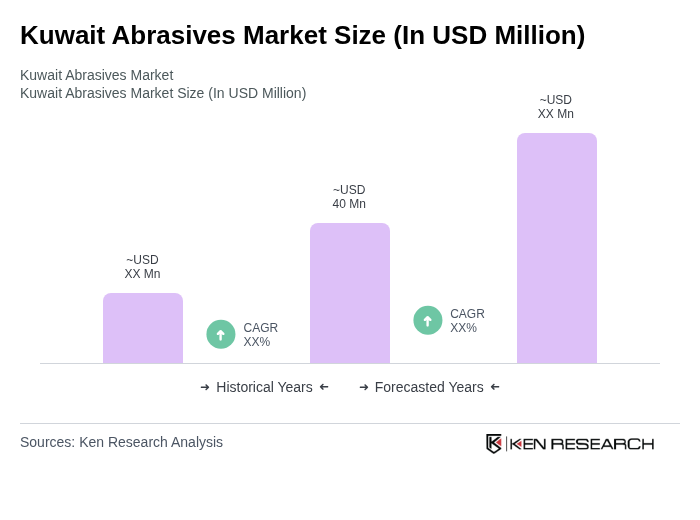
- The Kuwait Abrasives Market is valued at USD 40 million, based on a five-year historical analysis. This growth is primarily driven by increasing demand from sectors such as construction, automotive, and metal fabrication, which require high-quality abrasives for surface preparation and finishing processes. The expansion of manufacturing activity and the rise of advanced abrasive materials are also contributing to market growth.
- Kuwait City remains the dominant hub in the abrasives market due to its strategic location and robust industrial base. The presence of major construction projects, ongoing infrastructure development, and a growing automotive sector in the city significantly contribute to the demand for abrasives, making it a focal point for suppliers and manufacturers.
- In 2023, the Kuwaiti government implemented the “Kuwait Standard Specification for Abrasive Products” (KSS 2100:2023), issued by the Public Authority for Industry. This regulation mandates compliance with international safety and performance standards, including ISO 11126 for blasting abrasives and ISO 6344 for coated abrasives. All abrasives used in construction and manufacturing must meet these specifications for durability, efficiency, and occupational safety, with regular compliance audits and certification required for importers and manufacturers.
Kuwait Abrasives Market Segmentation
By Type:The abrasives market is segmented into bonded abrasives, coated abrasives, super abrasives, loose abrasives, and others. Each type serves distinct applications: bonded abrasives are widely used for grinding and cutting, coated abrasives for sanding and finishing, super abrasives for precision machining, and loose abrasives for blasting and polishing. These segments reflect the diverse requirements across construction, automotive, electronics, and metal fabrication industries.
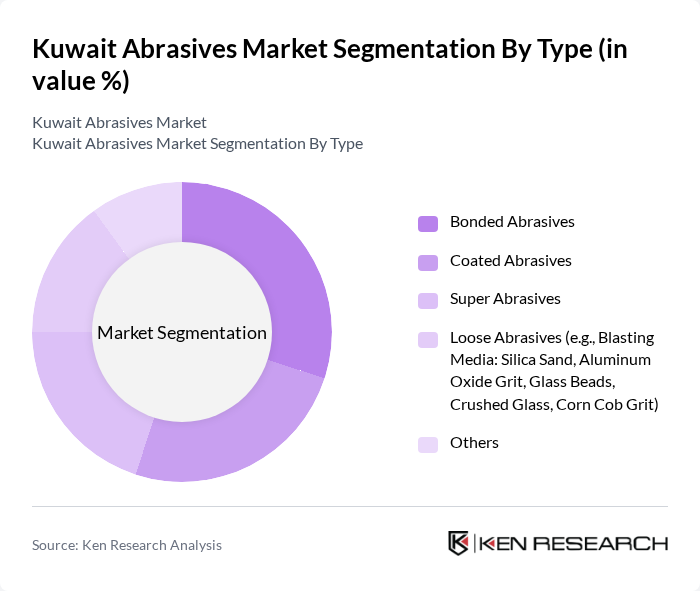
The bonded abrasives segment leads the market, driven by their extensive use in grinding and cutting applications across construction, metal fabrication, and automotive industries. Their durability and high material removal rates make them the preferred choice for manufacturers and contractors. The rising adoption of precision engineering and advanced manufacturing processes further accelerates demand for bonded abrasives, reinforcing their market dominance.
By End-User:The abrasives market is segmented by end-user industries, including construction & infrastructure, automotive & transportation, metal fabrication & machinery, electronics & electrical, oil & gas, and others. Each sector has unique requirements for abrasives, influencing the demand for specific types and grades. Construction and infrastructure require abrasives for surface preparation and finishing, automotive for bodywork and engine components, metal fabrication for grinding and deburring, electronics for precision polishing, and oil & gas for maintenance and refurbishment.
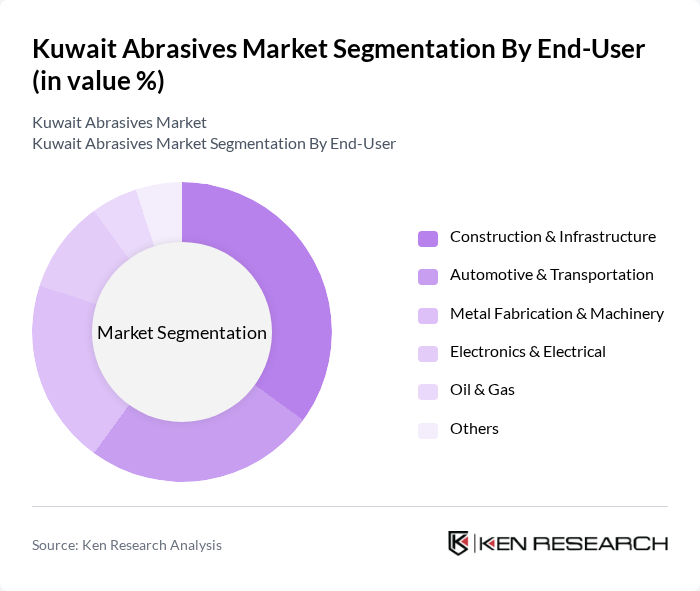
The construction and infrastructure segment is the leading end-user, propelled by ongoing and upcoming projects in Kuwait. Demand is fueled by the need for surface preparation, finishing, and maintenance of construction materials. Government investment in infrastructure, urbanization, and industrial expansion continues to drive abrasives consumption in this segment, supported by stringent quality standards and the adoption of advanced abrasive technologies.
Kuwait Abrasives Market Competitive Landscape
The Kuwait Abrasives Market is characterized by a dynamic mix of regional and international players. Leading participants such as Saint-Gobain Abrasives, 3M Company, Norton Abrasives, Tyrolit Group, Klingspor AG, Mirka Ltd., Sia Abrasives (Bosch Group), Pferd Werkzeuge, VSM AG, Flexovit (Saint-Gobain), Dronco GmbH, Carborundum Universal Limited (CUMI), Fujairah Gold (local GCC supplier), Al Shabib Trading Est. (UAE-based, active in Kuwait), Gulf Abrasives Manufacturing LLC (regional supplier) contribute to innovation, geographic expansion, and service delivery in this space.
Kuwait Abrasives Market Industry Analysis
Growth Drivers
- Increasing Demand from Construction and Manufacturing Sectors:The construction sector in Kuwait is projected to reach a value of approximately $20 billion in future, driven by ongoing infrastructure projects. This surge in construction activities is expected to increase the demand for abrasives, particularly for surface preparation and finishing. Additionally, the manufacturing sector, which contributes around 10% to Kuwait's GDP, is also expanding, further fueling the need for high-quality abrasive materials in various applications.
- Technological Advancements in Abrasive Materials:The Kuwait abrasives market is witnessing significant innovations, with investments in research and development reaching $5 million in future. These advancements focus on creating more efficient and durable abrasive products, which are essential for industries such as automotive and aerospace. Enhanced performance characteristics, such as longer lifespan and better cutting efficiency, are driving adoption among manufacturers, thereby boosting market growth.
- Rising Investments in Infrastructure Projects:Kuwait's government has allocated approximately $15 billion for infrastructure development in future, including roads, bridges, and public facilities. This investment is expected to create a robust demand for abrasives used in construction and maintenance activities. The focus on modernizing infrastructure not only supports economic growth but also enhances the overall demand for high-performance abrasive materials in the region.
Market Challenges
- Fluctuating Raw Material Prices:The abrasives industry in Kuwait faces challenges due to the volatility of raw material prices, particularly for minerals like aluminum oxide and silicon carbide. In future, the price of aluminum oxide is projected to fluctuate between $1,800 and $2,200 per ton, impacting production costs. This unpredictability can hinder manufacturers' ability to maintain competitive pricing and profit margins, posing a significant challenge to market stability.
- Intense Competition from International Players:The Kuwait abrasives market is increasingly competitive, with numerous international players entering the landscape. Companies from Europe and Asia are expanding their market share, leveraging advanced technologies and economies of scale. This competition is expected to intensify in future, making it challenging for local manufacturers to compete on price and innovation, potentially leading to market share erosion for domestic firms.
Kuwait Abrasives Market Future Outlook
The Kuwait abrasives market is poised for growth, driven by increasing demand from key sectors such as construction and manufacturing. As technological advancements continue to enhance product performance, local manufacturers are likely to adopt innovative solutions to remain competitive. Additionally, the government's commitment to infrastructure development will further stimulate market activity. However, companies must navigate challenges such as fluctuating raw material prices and intense competition to capitalize on emerging opportunities in the region.
Market Opportunities
- Expansion of the Automotive and Aerospace Industries:The automotive sector in Kuwait is expected to grow significantly, with vehicle sales projected to reach 200,000 units in future. This growth presents opportunities for abrasives used in manufacturing and finishing processes, particularly in high-performance applications. The aerospace industry is also expanding, creating demand for specialized abrasives that meet stringent quality standards.
- Development of Eco-Friendly Abrasive Products:With increasing environmental awareness, there is a growing demand for eco-friendly abrasive products. The market for sustainable abrasives is projected to reach $1 billion in future, driven by consumer preferences for environmentally responsible solutions. Companies that invest in developing biodegradable and recyclable abrasives can tap into this emerging market segment, enhancing their competitive edge.
Scope of the Report
| Segment | Sub-Segments |
|---|---|
| By Type | Bonded Abrasives Coated Abrasives Super Abrasives Loose Abrasives (e.g., Blasting Media: Silica Sand, Aluminum Oxide Grit, Glass Beads, Crushed Glass, Corn Cob Grit) Others |
| By End-User | Construction & Infrastructure Automotive & Transportation Metal Fabrication & Machinery Electronics & Electrical Oil & Gas Others |
| By Application | Surface Preparation & Cleaning Grinding & Deburring Polishing & Finishing Cutting & Drilling Others |
| By Material | Aluminum Oxide Silicon Carbide Diamond Cubic Boron Nitride Garnet Others |
| By Distribution Channel | Direct Sales Online Retail Industrial Distributors Wholesalers Others |
| By Region | Central Kuwait Southern Kuwait Northern Kuwait Eastern Kuwait Western Kuwait Others |
| By Customer Type | B2B (Industrial/Commercial) B2C (Retail/DIY) Government & Institutional Contracts Others |
Key Target Audience
Investors and Venture Capitalist Firms
Government and Regulatory Bodies (e.g., Kuwait Public Authority for Industry)
Manufacturers and Producers
Distributors and Retailers
Construction and Infrastructure Companies
Automotive and Aerospace Industries
Industrial Equipment Suppliers
Trade Associations and Chambers of Commerce
Players Mentioned in the Report:
Saint-Gobain Abrasives
3M Company
Norton Abrasives
Tyrolit Group
Klingspor AG
Mirka Ltd.
Sia Abrasives (Bosch Group)
Pferd Werkzeuge
VSM AG
Flexovit (Saint-Gobain)
Dronco GmbH
Carborundum Universal Limited (CUMI)
Fujairah Gold (local GCC supplier)
Al Shabib Trading Est. (UAE-based, active in Kuwait)
Gulf Abrasives Manufacturing LLC (regional supplier)
Table of Contents
Market Assessment Phase
1. Executive Summary and Approach
2. Kuwait Abrasives Market Overview
2.1 Key Insights and Strategic Recommendations
2.2 Kuwait Abrasives Market Overview
2.3 Definition and Scope
2.4 Evolution of Market Ecosystem
2.5 Timeline of Key Regulatory Milestones
2.6 Value Chain & Stakeholder Mapping
2.7 Business Cycle Analysis
2.8 Policy & Incentive Landscape
3. Kuwait Abrasives Market Analysis
3.1 Growth Drivers
3.1.1 Increasing demand from construction and manufacturing sectors
3.1.2 Technological advancements in abrasive materials
3.1.3 Rising investments in infrastructure projects
3.1.4 Growing awareness of surface finishing applications
3.2 Market Challenges
3.2.1 Fluctuating raw material prices
3.2.2 Intense competition from international players
3.2.3 Regulatory compliance and environmental concerns
3.2.4 Limited local manufacturing capabilities
3.3 Market Opportunities
3.3.1 Expansion of the automotive and aerospace industries
3.3.2 Development of eco-friendly abrasive products
3.3.3 Increasing demand for precision tools
3.3.4 Potential for export to neighboring markets
3.4 Market Trends
3.4.1 Shift towards automated abrasive solutions
3.4.2 Growing preference for high-performance abrasives
3.4.3 Rise in online sales channels
3.4.4 Focus on sustainability and recycling in production
3.5 Government Regulation
3.5.1 Standards for abrasive product safety
3.5.2 Environmental regulations on manufacturing processes
3.5.3 Import tariffs on abrasive materials
3.5.4 Incentives for local production of abrasives
4. SWOT Analysis
5. Stakeholder Analysis
6. Porter's Five Forces Analysis
7. Kuwait Abrasives Market Market Size, 2019-2024
7.1 By Value
7.2 By Volume
7.3 By Average Selling Price
8. Kuwait Abrasives Market Segmentation
8.1 By Type
8.1.1 Bonded Abrasives
8.1.2 Coated Abrasives
8.1.3 Super Abrasives
8.1.4 Loose Abrasives (e.g., Blasting Media: Silica Sand, Aluminum Oxide Grit, Glass Beads, Crushed Glass, Corn Cob Grit)
8.1.5 Others
8.2 By End-User
8.2.1 Construction & Infrastructure
8.2.2 Automotive & Transportation
8.2.3 Metal Fabrication & Machinery
8.2.4 Electronics & Electrical
8.2.5 Oil & Gas
8.2.6 Others
8.3 By Application
8.3.1 Surface Preparation & Cleaning
8.3.2 Grinding & Deburring
8.3.3 Polishing & Finishing
8.3.4 Cutting & Drilling
8.3.5 Others
8.4 By Material
8.4.1 Aluminum Oxide
8.4.2 Silicon Carbide
8.4.3 Diamond
8.4.4 Cubic Boron Nitride
8.4.5 Garnet
8.4.6 Others
8.5 By Distribution Channel
8.5.1 Direct Sales
8.5.2 Online Retail
8.5.3 Industrial Distributors
8.5.4 Wholesalers
8.5.5 Others
8.6 By Region
8.6.1 Central Kuwait
8.6.2 Southern Kuwait
8.6.3 Northern Kuwait
8.6.4 Eastern Kuwait
8.6.5 Western Kuwait
8.6.6 Others
8.7 By Customer Type
8.7.1 B2B (Industrial/Commercial)
8.7.2 B2C (Retail/DIY)
8.7.3 Government & Institutional Contracts
8.7.4 Others
9. Kuwait Abrasives Market Competitive Analysis
9.1 Market Share of Key Players
9.2 Cross Comparison of Key Players
9.2.1 Company Name
9.2.2 Group Size (Large, Medium, Small)
9.2.3 Revenue Growth Rate (Kuwait market-specific)
9.2.4 Market Penetration Rate (Share of Kuwait abrasives market)
9.2.5 Customer Retention Rate (Repeat business % in Kuwait)
9.2.6 Pricing Strategy (Premium, Value, Volume)
9.2.7 Product Portfolio Breadth (Number of abrasive SKUs offered in Kuwait)
9.2.8 Supply Chain Reliability (Lead time, local warehousing, import dependency)
9.2.9 Brand Recognition (Survey-based or distributor feedback in Kuwait)
9.2.10 Innovation Rate (New product launches or patents relevant to Kuwait)
9.3 SWOT Analysis of Top Players
9.4 Pricing Analysis
9.5 Detailed Profile of Major Companies
9.5.1 Saint-Gobain Abrasives
9.5.2 3M Company
9.5.3 Norton Abrasives
9.5.4 Tyrolit Group
9.5.5 Klingspor AG
9.5.6 Mirka Ltd.
9.5.7 Sia Abrasives (Bosch Group)
9.5.8 Pferd Werkzeuge
9.5.9 VSM AG
9.5.10 Flexovit (Saint-Gobain)
9.5.11 Dronco GmbH
9.5.12 Carborundum Universal Limited (CUMI)
9.5.13 Fujairah Gold (local GCC supplier)
9.5.14 Al Shabib Trading Est. (UAE-based, active in Kuwait)
9.5.15 Gulf Abrasives Manufacturing LLC (regional supplier)
10. Kuwait Abrasives Market End-User Analysis
10.1 Procurement Behavior of Key Ministries
10.1.1 Key procurement processes and timelines
10.1.2 Budget allocation for abrasives
10.1.3 Preferred suppliers and brands
10.1.4 Evaluation criteria for procurement
10.2 Corporate Spend on Infrastructure & Energy
10.2.1 Investment trends in infrastructure projects
10.2.2 Budgeting for abrasive materials
10.2.3 Impact of energy costs on spending
10.2.4 Corporate sustainability initiatives
10.3 Pain Point Analysis by End-User Category
10.3.1 Challenges faced by construction companies
10.3.2 Issues in the automotive sector
10.3.3 Pain points in manufacturing
10.3.4 Regulatory hurdles for government projects
10.4 User Readiness for Adoption
10.4.1 Awareness of abrasive technologies
10.4.2 Training and skill development needs
10.4.3 Adoption barriers in various sectors
10.4.4 Support for transitioning to new products
10.5 Post-Deployment ROI and Use Case Expansion
10.5.1 Measuring ROI from abrasive investments
10.5.2 Case studies of successful implementations
10.5.3 Opportunities for product expansion
10.5.4 Feedback mechanisms for continuous improvement
11. Kuwait Abrasives Market Future Size, 2025-2030
11.1 By Value
11.2 By Volume
11.3 By Average Selling Price
Go-To-Market Strategy Phase
1. Whitespace Analysis + Business Model Canvas
1.1 Market gaps and opportunities
2. Marketing and Positioning Recommendations
2.1 Branding strategies and Product USPs
3. Distribution Plan
3.1 Urban retail vs rural NGO tie-ups
4. Channel & Pricing Gaps
4.1 Underserved routes and Pricing bands
5. Unmet Demand & Latent Needs
5.1 Category gaps and Consumer segments
6. Customer Relationship
6.1 Loyalty programs and After-sales service
7. Value Proposition
7.1 Sustainability and Integrated supply chains
8. Key Activities
8.1 Regulatory compliance, Branding, Distribution setup
9. Entry Strategy Evaluation
9.1 Domestic Market Entry Strategy
9.1.1 Product mix and Pricing band
9.2 Export Entry Strategy
9.2.1 Target countries and Compliance roadmap
10. Entry Mode Assessment
10.1 JV, Greenfield, M&A, Distributor Model
11. Capital and Timeline Estimation
11.1 Capital requirements and Timelines
12. Control vs Risk Trade-Off
12.1 Ownership vs Partnerships
13. Profitability Outlook
13.1 Breakeven analysis and Long-term sustainability
14. Potential Partner List
14.1 Distributors, JVs, Acquisition targets
15. Execution Roadmap
15.1 Phased Plan for Market Entry
15.1.1 Market Setup ? Market Entry ? Growth Acceleration ? Scale & Stabilize
15.2 Key Activities and Milestones
15.2.1 Timeline for execution and key deliverables
Research Methodology
Phase 1: Approach1
Desk Research
- Industry reports from local trade associations and market research firms
- Government publications on manufacturing and import/export statistics
- Academic journals and articles focusing on abrasive materials and their applications
Primary Research
- Interviews with key stakeholders in the abrasives manufacturing sector
- Surveys targeting end-users in construction, automotive, and metalworking industries
- Field visits to manufacturing plants and distribution centers for firsthand insights
Validation & Triangulation
- Cross-referencing data from multiple sources to ensure consistency
- Expert panel reviews to validate findings and assumptions
- Sanity checks against historical market trends and growth rates
Phase 2: Market Size Estimation1
Top-down Assessment
- Analysis of national economic indicators and their correlation with abrasives demand
- Segmentation of the market by product type and end-user industry
- Incorporation of regional demand variations across Kuwait
Bottom-up Modeling
- Collection of sales data from leading abrasives manufacturers in Kuwait
- Estimation of market share based on production capacity and sales volume
- Cost analysis of raw materials and production processes to determine pricing strategies
Forecasting & Scenario Analysis
- Utilization of historical growth rates to project future market trends
- Scenario modeling based on potential economic shifts and regulatory changes
- Development of best-case, worst-case, and most-likely market scenarios through 2030
Phase 3: CATI Sample Composition1
| Scope Item/Segment | Sample Size | Target Respondent Profiles |
|---|---|---|
| Construction Industry Usage | 100 | Project Managers, Site Supervisors |
| Automotive Manufacturing Insights | 80 | Production Managers, Quality Control Engineers |
| Metalworking Sector Feedback | 70 | Machinists, Tooling Engineers |
| Retail Distribution Channels | 50 | Sales Managers, Supply Chain Coordinators |
| End-user Satisfaction Surveys | 60 | Purchasing Agents, Operations Managers |
Frequently Asked Questions
What is the current value of the Kuwait Abrasives Market?
The Kuwait Abrasives Market is valued at approximately USD 40 million, driven by increasing demand from sectors such as construction, automotive, and metal fabrication, which require high-quality abrasives for various applications.
What are the main drivers of growth in the Kuwait Abrasives Market?
Which sectors are the largest consumers of abrasives in Kuwait?
What types of abrasives are available in the Kuwait market?
Other Regional/Country Reports
Indonesia Abrasives Market
Malaysia Abrasives Market
APAC Abrasives Market
Other Adjacent Reports
Oman Automotive Components Market
South Africa Metalworking Market
Malaysia Electronics Manufacturing Market
Mexico Oil and Gas Services Market
Oman Aerospace Components Market
Philippines Industrial Coatings Market Size, Share & Forecast, By Product Type, End-Use Industry & Technology, 2026–2032Global Welding Equipment Market Size, Share & Forecast, By Product Type, End-Use Industry & Technology, 2025-2032Why Buy From Us?

What makes us stand out is that our consultants follow Robust, Refine and Result (RRR) methodology. Robust for clear definitions, approaches and sanity checking, Refine for differentiating respondents' facts and opinions, and Result for presenting data with story.

We have set a benchmark in the industry by offering our clients with syndicated and customized market research reports featuring coverage of entire market as well as meticulous research and analyst insights.

While we don't replace traditional research, we flip the method upside down. Our dual approach of Top Bottom & Bottom Top ensures quality deliverable by not just verifying company fundamentals but also looking at the sector and macroeconomic factors.

With one step in the future, our research team constantly tries to show you the bigger picture. We help with some of the tough questions you may encounter along the way: How is the industry positioned? Best marketing channel? KPI's of competitors? By aligning every element, we help maximize success.

Our report gives you instant access to the answers and sources that other companies might choose to hide. We elaborate each steps of research methodology we have used and showcase you the sample size to earn your trust.

If you need any support, we are here! We pride ourselves on universe strength, data quality, and quick, friendly, and professional service.