About the Report
Base Year 2024Kuwait Generic Pharmaceuticals Market Overview
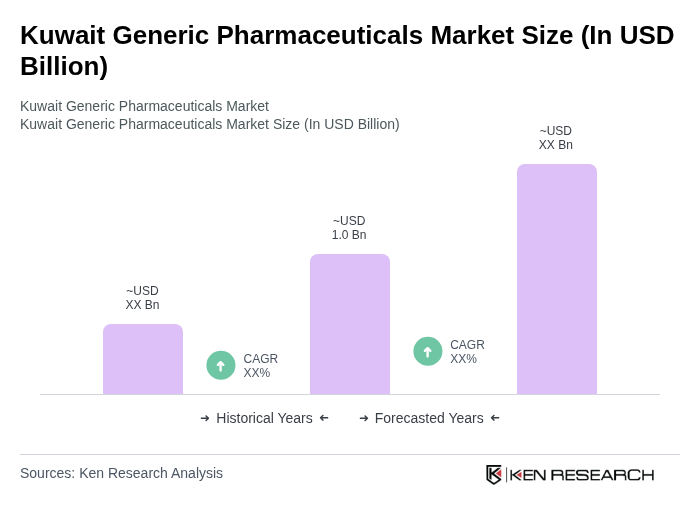
- The Kuwait Generic Pharmaceuticals Market is valued at USD 1.0 billion, based on a five-year historical analysis and the share of generics within the overall pharmaceutical market and contract manufacturing segment in the country. This growth is primarily driven by the increasing prevalence of chronic diseases such as diabetes, cardiovascular disorders, and obesity, rising healthcare expenditure, and a growing demand for cost-effective medication options among consumers. The market has seen a steady shift towards generics as healthcare providers and patients seek affordable alternatives to branded drugs, supported by government efforts to optimize pharmaceutical spending and encourage the use of therapeutically equivalent products.
- Kuwait City is the dominant hub in the market, owing to its advanced healthcare infrastructure, a high concentration of tertiary hospitals and specialized clinics, and the location of key public and private sector healthcare institutions. Additionally, the presence of major pharmaceutical distributors, local manufacturers, and a supportive policy environment for medicine registration and pricing contribute to the city's leadership in the generic pharmaceuticals sector. Other notable areas include Al Ahmadi and Hawalli, which also play significant roles in the distribution and consumption of generic medications through large public hospitals and private pharmacies.
- In 2023, the Kuwaiti government continued to strengthen policies that promote the rational use of medicines and encourage cost-effective prescribing in public healthcare facilities, including measures that give preference to generic equivalents where available and therapeutically appropriate. This policy orientation is aligned with the Pharmaceutical Law No. 28 of 1996 and its executive regulations issued by the Ministry of Health, which govern the registration, pricing, and quality standards of medicines in Kuwait, including generic drugs, and require adherence to bioequivalence and quality specifications for approved generics. These initiatives aim to enhance the accessibility of affordable healthcare solutions for the population, thereby promoting the use of generics and contributing to more sustainable healthcare expenditure.
Kuwait Generic Pharmaceuticals Market Segmentation
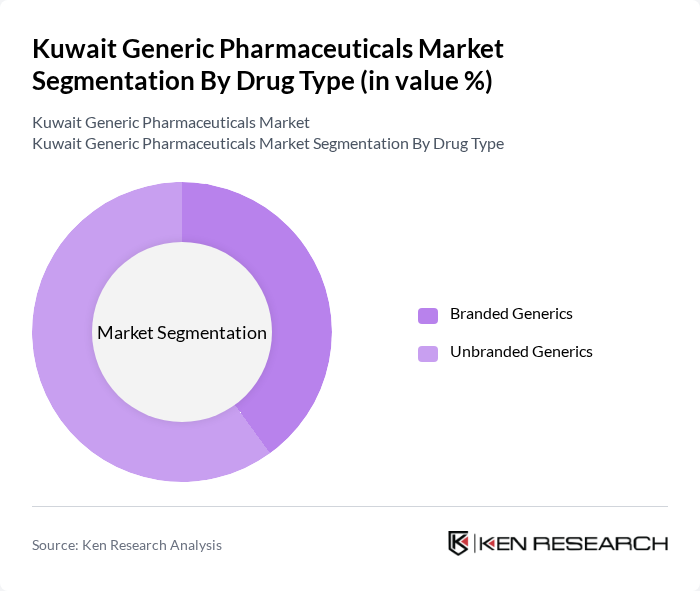
By Drug Type:The market is segmented into Branded Generics and Unbranded Generics, in line with the structure used in regional generic drug analyses. Branded generics are often preferred due to their perceived quality, established manufacturer reputation, and stronger promotion among prescribers, while unbranded generics are gaining traction due to their cost-effectiveness, particularly in chronic therapy areas with high prescription volumes. In Kuwait’s generic pharmaceuticals contract manufacturing segment, branded generics currently account for a larger revenue share; however, unbranded generics are registering faster growth as payers and healthcare providers place greater emphasis on cost containment and formulary optimization. The unbranded generics segment is increasingly relevant in high-burden disease areas where patients and insurers prioritize affordability.
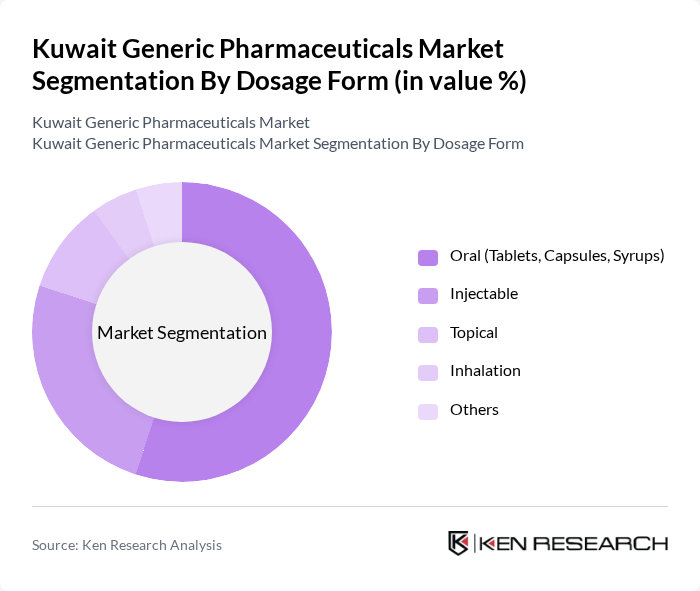
By Dosage Form:The market is categorized into Oral (Tablets, Capsules, Syrups), Injectable, Topical, Inhalation, and Others, which is consistent with the dominant formulation mix in Kuwait’s broader pharmaceutical and generic manufacturing landscape. Oral dosage forms dominate the market due to their convenience, patient preference, and suitability for mass production and chronic disease management, making them the preferred choice among patients and healthcare providers. The injectable segment is also significant, particularly for hospital-based care, critical and acute conditions, and certain chronic therapies requiring parenteral administration. The trend towards self-administration of certain injectables (for example, in diabetes and autoimmune disorders) and the expansion of outpatient and home-care services are expected to further support this segment.
Kuwait Generic Pharmaceuticals Market Competitive Landscape
The Kuwait Generic Pharmaceuticals Market is characterized by a dynamic mix of regional and international players. Leading participants such as Kuwait Saudi Pharmaceutical Industries Company (KSPICO), Kuwait Pharmaceutical Industries Company (KPI), Gulf Pharmaceutical Industries (Julphar), Hikma Pharmaceuticals, Tabuk Pharmaceuticals, SPIMACO Addwaeih, Bayer Consumer Health / Pharmaceuticals (Kuwait Operations), Pfizer (Kuwait Operations), Novartis (Sandoz / Generics Portfolio in Kuwait), Kuwait Life Sciences Company (KLSC), Al Mulla Group – Healthcare & Pharmaceuticals Division, YIACO Medical Company, Kayan Health Company, Abdi ?brahim ?laç Sanayi ve Ticaret A.?., Neopharma (GCC Operations Including Kuwait) contribute to innovation, geographic expansion, and service delivery in this space.
Kuwait Generic Pharmaceuticals Market Industry Analysis
Growth Drivers
- Increasing Demand for Cost-Effective Medications:The demand for cost-effective medications in Kuwait is driven by a healthcare expenditure that reached approximately $9.0 billion in future. With a significant portion of this budget allocated to pharmaceuticals, the generic segment is poised for growth. The Ministry of Health's initiatives to promote affordable healthcare solutions further bolster this trend, as patients increasingly seek alternatives to branded drugs, which can be up to 30% more expensive.
- Government Initiatives to Promote Generic Drugs:The Kuwaiti government has implemented various initiatives to encourage the use of generic drugs, including regulatory reforms that streamline the approval process. In future, the government allocated $1.5 billion specifically for the promotion of generics, aiming to increase their market share from 20% to 40% in future. These efforts are crucial in enhancing accessibility and affordability for patients, thereby driving market growth.
- Expanding Distribution Channels:The expansion of distribution channels in Kuwait is a significant growth driver for the generic pharmaceuticals market. In future, the number of pharmacies increased by 20%, reaching over 1,440 outlets nationwide. This growth facilitates better access to generic medications, particularly in underserved areas. Additionally, partnerships with e-pharmacies are emerging, allowing consumers to purchase medications online, further enhancing market penetration and consumer reach.
Market Challenges
- Regulatory Hurdles:Regulatory hurdles pose a significant challenge to the growth of the generic pharmaceuticals market in Kuwait. The approval process for generic drugs can take up to 18 months, which delays market entry. In future, only 65% of submitted applications received timely approvals, leading to a backlog that hampers competition. These regulatory delays can discourage investment and innovation within the sector, limiting the availability of affordable medications.
- Competition from Branded Pharmaceuticals:The competition from branded pharmaceuticals remains a formidable challenge for generic drug manufacturers in Kuwait. In future, branded drugs accounted for approximately 78% of the total pharmaceutical market value, creating a significant barrier for generics. The strong brand loyalty among healthcare providers and patients, coupled with aggressive marketing strategies from branded companies, complicates the efforts of generic manufacturers to capture market share.
Kuwait Generic Pharmaceuticals Market Future Outlook
The future outlook for the Kuwait generic pharmaceuticals market appears promising, driven by increasing healthcare expenditure and government support for generics. As the population ages and chronic diseases rise, the demand for affordable medications will likely intensify. Additionally, advancements in technology and drug development are expected to enhance the efficiency of generic drug production, making it easier for companies to enter the market and meet consumer needs effectively.
Market Opportunities
- Expansion into Emerging Therapeutic Areas:There is a significant opportunity for generic manufacturers to expand into emerging therapeutic areas such as oncology and diabetes management. With the prevalence of these conditions rising, the demand for affordable treatment options is expected to grow, providing a lucrative market for generics to fill the gap left by branded drugs.
- Collaborations with Local Healthcare Providers:Collaborating with local healthcare providers presents a valuable opportunity for generic pharmaceutical companies. By partnering with hospitals and clinics, companies can enhance their distribution networks and improve product visibility. Such collaborations can also facilitate better education about the benefits of generics, ultimately increasing their adoption among healthcare professionals and patients alike.
Scope of the Report
| Segment | Sub-Segments |
|---|---|
| By Drug Type | Branded Generics Unbranded Generics |
| By Dosage Form | Oral (Tablets, Capsules, Syrups) Injectable Topical Inhalation Others |
| By Therapeutic Area | Cardiovascular Diseases Anti-Infectives Central Nervous System Disorders Diabetes and Metabolic Disorders Oncology Respiratory Diseases Others |
| By End-User | Public Hospitals and Clinics Private Hospitals and Clinics Retail Pharmacies Online / E-Pharmacies Others |
| By Distribution Channel | Hospital Pharmacies Retail Pharmacies Government Procurement / Tenders Wholesalers & Distributors Others |
| By Source of Manufacture | Locally Manufactured Imported |
Key Target Audience
Investors and Venture Capitalist Firms
Government and Regulatory Bodies (e.g., Ministry of Health, Kuwait Food and Drug Administration)
Manufacturers and Producers
Distributors and Retailers
Pharmaceutical Wholesalers
Healthcare Providers and Institutions
Industry Associations
Financial Institutions
Players Mentioned in the Report:
Kuwait Saudi Pharmaceutical Industries Company (KSPICO)
Kuwait Pharmaceutical Industries Company (KPI)
Gulf Pharmaceutical Industries (Julphar)
Hikma Pharmaceuticals
Tabuk Pharmaceuticals
SPIMACO Addwaeih
Bayer Consumer Health / Pharmaceuticals (Kuwait Operations)
Pfizer (Kuwait Operations)
Novartis (Sandoz / Generics Portfolio in Kuwait)
Kuwait Life Sciences Company (KLSC)
Al Mulla Group Healthcare & Pharmaceuticals Division
YIACO Medical Company
Kayan Health Company
Abdi Ibrahim Ilac Sanayi ve Ticaret A.S.
Neopharma (GCC Operations Including Kuwait)
Table of Contents
Market Assessment Phase
1. Executive Summary and Approach
2. Kuwait Generic Pharmaceuticals Market Overview
2.1 Key Insights and Strategic Recommendations
2.2 Kuwait Generic Pharmaceuticals Market Overview
2.3 Definition and Scope
2.4 Evolution of Market Ecosystem
2.5 Timeline of Key Regulatory Milestones
2.6 Value Chain & Stakeholder Mapping
2.7 Business Cycle Analysis
2.8 Policy & Incentive Landscape
3. Kuwait Generic Pharmaceuticals Market Analysis
3.1 Growth Drivers
3.1.1 Increasing Demand for Cost-Effective Medications
3.1.2 Government Initiatives to Promote Generic Drugs
3.1.3 Rising Healthcare Expenditure
3.1.4 Expanding Distribution Channels
3.2 Market Challenges
3.2.1 Regulatory Hurdles
3.2.2 Competition from Branded Pharmaceuticals
3.2.3 Quality Assurance Issues
3.2.4 Limited Awareness Among Healthcare Providers
3.3 Market Opportunities
3.3.1 Expansion into Emerging Therapeutic Areas
3.3.2 Collaborations with Local Healthcare Providers
3.3.3 Increasing Export Potential
3.3.4 Technological Advancements in Drug Development
3.4 Market Trends
3.4.1 Shift Towards Personalized Medicine
3.4.2 Growth of E-Pharmacies
3.4.3 Increased Focus on Biologics and Biosimilars
3.4.4 Rising Popularity of Telemedicine
3.5 Government Regulation
3.5.1 Stricter Quality Control Measures
3.5.2 Enhanced Approval Processes for Generic Drugs
3.5.3 Price Control Regulations
3.5.4 Incentives for Local Manufacturing
4. SWOT Analysis
5. Stakeholder Analysis
6. Porter's Five Forces Analysis
7. Kuwait Generic Pharmaceuticals Market Market Size, 2019-2024
7.1 By Value
7.2 By Volume
7.3 By Average Selling Price
8. Kuwait Generic Pharmaceuticals Market Segmentation
8.1 By Drug Type
8.1.1 Branded Generics
8.1.2 Unbranded Generics
8.2 By Dosage Form
8.2.1 Oral (Tablets, Capsules, Syrups)
8.2.2 Injectable
8.2.3 Topical
8.2.4 Inhalation
8.2.5 Others
8.3 By Therapeutic Area
8.3.1 Cardiovascular Diseases
8.3.2 Anti-Infectives
8.3.3 Central Nervous System Disorders
8.3.4 Diabetes and Metabolic Disorders
8.3.5 Oncology
8.3.6 Respiratory Diseases
8.3.7 Others
8.4 By End-User
8.4.1 Public Hospitals and Clinics
8.4.2 Private Hospitals and Clinics
8.4.3 Retail Pharmacies
8.4.4 Online / E-Pharmacies
8.4.5 Others
8.5 By Distribution Channel
8.5.1 Hospital Pharmacies
8.5.2 Retail Pharmacies
8.5.3 Government Procurement / Tenders
8.5.4 Wholesalers & Distributors
8.5.5 Others
8.6 By Source of Manufacture
8.6.1 Locally Manufactured
8.6.2 Imported
9. Kuwait Generic Pharmaceuticals Market Competitive Analysis
9.1 Market Share of Key Players
9.2 Cross Comparison of Key Players
9.2.1 Company Name
9.2.2 Group Size (Large, Medium, or Small as per industry convention)
9.2.3 Kuwait Generic Revenue (USD Million)
9.2.4 Generic Revenue CAGR (Last 3–5 Years)
9.2.5 EBITDA Margin (%) – Generics Business
9.2.6 Market Share in Kuwait Generic Pharmaceuticals (%)
9.2.7 R&D Spend on Generics (% of Revenue)
9.2.8 Number of Generic SKUs Registered in Kuwait
9.2.9 Tender Win Rate with Ministry of Health (%)
9.2.10 Average Price vs Leading Brand (% Discount)
9.2.11 Fill Rate / On-Time Delivery Performance (%)
9.2.12 GMP / Regulatory Audit Pass Rate (%)
9.2.13 Pharmacovigilance / Product Recall Incidence
9.2.14 Brand Awareness among Prescribers / Pharmacists (Survey Score)
9.3 SWOT Analysis of Top Players
9.4 Pricing Analysis
9.5 Detailed Profile of Major Companies
9.5.1 Kuwait Saudi Pharmaceutical Industries Company (KSPICO)
9.5.2 Kuwait Pharmaceutical Industries Company (KPI)
9.5.3 Gulf Pharmaceutical Industries (Julphar)
9.5.4 Hikma Pharmaceuticals
9.5.5 Tabuk Pharmaceuticals
9.5.6 SPIMACO Addwaeih
9.5.7 Bayer Consumer Health / Pharmaceuticals (Kuwait Operations)
9.5.8 Pfizer (Kuwait Operations)
9.5.9 Novartis (Sandoz / Generics Portfolio in Kuwait)
9.5.10 Kuwait Life Sciences Company (KLSC)
9.5.11 Al Mulla Group – Healthcare & Pharmaceuticals Division
9.5.12 YIACO Medical Company
9.5.13 Kayan Health Company
9.5.14 Abdi ?brahim ?laç Sanayi ve Ticaret A.?.
9.5.15 Neopharma (GCC Operations Including Kuwait)
10. Kuwait Generic Pharmaceuticals Market End-User Analysis
10.1 Procurement Behavior of Key Ministries
10.1.1 Ministry of Health
10.1.2 Ministry of Defense
10.1.3 Ministry of Interior
10.1.4 Ministry of Education
10.1.5 Others
10.2 Corporate Spend on Infrastructure & Energy
10.2.1 Healthcare Infrastructure Investments
10.2.2 Energy Efficiency Initiatives
10.2.3 Technology Upgrades
10.2.4 Training and Development
10.2.5 Others
10.3 Pain Point Analysis by End-User Category
10.3.1 Hospitals
10.3.2 Retail Pharmacies
10.3.3 Clinics
10.3.4 Online Pharmacies
10.3.5 Others
10.4 User Readiness for Adoption
10.4.1 Awareness Levels
10.4.2 Training Needs
10.4.3 Infrastructure Readiness
10.4.4 Financial Readiness
10.4.5 Others
10.5 Post-Deployment ROI and Use Case Expansion
10.5.1 Cost Savings Analysis
10.5.2 Performance Metrics
10.5.3 User Satisfaction Levels
10.5.4 Future Use Cases
10.5.5 Others
11. Kuwait Generic Pharmaceuticals Market Future Size, 2025-2030
11.1 By Value
11.2 By Volume
11.3 By Average Selling Price
Go-To-Market Strategy Phase
1. Whitespace Analysis + Business Model Canvas
1.1 Market Gaps Identification
1.2 Business Model Development
2. Marketing and Positioning Recommendations
2.1 Branding Strategies
2.2 Product USPs
3. Distribution Plan
3.1 Urban Retail vs Rural NGO Tie-ups
4. Channel & Pricing Gaps
4.1 Underserved Routes
4.2 Pricing Bands
5. Unmet Demand & Latent Needs
5.1 Category Gaps
5.2 Consumer Segments
6. Customer Relationship
6.1 Loyalty Programs
6.2 After-sales Service
7. Value Proposition
7.1 Sustainability
7.2 Integrated Supply Chains
8. Key Activities
8.1 Regulatory Compliance
8.2 Branding
8.3 Distribution Setup
9. Entry Strategy Evaluation
9.1 Domestic Market Entry Strategy
9.1.1 Product Mix
9.1.2 Pricing Band
9.1.3 Packaging
9.2 Export Entry Strategy
9.2.1 Target Countries
9.2.2 Compliance Roadmap
10. Entry Mode Assessment
10.1 JV
10.2 Greenfield
10.3 M&A
10.4 Distributor Model
11. Capital and Timeline Estimation
11.1 Capital Requirements
11.2 Timelines
12. Control vs Risk Trade-Off
12.1 Ownership vs Partnerships
13. Profitability Outlook
13.1 Breakeven Analysis
13.2 Long-term Sustainability
14. Potential Partner List
14.1 Distributors
14.2 JVs
14.3 Acquisition Targets
15. Execution Roadmap
15.1 Phased Plan for Market Entry
15.1.1 Market Setup
15.1.2 Market Entry
15.1.3 Growth Acceleration
15.1.4 Scale & Stabilize
15.2 Key Activities and Milestones
15.2.1 Milestone Planning
15.2.2 Activity Tracking
Research Methodology
Phase 1: Approach1
Desk Research
- Analysis of market reports from Kuwait's Ministry of Health and pharmaceutical associations
- Review of published articles and white papers on generic pharmaceuticals in the Gulf region
- Examination of trade statistics and import/export data from Kuwait's Customs Department
Primary Research
- Interviews with key opinion leaders in the pharmaceutical industry, including regulatory officials
- Surveys with pharmacists and healthcare providers to understand market dynamics
- Focus groups with patients to gauge perceptions and preferences regarding generic medications
Validation & Triangulation
- Cross-validation of findings through multiple data sources, including government and industry reports
- Triangulation of qualitative insights from interviews with quantitative data from surveys
- Sanity checks conducted through expert panel reviews comprising industry veterans
Phase 2: Market Size Estimation1
Top-down Assessment
- Estimation of total pharmaceutical market size in Kuwait, with a focus on the generic segment
- Analysis of healthcare expenditure trends and their impact on generic drug adoption
- Incorporation of demographic data to assess potential market growth areas
Bottom-up Modeling
- Collection of sales data from leading generic pharmaceutical manufacturers operating in Kuwait
- Estimation of market share based on product categories and therapeutic areas
- Volume and pricing analysis to derive revenue projections for the generic segment
Forecasting & Scenario Analysis
- Development of forecasting models based on historical growth rates and market trends
- Scenario analysis considering regulatory changes and healthcare policy shifts
- Projections for market growth through 2030 under various economic conditions
Phase 3: CATI Sample Composition1
| Scope Item/Segment | Sample Size | Target Respondent Profiles |
|---|---|---|
| Pharmacy Sector Insights | 120 | Pharmacy Owners, Pharmacists |
| Healthcare Provider Perspectives | 90 | Doctors, Nurses, Healthcare Administrators |
| Patient Attitudes Towards Generics | 100 | Patients, Caregivers |
| Regulatory Insights | 60 | Regulatory Affairs Specialists, Compliance Officers |
| Market Trends and Forecasts | 70 | Market Analysts, Industry Experts |
Frequently Asked Questions
What is the current value of the Kuwait Generic Pharmaceuticals Market?
The Kuwait Generic Pharmaceuticals Market is valued at approximately USD 1.0 billion, reflecting a significant share within the overall pharmaceutical market and contract manufacturing segment in the country.
What factors are driving the growth of the generic pharmaceuticals market in Kuwait?
Which areas in Kuwait are significant for the distribution of generic medications?
How does the Kuwaiti government support the use of generic drugs?
Other Regional/Country Reports
Other Adjacent Reports
Egypt Branded Pharmaceuticals Market
Belgium Diabetes Therapeutics Market
UAE Cardiovascular Drugs MarketOman Oncology Pharmaceuticals Market
Philippines Over-the-Counter Medicines Market
Indonesia Pharmacy Retail Market Size, Share & Forecast, By Product Type, Pharmacy Format & Distribution Channel, 2026–2032Mexico Healthcare Distribution Market
UAE Biopharmaceuticals MarketBrazil Injectable Drugs Market
Why Buy From Us?

What makes us stand out is that our consultants follow Robust, Refine and Result (RRR) methodology. Robust for clear definitions, approaches and sanity checking, Refine for differentiating respondents' facts and opinions, and Result for presenting data with story.

We have set a benchmark in the industry by offering our clients with syndicated and customized market research reports featuring coverage of entire market as well as meticulous research and analyst insights.

While we don't replace traditional research, we flip the method upside down. Our dual approach of Top Bottom & Bottom Top ensures quality deliverable by not just verifying company fundamentals but also looking at the sector and macroeconomic factors.

With one step in the future, our research team constantly tries to show you the bigger picture. We help with some of the tough questions you may encounter along the way: How is the industry positioned? Best marketing channel? KPI's of competitors? By aligning every element, we help maximize success.

Our report gives you instant access to the answers and sources that other companies might choose to hide. We elaborate each steps of research methodology we have used and showcase you the sample size to earn your trust.

If you need any support, we are here! We pride ourselves on universe strength, data quality, and quick, friendly, and professional service.