About the Report
Base Year 2024Australia Generic Pharmaceuticals Market Overview
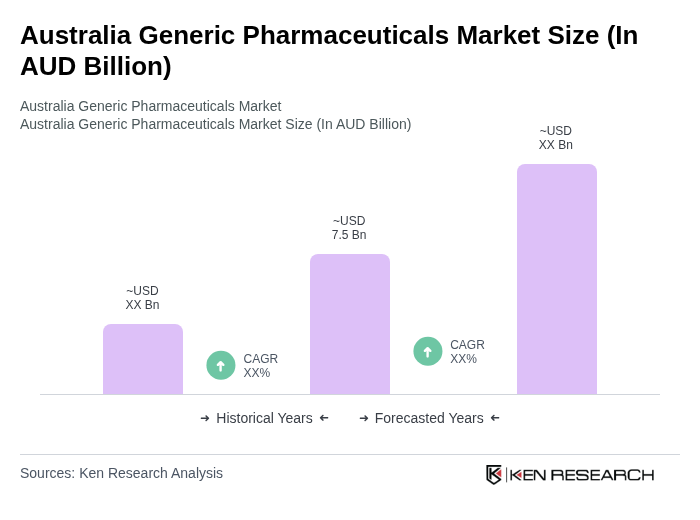
- The Australia Generic Pharmaceuticals Market is valued at AUD 7.5 billion, based on a five-year historical analysis of published estimates for generic drugs in Australia and the broader pharmaceutical sector. This growth is primarily driven by the increasing demand for cost-effective medication alternatives, the rising prevalence of chronic diseases, an aging population, and the government's push for affordable healthcare solutions through mechanisms such as the Pharmaceutical Benefits Scheme (PBS) and generic substitution policies. The market has seen a significant shift towards generics as healthcare providers and patients seek to reduce costs while maintaining access to essential medications, with generics accounting for the majority of prescription volume under PBS by count of prescriptions.
- Key centers of activity in this market include major cities such as Sydney, Melbourne, and Brisbane, which play a leading role due to their robust healthcare infrastructure, high population density, concentration of hospitals and specialist clinics, and significant investment in pharmaceutical research, development, and manufacturing. These cities serve as hubs for pharmaceutical companies, logistics providers, and contract manufacturers, facilitating innovation, clinical research, and efficient distribution across Australia, thereby enhancing the overall market dynamics.
- The Australian government’s medicines policy framework, articulated through the National Medicines Policy 2022 issued by the Australian Government Department of Health and Aged Care, aims to ensure that all Australians have timely access to affordable and effective medicines and recognizes the role of generics and biosimilars in achieving quality use of medicines and sustainability of the PBS. This policy, together with PBS pricing reforms and generic price-disclosure arrangements, emphasizes the importance of generics in the healthcare system by supporting generic substitution in community pharmacy, encouraging prescribers to consider cost-effective options, and enabling subsidies that lower out-of-pocket costs for patients.
Australia Generic Pharmaceuticals Market Segmentation
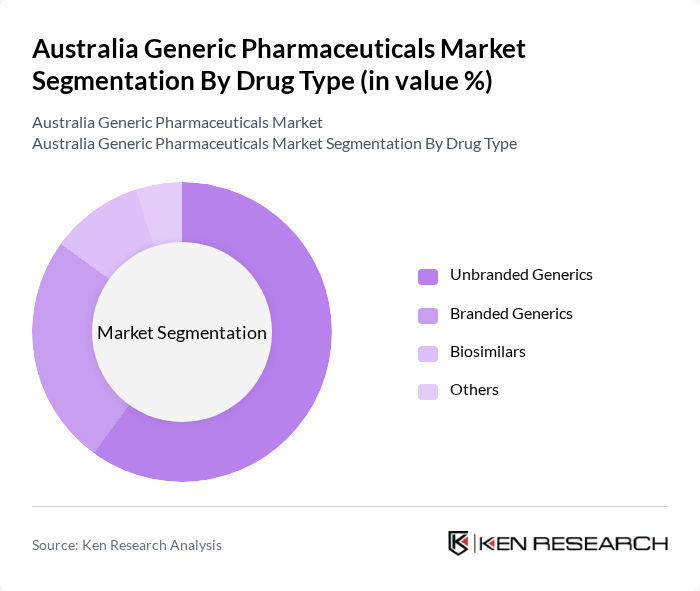
By Drug Type:The market is segmented into Unbranded Generics, Branded Generics, Biosimilars, and Others. Unbranded generics dominate the market in terms of prescription volume on the PBS, driven by mandatory or encouraged generic substitution at the pharmacy level and strong price competition after patent expiry. The increasing focus on cost containment in healthcare has led to a surge in the adoption of unbranded generics, which offer the same therapeutic benefits as their originator counterparts at a lower price, particularly in high-volume classes such as cardiovascular, central nervous system, diabetes, and respiratory therapies. Branded generics and biosimilars are also gaining traction, particularly in therapeutic areas such as oncology, rheumatology, and autoimmune diseases, where complex molecules and biologic therapies are increasingly subject to biosimilar competition and where payers seek further savings.
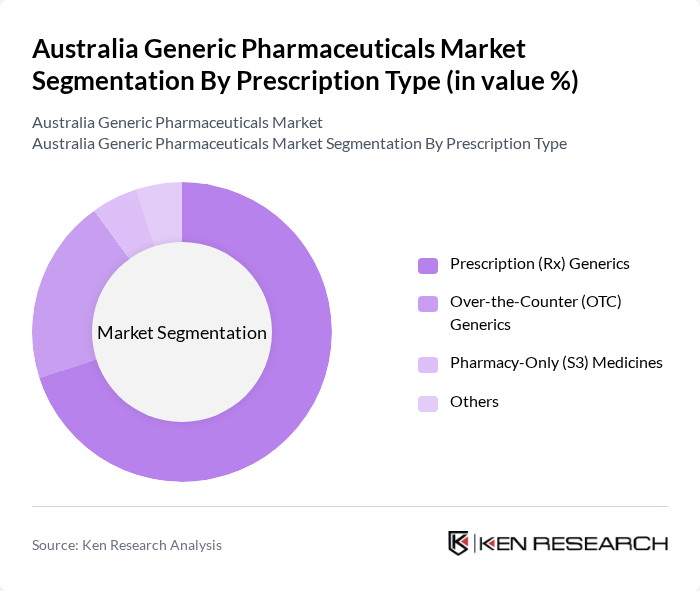
By Prescription Type:The market is categorized into Prescription (Rx) Generics, Over-the-Counter (OTC) Generics, Pharmacy-Only (S3) Medicines, and Others. Prescription generics hold the largest share, supported by the high burden of chronic diseases such as cardiovascular disorders, diabetes, respiratory diseases, and cancer, and by PBS-reimbursed prescribing patterns that favor cost-effective generic alternatives. OTC generics are also witnessing growth as consumers become more health-conscious, increasingly use self-care products, and seek affordable alternatives for common ailments such as pain, allergy, and gastrointestinal conditions, particularly in supermarket and pharmacy chains. The pharmacy-only segment (Schedule 3, Pharmacist Only Medicines) is expanding in line with regulatory up-scheduling and down-scheduling decisions that enable certain medicines to be supplied without a prescription under pharmacist supervision, increasing access to cost-effective generic options and further boosting the market.
Australia Generic Pharmaceuticals Market Competitive Landscape
The Australia Generic Pharmaceuticals Market is characterized by a dynamic mix of regional and international players. Leading participants such as Apotex Pty Ltd, Viatris (including legacy Mylan), Sandoz Australia, Teva Pharmaceutical Industries Ltd, Fresenius Kabi Australia, Arrotex Pharmaceuticals (including Sigma Healthcare generics portfolio), Pfizer Australia – Generics & Established Products, Viatris (Hospira injectable generics portfolio), AFT Pharmaceuticals, Generic Health Pty Ltd, Biocon Biologics (Biosimilars), Sun Pharmaceutical Industries Ltd, Hetero Labs Ltd, Dr. Reddy’s Laboratories Ltd, and other emerging domestic and regional generic players contribute to innovation, geographic expansion, and service delivery in this space.
Australia Generic Pharmaceuticals Market Industry Analysis
Growth Drivers
- Increasing Demand for Cost-Effective Medications:The Australian healthcare system is increasingly prioritizing cost-effective medications, with generic drugs accounting for approximately 90% of all prescriptions filled in future. This shift is driven by the rising out-of-pocket expenses for patients, which reached AUD 1,500 per year on average. The government’s focus on reducing healthcare costs has led to a significant increase in the adoption of generics, as they provide similar therapeutic benefits at a fraction of the cost of branded drugs.
- Expanding Aging Population:Australia’s population aged 65 and over is projected to reach 25% by future, up from 15% in 2020. This demographic shift is accompanied by a higher prevalence of chronic diseases, necessitating increased medication use. The demand for affordable treatment options is expected to surge, with older Australians spending an average of AUD 2,000 annually on prescription medications. This trend significantly boosts the market for generic pharmaceuticals, as they offer essential therapies at lower prices.
- Government Initiatives to Promote Generic Drugs:The Australian government has implemented various initiatives to encourage the use of generic medications, including the Pharmaceutical Benefits Scheme (PBS), which subsidizes the cost of generics. In future, the PBS saved Australians approximately AUD 3 billion in medication costs. Additionally, educational campaigns aimed at healthcare professionals and patients have increased awareness of generics, further driving their adoption and contributing to market growth.
Market Challenges
- Intense Competition Among Generic Manufacturers:The Australian generic pharmaceuticals market is characterized by fierce competition, with over 120 manufacturers vying for market share. This saturation has led to aggressive pricing strategies, resulting in an average price decline of 20% for generics in the past two years. Such competition can erode profit margins, making it challenging for companies to sustain operations and invest in research and development for new products.
- Regulatory Hurdles and Compliance Costs:Navigating the regulatory landscape in Australia poses significant challenges for generic pharmaceutical companies. Compliance with Therapeutic Goods Administration (TGA) guidelines requires substantial investment, with average costs exceeding AUD 600,000 per product for approval. These regulatory hurdles can delay market entry and increase operational costs, ultimately impacting the competitiveness of generic manufacturers in the market.
Australia Generic Pharmaceuticals Market Future Outlook
The future of the Australian generic pharmaceuticals market appears promising, driven by ongoing demographic changes and government support. As the population ages and healthcare costs continue to rise, the demand for affordable medications is expected to grow. Additionally, advancements in digital health technologies and telehealth services are likely to enhance access to generic drugs, further expanding their market presence. Companies that adapt to these trends will be well-positioned to capitalize on emerging opportunities in the sector.
Market Opportunities
- Expansion into Emerging Therapeutic Areas:There is a significant opportunity for generic manufacturers to expand into emerging therapeutic areas such as oncology and immunology. The Australian market for oncology drugs alone is projected to reach AUD 4 billion in future, presenting a lucrative avenue for generics. By developing affordable alternatives in these high-demand sectors, companies can enhance their market share and contribute to improved patient outcomes.
- Strategic Partnerships with Healthcare Providers:Forming strategic partnerships with healthcare providers can enhance the distribution and visibility of generic drugs. Collaborations with hospitals and clinics can facilitate better access to generics, particularly in underserved regions. Such partnerships can also lead to joint initiatives aimed at educating healthcare professionals about the benefits of generics, ultimately driving their adoption and increasing market penetration.
Scope of the Report
| Segment | Sub-Segments |
|---|---|
| By Drug Type | Unbranded Generics Branded Generics Biosimilars Others |
| By Prescription Type | Prescription (Rx) Generics Over-the-Counter (OTC) Generics Pharmacy-Only (S3) Medicines Others |
| By Route of Administration | Oral Parenteral (Injectable) Topical Inhalation Others |
| By Therapeutic Class | Cardiovascular Central Nervous System Anti-infectives Oncology Respiratory Gastrointestinal & Metabolic Musculoskeletal Others |
| By End-User | Public Hospitals Private Hospitals Retail Community Pharmacies Online Pharmacies / E-Pharmacy Clinics & Day Surgery Centres Others |
| By Distribution Channel | Direct Tender / Institutional Sales Pharmaceutical Wholesalers Pharmacy Banner Groups Online Platforms Others |
| By Region | Australian Capital Territory & New South Wales Victoria & Tasmania Queensland Northern Territory & South Australia Western Australia |
Key Target Audience
Investors and Venture Capitalist Firms
Government and Regulatory Bodies (e.g., Therapeutic Goods Administration, Department of Health)
Manufacturers and Producers
Distributors and Retailers
Pharmaceutical Wholesalers
Health Insurance Providers
Industry Associations (e.g., Generic Medicines Industry Association)
Pharmacy Chains and Independent Pharmacies
Players Mentioned in the Report:
Apotex Pty Ltd
Viatris (including legacy Mylan)
Sandoz Australia
Teva Pharmaceutical Industries Ltd
Fresenius Kabi Australia
Arrotex Pharmaceuticals (including Sigma Healthcare generics portfolio)
Pfizer Australia Generics & Established Products
Viatris (Hospira injectable generics portfolio)
AFT Pharmaceuticals
Generic Health Pty Ltd
Biocon Biologics (Biosimilars)
Sun Pharmaceutical Industries Ltd
Hetero Labs Ltd
Dr. Reddys Laboratories Ltd
Other Emerging Domestic and Regional Generic Players
Table of Contents
Market Assessment Phase
1. Executive Summary and Approach
2. Australia Generic Pharmaceuticals Market Overview
2.1 Key Insights and Strategic Recommendations
2.2 Australia Generic Pharmaceuticals Market Overview
2.3 Definition and Scope
2.4 Evolution of Market Ecosystem
2.5 Timeline of Key Regulatory Milestones
2.6 Value Chain & Stakeholder Mapping
2.7 Business Cycle Analysis
2.8 Policy & Incentive Landscape
3. Australia Generic Pharmaceuticals Market Analysis
3.1 Growth Drivers
3.1.1 Increasing Demand for Cost-Effective Medications
3.1.2 Expanding Aging Population
3.1.3 Government Initiatives to Promote Generic Drugs
3.1.4 Rising Healthcare Expenditure
3.2 Market Challenges
3.2.1 Intense Competition Among Generic Manufacturers
3.2.2 Regulatory Hurdles and Compliance Costs
3.2.3 Price Erosion Due to Market Saturation
3.2.4 Limited Brand Recognition Compared to Innovator Drugs
3.3 Market Opportunities
3.3.1 Expansion into Emerging Therapeutic Areas
3.3.2 Strategic Partnerships with Healthcare Providers
3.3.3 Adoption of Digital Health Solutions
3.3.4 Increasing Focus on Biosimilars
3.4 Market Trends
3.4.1 Growth of Online Pharmacies
3.4.2 Shift Towards Personalized Medicine
3.4.3 Rising Popularity of Telehealth Services
3.4.4 Emphasis on Sustainable and Eco-Friendly Practices
3.5 Government Regulation
3.5.1 Therapeutic Goods Administration (TGA) Guidelines
3.5.2 Pharmaceutical Benefits Scheme (PBS) Policies
3.5.3 Pricing and Reimbursement Regulations
3.5.4 Quality Assurance Standards for Generic Drugs
4. SWOT Analysis
5. Stakeholder Analysis
6. Porter's Five Forces Analysis
7. Australia Generic Pharmaceuticals Market Market Size, 2019-2024
7.1 By Value
7.2 By Volume
7.3 By Average Selling Price
8. Australia Generic Pharmaceuticals Market Segmentation
8.1 By Drug Type
8.1.1 Unbranded Generics
8.1.2 Branded Generics
8.1.3 Biosimilars
8.1.4 Others
8.2 By Prescription Type
8.2.1 Prescription (Rx) Generics
8.2.2 Over-the-Counter (OTC) Generics
8.2.3 Pharmacy-Only (S3) Medicines
8.2.4 Others
8.3 By Route of Administration
8.3.1 Oral
8.3.2 Parenteral (Injectable)
8.3.3 Topical
8.3.4 Inhalation
8.3.5 Others
8.4 By Therapeutic Class
8.4.1 Cardiovascular
8.4.2 Central Nervous System
8.4.3 Anti-infectives
8.4.4 Oncology
8.4.5 Respiratory
8.4.6 Gastrointestinal & Metabolic
8.4.7 Musculoskeletal
8.4.8 Others
8.5 By End-User
8.5.1 Public Hospitals
8.5.2 Private Hospitals
8.5.3 Retail Community Pharmacies
8.5.4 Online Pharmacies / E-Pharmacy
8.5.5 Clinics & Day Surgery Centres
8.5.6 Others
8.6 By Distribution Channel
8.6.1 Direct Tender / Institutional Sales
8.6.2 Pharmaceutical Wholesalers
8.6.3 Pharmacy Banner Groups
8.6.4 Online Platforms
8.6.5 Others
8.7 By Region
8.7.1 Australian Capital Territory & New South Wales
8.7.2 Victoria & Tasmania
8.7.3 Queensland
8.7.4 Northern Territory & South Australia
8.7.5 Western Australia
9. Australia Generic Pharmaceuticals Market Competitive Analysis
9.1 Market Share of Key Players
9.2 Cross Comparison of Key Players
9.2.1 Company Name
9.2.2 Revenue from Generics in Australia (AUD million)
9.2.3 3-Year CAGR in Generics Revenue
9.2.4 PBS-Listed Generic Molecules (Number)
9.2.5 Volume Share of Generics in Company’s Total Rx Portfolio (%)
9.2.6 Average PBS Price Discount vs Originator (%)
9.2.7 EBITDA Margin from Generics Business (%)
9.2.8 R&D Spend on Generics and Biosimilars (% of Revenue)
9.2.9 Australia Market Coverage (States / % Pharmacies Reached)
9.2.10 Hospital vs Retail Sales Mix (%)
9.2.11 Time-to-Market Post Patent Expiry (Months)
9.2.12 Regulatory Approval Success Rate with TGA (%)
9.2.13 New Product Launches in Last 3 Years (Number)
9.3 SWOT Analysis of Top Players
9.4 Pricing Analysis
9.5 Detailed Profile of Major Companies
9.5.1 Apotex Pty Ltd
9.5.2 Viatris (including legacy Mylan)
9.5.3 Sandoz Australia
9.5.4 Teva Pharmaceutical Industries Ltd
9.5.5 Fresenius Kabi Australia
9.5.6 Arrotex Pharmaceuticals (including Sigma Healthcare generics portfolio)
9.5.7 Pfizer Australia – Generics & Established Products
9.5.8 Viatris (Hospira injectable generics portfolio)
9.5.9 AFT Pharmaceuticals
9.5.10 Generic Health Pty Ltd
9.5.11 Biocon Biologics (Biosimilars)
9.5.12 Sun Pharmaceutical Industries Ltd
9.5.13 Hetero Labs Ltd
9.5.14 Dr. Reddy’s Laboratories Ltd
9.5.15 Other Emerging Domestic and Regional Generic Players
10. Australia Generic Pharmaceuticals Market End-User Analysis
10.1 Procurement Behavior of Key Ministries
10.1.1 Government Procurement Policies
10.1.2 Budget Allocations for Pharmaceuticals
10.1.3 Tendering Processes
10.1.4 Supplier Evaluation Criteria
10.2 Corporate Spend on Infrastructure & Energy
10.2.1 Investment in Pharmaceutical Infrastructure
10.2.2 Energy Efficiency Initiatives
10.2.3 Budgeting for R&D
10.2.4 Corporate Social Responsibility Spending
10.3 Pain Point Analysis by End-User Category
10.3.1 Access to Affordable Medications
10.3.2 Supply Chain Disruptions
10.3.3 Regulatory Compliance Challenges
10.3.4 Quality Assurance Concerns
10.4 User Readiness for Adoption
10.4.1 Awareness of Generic Options
10.4.2 Training and Support Needs
10.4.3 Technology Adoption Levels
10.4.4 Feedback Mechanisms
10.5 Post-Deployment ROI and Use Case Expansion
10.5.1 Measurement of Cost Savings
10.5.2 User Satisfaction Surveys
10.5.3 Expansion into New Therapeutic Areas
10.5.4 Long-term Partnership Opportunities
11. Australia Generic Pharmaceuticals Market Future Size, 2025-2030
11.1 By Value
11.2 By Volume
11.3 By Average Selling Price
Go-To-Market Strategy Phase
1. Whitespace Analysis + Business Model Canvas
1.1 Market Gaps Identification
1.2 Value Proposition Development
1.3 Revenue Streams Analysis
1.4 Cost Structure Evaluation
1.5 Key Partnerships Exploration
1.6 Customer Segmentation
1.7 Channels of Distribution
2. Marketing and Positioning Recommendations
2.1 Branding Strategies
2.2 Product USPs
2.3 Target Market Identification
2.4 Communication Strategies
2.5 Digital Marketing Approaches
3. Distribution Plan
3.1 Urban Retail vs Rural NGO Tie-ups
3.2 Logistics and Supply Chain Management
3.3 Distribution Partnerships
3.4 Inventory Management Strategies
4. Channel & Pricing Gaps
4.1 Underserved Routes
4.2 Pricing Bands
4.3 Competitive Pricing Analysis
5. Unmet Demand & Latent Needs
5.1 Category Gaps
5.2 Consumer Segments
5.3 Emerging Trends Analysis
6. Customer Relationship
6.1 Loyalty Programs
6.2 After-sales Service
6.3 Customer Feedback Mechanisms
7. Value Proposition
7.1 Sustainability
7.2 Integrated Supply Chains
7.3 Customer-Centric Approaches
8. Key Activities
8.1 Regulatory Compliance
8.2 Branding
8.3 Distribution Setup
9. Entry Strategy Evaluation
9.1 Domestic Market Entry Strategy
9.1.1 Product Mix
9.1.2 Pricing Band
9.1.3 Packaging
9.2 Export Entry Strategy
9.2.1 Target Countries
9.2.2 Compliance Roadmap
10. Entry Mode Assessment
10.1 JV
10.2 Greenfield
10.3 M&A
10.4 Distributor Model
11. Capital and Timeline Estimation
11.1 Capital Requirements
11.2 Timelines
12. Control vs Risk Trade-Off
12.1 Ownership vs Partnerships
13. Profitability Outlook
13.1 Breakeven Analysis
13.2 Long-term Sustainability
14. Potential Partner List
14.1 Distributors
14.2 JVs
14.3 Acquisition Targets
15. Execution Roadmap
15.1 Phased Plan for Market Entry
15.1.1 Market Setup
15.1.2 Market Entry
15.1.3 Growth Acceleration
15.1.4 Scale & Stabilize
15.2 Key Activities and Milestones
15.2.1 Milestone Planning
15.2.2 Activity Tracking
Research Methodology
Phase 1: Approach1
Desk Research
- Analysis of industry reports from Australian pharmaceutical associations and government health departments
- Review of published market studies and white papers on generic pharmaceuticals
- Examination of regulatory frameworks and guidelines from the Therapeutic Goods Administration (TGA)
Primary Research
- Interviews with key opinion leaders in the pharmaceutical sector, including pharmacists and healthcare professionals
- Surveys targeting procurement managers at major pharmaceutical distributors
- Field interviews with executives from generic drug manufacturing companies
Validation & Triangulation
- Cross-validation of data through multiple sources, including sales data and market trends
- Triangulation of findings from primary interviews and secondary data sources
- Sanity checks conducted through expert panel discussions and feedback sessions
Phase 2: Market Size Estimation1
Top-down Assessment
- Estimation of market size based on national healthcare expenditure and pharmaceutical spending
- Segmentation of the market by therapeutic categories and distribution channels
- Incorporation of government initiatives promoting the use of generic drugs
Bottom-up Modeling
- Volume estimates derived from sales data of leading generic pharmaceutical companies
- Cost analysis based on pricing strategies and production costs of generic drugs
- Calculation of market size using unit sales multiplied by average selling prices
Forecasting & Scenario Analysis
- Multi-variable forecasting models incorporating demographic trends and healthcare policies
- Scenario analysis based on potential changes in regulatory environments and market dynamics
- Development of baseline, optimistic, and pessimistic market projections through 2030
Phase 3: CATI Sample Composition1
| Scope Item/Segment | Sample Size | Target Respondent Profiles |
|---|---|---|
| Pharmacy Retail Sector | 120 | Pharmacy Owners, Pharmacists |
| Generic Drug Manufacturers | 90 | Production Managers, Quality Assurance Heads |
| Healthcare Providers | 80 | General Practitioners, Specialists |
| Pharmaceutical Distributors | 70 | Supply Chain Managers, Sales Directors |
| Regulatory Bodies | 40 | Regulatory Affairs Specialists, Compliance Officers |
Frequently Asked Questions
What is the current value of the Australia Generic Pharmaceuticals Market?
The Australia Generic Pharmaceuticals Market is valued at approximately AUD 7.5 billion, reflecting a significant growth driven by the demand for cost-effective medication alternatives and government initiatives promoting affordable healthcare solutions.
What factors are driving the growth of the generic pharmaceuticals market in Australia?
How does the aging population impact the generic pharmaceuticals market in Australia?
What role does the Pharmaceutical Benefits Scheme (PBS) play in the generic pharmaceuticals market?
Other Regional/Country Reports
Other Adjacent Reports
Japan Biosimilars Market
Japan Branded Pharmaceuticals Market
Malaysia Over-the-Counter Pharmaceuticals Market
New Zealand Pharmaceutical Manufacturing Market Size, Share & Forecast, By Product Type, Dosage Form & Manufacturing Model, 2026-2031Indonesia Active Pharmaceutical Ingredients Market Size, Share & Forecast, By API Type, Synthesis Type & Therapeutic Area, 2026-2031Saudi Arabia Pharmaceutical Distribution Market Size, Share, Growth Drivers, Trends, Opportunities & Forecast 2025–2030Ksa Contract Manufacturing Services Market Report Size, Share, Growth Drivers, Trends, Opportunities & Forecast 2025–2030Germany Oncology Drugs Market
Mexico Immunology Therapeutics Market
Middle East Chronic Disease Management Market Size, Share, Growth Drivers, Trends, Opportunities & Forecast 2025–2030Why Buy From Us?

What makes us stand out is that our consultants follow Robust, Refine and Result (RRR) methodology. Robust for clear definitions, approaches and sanity checking, Refine for differentiating respondents' facts and opinions, and Result for presenting data with story.

We have set a benchmark in the industry by offering our clients with syndicated and customized market research reports featuring coverage of entire market as well as meticulous research and analyst insights.

While we don't replace traditional research, we flip the method upside down. Our dual approach of Top Bottom & Bottom Top ensures quality deliverable by not just verifying company fundamentals but also looking at the sector and macroeconomic factors.

With one step in the future, our research team constantly tries to show you the bigger picture. We help with some of the tough questions you may encounter along the way: How is the industry positioned? Best marketing channel? KPI's of competitors? By aligning every element, we help maximize success.

Our report gives you instant access to the answers and sources that other companies might choose to hide. We elaborate each steps of research methodology we have used and showcase you the sample size to earn your trust.

If you need any support, we are here! We pride ourselves on universe strength, data quality, and quick, friendly, and professional service.