About the Report
Base Year 2024New Zealand Generic Pharmaceuticals Market Overview
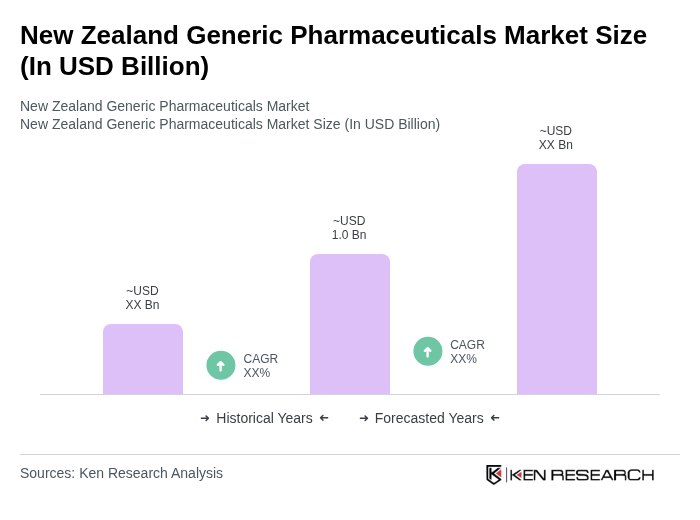
- The New Zealand Generic Pharmaceuticals Market is valued at USD 1.0 billion, based on a five-year historical analysis of prescription medicines funded through the public system and the high penetration of generics within this spend. This growth is primarily driven by the increasing demand for cost-effective medication alternatives, as well as the rising prevalence of chronic diseases such as diabetes, cardiovascular disease, and cancer in an aging population. The market is also supported by government initiatives aimed at promoting the use of generics to reduce healthcare costs, particularly through PHARMAC’s competitive tendering and reference pricing mechanisms that prioritize clinically effective, lower-cost generic options.
- Auckland, Wellington, and Christchurch are the dominant cities in the New Zealand Generic Pharmaceuticals Market. Auckland leads due to its large share of the national population and concentration of hospitals, specialist clinics, and distribution hubs for pharmaceutical wholesalers. Wellington serves as the political and administrative center, housing key health-sector agencies such as the Ministry of Health and PHARMAC, which influence funding and access policies for generic medicines nationwide. Christchurch, with its role as the main South Island urban center and its expanding healthcare infrastructure, also plays a significant role in dispensing, hospital use, and logistics for generic pharmaceuticals.
- The regulatory framework for generic medicines is primarily governed by the Medicines Act 1981 and the Medicines Regulations 1984, administered by Medsafe (a business unit of the Ministry of Health), which set requirements for quality, safety, efficacy, and bioequivalence of generic medicines. In addition, PHARMAC’s Pharmaceutical Schedule and related Operating Policies and Procedures guide funding decisions, competitive tendering, and listing of generic medicines, streamlining market access for generic manufacturers that meet these regulatory and evidentiary standards. This framework enhances competition and supports lower prices and broad availability of funded generic medications to New Zealand patients.
New Zealand Generic Pharmaceuticals Market Segmentation
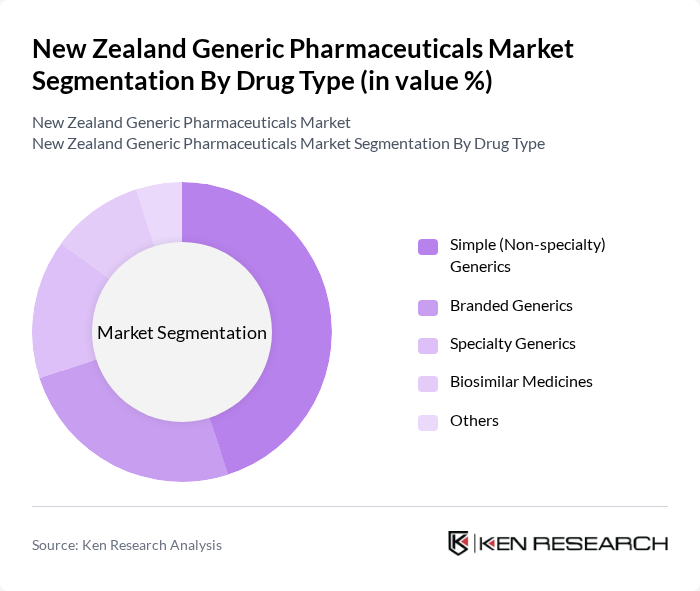
By Drug Type:The market is segmented into various drug types, including Simple (Non-specialty) Generics, Branded Generics, Specialty Generics, Biosimilar Medicines, and Others. Among these, Simple (Non-specialty) Generics dominate the market due to their widespread use for high-volume chronic and acute conditions and strong acceptance among prescribers and pharmacists in PHARMAC-funded categories. The affordability and accessibility of these generics, especially in primary care and community pharmacy settings, make them the preferred choice in a cost-sensitive healthcare environment with tight public budget controls. Branded Generics also hold a significant share, appealing to consumers and prescribers who prefer familiar brand names, particularly in over-the-counter and pharmacy-led brands, while still benefiting from lower costs compared to original patented drugs.
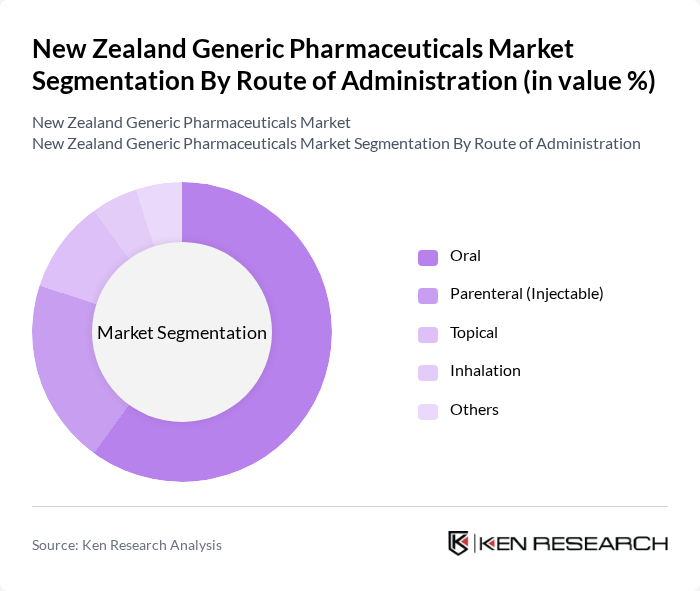
By Route of Administration:The market is segmented by route of administration into Oral, Parenteral (Injectable), Topical, Inhalation, and Others. Oral administration is the most prevalent route, accounting for a significant portion of the market due to its convenience, high patient adherence, and dominance of solid-dose generics on the PHARMAC schedule. Parenteral (Injectable) medications are also important, particularly for hospital and specialty care, including oncology, anti-infectives, and biologic or biosimilar products. The growing trend towards self-administration of injectables for chronic conditions, such as diabetes and autoimmune diseases, supported by patient education and device innovation, is expected to further support this segment.
New Zealand Generic Pharmaceuticals Market Competitive Landscape
The New Zealand Generic Pharmaceuticals Market is characterized by a dynamic mix of regional and international players. Leading participants such as PHARMAC (Pharmaceutical Management Agency – Buyer / Payer Context), AFT Pharmaceuticals, Teva Pharmaceutical Industries Ltd., Viatris Inc. (Including Legacy Mylan Portfolio), Sandoz Group AG, Apotex Inc., Accord Healthcare, Mylan New Zealand (Historical Presence Overview), Pfizer (Including Upjohn / Off-patent Portfolio), Dr. Reddy’s Laboratories, Cipla Ltd., Sun Pharmaceutical Industries Ltd., Aurobindo Pharma Ltd., Viatris / Mylan–Legacy Portfolio Competitors (Other Key Generics), Selected Local Distributors & Parallel Importers (e.g., Pharmacybrands / Green Cross Health, Others) contribute to innovation, geographic expansion, and service delivery in this space.
New Zealand Generic Pharmaceuticals Market Industry Analysis
Growth Drivers
- Increasing Demand for Cost-Effective Medications:The New Zealand healthcare system is increasingly prioritizing cost-effective medications, with the government spending approximatelyon generic drugs in recent periods. This trend is driven by the need to manage healthcare budgets effectively, especially as the country faces rising healthcare costs projected to reachin future. The emphasis on generics allows for broader access to essential medications, supporting overall public health.
- Expanding Aging Population:New Zealand's population aged 65 and over is projected to reachin future, representing aboutof the total population. This demographic shift is increasing the demand for pharmaceuticals, particularly generics, as older adults typically require more medications. The aging population's healthcare needs are expected to drive the generic pharmaceuticals market, as these medications offer affordable alternatives to brand-name drugs.
- Government Initiatives to Promote Generic Drugs:The New Zealand government has implemented various initiatives to promote the use of generic drugs, including the Pharmaceutical Management Agency (PHARMAC) policies that prioritize generics in public funding. In recent periods, PHARMAC allocatedspecifically for generic medications, reflecting a commitment to enhancing accessibility and affordability. These initiatives are crucial in fostering a competitive market environment that benefits consumers and healthcare providers alike.
Market Challenges
- Intense Competition Among Generic Manufacturers:The New Zealand generic pharmaceuticals market is characterized by intense competition, with overmanufacturers vying for market share. This saturation leads to aggressive pricing strategies, which can undermine profit margins. In recent periods, the average price of generics fell bydue to this competition, making it challenging for companies to maintain sustainable operations while ensuring product quality and compliance with regulations.
- Regulatory Hurdles and Compliance Costs:Navigating the regulatory landscape in New Zealand poses significant challenges for generic pharmaceutical companies. Compliance with the Medicines Act 1981 and associated regulations incurs substantial costs, estimated atper product for approval processes. These hurdles can delay market entry and increase operational costs, impacting the ability of companies to innovate and respond to market demands effectively.
New Zealand Generic Pharmaceuticals Market Future Outlook
The future of the New Zealand generic pharmaceuticals market appears promising, driven by ongoing government support and an increasing focus on healthcare affordability. As the population ages and healthcare expenditures rise, the demand for generics is expected to grow. Additionally, advancements in digital health solutions and personalized medicine are likely to reshape the market landscape, providing opportunities for innovation and improved patient outcomes. Companies that adapt to these trends will be well-positioned for success.
Market Opportunities
- Expansion into Emerging Therapeutic Areas:There is a significant opportunity for generic manufacturers to expand into emerging therapeutic areas such as oncology and chronic disease management. The New Zealand government allocatedfor research and development in these sectors, indicating a growing market potential for generics that address complex health issues.
- Adoption of Digital Health Solutions:The rise of digital health solutions presents a unique opportunity for generic pharmaceutical companies to enhance patient engagement and medication adherence. With the New Zealand government investingin digital health initiatives, companies can leverage technology to improve service delivery and streamline operations, ultimately driving growth in the generic market.
Scope of the Report
| Segment | Sub-Segments |
|---|---|
| By Drug Type | Simple (Non-specialty) Generics Branded Generics Specialty Generics Biosimilar Medicines Others |
| By Route of Administration | Oral Parenteral (Injectable) Topical Inhalation Others |
| By Therapeutic Area | Cardiovascular Diseases Oncology Central Nervous System Disorders Infectious Diseases Diabetes and Metabolic Disorders Respiratory Diseases Others |
| By Distribution Channel | Hospital Pharmacies Retail Community Pharmacies Online Pharmacies / E-commerce Wholesalers & Distributors Others |
| By End-User | Public Hospitals (DHB / Te Whatu Ora Network) Private Hospitals Primary Care Clinics & GP Practices Aged Care & Long-Term Care Facilities Others |
| By Manufacturer Type | Multinational Generic Manufacturers Local / Regional Manufacturers Contract Manufacturing Organizations (CMOs) Others |
| By Funding Status | PHARMAC-Funded Generics Non-funded / Private-Pay Generics |
Key Target Audience
Investors and Venture Capitalist Firms
Government and Regulatory Bodies (e.g., Medsafe, Ministry of Health)
Manufacturers and Producers
Distributors and Retailers
Pharmaceutical Wholesalers
Health Insurance Providers
Industry Associations (e.g., Generic Medicines Industry Association of New Zealand)
Pharmacy Chains and Independent Pharmacies
Players Mentioned in the Report:
PHARMAC (Pharmaceutical Management Agency Buyer / Payer Context)
AFT Pharmaceuticals
Teva Pharmaceutical Industries Ltd.
Viatris Inc. (Including Legacy Mylan Portfolio)
Sandoz Group AG
Apotex Inc.
Accord Healthcare
Mylan New Zealand (Historical Presence Overview)
Pfizer (Including Upjohn / Off-patent Portfolio)
Dr. Reddys Laboratories
Cipla Ltd.
Sun Pharmaceutical Industries Ltd.
Aurobindo Pharma Ltd.
Viatris / MylanLegacy Portfolio Competitors (Other Key Generics)
Selected Local Distributors & Parallel Importers (e.g., Pharmacybrands / Green Cross Health, Others)
Table of Contents
Market Assessment Phase
1. Executive Summary and Approach
2. New Zealand Generic Pharmaceuticals Market Overview
2.1 Key Insights and Strategic Recommendations
2.2 New Zealand Generic Pharmaceuticals Market Overview
2.3 Definition and Scope
2.4 Evolution of Market Ecosystem
2.5 Timeline of Key Regulatory Milestones
2.6 Value Chain & Stakeholder Mapping
2.7 Business Cycle Analysis
2.8 Policy & Incentive Landscape
3. New Zealand Generic Pharmaceuticals Market Analysis
3.1 Growth Drivers
3.1.1 Increasing Demand for Cost-Effective Medications
3.1.2 Expanding Aging Population
3.1.3 Government Initiatives to Promote Generic Drugs
3.1.4 Rising Healthcare Expenditure
3.2 Market Challenges
3.2.1 Intense Competition Among Generic Manufacturers
3.2.2 Regulatory Hurdles and Compliance Costs
3.2.3 Price Erosion Due to Market Saturation
3.2.4 Limited Awareness Among Healthcare Providers
3.3 Market Opportunities
3.3.1 Expansion into Emerging Therapeutic Areas
3.3.2 Strategic Partnerships with Healthcare Providers
3.3.3 Adoption of Digital Health Solutions
3.3.4 Increasing Focus on Biologics and Biosimilars
3.4 Market Trends
3.4.1 Shift Towards Personalized Medicine
3.4.2 Growth of Online Pharmacies
3.4.3 Rising Popularity of Telehealth Services
3.4.4 Emphasis on Sustainable and Eco-Friendly Practices
3.5 Government Regulation
3.5.1 Pharmac Regulation and Approval Processes
3.5.2 Pricing and Reimbursement Policies
3.5.3 Quality Assurance Standards
3.5.4 Intellectual Property Rights Enforcement
4. SWOT Analysis
5. Stakeholder Analysis
6. Porter's Five Forces Analysis
7. New Zealand Generic Pharmaceuticals Market Market Size, 2019-2024
7.1 By Value
7.2 By Volume
7.3 By Average Selling Price
8. New Zealand Generic Pharmaceuticals Market Segmentation
8.1 By Drug Type
8.1.1 Simple (Non-specialty) Generics
8.1.2 Branded Generics
8.1.3 Specialty Generics
8.1.4 Biosimilar Medicines
8.1.5 Others
8.2 By Route of Administration
8.2.1 Oral
8.2.2 Parenteral (Injectable)
8.2.3 Topical
8.2.4 Inhalation
8.2.5 Others
8.3 By Therapeutic Area
8.3.1 Cardiovascular Diseases
8.3.2 Oncology
8.3.3 Central Nervous System Disorders
8.3.4 Infectious Diseases
8.3.5 Diabetes and Metabolic Disorders
8.3.6 Respiratory Diseases
8.3.7 Others
8.4 By Distribution Channel
8.4.1 Hospital Pharmacies
8.4.2 Retail Community Pharmacies
8.4.3 Online Pharmacies / E-commerce
8.4.4 Wholesalers & Distributors
8.4.5 Others
8.5 By End-User
8.5.1 Public Hospitals (DHB / Te Whatu Ora Network)
8.5.2 Private Hospitals
8.5.3 Primary Care Clinics & GP Practices
8.5.4 Aged Care & Long-Term Care Facilities
8.5.5 Others
8.6 By Manufacturer Type
8.6.1 Multinational Generic Manufacturers
8.6.2 Local / Regional Manufacturers
8.6.3 Contract Manufacturing Organizations (CMOs)
8.6.4 Others
8.7 By Funding Status
8.7.1 PHARMAC-Funded Generics
8.7.2 Non-funded / Private-Pay Generics
9. New Zealand Generic Pharmaceuticals Market Competitive Analysis
9.1 Market Share of Key Players
9.2 Cross Comparison of Key Players
9.2.1 Company Name
9.2.2 Ownership Type (Multinational, Regional, Local)
9.2.3 New Zealand Generic Revenue (NZD, Latest FY)
9.2.4 3-Year Revenue CAGR in New Zealand Generic Portfolio
9.2.5 PHARMAC-Tender Win Rate (%)
9.2.6 Number of PHARMAC-Listed Molecules
9.2.7 Market Share in Key Therapeutic Classes (%)
9.2.8 EBITDA Margin for New Zealand Operations (%)
9.2.9 Average Price per Defined Daily Dose (NZD, Selected Molecules)
9.2.10 Time-to-Market Post-Patent Expiry (Months)
9.2.11 Portfolio Mix (Branded vs Unbranded Generics, % of Revenue)
9.2.12 R&D / In-licensing Spend as % of Revenue
9.2.13 Supply Reliability (Stock-out Incidents per Year)
9.2.14 Regulatory & Quality Compliance Track Record (Recalls / Warnings)
9.2.15 ESG & Sustainability Disclosures / Ratings (Where Applicable)
9.3 SWOT Analysis of Top Players
9.4 Pricing Analysis
9.5 Detailed Profile of Major Companies
9.5.1 PHARMAC (Pharmaceutical Management Agency – Buyer / Payer Context)
9.5.2 AFT Pharmaceuticals
9.5.3 Teva Pharmaceutical Industries Ltd.
9.5.4 Viatris Inc. (Including Legacy Mylan Portfolio)
9.5.5 Sandoz Group AG
9.5.6 Apotex Inc.
9.5.7 Accord Healthcare
9.5.8 Mylan New Zealand (Historical Presence Overview)
9.5.9 Pfizer (Including Upjohn / Off-patent Portfolio)
9.5.10 Dr. Reddy’s Laboratories
9.5.11 Cipla Ltd.
9.5.12 Sun Pharmaceutical Industries Ltd.
9.5.13 Aurobindo Pharma Ltd.
9.5.14 Viatris / Mylan–Legacy Portfolio Competitors (Other Key Generics)
9.5.15 Selected Local Distributors & Parallel Importers (e.g., Pharmacybrands / Green Cross Health, Others)
10. New Zealand Generic Pharmaceuticals Market End-User Analysis
10.1 Procurement Behavior of Key Ministries
10.1.1 Budget Allocation Trends
10.1.2 Preferred Procurement Channels
10.1.3 Evaluation Criteria for Suppliers
10.1.4 Frequency of Procurement Cycles
10.2 Corporate Spend on Infrastructure & Energy
10.2.1 Investment in Generic Drug Development
10.2.2 Spending on Research and Development
10.2.3 Budget for Marketing and Distribution
10.2.4 Allocation for Regulatory Compliance
10.3 Pain Point Analysis by End-User Category
10.3.1 Access to Affordable Medications
10.3.2 Quality Assurance Concerns
10.3.3 Supply Chain Disruptions
10.3.4 Limited Availability of Certain Drugs
10.4 User Readiness for Adoption
10.4.1 Awareness of Generic Options
10.4.2 Training Needs for Healthcare Providers
10.4.3 Infrastructure Readiness
10.4.4 Patient Acceptance Levels
10.5 Post-Deployment ROI and Use Case Expansion
10.5.1 Cost Savings Analysis
10.5.2 Impact on Patient Outcomes
10.5.3 Scalability of Solutions
10.5.4 Future Investment Opportunities
11. New Zealand Generic Pharmaceuticals Market Future Size, 2025-2030
11.1 By Value
11.2 By Volume
11.3 By Average Selling Price
Go-To-Market Strategy Phase
1. Whitespace Analysis + Business Model Canvas
1.1 Market Gaps Identification
1.2 Value Proposition Development
1.3 Revenue Streams Analysis
1.4 Customer Segmentation
1.5 Key Partnerships
1.6 Cost Structure Evaluation
1.7 Competitive Advantage Assessment
2. Marketing and Positioning Recommendations
2.1 Branding Strategies
2.2 Product USPs
2.3 Target Audience Identification
2.4 Communication Channels
2.5 Marketing Budget Allocation
3. Distribution Plan
3.1 Urban Retail Strategies
3.2 Rural NGO Tie-ups
3.3 Online Distribution Channels
3.4 Direct Sales Approaches
3.5 Logistics and Supply Chain Management
4. Channel & Pricing Gaps
4.1 Underserved Routes
4.2 Pricing Bands Analysis
4.3 Competitor Pricing Strategies
4.4 Customer Willingness to Pay
4.5 Price Sensitivity Assessment
5. Unmet Demand & Latent Needs
5.1 Category Gaps
5.2 Consumer Segments Analysis
5.3 Emerging Trends Identification
5.4 Future Demand Projections
5.5 Innovation Opportunities
6. Customer Relationship
6.1 Loyalty Programs
6.2 After-sales Service
6.3 Customer Feedback Mechanisms
6.4 Relationship Management Strategies
6.5 Engagement Tactics
7. Value Proposition
7.1 Sustainability Initiatives
7.2 Integrated Supply Chains
7.3 Customer-Centric Approaches
7.4 Competitive Differentiation
7.5 Long-term Value Creation
8. Key Activities
8.1 Regulatory Compliance
8.2 Branding Efforts
8.3 Distribution Setup
8.4 Market Research Activities
8.5 Training and Development
9. Entry Strategy Evaluation
9.1 Domestic Market Entry Strategy
9.1.1 Product Mix Considerations
9.1.2 Pricing Band Strategy
9.1.3 Packaging Innovations
9.2 Export Entry Strategy
9.2.1 Target Countries Identification
9.2.2 Compliance Roadmap Development
10. Entry Mode Assessment
10.1 Joint Ventures
10.2 Greenfield Investments
10.3 Mergers & Acquisitions
10.4 Distributor Model Evaluation
10.5 Risk Assessment
11. Capital and Timeline Estimation
11.1 Capital Requirements
11.2 Timelines for Implementation
11.3 Financial Projections
11.4 Funding Sources
11.5 Milestone Tracking
12. Control vs Risk Trade-Off
12.1 Ownership Considerations
12.2 Partnership Dynamics
12.3 Risk Mitigation Strategies
12.4 Control Mechanisms
12.5 Long-term Strategic Planning
13. Profitability Outlook
13.1 Breakeven Analysis
13.2 Long-term Sustainability
13.3 Profit Margin Projections
13.4 Cost Management Strategies
13.5 Revenue Growth Forecasts
14. Potential Partner List
14.1 Distributors
14.2 Joint Ventures
14.3 Acquisition Targets
14.4 Strategic Alliances
14.5 Collaborative Opportunities
15. Execution Roadmap
15.1 Phased Plan for Market Entry
15.1.1 Market Setup
15.1.2 Market Entry
15.1.3 Growth Acceleration
15.1.4 Scale & Stabilize
15.2 Key Activities and Milestones
15.2.1 Activity Planning
15.2.2 Milestone Tracking
15.2.3 Performance Metrics
Research Methodology
Phase 1: Approach1
Desk Research
- Analysis of industry reports from New Zealand's Ministry of Health and pharmaceutical associations
- Review of market trends and statistics from the Pharmaceutical Society of New Zealand
- Examination of regulatory frameworks and guidelines from Medsafe and the New Zealand Medicines and Medical Devices Safety Authority
Primary Research
- Interviews with key opinion leaders in the pharmaceutical sector, including pharmacists and healthcare professionals
- Surveys targeting generic pharmaceutical manufacturers and distributors operating in New Zealand
- Focus group discussions with patients and healthcare providers to understand perceptions and usage of generic drugs
Validation & Triangulation
- Cross-validation of findings through multiple data sources, including sales data and market share reports
- Triangulation of insights from primary interviews with secondary data trends
- Sanity checks conducted through expert panel reviews comprising industry veterans and regulatory experts
Phase 2: Market Size Estimation1
Top-down Assessment
- Estimation of the total pharmaceutical market size in New Zealand, with a focus on the generic segment
- Analysis of government healthcare expenditure and its impact on generic drug adoption
- Segmentation of the market by therapeutic categories and distribution channels
Bottom-up Modeling
- Collection of sales data from leading generic pharmaceutical companies operating in New Zealand
- Estimation of market share based on volume and revenue from various distribution channels
- Calculation of average pricing and volume sold across different therapeutic classes
Forecasting & Scenario Analysis
- Development of forecasting models based on historical growth rates and market dynamics
- Scenario analysis considering factors such as regulatory changes, pricing pressures, and market entry of new players
- Projections for market growth through 2030 under various economic conditions
Phase 3: CATI Sample Composition1
| Scope Item/Segment | Sample Size | Target Respondent Profiles |
|---|---|---|
| Pharmacy Sector Insights | 120 | Pharmacy Owners, Pharmacists |
| Healthcare Provider Perspectives | 90 | General Practitioners, Specialists |
| Patient Experience with Generics | 80 | Patients using generic medications |
| Manufacturer Insights | 70 | Product Managers, Sales Directors |
| Regulatory Compliance Feedback | 60 | Regulatory Affairs Specialists, Compliance Officers |
Frequently Asked Questions
What is the current value of the New Zealand Generic Pharmaceuticals Market?
The New Zealand Generic Pharmaceuticals Market is valued at approximately USD 1.0 billion, driven by the increasing demand for cost-effective medication alternatives and the prevalence of chronic diseases in an aging population.
What factors are driving the growth of the New Zealand Generic Pharmaceuticals Market?
Which cities are the main hubs for the New Zealand Generic Pharmaceuticals Market?
What regulatory framework governs the New Zealand Generic Pharmaceuticals Market?
Other Regional/Country Reports
Other Adjacent Reports
Bahrain Biosimilars Market
South Korea Branded Pharmaceuticals Market
Vietnam Over-the-Counter Pharmaceuticals Market
New Zealand Pharmaceutical Manufacturing Market Size, Share & Forecast, By Product Type, Dosage Form & Manufacturing Model, 2026-2031South Africa Drug Delivery Systems Market
KSA healthcare it market size, share, growth drivers, trends, opportunities & forecast 2025–2030Oman Medical Devices Market Size, Share & Forecast, By Product Type, Care Setting & End User, 2025-2032Saudi Arabia biotechnology market Size, Share, Growth Drivers, Trends, Opportunities & Forecast 2025–2030Indonesia Oncology Therapeutics Market
Middle East Chronic Disease Management Market Size, Share, Growth Drivers, Trends, Opportunities & Forecast 2025–2030Why Buy From Us?

What makes us stand out is that our consultants follow Robust, Refine and Result (RRR) methodology. Robust for clear definitions, approaches and sanity checking, Refine for differentiating respondents' facts and opinions, and Result for presenting data with story.

We have set a benchmark in the industry by offering our clients with syndicated and customized market research reports featuring coverage of entire market as well as meticulous research and analyst insights.

While we don't replace traditional research, we flip the method upside down. Our dual approach of Top Bottom & Bottom Top ensures quality deliverable by not just verifying company fundamentals but also looking at the sector and macroeconomic factors.

With one step in the future, our research team constantly tries to show you the bigger picture. We help with some of the tough questions you may encounter along the way: How is the industry positioned? Best marketing channel? KPI's of competitors? By aligning every element, we help maximize success.

Our report gives you instant access to the answers and sources that other companies might choose to hide. We elaborate each steps of research methodology we have used and showcase you the sample size to earn your trust.

If you need any support, we are here! We pride ourselves on universe strength, data quality, and quick, friendly, and professional service.