About the Report
Base Year 2024Philippines Recycled Base Oil Market Overview
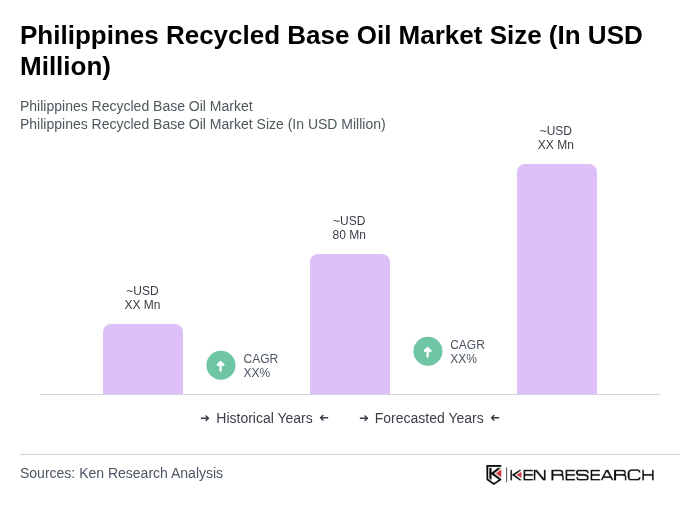
- The Philippines Recycled Base Oil Market is valued at USD 80 million, based on a five-year historical analysis and correlation with the global recycled base oil market and the domestic lubricants demand base. This growth is primarily driven by increasing environmental regulations and policy support for waste oil recovery, a rising focus on sustainability and circular economy in the lubricants value chain, and the growing automotive and industrial sectors, which demand cost-effective, high-quality lubricants. The market is also supported by government-backed recycling and used-oil management initiatives, as well as the need to reduce dependence on imported virgin base oils through more economical recycled alternatives.
- Key demand and supply hubs in this market include Metro Manila, Cebu, and Davao, which act as primary collection and processing centers rather than corporate “players.” Metro Manila dominates due to its high concentration of automotive services, logistics fleets, industrial facilities, and formal waste management operators, which together generate and aggregate substantial volumes of used lubricating oils. Cebu and Davao follow, benefiting from expanding transport corridors, port activity, and industrial bases in the Visayas and Mindanao regions, which facilitate the collection, pre-treatment, and shipment of used oils to re-refining and recycling facilities.
- In 2022, the Philippine government enacted Republic Act No. 11898, the Extended Producer Responsibility Act of 2022, which institutionalizes extended producer responsibility for obliged enterprises and their plastic packaging waste, under the implementation of the Department of Environment and Natural Resources. While the Act’s core obligations focus on plastic packaging, it reinforces lifecycle responsibility, recovery, and recycling frameworks that complement existing hazardous and waste-oil management rules under the Ecological Solid Waste Management Act and related DENR regulations, thereby indirectly supporting better collection, tracking, and recycling pathways for used lubricants and base oils.
Philippines Recycled Base Oil Market Segmentation
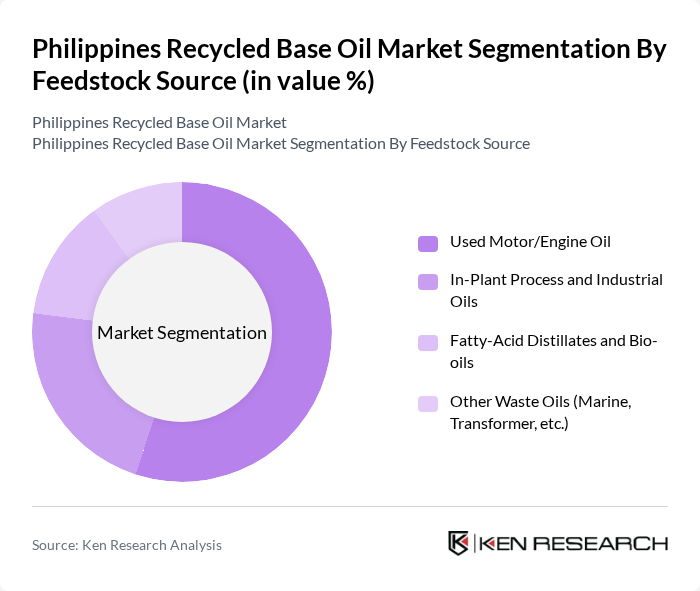
By Feedstock Source:The feedstock source segmentation includes various types of oils that are recycled to produce base oils. The subsegments are used motor/engine oil, in-plant process and industrial oils, fatty-acid distillates and bio-oils, and other waste oils such as marine and transformer oils, aligned with global recycled base oil segmentation practices. Among these, used motor/engine oil is the leading subsegment due to its high availability, well-established collection routes, and predictable composition, particularly from automotive service centers, commercial fleets, and industrial equipment. The increasing number of vehicles in the Philippines, rising lubricant consumption, and mandatory or recommended periodic oil changes in both passenger and commercial vehicles contribute to the dominance of this subsegment in the recycled base oil supply mix.
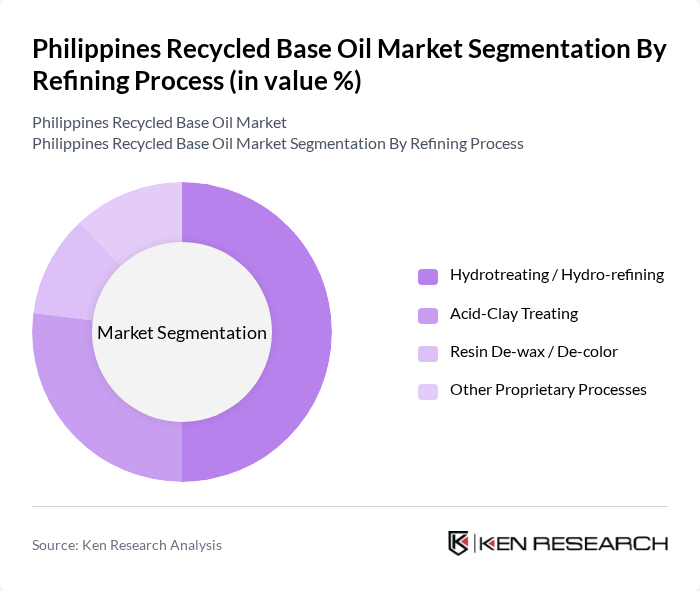
By Refining Process:The refining process segmentation includes hydrotreating/hydro-refining, acid-clay treating, resin de-wax/de-color, and other proprietary processes, in line with global re-refined base oil technologies. Hydrotreating/hydro-refining is the dominant process due to its effectiveness in producing higher-quality Group II and Group II+ base oils that meet increasingly stringent OEM and industry specifications for modern lubricants. This method is preferred for its ability to remove sulfur, nitrogen, metals, and aromatics, improving oxidation stability, color, and viscosity index of the recycled oils, which makes it a popular choice among manufacturers targeting automotive, industrial, and hydraulic applications.
Philippines Recycled Base Oil Market Competitive Landscape
The Philippines Recycled Base Oil Market is characterized by a dynamic mix of regional and international players. Leading participants such as EcoOil Philippines Inc., GenOil Philippines, Cleanway Technology Corporation, Greenergy Solutions Inc., Pilipinas Shell Petroleum Corporation (Re-refined Base Oil & Lubricants), Petron Corporation (Used Oil Collection & Re-refining Partnerships), Phoenix Petroleum Philippines Inc. (Lubricants & Used Oil Program), Chevron Philippines Inc. (Caltex Lubricants & Re-refined Base Oil Sourcing), Seaoil Philippines Inc. (Lubricants and Sustainability Initiatives), Royal Dutch Shell – Regional Re-refining Partners, Valvoline Inc., NexLube, Terrapure Environmental, Hering VPT, and other regional re-refiners and local collectors contribute to innovation, geographic expansion, and service delivery in this space.
Philippines Recycled Base Oil Market Industry Analysis
Growth Drivers
- Increasing Demand for Sustainable Products:The Philippines has seen a significant rise in consumer preference for sustainable products, with a reported 60% of consumers willing to pay more for eco-friendly options. This trend is supported by the country's commitment to the Sustainable Development Goals (SDGs), which aims to promote responsible consumption and production. As of in future, the market for sustainable products is projected to reach PHP 1.4 trillion, further driving the demand for recycled base oils in various applications.
- Government Initiatives Promoting Recycling:The Philippine government has implemented several initiatives to promote recycling, including the Ecological Solid Waste Management Act, which mandates local government units to establish recycling programs. In future, the government allocated PHP 600 million for recycling infrastructure development. These initiatives are expected to enhance the collection and processing of used oils, thereby increasing the availability of recycled base oils in the market.
- Rising Oil Prices Driving Recycled Oil Adoption:With global crude oil prices projected to average USD 90 per barrel in future, the cost-effectiveness of recycled base oils becomes increasingly attractive. The price differential between virgin and recycled oils is expected to widen, encouraging manufacturers to adopt recycled oils to reduce production costs. This economic incentive is anticipated to boost the recycled base oil market, as companies seek to mitigate the impact of rising raw material costs.
Market Challenges
- Limited Consumer Awareness:Despite the growing demand for sustainable products, consumer awareness regarding the benefits of recycled base oils remains low. A survey indicated that only 30% of consumers are aware of recycled oil options. This lack of knowledge hampers market growth, as consumers often prefer familiar virgin oil products. Educational campaigns and marketing strategies are essential to bridge this awareness gap and promote the advantages of recycled oils.
- High Initial Investment Costs:Establishing recycling facilities for base oils requires substantial initial investments, often exceeding PHP 25 million. This financial barrier can deter new entrants and limit the expansion of existing players. Additionally, the return on investment may take several years, making it challenging for companies to justify the costs. Financial incentives or subsidies from the government could help alleviate this challenge and encourage investment in the sector.
Philippines Recycled Base Oil Market Future Outlook
The Philippines recycled base oil market is poised for significant growth, driven by increasing consumer demand for sustainable products and supportive government policies. As the country continues to prioritize environmental sustainability, the adoption of recycled oils is expected to rise. Innovations in recycling technologies will further enhance product quality, making recycled oils more competitive against virgin alternatives. The market is likely to witness a shift towards eco-friendly automotive lubricants, aligning with global trends towards sustainability and circular economy practices.
Market Opportunities
- Expansion into Untapped Regional Markets:There is a significant opportunity for recycled base oil producers to expand into untapped regional markets, particularly in Mindanao and Visayas. These regions have shown a growing demand for lubricants, with an estimated market potential of PHP 350 million. Targeting these areas can enhance market penetration and drive sales growth for recycled oils.
- Partnerships with Automotive Industries:Collaborating with automotive manufacturers presents a lucrative opportunity for recycled base oil producers. The automotive sector in the Philippines is projected to grow by 12% annually, creating a demand for eco-friendly lubricants. Strategic partnerships can facilitate the integration of recycled oils into automotive applications, enhancing brand visibility and market share.
Scope of the Report
| Segment | Sub-Segments |
|---|---|
| By Feedstock Source | Used Motor/Engine Oil In-Plant Process and Industrial Oils Fatty-Acid Distillates and Bio-oils Other Waste Oils (Marine, Transformer, etc.) |
| By Refining Process | Hydrotreating / Hydro-refining Acid-Clay Treating Resin De-wax / De-color Other Proprietary Processes |
| By Application | Lubricant and Grease Blending Metal-working Fluids (Cutting, Forming) Hydraulic and Transformer Oils Industrial Machinery Lubrication Other Applications (Rubber Process Oils, Process Oils) |
| By End-User Industry | Automotive and Transportation OEM / Aftermarket Industrial Manufacturing and Heavy Equipment Power Generation and Utilities Oilfield and Drilling Services Marine and Shipping Other Sectors (Rail, Aviation, Defense) |
| By Distribution Channel | Direct Sales (B2B / Contracts) Distributors and Dealers Blenders and Lubricant Marketers Online and Specialized Channels |
| By Quality / Performance Tier | Group I Equivalent Group II / II+ Equivalent Group III and Above Non-OEM Approved / Off-spec Grades |
| By Region | Luzon Visayas Mindanao |
Key Target Audience
Investors and Venture Capitalist Firms
Government and Regulatory Bodies (e.g., Department of Environment and Natural Resources, Department of Trade and Industry)
Manufacturers and Producers of Recycled Base Oil
Distributors and Retailers of Automotive and Industrial Lubricants
Oil Refineries and Processing Plants
Waste Management and Recycling Companies
Industry Associations (e.g., Philippine Institute of Petroleum)
Financial Institutions and Banks
Players Mentioned in the Report:
EcoOil Philippines Inc.
GenOil Philippines
Cleanway Technology Corporation
Greenergy Solutions Inc.
Pilipinas Shell Petroleum Corporation (Re-refined Base Oil & Lubricants)
Petron Corporation (Used Oil Collection & Re-refining Partnerships)
Phoenix Petroleum Philippines Inc. (Lubricants & Used Oil Program)
Chevron Philippines Inc. (Caltex Lubricants & Re-refined Base Oil Sourcing)
Seaoil Philippines Inc. (Lubricants and Sustainability Initiatives)
Royal Dutch Shell Regional Re-refining Partners
Valvoline Inc.
NexLube
Terrapure Environmental
Hering VPT
Other Regional Re-refiners and Local Collectors
Table of Contents
Market Assessment Phase
1. Executive Summary and Approach
2. Philippines Recycled Base Oil Market Overview
2.1 Key Insights and Strategic Recommendations
2.2 Philippines Recycled Base Oil Market Overview
2.3 Definition and Scope
2.4 Evolution of Market Ecosystem
2.5 Timeline of Key Regulatory Milestones
2.6 Value Chain & Stakeholder Mapping
2.7 Business Cycle Analysis
2.8 Policy & Incentive Landscape
3. Philippines Recycled Base Oil Market Analysis
3.1 Growth Drivers
3.1.1 Increasing demand for sustainable products
3.1.2 Government initiatives promoting recycling
3.1.3 Rising oil prices driving recycled oil adoption
3.1.4 Technological advancements in recycling processes
3.2 Market Challenges
3.2.1 Limited consumer awareness
3.2.2 High initial investment costs
3.2.3 Regulatory compliance complexities
3.2.4 Competition from virgin oil products
3.3 Market Opportunities
3.3.1 Expansion into untapped regional markets
3.3.2 Development of new product lines
3.3.3 Partnerships with automotive industries
3.3.4 Increasing export potential
3.4 Market Trends
3.4.1 Shift towards circular economy practices
3.4.2 Growth in eco-friendly automotive lubricants
3.4.3 Rise of online sales channels
3.4.4 Increased focus on quality and performance
3.5 Government Regulation
3.5.1 Implementation of recycling mandates
3.5.2 Standards for recycled oil quality
3.5.3 Incentives for recycling facilities
3.5.4 Environmental protection regulations
4. SWOT Analysis
5. Stakeholder Analysis
6. Porter's Five Forces Analysis
7. Philippines Recycled Base Oil Market Market Size, 2019-2024
7.1 By Value
7.2 By Volume
7.3 By Average Selling Price
8. Philippines Recycled Base Oil Market Segmentation
8.1 By Feedstock Source
8.1.1 Used Motor/Engine Oil
8.1.2 In-Plant Process and Industrial Oils
8.1.3 Fatty-Acid Distillates and Bio-oils
8.1.4 Other Waste Oils (Marine, Transformer, etc.)
8.2 By Refining Process
8.2.1 Hydrotreating / Hydro-refining
8.2.2 Acid-Clay Treating
8.2.3 Resin De-wax / De-color
8.2.4 Other Proprietary Processes
8.3 By Application
8.3.1 Lubricant and Grease Blending
8.3.2 Metal-working Fluids (Cutting, Forming)
8.3.3 Hydraulic and Transformer Oils
8.3.4 Industrial Machinery Lubrication
8.3.5 Other Applications (Rubber Process Oils, Process Oils)
8.4 By End-User Industry
8.4.1 Automotive and Transportation OEM / Aftermarket
8.4.2 Industrial Manufacturing and Heavy Equipment
8.4.3 Power Generation and Utilities
8.4.4 Oilfield and Drilling Services
8.4.5 Marine and Shipping
8.4.6 Other Sectors (Rail, Aviation, Defense)
8.5 By Distribution Channel
8.5.1 Direct Sales (B2B / Contracts)
8.5.2 Distributors and Dealers
8.5.3 Blenders and Lubricant Marketers
8.5.4 Online and Specialized Channels
8.6 By Quality / Performance Tier
8.6.1 Group I Equivalent
8.6.2 Group II / II+ Equivalent
8.6.3 Group III and Above
8.6.4 Non-OEM Approved / Off-spec Grades
8.7 By Region
8.7.1 Luzon
8.7.2 Visayas
8.7.3 Mindanao
9. Philippines Recycled Base Oil Market Competitive Analysis
9.1 Market Share of Key Players
9.2 Cross Comparison of Key Players
9.2.1 Company Name
9.2.2 Group Size (Large, Medium, or Small as per industry convention)
9.2.3 Philippines Recycled Base Oil Revenue (USD Million)
9.2.4 Philippines Recycled Base Oil Volume Sold (KT per Year)
9.2.5 3-Year CAGR in Segment Revenue
9.2.6 EBITDA Margin (%) from Recycled Base Oil
9.2.7 Capital Expenditure on Re-refining / Capacity Expansion
9.2.8 Installed Re-refining Capacity (KT per Year)
9.2.9 Capacity Utilization Rate (%)
9.2.10 Market Share (%) in Philippines Recycled Base Oil
9.2.11 Average Realized Price (USD per Liter / per Ton)
9.2.12 Feedstock Collection Coverage (Number of Collection Points / Regions Covered)
9.2.13 Key End-User Mix (% Sales to Automotive, Industrial, Marine, etc.)
9.2.14 R&D / Sustainability Spend (% of Revenue)
9.3 SWOT Analysis of Top Players
9.4 Pricing Analysis
9.5 Detailed Profile of Major Companies
9.5.1 EcoOil Philippines Inc.
9.5.2 GenOil Philippines
9.5.3 Cleanway Technology Corporation
9.5.4 Greenergy Solutions Inc.
9.5.5 Pilipinas Shell Petroleum Corporation (Re-refined Base Oil & Lubricants)
9.5.6 Petron Corporation (Used Oil Collection & Re-refining Partnerships)
9.5.7 Phoenix Petroleum Philippines Inc. (Lubricants & Used Oil Program)
9.5.8 Chevron Philippines Inc. (Caltex Lubricants & Re-refined Base Oil Sourcing)
9.5.9 Seaoil Philippines Inc. (Lubricants and Sustainability Initiatives)
9.5.10 Royal Dutch Shell – Regional Re-refining Partners
9.5.11 Valvoline Inc.
9.5.12 NexLube
9.5.13 Terrapure Environmental
9.5.14 Hering VPT
9.5.15 Other Regional Re-refiners and Local Collectors
10. Philippines Recycled Base Oil Market End-User Analysis
10.1 Procurement Behavior of Key Ministries
10.1.1 Government procurement policies
10.1.2 Budget allocation for recycled products
10.1.3 Supplier selection criteria
10.1.4 Sustainability goals
10.2 Corporate Spend on Infrastructure & Energy
10.2.1 Investment in sustainable energy
10.2.2 Budget for maintenance and operations
10.2.3 Spending on eco-friendly products
10.2.4 Future spending projections
10.3 Pain Point Analysis by End-User Category
10.3.1 Quality concerns
10.3.2 Availability of products
10.3.3 Cost-effectiveness
10.3.4 Regulatory compliance issues
10.4 User Readiness for Adoption
10.4.1 Awareness of recycled oil benefits
10.4.2 Training and education needs
10.4.3 Infrastructure readiness
10.4.4 Adoption barriers
10.5 Post-Deployment ROI and Use Case Expansion
10.5.1 Performance metrics
10.5.2 Cost savings analysis
10.5.3 User feedback and satisfaction
10.5.4 Opportunities for scaling
11. Philippines Recycled Base Oil Market Future Size, 2025-2030
11.1 By Value
11.2 By Volume
11.3 By Average Selling Price
Go-To-Market Strategy Phase
1. Whitespace Analysis + Business Model Canvas
1.1 Market gaps identification
1.2 Value proposition development
1.3 Revenue model exploration
1.4 Customer segmentation analysis
1.5 Key partnerships identification
1.6 Cost structure analysis
1.7 Channels of distribution
2. Marketing and Positioning Recommendations
2.1 Branding strategies
2.2 Product USPs
2.3 Target audience identification
2.4 Communication strategies
2.5 Digital marketing tactics
2.6 Trade show participation
2.7 Customer engagement initiatives
3. Distribution Plan
3.1 Urban retail strategies
3.2 Rural NGO tie-ups
3.3 E-commerce integration
3.4 Logistics and supply chain management
3.5 Distribution partnerships
3.6 Inventory management
3.7 Customer service considerations
4. Channel & Pricing Gaps
4.1 Underserved routes
4.2 Pricing bands analysis
4.3 Competitor pricing strategies
4.4 Value-based pricing models
4.5 Discounts and promotions
4.6 Price elasticity considerations
4.7 Customer willingness to pay
5. Unmet Demand & Latent Needs
5.1 Category gaps identification
5.2 Consumer segments analysis
5.3 Product development opportunities
5.4 Market entry strategies
5.5 Customer feedback mechanisms
5.6 Future trends forecasting
5.7 Competitive landscape assessment
6. Customer Relationship
6.1 Loyalty programs
6.2 After-sales service
6.3 Customer feedback loops
6.4 Relationship management strategies
6.5 Community engagement
6.6 Customer education initiatives
6.7 Retention strategies
7. Value Proposition
7.1 Sustainability initiatives
7.2 Integrated supply chains
7.3 Cost savings for customers
7.4 Quality assurance
7.5 Brand reputation enhancement
7.6 Innovation in product offerings
7.7 Customer-centric approach
8. Key Activities
8.1 Regulatory compliance
8.2 Branding efforts
8.3 Distribution setup
8.4 Marketing campaigns
8.5 Training and development
8.6 Performance monitoring
8.7 Stakeholder engagement
9. Entry Strategy Evaluation
9.1 Domestic Market Entry Strategy
9.1.1 Product mix considerations
9.1.2 Pricing band analysis
9.1.3 Packaging strategies
9.2 Export Entry Strategy
9.2.1 Target countries identification
9.2.2 Compliance roadmap development
10. Entry Mode Assessment
10.1 JV opportunities
10.2 Greenfield investments
10.3 M&A considerations
10.4 Distributor model evaluation
11. Capital and Timeline Estimation
11.1 Capital requirements analysis
11.2 Timelines for market entry
12. Control vs Risk Trade-Off
12.1 Ownership considerations
12.2 Partnerships evaluation
13. Profitability Outlook
13.1 Breakeven analysis
13.2 Long-term sustainability strategies
14. Potential Partner List
14.1 Distributors identification
14.2 JVs opportunities
14.3 Acquisition targets
15. Execution Roadmap
15.1 Phased Plan for Market Entry
15.1.1 Market Setup
15.1.2 Market Entry
15.1.3 Growth Acceleration
15.1.4 Scale & Stabilize
15.2 Key Activities and Milestones
15.2.1 Activity timelines
15.2.2 Milestone tracking
Research Methodology
Phase 1: Approach1
Desk Research
- Analysis of industry reports from the Philippine Department of Environment and Natural Resources (DENR)
- Review of academic journals and publications on recycled base oil and sustainability practices
- Examination of market trends and statistics from local and international trade associations
Primary Research
- Interviews with key stakeholders in the recycled base oil supply chain, including manufacturers and distributors
- Surveys targeting end-users such as automotive and industrial lubricant companies
- Focus group discussions with environmental experts and regulatory bodies
Validation & Triangulation
- Cross-validation of findings through multiple data sources, including government publications and industry reports
- Triangulation of qualitative insights from interviews with quantitative data from surveys
- Sanity checks conducted through expert panel reviews to ensure data accuracy and relevance
Phase 2: Market Size Estimation1
Top-down Assessment
- Estimation of the total addressable market based on national oil consumption statistics
- Segmentation of the market by application areas such as automotive, industrial, and marine lubricants
- Incorporation of government policies promoting recycling and sustainability initiatives
Bottom-up Modeling
- Collection of production data from leading recycled base oil manufacturers in the Philippines
- Analysis of pricing models and cost structures within the recycled oil market
- Volume estimates based on historical production and consumption patterns
Forecasting & Scenario Analysis
- Development of forecasting models using historical growth rates and market drivers
- Scenario analysis based on potential regulatory changes and shifts in consumer behavior
- Creation of baseline, optimistic, and pessimistic forecasts through 2030
Phase 3: CATI Sample Composition1
| Scope Item/Segment | Sample Size | Target Respondent Profiles |
|---|---|---|
| Automotive Lubricant Manufacturers | 100 | Production Managers, Quality Control Officers |
| Industrial Oil Users | 80 | Maintenance Supervisors, Procurement Managers |
| Recycling Facility Operators | 60 | Operations Managers, Environmental Compliance Officers |
| Government Regulatory Bodies | 50 | Policy Makers, Environmental Analysts |
| Research and Development Experts | 70 | R&D Managers, Sustainability Consultants |
Frequently Asked Questions
What is the current value of the Philippines Recycled Base Oil Market?
The Philippines Recycled Base Oil Market is valued at approximately USD 80 million, reflecting a historical analysis and correlation with global trends and domestic lubricant demand. This valuation highlights the market's growth driven by sustainability and environmental regulations.
What factors are driving the growth of the recycled base oil market in the Philippines?
Which regions in the Philippines are key hubs for recycled base oil?
What is the significance of Republic Act No. 11898 in the recycled base oil market?
Other Regional/Country Reports
Other Adjacent Reports
Japan Virgin Base Oil Market
Indonesia Synthetic Base Oil Market
Philippines Bio-based Lubricants Market
Bahrain Waste Oil Collection Market
Saudi Arabia Oil Refining Market Report Size Share Growth Drivers Trends Opportunities & Forecast 2025–2030Saudi Arabia petrochemical market Size, Share, Growth Drivers, Trends, Opportunities & Forecast 2025–2030Indonesia Marine Lubricants Market Outlook to 2030Why Buy From Us?

What makes us stand out is that our consultants follow Robust, Refine and Result (RRR) methodology. Robust for clear definitions, approaches and sanity checking, Refine for differentiating respondents' facts and opinions, and Result for presenting data with story.

We have set a benchmark in the industry by offering our clients with syndicated and customized market research reports featuring coverage of entire market as well as meticulous research and analyst insights.

While we don't replace traditional research, we flip the method upside down. Our dual approach of Top Bottom & Bottom Top ensures quality deliverable by not just verifying company fundamentals but also looking at the sector and macroeconomic factors.

With one step in the future, our research team constantly tries to show you the bigger picture. We help with some of the tough questions you may encounter along the way: How is the industry positioned? Best marketing channel? KPI's of competitors? By aligning every element, we help maximize success.

Our report gives you instant access to the answers and sources that other companies might choose to hide. We elaborate each steps of research methodology we have used and showcase you the sample size to earn your trust.

If you need any support, we are here! We pride ourselves on universe strength, data quality, and quick, friendly, and professional service.