Ken Research Logo

Kuwait Routers Switchers Master Controls Market Report Size, Share, Growth Drivers, Trends, Opportunities & Forecast 2025–2030

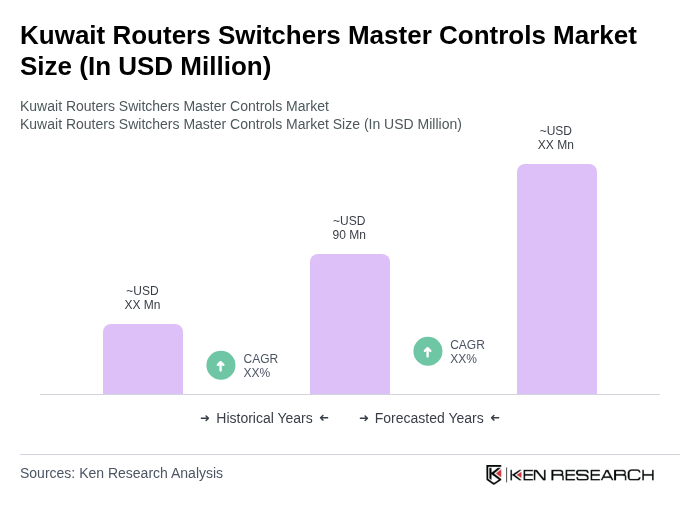
Kuwait Routers Switchers Master Controls Market, valued at USD 90 Mn, is growing due to demand for 5G, IoT, and network security amid smart city initiatives.

Region:Middle East

Author(s):Shubham

Product Code:KRAD5388

Pages:88

Published On:December 2025
About the Report

Base Year 2024

Kuwait Routers Switchers Master Controls Market Overview

  • The Kuwait Routers Switchers Master Controls Market is valued at USD 90 million, based on a five-year historical analysis and benchmarking against Kuwait’s total network infrastructure and service provider network infrastructure revenues. This growth is primarily driven by the increasing demand for high-speed internet connectivity, the expansion of data centers, and the rise of smart city initiatives under Kuwait Vision 2035. The market is also influenced by the growing adoption of cloud services, migration to 5G, software-defined networking, and the need for robust network security solutions to support rising data traffic and critical applications.
  • Kuwait City is the dominant hub for the Routers Switchers Master Controls Market due to its status as the capital, main business center, and primary location for major telecom operators, government entities, and large enterprises. Other significant areas include Al Ahmadi, which is pivotal for the oil and gas sector and associated industrial infrastructure, and Hawalli, known for its dense residential and commercial activities and ICT services. The concentration of telecom operators, data center projects, and government agencies in these regions further enhances their market dominance.
  • In 2023, the Kuwaiti government, through the Communication and Information Technology Regulatory Authority (CITRA), reinforced mandatory cybersecurity and telecom infrastructure requirements in line with the Cybersecurity Framework and related directives, obligating licensed telecom operators and critical network infrastructure to comply with updated security, resilience, and data protection controls. The CITRA Cybersecurity Regulatory Framework and Guidelines for Regulating Cybersecurity for Service Providers, issued by CITRA in 2021, define technical and organizational measures for network and information systems, including risk management, incident reporting, and protection of critical telecom infrastructure. This regulatory environment aims to enhance the security of network systems and protect sensitive data, thereby driving demand for advanced routers, switches, and security-capable platforms that meet these stringent requirements.
Kuwait Routers Switchers Master Controls Market Size

Kuwait Routers Switchers Master Controls Market Segmentation

By Product Type:The product type segmentation includes various categories that cater to different networking needs. The primary subsegments are Core Routers, Edge/Access Routers, Ethernet Switches (Layer 2), Multilayer/Data Center Switches (Layer 3+), Master Control Switchers (Broadcast & Media), Network Security & Session Border Controllers, and Others (Industrial & Ruggedized Devices). Each of these subsegments plays a crucial role in the overall market dynamics, reflecting the mix of service provider backbone networks, enterprise campus/data center environments, broadcast control rooms, and industrial communications in Kuwait.

Kuwait Routers Switchers Master Controls Market segmentation by Product Type.

The Core Routers segment is currently dominating the market due to the increasing demand for high-capacity data transmission and the need for efficient routing in large networks operated by telecom service providers and major enterprises. These routers are essential for telecom operators and large enterprises that require reliable and fast internet connectivity, including 5G backhaul, international gateways, and MPLS/IP backbone services. The rise in data traffic, driven by cloud computing, OTT and video streaming services, and IoT applications, has further propelled the adoption of core routers. Additionally, advancements in technology such as software-defined networking, segment routing, and higher-speed interfaces (100G/400G) have led to the development of more efficient and powerful core routers, making them a preferred choice for many organizations modernizing their networks.

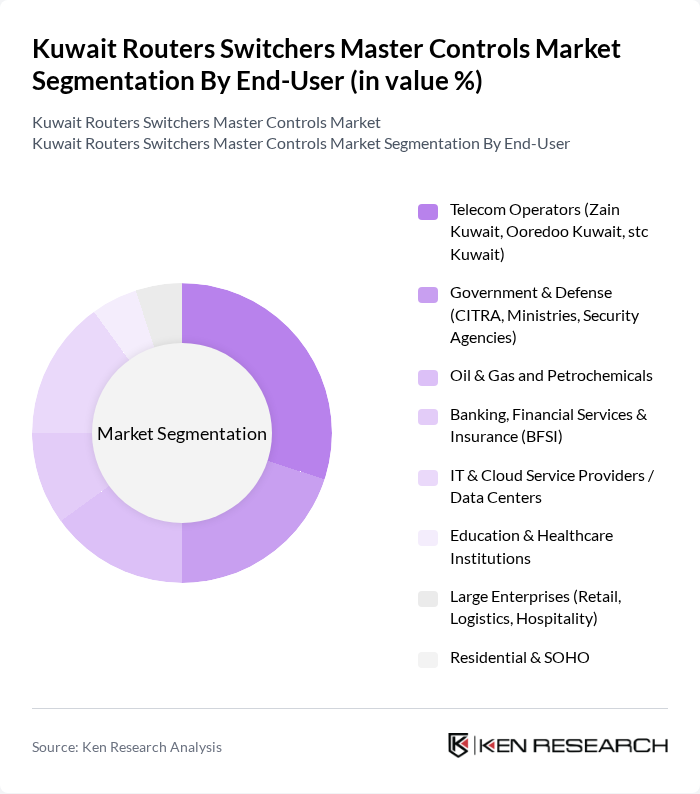
By End-User:The end-user segmentation encompasses various sectors that utilize routers and switches for their networking needs. Key subsegments include Telecom Operators, Government & Defense, Oil & Gas and Petrochemicals, Banking, Financial Services & Insurance (BFSI), IT & Cloud Service Providers/Data Centers, Education & Healthcare Institutions, Large Enterprises (Retail, Logistics, Hospitality), and Residential & SOHO. Each of these sectors has unique requirements that drive the demand for specific networking solutions, such as carrier-grade IP/MPLS for telecom, ruggedized and secure networks for oil and gas, low-latency and compliant infrastructure for BFSI, and scalable leaf–spine architectures for data centers.
Kuwait Routers Switchers Master Controls Market segmentation by End-User.

The Telecom Operators segment leads the market due to the continuous expansion of mobile and internet services in Kuwait and the need to upgrade transport networks for 4G and 5G, fixed broadband, and international connectivity. With the increasing number of subscribers and the demand for high-speed internet, telecom operators are investing heavily in upgrading their infrastructure, including IP core, aggregation, and access routers and carrier Ethernet switches. This trend is further supported by government initiatives aimed at enhancing digital connectivity and e-government services across the country. The focus on 5G technology, edge computing, and the Internet of Things (IoT) is also driving the need for advanced networking solutions in this sector, including low-latency, high-throughput, and security-integrated platforms.

Kuwait Routers Switchers Master Controls Market Competitive Landscape

The Kuwait Routers Switchers Master Controls Market is characterized by a dynamic mix of regional and international players. Leading participants such as Cisco Systems, Inc., Huawei Technologies Co., Ltd., Juniper Networks, Inc., Arista Networks, Inc., Hewlett Packard Enterprise (HPE) / Aruba Networking, Nokia Corporation (IP & Optical Networks), ZTE Corporation, Fortinet, Inc., Extreme Networks, Inc., Ubiquiti Inc., TP-Link Technologies Co., Ltd., D-Link Corporation, MikroTik SIA, Allied Telesis Holdings K.K., Ciena Corporation contribute to innovation, geographic expansion, and service delivery in this space, offering portfolios that span core and edge routing, campus and data center switching, Wi?Fi, and integrated security.

Cisco Systems, Inc.

1984

San Jose, California, USA

Huawei Technologies Co., Ltd.

1987

Shenzhen, China

Juniper Networks, Inc.

1996

Sunnyvale, California, USA

Arista Networks, Inc.

2004

Santa Clara, California, USA

Hewlett Packard Enterprise (HPE) / Aruba Networking

2015

Houston, Texas, USA

Company

Establishment Year

Headquarters

Kuwait Router/Switch Revenue (Latest Year, USD Million)

3-Year CAGR in Kuwait Networking Revenue

Installed Base in Kuwait (Number of Devices / Ports)

Share of Service Provider vs Enterprise Sales (%)

Average Selling Price Band by Product Category

Kuwait Market Share by Core Segment (Routers, Switches, Master Control)

Kuwait Routers Switchers Master Controls Market Industry Analysis

Growth Drivers

  • Increasing Demand for High-Speed Internet Connectivity:The demand for high-speed internet in Kuwait is projected to reach 1.5 million broadband subscriptions in future, driven by a growing population and digital transformation initiatives. The World Bank reports that Kuwait's internet penetration rate is approximately 99%, indicating a saturated market with a strong need for enhanced infrastructure. This surge in demand necessitates advanced routers and switchers to support increased data traffic and connectivity requirements across various sectors, including education and healthcare.
  • Expansion of Smart City Initiatives:Kuwait's government has allocated approximately 2 billion USD for smart city projects, aiming to enhance urban living through technology. These initiatives include the deployment of smart traffic systems and public safety networks, which require robust networking solutions. The Kuwait Smart City Strategy emphasizes the integration of IoT devices, necessitating advanced routers and switchers to manage the increased data flow and connectivity demands, thereby driving market growth significantly.
  • Rising Adoption of IoT Devices:The number of IoT devices in Kuwait is expected to exceed 5 million in future, reflecting a growing trend towards automation and connectivity in various sectors. This increase is supported by the Kuwait National Development Plan, which aims to enhance digital infrastructure. As IoT devices proliferate, the demand for reliable routers and switchers to facilitate seamless communication and data transfer will rise, further propelling market growth in the region.

Market Challenges

  • High Initial Investment Costs:The initial capital required for deploying advanced networking infrastructure in Kuwait can exceed 1 million USD for medium-sized enterprises. This financial barrier can deter smaller businesses from upgrading their systems, limiting market penetration. Additionally, the high costs associated with acquiring cutting-edge routers and switchers may hinder the overall growth of the market, as companies weigh the benefits against their financial capabilities.
  • Rapid Technological Advancements:The fast-paced evolution of networking technologies poses a significant challenge for businesses in Kuwait. Companies may struggle to keep up with the latest innovations, leading to potential obsolescence of existing equipment. For instance, the shift towards 5G technology requires substantial upgrades to current infrastructure, which can be daunting for organizations lacking the necessary expertise or resources to adapt quickly to these changes.

Kuwait Routers Switchers Master Controls Market Future Outlook

The Kuwait Routers Switchers Master Controls Market is poised for significant transformation as the government continues to invest in digital infrastructure and smart city initiatives. With the anticipated growth in IoT devices and the rollout of 5G networks, the demand for advanced networking solutions will escalate. Companies that embrace software-defined networking and integrate AI into their operations will likely gain a competitive edge. Furthermore, partnerships with global technology firms could enhance local capabilities, fostering innovation and driving market expansion in the coming years.

Market Opportunities

  • Growth in Cloud Computing Services:The cloud computing market in Kuwait is projected to reach 500 million USD in future, driven by increased digital transformation efforts. This growth presents an opportunity for networking companies to provide the necessary infrastructure, including routers and switchers, to support cloud services, enhancing data accessibility and operational efficiency for businesses across various sectors.
  • Development of 5G Networks:The rollout of 5G technology in Kuwait is expected to create a market worth 1 billion USD in future. This development will necessitate advanced networking solutions to handle increased data speeds and connectivity demands. Companies that invest in 5G-compatible routers and switchers will be well-positioned to capitalize on this burgeoning market opportunity, driving innovation and growth in the telecommunications sector.

Scope of the Report

SegmentSub-Segments
By Product Type

Core Routers

Edge / Access Routers

Ethernet Switches (Layer 2)

Multilayer / Data Center Switches (Layer 3+)

Master Control Switchers (Broadcast & Media)

Network Security & Session Border Controllers

Others (Industrial & Ruggedized Devices)

By End-User

Telecom Operators (Zain Kuwait, Ooredoo Kuwait, stc Kuwait)

Government & Defense (CITRA, Ministries, Security Agencies)

Oil & Gas and Petrochemicals

Banking, Financial Services & Insurance (BFSI)

IT & Cloud Service Providers / Data Centers

Education & Healthcare Institutions

Large Enterprises (Retail, Logistics, Hospitality)

Residential & SOHO

By Application

Service Provider Backbone & Aggregation Networks

Enterprise Campus & Branch Networking

Data Center & Cloud Interconnect

Industrial & OT Networks (Utilities, Oilfields)

Broadcast Playout, Master Control & Contribution

Smart City & Public Safety Networks

By Deployment Model

On-Premises Hardware

Virtual / Software-Defined (NFV, SDN)

Managed Network Services

Hybrid (On-Prem + Cloud-Managed)

By Industry Vertical

Telecommunications & Internet Service Providers

Government, Public Sector & Smart City Projects

Oil & Gas, Energy & Utilities

Banking & Financial Services

Healthcare & Education

Media, Broadcast & Entertainment

Transportation & Logistics

Retail & Hospitality

By Geographic Cluster within Kuwait

Kuwait City & Capital Governorate

Al Farwaniya & Al Jahra (Industrial & Logistics Corridors)

Hawalli & Mubarak Al-Kabeer (Residential & Commercial Hubs)

Southern Economic Zone & Port Projects (e.g., Al Ahmadi, Shuwaikh, Shuaiba)

By Ownership & Procurement Model

Direct Purchase (Capex)

Leasing & Network-as-a-Service (NaaS)

Public Sector Tenders & Framework Contracts

Public–Private Partnership (PPP) & Concession-Based Deployments

Key Target Audience

Investors and Venture Capitalist Firms

Government and Regulatory Bodies (e.g., Ministry of Communications, Kuwait National Petroleum Company)

Telecommunications Service Providers

Network Infrastructure Providers

Data Center Operators

System Integrators

Telecom Equipment Distributors

Utility Companies

Players Mentioned in the Report:

Cisco Systems, Inc.

Huawei Technologies Co., Ltd.

Juniper Networks, Inc.

Arista Networks, Inc.

Hewlett Packard Enterprise (HPE) / Aruba Networking

Nokia Corporation (IP & Optical Networks)

ZTE Corporation

Fortinet, Inc.

Extreme Networks, Inc.

Ubiquiti Inc.

TP-Link Technologies Co., Ltd.

D-Link Corporation

MikroTik SIA

Allied Telesis Holdings K.K.

Ciena Corporation

Table of Contents

Market Assessment Phase

1. Executive Summary and Approach


2. Kuwait Routers Switchers Master Controls Market Overview

2.1 Key Insights and Strategic Recommendations

2.2 Kuwait Routers Switchers Master Controls Market Overview

2.3 Definition and Scope

2.4 Evolution of Market Ecosystem

2.5 Timeline of Key Regulatory Milestones

2.6 Value Chain & Stakeholder Mapping

2.7 Business Cycle Analysis

2.8 Policy & Incentive Landscape


3. Kuwait Routers Switchers Master Controls Market Analysis

3.1 Growth Drivers

3.1.1 Increasing demand for high-speed internet connectivity
3.1.2 Expansion of smart city initiatives
3.1.3 Rising adoption of IoT devices
3.1.4 Government investments in telecommunications infrastructure

3.2 Market Challenges

3.2.1 High initial investment costs
3.2.2 Rapid technological advancements
3.2.3 Regulatory compliance issues
3.2.4 Limited local expertise in advanced technologies

3.3 Market Opportunities

3.3.1 Growth in cloud computing services
3.3.2 Development of 5G networks
3.3.3 Increasing demand for cybersecurity solutions
3.3.4 Potential for partnerships with global tech firms

3.4 Market Trends

3.4.1 Shift towards software-defined networking (SDN)
3.4.2 Integration of AI and machine learning in network management
3.4.3 Focus on energy-efficient technologies
3.4.4 Rise of managed services in network operations

3.5 Government Regulation

3.5.1 Telecommunications regulatory framework updates
3.5.2 Data protection and privacy laws
3.5.3 Standards for network equipment interoperability
3.5.4 Incentives for local manufacturing of telecom equipment

4. SWOT Analysis


5. Stakeholder Analysis


6. Porter's Five Forces Analysis


7. Kuwait Routers Switchers Master Controls Market Size, 2019-2024

7.1 By Value

7.2 By Volume

7.3 By Average Selling Price


8. Kuwait Routers Switchers Master Controls Market Segmentation

8.1 By Product Type

8.1.1 Core Routers
8.1.2 Edge / Access Routers
8.1.3 Ethernet Switches (Layer 2)
8.1.4 Multilayer / Data Center Switches (Layer 3+)
8.1.5 Master Control Switchers (Broadcast & Media)
8.1.6 Network Security & Session Border Controllers
8.1.7 Others (Industrial & Ruggedized Devices)

8.2 By End-User

8.2.1 Telecom Operators (Zain Kuwait, Ooredoo Kuwait, stc Kuwait)
8.2.2 Government & Defense (CITRA, Ministries, Security Agencies)
8.2.3 Oil & Gas and Petrochemicals
8.2.4 Banking, Financial Services & Insurance (BFSI)
8.2.5 IT & Cloud Service Providers / Data Centers
8.2.6 Education & Healthcare Institutions
8.2.7 Large Enterprises (Retail, Logistics, Hospitality)
8.2.8 Residential & SOHO

8.3 By Application

8.3.1 Service Provider Backbone & Aggregation Networks
8.3.2 Enterprise Campus & Branch Networking
8.3.3 Data Center & Cloud Interconnect
8.3.4 Industrial & OT Networks (Utilities, Oilfields)
8.3.5 Broadcast Playout, Master Control & Contribution
8.3.6 Smart City & Public Safety Networks

8.4 By Deployment Model

8.4.1 On-Premises Hardware
8.4.2 Virtual / Software-Defined (NFV, SDN)
8.4.3 Managed Network Services
8.4.4 Hybrid (On-Prem + Cloud-Managed)

8.5 By Industry Vertical

8.5.1 Telecommunications & Internet Service Providers
8.5.2 Government, Public Sector & Smart City Projects
8.5.3 Oil & Gas, Energy & Utilities
8.5.4 Banking & Financial Services
8.5.5 Healthcare & Education
8.5.6 Media, Broadcast & Entertainment
8.5.7 Transportation & Logistics
8.5.8 Retail & Hospitality

8.6 By Geographic Cluster within Kuwait

8.6.1 Kuwait City & Capital Governorate
8.6.2 Al Farwaniya & Al Jahra (Industrial & Logistics Corridors)
8.6.3 Hawalli & Mubarak Al-Kabeer (Residential & Commercial Hubs)
8.6.4 Southern Economic Zone & Port Projects (e.g., Al Ahmadi, Shuwaikh, Shuaiba)

8.7 By Ownership & Procurement Model

8.7.1 Direct Purchase (Capex)
8.7.2 Leasing & Network-as-a-Service (NaaS)
8.7.3 Public Sector Tenders & Framework Contracts
8.7.4 Public–Private Partnership (PPP) & Concession-Based Deployments

9. Kuwait Routers Switchers Master Controls Market Competitive Analysis

9.1 Market Share of Key Players

9.2 Cross Comparison of Key Players

9.2.1 Company Name
9.2.2 Kuwait Router/Switch Revenue (Latest Year, USD Million)
9.2.3 3-Year CAGR in Kuwait Networking Revenue
9.2.4 Installed Base in Kuwait (Number of Devices / Ports)
9.2.5 Share of Service Provider vs Enterprise Sales (%)
9.2.6 Average Selling Price Band by Product Category
9.2.7 Kuwait Market Share by Core Segment (Routers, Switches, Master Control)
9.2.8 Major Local Partners & System Integrators Coverage
9.2.9 Number of Active Projects with Tier-1 Operators & Government
9.2.10 Portfolio Breadth (L2/L3, DC, SDN, Security, Wi?Fi) in Kuwait
9.2.11 Compliance & Certification Status (CITRA, security standards)
9.2.12 Service & Support KPIs (SLA adherence, Mean Time to Repair)

9.3 SWOT Analysis of Top Players

9.4 Pricing Analysis

9.5 Detailed Profile of Major Companies

9.5.1 Cisco Systems, Inc.
9.5.2 Huawei Technologies Co., Ltd.
9.5.3 Juniper Networks, Inc.
9.5.4 Arista Networks, Inc.
9.5.5 Hewlett Packard Enterprise (HPE) / Aruba Networking
9.5.6 Nokia Corporation (IP & Optical Networks)
9.5.7 ZTE Corporation
9.5.8 Fortinet, Inc.
9.5.9 Extreme Networks, Inc.
9.5.10 Ubiquiti Inc.
9.5.11 TP-Link Technologies Co., Ltd.
9.5.12 D-Link Corporation
9.5.13 MikroTik SIA
9.5.14 Allied Telesis Holdings K.K.
9.5.15 Ciena Corporation

10. Kuwait Routers Switchers Master Controls Market End-User Analysis

10.1 Procurement Behavior of Key Ministries

10.1.1 Budget Allocation Trends
10.1.2 Decision-Making Processes
10.1.3 Preferred Suppliers
10.1.4 Contracting Practices

10.2 Corporate Spend on Infrastructure & Energy

10.2.1 Investment Priorities
10.2.2 Spending Patterns
10.2.3 Funding Sources
10.2.4 Project Timelines

10.3 Pain Point Analysis by End-User Category

10.3.1 Connectivity Issues
10.3.2 Cost Management Challenges
10.3.3 Technology Integration Difficulties
10.3.4 Support and Maintenance Concerns

10.4 User Readiness for Adoption

10.4.1 Training and Support Needs
10.4.2 Infrastructure Readiness
10.4.3 Change Management Strategies
10.4.4 User Feedback Mechanisms

10.5 Post-Deployment ROI and Use Case Expansion

10.5.1 Performance Metrics
10.5.2 Scalability Potential
10.5.3 User Satisfaction Levels
10.5.4 Future Investment Plans

11. Kuwait Routers Switchers Master Controls Market Future Size, 2025-2030

11.1 By Value

11.2 By Volume

11.3 By Average Selling Price


Go-To-Market Strategy Phase

1. Whitespace Analysis + Business Model Canvas

1.1 Market Gaps Identification

1.2 Value Proposition Development

1.3 Revenue Streams Analysis

1.4 Cost Structure Evaluation

1.5 Key Partnerships Exploration

1.6 Customer Segmentation

1.7 Channels of Distribution


2. Marketing and Positioning Recommendations

2.1 Branding Strategies

2.2 Product USPs

2.3 Target Audience Identification

2.4 Communication Strategies

2.5 Digital Marketing Approaches

2.6 Event Marketing Plans

2.7 Partnership Marketing Opportunities


3. Distribution Plan

3.1 Urban Retail Strategies

3.2 Rural NGO Tie-Ups

3.3 E-commerce Integration

3.4 Direct Sales Approaches

3.5 Distribution Partnerships

3.6 Logistics and Supply Chain Management

3.7 Inventory Management Solutions


4. Channel & Pricing Gaps

4.1 Underserved Routes

4.2 Pricing Bands Analysis

4.3 Competitor Pricing Strategies

4.4 Customer Willingness to Pay

4.5 Discounting Strategies

4.6 Bundling Opportunities

4.7 Price Sensitivity Analysis


5. Unmet Demand & Latent Needs

5.1 Category Gaps Identification

5.2 Consumer Segments Analysis

5.3 Emerging Trends Exploration

5.4 Customer Feedback Utilization

5.5 Market Research Insights

5.6 Innovation Opportunities

5.7 Future Demand Projections


6. Customer Relationship

6.1 Loyalty Programs Development

6.2 After-sales Service Enhancements

6.3 Customer Engagement Strategies

6.4 Feedback Mechanisms Implementation

6.5 Relationship Management Tools

6.6 Community Building Initiatives

6.7 Customer Education Programs


7. Value Proposition

7.1 Sustainability Initiatives

7.2 Integrated Supply Chains

7.3 Unique Selling Points

7.4 Customer-Centric Innovations

7.5 Competitive Advantages

7.6 Market Differentiation Strategies

7.7 Value-Added Services


8. Key Activities

8.1 Regulatory Compliance

8.2 Branding Initiatives

8.3 Distribution Setup

8.4 Training and Development

8.5 Marketing Campaign Execution

8.6 Performance Monitoring

8.7 Stakeholder Engagement


9. Entry Strategy Evaluation

9.1 Domestic Market Entry Strategy

9.1.1 Product Mix Considerations
9.1.2 Pricing Band Analysis
9.1.3 Packaging Strategies

9.2 Export Entry Strategy

9.2.1 Target Countries Identification
9.2.2 Compliance Roadmap Development

10. Entry Mode Assessment

10.1 Joint Ventures

10.2 Greenfield Investments

10.3 Mergers & Acquisitions

10.4 Distributor Model Evaluation


11. Capital and Timeline Estimation

11.1 Capital Requirements Analysis

11.2 Timelines for Implementation


12. Control vs Risk Trade-Off

12.1 Ownership vs Partnerships


13. Profitability Outlook

13.1 Breakeven Analysis

13.2 Long-term Sustainability Strategies


14. Potential Partner List

14.1 Distributors

14.2 Joint Ventures

14.3 Acquisition Targets


15. Execution Roadmap

15.1 Phased Plan for Market Entry

15.1.1 Market Setup
15.1.2 Market Entry
15.1.3 Growt

Research Methodology

ApproachModellingSample

Phase 1: Approach1

Desk Research

  • Analysis of market reports from telecommunications authorities in Kuwait
  • Review of industry publications and white papers on router and switch technology
  • Examination of government regulations and standards affecting the telecommunications sector

Primary Research

  • Interviews with IT managers and network administrators in key sectors
  • Surveys targeting telecommunications service providers and equipment distributors
  • Field interviews with technology consultants specializing in network infrastructure

Validation & Triangulation

  • Cross-validation of findings through multiple data sources including sales and usage statistics
  • Triangulation of insights from primary interviews with secondary research data
  • Sanity checks conducted through expert panel discussions and feedback sessions

Phase 2: Market Size Estimation1

Top-down Assessment

  • Estimation of total market size based on national telecommunications expenditure
  • Segmentation by application areas such as enterprise, government, and residential
  • Incorporation of growth trends in internet penetration and digital transformation initiatives

Bottom-up Modeling

  • Volume estimates derived from sales data of leading router and switch manufacturers
  • Cost analysis based on average pricing of routers and switches in the market
  • Calculation of market size using unit sales multiplied by average selling prices

Forecasting & Scenario Analysis

  • Multi-variable forecasting using factors such as 5G rollout and IoT adoption rates
  • Scenario planning based on potential regulatory changes and market disruptions
  • Development of baseline, optimistic, and pessimistic market growth projections through 2030

Phase 3: CATI Sample Composition1

Scope Item/SegmentSample SizeTarget Respondent Profiles
Enterprise Network Solutions90IT Managers, Network Architects
Telecommunications Service Providers80Operations Directors, Product Managers
Government Infrastructure Projects60Project Managers, Procurement Officers
Residential Broadband Services70Customer Service Managers, Sales Executives
IoT Connectivity Solutions50Technology Consultants, Business Development Managers

Frequently Asked Questions

What is the current value of the Kuwait Routers Switchers Master Controls Market?

The Kuwait Routers Switchers Master Controls Market is valued at approximately USD 90 million, reflecting a robust demand driven by high-speed internet connectivity, data center expansion, and smart city initiatives under Kuwait Vision 2035.

What factors are driving growth in the Kuwait Routers Switchers Master Controls Market?

Which regions in Kuwait are most significant for the Routers Switchers Master Controls Market?

How is the regulatory environment affecting the Kuwait Routers Switchers Master Controls Market?

Other Regional/Country Reports

Indonesia Routers Switchers Master Controls Market

Malaysia Routers Switchers Master Controls Market

KSA Routers Switchers Master Controls Market

APAC Routers Switchers Master Controls Market

SEA Routers Switchers Master Controls Market

Vietnam Routers Switchers Master Controls Market

Why Buy From Us?

Refine Robust Result (RRR) Framework

What makes us stand out is that our consultants follow Robust, Refine and Result (RRR) methodology. Robust for clear definitions, approaches and sanity checking, Refine for differentiating respondents' facts and opinions, and Result for presenting data with story.

Our Reach Is Unmatched

We have set a benchmark in the industry by offering our clients with syndicated and customized market research reports featuring coverage of entire market as well as meticulous research and analyst insights.

Shifting the Research Paradigm

While we don't replace traditional research, we flip the method upside down. Our dual approach of Top Bottom & Bottom Top ensures quality deliverable by not just verifying company fundamentals but also looking at the sector and macroeconomic factors.

More Insights-Better Decisions

With one step in the future, our research team constantly tries to show you the bigger picture. We help with some of the tough questions you may encounter along the way: How is the industry positioned? Best marketing channel? KPI's of competitors? By aligning every element, we help maximize success.

Transparency and Trust

Our report gives you instant access to the answers and sources that other companies might choose to hide. We elaborate each steps of research methodology we have used and showcase you the sample size to earn your trust.

Round the Clock Support

If you need any support, we are here! We pride ourselves on universe strength, data quality, and quick, friendly, and professional service.

Why Clients Choose Us?

400000+
Reports in repository
150+
Consulting projects a year
100+
Analysts
8000+
Client Queries in 2022








