About the Report
Base Year 2024Malaysia Food Truck Services Market Overview
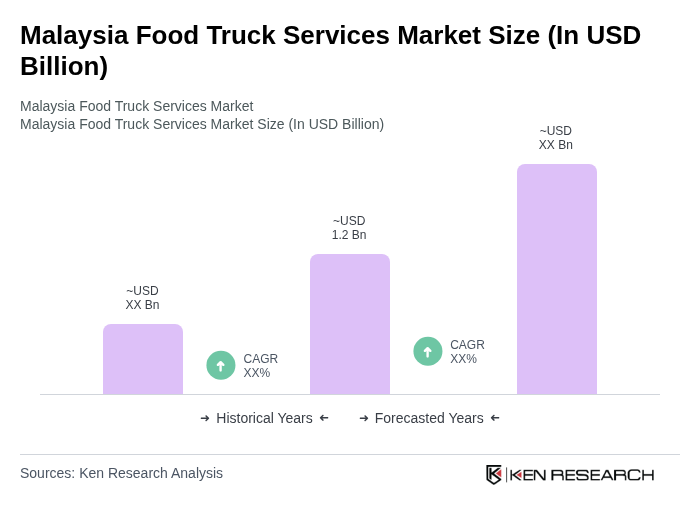
- The Malaysia Food Truck Services Market is valued at USD 1.2 billion, based on a five-year historical analysis. This growth is primarily driven by the increasing popularity of street food culture, urbanization, and a shift in consumer preferences towards convenient dining options. The market has seen a surge in food truck establishments, catering to diverse culinary tastes and offering unique dining experiences.
- Key cities such as Kuala Lumpur, Penang, and Johor Bahru dominate the market due to their high population density, vibrant tourism, and a growing appetite for diverse food options. These urban centers provide a conducive environment for food trucks, with frequent events and festivals that attract both locals and tourists, further enhancing the market's growth.
- In 2023, the Malaysian government implemented regulations to streamline the licensing process for food trucks, aiming to promote entrepreneurship in the food service sector. This initiative includes a simplified application process and reduced fees, encouraging more individuals to enter the food truck business and contribute to the local economy.
Malaysia Food Truck Services Market Segmentation
By Type:The food truck services market can be segmented into various types, including Traditional Food Trucks, Gourmet Food Trucks, Dessert Trucks, Beverage Trucks, Mobile Catering Services, and Others. Each type caters to different consumer preferences and occasions, with gourmet and dessert trucks gaining significant traction due to their unique offerings and presentation.
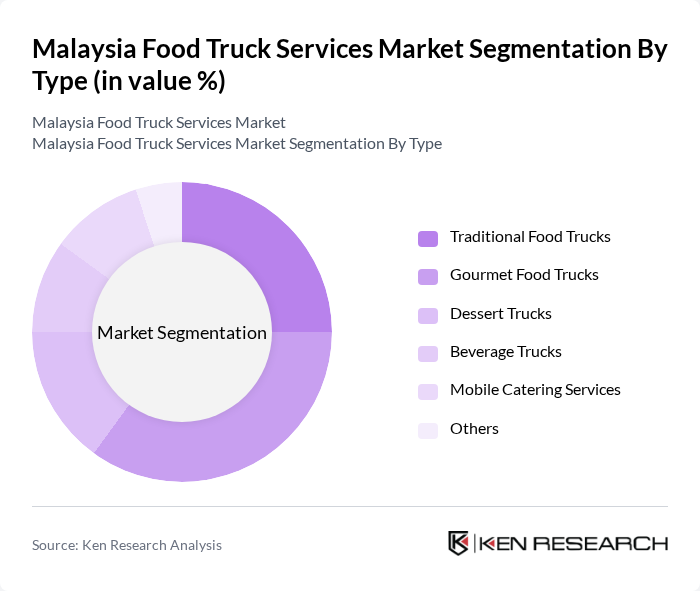
The Gourmet Food Trucks segment is currently leading the market, driven by the rising trend of food enthusiasts seeking high-quality, unique culinary experiences. Consumers are increasingly willing to pay a premium for gourmet offerings, which often feature innovative dishes and high-quality ingredients. This trend is further supported by social media, where visually appealing food presentations attract a larger audience, making gourmet food trucks a popular choice at events and festivals.
By End-User:The end-user segmentation includes Individual Consumers, Corporate Events, Festivals and Fairs, Private Parties, and Others. Each segment has distinct needs, with individual consumers driving demand for convenience and variety, while corporate events and festivals require larger-scale catering solutions.
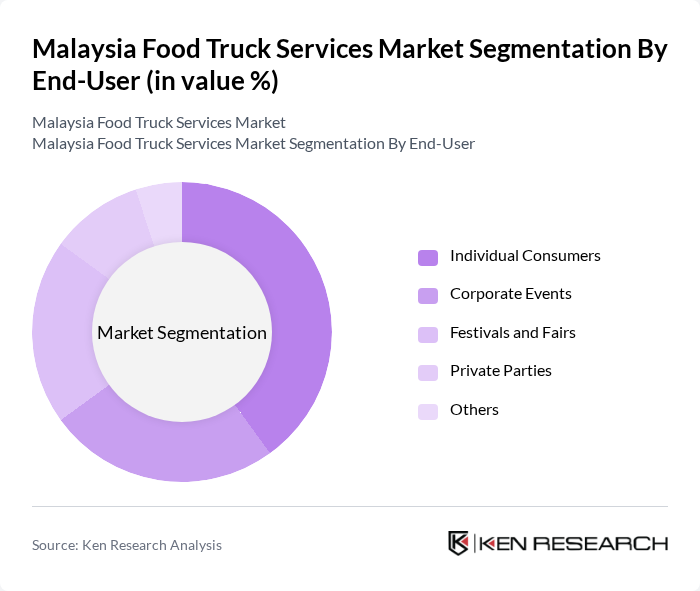
The Individual Consumers segment is the largest, as the growing trend of casual dining and street food culture attracts a wide range of customers. Food trucks offer a convenient and affordable dining option, appealing to busy professionals and families alike. The flexibility of food trucks to cater to various locations and events further enhances their popularity among individual consumers.
Malaysia Food Truck Services Market Competitive Landscape
The Malaysia Food Truck Services Market is characterized by a dynamic mix of regional and international players. Leading participants such as Food Truck Malaysia, The Food Truck Co., My Food Truck, Street Food Malaysia, Foodie Truck, Urban Food Truck, Gourmet Food Truck, Makan Truck, Food Truck Nation, The Hungry Truck, Food on Wheels, Truckin' Good Food, Taste Buds on Wheels, The Rolling Kitchen, Foodie Fiesta contribute to innovation, geographic expansion, and service delivery in this space.
Malaysia Food Truck Services Market Industry Analysis
Growth Drivers
- Increasing Urbanization:Malaysia's urban population is projected to reach 80% in the future, up from 77% in 2020, according to the World Bank. This rapid urbanization drives demand for convenient dining options, including food trucks. Urban areas, with their high foot traffic and diverse demographics, provide food truck operators with a lucrative customer base. The growing number of urban dwellers translates to increased opportunities for food trucks to cater to busy professionals and families seeking quick, affordable meals.
- Rising Demand for Street Food:The street food market in Malaysia is valued at approximately MYR 10 billion in the future, reflecting a growing consumer preference for affordable and diverse food options. This trend is fueled by the younger population, which increasingly seeks unique culinary experiences. Food trucks, offering a variety of cuisines, are well-positioned to meet this demand. The popularity of street food is further enhanced by social media, where food trucks can showcase their offerings and attract customers.
- Low Entry Barriers for Entrepreneurs:The Malaysian government has implemented supportive policies that lower entry barriers for food truck entrepreneurs. The cost to start a food truck business can be as low as MYR 50,000, significantly less than traditional restaurants. This accessibility encourages new entrants, fostering competition and innovation in the market. Additionally, the availability of micro-financing options and grants for small businesses further supports aspiring food truck operators, contributing to market growth.
Market Challenges
- Regulatory Compliance Issues:Food truck operators in Malaysia face complex regulatory requirements, including obtaining licenses and permits, which can be time-consuming and costly. In the future, it is estimated that compliance costs can reach up to MYR 10,000 annually for each food truck. These challenges can deter potential entrepreneurs and limit the growth of existing businesses. Navigating local zoning laws and health regulations adds to the operational burden, impacting profitability and sustainability.
- High Competition Among Vendors:The food truck market in Malaysia is becoming increasingly saturated, with over 3,000 registered food trucks in the future. This high level of competition leads to price wars and reduced profit margins for operators. Many vendors struggle to differentiate themselves in a crowded market, making it essential for food trucks to innovate and offer unique products. The intense competition can also lead to market instability, affecting long-term viability for some businesses.
Malaysia Food Truck Services Market Future Outlook
The future of the Malaysia food truck services market appears promising, driven by evolving consumer preferences and technological advancements. As urbanization continues, food trucks are likely to expand their presence in high-traffic areas, catering to diverse tastes. Additionally, the integration of technology, such as mobile ordering apps, will enhance customer convenience and operational efficiency. Sustainability practices are expected to gain traction, with food trucks adopting eco-friendly packaging and sourcing local ingredients to appeal to environmentally conscious consumers.
Market Opportunities
- Expansion into Untapped Regions:There are significant opportunities for food trucks to expand into rural and suburban areas, where demand for diverse food options is growing. With a population of over 32 million, regions outside major cities are increasingly seeking convenient dining solutions, presenting a lucrative market for food truck operators.
- Collaboration with Local Events:Partnering with local festivals, markets, and events can provide food trucks with increased visibility and customer access. In the future, Malaysia is expected to host over 200 food-related events, offering food trucks a platform to showcase their offerings and attract new customers, enhancing brand recognition and sales.
Scope of the Report
| Segment | Sub-Segments |
|---|---|
| By Type | Traditional Food Trucks Gourmet Food Trucks Dessert Trucks Beverage Trucks Mobile Catering Services Others |
| By End-User | Individual Consumers Corporate Events Festivals and Fairs Private Parties Others |
| By Location | Urban Areas Suburban Areas Rural Areas Event Venues Others |
| By Cuisine Type | Local Malaysian Cuisine Asian Cuisine Western Cuisine Fusion Cuisine Others |
| By Service Model | On-Site Catering Pre-Order Services Walk-Up Services Delivery Services Others |
| By Payment Method | Cash Payments Digital Wallets Credit/Debit Cards Mobile Payments Others |
| By Customer Demographics | Age Groups Income Levels Lifestyle Preferences Dietary Preferences Others |
Key Target Audience
Investors and Venture Capitalist Firms
Government and Regulatory Bodies (e.g., Ministry of Health, Ministry of Domestic Trade and Consumer Affairs)
Food Truck Operators and Entrepreneurs
Local Municipalities and City Councils
Food Suppliers and Ingredient Manufacturers
Event Organizers and Festival Planners
Marketing and Advertising Agencies
Financial Institutions and Banks
Players Mentioned in the Report:
Food Truck Malaysia
The Food Truck Co.
My Food Truck
Street Food Malaysia
Foodie Truck
Urban Food Truck
Gourmet Food Truck
Makan Truck
Food Truck Nation
The Hungry Truck
Food on Wheels
Truckin' Good Food
Taste Buds on Wheels
The Rolling Kitchen
Foodie Fiesta
Table of Contents
Market Assessment Phase
1. Executive Summary and Approach
2. Malaysia Food Truck Services Market Overview
2.1 Key Insights and Strategic Recommendations
2.2 Malaysia Food Truck Services Market Overview
2.3 Definition and Scope
2.4 Evolution of Market Ecosystem
2.5 Timeline of Key Regulatory Milestones
2.6 Value Chain & Stakeholder Mapping
2.7 Business Cycle Analysis
2.8 Policy & Incentive Landscape
3. Malaysia Food Truck Services Market Analysis
3.1 Growth Drivers
3.1.1 Increasing Urbanization
3.1.2 Rising Demand for Street Food
3.1.3 Low Entry Barriers for Entrepreneurs
3.1.4 Growing Popularity of Food Festivals
3.2 Market Challenges
3.2.1 Regulatory Compliance Issues
3.2.2 High Competition Among Vendors
3.2.3 Limited Access to Financing
3.2.4 Seasonal Demand Fluctuations
3.3 Market Opportunities
3.3.1 Expansion into Untapped Regions
3.3.2 Collaboration with Local Events
3.3.3 Introduction of Health-Conscious Menus
3.3.4 Leveraging Social Media for Marketing
3.4 Market Trends
3.4.1 Rise of Gourmet Food Trucks
3.4.2 Integration of Technology in Operations
3.4.3 Focus on Sustainability and Eco-Friendly Practices
3.4.4 Increasing Popularity of Mobile Apps for Ordering
3.5 Government Regulation
3.5.1 Licensing and Permits for Food Trucks
3.5.2 Health and Safety Standards Compliance
3.5.3 Zoning Laws Affecting Food Truck Locations
3.5.4 Taxation Policies for Mobile Food Vendors
4. SWOT Analysis
5. Stakeholder Analysis
6. Porter's Five Forces Analysis
7. Malaysia Food Truck Services Market Market Size, 2019-2024
7.1 By Value
7.2 By Volume
7.3 By Average Selling Price
8. Malaysia Food Truck Services Market Segmentation
8.1 By Type
8.1.1 Traditional Food Trucks
8.1.2 Gourmet Food Trucks
8.1.3 Dessert Trucks
8.1.4 Beverage Trucks
8.1.5 Mobile Catering Services
8.1.6 Others
8.2 By End-User
8.2.1 Individual Consumers
8.2.2 Corporate Events
8.2.3 Festivals and Fairs
8.2.4 Private Parties
8.2.5 Others
8.3 By Location
8.3.1 Urban Areas
8.3.2 Suburban Areas
8.3.3 Rural Areas
8.3.4 Event Venues
8.3.5 Others
8.4 By Cuisine Type
8.4.1 Local Malaysian Cuisine
8.4.2 Asian Cuisine
8.4.3 Western Cuisine
8.4.4 Fusion Cuisine
8.4.5 Others
8.5 By Service Model
8.5.1 On-Site Catering
8.5.2 Pre-Order Services
8.5.3 Walk-Up Services
8.5.4 Delivery Services
8.5.5 Others
8.6 By Payment Method
8.6.1 Cash Payments
8.6.2 Digital Wallets
8.6.3 Credit/Debit Cards
8.6.4 Mobile Payments
8.6.5 Others
8.7 By Customer Demographics
8.7.1 Age Groups
8.7.2 Income Levels
8.7.3 Lifestyle Preferences
8.7.4 Dietary Preferences
8.7.5 Others
9. Malaysia Food Truck Services Market Competitive Analysis
9.1 Market Share of Key Players
9.2 Cross Comparison of Key Players
9.2.1 Company Name
9.2.2 Group Size (Large, Medium, or Small as per industry convention)
9.2.3 Revenue Growth Rate
9.2.4 Customer Retention Rate
9.2.5 Average Order Value
9.2.6 Market Penetration Rate
9.2.7 Pricing Strategy
9.2.8 Brand Recognition Score
9.2.9 Customer Satisfaction Index
9.2.10 Operational Efficiency Ratio
9.3 SWOT Analysis of Top Players
9.4 Pricing Analysis
9.5 Detailed Profile of Major Companies
9.5.1 Food Truck Malaysia
9.5.2 The Food Truck Co.
9.5.3 My Food Truck
9.5.4 Street Food Malaysia
9.5.5 Foodie Truck
9.5.6 Urban Food Truck
9.5.7 Gourmet Food Truck
9.5.8 Makan Truck
9.5.9 Food Truck Nation
9.5.10 The Hungry Truck
9.5.11 Food on Wheels
9.5.12 Truckin' Good Food
9.5.13 Taste Buds on Wheels
9.5.14 The Rolling Kitchen
9.5.15 Foodie Fiesta
10. Malaysia Food Truck Services Market End-User Analysis
10.1 Procurement Behavior of Key Ministries
10.1.1 Ministry of Health
10.1.2 Ministry of Tourism
10.1.3 Ministry of Agriculture
10.1.4 Ministry of Domestic Trade
10.2 Corporate Spend on Infrastructure & Energy
10.2.1 Corporate Events
10.2.2 Sponsorships
10.2.3 Partnerships with Local Businesses
10.3 Pain Point Analysis by End-User Category
10.3.1 Quality of Food
10.3.2 Pricing Concerns
10.3.3 Accessibility
10.3.4 Variety of Options
10.4 User Readiness for Adoption
10.4.1 Awareness of Food Truck Services
10.4.2 Willingness to Try New Cuisines
10.4.3 Acceptance of Mobile Ordering
10.5 Post-Deployment ROI and Use Case Expansion
10.5.1 Customer Feedback Mechanisms
10.5.2 Repeat Business Metrics
10.5.3 Expansion into New Markets
11. Malaysia Food Truck Services Market Future Size, 2025-2030
11.1 By Value
11.2 By Volume
11.3 By Average Selling Price
Go-To-Market Strategy Phase
1. Whitespace Analysis + Business Model Canvas
1.1 Market Gaps Identification
1.2 Business Model Development
2. Marketing and Positioning Recommendations
2.1 Branding Strategies
2.2 Product USPs
3. Distribution Plan
3.1 Urban Retail vs Rural NGO Tie-Ups
4. Channel & Pricing Gaps
4.1 Underserved Routes
4.2 Pricing Bands
5. Unmet Demand & Latent Needs
5.1 Category Gaps
5.2 Consumer Segments
6. Customer Relationship
6.1 Loyalty Programs
6.2 After-Sales Service
7. Value Proposition
7.1 Sustainability
7.2 Integrated Supply Chains
8. Key Activities
8.1 Regulatory Compliance
8.2 Branding
8.3 Distribution Setup
9. Entry Strategy Evaluation
9.1 Domestic Market Entry Strategy
9.1.1 Product Mix
9.1.2 Pricing Band
9.1.3 Packaging
9.2 Export Entry Strategy
9.2.1 Target Countries
9.2.2 Compliance Roadmap
10. Entry Mode Assessment
10.1 JV
10.2 Greenfield
10.3 M&A
10.4 Distributor Model
11. Capital and Timeline Estimation
11.1 Capital Requirements
11.2 Timelines
12. Control vs Risk Trade-Off
12.1 Ownership vs Partnerships
13. Profitability Outlook
13.1 Breakeven Analysis
13.2 Long-Term Sustainability
14. Potential Partner List
14.1 Distributors
14.2 JVs
14.3 Acquisition Targets
15. Execution Roadmap
15.1 Phased Plan for Market Entry
15.1.1 Market Setup
15.1.2 Market Entry
15.1.3 Growth Acceleration
15.1.4 Scale & Stabilize
15.2 Key Activities and Milestones
15.2.1 Milestone Planning
Research Methodology
Phase 1: Approach1
Desk Research
- Analysis of industry reports from Malaysian government agencies and food service associations
- Review of market trends and consumer behavior studies published in local and international journals
- Examination of food truck regulations and licensing requirements from municipal authorities
Primary Research
- Interviews with food truck operators to gather insights on operational challenges and market dynamics
- Surveys targeting consumers to understand preferences and spending habits related to food trucks
- Focus group discussions with local entrepreneurs and food service experts to explore market opportunities
Validation & Triangulation
- Cross-validation of findings through comparison with existing market data and trends
- Triangulation of insights from primary interviews with secondary research findings
- Sanity checks conducted through expert panel reviews comprising industry veterans and market analysts
Phase 2: Market Size Estimation1
Top-down Assessment
- Estimation of total food service market size in Malaysia and identification of food truck segment share
- Analysis of demographic trends and urbanization rates influencing food truck demand
- Incorporation of tourism statistics to assess potential customer base for food trucks
Bottom-up Modeling
- Collection of sales data from a sample of food truck operators to establish revenue benchmarks
- Estimation of average transaction values and customer footfall based on location and time
- Volume x average spend calculations to derive total market size for food truck services
Forecasting & Scenario Analysis
- Multi-factor regression analysis incorporating economic indicators and consumer spending trends
- Scenario modeling based on potential regulatory changes and shifts in consumer preferences
- Development of baseline, optimistic, and pessimistic forecasts through 2030
Phase 3: CATI Sample Composition1
| Scope Item/Segment | Sample Size | Target Respondent Profiles |
|---|---|---|
| Food Truck Operators | 100 | Owners, Managers |
| Consumer Preferences | 150 | Food Enthusiasts, Local Residents |
| Regulatory Insights | 50 | Local Government Officials, Licensing Authorities |
| Market Trends | 80 | Industry Analysts, Food Service Consultants |
| Tourism Impact | 70 | Tour Operators, Hospitality Managers |
Frequently Asked Questions
What is the current value of the Malaysia Food Truck Services Market?
The Malaysia Food Truck Services Market is valued at approximately USD 1.2 billion, reflecting significant growth driven by urbanization, the popularity of street food culture, and changing consumer preferences towards convenient dining options.
Which cities are the main hubs for food truck services in Malaysia?
What types of food trucks are popular in Malaysia?
How has the Malaysian government supported food truck entrepreneurs?
Other Regional/Country Reports
Other Adjacent Reports
Japan Street Food Market
Qatar Mobile Catering Market
Malaysia Food Delivery Market
Philippines Quick Service Restaurant Market
Germany Event Catering Market
Vietnam Gourmet Food Market
Oman Dessert Truck Market
Indonesia Beverage Services Market
Brazil Hospitality Services Market
Saudi Arabia Culinary Tourism Market Report Size, Share, Growth Drivers, Trends, Opportunities & Forecast 2025–2030Why Buy From Us?

What makes us stand out is that our consultants follow Robust, Refine and Result (RRR) methodology. Robust for clear definitions, approaches and sanity checking, Refine for differentiating respondents' facts and opinions, and Result for presenting data with story.

We have set a benchmark in the industry by offering our clients with syndicated and customized market research reports featuring coverage of entire market as well as meticulous research and analyst insights.

While we don't replace traditional research, we flip the method upside down. Our dual approach of Top Bottom & Bottom Top ensures quality deliverable by not just verifying company fundamentals but also looking at the sector and macroeconomic factors.

With one step in the future, our research team constantly tries to show you the bigger picture. We help with some of the tough questions you may encounter along the way: How is the industry positioned? Best marketing channel? KPI's of competitors? By aligning every element, we help maximize success.

Our report gives you instant access to the answers and sources that other companies might choose to hide. We elaborate each steps of research methodology we have used and showcase you the sample size to earn your trust.

If you need any support, we are here! We pride ourselves on universe strength, data quality, and quick, friendly, and professional service.