Middle East Flat Flexible Cables Market Report Size Share Growth Drivers Trends Opportunities & Forecast 2025–2030

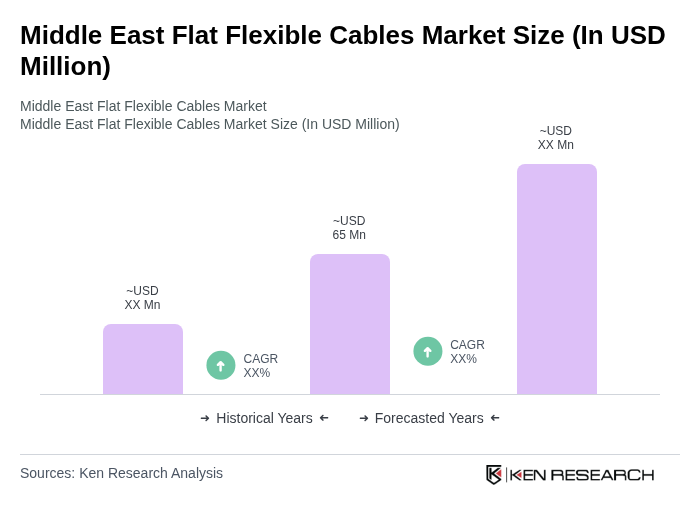
Middle East Flat Flexible Cables Market, valued at USD 65 Mn, grows due to infrastructure projects, renewable energy adoption, and demand in consumer electronics and automotive sectors.

Region:Middle East

Author(s):Geetanshi

Product Code:KRAA4032

Pages:86

Published On:January 2026
About the Report

Base Year 2024

Middle East Flat Flexible Cables Market Overview

  • The Middle East Flat Flexible Cables Market is valued at USD 65 million, based on a five-year historical analysis and regional share of the broader Middle East & Africa flat flexible cables market. This growth is primarily driven by the increasing demand for flexible cables in sectors such as consumer electronics, automotive, medical devices, and industrial automation, where compact, lightweight, and space-saving interconnect solutions are required. The rise in infrastructure projects, diversification into manufacturing and electronics, and technological advancements in cable design and materials have further fueled market expansion in the region.
  • Key players in this market include the GCC countries, particularly the United Arab Emirates and Saudi Arabia, which dominate due to their robust industrial base, large-scale infrastructure and smart city projects, and significant investments in telecommunications, transportation, and energy. The growing presence of electronics assembly, automotive component manufacturing, and oil and gas instrumentation in these economies, together with strong demand for consumer devices such as smartphones, laptops, and displays, contributes to their leadership in flat flexible cable consumption.
  • In 2023, Saudi Arabia strengthened its building safety and electrical infrastructure framework through the Saudi Building Code (SBC) and associated implementing regulations issued by the Saudi Standards, Metrology and Quality Organization (SASO), which mandate compliance of electrical components, including cables used in buildings, with approved performance and safety standards. These rules aim to enhance fire safety, reliability, and energy performance in new construction projects, indirectly driving demand for certified, high?quality flat flexible and related cable solutions in building systems, control panels, and connected devices.
Middle East Flat Flexible Cables Market Size

Middle East Flat Flexible Cables Market Segmentation

By Cable Type:The market is segmented into Shielded Flat Flexible Cables and Unshielded Flat Flexible Cables. Shielded cables are preferred in applications requiring protection against electromagnetic interference, such as high?speed data links, automotive electronics, medical equipment, and industrial controls, while unshielded cables are commonly used in less sensitive or shorter?distance environments where electromagnetic noise is limited.
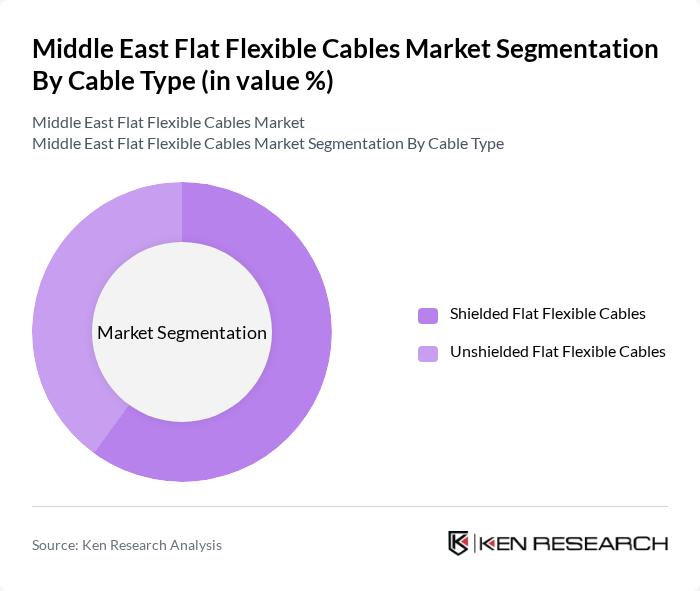
Middle East Flat Flexible Cables Market segmentation by Cable Type.

Shielded Flat Flexible Cables dominate the market due to their ability to minimize signal interference, making them essential for high-performance applications in consumer electronics, automotive control systems, and industrial automation where signal integrity and noise suppression are critical. The increasing complexity and data rates of electronic devices, together with denser electronic packaging, have led to a growing preference for shielded cables among manufacturers. This trend is further supported by advancements in cable technology, including improved shielding materials and high-temperature insulations, which enhance the durability, flexibility, and transmission efficiency of shielded options.

By Copper Wire Thickness:The market is categorized into three subsegments: < 35 Micron, 35 to 50 Micron, and 50 to 100 Micron. Each thickness range serves different applications based on conductivity, current?carrying capacity, and flexibility requirements.
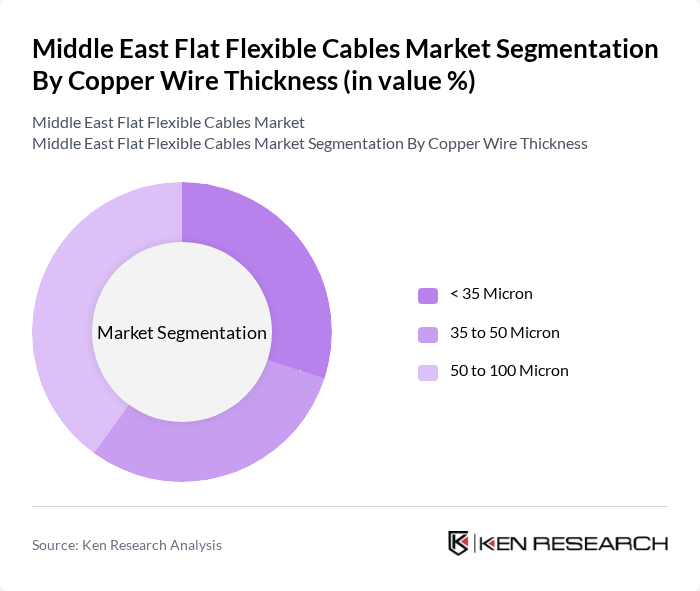
Middle East Flat Flexible Cables Market segmentation by Copper Wire Thickness.

The 50 to 100 Micron segment holds a leading revenue share in the broader Middle East & Africa flat flexible cables market, reflecting its suitability for applications requiring higher current capacity and mechanical robustness, such as automotive harnesses, industrial equipment, and display interconnects. The < 35 Micron segment, while smaller in share, is the fastest growing due to its use in miniaturized and lightweight consumer electronics, laptops, smartphones, and semiconductor packaging, where very thin conductors enable compact designs and tight bending radii. In the Middle East, ongoing adoption of advanced consumer devices and compact medical and industrial electronics supports demand across the full thickness range, with 35 to 50 Micron offering a balanced option between flexibility, reliability, and cost for mixed-use applications.

Middle East Flat Flexible Cables Market Competitive Landscape

The Middle East Flat Flexible Cables Market is characterized by a dynamic mix of regional and international players. Leading participants such as Sumitomo Electric Industries, Ltd., Molex LLC, TE Connectivity Ltd., Axon’ Cable SAS, 3M Company, Amphenol Corporation, Nexans S.A., Prysmian Group, Lapp Group (Lapp Holding SE), RS Group plc (RS Components), Belden Inc., LEONI AG, Yazaki Corporation, Fujikura Ltd., and local manufacturers contribute to innovation, geographic expansion, and service delivery in this space.

Sumitomo Electric Industries, Ltd.

1897

Osaka, Japan

Molex LLC

1938

Lisle, Illinois, USA

TE Connectivity Ltd.

2007

Schaffhausen, Switzerland

Axon’ Cable SAS

1965

Montmirail, France

3M Company

1902

St. Paul, Minnesota, USA

Company

Establishment Year

Headquarters

Regional Flat Flexible Cable Revenue (USD Mn)

Regional Revenue CAGR (2019–2030)

Middle East & Africa Market Share (%)

EBITDA Margin (%)

Return on Invested Capital (ROIC)

R&D Intensity (% of Revenue)

Middle East Flat Flexible Cables Market Industry Analysis

Growth Drivers

  • Increasing Demand for Energy-Efficient Solutions:The Middle East is witnessing a surge in energy-efficient solutions, driven by a regional commitment to sustainability. In future, energy consumption in the region is projected to reach 1,100 TWh, with a significant portion attributed to energy-efficient technologies. Governments are investing heavily in energy-saving initiatives, with the UAE alone allocating $160 billion towards energy efficiency projects, fostering a favorable environment for flat flexible cables that meet these standards.
  • Expansion of Construction and Infrastructure Projects:The construction sector in the Middle East is expected to grow by 6.0% in future, fueled by major infrastructure projects such as the NEOM city in Saudi Arabia, which has a projected investment of $500 billion. This expansion necessitates the use of flat flexible cables for efficient electrical installations, as they are essential for modern building designs and smart infrastructure, thereby driving market demand significantly.
  • Rising Adoption of Renewable Energy Sources:The Middle East is increasingly investing in renewable energy, with solar and wind energy capacity expected to exceed 120 GW in future. Countries like Saudi Arabia and the UAE are leading this transition, with investments of $50 billion and $30 billion, respectively, in renewable projects. This shift creates a robust demand for flat flexible cables, which are integral to the efficient transmission of renewable energy, enhancing market growth prospects.

Market Challenges

  • Fluctuating Raw Material Prices:The flat flexible cables market faces challenges due to volatile raw material prices, particularly copper and aluminum, which are essential for cable manufacturing. In future, copper prices are projected to fluctuate between $8,500 and $9,000 per ton, impacting production costs. This volatility can lead to increased prices for end consumers, potentially stifling market growth and profitability for manufacturers in the region.
  • Stringent Regulatory Requirements:Compliance with stringent regulatory standards poses a significant challenge for manufacturers in the Middle East. In future, new regulations regarding safety and environmental impact are expected to be enforced, requiring manufacturers to invest in compliance measures. This could increase operational costs and limit the ability of smaller companies to compete, thereby affecting overall market dynamics and growth potential.

Middle East Flat Flexible Cables Market Future Outlook

The future of the Middle East flat flexible cables market appears promising, driven by ongoing investments in infrastructure and renewable energy. As governments prioritize sustainable development, the demand for energy-efficient solutions will likely increase. Additionally, technological advancements in cable manufacturing are expected to enhance product offerings, making them more appealing to consumers. The integration of smart technologies will further propel market growth, creating a dynamic landscape for manufacturers and stakeholders in the region.

Market Opportunities

  • Growth in Smart City Initiatives:The rise of smart city projects across the Middle East presents a significant opportunity for flat flexible cables. With investments exceeding $100 billion in smart infrastructure, these cables are essential for efficient connectivity and energy management, positioning manufacturers to capitalize on this trend.
  • Increasing Investments in Renewable Energy:As the region shifts towards renewable energy, investments are projected to reach $50 billion in future. This transition will drive demand for flat flexible cables, which are crucial for integrating renewable sources into existing grids, offering manufacturers a lucrative market opportunity.

Scope of the Report

SegmentSub-Segments
By Cable Type

Shielded Flat Flexible Cables

Unshielded Flat Flexible Cables

By Copper Wire Thickness

< 35 Micron

to 50 Micron

to 100 Micron

By Pitch Size

mm Pitch

mm Pitch

mm Pitch

Others

By Application

Consumer Electronics

Automotive Electronics

Industrial Automation

Medical Devices

Others

By End-User

Electronics Manufacturers

Automotive OEMs

Industrial Equipment Manufacturers

Medical Device Manufacturers

Others

By Region (Middle East)

GCC Countries

Rest of Middle East

By Region (Africa)

North Africa

Sub-Saharan Africa

Key Target Audience

Investors and Venture Capitalist Firms

Government and Regulatory Bodies (e.g., Ministry of Energy, Ministry of Industry and Advanced Technology)

Manufacturers and Producers

Distributors and Retailers

Construction and Infrastructure Companies

Telecommunications Providers

Energy and Utility Companies

Financial Institutions

Players Mentioned in the Report:

Sumitomo Electric Industries, Ltd.

Molex LLC

TE Connectivity Ltd.

Axon Cable SAS

3M Company

Amphenol Corporation

Nexans S.A.

Prysmian Group

Lapp Group (Lapp Holding SE)

RS Group plc (RS Components)

Belden Inc.

LEONI AG

Yazaki Corporation

Fujikura Ltd.

Local & Regional Flat Flexible Cable Manufacturers in the Middle East & Africa

Table of Contents

Market Assessment Phase

1. Executive Summary and Approach


2. Middle East Flat Flexible Cables Market Overview

2.1 Key Insights and Strategic Recommendations

2.2 Middle East Flat Flexible Cables Market Overview

2.3 Definition and Scope

2.4 Evolution of Market Ecosystem

2.5 Timeline of Key Regulatory Milestones

2.6 Value Chain & Stakeholder Mapping

2.7 Business Cycle Analysis

2.8 Policy & Incentive Landscape


3. Middle East Flat Flexible Cables Market Analysis

3.1 Growth Drivers

3.1.1 Increasing demand for energy-efficient solutions
3.1.2 Expansion of construction and infrastructure projects
3.1.3 Rising adoption of renewable energy sources
3.1.4 Technological advancements in cable manufacturing

3.2 Market Challenges

3.2.1 Fluctuating raw material prices
3.2.2 Stringent regulatory requirements
3.2.3 Competition from alternative cable solutions
3.2.4 Limited awareness of product benefits

3.3 Market Opportunities

3.3.1 Growth in smart city initiatives
3.3.2 Increasing investments in renewable energy
3.3.3 Expansion of the automotive and electronics sectors
3.3.4 Development of innovative cable technologies

3.4 Market Trends

3.4.1 Shift towards sustainable and eco-friendly products
3.4.2 Integration of IoT in cable applications
3.4.3 Customization and personalization of cable solutions
3.4.4 Growth of e-commerce in cable distribution

3.5 Government Regulation

3.5.1 Compliance with international safety standards
3.5.2 Incentives for renewable energy projects
3.5.3 Regulations on waste management and recycling
3.5.4 Standards for energy efficiency in cables

4. SWOT Analysis


5. Stakeholder Analysis


6. Porter's Five Forces Analysis


7. Middle East Flat Flexible Cables Market Market Size, 2019-2024

7.1 By Value

7.2 By Volume

7.3 By Average Selling Price


8. Middle East Flat Flexible Cables Market Segmentation

8.1 By Cable Type

8.1.1 Shielded Flat Flexible Cables
8.1.2 Unshielded Flat Flexible Cables

8.2 By Copper Wire Thickness

8.2.1 < 35 Micron
8.2.2 35 to 50 Micron
8.2.3 50 to 100 Micron

8.3 By Pitch Size

8.3.1 0.500 mm Pitch
8.3.2 1.00 mm Pitch
8.3.3 1.250 mm Pitch
8.3.4 Others

8.4 By Application

8.4.1 Consumer Electronics
8.4.2 Automotive Electronics
8.4.3 Industrial Automation
8.4.4 Medical Devices
8.4.5 Others

8.5 By End-User

8.5.1 Electronics Manufacturers
8.5.2 Automotive OEMs
8.5.3 Industrial Equipment Manufacturers
8.5.4 Medical Device Manufacturers
8.5.5 Others

8.6 By Region (Middle East)

8.6.1 GCC Countries
8.6.2 Rest of Middle East

8.7 By Region (Africa)

8.7.1 North Africa
8.7.2 Sub-Saharan Africa

9. Middle East Flat Flexible Cables Market Competitive Analysis

9.1 Market Share of Key Players

9.2 Cross Comparison of Key Players

9.2.1 Company Name
9.2.2 Regional Flat Flexible Cable Revenue (USD Mn)
9.2.3 Regional Revenue CAGR (2019–2030)
9.2.4 Middle East & Africa Market Share (%)
9.2.5 EBITDA Margin (%)
9.2.6 Return on Invested Capital (ROIC)
9.2.7 R&D Intensity (% of Revenue)
9.2.8 Capex Intensity (% of Revenue)
9.2.9 Installed Production Capacity (km of FFC per year)
9.2.10 Average Selling Price Index (vs Regional Average)
9.2.11 Customer Concentration (Top 5 % of Revenue)
9.2.12 Order Backlog / Book-to-Bill Ratio

9.3 SWOT Analysis of Top Players

9.4 Pricing Analysis

9.5 Detailed Profile of Major Companies

9.5.1 Sumitomo Electric Industries, Ltd.
9.5.2 Molex LLC
9.5.3 TE Connectivity Ltd.
9.5.4 Axon’ Cable SAS
9.5.5 3M Company
9.5.6 Amphenol Corporation
9.5.7 Nexans S.A.
9.5.8 Prysmian Group
9.5.9 Lapp Group (Lapp Holding SE)
9.5.10 RS Group plc (RS Components)
9.5.11 Belden Inc.
9.5.12 LEONI AG
9.5.13 Yazaki Corporation
9.5.14 Fujikura Ltd.
9.5.15 Local & Regional Flat Flexible Cable Manufacturers in the Middle East & Africa

10. Middle East Flat Flexible Cables Market End-User Analysis

10.1 Procurement Behavior of Key Ministries

10.1.1 Government procurement policies
10.1.2 Budget allocation trends
10.1.3 Supplier selection criteria
10.1.4 Contract management practices

10.2 Corporate Spend on Infrastructure & Energy

10.2.1 Investment trends in infrastructure projects
10.2.2 Energy expenditure patterns
10.2.3 Budgeting for cable procurement
10.2.4 Corporate sustainability initiatives

10.3 Pain Point Analysis by End-User Category

10.3.1 Challenges faced by residential users
10.3.2 Issues in commercial applications
10.3.3 Industrial user concerns
10.3.4 Government and utility sector challenges

10.4 User Readiness for Adoption

10.4.1 Awareness of flat flexible cables
10.4.2 Training and support needs
10.4.3 Adoption barriers
10.4.4 User feedback mechanisms

10.5 Post-Deployment ROI and Use Case Expansion

10.5.1 Measurement of ROI
10.5.2 Case studies of successful deployments
10.5.3 Opportunities for expansion
10.5.4 Long-term benefits analysis

11. Middle East Flat Flexible Cables Market Future Size, 2025-2030

11.1 By Value

11.2 By Volume

11.3 By Average Selling Price


Go-To-Market Strategy Phase

1. Whitespace Analysis + Business Model Canvas

1.1 Market gaps identification

1.2 Business model development


2. Marketing and Positioning Recommendations

2.1 Branding strategies

2.2 Product USPs


3. Distribution Plan

3.1 Urban retail vs rural NGO tie-ups


4. Channel & Pricing Gaps

4.1 Underserved routes

4.2 Pricing bands


5. Unmet Demand & Latent Needs

5.1 Category gaps

5.2 Consumer segments


6. Customer Relationship

6.1 Loyalty programs

6.2 After-sales service


7. Value Proposition

7.1 Sustainability

7.2 Integrated supply chains


8. Key Activities

8.1 Regulatory compliance

8.2 Branding

8.3 Distribution setup


9. Entry Strategy Evaluation

9.1 Domestic Market Entry Strategy

9.1.1 Product mix
9.1.2 Pricing band
9.1.3 Packaging

9.2 Export Entry Strategy

9.2.1 Target countries
9.2.2 Compliance roadmap

10. Entry Mode Assessment

10.1 JV

10.2 Greenfield

10.3 M&A

10.4 Distributor Model


11. Capital and Timeline Estimation

11.1 Capital requirements

11.2 Timelines


12. Control vs Risk Trade-Off

12.1 Ownership vs Partnerships


13. Profitability Outlook

13.1 Breakeven analysis

13.2 Long-term sustainability


14. Potential Partner List

14.1 Distributors

14.2 JVs

14.3 Acquisition targets


15. Execution Roadmap

15.1 Phased Plan for Market Entry

15.1.1 Market Setup
15.1.2 Market Entry
15.1.3 Growth Acceleration
15.1.4 Scale & Stabilize

15.2 Key Activities and Milestones

15.2.1 Milestone tracking
15.2.2 Activity scheduling

Research Methodology

ApproachModellingSample

Phase 1: Approach1

Desk Research

  • Industry reports from regional trade associations and market research firms
  • Government publications and statistics on electrical and electronic manufacturing
  • Technical papers and white papers on flat flexible cable technologies and applications

Primary Research

  • Interviews with engineers and product managers at cable manufacturing companies
  • Surveys with electrical contractors and installers regarding usage trends
  • Field interviews with end-users in sectors such as automotive, telecommunications, and consumer electronics

Validation & Triangulation

  • Cross-validation of findings through multiple industry expert interviews
  • Triangulation of data from trade publications, market reports, and expert insights
  • Sanity checks through feedback from a panel of industry veterans

Phase 2: Market Size Estimation1

Top-down Assessment

  • Analysis of the overall electrical cable market size in the Middle East
  • Segmentation by application areas such as automotive, industrial, and consumer electronics
  • Incorporation of growth rates from related sectors influencing flat flexible cable demand

Bottom-up Modeling

  • Volume estimates based on production capacities of leading manufacturers in the region
  • Cost analysis derived from material costs and manufacturing processes
  • Estimation of market share based on sales data from key players

Forecasting & Scenario Analysis

  • Multi-variable forecasting using economic indicators and technological advancements
  • Scenario analysis based on regulatory changes and market entry of new technologies
  • Development of baseline, optimistic, and pessimistic market growth scenarios through 2030

Phase 3: CATI Sample Composition1

Scope Item/SegmentSample SizeTarget Respondent Profiles
Automotive Industry Applications120Design Engineers, Procurement Managers
Consumer Electronics Manufacturing90Product Development Managers, Quality Assurance Leads
Telecommunications Sector Usage100Network Engineers, Operations Managers
Industrial Automation Solutions80Automation Engineers, Facility Managers
Medical Device Applications70Regulatory Affairs Specialists, R&D Managers

Frequently Asked Questions

What is the current value of the Middle East Flat Flexible Cables Market?

The Middle East Flat Flexible Cables Market is valued at approximately USD 65 million, reflecting a five-year historical analysis and regional share within the broader Middle East & Africa flat flexible cables market.

What factors are driving the growth of the Middle East Flat Flexible Cables Market?

Which countries dominate the Middle East Flat Flexible Cables Market?

What are the main types of flat flexible cables in the market?

Why Buy From Us?

Refine Robust Result (RRR) Framework

What makes us stand out is that our consultants follow Robust, Refine and Result (RRR) methodology. Robust for clear definitions, approaches and sanity checking, Refine for differentiating respondents' facts and opinions, and Result for presenting data with story.

Our Reach Is Unmatched

We have set a benchmark in the industry by offering our clients with syndicated and customized market research reports featuring coverage of entire market as well as meticulous research and analyst insights.

Shifting the Research Paradigm

While we don't replace traditional research, we flip the method upside down. Our dual approach of Top Bottom & Bottom Top ensures quality deliverable by not just verifying company fundamentals but also looking at the sector and macroeconomic factors.

More Insights-Better Decisions

With one step in the future, our research team constantly tries to show you the bigger picture. We help with some of the tough questions you may encounter along the way: How is the industry positioned? Best marketing channel? KPI's of competitors? By aligning every element, we help maximize success.

Transparency and Trust

Our report gives you instant access to the answers and sources that other companies might choose to hide. We elaborate each steps of research methodology we have used and showcase you the sample size to earn your trust.

Round the Clock Support

If you need any support, we are here! We pride ourselves on universe strength, data quality, and quick, friendly, and professional service.

Why Clients Choose Us?

400000+
Reports in repository
150+
Consulting projects a year
100+
Analysts
8000+
Client Queries in 2022








