About the Report
Base Year 2024Listen to the audio summary
Middle East Off Road Vehicle Market Overview
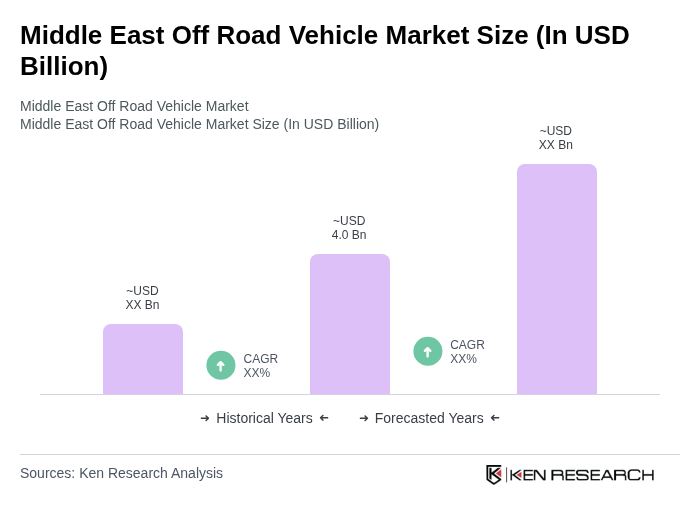
- The Middle East Off Road Vehicle Market is valued at USD 4.0 billion, based on a five-year historical analysis, reflecting the combined contribution of off-road SUVs and pickups, all-terrain vehicles (ATVs), utility task/side-by-side vehicles (UTVs/SxS), and off-road motorcycles across key Gulf markets. This growth is primarily driven by increasing consumer interest in outdoor recreational activities, coupled with a marked rise in tourism and adventure sports in the region, especially desert safaris, dune bashing, rally events, and camping. The demand for off-road vehicles has surged as consumers and operators seek vehicles that can handle diverse terrains, particularly in desert and mountainous areas, and as governments promote tourism and lifestyle-oriented mobility through national vision programs and large-scale recreational investments.
- Key country markets in this segment include Saudi Arabia, the United Arab Emirates, Qatar, Bahrain, and, more broadly, other Gulf Cooperation Council (GCC) economies, with Saudi Arabia and the United Arab Emirates accounting for a substantial share due to their large vehicle parks and strong tourism and leisure sectors. These countries dominate regional off-road activity due to vast desert landscapes and challenging terrains that are ideal for off-road use, as well as strong consumer preference for SUVs and pickups in everyday mobility and recreational applications. Additionally, the growing trend of adventure tourism, the expansion of desert tour operations, and the increasing number of organized off-road events, rallies, and motorsport competitions further bolster their market presence and stimulate demand for both new vehicles and rentals.
- In 2021, the Saudi Standards, Metrology and Quality Organization (SASO) issued the Technical Regulation for Motorcycles and Similar Vehicles, including quad bikes and certain off-road recreational vehicles, setting binding safety requirements on braking performance, lighting, stability, structural integrity, and protective devices for vehicles placed on the Saudi market. This regulation, together with SASO’s Technical Regulation for Vehicle Safety Parts and the Unified Traffic Law enforced by the General Directorate of Traffic, mandates compliance with approved standards for critical safety components such as seat belts, rollover protection structures where applicable, and other vehicle systems as a prerequisite for registration, import, and use. These frameworks aim to reduce accidents and improve user safety in demanding terrain, reflecting the government’s broader commitment under Vision 2030 to promote responsible off-road driving, tourism, and motorsport while ensuring that vehicles sold and operated in the Kingdom meet defined safety benchmarks.
Middle East Off Road Vehicle Market Segmentation
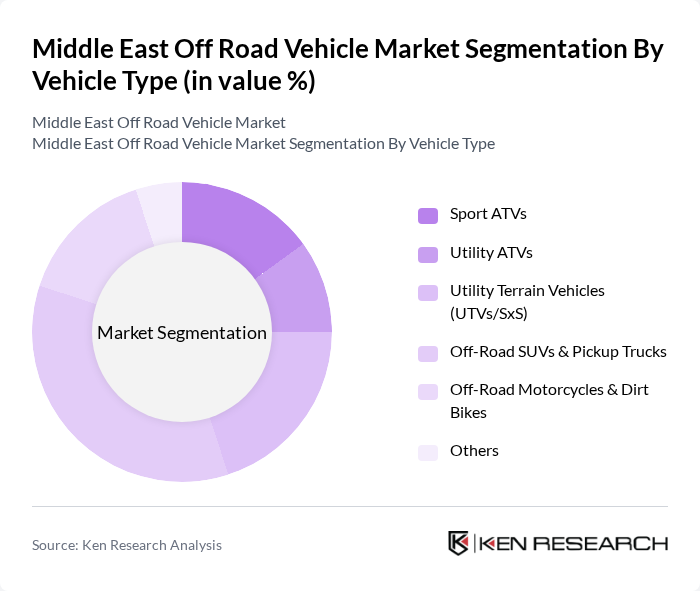
By Vehicle Type:The vehicle type segmentation includes various categories such as Sport ATVs, Utility ATVs, Utility Terrain Vehicles (UTVs/SxS), Off-Road SUVs & Pickup Trucks, Off-Road Motorcycles & Dirt Bikes, and Others. This structure is consistent with typical off-road portfolios in regional markets, where both recreational and commercial users employ a mix of light off-road vehicles and road-legal 4x4s. Among these, Off-Road SUVs & Pickup Trucks dominate the market due to their versatility, higher share in overall new-vehicle registrations, and suitability for both urban and rugged terrains, including use in oil and gas, construction support, government fleets, and family leisure travel. Consumers prefer these vehicles for their spaciousness, comfort, and capability to accommodate families and gear, making them ideal for recreational trips, weekend desert outings, and utility purposes in remote or harsh environments.
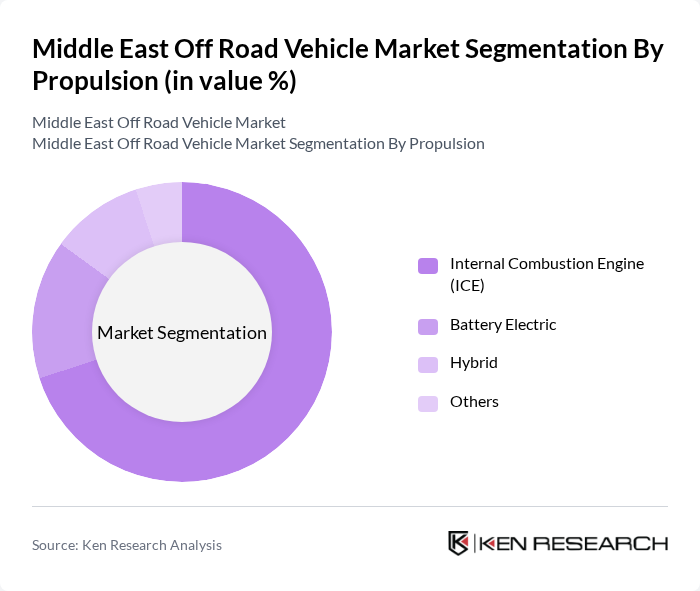
By Propulsion:The propulsion segmentation includes Internal Combustion Engine (ICE), Battery Electric, Hybrid, and Others. The Internal Combustion Engine (ICE) segment leads the market, primarily due to the established fuel distribution infrastructure, the dominance of petrol and diesel-powered SUVs and pickups in Gulf markets, and user familiarity with conventional powertrains for long-distance and heavy-duty use in deserts and remote areas. However, there is growing interest in Battery Electric and Hybrid off-road-capable vehicles, supported by national energy-transition strategies, investments in fast-charging networks in the United Arab Emirates and Saudi Arabia, and the introduction of electrified SUVs and high-performance off-road models by global automakers, indicating a gradual shift in premium and fleet segments.
Middle East Off Road Vehicle Market Competitive Landscape
The Middle East Off Road Vehicle Market is characterized by a dynamic mix of regional and international players. Leading participants such as Toyota Motor Corporation, Ford Motor Company, Jeep (Stellantis N.V.), Polaris Inc., BRP Inc. (Can-Am), Yamaha Motor Co., Ltd., Honda Motor Co., Ltd., Kawasaki Heavy Industries, Ltd., Textron Inc. (Arctic Cat), Mahindra & Mahindra Ltd., Suzuki Motor Corporation, Jaguar Land Rover Automotive plc (Land Rover), Mercedes-Benz Group AG, Nissan Motor Co., Ltd., Hyundai Motor Company contribute to innovation, geographic expansion, and service delivery in this space, offering portfolios that range from mass-market and premium 4x4 SUVs and pickups to specialized ATVs, UTVs, and sport side-by-sides tailored to desert and adventure use.
Middle East Off Road Vehicle Market Industry Analysis
Growth Drivers
- Increasing Popularity of Off-Road Recreational Activities:The Middle East has seen a surge in off-road recreational activities, with participation rates increasing by 30% from 2020 to 2023. This growth is driven by a rising interest in adventure tourism, with the region attracting over 10 million adventure tourists annually. The UAE alone reported a 25% increase in off-road vehicle registrations, reflecting the growing demand for recreational vehicles that cater to this trend, supported by improved infrastructure and accessibility to off-road terrains.
- Rising Disposable Income Among Consumers:The average disposable income in the Middle East is projected to reach $22,000 per capita in future, up from $18,500 previously. This increase allows consumers to invest in off-road vehicles, which are often seen as luxury items. Countries like Saudi Arabia and the UAE are leading this trend, with a 15% year-on-year growth in luxury vehicle sales, indicating a strong market for high-end off-road vehicles that cater to affluent consumers seeking adventure and leisure.
- Expansion of Tourism and Adventure Sports:The Middle East's tourism sector is expected to grow by 5% annually, with adventure sports becoming a significant draw. In future, the region hosted over 1.6 million adventure sports events, leading to increased demand for off-road vehicles. Countries like Oman and Jordan are investing heavily in adventure tourism infrastructure, with over $600 million allocated to develop off-road trails and facilities, further enhancing the market for off-road vehicles in the region.
Market Challenges
- High Initial Purchase Costs:The average cost of off-road vehicles in the Middle East ranges from $32,000 to $85,000, which can be prohibitive for many consumers. This high initial investment limits market penetration, particularly among middle-income households. Additionally, the economic impact of fluctuating oil prices can affect consumer spending power, making it challenging for manufacturers to attract a broader customer base in a price-sensitive market.
- Regulatory Hurdles and Compliance Issues:The off-road vehicle market faces significant regulatory challenges, including stringent emission standards and safety regulations. For instance, the UAE has implemented new regulations requiring off-road vehicles to meet specific environmental standards by future. Compliance with these regulations can increase production costs for manufacturers, potentially leading to higher retail prices and limiting market growth as companies navigate complex regulatory landscapes.
Middle East Off Road Vehicle Market Future Outlook
The future of the Middle East off-road vehicle market appears promising, driven by increasing consumer interest in adventure tourism and recreational activities. As disposable incomes rise, more consumers are likely to invest in off-road vehicles. Additionally, advancements in electric vehicle technology and sustainability initiatives are expected to reshape the market landscape, encouraging manufacturers to innovate and meet evolving consumer preferences for eco-friendly options. The collaboration between vehicle manufacturers and tourism companies will further enhance market growth.
Market Opportunities
- Growth in Electric Off-Road Vehicles:The demand for electric off-road vehicles is on the rise, with projections indicating a market growth of 22% annually. This shift is driven by increasing environmental awareness and government incentives for electric vehicle adoption. Manufacturers are investing in electric models, anticipating that in future, 18% of new off-road vehicle sales will be electric, creating significant opportunities for innovation and market expansion.
- Development of Off-Road Vehicle Accessories and Modifications:The accessories market for off-road vehicles is expected to grow significantly, with an estimated value of $1.2 billion in future. This growth is fueled by consumer demand for customization and personalization, as enthusiasts seek to enhance their vehicles' performance and aesthetics. Companies that focus on innovative accessory development can tap into this lucrative segment, driving additional revenue streams in the off-road vehicle market.
Scope of the Report
| Segment | Sub-Segments |
|---|---|
| By Vehicle Type | Sport ATVs Utility ATVs Utility Terrain Vehicles (UTVs/SxS) Off-Road SUVs & Pickup Trucks Off-Road Motorcycles & Dirt Bikes Others |
| By Propulsion | Internal Combustion Engine (ICE) Battery Electric Hybrid Others |
| By Application | Recreational & Sports Agriculture & Utility Industrial, Construction & Mining Military & Defense Tourism, Hospitality & Rental Fleets Others |
| By Drivetrain | Two-Wheel Drive Four-Wheel Drive All-Wheel Drive |
| By Engine Displacement (ICE Vehicles) | Up to 400 cc –800 cc Above 800 cc |
| By Country | Saudi Arabia United Arab Emirates Qatar Kuwait Oman Turkey Rest of Middle East |
Key Target Audience
Investors and Venture Capitalist Firms
Government and Regulatory Bodies (e.g., Ministry of Interior, Ministry of Transport)
Manufacturers and Producers
Distributors and Retailers
Automotive Aftermarket Suppliers
Tourism and Adventure Travel Companies
Event Organizers for Off-Road Competitions
Insurance Companies Specializing in Off-Road Vehicles
Players Mentioned in the Report:
Toyota Motor Corporation
Ford Motor Company
Jeep (Stellantis N.V.)
Polaris Inc.
BRP Inc. (Can-Am)
Yamaha Motor Co., Ltd.
Honda Motor Co., Ltd.
Kawasaki Heavy Industries, Ltd.
Textron Inc. (Arctic Cat)
Mahindra & Mahindra Ltd.
Suzuki Motor Corporation
Jaguar Land Rover Automotive plc (Land Rover)
Mercedes-Benz Group AG
Nissan Motor Co., Ltd.
Hyundai Motor Company
Table of Contents
Market Assessment Phase
1. Executive Summary and Approach
2. Middle East Off Road Vehicle Market Overview
2.1 Key Insights and Strategic Recommendations
2.2 Middle East Off Road Vehicle Market Overview
2.3 Definition and Scope
2.4 Evolution of Market Ecosystem
2.5 Timeline of Key Regulatory Milestones
2.6 Value Chain & Stakeholder Mapping
2.7 Business Cycle Analysis
2.8 Policy & Incentive Landscape
3. Middle East Off Road Vehicle Market Analysis
3.1 Growth Drivers
3.1.1 Increasing popularity of off-road recreational activities
3.1.2 Rising disposable income among consumers
3.1.3 Expansion of tourism and adventure sports
3.1.4 Government initiatives promoting off-road vehicle usage
3.2 Market Challenges
3.2.1 High initial purchase costs
3.2.2 Limited availability of financing options
3.2.3 Regulatory hurdles and compliance issues
3.2.4 Environmental concerns and sustainability issues
3.3 Market Opportunities
3.3.1 Growth in electric off-road vehicles
3.3.2 Development of off-road vehicle accessories and modifications
3.3.3 Expansion into emerging markets within the region
3.3.4 Collaborations with tourism and adventure companies
3.4 Market Trends
3.4.1 Increasing demand for customization and personalization
3.4.2 Rise of online sales channels
3.4.3 Integration of advanced technology in vehicles
3.4.4 Growing interest in sustainable and eco-friendly vehicles
3.5 Government Regulation
3.5.1 Emission standards for off-road vehicles
3.5.2 Safety regulations for vehicle manufacturing
3.5.3 Licensing requirements for off-road vehicle usage
3.5.4 Land use regulations for off-road activities
4. SWOT Analysis
5. Stakeholder Analysis
6. Porter's Five Forces Analysis
7. Middle East Off Road Vehicle Market Market Size, 2019-2024
7.1 By Value
7.2 By Volume
7.3 By Average Selling Price
8. Middle East Off Road Vehicle Market Segmentation
8.1 By Vehicle Type
8.1.1 Sport ATVs
8.1.2 Utility ATVs
8.1.3 Utility Terrain Vehicles (UTVs/SxS)
8.1.4 Off-Road SUVs & Pickup Trucks
8.1.5 Off-Road Motorcycles & Dirt Bikes
8.1.6 Others
8.2 By Propulsion
8.2.1 Internal Combustion Engine (ICE)
8.2.2 Battery Electric
8.2.3 Hybrid
8.2.4 Others
8.3 By Application
8.3.1 Recreational & Sports
8.3.2 Agriculture & Utility
8.3.3 Industrial, Construction & Mining
8.3.4 Military & Defense
8.3.5 Tourism, Hospitality & Rental Fleets
8.3.6 Others
8.4 By Drivetrain
8.4.1 Two-Wheel Drive
8.4.2 Four-Wheel Drive
8.4.3 All-Wheel Drive
8.5 By Engine Displacement (ICE Vehicles)
8.5.1 Up to 400 cc
8.5.2 400–800 cc
8.5.3 Above 800 cc
8.6 By Country
8.6.1 Saudi Arabia
8.6.2 United Arab Emirates
8.6.3 Qatar
8.6.4 Kuwait
8.6.5 Oman
8.6.6 Turkey
8.6.7 Rest of Middle East
9. Middle East Off Road Vehicle Market Competitive Analysis
9.1 Market Share of Key Players
9.2 Cross Comparison of Key Players
9.2.1 Company Name
9.2.2 Middle East Off-Road Revenue (USD, Latest FY)
9.2.3 3-Year CAGR in Regional Off-Road Revenue (%)
9.2.4 Off-Road Vehicle Unit Shipments in the Middle East
9.2.5 Middle East Market Share (%) – Off-Road Segment
9.2.6 EBITDA Margin for Off-Road Business (%)
9.2.7 Average Selling Price (ASP) Trend – Off-Road Portfolio
9.2.8 R&D Spend on Off-Road Technologies (% of Revenue)
9.2.9 Dealer & Service Network Coverage (No. of Outlets)
9.2.10 Customer Acquisition Cost (CAC)
9.2.11 Customer Lifetime Value (CLV)
9.2.12 Mix of ICE vs Electrified Off-Road Vehicles (%)
9.2.13 Return on Invested Capital (ROIC) – Regional Operations
9.3 SWOT Analysis of Top Players
9.4 Pricing Analysis
9.5 Detailed Profile of Major Companies
9.5.1 Toyota Motor Corporation
9.5.2 Ford Motor Company
9.5.3 Jeep (Stellantis N.V.)
9.5.4 Polaris Inc.
9.5.5 BRP Inc. (Can-Am)
9.5.6 Yamaha Motor Co., Ltd.
9.5.7 Honda Motor Co., Ltd.
9.5.8 Kawasaki Heavy Industries, Ltd.
9.5.9 Textron Inc. (Arctic Cat)
9.5.10 Mahindra & Mahindra Ltd.
9.5.11 Suzuki Motor Corporation
9.5.12 Jaguar Land Rover Automotive plc (Land Rover)
9.5.13 Mercedes-Benz Group AG
9.5.14 Nissan Motor Co., Ltd.
9.5.15 Hyundai Motor Company
10. Middle East Off Road Vehicle Market End-User Analysis
10.1 Procurement Behavior of Key Ministries
10.1.1 Ministry of Tourism
10.1.2 Ministry of Defense
10.1.3 Ministry of Interior
10.1.4 Ministry of Environment
10.2 Corporate Spend on Infrastructure & Energy
10.2.1 Investment in Off-Road Infrastructure
10.2.2 Corporate Sponsorship of Off-Road Events
10.2.3 Partnerships with Off-Road Vehicle Manufacturers
10.2.4 Others
10.3 Pain Point Analysis by End-User Category
10.3.1 Recreational Users
10.3.2 Commercial Users
10.3.3 Government Agencies
10.3.4 Others
10.4 User Readiness for Adoption
10.4.1 Awareness of Off-Road Vehicle Benefits
10.4.2 Availability of Training Programs
10.4.3 Access to Financing Options
10.4.4 Others
10.5 Post-Deployment ROI and Use Case Expansion
10.5.1 Performance Metrics Tracking
10.5.2 User Feedback Mechanisms
10.5.3 Expansion into New Use Cases
10.5.4 Others
11. Middle East Off Road Vehicle Market Future Size, 2025-2030
11.1 By Value
11.2 By Volume
11.3 By Average Selling Price
Go-To-Market Strategy Phase
1. Whitespace Analysis + Business Model Canvas
1.1 Market Gaps Identification
1.2 Business Model Development
2. Marketing and Positioning Recommendations
2.1 Branding Strategies
2.2 Product USPs
3. Distribution Plan
3.1 Urban Retail vs Rural NGO Tie-Ups
4. Channel & Pricing Gaps
4.1 Underserved Routes
4.2 Pricing Bands
5. Unmet Demand & Latent Needs
5.1 Category Gaps
5.2 Consumer Segments
6. Customer Relationship
6.1 Loyalty Programs
6.2 After-Sales Service
7. Value Proposition
7.1 Sustainability
7.2 Integrated Supply Chains
8. Key Activities
8.1 Regulatory Compliance
8.2 Branding
8.3 Distribution Setup
9. Entry Strategy Evaluation
9.1 Domestic Market Entry Strategy
9.1.1 Product Mix
9.1.2 Pricing Band
9.1.3 Packaging
9.2 Export Entry Strategy
9.2.1 Target Countries
9.2.2 Compliance Roadmap
10. Entry Mode Assessment
10.1 JV
10.2 Greenfield
10.3 M&A
10.4 Distributor Model
11. Capital and Timeline Estimation
11.1 Capital Requirements
11.2 Timelines
12. Control vs Risk Trade-Off
12.1 Ownership vs Partnerships
13. Profitability Outlook
13.1 Breakeven Analysis
13.2 Long-Term Sustainability
14. Potential Partner List
14.1 Distributors
14.2 JVs
14.3 Acquisition Targets
15. Execution Roadmap
15.1 Phased Plan for Market Entry
15.1.1 Market Setup
15.1.2 Market Entry
15.1.3 Growth Acceleration
15.1.4 Scale & Stabilize
15.2 Key Activities and Milestones
15.2.1 Milestone Tracking
15.2.2 Activity Scheduling
Research Methodology
Phase 1: Approach1
Desk Research
- Market reports from industry associations and trade publications focused on off-road vehicles
- Government publications and regulations related to vehicle standards and environmental policies in the Middle East
- Statistical data from automotive industry databases and market analysis platforms
Primary Research
- Interviews with key stakeholders including manufacturers, distributors, and retailers of off-road vehicles
- Surveys targeting end-users such as recreational vehicle owners and off-road enthusiasts
- Field visits to off-road vehicle events and exhibitions to gather firsthand insights
Validation & Triangulation
- Cross-validation of findings through multiple data sources including sales data and consumer feedback
- Triangulation of market trends with expert opinions from industry veterans
- Sanity checks through peer reviews and expert panel discussions
Phase 2: Market Size Estimation1
Top-down Assessment
- Analysis of total automotive market size in the Middle East to estimate the share of off-road vehicles
- Segmentation by vehicle type, including ATVs, UTVs, and 4x4s, based on consumer preferences
- Incorporation of regional economic indicators and demographic trends influencing off-road vehicle sales
Bottom-up Modeling
- Collection of sales data from leading off-road vehicle manufacturers and dealers
- Estimation of average selling prices and volume sold across different vehicle categories
- Analysis of aftermarket services and accessories contributing to overall market revenue
Forecasting & Scenario Analysis
- Multi-variable forecasting models incorporating economic growth, tourism trends, and outdoor recreational activities
- Scenario analysis based on potential regulatory changes and shifts in consumer behavior
- Development of baseline, optimistic, and pessimistic market growth projections through 2030
Phase 3: CATI Sample Composition1
| Scope Item/Segment | Sample Size | Target Respondent Profiles |
|---|---|---|
| Recreational Off-Road Vehicle Owners | 120 | Individual Consumers, Hobbyists |
| Commercial Off-Road Vehicle Users | 90 | Fleet Managers, Business Owners |
| Dealers and Distributors of Off-Road Vehicles | 70 | Sales Managers, Business Development Executives |
| Manufacturers of Off-Road Vehicle Components | 60 | Product Managers, R&D Engineers |
| Event Organizers for Off-Road Vehicle Shows | 50 | Event Coordinators, Marketing Managers |
Frequently Asked Questions
What is the current value of the Middle East Off Road Vehicle Market?
The Middle East Off Road Vehicle Market is valued at approximately USD 4.0 billion, reflecting the combined contributions of off-road SUVs, pickups, ATVs, UTVs, and off-road motorcycles across key Gulf markets.
What factors are driving the growth of the off-road vehicle market in the Middle East?
Which countries dominate the Middle East Off Road Vehicle Market?
What types of vehicles are included in the Middle East Off Road Vehicle Market?
Other Regional/Country Reports
Other Adjacent Reports
South Africa Automotive Accessories Market
Malaysia Electric Vehicle Market Size, Share & Forecast, By Vehicle Type, Battery Type & Sales Channel, 2026-2031Philippines Motorsport Market
Philippines Vehicle Modification Market
Kuwait All-Terrain Tire Market
China Vehicle Rental MarketPeru Construction Equipment Market Size, Share & Forecast, By Equipment Type, Application, Customer Type & Sales Channel, 2026-2031Germany Fleet Management Market Size, Share & Forecast, By Solution Type, Deployment Model & End-Use Industry, 2026-2031Why Buy From Us?

What makes us stand out is that our consultants follow Robust, Refine and Result (RRR) methodology. Robust for clear definitions, approaches and sanity checking, Refine for differentiating respondents' facts and opinions, and Result for presenting data with story.

We have set a benchmark in the industry by offering our clients with syndicated and customized market research reports featuring coverage of entire market as well as meticulous research and analyst insights.

While we don't replace traditional research, we flip the method upside down. Our dual approach of Top Bottom & Bottom Top ensures quality deliverable by not just verifying company fundamentals but also looking at the sector and macroeconomic factors.

With one step in the future, our research team constantly tries to show you the bigger picture. We help with some of the tough questions you may encounter along the way: How is the industry positioned? Best marketing channel? KPI's of competitors? By aligning every element, we help maximize success.

Our report gives you instant access to the answers and sources that other companies might choose to hide. We elaborate each steps of research methodology we have used and showcase you the sample size to earn your trust.

If you need any support, we are here! We pride ourselves on universe strength, data quality, and quick, friendly, and professional service.