About the Report
Base Year 2024Listen to the audio summary
Vietnam Off Road Vehicle Market Overview
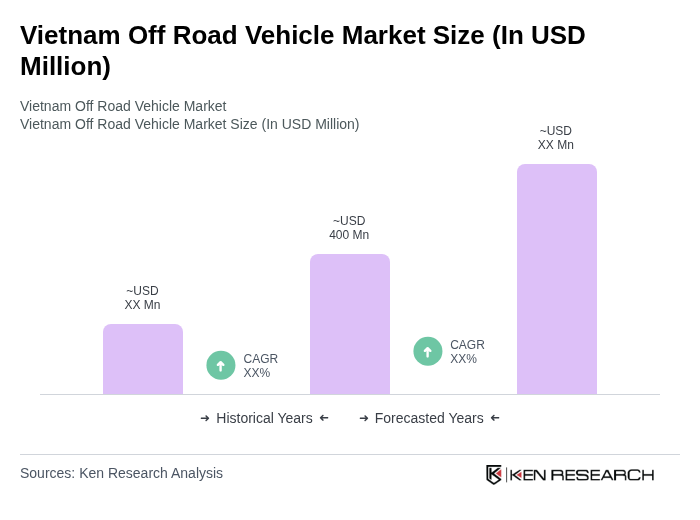
- The Vietnam Off Road Vehicle market is valued at USD 400 million, based on a five-year historical analysis. This growth is primarily driven by increasing consumer interest in outdoor recreational activities, coupled with a rise in disposable income among the population. The expanding infrastructure and tourism sector have also contributed to the demand for off-road vehicles, as more consumers seek adventure and leisure opportunities.
- Key cities such as Ho Chi Minh City and Hanoi dominate the market due to their large populations and growing urbanization. These cities have seen a surge in recreational activities, leading to higher demand for off-road vehicles. Additionally, the presence of various dealerships and service centers in these urban areas facilitates easier access for consumers, further driving market growth.
- The Decree No. 10/2022/ND-CP issued by the Government of Vietnam in 2022 regulates environmentally friendly vehicles, including electric off-road vehicles. It mandates compliance standards for battery safety, charging infrastructure, and emission limits, requiring manufacturers to obtain type approval certification and vehicles to meet technical thresholds for energy efficiency and range before market entry.
Vietnam Off Road Vehicle Market Segmentation
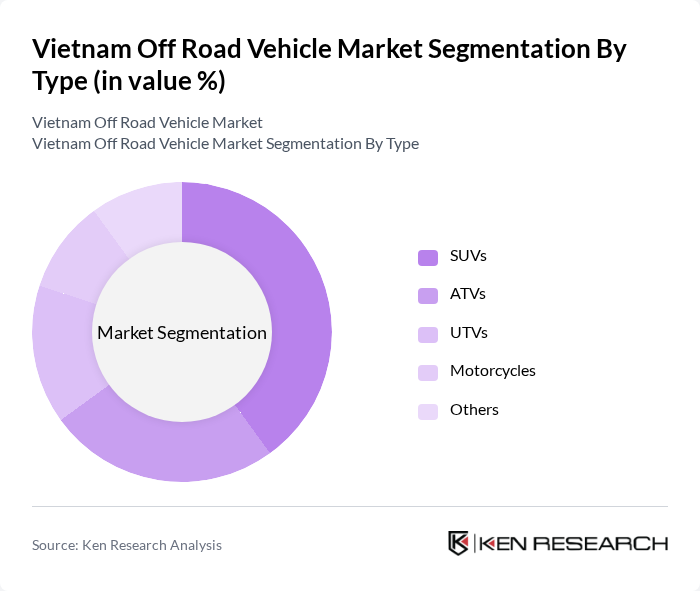
By Type:The market is segmented into various types of off-road vehicles, including SUVs, ATVs, UTVs, motorcycles, and others. Among these, SUVs and ATVs are particularly popular due to their versatility and suitability for both urban and off-road environments. The increasing trend of adventure tourism has also contributed to the growth of these segments, as consumers seek vehicles that can handle diverse terrains such as steep slopes, forest roads, sand hills, and obstacle-filled paths.
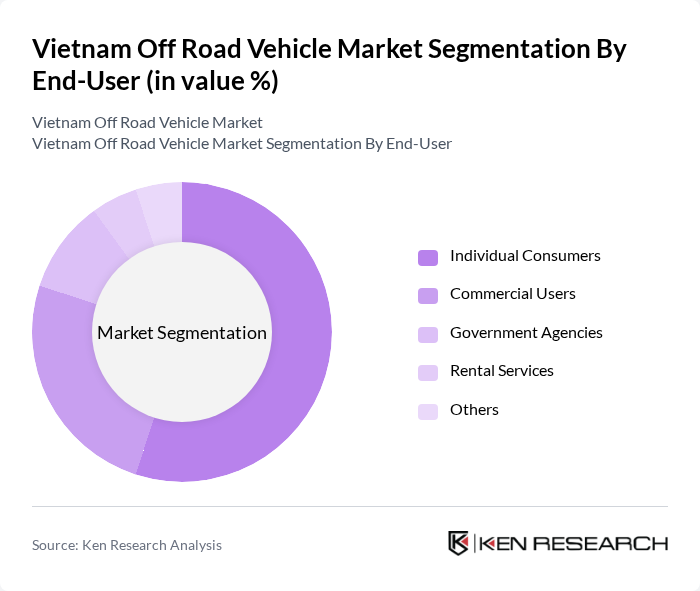
By End-User:The end-user segmentation includes individual consumers, commercial users, government agencies, rental services, and others. Individual consumers dominate the market, driven by a growing interest in recreational activities and outdoor adventures. Commercial users, including tourism companies, also contribute significantly to the market, as they require off-road vehicles for various services.
Vietnam Off Road Vehicle Market Competitive Landscape
The Vietnam Off Road Vehicle Market is characterized by a dynamic mix of regional and international players. Leading participants such as Toyota Vietnam, Ford Vietnam, Honda Vietnam, Mitsubishi Motors Vietnam, Isuzu Vietnam, Yamaha Motor Vietnam, Suzuki Vietnam, VinFast, Polaris Vietnam, Kawasaki Vietnam, KTM Vietnam, Can-Am Vietnam, Arctic Cat Vietnam, Mahindra Vietnam, and Polaris Industries contribute to innovation, geographic expansion, and service delivery in this space.
Vietnam Off Road Vehicle Market Industry Analysis
Growth Drivers
- Increasing Popularity of Outdoor Activities:The Vietnamese population increasingly engages in outdoor activities, with over 65 million people participating in recreational sports annually. This trend is supported by a growing interest in adventure tourism, which saw a 20% increase in participation in future. The rise in outdoor activities drives demand for off-road vehicles, as consumers seek vehicles that can handle diverse terrains, enhancing their outdoor experiences and adventures.
- Rising Disposable Income Among Consumers:Vietnam's GDP per capita is projected to reach approximately $5,000 in future, reflecting a 7% annual growth. This increase in disposable income allows consumers to invest in recreational vehicles, including off-road options. As more households enter the middle class, the demand for leisure activities and associated vehicles is expected to rise, further propelling the off-road vehicle market in the region.
- Expansion of Tourism and Adventure Sports:Vietnam's tourism sector is anticipated to grow by 12% in future, with adventure tourism becoming a significant segment. The government aims to attract 25 million international tourists, many of whom seek off-road experiences. This growth in tourism creates a robust market for off-road vehicles, as both local and foreign tourists require reliable vehicles for exploring Vietnam's diverse landscapes and natural attractions.
Market Challenges
- High Import Tariffs on Off-Road Vehicles:Vietnam imposes import tariffs of up to 75% on off-road vehicles, significantly increasing their retail prices. This high cost limits accessibility for many potential buyers, particularly in a market where affordability is crucial. As a result, manufacturers and dealers face challenges in pricing their products competitively, which can hinder market growth and consumer adoption of off-road vehicles.
- Limited Infrastructure for Off-Road Trails:The lack of developed off-road trails in Vietnam poses a significant challenge for the market. Currently, there are only about 600 kilometers of designated off-road trails, which restricts the potential for off-road vehicle usage. This limited infrastructure can deter consumers from purchasing off-road vehicles, as they may not find suitable locations to utilize them effectively, impacting overall market growth.
Vietnam Off Road Vehicle Market Future Outlook
The Vietnam off-road vehicle market is poised for significant growth, driven by increasing consumer interest in outdoor activities and adventure tourism. As disposable incomes rise, more consumers are likely to invest in off-road vehicles. Additionally, the government’s focus on enhancing tourism infrastructure will likely create more opportunities for off-road vehicle usage. With the growing trend towards eco-friendly vehicles and technological advancements, the market is expected to evolve, catering to a more environmentally conscious consumer base while expanding its offerings.
Market Opportunities
- Development of Electric Off-Road Vehicles:The shift towards electric vehicles is gaining momentum, with the Vietnamese government targeting 2 million electric vehicles by future. This presents a significant opportunity for manufacturers to develop electric off-road vehicles, catering to environmentally conscious consumers and aligning with government initiatives to reduce emissions and promote sustainable transportation.
- Partnerships with Tourism Companies:Collaborating with tourism companies can enhance market reach and visibility for off-road vehicle manufacturers. By offering packages that include vehicle rentals for adventure tours, companies can tap into the growing tourism sector. This strategy not only boosts sales but also promotes off-road vehicles as essential for exploring Vietnam's natural beauty, creating a win-win situation for both parties.
Scope of the Report
| Segment | Sub-Segments |
|---|---|
| By Type | SUVs ATVs UTVs Motorcycles Others |
| By End-User | Individual Consumers Commercial Users Government Agencies Rental Services Others |
| By Vehicle Size | Compact Mid-Size Full-Size Others |
| By Fuel Type | Gasoline Diesel Electric Hybrid Others |
| By Price Range | Budget Mid-Range Premium Luxury Others |
| By Distribution Channel | Online Retail Dealerships Direct Sales Auctions Others |
| By Usage Type | Recreational Competitive Utility Others |
Key Target Audience
Investors and Venture Capitalist Firms
Government and Regulatory Bodies (e.g., Ministry of Transport, Ministry of Industry and Trade)
Manufacturers and Producers
Distributors and Retailers
Automotive Parts Suppliers
Tourism and Adventure Travel Companies
Off-Road Vehicle Clubs and Associations
Financial Institutions
Players Mentioned in the Report:
Toyota Vietnam
Ford Vietnam
Honda Vietnam
Mitsubishi Motors Vietnam
Isuzu Vietnam
Yamaha Motor Vietnam
Suzuki Vietnam
VinFast
Polaris Vietnam
Kawasaki Vietnam
KTM Vietnam
Can-Am Vietnam
Arctic Cat Vietnam
Mahindra Vietnam
Polaris Industries
Table of Contents
Market Assessment Phase
1. Executive Summary and Approach
2. Vietnam Off Road Vehicle Market Overview
2.1 Key Insights and Strategic Recommendations
2.2 Vietnam Off Road Vehicle Market Overview
2.3 Definition and Scope
2.4 Evolution of Market Ecosystem
2.5 Timeline of Key Regulatory Milestones
2.6 Value Chain & Stakeholder Mapping
2.7 Business Cycle Analysis
2.8 Policy & Incentive Landscape
3. Vietnam Off Road Vehicle Market Analysis
3.1 Growth Drivers
3.1.1 Increasing popularity of outdoor activities
3.1.2 Rising disposable income among consumers
3.1.3 Expansion of tourism and adventure sports
3.1.4 Government initiatives to promote off-road events
3.2 Market Challenges
3.2.1 High import tariffs on off-road vehicles
3.2.2 Limited infrastructure for off-road trails
3.2.3 Environmental regulations affecting vehicle designs
3.2.4 Competition from alternative recreational vehicles
3.3 Market Opportunities
3.3.1 Development of electric off-road vehicles
3.3.2 Growth in e-commerce for vehicle sales
3.3.3 Partnerships with tourism companies
3.3.4 Customization and aftermarket services
3.4 Market Trends
3.4.1 Increasing demand for eco-friendly vehicles
3.4.2 Rise of social media marketing for off-road brands
3.4.3 Technological advancements in vehicle safety
3.4.4 Growth of off-road vehicle clubs and communities
3.5 Government Regulation
3.5.1 Emission standards for off-road vehicles
3.5.2 Licensing requirements for off-road events
3.5.3 Safety regulations for vehicle manufacturing
3.5.4 Tax incentives for electric vehicle production
4. SWOT Analysis
5. Stakeholder Analysis
6. Porter's Five Forces Analysis
7. Vietnam Off Road Vehicle Market Market Size, 2019-2024
7.1 By Value
7.2 By Volume
7.3 By Average Selling Price
8. Vietnam Off Road Vehicle Market Segmentation
8.1 By Type
8.1.1 SUVs
8.1.2 ATVs
8.1.3 UTVs
8.1.4 Motorcycles
8.1.5 Others
8.2 By End-User
8.2.1 Individual Consumers
8.2.2 Commercial Users
8.2.3 Government Agencies
8.2.4 Rental Services
8.2.5 Others
8.3 By Vehicle Size
8.3.1 Compact
8.3.2 Mid-Size
8.3.3 Full-Size
8.3.4 Others
8.4 By Fuel Type
8.4.1 Gasoline
8.4.2 Diesel
8.4.3 Electric
8.4.4 Hybrid
8.4.5 Others
8.5 By Price Range
8.5.1 Budget
8.5.2 Mid-Range
8.5.3 Premium
8.5.4 Luxury
8.5.5 Others
8.6 By Distribution Channel
8.6.1 Online Retail
8.6.2 Dealerships
8.6.3 Direct Sales
8.6.4 Auctions
8.6.5 Others
8.7 By Usage Type
8.7.1 Recreational
8.7.2 Competitive
8.7.3 Utility
8.7.4 Others
9. Vietnam Off Road Vehicle Market Competitive Analysis
9.1 Market Share of Key Players
9.2 Cross Comparison of Key Players
9.2.1 Company Name
9.2.2 Group Size (Large, Medium, or Small as per industry convention)
9.2.3 Revenue Growth Rate
9.2.4 Market Penetration Rate
9.2.5 Customer Retention Rate
9.2.6 Pricing Strategy
9.2.7 Product Diversification Index
9.2.8 Brand Recognition Score
9.2.9 Distribution Efficiency
9.2.10 Customer Satisfaction Index
9.3 SWOT Analysis of Top Players
9.4 Pricing Analysis
9.5 Detailed Profile of Major Companies
9.5.1 Toyota Vietnam
9.5.2 Ford Vietnam
9.5.3 Honda Vietnam
9.5.4 Mitsubishi Motors Vietnam
9.5.5 Isuzu Vietnam
9.5.6 Yamaha Motor Vietnam
9.5.7 Suzuki Vietnam
9.5.8 VinFast
9.5.9 Polaris Vietnam
9.5.10 Kawasaki Vietnam
9.5.11 KTM Vietnam
9.5.12 Can-Am Vietnam
9.5.13 Arctic Cat Vietnam
9.5.14 Mahindra Vietnam
9.5.15 Polaris Industries
10. Vietnam Off Road Vehicle Market End-User Analysis
10.1 Procurement Behavior of Key Ministries
10.1.1 Government procurement policies
10.1.2 Budget allocation for off-road vehicles
10.1.3 Evaluation criteria for procurement
10.1.4 Supplier selection process
10.2 Corporate Spend on Infrastructure & Energy
10.2.1 Investment in off-road infrastructure
10.2.2 Corporate partnerships for vehicle usage
10.2.3 Budgeting for maintenance and operations
10.2.4 Trends in corporate vehicle fleets
10.3 Pain Point Analysis by End-User Category
10.3.1 Cost of ownership
10.3.2 Availability of service centers
10.3.3 Vehicle performance issues
10.3.4 Regulatory compliance challenges
10.4 User Readiness for Adoption
10.4.1 Awareness of off-road vehicle benefits
10.4.2 Financial readiness for purchase
10.4.3 Training and support needs
10.4.4 Community engagement levels
10.5 Post-Deployment ROI and Use Case Expansion
10.5.1 Measurement of ROI post-purchase
10.5.2 Expansion into new use cases
10.5.3 Customer feedback and improvement
10.5.4 Long-term maintenance considerations
11. Vietnam Off Road Vehicle Market Future Size, 2025-2030
11.1 By Value
11.2 By Volume
11.3 By Average Selling Price
Go-To-Market Strategy Phase
1. Whitespace Analysis + Business Model Canvas
1.1 Market gaps identification
1.2 Business model development
2. Marketing and Positioning Recommendations
2.1 Branding strategies
2.2 Product USPs
3. Distribution Plan
3.1 Urban retail vs rural NGO tie-ups
4. Channel & Pricing Gaps
4.1 Underserved routes
4.2 Pricing bands
5. Unmet Demand & Latent Needs
5.1 Category gaps
5.2 Consumer segments
6. Customer Relationship
6.1 Loyalty programs
6.2 After-sales service
7. Value Proposition
7.1 Sustainability
7.2 Integrated supply chains
8. Key Activities
8.1 Regulatory compliance
8.2 Branding
8.3 Distribution setup
9. Entry Strategy Evaluation
9.1 Domestic Market Entry Strategy
9.1.1 Product mix
9.1.2 Pricing band
9.1.3 Packaging
9.2 Export Entry Strategy
9.2.1 Target countries
9.2.2 Compliance roadmap
10. Entry Mode Assessment
10.1 JV
10.2 Greenfield
10.3 M&A
10.4 Distributor Model
11. Capital and Timeline Estimation
11.1 Capital requirements
11.2 Timelines
12. Control vs Risk Trade-Off
12.1 Ownership vs Partnerships
13. Profitability Outlook
13.1 Breakeven analysis
13.2 Long-term sustainability
14. Potential Partner List
14.1 Distributors
14.2 JVs
14.3 Acquisition targets
15. Execution Roadmap
15.1 Phased Plan for Market Entry
15.1.1 Market Setup
15.1.2 Market Entry
15.1.3 Growth Acceleration
15.1.4 Scale & Stabilize
15.2 Key Activities and Milestones
15.2.1 Activity timelines
15.2.2 Milestone tracking
Research Methodology
Phase 1: Approach1
Desk Research
- Analysis of industry reports from Vietnamese automotive associations and market research firms
- Review of government publications on transportation and vehicle regulations in Vietnam
- Examination of trade statistics and import/export data related to off-road vehicles
Primary Research
- Interviews with key stakeholders in the off-road vehicle manufacturing sector
- Surveys conducted with dealerships and distributors of off-road vehicles across Vietnam
- Focus group discussions with off-road vehicle enthusiasts and users to gather insights on preferences
Validation & Triangulation
- Cross-validation of findings through multiple data sources including sales data and consumer feedback
- Triangulation of insights from industry experts, market reports, and consumer surveys
- Sanity checks through expert panel reviews to ensure data accuracy and relevance
Phase 2: Market Size Estimation1
Top-down Assessment
- Estimation of the total addressable market based on national vehicle registration statistics
- Segmentation of the market by vehicle type, including ATVs, UTVs, and off-road motorcycles
- Incorporation of growth trends in outdoor recreational activities and tourism in Vietnam
Bottom-up Modeling
- Collection of sales data from leading off-road vehicle manufacturers and dealers
- Estimation of average selling prices and volume sold across different vehicle categories
- Analysis of consumer purchasing behavior and frequency of off-road vehicle usage
Forecasting & Scenario Analysis
- Multi-factor regression analysis incorporating economic indicators and consumer spending trends
- Scenario modeling based on potential regulatory changes and environmental considerations
- Development of baseline, optimistic, and pessimistic forecasts through 2030
Phase 3: CATI Sample Composition1
| Scope Item/Segment | Sample Size | Target Respondent Profiles |
|---|---|---|
| Off-road Vehicle Retailers | 100 | Dealership Owners, Sales Managers |
| Manufacturers of Off-road Vehicles | 50 | Product Managers, R&D Heads |
| End-users of Off-road Vehicles | 150 | Outdoor Enthusiasts, Recreational Vehicle Owners |
| Tourism Operators Offering Off-road Experiences | 60 | Operations Managers, Marketing Directors |
| Government Regulatory Bodies | 40 | Policy Makers, Transportation Officials |
Frequently Asked Questions
What is the current value of the Vietnam Off Road Vehicle market?
The Vietnam Off Road Vehicle market is valued at approximately USD 400 million, reflecting a significant growth trend driven by increasing consumer interest in outdoor activities and rising disposable incomes among the population.
Which cities are the main hubs for off-road vehicle sales in Vietnam?
What types of off-road vehicles are popular in Vietnam?
Who are the main consumers of off-road vehicles in Vietnam?
Other Regional/Country Reports
Other Adjacent Reports
Germany Motorcycle Market
UAE Adventure Tourism Market Size, Share & Forecast, By Activity Type, Traveler Type & Booking Channel, 2026–2032China Vehicle Rental Market Size, Share & Forecast, 2026–2032Brazil Outdoor Recreation Market
Thailand SUV Market
Singapore ATV Market
KSA UTV Market
Why Buy From Us?

What makes us stand out is that our consultants follow Robust, Refine and Result (RRR) methodology. Robust for clear definitions, approaches and sanity checking, Refine for differentiating respondents' facts and opinions, and Result for presenting data with story.

We have set a benchmark in the industry by offering our clients with syndicated and customized market research reports featuring coverage of entire market as well as meticulous research and analyst insights.

While we don't replace traditional research, we flip the method upside down. Our dual approach of Top Bottom & Bottom Top ensures quality deliverable by not just verifying company fundamentals but also looking at the sector and macroeconomic factors.

With one step in the future, our research team constantly tries to show you the bigger picture. We help with some of the tough questions you may encounter along the way: How is the industry positioned? Best marketing channel? KPI's of competitors? By aligning every element, we help maximize success.

Our report gives you instant access to the answers and sources that other companies might choose to hide. We elaborate each steps of research methodology we have used and showcase you the sample size to earn your trust.

If you need any support, we are here! We pride ourselves on universe strength, data quality, and quick, friendly, and professional service.