About the Report
Base Year 2024New Zealand Off Road Vehicle Market Overview
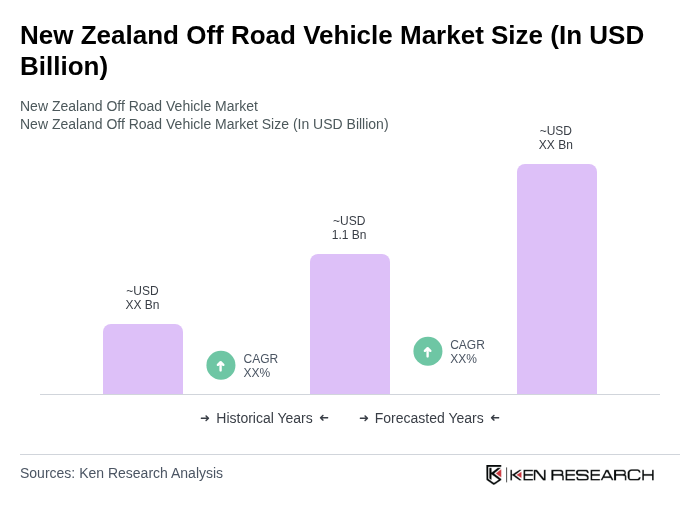
- The New Zealand Off Road Vehicle Market is valued at USD 1.1 billion, based on a five-year historical analysis. This growth is primarily driven by increasing outdoor recreational activities, a rise in agricultural mechanization, and the growing popularity of off-road sports, as highlighted by rising registrations, rental services, and organized off-road events in the country. The demand for versatile vehicles that can handle rugged terrains has surged, reflecting a shift in consumer preferences towards adventure, utility, and adventure tourism-focused experiences.
- Key regions dominating the market include Auckland, Wellington, and Canterbury. Auckland's large urban population and proximity to coastal and forested recreational areas support strong demand for off-road vehicles for leisure and lifestyle farming. Wellington, being the capital, has a significant concentration of government, commercial, and utility fleet users, while Canterbury's extensive pastoral and arable farming base drives the need for ATVs and UTVs as core farm vehicles.
- In 2023, the New Zealand government implemented regulations requiring all off-road vehicles to meet stringent emissions standards. This regulation aims to reduce environmental impact and promote the use of cleaner technologies in off-road vehicles, encouraging manufacturers to innovate and comply with eco-friendly practices. A key binding instrument is the Land Transport Rule: Vehicle Exhaust Emissions 2007 (Rule 33001/2), issued by Waka Kotahi NZ Transport Agency and the Ministry of Transport, which sets maximum exhaust emission levels and requires vehicles (including many off?road-capable models when imported or registered) to comply with specified Euro and Japanese standards, thereby pushing the market toward lower-emission engines and newer technologies.
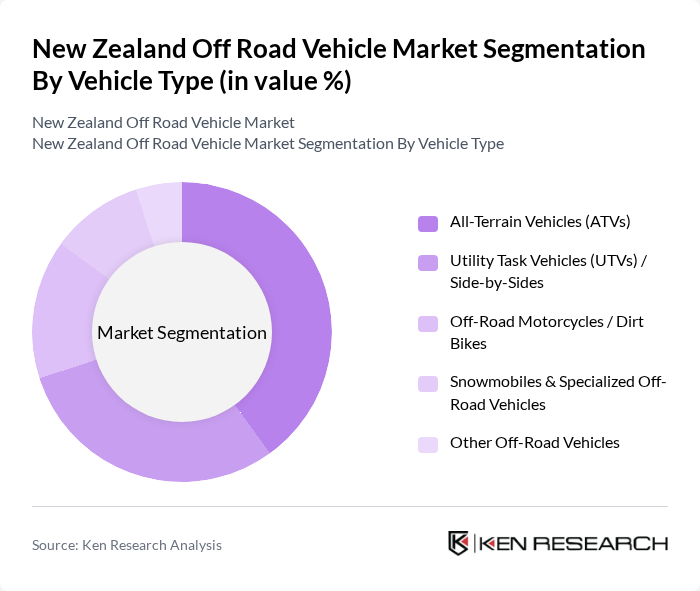
New Zealand Off Road Vehicle Market Segmentation
By Vehicle Type:The vehicle type segmentation includes All-Terrain Vehicles (ATVs), Utility Task Vehicles (UTVs) / Side-by-Sides, Off-Road Motorcycles / Dirt Bikes, Snowmobiles & Specialized Off-Road Vehicles, and Other Off-Road Vehicles. Among these, ATVs are particularly popular due to their versatility and suitability for both recreational and agricultural use. UTVs are also gaining traction for their utility in various applications, including farming and outdoor adventures.
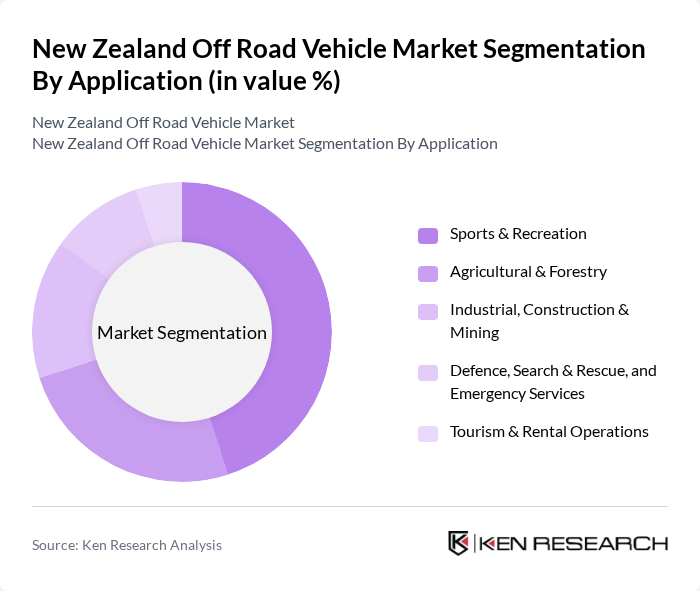
By Application:The application segmentation encompasses Sports & Recreation, Agricultural & Forestry, Industrial, Construction & Mining, Defence, Search & Rescue, and Emergency Services, and Tourism & Rental Operations. The sports and recreation segment is the largest, driven by the increasing popularity of off-road racing and recreational riding. Agricultural applications are also significant, as farmers utilize off-road vehicles for various tasks, enhancing productivity and efficiency.
New Zealand Off Road Vehicle Market Competitive Landscape
The New Zealand Off Road Vehicle Market is characterized by a dynamic mix of regional and international players. Leading participants such as Polaris Inc., Yamaha Motor Co., Ltd., Honda Motor Co., Ltd., Kawasaki Heavy Industries, Ltd., BRP Inc. (Can-Am), Arctic Cat (Textron Inc.), Deere & Company (John Deere), Suzuki Motor Corporation, KTM AG, Mahindra & Mahindra Ltd., CFMOTO Powersports Inc., Polaris New Zealand, Honda New Zealand, Yamaha Motor New Zealand, Kawasaki Motors New Zealand contribute to innovation, geographic expansion, and service delivery in this space.
New Zealand Off Road Vehicle Market Industry Analysis
Growth Drivers
- Increasing Adventure Tourism:The adventure tourism sector in New Zealand has seen significant growth, with over 3.9 million international visitors in future, contributing NZD 12.6 billion to the economy. This surge in tourism has led to a heightened demand for off-road vehicles, as tourists seek unique experiences in the country's diverse landscapes. The government aims to significantly increase this sector's contribution in future, further driving the off-road vehicle market.
- Rising Disposable Income:New Zealand's average household disposable income reached NZD 119,000 in the most recent comparable period, reflecting an increase from the previous year. This rise in disposable income allows consumers to invest in recreational activities, including off-road vehicles. As more households can afford leisure spending, the demand for off-road vehicles is expected to grow, particularly among middle and upper-income groups seeking outdoor adventures.
- Expanding Infrastructure Development:The New Zealand government has announced a multi?year National Land Transport Programme and related transport and infrastructure packages totaling several billions of New Zealand dollars, including a transport investment package of about NZD 20 billion over a coming decade, focusing on enhancing road networks and related facilities. This investment is expected to improve access to outdoor recreation areas, including off-road trails and parks, encouraging more outdoor activities. As infrastructure improves, the off-road vehicle market will benefit from increased accessibility, leading to higher sales and usage rates among both locals and tourists.
Market Challenges
- Regulatory Compliance Costs:The off-road vehicle industry faces significant regulatory compliance costs, with estimates suggesting that manufacturers spend substantial amounts annually to meet safety and environmental standards. These costs can deter new entrants and strain existing businesses, limiting market growth. As regulations become stricter, companies must invest more in compliance, impacting their profitability and pricing strategies.
- Limited Availability of Spare Parts:The off-road vehicle market in New Zealand struggles with a limited supply of spare parts, particularly for niche models. This scarcity can lead to extended downtime for vehicles, affecting customer satisfaction and overall market growth. Difficulties in sourcing parts can hinder the maintenance and repair of off-road vehicles, ultimately impacting sales.
New Zealand Off Road Vehicle Market Future Outlook
The future of the New Zealand off-road vehicle market appears promising, driven by increasing consumer interest in adventure tourism and outdoor activities. As infrastructure improvements continue, accessibility to off-road trails will enhance market growth. Additionally, the rise of eco-friendly vehicles and technological advancements in vehicle design will likely attract environmentally conscious consumers, creating a shift in purchasing preferences. The market is poised for innovation, with opportunities for growth in electric vehicle segments and partnerships with tourism operators.
Market Opportunities
- Expansion of Electric Off Road Vehicles:The demand for electric off-road vehicles is on the rise, with the government targeting a reduction in emissions of at least 30 percent below a baseline level in future through its climate commitments. This presents a significant opportunity for manufacturers to innovate and capture a growing market segment focused on sustainability. The introduction of electric models can attract environmentally conscious consumers, enhancing market competitiveness.
- Development of Off-Road Parks:The establishment of dedicated off-road parks is gaining traction, with several projects planned in future. These parks will provide safe environments for off-road vehicle enthusiasts, promoting usage and sales. With an estimated investment in park development mentioned for the sector, this initiative can significantly boost the off-road vehicle market by attracting both locals and tourists seeking recreational activities.
Scope of the Report
| Segment | Sub-Segments |
|---|---|
| By Vehicle Type | All-Terrain Vehicles (ATVs) Utility Task Vehicles (UTVs) / Side-by-Sides Off-Road Motorcycles / Dirt Bikes Snowmobiles & Specialized Off-Road Vehicles Other Off-Road Vehicles |
| By Application | Sports & Recreation Agricultural & Forestry Industrial, Construction & Mining Defence, Search & Rescue, and Emergency Services Tourism & Rental Operations |
| By End-User | Individual / Household Users Farms & Agribusinesses Commercial & Industrial Enterprises Government & Local Authorities Tourism Operators & Adventure Parks |
| By Propulsion / Engine Type | Gasoline Diesel Electric Hybrid |
| By Price Band | Entry-Level / Budget Mid-Range Premium Performance / Specialty |
| By Distribution Channel | Authorized Dealerships Independent Dealers Online Platforms Direct & Fleet Sales |
| By Region | North Island – Auckland & Upper North Central North Island Wellington & Lower North Island Canterbury & Upper South Island Otago, Southland & Other Regions |
Key Target Audience
Investors and Venture Capitalist Firms
Government and Regulatory Bodies (e.g., New Zealand Transport Agency, Ministry of Business, Innovation and Employment)
Manufacturers and Producers
Distributors and Retailers
Off-Road Vehicle Clubs and Associations
Environmental and Conservation Organizations
Tourism and Adventure Companies
Insurance Providers
Players Mentioned in the Report:
Polaris Inc.
Yamaha Motor Co., Ltd.
Honda Motor Co., Ltd.
Kawasaki Heavy Industries, Ltd.
BRP Inc. (Can-Am)
Arctic Cat (Textron Inc.)
Deere & Company (John Deere)
Suzuki Motor Corporation
KTM AG
Mahindra & Mahindra Ltd.
CFMOTO Powersports Inc.
Polaris New Zealand
Honda New Zealand
Yamaha Motor New Zealand
Kawasaki Motors New Zealand
Table of Contents
Market Assessment Phase
1. Executive Summary and Approach
2. New Zealand Off Road Vehicle Market Overview
2.1 Key Insights and Strategic Recommendations
2.2 New Zealand Off Road Vehicle Market Overview
2.3 Definition and Scope
2.4 Evolution of Market Ecosystem
2.5 Timeline of Key Regulatory Milestones
2.6 Value Chain & Stakeholder Mapping
2.7 Business Cycle Analysis
2.8 Policy & Incentive Landscape
3. New Zealand Off Road Vehicle Market Analysis
3.1 Growth Drivers
3.1.1 Increasing Adventure Tourism
3.1.2 Rising Disposable Income
3.1.3 Expanding Infrastructure Development
3.1.4 Growing Environmental Awareness
3.2 Market Challenges
3.2.1 Regulatory Compliance Costs
3.2.2 Limited Availability of Spare Parts
3.2.3 High Initial Investment
3.2.4 Competition from Imported Vehicles
3.3 Market Opportunities
3.3.1 Technological Advancements in Vehicle Design
3.3.2 Expansion of Electric Off Road Vehicles
3.3.3 Partnerships with Tourism Operators
3.3.4 Development of Off-Road Parks
3.4 Market Trends
3.4.1 Increasing Popularity of Eco-Friendly Vehicles
3.4.2 Growth in Online Sales Channels
3.4.3 Customization and Personalization of Vehicles
3.4.4 Rise of Social Media Influencers in Marketing
3.5 Government Regulation
3.5.1 Emission Standards Compliance
3.5.2 Safety Regulations for Off Road Vehicles
3.5.3 Licensing Requirements for Off Road Use
3.5.4 Land Use Regulations for Off Road Activities
4. SWOT Analysis
5. Stakeholder Analysis
6. Porter's Five Forces Analysis
7. New Zealand Off Road Vehicle Market Market Size, 2019-2024
7.1 By Value
7.2 By Volume
7.3 By Average Selling Price
8. New Zealand Off Road Vehicle Market Segmentation
8.1 By Vehicle Type
8.1.1 All-Terrain Vehicles (ATVs)
8.1.2 Utility Task Vehicles (UTVs) / Side-by-Sides
8.1.3 Off-Road Motorcycles / Dirt Bikes
8.1.4 Snowmobiles & Specialized Off-Road Vehicles
8.1.5 Other Off-Road Vehicles
8.2 By Application
8.2.1 Sports & Recreation
8.2.2 Agricultural & Forestry
8.2.3 Industrial, Construction & Mining
8.2.4 Defence, Search & Rescue, and Emergency Services
8.2.5 Tourism & Rental Operations
8.3 By End-User
8.3.1 Individual / Household Users
8.3.2 Farms & Agribusinesses
8.3.3 Commercial & Industrial Enterprises
8.3.4 Government & Local Authorities
8.3.5 Tourism Operators & Adventure Parks
8.4 By Propulsion / Engine Type
8.4.1 Gasoline
8.4.2 Diesel
8.4.3 Electric
8.4.4 Hybrid
8.5 By Price Band
8.5.1 Entry-Level / Budget
8.5.2 Mid-Range
8.5.3 Premium
8.5.4 Performance / Specialty
8.6 By Distribution Channel
8.6.1 Authorized Dealerships
8.6.2 Independent Dealers
8.6.3 Online Platforms
8.6.4 Direct & Fleet Sales
8.7 By Region
8.7.1 North Island – Auckland & Upper North
8.7.2 Central North Island
8.7.3 Wellington & Lower North Island
8.7.4 Canterbury & Upper South Island
8.7.5 Otago, Southland & Other Regions
9. New Zealand Off Road Vehicle Market Competitive Analysis
9.1 Market Share of Key Players
9.2 Cross Comparison of Key Players
9.2.1 Company Name
9.2.2 Company Size (Global & New Zealand Revenue)
9.2.3 New Zealand Off-Road Vehicle Revenue & Volume Share
9.2.4 3-Year Revenue CAGR (Global & New Zealand)
9.2.5 EBITDA Margin from Off-Road Vehicle Segment
9.2.6 Average Realized Selling Price per Vehicle in New Zealand
9.2.7 Dealer Network Size & Geographic Coverage in New Zealand
9.2.8 Product Portfolio Breadth (ATV, UTV, Motorcycle, Electric, etc.)
9.2.9 R&D Intensity (% of Revenue Invested in R&D)
9.2.10 Market Penetration in Key End-User Segments
9.2.11 After-Sales Service Coverage & Parts Availability Index
9.2.12 Brand Preference / Net Promoter Score (NPS)
9.3 SWOT Analysis of Top Players
9.4 Pricing Analysis
9.5 Detailed Profile of Major Companies
9.5.1 Polaris Inc.
9.5.2 Yamaha Motor Co., Ltd.
9.5.3 Honda Motor Co., Ltd.
9.5.4 Kawasaki Heavy Industries, Ltd.
9.5.5 BRP Inc. (Can-Am)
9.5.6 Arctic Cat (Textron Inc.)
9.5.7 Deere & Company (John Deere)
9.5.8 Suzuki Motor Corporation
9.5.9 KTM AG
9.5.10 Mahindra & Mahindra Ltd.
9.5.11 CFMOTO Powersports Inc.
9.5.12 Polaris New Zealand
9.5.13 Honda New Zealand
9.5.14 Yamaha Motor New Zealand
9.5.15 Kawasaki Motors New Zealand
10. New Zealand Off Road Vehicle Market End-User Analysis
10.1 Procurement Behavior of Key Ministries
10.1.1 Budget Allocation Trends
10.1.2 Decision-Making Processes
10.1.3 Preferred Suppliers
10.1.4 Procurement Timelines
10.2 Corporate Spend on Infrastructure & Energy
10.2.1 Investment Trends
10.2.2 Key Projects
10.2.3 Budget Priorities
10.3 Pain Point Analysis by End-User Category
10.3.1 Common Challenges Faced
10.3.2 Support Needs
10.3.3 Feedback Mechanisms
10.4 User Readiness for Adoption
10.4.1 Training Requirements
10.4.2 Technology Acceptance Levels
10.4.3 Infrastructure Readiness
10.5 Post-Deployment ROI and Use Case Expansion
10.5.1 Performance Metrics
10.5.2 Case Studies
10.5.3 Future Expansion Plans
11. New Zealand Off Road Vehicle Market Future Size, 2025-2030
11.1 By Value
11.2 By Volume
11.3 By Average Selling Price
Go-To-Market Strategy Phase
1. Whitespace Analysis + Business Model Canvas
1.1 Market Gaps Identification
1.2 Business Model Development
2. Marketing and Positioning Recommendations
2.1 Branding Strategies
2.2 Product USPs
3. Distribution Plan
3.1 Urban Retail vs Rural NGO Tie-Ups
4. Channel & Pricing Gaps
4.1 Underserved Routes
4.2 Pricing Bands
5. Unmet Demand & Latent Needs
5.1 Category Gaps
5.2 Consumer Segments
6. Customer Relationship
6.1 Loyalty Programs
6.2 After-Sales Service
7. Value Proposition
7.1 Sustainability
7.2 Integrated Supply Chains
8. Key Activities
8.1 Regulatory Compliance
8.2 Branding
8.3 Distribution Setup
9. Entry Strategy Evaluation
9.1 Domestic Market Entry Strategy
9.1.1 Product Mix
9.1.2 Pricing Band
9.1.3 Packaging
9.2 Export Entry Strategy
9.2.1 Target Countries
9.2.2 Compliance Roadmap
10. Entry Mode Assessment
10.1 JV
10.2 Greenfield
10.3 M&A
10.4 Distributor Model
11. Capital and Timeline Estimation
11.1 Capital Requirements
11.2 Timelines
12. Control vs Risk Trade-Off
12.1 Ownership vs Partnerships
13. Profitability Outlook
13.1 Breakeven Analysis
13.2 Long-Term Sustainability
14. Potential Partner List
14.1 Distributors
14.2 JVs
14.3 Acquisition Targets
15. Execution Roadmap
15.1 Phased Plan for Market Entry
15.1.1 Market Setup
15.1.2 Market Entry
15.1.3 Growth Acceleration
15.1.4 Scale & Stabilize
15.2 Key Activities and Milestones
15.2.1 Activity Timeline
15.2.2 Milestone Tracking
Research Methodology
Phase 1: Approach1
Desk Research
- Analysis of industry reports from New Zealand's Ministry of Transport and relevant automotive associations
- Review of market trends and statistics from New Zealand's Off-Road Vehicle Council
- Examination of consumer behavior studies and surveys published by local research firms
Primary Research
- Interviews with key stakeholders including manufacturers, dealers, and distributors of off-road vehicles
- Surveys conducted with off-road vehicle enthusiasts and recreational users
- Focus group discussions with industry experts and off-road vehicle clubs
Validation & Triangulation
- Cross-validation of findings through multiple data sources including sales data and consumer feedback
- Triangulation of insights from primary interviews with secondary data trends
- Sanity checks through expert panel reviews comprising industry veterans and market analysts
Phase 2: Market Size Estimation1
Top-down Assessment
- Estimation of market size based on national vehicle registration statistics and off-road vehicle sales data
- Segmentation of the market by vehicle type, including ATVs, UTVs, and dirt bikes
- Incorporation of growth factors such as tourism and recreational activities in New Zealand
Bottom-up Modeling
- Collection of sales volume data from leading off-road vehicle manufacturers and dealers
- Operational cost analysis based on pricing models and service offerings in the market
- Estimation of market potential based on user demographics and purchasing behavior
Forecasting & Scenario Analysis
- Multi-factor regression analysis incorporating economic indicators and consumer trends
- Scenario modeling based on potential regulatory changes and environmental considerations
- Development of baseline, optimistic, and pessimistic forecasts through 2030
Phase 3: CATI Sample Composition1
| Scope Item/Segment | Sample Size | Target Respondent Profiles |
|---|---|---|
| ATV Owners | 120 | Recreational Users, Outdoor Enthusiasts |
| UTV Dealers | 90 | Sales Managers, Business Owners |
| Dirt Bike Enthusiasts | 85 | Club Members, Event Organizers |
| Off-Road Vehicle Accessory Retailers | 70 | Store Managers, Product Buyers |
| Tourism Operators Offering Off-Road Experiences | 65 | Business Owners, Activity Coordinators |
Frequently Asked Questions
What is the current value of the New Zealand Off Road Vehicle Market?
The New Zealand Off Road Vehicle Market is valued at approximately USD 1.1 billion, reflecting a significant growth trend driven by increased outdoor recreational activities, agricultural mechanization, and the popularity of off-road sports.
Which regions in New Zealand dominate the Off Road Vehicle Market?
What types of off-road vehicles are popular in New Zealand?
How has adventure tourism impacted the off-road vehicle market in New Zealand?
Other Regional/Country Reports
Other Adjacent Reports
Qatar Motorcycle Market
China Vehicle Rental Market Size, Share & Forecast, 2026–2032Indonesia Automotive Parts MarketWhy Buy From Us?

What makes us stand out is that our consultants follow Robust, Refine and Result (RRR) methodology. Robust for clear definitions, approaches and sanity checking, Refine for differentiating respondents' facts and opinions, and Result for presenting data with story.

We have set a benchmark in the industry by offering our clients with syndicated and customized market research reports featuring coverage of entire market as well as meticulous research and analyst insights.

While we don't replace traditional research, we flip the method upside down. Our dual approach of Top Bottom & Bottom Top ensures quality deliverable by not just verifying company fundamentals but also looking at the sector and macroeconomic factors.

With one step in the future, our research team constantly tries to show you the bigger picture. We help with some of the tough questions you may encounter along the way: How is the industry positioned? Best marketing channel? KPI's of competitors? By aligning every element, we help maximize success.

Our report gives you instant access to the answers and sources that other companies might choose to hide. We elaborate each steps of research methodology we have used and showcase you the sample size to earn your trust.

If you need any support, we are here! We pride ourselves on universe strength, data quality, and quick, friendly, and professional service.