About the Report
Base Year 2024New Zealand Digital Badges Market Overview
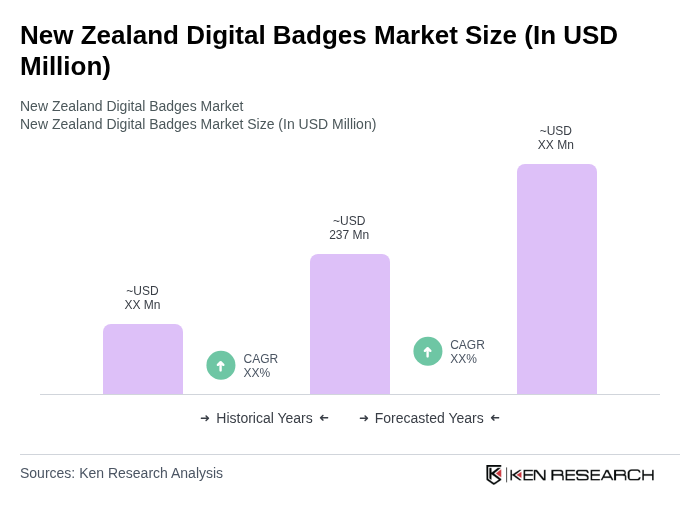
- The New Zealand Digital Badges Market is valued at approximately USD 237 million, based on current market analysis. This growth is primarily driven by the increasing adoption of digital credentials in educational institutions and corporate training programs, as organizations seek to enhance skills recognition and learner engagement through innovative digital solutions. The market expansion is further supported by the convergence of artificial intelligence, blockchain authentication, and personalized upskilling initiatives that enable secure and verifiable credential management.
- Auckland and Wellington are the dominant cities in the New Zealand Digital Badges Market, primarily due to their robust educational infrastructure and the presence of numerous tech companies. These cities foster a culture of innovation and collaboration, making them ideal environments for the development and implementation of digital badge systems.
- The New Zealand government has established regulatory frameworks governing digital credentials and their standardization across various sectors. These regulations are designed to enhance the credibility of digital credentials, ensuring that they meet specific quality standards and are widely accepted by employers and educational institutions.
New Zealand Digital Badges Market Segmentation
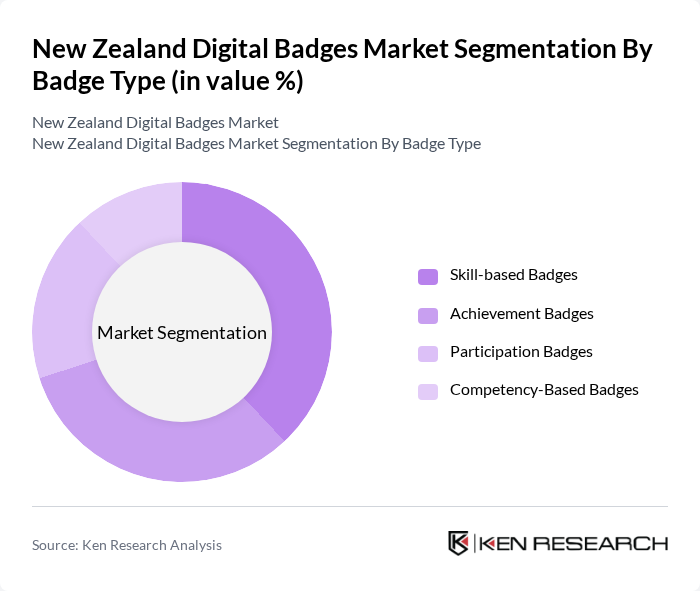
By Badge Type:The market is segmented into four main types of badges: Skill-based Badges, Achievement Badges, Participation Badges, and Competency-Based Badges. Skill-based Badges are gaining significant traction as they directly correlate with specific skills acquired, making them highly sought after by employers and aligning with outcome-based learning and certification models. Achievement Badges recognize accomplishments and milestones, while Participation Badges encourage engagement in various activities. Competency-Based Badges focus on demonstrating proficiency in specific areas, appealing to both learners and organizations.
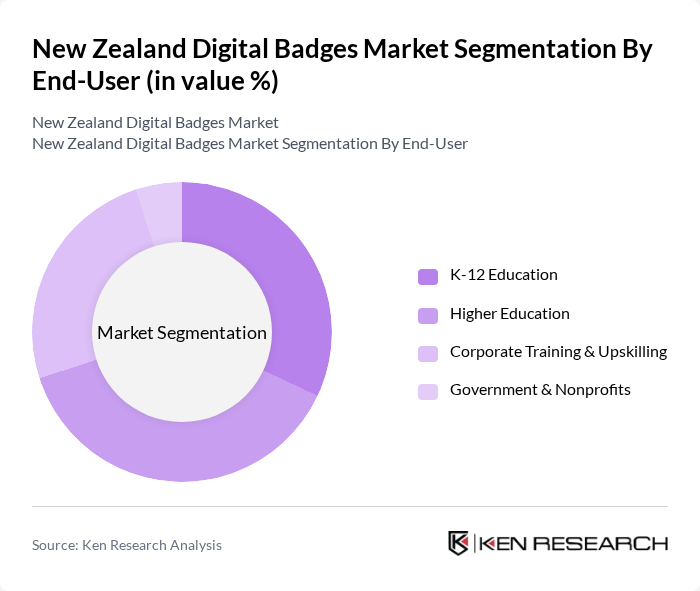
By End-User:The end-user segmentation includes K-12 Education, Higher Education, Corporate Training & Upskilling, and Government & Nonprofits. K-12 Education is a significant segment as schools increasingly adopt digital badges to motivate students and recognize their achievements. Higher Education institutions utilize badges to enhance student portfolios and integrate them into both academic and extracurricular frameworks, aligning them with industry requirements. Corporate Training & Upskilling leverage them to validate employee skills and support professional development initiatives. Government & Nonprofits also play a role in promoting digital badges for workforce development and community engagement.
New Zealand Digital Badges Market Competitive Landscape
The New Zealand Digital Badges Market is characterized by a dynamic mix of regional and international players. Leading participants such as Credly, Badgr, Mozilla Open Badges, Digitalme, Skillshare, LinkedIn Learning, Coursera, Udacity, FutureLearn, Microsoft Certifications, IBM Digital Badges, Pearson, Google Career Certificates, Amazon Web Services (AWS) Certifications, Emsi Burning Glass contribute to innovation, geographic expansion, and service delivery in this space.
New Zealand Digital Badges Market Industry Analysis
Growth Drivers
- Increasing Demand for Credentialing and Recognition:The New Zealand education sector is witnessing a significant shift towards digital credentialing, with over 1.5 million students enrolled in tertiary education in future. This trend is driven by the need for verifiable skills and competencies, as employers increasingly seek evidence of qualifications. The Ministry of Education reported a 20% increase in institutions adopting digital badges for skill recognition, reflecting a growing acceptance of alternative credentialing methods.
- Rise of Online Learning Platforms:The online learning market in New Zealand is projected to reach NZD 1.2 billion in future, driven by a surge in demand for flexible learning options. Platforms like FutureLearn and EdX are integrating digital badges to enhance learner engagement and motivation. With over 60% of learners preferring online courses, the incorporation of digital badges is becoming essential for institutions to attract and retain students, thereby fueling market growth.
- Government Initiatives Promoting Digital Literacy:The New Zealand government has allocated NZD 50 million towards enhancing digital literacy programs in future. This initiative aims to equip citizens with essential digital skills, thereby increasing the adoption of digital badges as a means of recognizing competencies. The focus on digital literacy is expected to drive demand for digital badges, as more individuals seek to validate their skills in an increasingly digital economy.
Market Challenges
- Lack of Standardization in Digital Badges:The absence of a unified framework for digital badges poses a significant challenge in New Zealand. Currently, over 30 different badge systems exist, leading to confusion among users and employers. This fragmentation undermines the credibility of digital badges, as employers may struggle to assess the value of various badges, hindering widespread adoption and acceptance in the job market.
- Limited Awareness Among Potential Users:Despite the benefits of digital badges, awareness remains low, with only 25% of employers familiar with their use as a credentialing tool. This lack of understanding can deter both learners and organizations from adopting digital badges. Educational institutions must invest in marketing and outreach efforts to educate stakeholders about the advantages of digital badges, which is crucial for overcoming this challenge.
New Zealand Digital Badges Market Future Outlook
The future of the New Zealand digital badges market appears promising, driven by increasing integration of technology in education and corporate training. As more organizations recognize the value of micro-credentialing, the demand for digital badges is expected to rise. Additionally, the ongoing development of partnerships between educational institutions and businesses will likely enhance the credibility and acceptance of digital badges, fostering a culture of continuous learning and skill validation across various sectors.
Market Opportunities
- Expansion into Corporate Training Sectors:With the corporate training market in New Zealand valued at NZD 1 billion, there is a significant opportunity for digital badges to validate employee skills. Companies are increasingly investing in training programs, and integrating digital badges can enhance employee motivation and retention, making this a lucrative avenue for growth.
- Partnerships with Educational Institutions:Collaborations between digital badge providers and educational institutions can create tailored credentialing solutions. By aligning badge offerings with industry needs, these partnerships can enhance the employability of graduates, driving demand for digital badges and fostering a more skilled workforce in New Zealand.
Scope of the Report
| Segment | Sub-Segments |
|---|---|
| By Badge Type | Skill-based Badges Achievement Badges Participation Badges Competency-Based Badges |
| By End-User | K-12 Education Higher Education Corporate Training & Upskilling Government & Nonprofits |
| By Offering | Platforms Services (Consulting, Integration, Support & Maintenance) |
| By Deployment Mode | Cloud-Based On-Premise |
| By Geographic Distribution | North Island South Island Urban Areas Rural Areas |
Key Target Audience
Investors and Venture Capitalist Firms
Government and Regulatory Bodies (e.g., New Zealand Qualifications Authority, Ministry of Education)
Technology Providers
Corporate Training and Development Organizations
Non-Profit Organizations and NGOs
Professional Associations and Industry Groups
Employers and Human Resource Departments
Digital Learning Platforms and EdTech Companies
Players Mentioned in the Report:
Credly
Badgr
Mozilla Open Badges
Digitalme
Skillshare
LinkedIn Learning
Coursera
Udacity
FutureLearn
Microsoft Certifications
IBM Digital Badges
Pearson
Google Career Certificates
Amazon Web Services (AWS) Certifications
Emsi Burning Glass
Table of Contents
Market Assessment Phase
1. Executive Summary and Approach
2. New Zealand Digital Badges Market Overview
2.1 Key Insights and Strategic Recommendations
2.2 New Zealand Digital Badges Market Overview
2.3 Definition and Scope
2.4 Evolution of Market Ecosystem
2.5 Timeline of Key Regulatory Milestones
2.6 Value Chain & Stakeholder Mapping
2.7 Business Cycle Analysis
2.8 Policy & Incentive Landscape
3. New Zealand Digital Badges Market Analysis
3.1 Growth Drivers
3.1.1 Increasing demand for credentialing and recognition
3.1.2 Rise of online learning platforms
3.1.3 Government initiatives promoting digital literacy
3.1.4 Corporate adoption for employee skill validation
3.2 Market Challenges
3.2.1 Lack of standardization in digital badges
3.2.2 Limited awareness among potential users
3.2.3 Resistance to change from traditional credentialing
3.2.4 Data privacy concerns
3.3 Market Opportunities
3.3.1 Expansion into corporate training sectors
3.3.2 Partnerships with educational institutions
3.3.3 Development of mobile applications for badge management
3.3.4 Integration with blockchain for enhanced security
3.4 Market Trends
3.4.1 Increasing use of gamification in learning
3.4.2 Growth of micro-credentialing
3.4.3 Focus on lifelong learning and continuous education
3.4.4 Adoption of AI in personalized learning experiences
3.5 Government Regulation
3.5.1 Guidelines for digital credentialing
3.5.2 Support for educational technology initiatives
3.5.3 Data protection regulations impacting digital badges
3.5.4 Funding for digital literacy programs
4. SWOT Analysis
5. Stakeholder Analysis
6. Porter's Five Forces Analysis
7. New Zealand Digital Badges Market Market Size, 2019-2024
7.1 By Value
7.2 By Volume
7.3 By Average Selling Price
8. New Zealand Digital Badges Market Segmentation
8.1 By Badge Type
8.1.1 Skill-based Badges
8.1.2 Achievement Badges
8.1.3 Participation Badges
8.1.4 Competency-Based Badges
8.2 By End-User
8.2.1 K-12 Education
8.2.2 Higher Education
8.2.3 Corporate Training & Upskilling
8.2.4 Government & Nonprofits
8.3 By Offering
8.3.1 Platforms
8.3.2 Services (Consulting, Integration, Support & Maintenance)
8.4 By Deployment Mode
8.4.1 Cloud-Based
8.4.2 On-Premise
8.5 By Geographic Distribution
8.5.1 North Island
8.5.2 South Island
8.5.3 Urban Areas
8.5.4 Rural Areas
9. New Zealand Digital Badges Market Competitive Analysis
9.1 Market Share of Key Players
9.2 Cross Comparison of Key Players
9.2.1 Company Name
9.2.2 Organization Size (Enterprise, Mid-Market, or SME)
9.2.3 Customer Acquisition Cost (CAC)
9.2.4 Customer Lifetime Value (CLV)
9.2.5 Average Revenue Per User (ARPU)
9.2.6 Market Penetration Rate (%)
9.2.7 Pricing Model (Freemium, Subscription, Enterprise)
9.2.8 Monthly Active Users (MAU) Growth Rate
9.2.9 Net Promoter Score (NPS)
9.2.10 Customer Churn Rate
9.3 SWOT Analysis of Top Players
9.4 Pricing Analysis
9.5 Detailed Profile of Major Companies
9.5.1 Credly
9.5.2 Badgr
9.5.3 Mozilla Open Badges
9.5.4 Digitalme
9.5.5 Skillshare
9.5.6 LinkedIn Learning
9.5.7 Coursera
9.5.8 Udacity
9.5.9 FutureLearn
9.5.10 Microsoft Certifications
9.5.11 IBM Digital Badges
9.5.12 Pearson
9.5.13 Google Career Certificates
9.5.14 Amazon Web Services (AWS) Certifications
9.5.15 Emsi Burning Glass
10. New Zealand Digital Badges Market End-User Analysis
10.1 Procurement Behavior of Key Ministries
10.1.1 Ministry of Education
10.1.2 Ministry of Business, Innovation and Employment
10.1.3 Ministry of Social Development
10.1.4 Ministry of Health
10.1.5 Others
10.2 Corporate Spend on Infrastructure & Energy
10.2.1 Training and Development Budgets
10.2.2 Technology Investments
10.2.3 Employee Engagement Initiatives
10.2.4 Digital Transformation Projects
10.2.5 Others
10.3 Pain Point Analysis by End-User Category
10.3.1 Educational Institutions
10.3.2 Corporates
10.3.3 Non-Profits
10.3.4 Government Agencies
10.3.5 Others
10.4 User Readiness for Adoption
10.4.1 Awareness Levels
10.4.2 Training Needs
10.4.3 Technological Infrastructure
10.4.4 Cultural Acceptance
10.4.5 Others
10.5 Post-Deployment ROI and Use Case Expansion
10.5.1 Measurement of Success
10.5.2 User Feedback Mechanisms
10.5.3 Scalability of Solutions
10.5.4 Future Use Cases
10.5.5 Others
11. New Zealand Digital Badges Market Future Size, 2025-2030
11.1 By Value
11.2 By Volume
11.3 By Average Selling Price
Go-To-Market Strategy Phase
1. Whitespace Analysis + Business Model Canvas
1.1 Market Gaps Identification
1.2 Value Proposition Development
1.3 Revenue Streams
1.4 Cost Structure Analysis
1.5 Key Partnerships
1.6 Customer Segments
1.7 Channels
2. Marketing and Positioning Recommendations
2.1 Branding Strategies
2.2 Product USPs
3. Distribution Plan
3.1 Urban Retail vs Rural NGO Tie-ups
4. Channel & Pricing Gaps
4.1 Underserved Routes
4.2 Pricing Bands
5. Unmet Demand & Latent Needs
5.1 Category Gaps
5.2 Consumer Segments
6. Customer Relationship
6.1 Loyalty Programs
6.2 After-sales Service
7. Value Proposition
7.1 Sustainability
7.2 Integrated Supply Chains
8. Key Activities
8.1 Regulatory Compliance
8.2 Branding
8.3 Distribution Setup
9. Entry Strategy Evaluation
9.1 Domestic Market Entry Strategy
9.1.1 Product Mix
9.1.2 Pricing Band
9.1.3 Packaging
9.2 Export Entry Strategy
9.2.1 Target Countries
9.2.2 Compliance Roadmap
10. Entry Mode Assessment
10.1 JV
10.2 Greenfield
10.3 M&A
10.4 Distributor Model
11. Capital and Timeline Estimation
11.1 Capital Requirements
11.2 Timelines
12. Control vs Risk Trade-Off
12.1 Ownership vs Partnerships
13. Profitability Outlook
13.1 Breakeven Analysis
13.2 Long-term Sustainability
14. Potential Partner List
14.1 Distributors
14.2 JVs
14.3 Acquisition Targets
15. Execution Roadmap
15.1 Phased Plan for Market Entry
15.1.1 Market Setup
15.1.2 Market Entry
15.1.3 Growth Acceleration
15.1.4 Scale & Stabilize
15.2 Key Activities and Milestones
15.2.1 Milestone Planning
15.2.2 Activity Tracking
Research Methodology
Phase 1: Approach1
Desk Research
- Analysis of government reports on digital education initiatives in New Zealand
- Review of academic publications on the effectiveness of digital badges in learning environments
- Examination of market reports from educational technology firms focusing on digital credentialing
Primary Research
- Interviews with educational institutions implementing digital badge systems
- Surveys of learners and educators regarding their perceptions of digital badges
- Focus groups with industry experts on the future of digital credentialing
Validation & Triangulation
- Cross-validation of findings through multiple educational case studies
- Triangulation of data from government, academic, and industry sources
- Sanity checks through expert panel discussions and feedback sessions
Phase 2: Market Size Estimation1
Top-down Assessment
- Estimation of the total addressable market based on national education spending
- Segmentation by educational levels (primary, secondary, tertiary) and sectors (formal, informal)
- Incorporation of trends in digital learning and credentialing adoption rates
Bottom-up Modeling
- Data collection from institutions currently issuing digital badges
- Analysis of user engagement metrics and badge issuance rates
- Cost analysis of implementing digital badge systems across various educational settings
Forecasting & Scenario Analysis
- Multi-factor regression analysis considering technological advancements and educational policy changes
- Scenario modeling based on varying levels of adoption and market penetration
- Baseline, optimistic, and pessimistic forecasts through 2030
Phase 3: CATI Sample Composition1
| Scope Item/Segment | Sample Size | Target Respondent Profiles |
|---|---|---|
| Higher Education Institutions | 120 | Deans, Program Coordinators, IT Directors |
| Vocational Training Providers | 100 | Training Managers, Curriculum Developers |
| Corporate Learning and Development | 90 | HR Managers, Learning Officers |
| Government Education Departments | 80 | Policy Makers, Education Analysts |
| EdTech Companies | 110 | Product Managers, Marketing Directors |
Frequently Asked Questions
What is the current value of the New Zealand Digital Badges Market?
The New Zealand Digital Badges Market is valued at approximately USD 237 million. This growth is driven by the increasing adoption of digital credentials in educational institutions and corporate training programs, enhancing skills recognition and learner engagement.
Which cities are leading in the New Zealand Digital Badges Market?
What types of digital badges are available in New Zealand?
Who are the primary end-users of digital badges in New Zealand?
Other Regional/Country Reports
Other Adjacent Reports
Japan Educational Technology Market
Japan E-Learning Platforms Market
China Corporate Training Market Size, Share & Forecast, By Service Type, Delivery Model & End-Use Industry, 2026-2031APAC blockchain technology market Size, Share, Growth Drivers, Trends, Opportunities & Forecast 2025–2030Germany Artificial Intelligence Education Market
Singapore Micro-Credentialing Market
Qatar Professional Certification Market
Oman Learning Management Systems Market
Indonesia Digital Skills Assessment Market
Thailand Human Resources Technology Market
Why Buy From Us?

What makes us stand out is that our consultants follow Robust, Refine and Result (RRR) methodology. Robust for clear definitions, approaches and sanity checking, Refine for differentiating respondents' facts and opinions, and Result for presenting data with story.

We have set a benchmark in the industry by offering our clients with syndicated and customized market research reports featuring coverage of entire market as well as meticulous research and analyst insights.

While we don't replace traditional research, we flip the method upside down. Our dual approach of Top Bottom & Bottom Top ensures quality deliverable by not just verifying company fundamentals but also looking at the sector and macroeconomic factors.

With one step in the future, our research team constantly tries to show you the bigger picture. We help with some of the tough questions you may encounter along the way: How is the industry positioned? Best marketing channel? KPI's of competitors? By aligning every element, we help maximize success.

Our report gives you instant access to the answers and sources that other companies might choose to hide. We elaborate each steps of research methodology we have used and showcase you the sample size to earn your trust.

If you need any support, we are here! We pride ourselves on universe strength, data quality, and quick, friendly, and professional service.