About the Report
Base Year 2024Listen to the audio summary
New Zealand Forklift Rental Market Overview
- The New Zealand Forklift Rental Market is valued at USD 55 million, based on a five-year historical analysis and alignment with the share of New Zealand within the broader global forklift rental market. This growth is primarily driven by the increasing demand for efficient material handling solutions across sectors such as construction, manufacturing, wholesale trade, and logistics, where transport equipment and large vehicle rental activities have expanded steadily. The rise in e-commerce, the growth of warehousing and distribution infrastructure, and the need for optimized supply chain operations have further fueled the demand for forklift rentals, as businesses seek to minimize capital expenditure while maximizing operational efficiency.
- Auckland and Wellington are among the key demand centers in the New Zealand Forklift Rental Market due to their status as major economic hubs. Auckland, being the largest urban and logistics center, hosts a high concentration of warehouses, ports, freight operations, and distribution facilities, while Wellington serves as the political and administrative center with significant public-sector, transport, and commercial activities supporting industrial and logistics demand. The concentration of businesses, logistics corridors, and infrastructure in these regions underpins rental activity, alongside other industrial regions such as Hamilton and Christchurch.
- In 2023, updated health and safety expectations for forklift operations in New Zealand continued to be shaped under the Health and Safety at Work Act 2015 and its associated regulations and guidance, including the Health and Safety at Work (General Risk and Workplace Management) Regulations 2016 and Worksafe New Zealand’s Approved Code of Practice for Operator Protective Structures on Industrial Lift Trucks. These instruments require Persons Conducting a Business or Undertaking (PCBUs) and rental providers to ensure that forklifts are safe for use, that operators are adequately trained and competent, that appropriate protective structures and traffic management plans are in place, and that inspection and maintenance regimes are followed, thereby supporting safer workplace environments across industries that rely on rented material handling equipment.
New Zealand Forklift Rental Market Segmentation
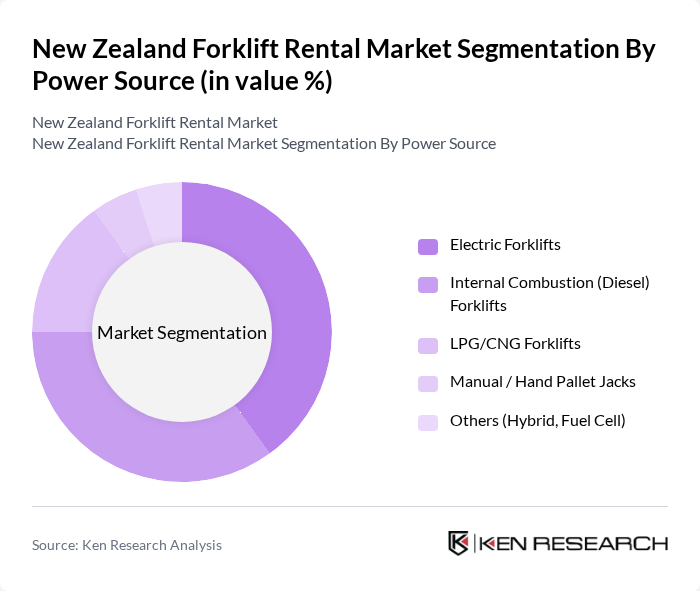
By Power Source:The power source segmentation of the forklift rental market includes Electric Forklifts, Internal Combustion (Diesel) Forklifts, LPG/CNG Forklifts, Manual / Hand Pallet Jacks, and Others (Hybrid, Fuel Cell). Electric Forklifts are gaining popularity due to their environmental benefits, compliance with indoor emission requirements, lower noise levels, and reduced operating costs in warehousing and logistics applications. Internal Combustion Forklifts remain widely used in heavy-duty, outdoor, and construction-related applications where higher load capacities and longer operating times are required. The demand for LPG/CNG Forklifts is also increasing as businesses look for alternative fuel options that offer lower emissions than conventional diesel while maintaining similar performance. Manual / Hand Pallet Jacks are essential for smaller operations and last?meter movements within warehouses and retail stores, and the Others category includes emerging technologies like hybrid and fuel cell forklifts, which are gradually entering advanced logistics and high?throughput environments.
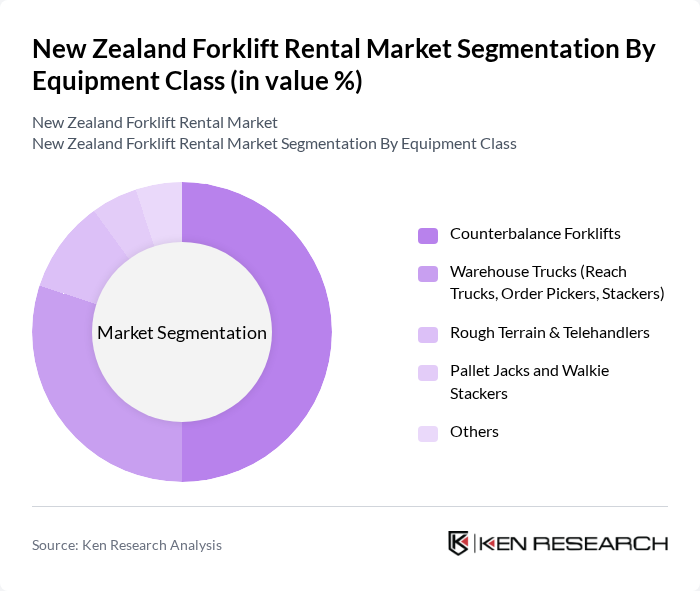
By Equipment Class:The equipment class segmentation includes Counterbalance Forklifts, Warehouse Trucks (Reach Trucks, Order Pickers, Stackers), Rough Terrain & Telehandlers, Pallet Jacks and Walkie Stackers, and Others. Counterbalance Forklifts dominate the rental market due to their versatility, ability to operate in both indoor and outdoor environments, and suitability for a wide range of palletized loads across manufacturing, logistics, and general warehousing. Warehouse Trucks (such as reach trucks, order pickers, and stackers) are essential for efficient high?bay storage, narrow?aisle operations, and e?commerce fulfillment centers where rapid order picking and vertical storage optimization are critical. Rough Terrain Forklifts and Telehandlers are crucial for construction, agriculture, and infrastructure projects where uneven ground conditions and extended reach are required. Pallet Jacks and Walkie Stackers are popular for smaller operations, back?of?store logistics, and short?distance movements, and the Others category includes specialized equipment tailored for niche applications such as very narrow aisle trucks, high?capacity forklifts, and container handlers.
New Zealand Forklift Rental Market Competitive Landscape
The New Zealand Forklift Rental Market is characterized by a dynamic mix of regional and international players. Leading participants such as Hirepool, Youngman Richardson & Co., CablePrice (NZ) Ltd, Caliber Hire, NZ Forklift Hire, TSL Forklifts, All Lift Forklifts & Access Equipment, TCM Forklifts New Zealand, Crown Equipment New Zealand, Toyota Material Handling New Zealand, Manitou New Zealand, Hyster-Yale Group (Hyster & Yale brands), Linde Material Handling New Zealand, Mitsubishi Forklift Trucks, Doosan Industrial Vehicle contribute to innovation, geographic expansion, and service delivery in this space.
New Zealand Forklift Rental Market Industry Analysis
Growth Drivers
- Increasing Demand for Logistics and Warehousing:The New Zealand logistics sector is projected to grow significantly, with the warehousing market expected to reach NZD 1.8 billion in future. This growth is driven by the rise in e-commerce, which saw a 30% increase in online sales in the past year. Consequently, the demand for forklift rentals in warehouses is surging, as companies seek efficient material handling solutions to manage increased inventory levels and streamline operations.
- Growth in Construction and Infrastructure Projects:New Zealand's construction sector is anticipated to expand, with government spending on infrastructure projected to exceed NZD 12 billion in future. This investment is expected to create a robust demand for forklift rentals, as construction companies require reliable equipment for material handling. The ongoing projects, including road upgrades and housing developments, are driving the need for efficient logistics solutions, further boosting the forklift rental market.
- Technological Advancements in Forklift Equipment:The forklift rental market is benefiting from rapid technological advancements, with the introduction of smart forklifts equipped with IoT capabilities. In future, it is estimated that 35% of forklifts in New Zealand will feature advanced technologies, enhancing operational efficiency and safety. These innovations are attracting businesses to rental services, as they seek to leverage the latest equipment without the burden of ownership costs.
Market Challenges
- High Operational Costs:The operational costs associated with forklift rentals in New Zealand are rising, with average maintenance costs estimated at NZD 1,500 per unit annually. Additionally, fuel prices have increased by 20% in the past year, further straining rental companies' profit margins. These high costs can deter potential customers from opting for rental services, impacting overall market growth and profitability.
- Limited Availability of Skilled Operators:The New Zealand forklift rental market faces a significant challenge due to a shortage of skilled operators. In recent labor market commentary, it was reported that there were approximately 2,500 unfilled positions for forklift operators across the country. This shortage not only hampers operational efficiency but also increases labor costs, making it difficult for rental companies to meet growing demand effectively.
New Zealand Forklift Rental Market Future Outlook
The New Zealand forklift rental market is poised for significant growth, driven by increasing automation and the adoption of flexible rental agreements. As businesses seek to optimize their operations, the integration of IoT technologies will enhance efficiency and safety in material handling. Furthermore, the shift towards electric forklifts aligns with sustainability goals, presenting opportunities for rental companies to expand their offerings. Overall, the market is expected to adapt to evolving customer needs and technological advancements, ensuring a dynamic landscape in the coming years.
Market Opportunities
- Expansion of Rental Services in Rural Areas:There is a growing opportunity for forklift rental services to expand into rural regions, where demand for material handling equipment is increasing. With rural construction projects projected to rise by 25% in future, rental companies can tap into this underserved market, providing essential equipment to local businesses and enhancing their operational capabilities.
- Adoption of Electric Forklifts:The shift towards electric forklifts presents a significant market opportunity, as businesses increasingly prioritize sustainability. With the government aiming for a 55% reduction in emissions in future, the demand for electric forklift rentals is expected to rise. This trend not only aligns with environmental goals but also offers cost savings on fuel and maintenance, making it an attractive option for rental companies.
Scope of the Report
| Segment | Sub-Segments |
|---|---|
| By Power Source | Electric Forklifts Internal Combustion (Diesel) Forklifts LPG/CNG Forklifts Manual / Hand Pallet Jacks Others (Hybrid, Fuel Cell) |
| By Equipment Class | Counterbalance Forklifts Warehouse Trucks (Reach Trucks, Order Pickers, Stackers) Rough Terrain & Telehandlers Pallet Jacks and Walkie Stackers Others |
| By Application | Warehousing & Logistics Manufacturing Construction & Infrastructure Retail & Wholesale Trade Food & Beverage and Cold Chain Others |
| By Rental Duration | Short-term Rentals (up to 1 month) Medium-term Rentals (1–12 months) Long-term Rentals (above 12 months) Project-based / Seasonal Rentals |
| By Load Capacity | Below 3 Tons –5 Tons –10 Tons Above 10 Tons |
| By Region | Auckland & Upper North Island Central & Lower North Island (including Wellington) South Island (including Christchurch & Dunedin) Other Regions |
| By Customer Type | Small and Medium Enterprises (SMEs) Large Enterprises Government & Public Sector Rental & Equipment Management Outsourcers |
Key Target Audience
Investors and Venture Capitalist Firms
Government and Regulatory Bodies (e.g., New Zealand Transport Agency, Worksafe New Zealand)
Logistics and Supply Chain Companies
Construction and Infrastructure Firms
Warehouse and Distribution Centers
Retail Chains and Supermarkets
Manufacturers and Producers
Fleet Management Companies
Players Mentioned in the Report:
Hirepool
Youngman Richardson & Co.
CablePrice (NZ) Ltd
Caliber Hire
NZ Forklift Hire
TSL Forklifts
All Lift Forklifts & Access Equipment
TCM Forklifts New Zealand
Crown Equipment New Zealand
Toyota Material Handling New Zealand
Manitou New Zealand
Hyster-Yale Group (Hyster & Yale brands)
Linde Material Handling New Zealand
Mitsubishi Forklift Trucks
Doosan Industrial Vehicle
Table of Contents
Market Assessment Phase
1. Executive Summary and Approach
2. New Zealand Forklift Rental Market Overview
2.1 Key Insights and Strategic Recommendations
2.2 New Zealand Forklift Rental Market Overview
2.3 Definition and Scope
2.4 Evolution of Market Ecosystem
2.5 Timeline of Key Regulatory Milestones
2.6 Value Chain & Stakeholder Mapping
2.7 Business Cycle Analysis
2.8 Policy & Incentive Landscape
3. New Zealand Forklift Rental Market Analysis
3.1 Growth Drivers
3.1.1 Increasing demand for logistics and warehousing
3.1.2 Growth in construction and infrastructure projects
3.1.4 Technological advancements in forklift equipment
3.2 Market Challenges
3.2.1 High operational costs
3.2.2 Limited availability of skilled operators
3.2.3 Stringent safety regulations
3.2.4 Competition from used equipment sales
3.3 Market Opportunities
3.3.1 Expansion of rental services in rural areas
3.3.2 Adoption of electric forklifts
3.3.3 Partnerships with logistics companies
3.3.4 Growth in green initiatives and sustainability
3.4 Market Trends
3.4.1 Increasing automation in material handling
3.4.2 Shift towards flexible rental agreements
3.4.3 Integration of IoT in forklift operations
3.4.4 Focus on safety and compliance technologies
3.5 Government Regulation
3.5.1 Occupational Safety and Health Administration (OSHA) standards
3.5.2 Environmental regulations on emissions
3.5.3 Licensing requirements for operators
3.5.4 Rental equipment safety inspections
4. SWOT Analysis
5. Stakeholder Analysis
6. Porter's Five Forces Analysis
7. New Zealand Forklift Rental Market Market Size, 2019-2024
7.1 By Value
7.2 By Volume
7.3 By Average Selling Price
8. New Zealand Forklift Rental Market Segmentation
8.1 By Power Source
8.1.1 Electric Forklifts
8.1.2 Internal Combustion (Diesel) Forklifts
8.1.3 LPG/CNG Forklifts
8.1.4 Manual / Hand Pallet Jacks
8.1.5 Others (Hybrid, Fuel Cell)
8.2 By Equipment Class
8.2.1 Counterbalance Forklifts
8.2.2 Warehouse Trucks (Reach Trucks, Order Pickers, Stackers)
8.2.3 Rough Terrain & Telehandlers
8.2.4 Pallet Jacks and Walkie Stackers
8.2.5 Others
8.3 By Application
8.3.1 Warehousing & Logistics
8.3.2 Manufacturing
8.3.3 Construction & Infrastructure
8.3.4 Retail & Wholesale Trade
8.3.5 Food & Beverage and Cold Chain
8.3.6 Others
8.4 By Rental Duration
8.4.1 Short-term Rentals (up to 1 month)
8.4.2 Medium-term Rentals (1–12 months)
8.4.3 Long-term Rentals (above 12 months)
8.4.4 Project-based / Seasonal Rentals
8.5 By Load Capacity
8.5.1 Below 3 Tons
8.5.2 3–5 Tons
8.5.3 5–10 Tons
8.5.4 Above 10 Tons
8.6 By Region
8.6.1 Auckland & Upper North Island
8.6.2 Central & Lower North Island (including Wellington)
8.6.3 South Island (including Christchurch & Dunedin)
8.6.4 Other Regions
8.7 By Customer Type
8.7.1 Small and Medium Enterprises (SMEs)
8.7.2 Large Enterprises
8.7.3 Government & Public Sector
8.7.4 Rental & Equipment Management Outsourcers
9. New Zealand Forklift Rental Market Competitive Analysis
9.1 Market Share of Key Players
9.2 Cross Comparison of Key Players
9.2.1 Company Name
9.2.2 Group Size (Large, Medium, or Small as per industry convention)
9.2.3 Fleet Size (Number of Units in Rental Fleet)
9.2.4 Fleet Utilization Rate (%)
9.2.5 Average Rental Rate per Day (NZD)
9.2.6 Revenue per Active Unit (NZD/Unit/Year)
9.2.7 EBITDA Margin (%)
9.2.8 Customer Retention Rate (%)
9.2.9 Average Contract Tenure (Months)
9.2.10 Market Share in New Zealand Forklift Rentals (%)
9.2.11 Geographic Coverage (Number of Branches / Depots)
9.2.12 On-time Delivery & Service SLA Compliance (%)
9.2.13 Digital Capability Index (Telematics / Online Booking / Fleet Tracking)
9.2.14 Health & Safety Compliance Record (Incidents per 100 Units)
9.3 SWOT Analysis of Top Players
9.4 Pricing Analysis
9.5 Detailed Profile of Major Companies
9.5.1 Hirepool
9.5.2 Youngman Richardson & Co.
9.5.3 CablePrice (NZ) Ltd
9.5.4 Caliber Hire
9.5.5 NZ Forklift Hire
9.5.6 TSL Forklifts
9.5.7 All Lift Forklifts & Access Equipment
9.5.8 TCM Forklifts New Zealand
9.5.9 Crown Equipment New Zealand
9.5.10 Toyota Material Handling New Zealand
9.5.11 Manitou New Zealand
9.5.12 Hyster-Yale Group (Hyster & Yale brands)
9.5.13 Linde Material Handling New Zealand
9.5.14 Mitsubishi Forklift Trucks
9.5.15 Doosan Industrial Vehicle
10. New Zealand Forklift Rental Market End-User Analysis
10.1 Procurement Behavior of Key Ministries
10.1.1 Government procurement policies
10.1.2 Budget allocation for equipment rental
10.1.3 Supplier selection criteria
10.1.4 Contract management practices
10.2 Corporate Spend on Infrastructure & Energy
10.2.1 Investment trends in infrastructure
10.2.2 Budgeting for equipment rentals
10.2.3 Impact of economic conditions on spending
10.2.4 Sector-specific spending patterns
10.3 Pain Point Analysis by End-User Category
10.3.1 Equipment availability issues
10.3.2 Maintenance and service challenges
10.3.3 Cost management concerns
10.3.4 Compliance with safety regulations
10.4 User Readiness for Adoption
10.4.1 Awareness of rental options
10.4.2 Training and support needs
10.4.3 Technology adoption readiness
10.4.4 Financial readiness for rental agreements
10.5 Post-Deployment ROI and Use Case Expansion
10.5.1 Measurement of rental effectiveness
10.5.2 Case studies of successful deployments
10.5.3 Expansion into new applications
10.5.4 Long-term benefits realization
11. New Zealand Forklift Rental Market Future Size, 2025-2030
11.1 By Value
11.2 By Volume
11.3 By Average Selling Price
Go-To-Market Strategy Phase
1. Whitespace Analysis + Business Model Canvas
1.1 Market gaps identification
1.2 Value proposition development
1.3 Revenue model exploration
1.4 Customer segmentation analysis
1.5 Key partnerships identification
1.6 Cost structure analysis
1.7 Channels and customer relationships
2. Marketing and Positioning Recommendations
2.1 Branding strategies
2.2 Product USPs
2.3 Target market identification
2.4 Communication strategies
2.5 Digital marketing initiatives
3. Distribution Plan
3.1 Urban retail vs rural NGO tie-ups
3.2 Distribution channel optimization
3.3 Logistics and supply chain management
3.4 Partnership opportunities
4. Channel & Pricing Gaps
4.1 Underserved routes
4.2 Pricing bands
4.3 Competitive pricing analysis
4.4 Customer feedback on pricing
5. Unmet Demand & Latent Needs
5.1 Category gaps
5.2 Consumer segments
5.3 Emerging trends analysis
5.4 Future demand forecasting
6. Customer Relationship
6.1 Loyalty programs
6.2 After-sales service
6.3 Customer engagement strategies
6.4 Feedback and improvement mechanisms
7. Value Proposition
7.1 Sustainability
7.2 Integrated supply chains
7.3 Customer-centric solutions
7.4 Competitive advantages
8. Key Activities
8.1 Regulatory compliance
8.2 Branding
8.3 Distribution setup
8.4 Training and development
9. Entry Strategy Evaluation
9.1 Domestic Market Entry Strategy
9.1.1 Product mix
9.1.2 Pricing band
9.1.3 Packaging
9.2 Export Entry Strategy
9.2.1 Target countries
9.2.2 Compliance roadmap
10. Entry Mode Assessment
10.1 JV
10.2 Greenfield
10.3 M&A
10.4 Distributor Model
11. Capital and Timeline Estimation
11.1 Capital requirements
11.2 Timelines
12. Control vs Risk Trade-Off
12.1 Ownership vs Partnerships
13. Profitability Outlook
13.1 Breakeven analysis
13.2 Long-term sustainability
14. Potential Partner List
14.1 Distributors
14.2 JVs
14.3 Acquisition targets
15. Execution Roadmap
15.1 Phased Plan for Market Entry
15.1.1 Market Setup
15.1.2 Market Entry
15.1.3 Growth Acceleration
15.1.4 Scale & Stabilize
15.2 Key Activities and Milestones
15.2.1 Activity timelines
15.2.2 Milestone tracking
Research Methodology
Phase 1: Approach1
Desk Research
- Analysis of industry reports from New Zealand's Ministry of Transport and relevant trade associations
- Review of market trends and statistics from the New Zealand Transport Agency
- Examination of rental market dynamics through publications from industry journals and logistics magazines
Primary Research
- Interviews with fleet managers and rental service providers in the forklift sector
- Surveys targeting warehouse operators and logistics companies utilizing forklift rentals
- Field interviews with industry experts and consultants specializing in material handling equipment
Validation & Triangulation
- Cross-validation of findings through multiple data sources including government reports and industry publications
- Triangulation of insights from primary interviews with secondary data trends
- Sanity checks conducted through expert panel reviews and feedback sessions
Phase 2: Market Size Estimation1
Top-down Assessment
- Estimation of the forklift rental market size based on national construction and logistics spending
- Segmentation of the market by end-user industries such as construction, warehousing, and manufacturing
- Incorporation of government infrastructure projects and their impact on rental demand
Bottom-up Modeling
- Collection of rental rates and utilization metrics from leading forklift rental companies
- Operational cost analysis based on maintenance, insurance, and depreciation of rental fleets
- Volume x cost calculations to derive revenue estimates for different rental segments
Forecasting & Scenario Analysis
- Multi-factor regression analysis incorporating economic indicators and industry growth rates
- Scenario modeling based on potential regulatory changes and technological advancements in forklift design
- Development of baseline, optimistic, and pessimistic forecasts through 2030
Phase 3: CATI Sample Composition1
| Scope Item/Segment | Sample Size | Target Respondent Profiles |
|---|---|---|
| Construction Sector Forklift Rentals | 100 | Project Managers, Site Supervisors |
| Warehouse Operations | 80 | Warehouse Managers, Inventory Control Specialists |
| Manufacturing Industry Usage | 70 | Production Managers, Operations Directors |
| Logistics and Distribution Centers | 90 | Logistics Coordinators, Supply Chain Managers |
| Retail Sector Forklift Needs | 60 | Retail Operations Managers, Facility Managers |
Frequently Asked Questions
What is the current value of the New Zealand Forklift Rental Market?
The New Zealand Forklift Rental Market is valued at approximately USD 55 million, reflecting a steady growth driven by increased demand for efficient material handling solutions across various sectors, including construction, manufacturing, and logistics.
What factors are driving the growth of the forklift rental market in New Zealand?
Which regions in New Zealand have the highest demand for forklift rentals?
What are the main types of forklifts available for rent in New Zealand?
Other Regional/Country Reports
Other Adjacent Reports
Egypt E-commerce Fulfillment Market
Mexico Industrial Machinery Rental Market
Malaysia Telehandler Rental Market
KSA Pallet Truck Rental Market
Brazil Electric Vehicle Charging Market
South Africa Operator Training Services Market
Why Buy From Us?

What makes us stand out is that our consultants follow Robust, Refine and Result (RRR) methodology. Robust for clear definitions, approaches and sanity checking, Refine for differentiating respondents' facts and opinions, and Result for presenting data with story.

We have set a benchmark in the industry by offering our clients with syndicated and customized market research reports featuring coverage of entire market as well as meticulous research and analyst insights.

While we don't replace traditional research, we flip the method upside down. Our dual approach of Top Bottom & Bottom Top ensures quality deliverable by not just verifying company fundamentals but also looking at the sector and macroeconomic factors.

With one step in the future, our research team constantly tries to show you the bigger picture. We help with some of the tough questions you may encounter along the way: How is the industry positioned? Best marketing channel? KPI's of competitors? By aligning every element, we help maximize success.

Our report gives you instant access to the answers and sources that other companies might choose to hide. We elaborate each steps of research methodology we have used and showcase you the sample size to earn your trust.

If you need any support, we are here! We pride ourselves on universe strength, data quality, and quick, friendly, and professional service.