New Zealand Gas Cleaning Technologies Market Report Size Share Growth Drivers Trends Opportunities & Forecast 2025–2030

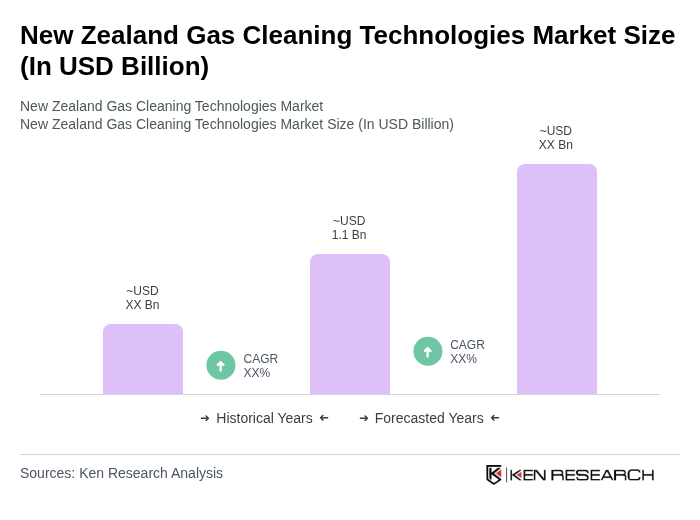
The New Zealand gas cleaning technologies market, worth USD 1.1 Bn, is growing due to environmental regulations and innovations in emission control systems across key industries.

Region:Global

Author(s):Rebecca

Product Code:KRAA4322

Pages:88

Published On:January 2026
About the Report

Base Year 2024

New Zealand Gas Cleaning Technologies Market Overview

  • The New Zealand Gas Cleaning Technologies Market is valued at USD 1.1 billion, based on a five-year historical analysis of the country’s share within the global gas cleaning technologies and related industrial gas treatment markets. This growth is primarily driven by increasingly stringent environmental regulations on air emissions, the need for cleaner industrial processes, decarbonisation policies, and ongoing advancements in gas cleaning solutions such as scrubbers, filters, and NOx/SOx control systems. The market has seen a steady rise in demand for efficient gas cleaning solutions across key New Zealand industries, including power generation (particularly gas?fired and cogeneration assets), food processing, metals, cement, wood processing, and manufacturing.
  • Key regional demand centres in this market include Auckland, Wellington, and Christchurch, which account for a significant share of industrial and commercial activity and apply relatively stringent local air quality and resource consent conditions through regional councils. These urban and industrial hubs host major power plants, manufacturing facilities, steel and metals operations, food and beverage plants, and waste and wastewater treatment assets that require advanced gas cleaning, filtration, and emission control systems to comply with regional air discharge permits and national standards.
  • New Zealand’s core regulatory driver for industrial air emissions is the Resource Management (National Environmental Standards for Air Quality) Regulations 2004, issued under the Resource Management Act 1991 by the Ministry for the Environment. These standards set binding limits for ambient concentrations of pollutants such as particulate matter (PM10), carbon monoxide, nitrogen dioxide, sulphur dioxide and ozone, and require regional councils to control emissions from activities including industrial boilers and combustion sources through resource consents and discharge rules. Compliance with these requirements is driving the adoption and upgrading of gas cleaning technologies (e.g., scrubbers, baghouses, electrostatic and fabric filters, sorbent injection, and NOx/SOx reduction systems) across sectors such as power generation, manufacturing, cement, metals, and waste management.
New Zealand Gas Cleaning Technologies Market Size

New Zealand Gas Cleaning Technologies Market Segmentation

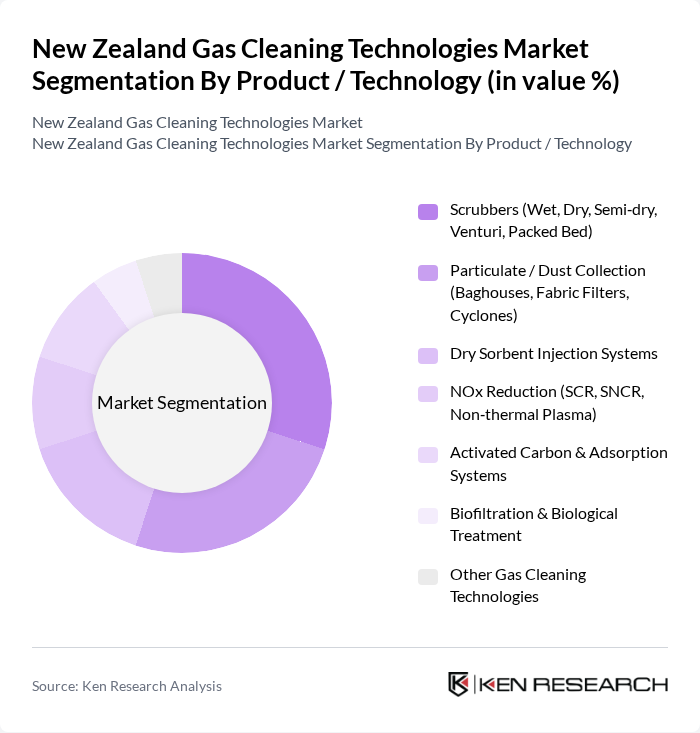
By Product / Technology:The market is segmented into various technologies that are essential for effective gas cleaning. The primary subsegments include scrubbers, particulate/dust collection systems, dry sorbent injection systems, NOx reduction technologies, activated carbon and adsorption systems, biofiltration, and other gas cleaning technologies. Each of these technologies plays a crucial role in addressing specific pollutants and improving air quality, with scrubbers and particulate/dust collection systems generally accounting for the largest technology shares globally due to their extensive use in power generation, chemicals, metals, cement, and process industries.
New Zealand Gas Cleaning Technologies Market segmentation by Product / Technology.

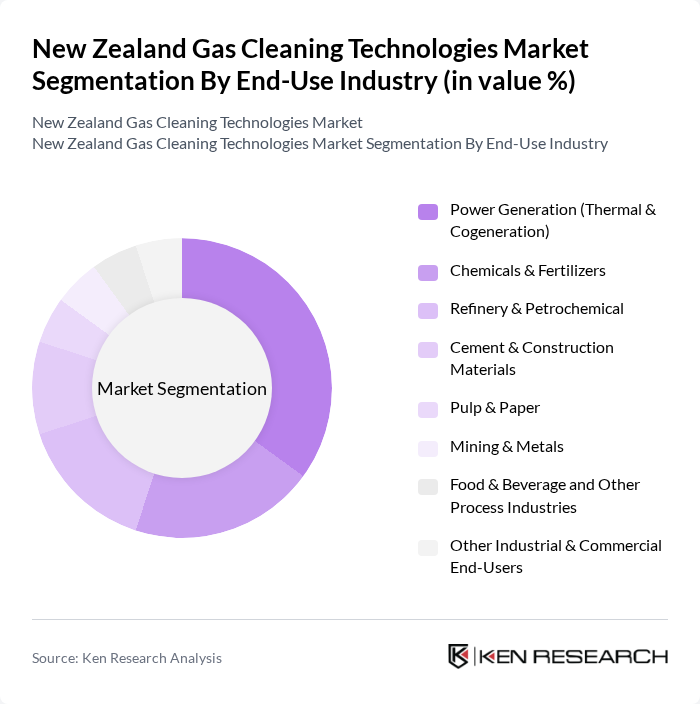
By End-Use Industry:The gas cleaning technologies market is also segmented by end-use industries, which include power generation, chemicals and fertilizers, refinery and petrochemical, cement and construction materials, pulp and paper, mining and metals, food and beverage, and other industrial and commercial end-users. Each industry has unique requirements for gas cleaning technologies based on the types of emissions they produce, with power generation and chemical/process industries typically representing leading demand segments for scrubbers, particulate collection, and gas treatment systems at the global level.
New Zealand Gas Cleaning Technologies Market segmentation by End-Use Industry.

New Zealand Gas Cleaning Technologies Market Competitive Landscape

The New Zealand Gas Cleaning Technologies Market is characterized by a dynamic mix of regional and international players. Leading participants such as BOC New Zealand (Linde plc), Air Liquide New Zealand Limited, Coregas New Zealand, Supagas New Zealand, Wesfarmers Chemicals, Energy & Fertilisers (WesCEF), New Zealand Steel, FLSmidth, Babcock & Wilcox Enterprises, Inc., Mitsubishi Heavy Industries, Ltd., Veolia Environnement S.A. / Veolia New Zealand, SUEZ (including New Zealand Operations), Cleanaway Waste Management Limited (New Zealand), Jacobs Engineering Group, AECOM New Zealand, and other emerging local gas cleaning solution providers contribute to innovation, geographic expansion, and service delivery in this space, leveraging their expertise in industrial gases, combustion and process engineering, air pollution control equipment, and environmental services.

BOC New Zealand (Linde plc)

1912

Auckland, New Zealand

Air Liquide New Zealand Limited

1983

Auckland, New Zealand

Coregas New Zealand

1974

Auckland, New Zealand

Supagas New Zealand

1968

Auckland, New Zealand

Wesfarmers Chemicals, Energy & Fertilisers (WesCEF)

1984

Perth, Australia

Company

Establishment Year

Headquarters

Group Size (Large, Medium, or Small as per industry convention)

New Zealand Gas Cleaning Revenue (NZD) and 3?Year Revenue CAGR

EBITDA Margin from Gas Cleaning Portfolio

Order Backlog / Book?to?Bill Ratio

Installed Base in New Zealand (Number of Systems / MW / kNm³/h Treated)

Market Share by Key End?Use Segment (Power, Industrial, Others)

New Zealand Gas Cleaning Technologies Market Industry Analysis

Growth Drivers

  • Increasing Environmental Regulations:New Zealand's stringent environmental regulations are driving the gas cleaning technologies market. The government has set ambitious targets to reduce greenhouse gas emissions by 30% by 2030, which translates to a reduction of approximately 20 million tons of CO2 equivalent. This regulatory framework compels industries to adopt advanced gas cleaning technologies to comply with emission standards, thereby fostering market growth and innovation in cleaner technologies.
  • Rising Demand for Clean Energy Solutions:The demand for clean energy solutions in New Zealand is surging, with renewable energy sources accounting for around 80–85 percent of the country's electricity generation in recent years. This shift towards sustainable energy is prompting industries to invest in gas cleaning technologies to minimize emissions and enhance energy efficiency. The transition is expected to create a market environment conducive to the adoption of innovative gas cleaning solutions, further propelling growth.
  • Government Incentives for Sustainable Practices:The New Zealand government has introduced various incentives to promote sustainable practices, including grants and support mechanisms for companies investing in clean technologies, such as those provided through the Government Investment in Decarbonising Industry (GIDI) fund and related programs. In future, the government allocated NZD 150 million to support clean technology initiatives. These financial incentives encourage businesses to adopt gas cleaning technologies, thereby enhancing market penetration and fostering a culture of sustainability across various sectors.

Market Challenges

  • High Initial Investment Costs:One of the significant challenges facing the gas cleaning technologies market in New Zealand is the high initial investment required for advanced systems. The average cost of implementing state-of-the-art gas cleaning solutions can exceed NZD 1 million for medium-sized enterprises. This financial barrier often deters smaller companies from adopting necessary technologies, limiting overall market growth and innovation in the sector.
  • Limited Awareness Among End-Users:There is a notable lack of awareness regarding the benefits of gas cleaning technologies among end-users in New Zealand. A survey conducted in future indicated that only 40% of industrial operators were familiar with available gas cleaning solutions. This limited knowledge hampers the adoption of these technologies, as potential users may not fully understand their advantages, thus stalling market expansion and technological advancement.

New Zealand Gas Cleaning Technologies Market Future Outlook

The future of the gas cleaning technologies market in New Zealand appears promising, driven by increasing environmental awareness and technological advancements. As industries strive to meet stringent emission regulations, the integration of innovative solutions will become essential. Furthermore, the growing emphasis on renewable energy sources will likely stimulate investments in gas cleaning technologies, fostering a competitive landscape. Companies that prioritize sustainability and innovation will be well-positioned to capitalize on emerging opportunities in this evolving market.

Market Opportunities

  • Expansion into Emerging Markets:New Zealand's gas cleaning technology firms have significant opportunities to expand into emerging markets in the Asia-Pacific region. With a projected increase in energy demand and environmental regulations, these markets present a fertile ground for innovative gas cleaning solutions, potentially increasing revenue streams and market share for local companies.
  • Development of Innovative Cleaning Technologies:There is a growing opportunity for the development of innovative gas cleaning technologies that utilize artificial intelligence and machine learning. These advancements can enhance efficiency and reduce operational costs, making them attractive to industries seeking to improve their environmental footprint while maintaining profitability in a competitive market.

Scope of the Report

SegmentSub-Segments
By Product / Technology

Scrubbers (Wet, Dry, Semi?dry, Venturi, Packed Bed)

Particulate / Dust Collection (Baghouses, Fabric Filters, Cyclones)

Dry Sorbent Injection Systems

NOx Reduction (SCR, SNCR, Non?thermal Plasma)

Activated Carbon & Adsorption Systems

Biofiltration & Biological Treatment

Other Gas Cleaning Technologies

By End-Use Industry

Power Generation (Thermal & Cogeneration)

Chemicals & Fertilizers

Refinery & Petrochemical

Cement & Construction Materials

Pulp & Paper

Mining & Metals

Food & Beverage and Other Process Industries

Other Industrial & Commercial End-Users

By Application

Particulate Cleaning / Dust Control

Gaseous / Chemical Pollutant Control (SOx, NOx, VOCs, Odors)

Flue Gas Desulfurization & Flue Gas Treatment

Indoor & Ambient Air Quality Management

Waste-to-Energy and Landfill Gas Cleaning

Other Environmental Compliance Applications

By System Configuration

New Build / Greenfield Installations

Retrofit & Upgrade of Existing Plants

Mobile / Modular and Skid?Mounted Systems

By Ownership & Investment Model

Owner?Operated (Capex Purchase)

Build?Own?Operate (BOO) / Build?Own?Operate?Transfer (BOOT)

Leasing & Performance?Based Contracts (Opex Models)

Public–Private Partnerships and Government?Backed Projects

By Facility Size

Large?Scale Industrial Plants

Medium?Scale Facilities

Small?Scale & Decentralized Installations

By Region in New Zealand

North Island (Auckland, Waikato, Bay of Plenty, Wellington, Others)

South Island (Canterbury, Otago, Southland, Others)

Other Territories and Offshore Industrial Sites

Key Target Audience

Investors and Venture Capitalist Firms

Government and Regulatory Bodies (e.g., Ministry of Business, Innovation and Employment)

Manufacturers and Producers of Gas Cleaning Technologies

Energy Sector Companies

Environmental Protection Agencies (e.g., Environmental Protection Authority)

Utility Companies

Industry Associations (e.g., Gas Association of New Zealand)

Financial Institutions and Banks

Players Mentioned in the Report:

BOC New Zealand (Linde plc)

Air Liquide New Zealand Limited

Coregas New Zealand

Supagas New Zealand

Wesfarmers Chemicals, Energy & Fertilisers (WesCEF)

New Zealand Steel

FLSmidth

Babcock & Wilcox Enterprises, Inc.

Mitsubishi Heavy Industries, Ltd.

Veolia Environnement S.A. / Veolia New Zealand

SUEZ (including New Zealand Operations)

Cleanaway Waste Management Limited (New Zealand)

Jacobs Engineering Group

AECOM New Zealand

Other Emerging Local Gas Cleaning Solution Providers

Table of Contents

Market Assessment Phase

1. Executive Summary and Approach


2. New Zealand Gas Cleaning Technologies Market Overview

2.1 Key Insights and Strategic Recommendations

2.2 New Zealand Gas Cleaning Technologies Market Overview

2.3 Definition and Scope

2.4 Evolution of Market Ecosystem

2.5 Timeline of Key Regulatory Milestones

2.6 Value Chain & Stakeholder Mapping

2.7 Business Cycle Analysis

2.8 Policy & Incentive Landscape


3. New Zealand Gas Cleaning Technologies Market Analysis

3.1 Growth Drivers

3.1.1 Increasing Environmental Regulations
3.1.3 Rising Demand for Clean Energy Solutions
3.1.4 Government Incentives for Sustainable Practices

3.2 Market Challenges

3.2.1 High Initial Investment Costs
3.2.2 Limited Awareness Among End-Users
3.2.3 Competition from Alternative Technologies
3.2.4 Regulatory Compliance Complexity

3.3 Market Opportunities

3.3.1 Expansion into Emerging Markets
3.3.2 Development of Innovative Cleaning Technologies
3.3.3 Strategic Partnerships with Local Firms
3.3.4 Increasing Investment in Renewable Energy

3.4 Market Trends

3.4.1 Shift Towards Decentralized Energy Solutions
3.4.2 Integration of IoT in Gas Cleaning Technologies
3.4.3 Focus on Circular Economy Practices
3.4.4 Growing Consumer Demand for Transparency

3.5 Government Regulation

3.5.1 Emission Standards for Industrial Processes
3.5.2 Incentives for Clean Technology Adoption
3.5.3 Regulations on Waste Management
3.5.4 Compliance Requirements for Gas Emissions

4. SWOT Analysis


5. Stakeholder Analysis


6. Porter's Five Forces Analysis


7. New Zealand Gas Cleaning Technologies Market Market Size, 2019-2024

7.1 By Value

7.2 By Volume

7.3 By Average Selling Price


8. New Zealand Gas Cleaning Technologies Market Segmentation

8.1 By Product / Technology

8.1.1 Scrubbers (Wet, Dry, Semi?dry, Venturi, Packed Bed)
8.1.2 Particulate / Dust Collection (Baghouses, Fabric Filters, Cyclones)
8.1.3 Dry Sorbent Injection Systems
8.1.4 NOx Reduction (SCR, SNCR, Non?thermal Plasma)
8.1.5 Activated Carbon & Adsorption Systems
8.1.6 Biofiltration & Biological Treatment
8.1.7 Other Gas Cleaning Technologies

8.2 By End-Use Industry

8.2.1 Power Generation (Thermal & Cogeneration)
8.2.2 Chemicals & Fertilizers
8.2.3 Refinery & Petrochemical
8.2.4 Cement & Construction Materials
8.2.5 Pulp & Paper
8.2.6 Mining & Metals
8.2.7 Food & Beverage and Other Process Industries
8.2.8 Other Industrial & Commercial End-Users

8.3 By Application

8.3.1 Particulate Cleaning / Dust Control
8.3.2 Gaseous / Chemical Pollutant Control (SOx, NOx, VOCs, Odors)
8.3.3 Flue Gas Desulfurization & Flue Gas Treatment
8.3.4 Indoor & Ambient Air Quality Management
8.3.5 Waste-to-Energy and Landfill Gas Cleaning
8.3.6 Other Environmental Compliance Applications

8.4 By System Configuration

8.4.1 New Build / Greenfield Installations
8.4.2 Retrofit & Upgrade of Existing Plants
8.4.3 Mobile / Modular and Skid?Mounted Systems

8.5 By Ownership & Investment Model

8.5.1 Owner?Operated (Capex Purchase)
8.5.2 Build?Own?Operate (BOO) / Build?Own?Operate?Transfer (BOOT)
8.5.3 Leasing & Performance?Based Contracts (Opex Models)
8.5.4 Public–Private Partnerships and Government?Backed Projects

8.6 By Facility Size

8.6.1 Large?Scale Industrial Plants
8.6.2 Medium?Scale Facilities
8.6.3 Small?Scale & Decentralized Installations

8.7 By Region in New Zealand

8.7.1 North Island (Auckland, Waikato, Bay of Plenty, Wellington, Others)
8.7.2 South Island (Canterbury, Otago, Southland, Others)
8.7.3 Other Territories and Offshore Industrial Sites

9. New Zealand Gas Cleaning Technologies Market Competitive Analysis

9.1 Market Share of Key Players

9.2 Cross Comparison of Key Players

9.2.1 Company Name
9.2.2 Group Size (Large, Medium, or Small as per industry convention)
9.2.3 New Zealand Gas Cleaning Revenue (NZD) and 3?Year Revenue CAGR
9.2.4 EBITDA Margin from Gas Cleaning Portfolio
9.2.5 Order Backlog / Book?to?Bill Ratio
9.2.6 Installed Base in New Zealand (Number of Systems / MW / kNm³/h Treated)
9.2.7 Market Share by Key End?Use Segment (Power, Industrial, Others)
9.2.8 Average Contract Value and Payback Period for Customers
9.2.9 Share of Recurring / Service Revenue
9.2.10 R&D Intensity (% of Revenue) and Rate of New Product Launches
9.2.11 Win Rate in Competitive Tenders in New Zealand
9.2.12 Customer Satisfaction / Net Promoter Score (NPS)

9.3 SWOT Analysis of Top Players

9.4 Pricing Analysis

9.5 Detailed Profile of Major Companies

9.5.1 BOC New Zealand (Linde plc)
9.5.2 Air Liquide New Zealand Limited
9.5.3 Coregas New Zealand
9.5.4 Supagas New Zealand
9.5.5 Wesfarmers Chemicals, Energy & Fertilisers (WesCEF)
9.5.6 New Zealand Steel
9.5.7 FLSmidth
9.5.8 Babcock & Wilcox Enterprises, Inc.
9.5.9 Mitsubishi Heavy Industries, Ltd.
9.5.10 Veolia Environnement S.A. / Veolia New Zealand
9.5.11 SUEZ (including New Zealand Operations)
9.5.12 Cleanaway Waste Management Limited (New Zealand)
9.5.13 Jacobs Engineering Group
9.5.14 AECOM New Zealand
9.5.15 Other Emerging Local Gas Cleaning Solution Providers

10. New Zealand Gas Cleaning Technologies Market End-User Analysis

10.1 Procurement Behavior of Key Ministries

10.1.1 Government Procurement Policies
10.1.2 Budget Allocations for Environmental Technologies
10.1.3 Decision-Making Processes
10.1.4 Stakeholder Engagement Strategies

10.2 Corporate Spend on Infrastructure & Energy

10.2.1 Investment Trends in Gas Cleaning Technologies
10.2.2 Budget Prioritization for Sustainability
10.2.3 Long-term Contracts and Partnerships
10.2.4 Cost-Benefit Analysis Practices

10.3 Pain Point Analysis by End-User Category

10.3.1 Industrial Sector Challenges
10.3.2 Regulatory Compliance Issues
10.3.3 Technology Integration Difficulties
10.3.4 Financial Constraints

10.4 User Readiness for Adoption

10.4.1 Awareness of Gas Cleaning Technologies
10.4.2 Training and Support Needs
10.4.3 Perceived Value of Adoption
10.4.4 Barriers to Entry

10.5 Post-Deployment ROI and Use Case Expansion

10.5.1 Measurement of ROI
10.5.2 Case Studies of Successful Implementations
10.5.3 Future Use Case Opportunities
10.5.4 Feedback Mechanisms for Improvement

11. New Zealand Gas Cleaning Technologies Market Future Size, 2025-2030

11.1 By Value

11.2 By Volume

11.3 By Average Selling Price


Go-To-Market Strategy Phase

1. Whitespace Analysis + Business Model Canvas

1.1 Market Gaps Identification

1.2 Business Model Development


2. Marketing and Positioning Recommendations

2.1 Branding Strategies

2.2 Product USPs


3. Distribution Plan

3.1 Urban Retail vs Rural NGO Tie-ups


4. Channel & Pricing Gaps

4.1 Underserved Routes

4.2 Pricing Bands


5. Unmet Demand & Latent Needs

5.1 Category Gaps

5.2 Consumer Segments


6. Customer Relationship

6.1 Loyalty Programs

6.2 After-sales Service


7. Value Proposition

7.1 Sustainability

7.2 Integrated Supply Chains


8. Key Activities

8.1 Regulatory Compliance

8.2 Branding

8.3 Distribution Setup


9. Entry Strategy Evaluation

9.1 Domestic Market Entry Strategy

9.1.1 Product Mix
9.1.2 Pricing Band
9.1.3 Packaging

9.2 Export Entry Strategy

9.2.1 Target Countries
9.2.2 Compliance Roadmap

10. Entry Mode Assessment

10.1 JV

10.2 Greenfield

10.3 M&A

10.4 Distributor Model


11. Capital and Timeline Estimation

11.1 Capital Requirements

11.2 Timelines


12. Control vs Risk Trade-Off

12.1 Ownership vs Partnerships


13. Profitability Outlook

13.1 Breakeven Analysis

13.2 Long-term Sustainability


14. Potential Partner List

14.1 Distributors

14.2 JVs

14.3 Acquisition Targets


15. Execution Roadmap

15.1 Phased Plan for Market Entry

15.1.1 Market Setup
15.1.2 Market Entry
15.1.3 Growth Acceleration
15.1.4 Scale & Stabilize

15.2 Key Activities and Milestones

15.2.1 Milestone Planning
15.2.2 Activity Tracking

Research Methodology

ApproachModellingSample

Phase 1: Approach1

Desk Research

  • Analysis of industry reports from New Zealand's Ministry of Business, Innovation and Employment
  • Review of academic publications and white papers on gas cleaning technologies
  • Examination of market trends and forecasts from local environmental agencies

Primary Research

  • Interviews with industry experts and engineers specializing in gas cleaning technologies
  • Surveys conducted with facility managers in sectors utilizing gas cleaning systems
  • Focus groups with environmental consultants and regulatory bodies

Validation & Triangulation

  • Cross-validation of findings through multiple data sources including government and industry reports
  • Triangulation of qualitative insights from interviews with quantitative data from surveys
  • Sanity checks performed by a panel of experts in environmental technology

Phase 2: Market Size Estimation1

Top-down Assessment

  • Estimation of market size based on national emissions data and regulatory requirements
  • Segmentation of the market by application areas such as industrial, commercial, and residential
  • Incorporation of government initiatives promoting cleaner technologies and emissions reduction

Bottom-up Modeling

  • Collection of sales data from leading gas cleaning technology providers in New Zealand
  • Estimation of installation and maintenance costs based on industry standards
  • Volume estimates derived from the number of operational units across various sectors

Forecasting & Scenario Analysis

  • Utilization of historical growth rates to project future market trends through 2030
  • Scenario analysis based on potential changes in environmental regulations and technology adoption rates
  • Development of baseline, optimistic, and pessimistic forecasts to account for market volatility

Phase 3: CATI Sample Composition1

Scope Item/SegmentSample SizeTarget Respondent Profiles
Industrial Gas Cleaning Systems120Plant Managers, Environmental Compliance Officers
Commercial Air Filtration Solutions90Facility Managers, HVAC Technicians
Residential Emission Control Devices70Homeowners, Energy Efficiency Consultants
Regulatory Compliance and Standards50Policy Makers, Environmental Analysts
Research and Development in Gas Cleaning Technologies60R&D Managers, Academic Researchers

Frequently Asked Questions

What is the current value of the New Zealand Gas Cleaning Technologies Market?

The New Zealand Gas Cleaning Technologies Market is valued at approximately USD 1.1 billion, reflecting a significant share within the global gas cleaning technologies and industrial gas treatment markets, driven by stringent environmental regulations and the need for cleaner industrial processes.

What are the main drivers of growth in the New Zealand Gas Cleaning Technologies Market?

Which industries are the largest consumers of gas cleaning technologies in New Zealand?

What technologies are included in the New Zealand Gas Cleaning Technologies Market?

Other Adjacent Reports

KSA Air Pollution Control Market

Kuwait Industrial Gases Market Report Size, Share, Growth Drivers, Trends, Opportunities & Forecast 2025–2030

Oman Emission Monitoring Market

Indonesia Environmental Services Market

India Waste Management Market (2022-2030)

Brazil Water Treatment Market

KSA Europe Renewable Energy Market

KSA Carbon Capture Market

Qatar Decarbonization Technologies Market

United States Industrial Filtration Market

Why Buy From Us?

Refine Robust Result (RRR) Framework

What makes us stand out is that our consultants follow Robust, Refine and Result (RRR) methodology. Robust for clear definitions, approaches and sanity checking, Refine for differentiating respondents' facts and opinions, and Result for presenting data with story.

Our Reach Is Unmatched

We have set a benchmark in the industry by offering our clients with syndicated and customized market research reports featuring coverage of entire market as well as meticulous research and analyst insights.

Shifting the Research Paradigm

While we don't replace traditional research, we flip the method upside down. Our dual approach of Top Bottom & Bottom Top ensures quality deliverable by not just verifying company fundamentals but also looking at the sector and macroeconomic factors.

More Insights-Better Decisions

With one step in the future, our research team constantly tries to show you the bigger picture. We help with some of the tough questions you may encounter along the way: How is the industry positioned? Best marketing channel? KPI's of competitors? By aligning every element, we help maximize success.

Transparency and Trust

Our report gives you instant access to the answers and sources that other companies might choose to hide. We elaborate each steps of research methodology we have used and showcase you the sample size to earn your trust.

Round the Clock Support

If you need any support, we are here! We pride ourselves on universe strength, data quality, and quick, friendly, and professional service.

Why Clients Choose Us?

400000+
Reports in repository
150+
Consulting projects a year
100+
Analysts
8000+
Client Queries in 2022








