Oman Gas Cleaning Technologies Market Report Size Share Growth Drivers Trends Opportunities & Forecast 2025–2030

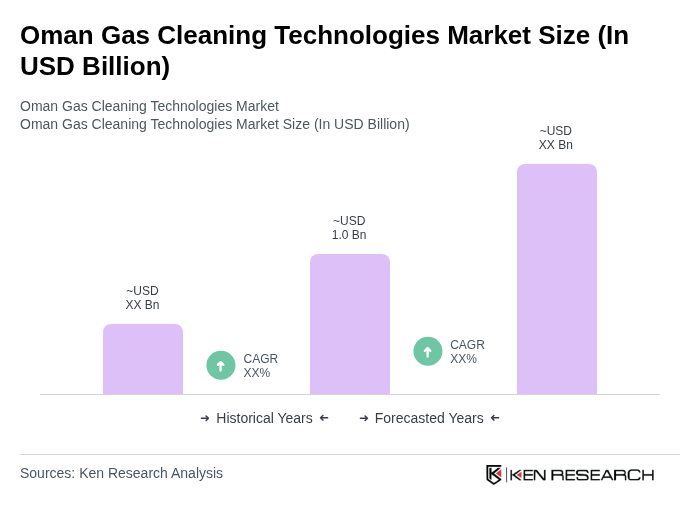
Oman gas cleaning technologies market, valued at USD 1.0 billion, is growing due to environmental compliance, clean energy demand, and advancements in emission control systems for industrial hubs like Muscat and Sohar.

Region:Middle East

Author(s):Rebecca

Product Code:KRAA4318

Pages:89

Published On:January 2026
About the Report

Base Year 2024

Oman Gas Cleaning Technologies Market Overview

  • The Oman Gas Cleaning Technologies Market is valued at USD 1.0 billion, based on a five-year historical analysis and Oman’s share within the Middle East and Africa gas cleaning technologies market, which generated around USD 2.7 billion in revenue for the region. This growth is primarily driven by increasingly stringent environmental requirements for industrial emissions, the need for cleaner energy solutions in the oil and gas value chain, and the continued expansion and modernization of Oman’s oil and gas sector. The market is also supported by investments in advanced flue?gas and process?gas treatment technologies at refineries, LNG facilities and petrochemical plants, aimed at reducing emissions and improving ambient air quality in line with national sustainability objectives.
  • Key industrial hubs driving demand for gas cleaning technologies include Muscat, Salalah, Duqm and Sohar, which dominate due to their strategic locations and significant refinery, petrochemical, LNG and power generation activities. Muscat serves as the capital and a hub for upstream and downstream energy projects, while Salalah is known for its port facilities and petrochemical and gas-related industries that require emission control systems. Duqm is emerging as a key industrial and refining zone with ongoing investments in the Duqm Refinery and Petrochemical Industries Company (OQ8), which incorporates modern gas cleaning and emission?reduction units. Sohar, another major cluster, hosts refineries, petrochemicals and metals industries that deploy flue gas desulfurization, dust collection and other gas treatment technologies.
  • In 2023, the Omani government continued to strengthen industrial air?emission controls under instruments such as the Environmental Protection and Pollution Control Law issued by Royal Decree 114/2001 and implementing regulations of the Environment Authority, including standards for sulfur dioxide (SO?) and other pollutants from stationary sources. These rules set maximum permissible limits for pollutants in stack emissions and ambient air and require industrial facilities to install appropriate treatment systems, continuous monitoring and reporting to obtain and maintain environmental permits. In practice, this pushes refineries, LNG plants, power stations and heavy industries to adopt advanced gas cleaning technologies such as scrubbers, desulfurization units and particulate control systems to comply with the applicable emission limits and align with global environmental standards.
Oman Gas Cleaning Technologies Market Size

Oman Gas Cleaning Technologies Market Segmentation

By Technology:The technology segment includes various methods used for gas cleaning, each with unique applications and efficiencies. The dominant technologies in this market are Wet Scrubbers and Electrostatic Precipitators, which are widely adopted due to their effectiveness in removing particulate matter, sulfur oxides and other pollutants from industrial emissions, in line with regional trends where scrubber technologies hold a major share of gas cleaning investments. The increasing focus on environmental compliance across refineries, LNG facilities, power generation and metals processing, along with the need for efficient gas cleaning solutions with lower water and energy consumption, is driving the adoption of these technologies as well as supporting uptake of dry sorbent injection, fabric filters and advanced hybrid systems.
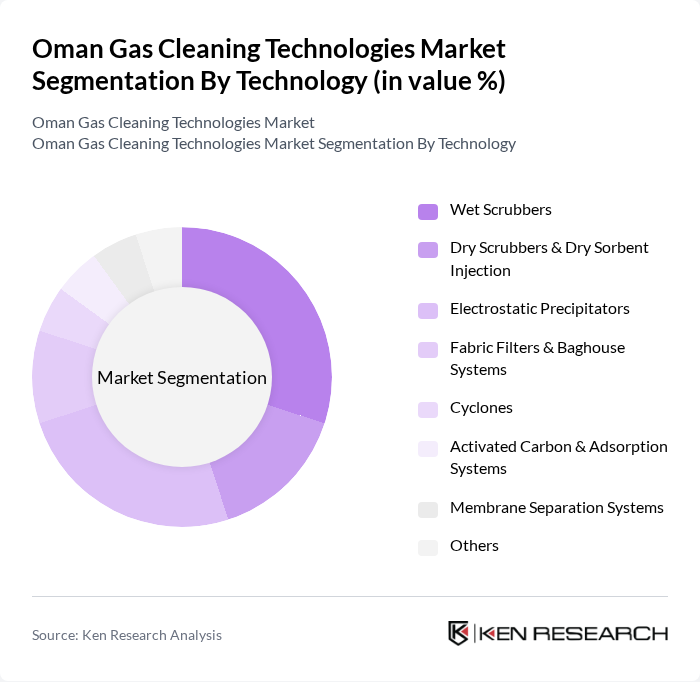
Oman Gas Cleaning Technologies Market segmentation by Technology.

By Pollutant Type:This segment categorizes the market based on the types of pollutants being targeted for removal. The leading pollutant types include Particulate Matter (PM) and Nitrogen Oxides (NOx), which are prevalent in emissions from refineries, gas processing, LNG trains, metal smelters and power plants and are a major focus of air?quality standards in Oman and the wider Middle East and Africa region. The increasing regulatory pressure to control PM, SOx, NOx and greenhouse gas emissions, combined with corporate decarbonization and sustainability initiatives, is driving the demand for advanced gas cleaning technologies that can effectively address multi?pollutant control, integrate with continuous emissions monitoring systems and support compliance with both national and international environmental benchmarks.
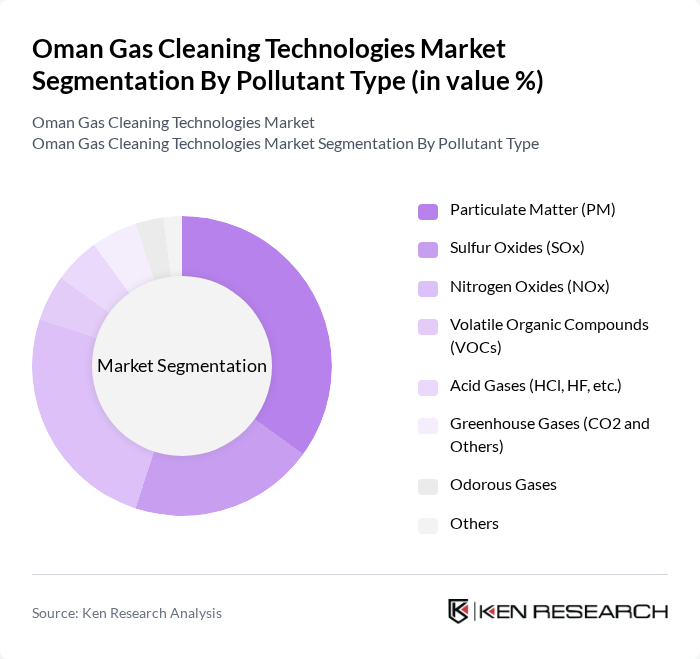
Oman Gas Cleaning Technologies Market segmentation by Pollutant Type.

Oman Gas Cleaning Technologies Market Competitive Landscape

The Oman Gas Cleaning Technologies Market is characterized by a dynamic mix of regional and international players. Leading participants such as OQ (Oman Oil & Orpic Group), Petroleum Development Oman (PDO), Oman Gas Company / OQ Gas Networks, Gulf Energy SAOC, Oman LNG, Veolia Environnement, SUEZ Group, Siemens AG, Honeywell International Inc., AECOM, Jacobs Engineering Group, WorleyParsons, Air Products and Chemicals, Inc., Mitsubishi Heavy Industries, Linde plc contribute to innovation, geographic expansion, and service delivery in this space.

OQ (Oman Oil & Orpic Group)

2019

Muscat, Oman

Petroleum Development Oman (PDO)

1937

Muscat, Oman

Oman Gas Company

2000

Muscat, Oman

Gulf Energy SAOC

2005

Muscat, Oman

Oman LNG

1994

Muscat, Oman

Company

Establishment Year

Headquarters

Group Size (Large, Medium, or Small as per industry convention)

Oman Gas Cleaning Revenue (USD Million)

3-Year CAGR in Oman Gas Cleaning Revenue (%)

Order Backlog in Oman (Number of Active Projects)

Installed Base in Oman (Number of Units / Systems)

Market Share in Key End-Use Segments (%)

Oman Gas Cleaning Technologies Market Industry Analysis

Growth Drivers

  • Increasing Environmental Regulations:The Omani government has implemented stringent environmental regulations, mandating a reduction in industrial emissions. In future, Oman aims to achieve a 30% reduction in greenhouse gas emissions from 2010 levels, as per the Ministry of Environment and Climate Affairs. This regulatory push is driving industries to adopt advanced gas cleaning technologies, with an estimated investment of OMR 200 million expected in compliance technologies over the next five years.
  • Rising Demand for Clean Energy Solutions:The demand for clean energy solutions in Oman is projected to increase significantly, with the government targeting a 20% contribution from renewable sources in future. This shift is expected to drive investments in gas cleaning technologies, as industries seek to align with national energy goals. The total investment in clean energy projects is anticipated to reach OMR 1 billion, fostering growth in the gas cleaning sector.
  • Technological Advancements in Gas Cleaning:Innovations in gas cleaning technologies are enhancing efficiency and effectiveness, with new systems capable of reducing emissions by up to 95%. In future, the introduction of advanced filtration and scrubbing technologies is expected to attract OMR 150 million in investments. These advancements not only improve compliance with regulations but also reduce operational costs, making them attractive to industries across Oman.

Market Challenges

  • High Initial Investment Costs:The initial capital required for implementing advanced gas cleaning technologies can be prohibitive, often exceeding OMR 1 million for large-scale operations. Many companies face budget constraints, which can delay the adoption of necessary technologies. This challenge is compounded by the need for ongoing maintenance and operational costs, which can deter smaller enterprises from investing in these solutions.
  • Limited Awareness Among End-Users:A significant barrier to the adoption of gas cleaning technologies is the limited awareness among end-users regarding the benefits and functionalities of these systems. In future, surveys indicate that only 40% of industrial operators in Oman are familiar with the latest gas cleaning technologies. This knowledge gap can hinder investment decisions and slow down the market's growth potential.

Oman Gas Cleaning Technologies Market Future Outlook

The future of the Oman gas cleaning technologies market appears promising, driven by increasing environmental regulations and a national commitment to sustainable energy. As industries adapt to these changes, the integration of smart technologies and automation is expected to enhance operational efficiency. Furthermore, the collaboration between local firms and international technology providers will likely accelerate innovation, leading to more effective gas cleaning solutions that meet stringent compliance requirements and support the transition to a greener economy.

Market Opportunities

  • Expansion of Oil and Gas Sector:The ongoing expansion of Oman’s oil and gas sector presents significant opportunities for gas cleaning technologies. With an estimated OMR 500 million allocated for infrastructure development in future, companies are likely to invest in advanced cleaning solutions to meet regulatory standards and enhance operational efficiency.
  • Investment in Renewable Energy Projects:The surge in renewable energy projects, with an expected investment of OMR 300 million in future, creates a favorable environment for gas cleaning technologies. These projects will require efficient gas cleaning systems to minimize emissions, thus opening new avenues for technology providers to enter the market and collaborate with energy developers.

Scope of the Report

SegmentSub-Segments
By Technology

Wet Scrubbers

Dry Scrubbers & Dry Sorbent Injection

Electrostatic Precipitators

Fabric Filters & Baghouse Systems

Cyclones

Activated Carbon & Adsorption Systems

Membrane Separation Systems

Others

By Pollutant Type

Particulate Matter (PM)

Sulfur Oxides (SOx)

Nitrogen Oxides (NOx)

Volatile Organic Compounds (VOCs)

Acid Gases (HCl, HF, etc.)

Greenhouse Gases (CO2 and Others)

Odorous Gases

Others

By Application

Flue Gas Cleaning in Power & Desalination Plants

Process Gas Cleaning in Refineries & Petrochemicals

Gas Cleaning in LNG & Gas Processing Facilities

Industrial Emission Control (Cement, Metals, etc.)

Waste Gas Treatment & Flaring Optimization

Others

By End-Use Industry

Oil & Gas (Upstream, Midstream, Downstream)

Power Generation & Water Desalination

Chemicals & Petrochemicals

Metals, Mining & Cement

Waste Management & Environmental Services

Other Industrial & Commercial Users

By Project Type

Greenfield Installations

Brownfield Retrofits & Upgrades

Operation & Maintenance (O&M) Contracts

Rental & Temporary Systems

By Ownership / Business Model

End-User Owned Systems (Capex Model)

Build-Own-Operate / Service-as-a-Solution

Public-Private Partnerships (PPP)

Others

By Region in Oman

Muscat & Batinah Corridor

Dhofar (Salalah)

Duqm & Al Wusta

Interior Oil & Gas Clusters

Other Industrial Zones

Key Target Audience

Investors and Venture Capitalist Firms

Government and Regulatory Bodies (e.g., Ministry of Oil and Gas, Oman Environmental Authority)

Manufacturers and Producers of Gas Cleaning Technologies

Oil and Gas Exploration and Production Companies

Energy Sector Stakeholders

Environmental Compliance Organizations

Technology Providers and Innovators

Financial Institutions and Banks

Players Mentioned in the Report:

OQ (Oman Oil & Orpic Group)

Petroleum Development Oman (PDO)

Oman Gas Company / OQ Gas Networks

Gulf Energy SAOC

Oman LNG

Veolia Environnement

SUEZ Group

Siemens AG

Honeywell International Inc.

AECOM

Jacobs Engineering Group

WorleyParsons

Air Products and Chemicals, Inc.

Mitsubishi Heavy Industries

Linde plc

Table of Contents

Market Assessment Phase

1. Executive Summary and Approach


2. Oman Gas Cleaning Technologies Market Overview

2.1 Key Insights and Strategic Recommendations

2.2 Oman Gas Cleaning Technologies Market Overview

2.3 Definition and Scope

2.4 Evolution of Market Ecosystem

2.5 Timeline of Key Regulatory Milestones

2.6 Value Chain & Stakeholder Mapping

2.7 Business Cycle Analysis

2.8 Policy & Incentive Landscape


3. Oman Gas Cleaning Technologies Market Analysis

3.1 Growth Drivers

3.1.1 Increasing Environmental Regulations
3.1.2 Rising Demand for Clean Energy Solutions
3.1.3 Technological Advancements in Gas Cleaning
3.1.4 Government Initiatives for Sustainable Development

3.2 Market Challenges

3.2.1 High Initial Investment Costs
3.2.2 Limited Awareness Among End-Users
3.2.3 Regulatory Compliance Complexity
3.2.4 Competition from Alternative Technologies

3.3 Market Opportunities

3.3.1 Expansion of Oil and Gas Sector
3.3.2 Investment in Renewable Energy Projects
3.3.3 Development of Smart Gas Cleaning Solutions
3.3.4 Partnerships with International Technology Providers

3.4 Market Trends

3.4.1 Shift Towards Automation in Gas Cleaning
3.4.2 Increasing Focus on Sustainability
3.4.3 Adoption of IoT in Monitoring Systems
3.4.4 Growth of Circular Economy Practices

3.5 Government Regulation

3.5.1 Emission Standards for Industrial Operations
3.5.2 Incentives for Clean Technology Adoption
3.5.3 Regulations on Waste Management
3.5.4 Compliance Requirements for Gas Emissions

4. SWOT Analysis


5. Stakeholder Analysis


6. Porter's Five Forces Analysis


7. Oman Gas Cleaning Technologies Market Size, 2019-2024

7.1 By Value

7.2 By Volume

7.3 By Average Selling Price


8. Oman Gas Cleaning Technologies Market Segmentation

8.1 By Technology

8.1.1 Wet Scrubbers
8.1.2 Dry Scrubbers & Dry Sorbent Injection
8.1.3 Electrostatic Precipitators
8.1.4 Fabric Filters & Baghouse Systems
8.1.5 Cyclones
8.1.6 Activated Carbon & Adsorption Systems
8.1.7 Membrane Separation Systems
8.1.8 Others

8.2 By Pollutant Type

8.2.1 Particulate Matter (PM)
8.2.2 Sulfur Oxides (SOx)
8.2.3 Nitrogen Oxides (NOx)
8.2.4 Volatile Organic Compounds (VOCs)
8.2.5 Acid Gases (HCl, HF, etc.)
8.2.6 Greenhouse Gases (CO2 and Others)
8.2.7 Odorous Gases
8.2.8 Others

8.3 By Application

8.3.1 Flue Gas Cleaning in Power & Desalination Plants
8.3.2 Process Gas Cleaning in Refineries & Petrochemicals
8.3.3 Gas Cleaning in LNG & Gas Processing Facilities
8.3.4 Industrial Emission Control (Cement, Metals, etc.)
8.3.5 Waste Gas Treatment & Flaring Optimization
8.3.6 Others

8.4 By End-Use Industry

8.4.1 Oil & Gas (Upstream, Midstream, Downstream)
8.4.2 Power Generation & Water Desalination
8.4.3 Chemicals & Petrochemicals
8.4.4 Metals, Mining & Cement
8.4.5 Waste Management & Environmental Services
8.4.6 Other Industrial & Commercial Users

8.5 By Project Type

8.5.1 Greenfield Installations
8.5.2 Brownfield Retrofits & Upgrades
8.5.3 Operation & Maintenance (O&M) Contracts
8.5.4 Rental & Temporary Systems

8.6 By Ownership / Business Model

8.6.1 End-User Owned Systems (Capex Model)
8.6.2 Build-Own-Operate / Service-as-a-Solution
8.6.3 Public-Private Partnerships (PPP)
8.6.4 Others

8.7 By Region in Oman

8.7.1 Muscat & Batinah Corridor
8.7.2 Dhofar (Salalah)
8.7.3 Duqm & Al Wusta
8.7.4 Interior Oil & Gas Clusters
8.7.5 Other Industrial Zones

9. Oman Gas Cleaning Technologies Market Competitive Analysis

9.1 Market Share of Key Players

9.2 Cross Comparison of Key Players

9.2.1 Company Name
9.2.2 Group Size (Large, Medium, or Small as per industry convention)
9.2.3 Oman Gas Cleaning Revenue (USD Million)
9.2.4 3-Year CAGR in Oman Gas Cleaning Revenue (%)
9.2.5 Order Backlog in Oman (Number of Active Projects)
9.2.6 Installed Base in Oman (Number of Units / Systems)
9.2.7 Market Share in Key End-Use Segments (%)
9.2.8 EBITDA Margin on Oman Gas Cleaning Business (%)
9.2.9 Average Project Ticket Size (USD Million)
9.2.10 Win Rate in Competitive Tenders (%)
9.2.11 R&D / Innovation Spend as % of Revenue
9.2.12 On-Time Project Delivery Rate (%)
9.2.13 HSE (Health, Safety & Environment) Incident Rate
9.2.14 Credit Rating / Financial Strength Indicator

9.3 SWOT Analysis of Top Players

9.4 Pricing Analysis

9.5 Detailed Profile of Major Companies

9.5.1 OQ (Oman Oil & Orpic Group)
9.5.2 Petroleum Development Oman (PDO)
9.5.3 Oman Gas Company / OQ Gas Networks
9.5.4 Gulf Energy SAOC
9.5.5 Oman LNG
9.5.6 Veolia Environnement
9.5.7 SUEZ Group
9.5.8 Siemens AG
9.5.9 Honeywell International Inc.
9.5.10 AECOM
9.5.11 Jacobs Engineering Group
9.5.12 WorleyParsons
9.5.13 Air Products and Chemicals, Inc.
9.5.14 Mitsubishi Heavy Industries
9.5.15 Linde plc

10. Oman Gas Cleaning Technologies Market End-User Analysis

10.1 Procurement Behavior of Key Ministries

10.1.1 Government Procurement Policies
10.1.2 Budget Allocations for Gas Cleaning Technologies
10.1.3 Decision-Making Processes
10.1.4 Supplier Selection Criteria

10.2 Corporate Spend on Infrastructure & Energy

10.2.1 Investment Trends in Gas Cleaning
10.2.2 Budgeting for Environmental Compliance
10.2.3 Corporate Sustainability Initiatives
10.2.4 Energy Efficiency Investments

10.3 Pain Point Analysis by End-User Category

10.3.1 Industrial Sector Challenges
10.3.2 Government Sector Challenges
10.3.3 Commercial Sector Challenges
10.3.4 Others

10.4 User Readiness for Adoption

10.4.1 Awareness Levels
10.4.2 Training and Support Needs
10.4.3 Financial Readiness
10.4.4 Technological Readiness

10.5 Post-Deployment ROI and Use Case Expansion

10.5.1 Measurement of ROI
10.5.2 Case Studies of Successful Implementations
10.5.3 Future Use Case Opportunities
10.5.4 Feedback Mechanisms for Improvement

11. Oman Gas Cleaning Technologies Market Future Size, 2025-2030

11.1 By Value

11.2 By Volume

11.3 By Average Selling Price


Go-To-Market Strategy Phase

1. Whitespace Analysis + Business Model Canvas

1.1 Market Gaps Identification

1.2 Business Model Development


2. Marketing and Positioning Recommendations

2.1 Branding Strategies

2.2 Product USPs


3. Distribution Plan

3.1 Urban Retail Strategies

3.2 Rural NGO Tie-Ups


4. Channel & Pricing Gaps

4.1 Underserved Routes

4.2 Pricing Bands Analysis


5. Unmet Demand & Latent Needs

5.1 Category Gaps

5.2 Consumer Segments


6. Customer Relationship

6.1 Loyalty Programs

6.2 After-Sales Service


7. Value Proposition

7.1 Sustainability Initiatives

7.2 Integrated Supply Chains


8. Key Activities

8.1 Regulatory Compliance

8.2 Branding Efforts

8.3 Distribution Setup


9. Entry Strategy Evaluation

9.1 Domestic Market Entry Strategy

9.1.1 Product Mix Considerations
9.1.2 Pricing Band Strategy
9.1.3 Packaging Solutions

9.2 Export Entry Strategy

9.2.1 Target Countries Identification
9.2.2 Compliance Roadmap Development

10. Entry Mode Assessment

10.1 Joint Ventures

10.2 Greenfield Investments

10.3 Mergers & Acquisitions

10.4 Distributor Model Evaluation


11. Capital and Timeline Estimation

11.1 Capital Requirements

11.2 Timelines for Implementation


12. Control vs Risk Trade-Off

12.1 Ownership Considerations

12.2 Partnerships Evaluation


13. Profitability Outlook

13.1 Breakeven Analysis

13.2 Long-Term Sustainability Strategies


14. Potential Partner List

14.1 Distributors

14.2 Joint Ventures

14.3 Acquisition Targets


15. Execution Roadmap

15.1 Phased Plan for Market Entry

15.1.1 Market Setup
15.1.2 Market Entry
15.1.3 Growth Acceleration
15.1.4 Scale & Stabilize

15.2 Key Activities and Milestones

15.2.1 Milestone Planning
15.2.2 Activity Tracking

Research Methodology

ApproachModellingSample

Phase 1: Approach1

Desk Research

  • Industry reports from the Oman Ministry of Energy and Minerals
  • Market analysis publications from regional energy research firms
  • Academic journals focusing on gas cleaning technologies and environmental regulations

Primary Research

  • Interviews with technical experts in gas cleaning technology firms
  • Surveys with environmental compliance officers in the oil and gas sector
  • Field interviews with engineers involved in gas processing plants

Validation & Triangulation

  • Cross-validation of findings through multiple industry reports and expert opinions
  • Triangulation of data from government publications and private sector insights
  • Sanity checks through feedback from a panel of industry veterans

Phase 2: Market Size Estimation1

Top-down Assessment

  • Analysis of national gas production statistics and projected growth rates
  • Segmentation of the market by technology type and application area
  • Incorporation of government initiatives aimed at reducing emissions

Bottom-up Modeling

  • Estimation of market size based on installed capacity of gas cleaning technologies
  • Cost analysis of technology implementation and operational expenses
  • Volume estimates based on projected gas processing rates and efficiency improvements

Forecasting & Scenario Analysis

  • Multi-variable regression analysis incorporating economic growth and regulatory changes
  • Scenario modeling based on potential shifts in energy policy and market demand
  • Development of baseline, optimistic, and pessimistic forecasts through 2030

Phase 3: CATI Sample Composition1

Scope Item/SegmentSample SizeTarget Respondent Profiles
Gas Processing Plants100Plant Managers, Operations Directors
Environmental Compliance80Compliance Officers, Environmental Engineers
Technology Providers70Product Managers, R&D Heads
Government Regulatory Bodies50Policy Makers, Regulatory Analysts
Industry Associations60Association Leaders, Industry Analysts

Frequently Asked Questions

What is the current value of the Oman Gas Cleaning Technologies Market?

The Oman Gas Cleaning Technologies Market is valued at approximately USD 1.0 billion, reflecting its significant share within the broader Middle East and Africa gas cleaning technologies market, which generated around USD 2.7 billion in revenue.

What are the key drivers of growth in the Oman Gas Cleaning Technologies Market?

Which technologies dominate the Oman Gas Cleaning Technologies Market?

What types of pollutants are targeted by gas cleaning technologies in Oman?

Other Adjacent Reports

Japan Air Pollution Control Market

Brazil Emission Control Systems Market

Qatar Flue Gas Desulfurization Market Size, Share, Growth Drivers, Trends, Opportunities & Forecast 2025–2030KSA Electrostatic Precipitator Market Outlook to 2030

Malaysia Wet Scrubber Market

United States Industrial Filtration MarketPhilippines Oil and Gas Downstream Market

South Africa Petrochemical Processing Market

South Korea LNG Production Market

KSA Power Generation Equipment Market

Why Buy From Us?

Refine Robust Result (RRR) Framework

What makes us stand out is that our consultants follow Robust, Refine and Result (RRR) methodology. Robust for clear definitions, approaches and sanity checking, Refine for differentiating respondents' facts and opinions, and Result for presenting data with story.

Our Reach Is Unmatched

We have set a benchmark in the industry by offering our clients with syndicated and customized market research reports featuring coverage of entire market as well as meticulous research and analyst insights.

Shifting the Research Paradigm

While we don't replace traditional research, we flip the method upside down. Our dual approach of Top Bottom & Bottom Top ensures quality deliverable by not just verifying company fundamentals but also looking at the sector and macroeconomic factors.

More Insights-Better Decisions

With one step in the future, our research team constantly tries to show you the bigger picture. We help with some of the tough questions you may encounter along the way: How is the industry positioned? Best marketing channel? KPI's of competitors? By aligning every element, we help maximize success.

Transparency and Trust

Our report gives you instant access to the answers and sources that other companies might choose to hide. We elaborate each steps of research methodology we have used and showcase you the sample size to earn your trust.

Round the Clock Support

If you need any support, we are here! We pride ourselves on universe strength, data quality, and quick, friendly, and professional service.

Why Clients Choose Us?

400000+
Reports in repository
150+
Consulting projects a year
100+
Analysts
8000+
Client Queries in 2022








