Japan Gas Cleaning Technologies Market Report Size Share Growth Drivers Trends Opportunities & Forecast 2025–2030

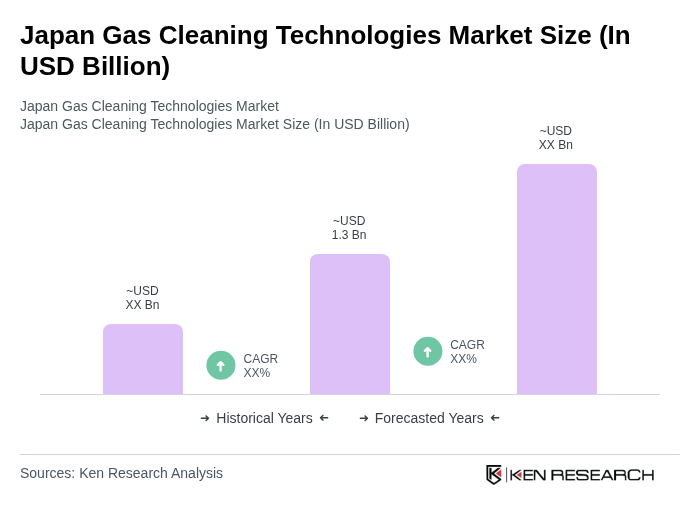
Japan gas cleaning technologies market, worth USD 1.3 billion, is propelled by environmental regulations and tech advancements, targeting emission reductions and clean energy transitions by 2030.

Region:Asia

Author(s):Rebecca

Product Code:KRAA4321

Pages:97

Published On:January 2026
About the Report

Base Year 2024

Japan Gas Cleaning Technologies Market Overview

  • The Japan Gas Cleaning Technologies Market is valued at USD 1.3 billion, based on a five-year historical analysis. This growth is primarily driven by stringent environmental regulations on stationary sources, increasing industrial emissions from sectors such as power generation, waste-to-energy, chemicals, and metals, and the rising demand for cleaner technologies to support Japan’s decarbonization and air quality goals. The market has seen a significant uptick in investments aimed at reducing air pollution, enhancing energy efficiency across industries, and supporting clean energy transition initiatives.
  • Key players in this market are concentrated in major urban and industrial centers such as Tokyo, Osaka, and Yokohama, which host dense clusters of manufacturing, power, waste-to-energy, petrochemical, and engineering companies. These cities dominate due to their high industrial activity, advanced local air-quality policies, and significant investments in flue gas treatment and process gas cleaning systems. The presence of leading technology firms, engineering contractors, and research institutions in these areas further bolsters their market position by accelerating deployment and localization of advanced gas cleaning solutions.
  • The Japanese government regulates emissions through the Air Pollution Control Act (K?gai Boshi-h?) administered by the Ministry of the Environment, with successive amendments tightening standards for sulfur oxides (SOx), nitrogen oxides (NOx), particulate matter, and hazardous air pollutants from factories and power plants. Under this framework, operators of specified facilities must install and maintain appropriate gas cleaning and dust collection equipment, conduct regular monitoring, and comply with prefectural ordinances that can set stricter limits, which collectively promotes the adoption of advanced gas cleaning technologies and supports alignment with international environmental standards.
Japan Gas Cleaning Technologies Market Size

Japan Gas Cleaning Technologies Market Segmentation

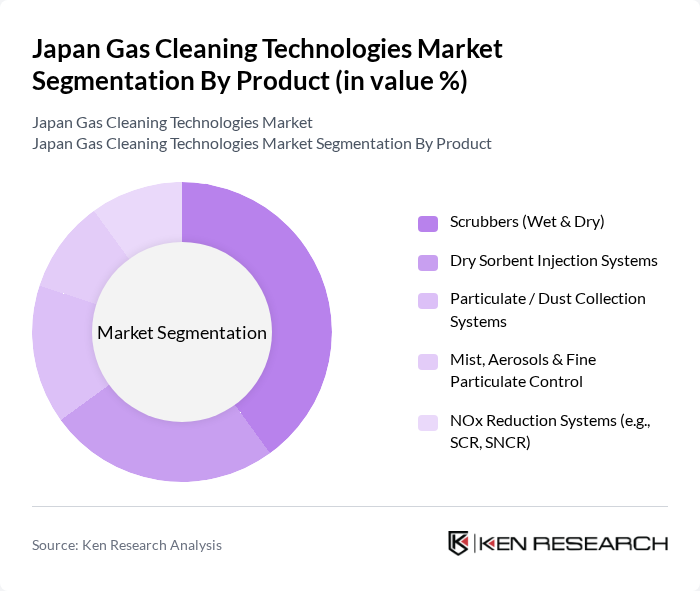
By Product:The product segmentation includes various technologies designed to clean gases emitted from industrial processes. The primary subsegments are Scrubbers (Wet & Dry), Dry Sorbent Injection Systems, Particulate / Dust Collection Systems, Mist, Aerosols & Fine Particulate Control, and NOx Reduction Systems (e.g., SCR, SNCR). Scrubbers (Wet & Dry) are widely deployed for flue gas desulfurization and acid gas control, particularly in power, waste incineration, and chemical facilities, due to their high efficiency in removing SOx, HCl, HF, and soluble pollutants from flue gases. Dry sorbent injection systems and particulate / dust collection systems (including filters and cyclones) are also important for solid-fuel combustion and industrial processes, while NOx reduction systems such as SCR and SNCR are key for meeting NOx limits in boilers, gas turbines, and engine-based plants.
Japan Gas Cleaning Technologies Market segmentation by Product.

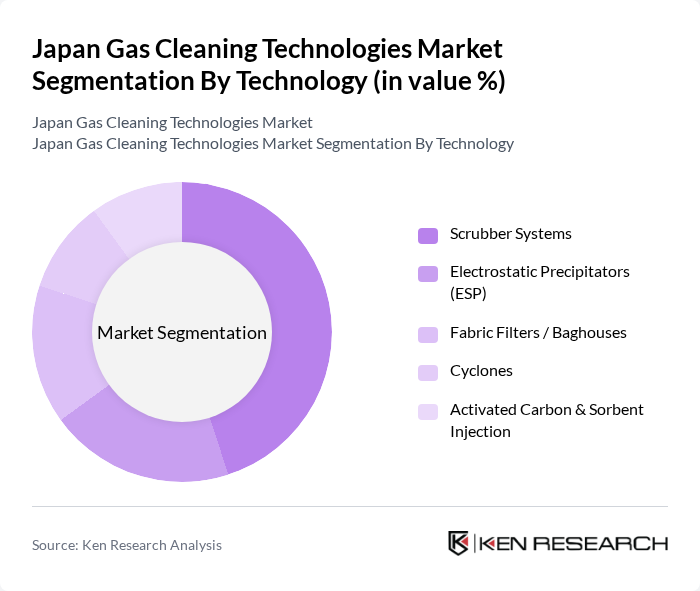
By Technology:The technology segmentation encompasses various methods used for gas cleaning, including Scrubber Systems, Electrostatic Precipitators (ESP), Fabric Filters / Baghouses, Cyclones, Activated Carbon & Sorbent Injection, and Others. Scrubber Systems lead many applications globally because of their versatility in handling high-sulfur and acid-gas streams, and they are widely used in Japan for flue gas desulfurization and multi-pollutant control. Electrostatic precipitators and fabric filters / baghouses are critical for high-efficiency particulate removal in power, steel, and cement plants, while activated carbon and sorbent injection are increasingly applied for mercury, dioxin, and VOC control, especially in waste-to-energy and industrial incineration facilities.
Japan Gas Cleaning Technologies Market segmentation by Technology.

Japan Gas Cleaning Technologies Market Competitive Landscape

The Japan Gas Cleaning Technologies Market is characterized by a dynamic mix of regional and international players. Leading participants such as Mitsubishi Heavy Industries, Ltd., Hitachi Zosen Corporation, JGC Holdings Corporation, Chiyoda Corporation, Sumitomo Heavy Industries, Ltd., Daikin Industries, Ltd., Yokogawa Electric Corporation, Fujikura Ltd., Aisin Corporation, Tsubakimoto Chain Co., Kurita Water Industries Ltd., EBARA Corporation, Nitto Denko Corporation, Resonac Holdings Corporation (formerly Showa Denko K.K.), Asahi Kasei Corporation contribute to innovation, geographic expansion, and service delivery in this space.

Mitsubishi Heavy Industries, Ltd.

1884

Tokyo, Japan

Hitachi Zosen Corporation

1881

Osaka, Japan

JGC Holdings Corporation

1928

Yokohama, Japan

Chiyoda Corporation

1948

Yokohama, Japan

Sumitomo Heavy Industries, Ltd.

1934

Tokyo, Japan

Company

Establishment Year

Headquarters

Group Size (Large, Medium, or Small as per industry convention)

Japan Gas Cleaning Technologies Revenue (Latest FY, USD Million)

Japan Gas Cleaning Technologies Revenue CAGR (3–5 Years)

EBITDA Margin (%) – Japan Gas Cleaning Technologies

R&D Intensity (% of Revenue)

Installed Base in Japan (Number of Systems / Capacity MW or Nm³/h)

Japan Gas Cleaning Technologies Market Industry Analysis

Growth Drivers

  • Increasing Environmental Regulations:Japan's stringent environmental regulations are driving the gas cleaning technologies market. The Ministry of the Environment has set a target to reduce greenhouse gas emissions by 46% from fiscal 2013 levels by fiscal 2030, which corresponds to a reduction of approximately 0.65 billion tons of CO2 equivalent. This regulatory framework compels industries to adopt advanced gas cleaning technologies to comply with emission standards, thereby boosting market demand significantly.
  • Technological Advancements in Filtration:The gas cleaning technologies sector is witnessing rapid technological advancements, particularly in filtration systems. Innovations such as high-efficiency particulate air (HEPA) filters and electrostatic precipitators are becoming prevalent. For instance, the introduction of HEPA filters has improved particulate matter removal efficiency to over 99.97%, enhancing air quality in industrial settings. This technological evolution is expected to drive market growth as industries seek more effective solutions.
  • Rising Demand for Clean Energy Solutions:The shift towards clean energy solutions is a significant growth driver for the gas cleaning technologies market. Japan aims to increase the share of renewable energy in its power generation mix to 36–38% by around 2030, which necessitates the implementation of effective gas cleaning technologies. The government’s commitment to clean energy is projected to create a market worth approximately ¥1 trillion (USD 9 billion) in future, fostering further investment in gas cleaning technologies.

Market Challenges

  • High Initial Investment Costs:One of the primary challenges facing the gas cleaning technologies market in Japan is the high initial investment required for advanced systems. The cost of implementing state-of-the-art gas cleaning solutions can exceed ¥100 million (USD 0.9 million) for large industrial facilities. This financial barrier often deters smaller enterprises from adopting necessary technologies, limiting overall market growth and innovation in the sector.
  • Limited Awareness Among End-Users:There is a notable lack of awareness regarding the benefits of gas cleaning technologies among end-users, particularly in small to medium-sized enterprises (SMEs). According to a survey by the Japan Industrial Clean Air Association, only 40% of SMEs are aware of the latest gas cleaning technologies available. This limited knowledge hampers the adoption of these technologies, posing a significant challenge to market expansion and environmental compliance.

Japan Gas Cleaning Technologies Market Future Outlook

The future of the gas cleaning technologies market in Japan appears promising, driven by increasing environmental awareness and regulatory pressures. As industries strive to meet stringent emission standards, the demand for innovative gas cleaning solutions is expected to rise. Furthermore, the integration of smart technologies and IoT in gas cleaning systems will enhance operational efficiency and monitoring capabilities, paving the way for sustainable industrial practices. This trend is likely to attract significant investments and foster technological advancements in the sector.

Market Opportunities

  • Growth in Renewable Energy Sector:The expansion of the renewable energy sector presents a substantial opportunity for gas cleaning technologies. With Japan's commitment to increasing renewable energy sources, the demand for efficient gas cleaning solutions in biomass and solar energy plants is expected to rise, potentially generating an additional ¥300 billion (USD 2.7 billion) in market value in future.
  • Government Incentives for Clean Technologies:The Japanese government is actively promoting clean technologies through various incentives, including subsidies and tax breaks. In future, the government allocated ¥50 billion (USD 450 million) for clean technology initiatives, which will encourage industries to invest in gas cleaning technologies, thereby enhancing market growth and innovation.

Scope of the Report

SegmentSub-Segments
By Product

Scrubbers (Wet & Dry)

Dry Sorbent Injection Systems

Particulate / Dust Collection Systems

Mist, Aerosols & Fine Particulate Control

NOx Reduction Systems (e.g., SCR, SNCR)

By Technology

Scrubber Systems

Electrostatic Precipitators (ESP)

Fabric Filters / Baghouses

Cyclones

Activated Carbon & Sorbent Injection

Others

By Application

Particulate Cleaning

Gaseous / Chemical Cleaning

Flue Gas Desulfurization (SO? Control)

VOC & Odor Control

Others

By End-User Industry

Power Generation

Chemical

Refinery & Petrochemical

Cement

Pulp & Paper

Metals & Mining

Waste Incineration

Others

By Gas Type Treated

Acid Gases (SOx, HCl, HF)

Nitrogen Oxides (NOx)

Particulate Matter (PM)

Volatile Organic Compounds (VOCs)

Greenhouse Gases & Others

By Plant Capacity

Small-scale Facilities

Medium-scale Facilities

Large-scale Facilities

By Ownership & Investment Model

Captive Industrial Installations

EPC / Turnkey Projects

Third-party O&M / Service-led Models

Public Sector & Municipal Installations

Key Target Audience

Investors and Venture Capitalist Firms

Government and Regulatory Bodies (e.g., Ministry of the Environment, Japan)

Manufacturers and Producers of Gas Cleaning Equipment

Energy and Utility Companies

Environmental Protection Agencies (e.g., Japan Environmental Safety Corporation)

Industrial Process Operators

Technology Providers and Innovators

Trade Associations and Industry Groups

Players Mentioned in the Report:

Mitsubishi Heavy Industries, Ltd.

Hitachi Zosen Corporation

JGC Holdings Corporation

Chiyoda Corporation

Sumitomo Heavy Industries, Ltd.

Daikin Industries, Ltd.

Yokogawa Electric Corporation

Fujikura Ltd.

Aisin Corporation

Tsubakimoto Chain Co.

Kurita Water Industries Ltd.

EBARA Corporation

Nitto Denko Corporation

Resonac Holdings Corporation (formerly Showa Denko K.K.)

Asahi Kasei Corporation

Table of Contents

Market Assessment Phase

1. Executive Summary and Approach


2. Japan Gas Cleaning Technologies Market Overview

2.1 Key Insights and Strategic Recommendations

2.2 Japan Gas Cleaning Technologies Market Overview

2.3 Definition and Scope

2.4 Evolution of Market Ecosystem

2.5 Timeline of Key Regulatory Milestones

2.6 Value Chain & Stakeholder Mapping

2.7 Business Cycle Analysis

2.8 Policy & Incentive Landscape


3. Japan Gas Cleaning Technologies Market Analysis

3.1 Growth Drivers

3.1.1 Increasing Environmental Regulations
3.1.2 Technological Advancements in Filtration
3.1.3 Rising Demand for Clean Energy Solutions
3.1.4 Expansion of Industrial Activities

3.2 Market Challenges

3.2.1 High Initial Investment Costs
3.2.2 Limited Awareness Among End-Users
3.2.3 Stringent Compliance Requirements
3.2.4 Competition from Alternative Technologies

3.3 Market Opportunities

3.3.1 Growth in Renewable Energy Sector
3.3.2 Government Incentives for Clean Technologies
3.3.3 Increasing Urbanization and Industrialization
3.3.4 Technological Innovations in Gas Cleaning

3.4 Market Trends

3.4.1 Shift Towards Sustainable Practices
3.4.2 Integration of IoT in Gas Cleaning Solutions
3.4.3 Focus on Energy Efficiency
3.4.4 Adoption of Smart Technologies

3.5 Government Regulation

3.5.1 Emission Standards for Industries
3.5.2 Incentives for Clean Technology Adoption
3.5.3 Regulations on Waste Management
3.5.4 Compliance Requirements for Gas Emissions

4. SWOT Analysis


5. Stakeholder Analysis


6. Porter's Five Forces Analysis


7. Japan Gas Cleaning Technologies Market Market Size, 2019-2024

7.1 By Value

7.2 By Volume

7.3 By Average Selling Price


8. Japan Gas Cleaning Technologies Market Segmentation

8.1 By Product

8.1.1 Scrubbers (Wet & Dry)
8.1.2 Dry Sorbent Injection Systems
8.1.3 Particulate / Dust Collection Systems
8.1.4 Mist, Aerosols & Fine Particulate Control
8.1.5 NOx Reduction Systems (e.g., SCR, SNCR)

8.2 By Technology

8.2.1 Scrubber Systems
8.2.2 Electrostatic Precipitators (ESP)
8.2.3 Fabric Filters / Baghouses
8.2.4 Cyclones
8.2.5 Activated Carbon & Sorbent Injection
8.2.6 Others

8.3 By Application

8.3.1 Particulate Cleaning
8.3.2 Gaseous / Chemical Cleaning
8.3.3 Flue Gas Desulfurization (SO? Control)
8.3.4 VOC & Odor Control
8.3.5 Others

8.4 By End-User Industry

8.4.1 Power Generation
8.4.2 Chemical
8.4.3 Refinery & Petrochemical
8.4.4 Cement
8.4.5 Pulp & Paper
8.4.6 Metals & Mining
8.4.7 Waste Incineration
8.4.8 Others

8.5 By Gas Type Treated

8.5.1 Acid Gases (SOx, HCl, HF)
8.5.2 Nitrogen Oxides (NOx)
8.5.3 Particulate Matter (PM)
8.5.4 Volatile Organic Compounds (VOCs)
8.5.5 Greenhouse Gases & Others

8.6 By Plant Capacity

8.6.1 Small-scale Facilities
8.6.2 Medium-scale Facilities
8.6.3 Large-scale Facilities

8.7 By Ownership & Investment Model

8.7.1 Captive Industrial Installations
8.7.2 EPC / Turnkey Projects
8.7.3 Third-party O&M / Service-led Models
8.7.4 Public Sector & Municipal Installations

9. Japan Gas Cleaning Technologies Market Competitive Analysis

9.1 Market Share of Key Players

9.2 Cross Comparison of Key Players

9.2.1 Company Name
9.2.2 Group Size (Large, Medium, or Small as per industry convention)
9.2.3 Japan Gas Cleaning Technologies Revenue (Latest FY, USD Million)
9.2.4 Japan Gas Cleaning Technologies Revenue CAGR (3–5 Years)
9.2.5 EBITDA Margin (%) – Japan Gas Cleaning Technologies
9.2.6 R&D Intensity (% of Revenue)
9.2.7 Installed Base in Japan (Number of Systems / Capacity MW or Nm³/h)
9.2.8 Market Share in Japan Gas Cleaning Technologies (%)
9.2.9 Order Backlog / Book-to-Bill Ratio
9.2.10 Average Contract Value (USD Million) & Payback Period at Client Site

9.3 SWOT Analysis of Top Players

9.4 Pricing Analysis

9.5 Detailed Profile of Major Companies

9.5.1 Mitsubishi Heavy Industries, Ltd.
9.5.2 Hitachi Zosen Corporation
9.5.3 JGC Holdings Corporation
9.5.4 Chiyoda Corporation
9.5.5 Sumitomo Heavy Industries, Ltd.
9.5.6 Daikin Industries, Ltd.
9.5.7 Yokogawa Electric Corporation
9.5.8 Fujikura Ltd.
9.5.9 Aisin Corporation
9.5.10 Tsubakimoto Chain Co.
9.5.11 Kurita Water Industries Ltd.
9.5.12 EBARA Corporation
9.5.13 Nitto Denko Corporation
9.5.14 Resonac Holdings Corporation (formerly Showa Denko K.K.)
9.5.15 Asahi Kasei Corporation

10. Japan Gas Cleaning Technologies Market End-User Analysis

10.1 Procurement Behavior of Key Ministries

10.1.1 Government Procurement Policies
10.1.2 Budget Allocation for Clean Technologies
10.1.3 Decision-Making Processes
10.1.4 Supplier Selection Criteria

10.2 Corporate Spend on Infrastructure & Energy

10.2.1 Investment Trends in Clean Technologies
10.2.2 Budgeting for Gas Cleaning Solutions
10.2.3 Long-term Financial Commitments
10.2.4 Cost-Benefit Analysis Practices

10.3 Pain Point Analysis by End-User Category

10.3.1 Challenges in Compliance
10.3.2 Operational Inefficiencies
10.3.3 High Maintenance Costs
10.3.4 Technology Integration Issues

10.4 User Readiness for Adoption

10.4.1 Awareness of Gas Cleaning Technologies
10.4.2 Training and Skill Development Needs
10.4.3 Financial Readiness
10.4.4 Infrastructure Compatibility

10.5 Post-Deployment ROI and Use Case Expansion

10.5.1 Measurement of ROI
10.5.2 Case Studies of Successful Implementations
10.5.3 Potential for Scaling Solutions
10.5.4 User Feedback and Improvement Areas

11. Japan Gas Cleaning Technologies Market Future Size, 2025-2030

11.1 By Value

11.2 By Volume

11.3 By Average Selling Price


Go-To-Market Strategy Phase

1. Whitespace Analysis + Business Model Canvas

1.1 Market Gaps Identification

1.2 Business Model Development


2. Marketing and Positioning Recommendations

2.1 Branding Strategies

2.2 Product USPs


3. Distribution Plan

3.1 Urban Retail Strategies

3.2 Rural NGO Tie-ups


4. Channel & Pricing Gaps

4.1 Underserved Routes

4.2 Pricing Bands


5. Unmet Demand & Latent Needs

5.1 Category Gaps

5.2 Consumer Segments


6. Customer Relationship

6.1 Loyalty Programs

6.2 After-sales Service


7. Value Proposition

7.1 Sustainability Initiatives

7.2 Integrated Supply Chains


8. Key Activities

8.1 Regulatory Compliance

8.2 Branding Efforts

8.3 Distribution Setup


9. Entry Strategy Evaluation

9.1 Domestic Market Entry Strategy

9.1.1 Product Mix Considerations
9.1.2 Pricing Band Strategies
9.1.3 Packaging Solutions

9.2 Export Entry Strategy

9.2.1 Target Countries
9.2.2 Compliance Roadmap

10. Entry Mode Assessment

10.1 Joint Ventures

10.2 Greenfield Investments

10.3 Mergers & Acquisitions

10.4 Distributor Model


11. Capital and Timeline Estimation

11.1 Capital Requirements

11.2 Timelines for Implementation


12. Control vs Risk Trade-Off

12.1 Ownership vs Partnerships


13. Profitability Outlook

13.1 Breakeven Analysis

13.2 Long-term Sustainability


14. Potential Partner List

14.1 Distributors

14.2 Joint Ventures

14.3 Acquisition Targets


15. Execution Roadmap

15.1 Phased Plan for Market Entry

15.1.1 Market Setup
15.1.2 Market Entry
15.1.3 Growth Acceleration
15.1.4 Scale & Stabilize

15.2 Key Activities and Milestones

15.2.1 Milestone Planning
15.2.2 Activity Tracking

Research Methodology

ApproachModellingSample

Phase 1: Approach1

Desk Research

  • Industry reports from Japanese energy and environmental agencies
  • Market analysis publications from trade associations focused on gas cleaning technologies
  • Academic journals and white papers on advancements in gas cleaning technologies

Primary Research

  • Interviews with engineers and technical experts in gas cleaning technology firms
  • Surveys with environmental compliance officers in major industrial sectors
  • Field interviews with plant managers operating gas cleaning systems

Validation & Triangulation

  • Cross-validation of data from multiple industry sources and expert opinions
  • Triangulation of market trends with regulatory frameworks and technological advancements
  • Sanity checks through feedback from a panel of industry experts

Phase 2: Market Size Estimation1

Top-down Assessment

  • Analysis of national energy consumption data to estimate gas cleaning technology demand
  • Segmentation of the market by end-user industries such as power generation and manufacturing
  • Incorporation of government policies promoting cleaner technologies and emissions reduction

Bottom-up Modeling

  • Collection of sales data from leading gas cleaning technology providers
  • Estimation of installation and operational costs based on industry benchmarks
  • Volume x cost analysis for various gas cleaning solutions deployed across sectors

Forecasting & Scenario Analysis

  • Multi-factor regression analysis considering economic growth, regulatory changes, and technology adoption rates
  • Scenario modeling based on potential shifts in environmental regulations and market dynamics
  • Development of baseline, optimistic, and pessimistic forecasts through 2030

Phase 3: CATI Sample Composition1

Scope Item/SegmentSample SizeTarget Respondent Profiles
Power Generation Sector100Plant Managers, Environmental Compliance Officers
Manufacturing Industry80Operations Managers, Sustainability Coordinators
Oil & Gas Sector70Technical Directors, Process Engineers
Waste Management Companies60Business Development Managers, Regulatory Affairs Specialists
Research Institutions40Research Scientists, Policy Analysts

Frequently Asked Questions

What is the current value of the Japan Gas Cleaning Technologies Market?

The Japan Gas Cleaning Technologies Market is valued at approximately USD 1.3 billion, driven by stringent environmental regulations and increasing industrial emissions. This market is expected to grow as industries adopt cleaner technologies to meet decarbonization and air quality goals.

What are the main drivers of growth in the Japan Gas Cleaning Technologies Market?

Which cities in Japan are key players in the gas cleaning technologies market?

What types of products are included in the Japan Gas Cleaning Technologies Market?

Other Adjacent Reports

Singapore Air Pollution Control Market

Qatar Flue Gas Desulfurization Market Size, Share, Growth Drivers, Trends, Opportunities & Forecast 2025–2030KSA Electrostatic Precipitator Market Outlook to 2030United States Industrial Filtration Market

Malaysia NOx Control Systems Market

Malaysia Waste-to-Energy Market

Brazil Power Generation Equipment Market

Philippines Chemical Processing Equipment Market

Saudi Arabia environmental monitoring market report Size, Share, Growth Drivers, Trends, Opportunities & Forecast 2025–2030

Thailand Carbon Capture Technology Market

Why Buy From Us?

Refine Robust Result (RRR) Framework

What makes us stand out is that our consultants follow Robust, Refine and Result (RRR) methodology. Robust for clear definitions, approaches and sanity checking, Refine for differentiating respondents' facts and opinions, and Result for presenting data with story.

Our Reach Is Unmatched

We have set a benchmark in the industry by offering our clients with syndicated and customized market research reports featuring coverage of entire market as well as meticulous research and analyst insights.

Shifting the Research Paradigm

While we don't replace traditional research, we flip the method upside down. Our dual approach of Top Bottom & Bottom Top ensures quality deliverable by not just verifying company fundamentals but also looking at the sector and macroeconomic factors.

More Insights-Better Decisions

With one step in the future, our research team constantly tries to show you the bigger picture. We help with some of the tough questions you may encounter along the way: How is the industry positioned? Best marketing channel? KPI's of competitors? By aligning every element, we help maximize success.

Transparency and Trust

Our report gives you instant access to the answers and sources that other companies might choose to hide. We elaborate each steps of research methodology we have used and showcase you the sample size to earn your trust.

Round the Clock Support

If you need any support, we are here! We pride ourselves on universe strength, data quality, and quick, friendly, and professional service.

Why Clients Choose Us?

400000+
Reports in repository
150+
Consulting projects a year
100+
Analysts
8000+
Client Queries in 2022








