Philippines Gas Cleaning Technologies Market Report Size Share Growth Drivers Trends Opportunities & Forecast 2025–2030

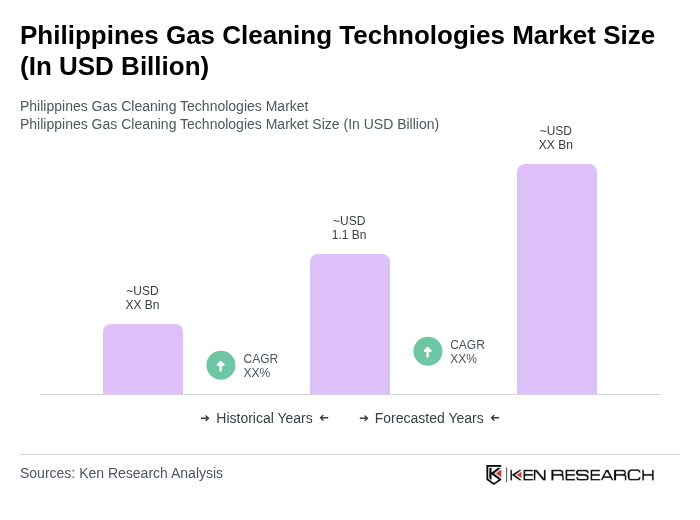
The Philippines gas cleaning technologies market, worth USD 1.1 Bn, is growing due to rising industrial emissions, regulatory compliance under the Clean Air Act, and advancements in filtration technologies.

Region:Asia

Author(s):Rebecca

Product Code:KRAA4316

Pages:99

Published On:January 2026
About the Report

Base Year 2024

Philippines Gas Cleaning Technologies Market Overview

  • The Philippines Gas Cleaning Technologies Market is valued at USD 1.1 billion, based on a five-year historical analysis. This growth is primarily driven by increasing industrial activities in manufacturing, cement, power generation, oil and gas, and chemicals, alongside the expansion of industrial gases and related infrastructure in the country. The market is further supported by investments in infrastructure and energy projects such as coal, gas, and increasingly renewable-linked thermal plants, which necessitate advanced gas cleaning technologies like scrubbers, electrostatic precipitators, and fabric filters to meet emission standards.
  • Key cities such as Manila, Cebu, and Davao dominate the market due to their industrial bases and urbanization rates. Metro Manila accounts for a substantial share of the country’s manufacturing, power, and commercial activities, driving concentrated emissions and the need for stationary source controls. Cebu and Davao are consolidating roles as regional industrial and logistics hubs with growing manufacturing, processing, and port-related activities, attracting investments in gas cleaning and air pollution control systems to address localized air quality challenges and comply with environmental regulations.
  • The primary regulatory framework shaping industrial gas emissions is Republic Act No. 8749, the Philippine Clean Air Act of 1999, implemented by the Department of Environment and Natural Resources (DENR) through the Environmental Management Bureau (EMB). Under its Implementing Rules and Regulations (DENR Administrative Order No. 2000-81), stationary sources such as power plants, cement kilns, boilers, and industrial furnaces must secure permits to operate, install continuous emission monitoring where required, and comply with specific limits on particulate matter, sulfur oxides (SOx), nitrogen oxides (NOx), and other hazardous pollutants. These binding requirements are driving the adoption and upgrading of gas cleaning technologies across power generation, manufacturing, and key process industries.
Philippines Gas Cleaning Technologies Market Size

Philippines Gas Cleaning Technologies Market Segmentation

By Technology Type:The market is segmented into various technology types, including Wet Scrubbers, Dry & Semi-Dry Scrubbing Systems, Electrostatic Precipitators, Fabric Filters, Cyclones, Activated Carbon Systems, and others. Wet scrubbers, particularly flue gas desulfurization (FGD) systems and Venturi/packed-bed designs, hold a prominent share globally and across Asia Pacific due to their effectiveness in removing SOx, acid gases, and particulate matter from flue gas streams in coal and oil-fired power plants, cement, and chemical plants. In the Philippines, the reliance on fossil-based power and process industries, combined with SOx and particulate emission limits under the Clean Air Act framework, supports strong adoption of wet scrubbers as a leading solution for industrial emission control.
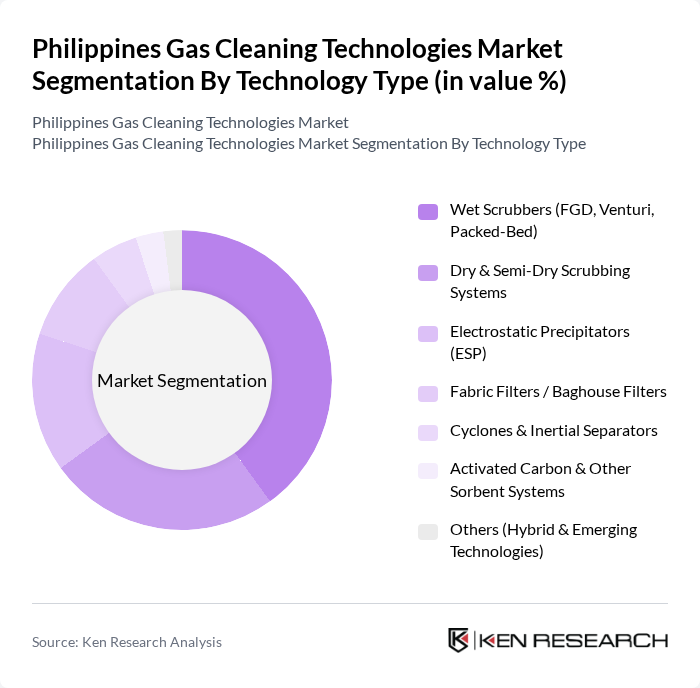
Philippines Gas Cleaning Technologies Market segmentation by Technology Type.

By Pollutant Type:The market is also segmented by pollutant types, including Particulate Matter, SOx, NOx, VOCs, Acid Gases, Odorous Gases, and others. Particulate Matter is the leading pollutant type in terms of regulatory focus and health impact, as Philippine standards under the Clean Air Act set limits for total suspended particulates and PM?? from stationary sources, while ambient air quality monitoring increasingly emphasizes PM?.? due to its association with cardiopulmonary disease. This heightened focus, together with World Health Organization guidance on fine particulates, has led industries to invest in high-efficiency particulate controls such as fabric filters, ESPs, and high-performance scrubbers, making the particulate segment a priority for compliance and environmental performance improvement.
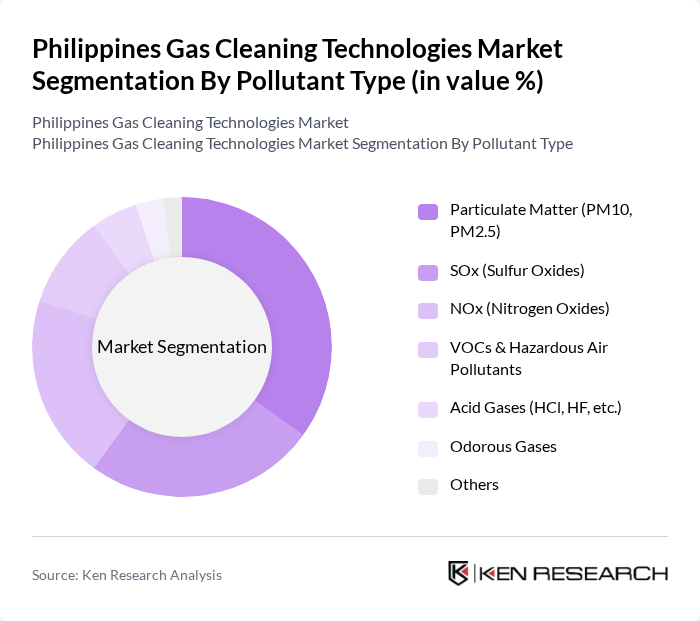
Philippines Gas Cleaning Technologies Market segmentation by Pollutant Type.

Philippines Gas Cleaning Technologies Market Competitive Landscape

The Philippines Gas Cleaning Technologies Market is characterized by a dynamic mix of regional and international players. Leading participants such as Babcock & Wilcox Enterprises, Inc., General Electric Company (GE Power), Siemens Energy AG, Mitsubishi Power, Ltd., FLSmidth & Co. A/S, Andritz AG, Thermax Limited, Ducon Technologies Inc., John Wood Group PLC, CECO Environmental Corp., AAF International (Daikin Group), Camfil AB, Donaldson Company, Inc., Local EPC & Environmental Engineering Firms in the Philippines, and Other Regional Gas Cleaning Technology Providers contribute to innovation, geographic expansion, and service delivery in this space.

Babcock & Wilcox Enterprises, Inc.

1867

Akron, Ohio, USA

General Electric Company (GE Power)

1892

Boston, Massachusetts, USA

Siemens Energy AG

2020

Munich, Germany

Mitsubishi Power, Ltd.

2014

Yokohama, Japan

FLSmidth & Co. A/S

1882

Copenhagen, Denmark

Company

Establishment Year

Headquarters

Revenue (Philippines, Latest FY)

3–5 Year Revenue CAGR

EBITDA Margin

Order Backlog / Book-to-Bill Ratio

Market Share in Philippines Gas Cleaning Technologies

Installed Base (Number of Plants / Systems)

Philippines Gas Cleaning Technologies Market Industry Analysis

Growth Drivers

  • Increasing Environmental Regulations:The Philippines has seen a rise in environmental regulations, with the Department of Environment and Natural Resources (DENR) enforcing stricter emission standards. In future, the government aims to reduce greenhouse gas emissions by 75% relative to a business-as-usual scenario, which translates to a reduction of approximately 200 million tons of CO2. This regulatory push is driving industries to adopt advanced gas cleaning technologies to comply with these standards, thereby fostering market growth.
  • Rising Industrial Emissions:Industrial emissions in the Philippines are projected to increase by 5% annually, reaching approximately 150 million tons in future. This surge is primarily due to the growth of manufacturing and energy sectors. As industries expand, the need for effective gas cleaning technologies becomes critical to mitigate environmental impacts, prompting investments in filtration and cleaning solutions to address rising pollution levels and meet regulatory requirements.
  • Technological Advancements in Filtration:The gas cleaning technologies sector is experiencing rapid technological advancements, with investments in R&D expected to exceed PHP 1 billion in future. Innovations such as high-efficiency particulate air (HEPA) filters and electrostatic precipitators are becoming more prevalent. These technologies not only enhance filtration efficiency but also reduce operational costs, making them attractive options for industries seeking to improve air quality and comply with environmental regulations.

Market Challenges

  • High Initial Investment Costs:The adoption of advanced gas cleaning technologies often requires significant upfront capital. In future, the average cost for implementing these systems in industrial settings is estimated to be around PHP 10 million. This high initial investment can deter smaller enterprises from upgrading their systems, limiting the overall market growth and hindering the transition to cleaner technologies in the Philippines.
  • Limited Awareness Among End-Users:Many industries in the Philippines remain unaware of the benefits and availability of modern gas cleaning technologies. A survey conducted in future indicated that over 60% of small to medium enterprises lack knowledge about compliance requirements and available solutions. This gap in awareness can lead to delayed adoption of necessary technologies, posing a challenge to market expansion and environmental improvement efforts.

Philippines Gas Cleaning Technologies Market Future Outlook

The future of the gas cleaning technologies market in the Philippines appears promising, driven by increasing environmental awareness and regulatory pressures. As industries strive to meet stringent emission standards, investments in innovative cleaning solutions are expected to rise. Furthermore, the integration of smart technologies, such as IoT, will enhance operational efficiency and monitoring capabilities. This trend will likely lead to a more sustainable industrial landscape, fostering growth in the gas cleaning sector while addressing environmental concerns effectively.

Market Opportunities

  • Expansion of Renewable Energy Projects:The Philippine government plans to invest PHP 200 billion in renewable energy projects in future. This investment will create opportunities for gas cleaning technologies to be integrated into new energy facilities, enhancing their environmental performance and compliance with emission standards.
  • Government Incentives for Clean Technologies:In future, the Philippine government is expected to introduce tax incentives worth PHP 5 billion for companies adopting clean technologies. This initiative will encourage industries to invest in gas cleaning solutions, driving market growth and promoting sustainable practices across various sectors.

Scope of the Report

SegmentSub-Segments
By Technology Type

Wet Scrubbers (FGD, Venturi, Packed-Bed)

Dry & Semi-Dry Scrubbing Systems

Electrostatic Precipitators (ESP)

Fabric Filters / Baghouse Filters

Cyclones & Inertial Separators

Activated Carbon & Other Sorbent Systems

Others (Hybrid & Emerging Technologies)

By Pollutant Type

Particulate Matter (PM10, PM2.5)

SOx (Sulfur Oxides)

NOx (Nitrogen Oxides)

VOCs & Hazardous Air Pollutants

Acid Gases (HCl, HF, etc.)

Odorous Gases

Others

By End-Use Industry

Power Generation (Coal, Oil, Gas, Biomass)

Cement & Construction Materials

Metals & Mining

Oil, Gas & Petrochemicals

Chemicals & Fertilizers

Pulp & Paper

Food & Beverages and Other Manufacturing

Others (Waste Incineration, etc.)

By System Configuration

New Installed Systems (Greenfield)

Retrofit & Upgrade of Existing Systems

Standalone Units

Integrated Process Gas Cleaning Systems

By Service Offering

Equipment Supply

Installation & EPC Services

Operation & Maintenance (O&M)

Monitoring, Control & Digital Services

Consulting, Compliance & Audit Services

By Ownership & Financing Model

End-User Owned Capex Projects

ESCO / Performance-Based Contracts

Public-Private Partnerships (PPP)

Lease / Rental & Other Models

By Geography (Philippines)

Luzon

Visayas

Mindanao

Key Industrial Clusters & Economic Zones

Key Target Audience

Investors and Venture Capitalist Firms

Government and Regulatory Bodies (e.g., Department of Energy, Environmental Management Bureau)

Manufacturers and Producers of Gas Cleaning Technologies

Energy Companies and Utilities

Environmental NGOs and Advocacy Groups

Industry Associations (e.g., Philippine Chamber of Commerce and Industry)

Financial Institutions and Banks

Technology Providers and Equipment Suppliers

Players Mentioned in the Report:

Babcock & Wilcox Enterprises, Inc.

General Electric Company (GE Power)

Siemens Energy AG

Mitsubishi Power, Ltd.

FLSmidth & Co. A/S

Andritz AG

Thermax Limited

Ducon Technologies Inc.

John Wood Group PLC

CECO Environmental Corp.

AAF International (Daikin Group)

Camfil AB

Donaldson Company, Inc.

Local EPC & Environmental Engineering Firms in the Philippines

Other Regional Gas Cleaning Technology Providers

Table of Contents

Market Assessment Phase

1. Executive Summary and Approach


2. Philippines Gas Cleaning Technologies Market Overview

2.1 Key Insights and Strategic Recommendations

2.2 Philippines Gas Cleaning Technologies Market Overview

2.3 Definition and Scope

2.4 Evolution of Market Ecosystem

2.5 Timeline of Key Regulatory Milestones

2.6 Value Chain & Stakeholder Mapping

2.7 Business Cycle Analysis

2.8 Policy & Incentive Landscape


3. Philippines Gas Cleaning Technologies Market Analysis

3.1 Growth Drivers

3.1.1 Increasing Environmental Regulations
3.1.2 Rising Industrial Emissions
3.1.3 Technological Advancements in Filtration
3.1.4 Growing Demand for Clean Energy Solutions

3.2 Market Challenges

3.2.1 High Initial Investment Costs
3.2.2 Limited Awareness Among End-Users
3.2.3 Regulatory Compliance Complexity
3.2.4 Competition from Alternative Technologies

3.3 Market Opportunities

3.3.1 Expansion of Renewable Energy Projects
3.3.2 Government Incentives for Clean Technologies
3.3.3 Partnerships with Local Industries
3.3.4 Development of Innovative Cleaning Solutions

3.4 Market Trends

3.4.1 Shift Towards Sustainable Practices
3.4.2 Integration of IoT in Gas Cleaning Technologies
3.4.3 Increased Investment in R&D
3.4.4 Focus on Circular Economy Initiatives

3.5 Government Regulation

3.5.1 Emission Standards Enforcement
3.5.2 Incentives for Clean Technology Adoption
3.5.3 Compliance with International Standards
3.5.4 Support for Local Manufacturing

4. SWOT Analysis


5. Stakeholder Analysis


6. Porter's Five Forces Analysis


7. Philippines Gas Cleaning Technologies Market Market Size, 2019-2024

7.1 By Value

7.2 By Volume

7.3 By Average Selling Price


8. Philippines Gas Cleaning Technologies Market Segmentation

8.1 By Technology Type

8.1.1 Wet Scrubbers (FGD, Venturi, Packed-Bed)
8.1.2 Dry & Semi-Dry Scrubbing Systems
8.1.3 Electrostatic Precipitators (ESP)
8.1.4 Fabric Filters / Baghouse Filters
8.1.5 Cyclones & Inertial Separators
8.1.6 Activated Carbon & Other Sorbent Systems
8.1.7 Others (Hybrid & Emerging Technologies)

8.2 By Pollutant Type

8.2.1 Particulate Matter (PM10, PM2.5)
8.2.2 SOx (Sulfur Oxides)
8.2.3 NOx (Nitrogen Oxides)
8.2.4 VOCs & Hazardous Air Pollutants
8.2.5 Acid Gases (HCl, HF, etc.)
8.2.6 Odorous Gases
8.2.7 Others

8.3 By End-Use Industry

8.3.1 Power Generation (Coal, Oil, Gas, Biomass)
8.3.2 Cement & Construction Materials
8.3.3 Metals & Mining
8.3.4 Oil, Gas & Petrochemicals
8.3.5 Chemicals & Fertilizers
8.3.6 Pulp & Paper
8.3.7 Food & Beverages and Other Manufacturing
8.3.8 Others (Waste Incineration, etc.)

8.4 By System Configuration

8.4.1 New Installed Systems (Greenfield)
8.4.2 Retrofit & Upgrade of Existing Systems
8.4.3 Standalone Units
8.4.4 Integrated Process Gas Cleaning Systems

8.5 By Service Offering

8.5.1 Equipment Supply
8.5.2 Installation & EPC Services
8.5.3 Operation & Maintenance (O&M)
8.5.4 Monitoring, Control & Digital Services
8.5.5 Consulting, Compliance & Audit Services

8.6 By Ownership & Financing Model

8.6.1 End-User Owned Capex Projects
8.6.2 ESCO / Performance-Based Contracts
8.6.3 Public-Private Partnerships (PPP)
8.6.4 Lease / Rental & Other Models

8.7 By Geography (Philippines)

8.7.1 Luzon
8.7.2 Visayas
8.7.3 Mindanao
8.7.4 Key Industrial Clusters & Economic Zones

9. Philippines Gas Cleaning Technologies Market Competitive Analysis

9.1 Market Share of Key Players

9.2 Cross Comparison of Key Players

9.2.1 Company Name
9.2.2 Revenue (Philippines, Latest FY)
9.2.3 3–5 Year Revenue CAGR
9.2.4 EBITDA Margin
9.2.5 Order Backlog / Book-to-Bill Ratio
9.2.6 Market Share in Philippines Gas Cleaning Technologies
9.2.7 Installed Base (Number of Plants / Systems)
9.2.8 Average Contract Value (Equipment / EPC / O&M)
9.2.9 Win Rate in Competitive Tenders
9.2.10 R&D Intensity (% of Revenue)
9.2.11 Localization Level (% Local Sourcing / Local Execution)
9.2.12 Export Revenue from Philippines Operations

9.3 SWOT Analysis of Top Players

9.4 Pricing Analysis

9.5 Detailed Profile of Major Companies

9.5.1 Babcock & Wilcox Enterprises, Inc.
9.5.2 General Electric Company (GE Power)
9.5.3 Siemens Energy AG
9.5.4 Mitsubishi Power, Ltd.
9.5.5 FLSmidth & Co. A/S
9.5.6 Andritz AG
9.5.7 Thermax Limited
9.5.8 Ducon Technologies Inc.
9.5.9 John Wood Group PLC
9.5.10 CECO Environmental Corp.
9.5.11 AAF International (Daikin Group)
9.5.12 Camfil AB
9.5.13 Donaldson Company, Inc.
9.5.14 Local EPC & Environmental Engineering Firms in the Philippines
9.5.15 Other Regional Gas Cleaning Technology Providers

10. Philippines Gas Cleaning Technologies Market End-User Analysis

10.1 Procurement Behavior of Key Ministries

10.1.1 Government Procurement Policies
10.1.2 Budget Allocation Trends
10.1.3 Decision-Making Processes
10.1.4 Supplier Selection Criteria

10.2 Corporate Spend on Infrastructure & Energy

10.2.1 Investment Trends in Clean Technologies
10.2.2 Budgeting for Environmental Compliance
10.2.3 Long-term Infrastructure Planning
10.2.4 Energy Efficiency Initiatives

10.3 Pain Point Analysis by End-User Category

10.3.1 Industrial Sector Challenges
10.3.2 Government Sector Needs
10.3.3 Commercial Sector Issues
10.3.4 Residential Sector Concerns

10.4 User Readiness for Adoption

10.4.1 Awareness Levels
10.4.2 Training and Support Needs
10.4.3 Financial Readiness
10.4.4 Technology Acceptance

10.5 Post-Deployment ROI and Use Case Expansion

10.5.1 Performance Metrics
10.5.2 Case Studies of Successful Implementations
10.5.3 Long-term Benefits Analysis
10.5.4 Opportunities for Scaling

11. Philippines Gas Cleaning Technologies Market Future Size, 2025-2030

11.1 By Value

11.2 By Volume

11.3 By Average Selling Price


Go-To-Market Strategy Phase

1. Whitespace Analysis + Business Model Canvas

1.1 Market Gaps Identification

1.2 Business Model Development


2. Marketing and Positioning Recommendations

2.1 Branding Strategies

2.2 Product USPs


3. Distribution Plan

3.1 Urban Retail vs Rural NGO Tie-ups


4. Channel & Pricing Gaps

4.1 Underserved Routes

4.2 Pricing Bands


5. Unmet Demand & Latent Needs

5.1 Category Gaps

5.2 Consumer Segments


6. Customer Relationship

6.1 Loyalty Programs

6.2 After-sales Service


7. Value Proposition

7.1 Sustainability

7.2 Integrated Supply Chains


8. Key Activities

8.1 Regulatory Compliance

8.2 Branding

8.3 Distribution Setup


9. Entry Strategy Evaluation

9.1 Domestic Market Entry Strategy

9.1.1 Product Mix
9.1.2 Pricing Band
9.1.3 Packaging

9.2 Export Entry Strategy

9.2.1 Target Countries
9.2.2 Compliance Roadmap

10. Entry Mode Assessment

10.1 JV

10.2 Greenfield

10.3 M&A

10.4 Distributor Model


11. Capital and Timeline Estimation

11.1 Capital Requirements

11.2 Timelines


12. Control vs Risk Trade-Off

12.1 Ownership vs Partnerships


13. Profitability Outlook

13.1 Breakeven Analysis

13.2 Long-term Sustainability


14. Potential Partner List

14.1 Distributors

14.2 JVs

14.3 Acquisition Targets


15. Execution Roadmap

15.1 Phased Plan for Market Entry

15.1.1 Market Setup
15.1.2 Market Entry
15.1.3 Growth Acceleration
15.1.4 Scale & Stabilize

15.2 Key Activities and Milestones

15.2.1 Milestone Planning
15.2.2 Activity Tracking

Research Methodology

ApproachModellingSample

Phase 1: Approach1

Desk Research

  • Analysis of industry reports from government agencies such as the Department of Energy (DOE) and the Department of Environment and Natural Resources (DENR)
  • Review of academic journals and publications focusing on gas cleaning technologies and environmental regulations in the Philippines
  • Examination of market trends and forecasts from trade associations and industry bodies related to energy and environmental technology

Primary Research

  • Interviews with key stakeholders including plant managers and environmental compliance officers in the gas cleaning sector
  • Surveys targeting technology providers and equipment manufacturers specializing in gas cleaning solutions
  • Focus group discussions with industry experts and environmental consultants to gather insights on market dynamics

Validation & Triangulation

  • Cross-validation of findings through comparison with historical data and industry benchmarks
  • Triangulation of insights from primary interviews with secondary data sources to ensure consistency
  • Sanity checks conducted through expert panel reviews to validate assumptions and projections

Phase 2: Market Size Estimation1

Top-down Assessment

  • Estimation of the overall market size based on national energy consumption statistics and emissions data
  • Segmentation of the market by application areas such as industrial, commercial, and residential gas cleaning technologies
  • Incorporation of government policies and incentives promoting cleaner technologies in the energy sector

Bottom-up Modeling

  • Collection of data on sales volumes and pricing from leading gas cleaning technology providers
  • Estimation of market share based on the number of installations and operational capacities of existing technologies
  • Calculation of market size using a volume x price approach for different segments of gas cleaning technologies

Forecasting & Scenario Analysis

  • Development of forecasting models based on historical growth rates and projected regulatory changes
  • Scenario analysis considering factors such as technological advancements and shifts in environmental policies
  • Creation of multiple growth scenarios (baseline, optimistic, and pessimistic) to assess potential market trajectories through 2030

Phase 3: CATI Sample Composition1

Scope Item/SegmentSample SizeTarget Respondent Profiles
Industrial Gas Cleaning Solutions120Plant Managers, Environmental Compliance Officers
Commercial Emission Control Technologies90Facility Managers, Sustainability Coordinators
Residential Air Quality Improvement Systems70Homeowners, HVAC Technicians
Government Regulatory Frameworks60Policy Makers, Environmental Analysts
Research and Development in Gas Cleaning80R&D Managers, Technology Innovators

Frequently Asked Questions

What is the current value of the Philippines Gas Cleaning Technologies Market?

The Philippines Gas Cleaning Technologies Market is valued at approximately USD 1.1 billion, reflecting growth driven by increasing industrial activities in sectors such as manufacturing, power generation, and chemicals, alongside investments in infrastructure and energy projects.

What are the main technologies used in gas cleaning in the Philippines?

Which cities in the Philippines are key players in the gas cleaning technologies market?

What regulatory framework governs gas emissions in the Philippines?

Why Buy From Us?

Refine Robust Result (RRR) Framework

What makes us stand out is that our consultants follow Robust, Refine and Result (RRR) methodology. Robust for clear definitions, approaches and sanity checking, Refine for differentiating respondents' facts and opinions, and Result for presenting data with story.

Our Reach Is Unmatched

We have set a benchmark in the industry by offering our clients with syndicated and customized market research reports featuring coverage of entire market as well as meticulous research and analyst insights.

Shifting the Research Paradigm

While we don't replace traditional research, we flip the method upside down. Our dual approach of Top Bottom & Bottom Top ensures quality deliverable by not just verifying company fundamentals but also looking at the sector and macroeconomic factors.

More Insights-Better Decisions

With one step in the future, our research team constantly tries to show you the bigger picture. We help with some of the tough questions you may encounter along the way: How is the industry positioned? Best marketing channel? KPI's of competitors? By aligning every element, we help maximize success.

Transparency and Trust

Our report gives you instant access to the answers and sources that other companies might choose to hide. We elaborate each steps of research methodology we have used and showcase you the sample size to earn your trust.

Round the Clock Support

If you need any support, we are here! We pride ourselves on universe strength, data quality, and quick, friendly, and professional service.

Why Clients Choose Us?

400000+
Reports in repository
150+
Consulting projects a year
100+
Analysts
8000+
Client Queries in 2022








