About the Report
Base Year 2024New Zealand Hazardous Waste Management Market Overview
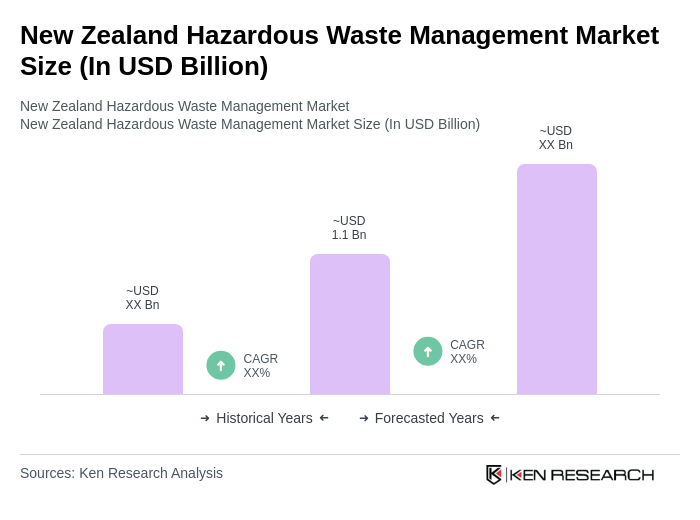
- The New Zealand Hazardous Waste Management Market is valued at USD 1.1 billion, based on a five-year historical analysis. This growth is primarily driven by increasing industrialization, stricter environmental regulations, and heightened awareness of sustainable waste management practices. The market has experienced rising demand for advanced hazardous waste disposal and recycling solutions, in line with global trends emphasizing sustainability and environmental protection .
- Auckland, Wellington, and Christchurch remain the leading cities in the New Zealand hazardous waste management market. Auckland, as the largest urban and industrial center, generates the highest volume of hazardous waste. Wellington, the political capital, enforces robust regulatory frameworks and waste minimization initiatives, while Christchurch's ongoing infrastructure development and urban renewal further stimulate demand for comprehensive waste management services .
- The Waste Minimisation Act, which has been in effect since 2008, continues to be a cornerstone of hazardous waste regulation in New Zealand. While there have been recent amendments and increased enforcement, the Act requires businesses to develop and implement waste management plans, aiming to reduce hazardous waste generation and promote recycling and recovery. This legislation underpins the adoption of sustainable practices and compliance with environmental standards across the sector .
New Zealand Hazardous Waste Management Market Segmentation
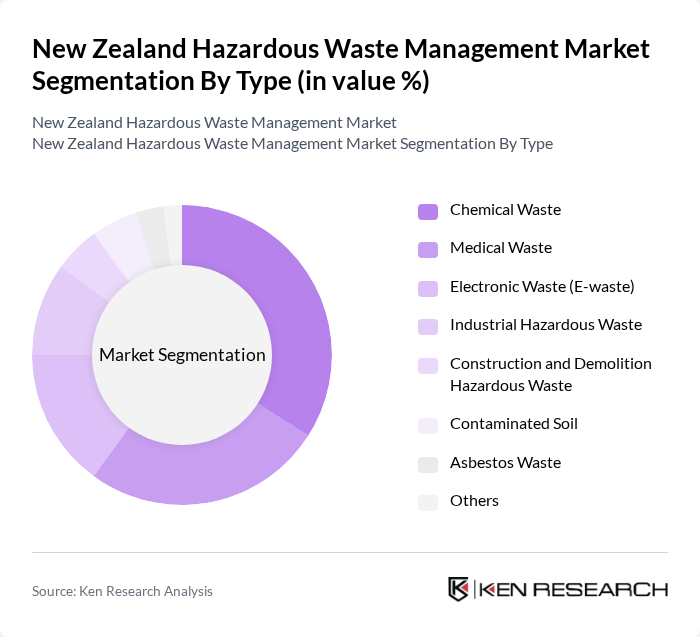
By Type:The hazardous waste management market in New Zealand is segmented by waste type, including Chemical Waste, Medical Waste, Electronic Waste (E-waste), Industrial Hazardous Waste, Construction and Demolition Hazardous Waste, Contaminated Soil, Asbestos Waste, and Others. Chemical Waste is the largest segment, driven by significant industrial output, while Medical Waste is also substantial due to the expanding healthcare sector and stringent medical waste disposal regulations .
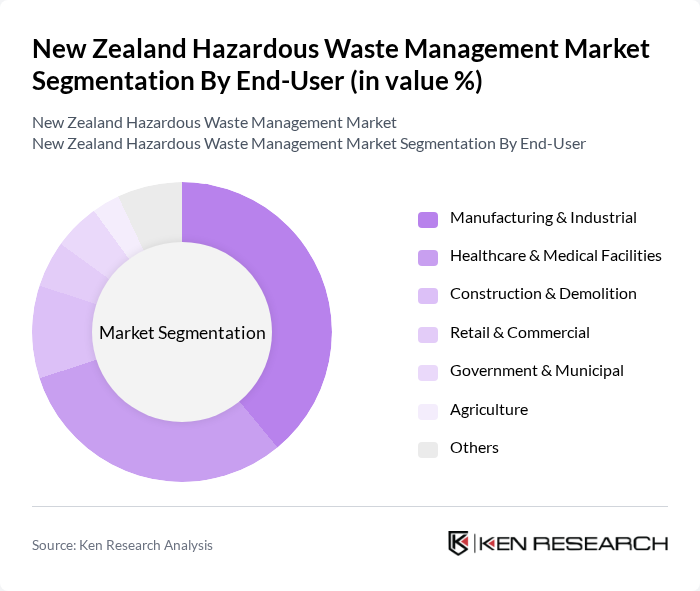
By End-User:End-user segmentation comprises Manufacturing & Industrial, Healthcare & Medical Facilities, Construction & Demolition, Retail & Commercial, Government & Municipal, Agriculture, and Others. The Manufacturing & Industrial segment leads due to the high volume of hazardous waste from production processes, while Healthcare & Medical Facilities are significant contributors, reflecting the sector's growth and regulatory focus on safe medical waste handling .
New Zealand Hazardous Waste Management Market Competitive Landscape
The New Zealand Hazardous Waste Management Market is characterized by a dynamic mix of regional and international players. Leading participants such as Waste Management NZ Limited, EnviroWaste Services Limited, ChemWaste, Interwaste (NZ) Limited, Cleanaway New Zealand, Veolia Environmental Services (NZ) Limited, Green Gorilla, MedCollect, Reclaim Limited, Waste Solutions, Transpacific Technical Services (NZ) Limited, EnviroNZ, Waste Watchers, Hazardous Waste Management Limited, Waste Management Association of New Zealand (Industry Body) contribute to innovation, geographic expansion, and service delivery in this space.
New Zealand Hazardous Waste Management Market Industry Analysis
Growth Drivers
- Increasing Environmental Regulations:New Zealand's stringent environmental regulations are a significant growth driver for hazardous waste management. The government has implemented over 200 regulations under the Resource Management Act, which mandates proper disposal and treatment of hazardous waste. In future, compliance costs for businesses are projected to reach NZD 1.6 billion, emphasizing the need for effective waste management solutions. This regulatory landscape encourages investment in advanced waste management technologies and services, fostering market growth.
- Rising Industrial Waste Generation:The industrial sector in New Zealand is expected to generate approximately 1.3 million tonnes of hazardous waste in future, driven by increased manufacturing and construction activities. The construction industry alone is projected to contribute around 30% of this waste, necessitating efficient management solutions. This surge in waste generation compels industries to adopt sustainable practices, thereby boosting demand for hazardous waste management services and technologies.
- Technological Advancements in Waste Management:The adoption of innovative technologies in hazardous waste management is transforming the industry landscape. In future, investments in waste treatment technologies are expected to exceed NZD 600 million, focusing on advanced recycling and waste-to-energy solutions. These technologies not only enhance efficiency but also reduce environmental impact, aligning with New Zealand's sustainability goals. As businesses seek to optimize waste management processes, the demand for these technologies will continue to rise.
Market Challenges
- High Disposal Costs:One of the primary challenges facing the hazardous waste management market in New Zealand is the high cost of disposal. In future, average disposal costs are projected to reach NZD 350 per tonne, significantly impacting businesses, especially small and medium enterprises. These costs can deter compliance with regulations, leading to improper waste disposal practices, which pose environmental risks and potential legal repercussions for companies.
- Limited Infrastructure for Hazardous Waste Treatment:New Zealand's infrastructure for hazardous waste treatment is currently inadequate, with only three major treatment facilities operating nationwide. This limitation results in logistical challenges and increased transportation costs, estimated at NZD 160 million annually. The lack of facilities hampers the efficient processing of hazardous waste, leading to potential environmental hazards and regulatory non-compliance, which can stifle market growth.
New Zealand Hazardous Waste Management Market Future Outlook
The future of the hazardous waste management market in New Zealand appears promising, driven by increasing environmental awareness and regulatory pressures. As industries adapt to stringent regulations, the demand for innovative waste management solutions is expected to rise. Furthermore, the integration of digital technologies and AI in waste management processes will enhance operational efficiency. The focus on sustainable practices will likely lead to the development of new treatment technologies, positioning the market for significant growth in the coming years.
Market Opportunities
- Expansion of Recycling Programs:The New Zealand government aims to increase recycling rates to 55% in future, creating opportunities for hazardous waste management companies to develop specialized recycling programs. This initiative can significantly reduce landfill waste and promote sustainable practices, enhancing the market's growth potential.
- Increased Investment in Waste-to-Energy Projects:With a growing emphasis on renewable energy, investments in waste-to-energy projects are projected to reach NZD 250 million in future. This trend presents opportunities for hazardous waste management firms to collaborate on energy recovery initiatives, transforming waste into valuable resources while addressing disposal challenges.
Scope of the Report
| Segment | Sub-Segments |
|---|---|
| By Type | Chemical Waste Medical Waste Electronic Waste (E-waste) Industrial Hazardous Waste Construction and Demolition Hazardous Waste Contaminated Soil Asbestos Waste Others |
| By End-User | Manufacturing & Industrial Healthcare & Medical Facilities Construction & Demolition Retail & Commercial Government & Municipal Agriculture Others |
| By Disposal Method | Landfilling Incineration Recycling & Resource Recovery Chemical Treatment & Neutralization Secure Storage Others |
| By Collection Method | Scheduled Collection On-Demand Collection Drop-off Centers Mobile Collection Units Others |
| By Regulatory Compliance Level | Fully Compliant Partially Compliant Non-Compliant Others |
| By Geographic Coverage | North Island South Island Remote & Offshore Islands Others |
| By Policy Support | Government Subsidies Tax Incentives Grants for Waste Management Projects Others |
Key Target Audience
Investors and Venture Capitalist Firms
Government and Regulatory Bodies (e.g., Ministry for the Environment, Environmental Protection Authority)
Waste Management Companies
Industrial Manufacturers
Construction and Demolition Firms
Environmental NGOs and Advocacy Groups
Local Government Authorities
Health and Safety Regulators
Players Mentioned in the Report:
Waste Management NZ Limited
EnviroWaste Services Limited
ChemWaste
Interwaste (NZ) Limited
Cleanaway New Zealand
Veolia Environmental Services (NZ) Limited
Green Gorilla
MedCollect
Reclaim Limited
Waste Solutions
Transpacific Technical Services (NZ) Limited
EnviroNZ
Waste Watchers
Hazardous Waste Management Limited
Waste Management Association of New Zealand (Industry Body)
Table of Contents
Market Assessment Phase
1. Executive Summary and Approach
2. New Zealand Hazardous Waste Management Market Overview
2.1 Key Insights and Strategic Recommendations
2.2 New Zealand Hazardous Waste Management Market Overview
2.3 Definition and Scope
2.4 Evolution of Market Ecosystem
2.5 Timeline of Key Regulatory Milestones
2.6 Value Chain & Stakeholder Mapping
2.7 Business Cycle Analysis
2.8 Policy & Incentive Landscape
3. New Zealand Hazardous Waste Management Market Analysis
3.1 Growth Drivers
3.1.1 Increasing Environmental Regulations
3.1.2 Rising Industrial Waste Generation
3.1.3 Growing Public Awareness of Hazardous Waste
3.1.4 Technological Advancements in Waste Management
3.2 Market Challenges
3.2.1 High Disposal Costs
3.2.2 Limited Infrastructure for Hazardous Waste Treatment
3.2.3 Regulatory Compliance Complexity
3.2.4 Public Opposition to Waste Facilities
3.3 Market Opportunities
3.3.1 Expansion of Recycling Programs
3.3.2 Development of New Treatment Technologies
3.3.3 Partnerships with Local Governments
3.3.4 Increased Investment in Waste-to-Energy Projects
3.4 Market Trends
3.4.1 Shift Towards Circular Economy Practices
3.4.2 Adoption of Digital Waste Management Solutions
3.4.3 Focus on Sustainable Waste Disposal Methods
3.4.4 Integration of AI in Waste Sorting and Management
3.5 Government Regulation
3.5.1 Hazardous Substances and New Organisms Act
3.5.2 Resource Management Act
3.5.3 Waste Minimisation Act
3.5.4 Health and Safety at Work Act
4. SWOT Analysis
5. Stakeholder Analysis
6. Porter's Five Forces Analysis
7. New Zealand Hazardous Waste Management Market Market Size, 2019-2024
7.1 By Value
7.2 By Volume
7.3 By Average Selling Price
8. New Zealand Hazardous Waste Management Market Segmentation
8.1 By Type
8.1.1 Chemical Waste
8.1.2 Medical Waste
8.1.3 Electronic Waste (E-waste)
8.1.4 Industrial Hazardous Waste
8.1.5 Construction and Demolition Hazardous Waste
8.1.6 Contaminated Soil
8.1.7 Asbestos Waste
8.1.8 Others
8.2 By End-User
8.2.1 Manufacturing & Industrial
8.2.2 Healthcare & Medical Facilities
8.2.3 Construction & Demolition
8.2.4 Retail & Commercial
8.2.5 Government & Municipal
8.2.6 Agriculture
8.2.7 Others
8.3 By Disposal Method
8.3.1 Landfilling
8.3.2 Incineration
8.3.3 Recycling & Resource Recovery
8.3.4 Chemical Treatment & Neutralization
8.3.5 Secure Storage
8.3.6 Others
8.4 By Collection Method
8.4.1 Scheduled Collection
8.4.2 On-Demand Collection
8.4.3 Drop-off Centers
8.4.4 Mobile Collection Units
8.4.5 Others
8.5 By Regulatory Compliance Level
8.5.1 Fully Compliant
8.5.2 Partially Compliant
8.5.3 Non-Compliant
8.5.4 Others
8.6 By Geographic Coverage
8.6.1 North Island
8.6.2 South Island
8.6.3 Remote & Offshore Islands
8.6.4 Others
8.7 By Policy Support
8.7.1 Government Subsidies
8.7.2 Tax Incentives
8.7.3 Grants for Waste Management Projects
8.7.4 Others
9. New Zealand Hazardous Waste Management Market Competitive Analysis
9.1 Market Share of Key Players
9.2 Cross Comparison of Key Players
9.2.1 Company Name
9.2.2 Group Size (Large, Medium, or Small as per industry convention)
9.2.3 Annual Revenue (NZD)
9.2.4 Revenue Growth Rate (%)
9.2.5 Market Share (%)
9.2.6 Number of Hazardous Waste Facilities
9.2.7 Waste Processed Annually (Tonnes)
9.2.8 Waste Diversion Rate (%)
9.2.9 Compliance Rate with Environmental Standards (%)
9.2.10 Customer Retention Rate (%)
9.2.11 Average Service Response Time (Hours)
9.2.12 Investment in Technology & Innovation (NZD)
9.2.13 Health & Safety Incident Rate
9.2.14 Geographic Coverage (Regions Served)
9.2.15 Sustainability Initiatives (Qualitative/Quantitative)
9.3 SWOT Analysis of Top Players
9.4 Pricing Analysis
9.5 Detailed Profile of Major Companies
9.5.1 Waste Management NZ Limited
9.5.2 EnviroWaste Services Limited
9.5.3 ChemWaste
9.5.4 Interwaste (NZ) Limited
9.5.5 Cleanaway New Zealand
9.5.6 Veolia Environmental Services (NZ) Limited
9.5.7 Green Gorilla
9.5.8 MedCollect
9.5.9 Reclaim Limited
9.5.10 Waste Solutions
9.5.11 Transpacific Technical Services (NZ) Limited
9.5.12 EnviroNZ
9.5.13 Waste Watchers
9.5.14 Hazardous Waste Management Limited
9.5.15 Waste Management Association of New Zealand (Industry Body)
10. New Zealand Hazardous Waste Management Market End-User Analysis
10.1 Procurement Behavior of Key Ministries
10.1.1 Ministry of Environment
10.1.2 Ministry of Health
10.1.3 Ministry of Business, Innovation and Employment
10.2 Corporate Spend on Infrastructure & Energy
10.2.1 Investment in Waste Management Infrastructure
10.2.2 Expenditure on Sustainable Practices
10.2.3 Budget Allocation for Hazardous Waste Disposal
10.3 Pain Point Analysis by End-User Category
10.3.1 Compliance with Regulations
10.3.2 Cost of Disposal
10.3.3 Availability of Services
10.4 User Readiness for Adoption
10.4.1 Awareness of Hazardous Waste Issues
10.4.2 Willingness to Invest in Solutions
10.4.3 Training and Education Needs
10.5 Post-Deployment ROI and Use Case Expansion
10.5.1 Measurement of Cost Savings
10.5.2 Expansion of Services Offered
10.5.3 Long-term Sustainability Benefits
11. New Zealand Hazardous Waste Management Market Future Size, 2025-2030
11.1 By Value
11.2 By Volume
11.3 By Average Selling Price
Go-To-Market Strategy Phase
1. Whitespace Analysis + Business Model Canvas
1.1 Market Gaps Identification
1.2 Value Proposition Development
1.3 Revenue Streams Analysis
1.4 Cost Structure Evaluation
1.5 Key Partnerships Identification
1.6 Customer Segments Definition
1.7 Channels for Delivery
2. Marketing and Positioning Recommendations
2.1 Branding Strategies
2.2 Product USPs
3. Distribution Plan
3.1 Urban Retail vs Rural NGO Tie-ups
4. Channel & Pricing Gaps
4.1 Underserved Routes
4.2 Pricing Bands
5. Unmet Demand & Latent Needs
5.1 Category Gaps
5.2 Consumer Segments
6. Customer Relationship
6.1 Loyalty Programs
6.2 After-sales Service
7. Value Proposition
7.1 Sustainability
7.2 Integrated Supply Chains
8. Key Activities
8.1 Regulatory Compliance
8.2 Branding
8.3 Distribution Setup
9. Entry Strategy Evaluation
9.1 Domestic Market Entry Strategy
9.1.1 Product Mix
9.1.2 Pricing Band
9.1.3 Packaging
9.2 Export Entry Strategy
9.2.1 Target Countries
9.2.2 Compliance Roadmap
10. Entry Mode Assessment
10.1 JV
10.2 Greenfield
10.3 M&A
10.4 Distributor Model
11. Capital and Timeline Estimation
11.1 Capital Requirements
11.2 Timelines
12. Control vs Risk Trade-Off
12.1 Ownership vs Partnerships
13. Profitability Outlook
13.1 Breakeven Analysis
13.2 Long-term Sustainability
14. Potential Partner List
14.1 Distributors
14.2 JVs
14.3 Acquisition Targets
15. Execution Roadmap
15.1 Phased Plan for Market Entry
15.1.1 Market Setup
15.1.2 Market Entry
15.1.3 Growth Acceleration
15.1.4 Scale & Stabilize
15.2 Key Activities and Milestones
15.2.1 Activity Timeline
15.2.2 Milestone Tracking
Research Methodology
Phase 1: Approach1
Desk Research
- Analysis of government reports on hazardous waste regulations and compliance
- Review of industry publications and white papers on waste management technologies
- Examination of statistical data from the Ministry for the Environment on waste generation and disposal
Primary Research
- Interviews with waste management facility operators and environmental consultants
- Surveys targeting municipal waste management authorities and regulatory bodies
- Field visits to hazardous waste treatment and recycling facilities for observational insights
Validation & Triangulation
- Cross-validation of findings with industry reports and expert opinions
- Triangulation of data from regulatory frameworks, market trends, and expert interviews
- Sanity checks through feedback from a panel of environmental scientists and waste management experts
Phase 2: Market Size Estimation1
Top-down Assessment
- Estimation of total hazardous waste generated based on national waste statistics
- Segmentation of waste types (e.g., industrial, medical, electronic) for detailed analysis
- Incorporation of government initiatives aimed at reducing hazardous waste through recycling
Bottom-up Modeling
- Collection of data on waste processing capacities from leading waste management firms
- Operational cost analysis based on treatment methods and disposal fees
- Volume estimates derived from waste generation rates and treatment efficiencies
Forecasting & Scenario Analysis
- Multi-variable regression analysis incorporating economic growth and regulatory changes
- Scenario modeling based on potential shifts in public policy and environmental awareness
- Development of baseline, optimistic, and pessimistic forecasts through 2030
Phase 3: CATI Sample Composition1
| Scope Item/Segment | Sample Size | Target Respondent Profiles |
|---|---|---|
| Industrial Hazardous Waste Management | 100 | Facility Managers, Environmental Compliance Officers |
| Medical Waste Disposal Services | 80 | Healthcare Waste Managers, Hospital Administrators |
| Electronic Waste Recycling | 70 | Recycling Plant Operators, Sustainability Coordinators |
| Government Regulatory Bodies | 50 | Policy Makers, Environmental Inspectors |
| Consulting Firms in Waste Management | 40 | Environmental Consultants, Waste Management Analysts |
Frequently Asked Questions
What is the current value of the New Zealand Hazardous Waste Management Market?
The New Zealand Hazardous Waste Management Market is valued at approximately USD 1.1 billion, reflecting growth driven by industrialization, stricter environmental regulations, and increased awareness of sustainable waste management practices.
Which cities are the leaders in hazardous waste management in New Zealand?
What is the Waste Minimisation Act in New Zealand?
What types of hazardous waste are managed in New Zealand?
Other Regional/Country Reports
Why Buy From Us?

What makes us stand out is that our consultants follow Robust, Refine and Result (RRR) methodology. Robust for clear definitions, approaches and sanity checking, Refine for differentiating respondents' facts and opinions, and Result for presenting data with story.

We have set a benchmark in the industry by offering our clients with syndicated and customized market research reports featuring coverage of entire market as well as meticulous research and analyst insights.

While we don't replace traditional research, we flip the method upside down. Our dual approach of Top Bottom & Bottom Top ensures quality deliverable by not just verifying company fundamentals but also looking at the sector and macroeconomic factors.

With one step in the future, our research team constantly tries to show you the bigger picture. We help with some of the tough questions you may encounter along the way: How is the industry positioned? Best marketing channel? KPI's of competitors? By aligning every element, we help maximize success.

Our report gives you instant access to the answers and sources that other companies might choose to hide. We elaborate each steps of research methodology we have used and showcase you the sample size to earn your trust.

If you need any support, we are here! We pride ourselves on universe strength, data quality, and quick, friendly, and professional service.