About the Report
Base Year 2024New Zealand Office Real Estate Market Overview
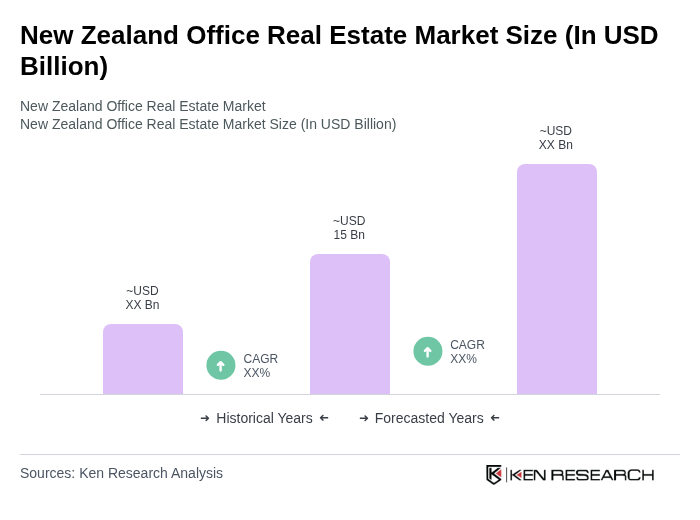
- The New Zealand Office Real Estate Market is valued at approximately USD 15 billion, based on a five-year historical analysis. This growth is primarily driven by increasing demand for flexible workspaces, urbanization, a robust economy that encourages business expansion, moderating supply cycles, and recovering investor confidence amid falling interest rates. The market has seen a significant rise in investment, particularly in major cities, as companies seek modern office environments that cater to evolving workforce needs.
- Key cities dominating this market include Auckland, Wellington, and Christchurch. Auckland stands out due to its status as the largest city and economic hub, attracting both local and international businesses. Wellington, as the political capital, hosts numerous government agencies, while Christchurch is experiencing a resurgence in office space development following post-earthquake reconstruction efforts.
- The Building (Earthquake-prone Buildings) Amendment Act 2019, issued by the New Zealand Parliament, requires territorial authorities to identify earthquake-prone buildings and mandates owners of affected commercial structures to complete seismic strengthening or demolition within a specified timeframe, typically 15 years from identification with possible extensions. This regulation aims to enhance public safety and resilience in the face of natural disasters, thereby influencing the office real estate market by necessitating upgrades and renovations to existing structures.
New Zealand Office Real Estate Market Segmentation
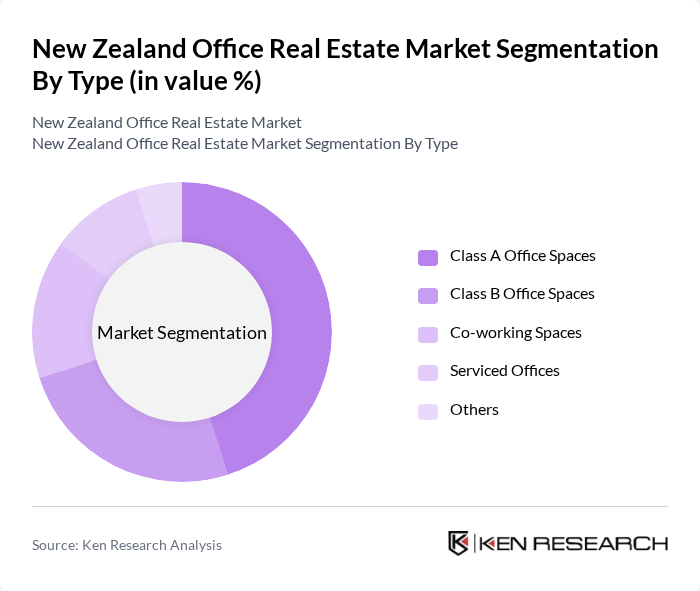
By Type:The office real estate market is segmented into various types, including Class A Office Spaces, Class B Office Spaces, Co-working Spaces, Serviced Offices, and Others. Class A office spaces dominate the market due to their premium location, modern amenities, and higher rental yields, appealing to high-profile tenants, with prime grade stock showing modest net effective rent growth. The demand for co-working spaces has also surged, driven by the rise of startups and the gig economy, which prefer flexible leasing options.
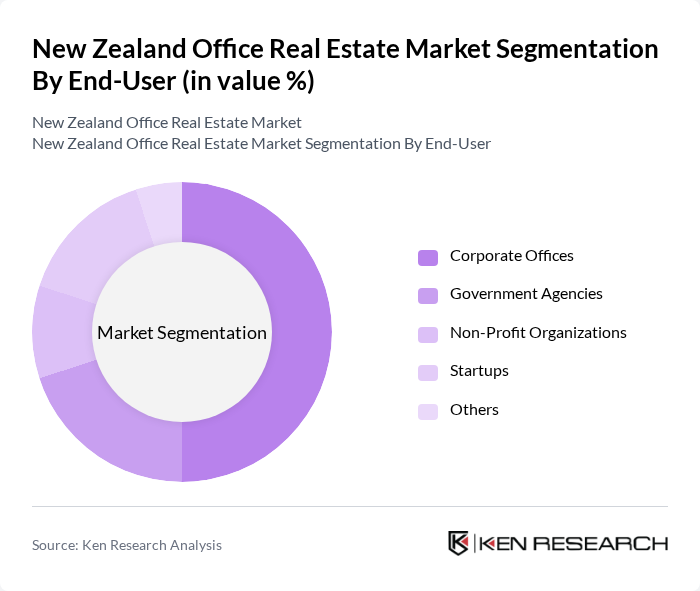
By End-User:The end-user segmentation includes Corporate Offices, Government Agencies, Non-Profit Organizations, Startups, and Others. Corporate offices represent the largest segment, driven by the need for dedicated spaces that enhance productivity and collaboration. Startups are increasingly opting for flexible office solutions, contributing to the growth of co-working spaces, while government agencies require specific facilities that comply with regulatory standards.
New Zealand Office Real Estate Market Competitive Landscape
The New Zealand Office Real Estate Market is characterized by a dynamic mix of regional and international players. Leading participants such as Colliers International, CBRE Group, JLL (Jones Lang LaSalle), Knight Frank, Savills, Bayleys Real Estate, NAI Harcourts, Cushman & Wakefield, Property Brokers, First National Real Estate, Ray White, Barfoot & Thompson, Harcourts, LJ Hooker, Real Estate Institute of New Zealand (REINZ) contribute to innovation, geographic expansion, and service delivery in this space.
New Zealand Office Real Estate Market Industry Analysis
Growth Drivers
- Increasing Demand for Flexible Workspaces:The demand for flexible workspaces in New Zealand has surged, with a reported increase of 25% in co-working space occupancy in recent times. This trend is driven by businesses adapting to hybrid work models, which allow employees to work remotely part-time. According to the New Zealand Productivity Commission, flexible work arrangements can enhance productivity by up to 20%, further fueling the need for adaptable office environments that cater to diverse workforce needs.
- Urbanization and Population Growth:New Zealand's urban population is projected to reach 4.5 million in future, up from 4.4 million. This urbanization trend drives demand for office space in metropolitan areas, as businesses seek to establish a presence in densely populated regions. The influx of residents into cities creates a need for more commercial real estate, particularly in Auckland and Wellington, where office vacancy rates are declining due to increased demand.
- Government Investment in Infrastructure:The New Zealand government has committed NZD 15 billion to infrastructure projects over the next five years, focusing on transport and urban development. This investment is expected to stimulate economic growth and attract businesses to urban centers, thereby increasing demand for office space. Enhanced infrastructure, such as improved public transport and road networks, will facilitate easier access to commercial areas, making them more attractive to potential tenants and investors.
Market Challenges
- Economic Fluctuations:Economic fluctuations pose a significant challenge to the New Zealand office real estate market. The Reserve Bank of New Zealand has projected GDP growth to slow to 2.3% in future, down from 3.0%. This slowdown can lead to reduced business confidence and lower demand for office space, as companies may delay expansion plans or downsize their operations in response to economic uncertainty, impacting rental rates and occupancy levels.
- High Construction Costs:The construction sector in New Zealand is facing escalating costs, with building material prices rising by 12% year-on-year. This increase is attributed to supply chain disruptions and inflationary pressures. Consequently, developers may find it challenging to initiate new office projects, leading to a constrained supply of office space in key markets. High construction costs can also deter potential investors, impacting overall market growth.
New Zealand Office Real Estate Market Future Outlook
The New Zealand office real estate market is poised for transformation as it adapts to evolving work patterns and sustainability demands. The shift towards hybrid work models is expected to redefine office space requirements, with an emphasis on flexibility and wellness. Additionally, the integration of smart technologies will enhance operational efficiency and tenant experience. As urbanization continues, the demand for sustainable and innovative office solutions will likely drive investment and development in the sector, fostering a more resilient market landscape.
Market Opportunities
- Growth in Co-Working Spaces:The rise of co-working spaces presents a significant opportunity, with the sector expected to grow by NZD 600 million in future. This growth is driven by startups and freelancers seeking flexible office solutions. As businesses increasingly adopt hybrid work models, co-working spaces can cater to fluctuating demand, providing adaptable environments that meet diverse needs while maximizing occupancy rates.
- Sustainable Building Practices:The push for sustainability in construction is creating opportunities for developers to invest in green buildings. With the New Zealand government aiming for a 50% reduction in carbon emissions by 2030, sustainable office developments are becoming more attractive. Properties that meet green building standards can command higher rental rates and attract environmentally conscious tenants, enhancing long-term investment returns.
Scope of the Report
| Segment | Sub-Segments |
|---|---|
| By Type | Class A Office Spaces Class B Office Spaces Co-working Spaces Serviced Offices Others |
| By End-User | Corporate Offices Government Agencies Non-Profit Organizations Startups Others |
| By Location | Central Business Districts Suburban Areas Regional Towns Others |
| By Lease Type | Short-term Leases Long-term Leases Flexible Leases Others |
| By Building Age | New Developments Renovated Buildings Historical Buildings Others |
| By Amenities Offered | High-Speed Internet Parking Facilities Conference Rooms Others |
| By Investment Source | Domestic Investors Foreign Direct Investment Public-Private Partnerships Others |
Key Target Audience
Investors and Venture Capitalist Firms
Government and Regulatory Bodies (e.g., New Zealand Ministry of Business, Innovation and Employment)
Real Estate Investment Trusts (REITs)
Property Management Companies
Commercial Real Estate Brokers
Corporate Occupiers and Tenants
Financial Institutions (e.g., Banks and Credit Unions)
Real Estate Developers
Players Mentioned in the Report:
Colliers International
CBRE Group
JLL (Jones Lang LaSalle)
Knight Frank
Savills
Bayleys Real Estate
NAI Harcourts
Cushman & Wakefield
Property Brokers
First National Real Estate
Ray White
Barfoot & Thompson
Harcourts
LJ Hooker
Real Estate Institute of New Zealand (REINZ)
Table of Contents
Market Assessment Phase
1. Executive Summary and Approach
2. New Zealand Office Real Estate Market Overview
2.1 Key Insights and Strategic Recommendations
2.2 New Zealand Office Real Estate Market Overview
2.3 Definition and Scope
2.4 Evolution of Market Ecosystem
2.5 Timeline of Key Regulatory Milestones
2.6 Value Chain & Stakeholder Mapping
2.7 Business Cycle Analysis
2.8 Policy & Incentive Landscape
3. New Zealand Office Real Estate Market Analysis
3.1 Growth Drivers
3.1.1 Increasing demand for flexible workspaces
3.1.2 Urbanization and population growth
3.1.3 Government investment in infrastructure
3.1.4 Rise of technology companies
3.2 Market Challenges
3.2.1 Economic fluctuations
3.2.2 High construction costs
3.2.3 Regulatory hurdles
3.2.4 Limited availability of prime locations
3.3 Market Opportunities
3.3.1 Growth in co-working spaces
3.3.2 Sustainable building practices
3.3.3 Technological advancements in property management
3.3.4 Increased foreign investment
3.4 Market Trends
3.4.1 Shift towards hybrid work models
3.4.2 Emphasis on sustainability and green buildings
3.4.3 Integration of smart technologies
3.4.4 Demand for wellness-focused office environments
3.5 Government Regulation
3.5.1 Building Code compliance
3.5.2 Environmental regulations
3.5.3 Zoning laws
3.5.4 Health and safety standards
4. SWOT Analysis
5. Stakeholder Analysis
6. Porter's Five Forces Analysis
7. New Zealand Office Real Estate Market Market Size, 2019-2024
7.1 By Value
7.2 By Volume
7.3 By Average Selling Price
8. New Zealand Office Real Estate Market Segmentation
8.1 By Type
8.1.1 Class A Office Spaces
8.1.2 Class B Office Spaces
8.1.3 Co-working Spaces
8.1.4 Serviced Offices
8.1.5 Others
8.2 By End-User
8.2.1 Corporate Offices
8.2.2 Government Agencies
8.2.3 Non-Profit Organizations
8.2.4 Startups
8.2.5 Others
8.3 By Location
8.3.1 Central Business Districts
8.3.2 Suburban Areas
8.3.3 Regional Towns
8.3.4 Others
8.4 By Lease Type
8.4.1 Short-term Leases
8.4.2 Long-term Leases
8.4.3 Flexible Leases
8.4.4 Others
8.5 By Building Age
8.5.1 New Developments
8.5.2 Renovated Buildings
8.5.3 Historical Buildings
8.5.4 Others
8.6 By Amenities Offered
8.6.1 High-Speed Internet
8.6.2 Parking Facilities
8.6.3 Conference Rooms
8.6.4 Others
8.7 By Investment Source
8.7.1 Domestic Investors
8.7.2 Foreign Direct Investment
8.7.3 Public-Private Partnerships
8.7.4 Others
9. New Zealand Office Real Estate Market Competitive Analysis
9.1 Market Share of Key Players
9.2 Cross Comparison of Key Players
9.2.1 Company Name
9.2.2 Group Size (Large, Medium, or Small as per industry convention)
9.2.3 Occupancy Rate
9.2.4 Rental Yield
9.2.5 Pricing Strategy
9.2.6 Tenant Retention Rate
9.2.7 Average Lease Duration
9.2.8 Revenue per Square Foot
9.2.9 Market Penetration Rate
9.2.10 Customer Satisfaction Score
9.3 SWOT Analysis of Top Players
9.4 Pricing Analysis
9.5 Detailed Profile of Major Companies
9.5.1 Colliers International
9.5.2 CBRE Group
9.5.3 JLL (Jones Lang LaSalle)
9.5.4 Knight Frank
9.5.5 Savills
9.5.6 Bayleys Real Estate
9.5.7 NAI Harcourts
9.5.8 Cushman & Wakefield
9.5.9 Property Brokers
9.5.10 First National Real Estate
9.5.11 Ray White
9.5.12 Barfoot & Thompson
9.5.13 Harcourts
9.5.14 LJ Hooker
9.5.15 Real Estate Institute of New Zealand (REINZ)
10. New Zealand Office Real Estate Market End-User Analysis
10.1 Procurement Behavior of Key Ministries
10.1.1 Ministry of Business, Innovation and Employment
10.1.2 Ministry of Education
10.1.3 Ministry of Health
10.1.4 Others
10.2 Corporate Spend on Infrastructure & Energy
10.2.1 Corporate Office Renovations
10.2.2 Energy Efficiency Upgrades
10.2.3 Smart Building Technologies
10.2.4 Others
10.3 Pain Point Analysis by End-User Category
10.3.1 High Rental Costs
10.3.2 Limited Space Availability
10.3.3 Compliance with Regulations
10.3.4 Others
10.4 User Readiness for Adoption
10.4.1 Awareness of Flexible Workspaces
10.4.2 Interest in Sustainable Practices
10.4.3 Technology Adoption
10.4.4 Others
10.5 Post-Deployment ROI and Use Case Expansion
10.5.1 Increased Productivity
10.5.2 Cost Savings
10.5.3 Enhanced Employee Satisfaction
10.5.4 Others
11. New Zealand Office Real Estate Market Future Size, 2025-2030
11.1 By Value
11.2 By Volume
11.3 By Average Selling Price
Go-To-Market Strategy Phase
1. Whitespace Analysis + Business Model Canvas
1.1 Market Gaps Identification
1.2 Business Model Development
2. Marketing and Positioning Recommendations
2.1 Branding Strategies
2.2 Product USPs
3. Distribution Plan
3.1 Urban Retail vs Rural NGO Tie-ups
4. Channel & Pricing Gaps
4.1 Underserved Routes
4.2 Pricing Bands
5. Unmet Demand & Latent Needs
5.1 Category Gaps
5.2 Consumer Segments
6. Customer Relationship
6.1 Loyalty Programs
6.2 After-sales Service
7. Value Proposition
7.1 Sustainability
7.2 Integrated Supply Chains
8. Key Activities
8.1 Regulatory Compliance
8.2 Branding
8.3 Distribution Setup
9. Entry Strategy Evaluation
9.1 Domestic Market Entry Strategy
9.1.1 Product Mix
9.1.2 Pricing Band
9.1.3 Packaging
9.2 Export Entry Strategy
9.2.1 Target Countries
9.2.2 Compliance Roadmap
10. Entry Mode Assessment
10.1 JV
10.2 Greenfield
10.3 M&A
10.4 Distributor Model
11. Capital and Timeline Estimation
11.1 Capital Requirements
11.2 Timelines
12. Control vs Risk Trade-Off
12.1 Ownership vs Partnerships
13. Profitability Outlook
13.1 Breakeven Analysis
13.2 Long-term Sustainability
14. Potential Partner List
14.1 Distributors
14.2 JVs
14.3 Acquisition Targets
15. Execution Roadmap
15.1 Phased Plan for Market Entry
15.1.1 Market Setup
15.1.2 Market Entry
15.1.3 Growth Acceleration
15.1.4 Scale & Stabilize
15.2 Key Activities and Milestones
15.2.1 Milestone Planning
15.2.2 Activity Tracking
Research Methodology
Phase 1: Approach1
Desk Research
- Analysis of real estate market reports from New Zealand's Property Council and Statistics New Zealand
- Review of economic indicators and trends from the Reserve Bank of New Zealand
- Examination of property transaction data and rental yields from real estate platforms and government databases
Primary Research
- Interviews with commercial real estate brokers and agents specializing in office spaces
- Surveys with property managers and facility management professionals
- Focus groups with corporate real estate decision-makers and tenants
Validation & Triangulation
- Cross-validation of findings through multiple data sources, including government reports and industry publications
- Triangulation of qualitative insights from interviews with quantitative data from market reports
- Sanity checks through expert panel reviews comprising real estate analysts and economists
Phase 2: Market Size Estimation1
Top-down Assessment
- Estimation of total office space stock based on national building permits and construction data
- Segmentation of the market by geographic regions and office types (e.g., A-grade, B-grade)
- Incorporation of macroeconomic factors such as GDP growth and employment rates affecting office demand
Bottom-up Modeling
- Collection of rental rates and occupancy levels from leading property management firms
- Analysis of tenant profiles and lease structures to determine revenue potential
- Volume x rental rate calculations to derive market size estimates for different office segments
Forecasting & Scenario Analysis
- Multi-factor regression analysis incorporating economic growth, remote work trends, and urbanization rates
- Scenario modeling based on potential changes in government policies and economic conditions
- Baseline, optimistic, and pessimistic forecasts for office space demand through 2030
Phase 3: CATI Sample Composition1
| Scope Item/Segment | Sample Size | Target Respondent Profiles |
|---|---|---|
| Corporate Office Tenants | 120 | Real Estate Managers, Facility Directors |
| Commercial Property Owners | 100 | Property Developers, Asset Managers |
| Real Estate Brokers | 80 | Commercial Agents, Leasing Specialists |
| Investment Analysts | 70 | Financial Analysts, Portfolio Managers |
| Urban Planners | 60 | City Planners, Policy Advisors |
Frequently Asked Questions
What is the current value of the New Zealand office real estate market?
The New Zealand office real estate market is valued at approximately USD 15 billion, driven by increasing demand for flexible workspaces, urbanization, and a robust economy. This growth reflects a significant rise in investment, particularly in major cities like Auckland, Wellington, and Christchurch.
Which cities are the main hubs for office real estate in New Zealand?
What factors are driving growth in the New Zealand office real estate market?
How has the Building (Earthquake-prone Buildings) Amendment Act 2019 impacted the market?
Other Regional/Country Reports
Other Adjacent Reports
South Korea Retail Real Estate Market
Brazil Industrial Real Estate Market
Dammam Residential Real Estate Market Size, Share & Forecast, By Property Type, Buyer Type & Price Tier, 2025-2032Saudi Arabia Construction Market Size, Share & Forecast, By Project Type, Asset Type & End-Use Sector, 2025-2032KSA Property Management Market Outlook to 2030Indonesia Real Estate Investment Market
Singapore Sustainable Building Market
Japan PropTech Market
Belgium Infrastructure Development Market
Why Buy From Us?

What makes us stand out is that our consultants follow Robust, Refine and Result (RRR) methodology. Robust for clear definitions, approaches and sanity checking, Refine for differentiating respondents' facts and opinions, and Result for presenting data with story.

We have set a benchmark in the industry by offering our clients with syndicated and customized market research reports featuring coverage of entire market as well as meticulous research and analyst insights.

While we don't replace traditional research, we flip the method upside down. Our dual approach of Top Bottom & Bottom Top ensures quality deliverable by not just verifying company fundamentals but also looking at the sector and macroeconomic factors.

With one step in the future, our research team constantly tries to show you the bigger picture. We help with some of the tough questions you may encounter along the way: How is the industry positioned? Best marketing channel? KPI's of competitors? By aligning every element, we help maximize success.

Our report gives you instant access to the answers and sources that other companies might choose to hide. We elaborate each steps of research methodology we have used and showcase you the sample size to earn your trust.

If you need any support, we are here! We pride ourselves on universe strength, data quality, and quick, friendly, and professional service.