About the Report
Base Year 2024Nigeria Oil & Gas EPC Services Market Overview
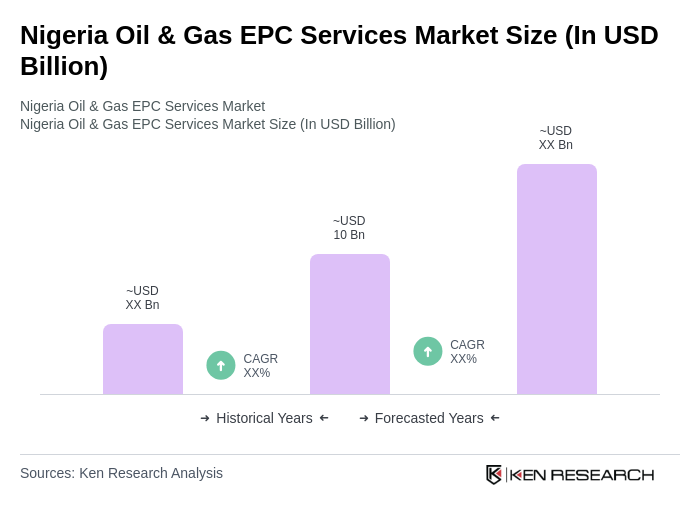
- The Nigeria Oil & Gas EPC Services Market is valued at USD 10 billion, based on a five-year historical analysis. This market value reflects the robust expansion driven by rising indigenous participation, significant investments in upstream exploration, and infrastructure projects such as the Dangote Refinery and modular refineries in Bayelsa and Rivers states. The market’s growth is further supported by the transition of the Nigerian National Petroleum Company Limited (NNPC Ltd.) into a fully commercial entity and the implementation of the National Gas Expansion Programme, which are catalyzing demand for engineering, procurement, and construction services across the sector .
- Key cities including Lagos, Port Harcourt, and Abuja remain dominant in the market due to their strategic locations and established infrastructure. Lagos serves as the commercial and financial hub, Port Harcourt is central to oil production and processing activities, and Abuja, as the capital, plays a pivotal role in policy formulation and regulatory oversight for the oil and gas industry .
- The Petroleum Industry Act (PIA), enacted in 2021 by the Federal Government of Nigeria, provides a comprehensive regulatory framework for the oil and gas sector. The PIA establishes governance structures, fiscal terms, and local content requirements, mandating that a significant portion of contracts be awarded to Nigerian companies. The Act is administered by the Nigerian Upstream Petroleum Regulatory Commission (NUPRC) and the Nigerian Midstream and Downstream Petroleum Regulatory Authority (NMDPRA), with operational provisions covering licensing, compliance thresholds, and mandatory reporting for transparency .
Nigeria Oil & Gas EPC Services Market Segmentation
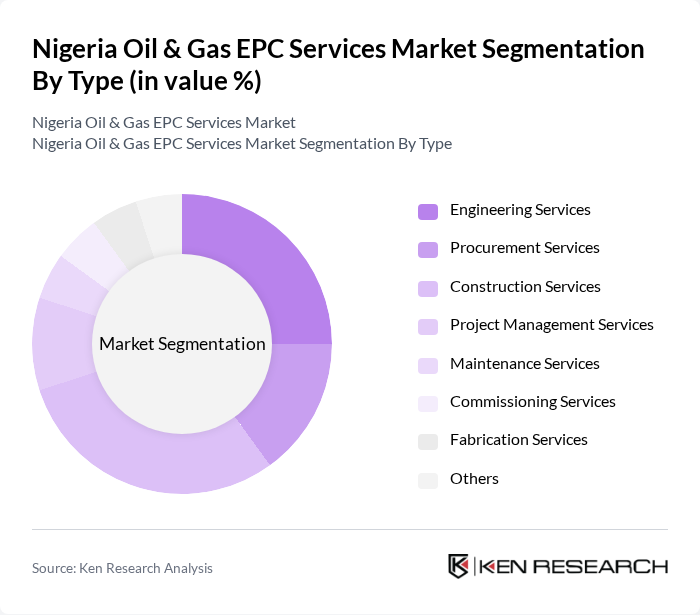
By Type:The market is segmented into Engineering Services, Procurement Services, Construction Services, Project Management Services, Maintenance Services, Commissioning Services, Fabrication Services, and Others. Engineering Services encompass design and feasibility studies; Procurement Services involve sourcing and logistics for equipment and materials; Construction Services cover civil and mechanical works; Project Management Services ensure timely delivery and budget control; Maintenance Services focus on asset integrity; Commissioning Services handle system startup and operational readiness; Fabrication Services provide structural and modular components; Others include specialized consulting and technical support .
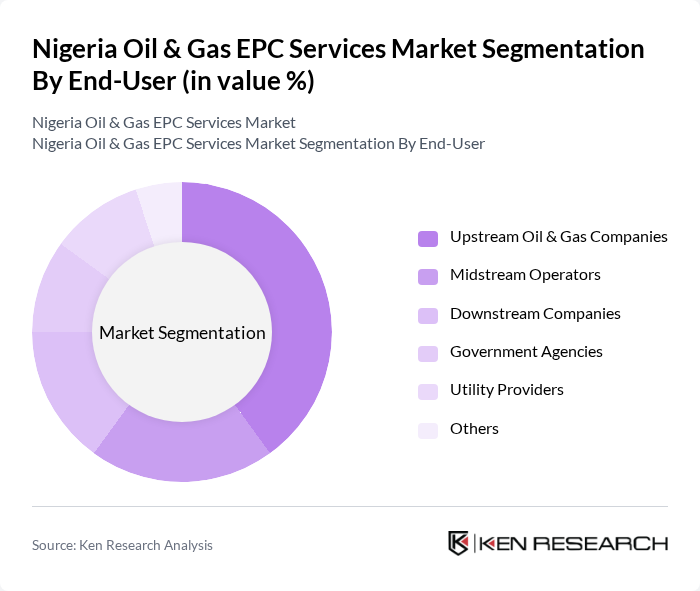
By End-User:The end-user segmentation includes Upstream Oil & Gas Companies, Midstream Operators, Downstream Companies, Government Agencies, Utility Providers, and Others. Upstream Oil & Gas Companies focus on exploration and production; Midstream Operators manage transportation and storage; Downstream Companies handle refining and distribution; Government Agencies oversee policy and regulatory compliance; Utility Providers supply energy infrastructure; Others include service contractors and technical consultants .
Nigeria Oil & Gas EPC Services Market Competitive Landscape
The Nigeria Oil & Gas EPC Services Market is characterized by a dynamic mix of regional and international players. Leading participants such as Julius Berger Nigeria Plc, Saipem Contracting Nigeria Ltd., TechnipFMC Nigeria Ltd., Dorman Long Engineering Ltd., Cappa and D'Alberto Plc, Oilserv Ltd., Nestoil Plc, Eni Nigeria, Shell Nigeria Exploration and Production Company, TotalEnergies Nigeria, ExxonMobil Nigeria, Chevron Nigeria Ltd., AOS Orwell, Matrix Energy Ltd., Sterling Oil Exploration & Energy Production Company Ltd., Nigerian National Petroleum Company Limited (NNPC Ltd.), Daewoo E&C Nigeria, Lekoil Nigeria Limited, Pinnacle Oil and Gas Company Limited, CNOOC International Nigeria Ltd. contribute to innovation, geographic expansion, and service delivery in this space.
Nigeria Oil & Gas EPC Services Market Industry Analysis
Growth Drivers
- Increasing Oil Production Capacity:Nigeria's oil production capacity is projected to reach 1.4 million barrels per day (bpd) in future, up from 1.8 million bpd in future. This increase is driven by the government's commitment to enhancing production through new investments and technology. The Nigerian National Petroleum Corporation (NNPC) has allocated approximately $3 billion for upstream projects, which will significantly boost the EPC services sector, creating a robust demand for engineering, procurement, and construction services.
- Government Investment in Infrastructure:The Nigerian government has earmarked $7 billion for infrastructure development in the oil and gas sector in future. This investment aims to improve transportation, refining, and processing facilities, which are crucial for the EPC services market. Enhanced infrastructure will facilitate smoother operations and reduce bottlenecks, thereby attracting more EPC contracts and fostering a conducive environment for industry growth and sustainability.
- Rising Demand for Energy Security:With Nigeria's energy consumption projected to increase by 30% in future, the demand for reliable energy sources is paramount. The government is focusing on energy security to support economic growth, leading to increased investments in oil and gas projects. This heightened focus on energy security is expected to drive the demand for EPC services, as companies seek to enhance production capabilities and ensure stable energy supply for the nation.
Market Challenges
- Regulatory Uncertainty:The Nigerian oil and gas sector faces significant regulatory challenges, with frequent changes in policies affecting investment decisions. For instance, the Petroleum Industry Act (PIA) introduced in future has created confusion regarding tax regimes and operational guidelines. This uncertainty has led to a decline in foreign direct investment, with FDI dropping to $1.1 billion in future, down from $2.2 billion in future, hindering the growth of the EPC services market.
- Infrastructural Deficiencies:Nigeria's oil and gas infrastructure is plagued by inadequacies, with over 40% of pipelines reported to be in poor condition. This has resulted in significant operational delays and increased costs for EPC contractors. The lack of reliable transportation and processing facilities has led to an estimated loss of $1 billion annually due to inefficiencies, posing a substantial challenge to the growth of the EPC services market in the region.
Nigeria Oil & Gas EPC Services Market Future Outlook
The future of the Nigeria Oil & Gas EPC services market appears promising, driven by ongoing investments in production capacity and infrastructure. As the government continues to prioritize energy security, the demand for EPC services is expected to rise. Additionally, the integration of digital technologies and sustainable practices will likely reshape the industry landscape, enhancing operational efficiency and safety standards. Strategic partnerships with global firms may further bolster local capabilities, positioning Nigeria as a competitive player in the EPC services sector.
Market Opportunities
- Expansion of Renewable Energy Projects:The Nigerian government aims to diversify its energy portfolio, targeting 30% of energy generation from renewable sources in future. This shift presents significant opportunities for EPC firms to engage in renewable energy projects, such as solar and wind, potentially attracting investments exceeding $5 billion, thereby enhancing the overall market landscape.
- Strategic Partnerships with Global EPC Firms:Collaborations with international EPC firms can enhance local expertise and technology transfer. Such partnerships are expected to facilitate the execution of large-scale projects, with an estimated value of $4 billion in upcoming contracts. This collaboration will not only improve project delivery but also strengthen the local EPC market's competitiveness and innovation capacity.
Scope of the Report
| Segment | Sub-Segments |
|---|---|
| By Type | Engineering Services Procurement Services Construction Services Project Management Services Maintenance Services Commissioning Services Fabrication Services Others |
| By End-User | Upstream Oil & Gas Companies Midstream Operators Downstream Companies Government Agencies Utility Providers Others |
| By Project Size | Small Scale Projects Medium Scale Projects Large Scale Projects Mega Projects |
| By Contract Type | Lump Sum Turnkey (LSTK) Contracts Engineering, Procurement, and Construction Management (EPCM) Contracts Cost Plus Contracts Time and Material Contracts Others |
| By Geographic Location | Niger Delta Region Offshore Locations Northern Nigeria Western Nigeria Others |
| By Investment Source | Domestic Investments Foreign Direct Investments (FDI) Public-Private Partnerships (PPP) Government Funding |
| By Policy Support | Subsidies for Local Content Development Tax Incentives for EPC Projects Grants for Renewable Energy Integration Others |
Key Target Audience
Investors and Venture Capitalist Firms
Government and Regulatory Bodies (e.g., Nigerian National Petroleum Corporation, Department of Petroleum Resources)
Oil and Gas Exploration and Production Companies
Engineering, Procurement, and Construction (EPC) Contractors
Infrastructure Development Firms
Local Content Development Agencies
Environmental and Safety Regulatory Agencies
Financial Institutions and Banks
Players Mentioned in the Report:
Julius Berger Nigeria Plc
Saipem Contracting Nigeria Ltd.
TechnipFMC Nigeria Ltd.
Dorman Long Engineering Ltd.
Cappa and D'Alberto Plc
Oilserv Ltd.
Nestoil Plc
Eni Nigeria
Shell Nigeria Exploration and Production Company
TotalEnergies Nigeria
ExxonMobil Nigeria
Chevron Nigeria Ltd.
AOS Orwell
Matrix Energy Ltd.
Sterling Oil Exploration & Energy Production Company Ltd.
Nigerian National Petroleum Company Limited (NNPC Ltd.)
Daewoo E&C Nigeria
Lekoil Nigeria Limited
Pinnacle Oil and Gas Company Limited
CNOOC International Nigeria Ltd.
Table of Contents
Market Assessment Phase
1. Executive Summary and Approach
2. Nigeria Oil & Gas EPC Services Market Overview
2.1 Key Insights and Strategic Recommendations
2.2 Nigeria Oil & Gas EPC Services Market Overview
2.3 Definition and Scope
2.4 Evolution of Market Ecosystem
2.5 Timeline of Key Regulatory Milestones
2.6 Value Chain & Stakeholder Mapping
2.7 Business Cycle Analysis
2.8 Policy & Incentive Landscape
3. Nigeria Oil & Gas EPC Services Market Analysis
3.1 Growth Drivers
3.1.1 Increasing Oil Production Capacity
3.1.2 Government Investment in Infrastructure
3.1.3 Rising Demand for Energy Security
3.1.4 Technological Advancements in EPC Services
3.2 Market Challenges
3.2.1 Regulatory Uncertainty
3.2.2 Infrastructural Deficiencies
3.2.3 Security Concerns in Oil-Producing Regions
3.2.4 Fluctuating Oil Prices
3.3 Market Opportunities
3.3.1 Expansion of Renewable Energy Projects
3.3.2 Foreign Direct Investment (FDI) Inflows
3.3.3 Strategic Partnerships with Global EPC Firms
3.3.4 Development of Local Content Policies
3.4 Market Trends
3.4.1 Shift Towards Sustainable Practices
3.4.2 Digital Transformation in EPC Services
3.4.3 Increased Focus on Safety Standards
3.4.4 Adoption of Modular Construction Techniques
3.5 Government Regulation
3.5.1 Local Content Act Compliance
3.5.2 Environmental Impact Assessment Regulations
3.5.3 Tax Incentives for Oil & Gas Investments
3.5.4 Health and Safety Regulations
4. SWOT Analysis
5. Stakeholder Analysis
6. Porter's Five Forces Analysis
7. Nigeria Oil & Gas EPC Services Market Market Size, 2019-2024
7.1 By Value
7.2 By Volume
7.3 By Average Selling Price
8. Nigeria Oil & Gas EPC Services Market Segmentation
8.1 By Type
8.1.1 Engineering Services
8.1.2 Procurement Services
8.1.3 Construction Services
8.1.4 Project Management Services
8.1.5 Maintenance Services
8.1.6 Commissioning Services
8.1.7 Fabrication Services
8.1.8 Others
8.2 By End-User
8.2.1 Upstream Oil & Gas Companies
8.2.2 Midstream Operators
8.2.3 Downstream Companies
8.2.4 Government Agencies
8.2.5 Utility Providers
8.2.6 Others
8.3 By Project Size
8.3.1 Small Scale Projects
8.3.2 Medium Scale Projects
8.3.3 Large Scale Projects
8.3.4 Mega Projects
8.4 By Contract Type
8.4.1 Lump Sum Turnkey (LSTK) Contracts
8.4.2 Engineering, Procurement, and Construction Management (EPCM) Contracts
8.4.3 Cost Plus Contracts
8.4.4 Time and Material Contracts
8.4.5 Others
8.5 By Geographic Location
8.5.1 Niger Delta Region
8.5.2 Offshore Locations
8.5.3 Northern Nigeria
8.5.4 Western Nigeria
8.5.5 Others
8.6 By Investment Source
8.6.1 Domestic Investments
8.6.2 Foreign Direct Investments (FDI)
8.6.3 Public-Private Partnerships (PPP)
8.6.4 Government Funding
8.7 By Policy Support
8.7.1 Subsidies for Local Content Development
8.7.2 Tax Incentives for EPC Projects
8.7.3 Grants for Renewable Energy Integration
8.7.4 Others
9. Nigeria Oil & Gas EPC Services Market Competitive Analysis
9.1 Market Share of Key Players
9.2 Cross Comparison of Key Players
9.2.1 Company Name
9.2.2 Group Size (Large, Medium, or Small as per industry convention)
9.2.3 Revenue (USD Million)
9.2.4 Revenue Growth Rate (%)
9.2.5 Number of EPC Projects Completed (Past 5 Years)
9.2.6 Project Completion Rate (%)
9.2.7 Average Project Size (USD Million)
9.2.8 Market Share (%)
9.2.9 Local Content Ratio (%)
9.2.10 Safety Performance (TRIR/LTIFR)
9.2.11 Customer Satisfaction Index
9.2.12 Market Penetration Rate
9.2.13 Pricing Strategy
9.2.14 Operational Efficiency Ratio
9.2.15 Employee Turnover Rate
9.2.16 Innovation Index
9.3 SWOT Analysis of Top Players
9.4 Pricing Analysis
9.5 Detailed Profile of Major Companies
9.5.1 Julius Berger Nigeria Plc
9.5.2 Saipem Contracting Nigeria Ltd.
9.5.3 TechnipFMC Nigeria Ltd.
9.5.4 Dorman Long Engineering Ltd.
9.5.5 Cappa and D'Alberto Plc
9.5.6 Oilserv Ltd.
9.5.7 Nestoil Plc
9.5.8 Eni Nigeria
9.5.9 Shell Nigeria Exploration and Production Company
9.5.10 TotalEnergies Nigeria
9.5.11 ExxonMobil Nigeria
9.5.12 Chevron Nigeria Ltd.
9.5.13 AOS Orwell
9.5.14 Matrix Energy Ltd.
9.5.15 Sterling Oil Exploration & Energy Production Company Ltd.
9.5.16 Nigerian National Petroleum Company Limited (NNPC Ltd.)
9.5.17 Daewoo E&C Nigeria
9.5.18 Lekoil Nigeria Limited
9.5.19 Pinnacle Oil and Gas Company Limited
9.5.20 CNOOC International Nigeria Ltd.
10. Nigeria Oil & Gas EPC Services Market End-User Analysis
10.1 Procurement Behavior of Key Ministries
10.1.1 Ministry of Petroleum Resources
10.1.2 Ministry of Finance
10.1.3 Ministry of Environment
10.1.4 Others
10.2 Corporate Spend on Infrastructure & Energy
10.2.1 Oil and Gas Sector Investments
10.2.2 Infrastructure Development Budgets
10.2.3 Energy Transition Funding
10.2.4 Others
10.3 Pain Point Analysis by End-User Category
10.3.1 Oil Exploration Companies
10.3.2 Oil Refining Companies
10.3.3 Government Agencies
10.3.4 Utility Providers
10.4 User Readiness for Adoption
10.4.1 Awareness of EPC Services
10.4.2 Financial Readiness
10.4.3 Technical Capability
10.4.4 Others
10.5 Post-Deployment ROI and Use Case Expansion
10.5.1 ROI Measurement Techniques
10.5.2 Use Case Development
10.5.3 Long-term Sustainability Plans
10.5.4 Others
11. Nigeria Oil & Gas EPC Services Market Future Size, 2025-2030
11.1 By Value
11.2 By Volume
11.3 By Average Selling Price
Go-To-Market Strategy Phase
1. Whitespace Analysis + Business Model Canvas
1.1 Market Gaps Identification
1.2 Business Model Framework
1.3 Value Proposition Development
1.4 Competitive Landscape Overview
1.5 Customer Segmentation Analysis
2. Marketing and Positioning Recommendations
2.1 Branding Strategies
2.2 Product USPs
2.3 Target Market Identification
2.4 Communication Strategy
3. Distribution Plan
3.1 Urban Retail Strategies
3.2 Rural NGO Tie-ups
3.3 Logistics and Supply Chain Management
3.4 Distribution Channel Optimization
4. Channel & Pricing Gaps
4.1 Underserved Routes
4.2 Pricing Bands Analysis
4.3 Competitive Pricing Strategies
5. Unmet Demand & Latent Needs
5.1 Category Gaps
5.2 Consumer Segments Analysis
5.3 Future Demand Projections
6. Customer Relationship
6.1 Loyalty Programs
6.2 After-sales Service Strategies
6.3 Customer Feedback Mechanisms
7. Value Proposition
7.1 Sustainability Initiatives
7.2 Integrated Supply Chains
7.3 Competitive Advantages
8. Key Activities
8.1 Regulatory Compliance
8.2 Branding Initiatives
8.3 Distribution Setup
9. Entry Strategy Evaluation
9.1 Domestic Market Entry Strategy
9.1.1 Product Mix Considerations
9.1.2 Pricing Band Strategy
9.1.3 Packaging Solutions
9.2 Export Entry Strategy
9.2.1 Target Countries Identification
9.2.2 Compliance Roadmap Development
10. Entry Mode Assessment
10.1 Joint Ventures
10.2 Greenfield Investments
10.3 Mergers & Acquisitions
10.4 Distributor Model Evaluation
11. Capital and Timeline Estimation
11.1 Capital Requirements Analysis
11.2 Project Timelines
12. Control vs Risk Trade-Off
12.1 Ownership vs Partnerships
12.2 Risk Management Strategies
13. Profitability Outlook
13.1 Breakeven Analysis
13.2 Long-term Sustainability Plans
14. Potential Partner List
14.1 Distributors
14.2 Joint Ventures
14.3 Acquisition Targets
15. Execution Roadmap
15.1 Phased Plan for Market Entry
15.1.1 Market Setup
15.1.2 Market Entry
15.1.3 Growth Acceleration
15.1.4 Scale & Stabilize
15.2 Key Activities and Milestones
15.2.1 Milestone Planning
15.2.2 Activity Tracking
Research Methodology
Phase 1: Approach1
Desk Research
- Analysis of industry reports from the Nigerian National Petroleum Corporation (NNPC)
- Review of market studies published by the Nigerian Content Development and Monitoring Board (NCDMB)
- Examination of trade publications and journals focusing on oil and gas EPC services in Nigeria
Primary Research
- Interviews with project managers and engineers from leading EPC firms operating in Nigeria
- Telephonic surveys with stakeholders in the oil and gas sector, including operators and service providers
- Field interviews with regulatory officials and industry experts to gather insights on market dynamics
Validation & Triangulation
- Cross-validation of findings through multiple data sources, including financial reports and industry forecasts
- Triangulation of qualitative insights from interviews with quantitative data from market reports
- Sanity checks conducted through expert panel reviews to ensure data accuracy and relevance
Phase 2: Market Size Estimation1
Top-down Assessment
- Estimation of the overall oil and gas market size in Nigeria as a basis for EPC services
- Segmentation of the market by project type, including upstream, midstream, and downstream services
- Incorporation of government initiatives and policies affecting the EPC sector in Nigeria
Bottom-up Modeling
- Collection of project-level data from ongoing and completed EPC contracts in Nigeria
- Operational cost analysis based on service pricing and project scope
- Volume and cost calculations based on historical project data and future project pipelines
Forecasting & Scenario Analysis
- Multi-factor regression analysis incorporating oil price trends, investment flows, and regulatory changes
- Scenario modeling based on potential shifts in government policy and global oil market dynamics
- Development of baseline, optimistic, and pessimistic forecasts through 2030
Phase 3: CATI Sample Composition1
| Scope Item/Segment | Sample Size | Target Respondent Profiles |
|---|---|---|
| Upstream Oil & Gas Projects | 100 | Project Managers, Operations Directors |
| Midstream Infrastructure Development | 80 | Engineering Managers, Logistics Coordinators |
| Downstream Refinery Services | 70 | Procurement Managers, Quality Assurance Leads |
| Regulatory Compliance in EPC | 60 | Compliance Officers, Legal Advisors |
| Technology Integration in EPC Services | 90 | IT Managers, Innovation Leads |
Frequently Asked Questions
What is the current value of the Nigeria Oil & Gas EPC Services Market?
The Nigeria Oil & Gas EPC Services Market is valued at approximately USD 10 billion, reflecting significant growth driven by increased indigenous participation and substantial investments in upstream exploration and infrastructure projects.
What are the key cities driving the Nigeria Oil & Gas EPC Services Market?
What is the Petroleum Industry Act (PIA) and its significance?
What are the main types of services offered in the Nigeria Oil & Gas EPC market?
Other Adjacent Reports
Indonesia Oil Exploration Services Market
Oman Gas Processing Equipment Market
Bahrain Petrochemical Plant Construction Market
Singapore Pipeline Infrastructure Development Market
Singapore Offshore Platform Fabrication Market
South Korea Refinery Maintenance Services Market
Bahrain Energy Project Management Market
Germany Industrial Engineering Consulting Market
South Korea Environmental Impact Assessment Market
South Korea Renewable Energy Integration Market
Why Buy From Us?

What makes us stand out is that our consultants follow Robust, Refine and Result (RRR) methodology. Robust for clear definitions, approaches and sanity checking, Refine for differentiating respondents' facts and opinions, and Result for presenting data with story.

We have set a benchmark in the industry by offering our clients with syndicated and customized market research reports featuring coverage of entire market as well as meticulous research and analyst insights.

While we don't replace traditional research, we flip the method upside down. Our dual approach of Top Bottom & Bottom Top ensures quality deliverable by not just verifying company fundamentals but also looking at the sector and macroeconomic factors.

With one step in the future, our research team constantly tries to show you the bigger picture. We help with some of the tough questions you may encounter along the way: How is the industry positioned? Best marketing channel? KPI's of competitors? By aligning every element, we help maximize success.

Our report gives you instant access to the answers and sources that other companies might choose to hide. We elaborate each steps of research methodology we have used and showcase you the sample size to earn your trust.

If you need any support, we are here! We pride ourselves on universe strength, data quality, and quick, friendly, and professional service.