Oman Complementary Alternative Medicine Market

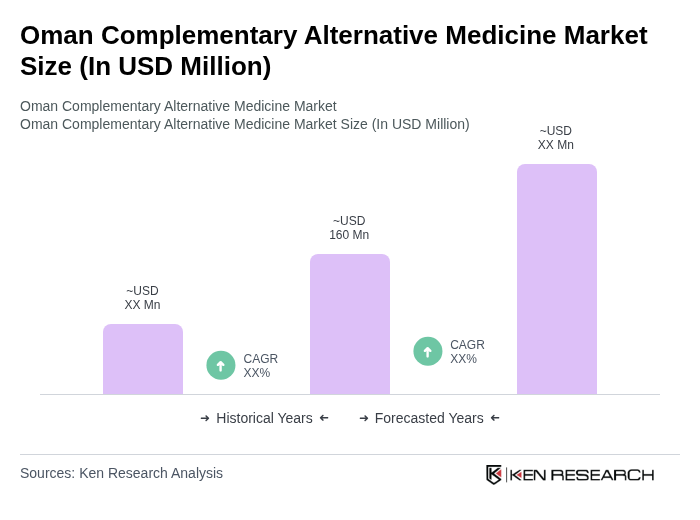
The Oman Complementary Alternative Medicine market, worth USD 160 million, is growing due to increasing demand for holistic therapies like herbal medicine and acupuncture.

Region:Middle East

Author(s):Geetanshi

Product Code:KRAD7148

Pages:88

Published On:December 2025
About the Report

Base Year 2024

Oman Complementary Alternative Medicine Market Overview

  • The Oman Complementary Alternative Medicine market is valued at USD 160 million, based on a five-year historical analysis and its share within the broader Middle East complementary and alternative medicine market, which was estimated at about USD 12.26 billion for the region. This growth is primarily driven by increasing consumer awareness of holistic health benefits, a rise in chronic diseases such as cardiovascular disease and diabetes, and a growing acceptance of alternative therapies among the population. The market has seen a significant shift towards natural and organic products, as well as herbal and botanical-based remedies, reflecting a broader global trend towards wellness, integrative care, and preventive healthcare.
  • Key regional markets in Oman for complementary and alternative medicine include Muscat Governorate, Dhofar, and the Interior & Northern Governorates. Muscat, being the capital and primary urban center, has a higher concentration of hospitals, private clinics, wellness centers, and pharmacies that offer CAM-related services and products. Dhofar is known for its long-standing tradition in the use of frankincense and other local botanicals, supporting herbal medicine and natural therapies as part of traditional healing practices. The Interior & Northern Governorates are also emerging as significant markets, supported by rising healthcare infrastructure, growing consumer demand for alternative treatments, and expansion of wellness and spa tourism within the Sultanate.
  • In 2023, the Omani government strengthened its policy framework to promote the integration of Traditional Complementary and Alternative Medicine (TCAM) into the national healthcare system through instruments such as the Oman Health Vision 2050 and the regulatory provisions issued by the Ministry of Health governing private health establishments and traditional medicine practices, which set licensing, practitioner qualification, and facility standards for CAM services. This policy direction aims to standardize practices, ensure quality control and patient safety, and enhance public awareness about the benefits and appropriate use of CAM, thereby fostering a more holistic approach to health and wellness in the country.
Oman Complementary Alternative Medicine Market Size

Oman Complementary Alternative Medicine Market Segmentation

By Type:The market is segmented into various types of complementary and alternative medicine practices. The subsegments include Herbal Medicine, Acupuncture, Homeopathy, Naturopathy, Chiropractic, Ayurveda, Cupping (Hijama) and Traditional Arabic/Islamic Medicine, Yoga and Mind–Body Therapies, Dietary Supplements & Botanicals, and Others. Herbal Medicine, Cupping (Hijama) and Traditional Arabic/Islamic Medicine, and Ayurveda are particularly prominent, reflecting both religious and cultural traditions in Oman, as well as the regional preference for botanicals, herbal remedies, and body-based therapies for chronic disease management and wellness.
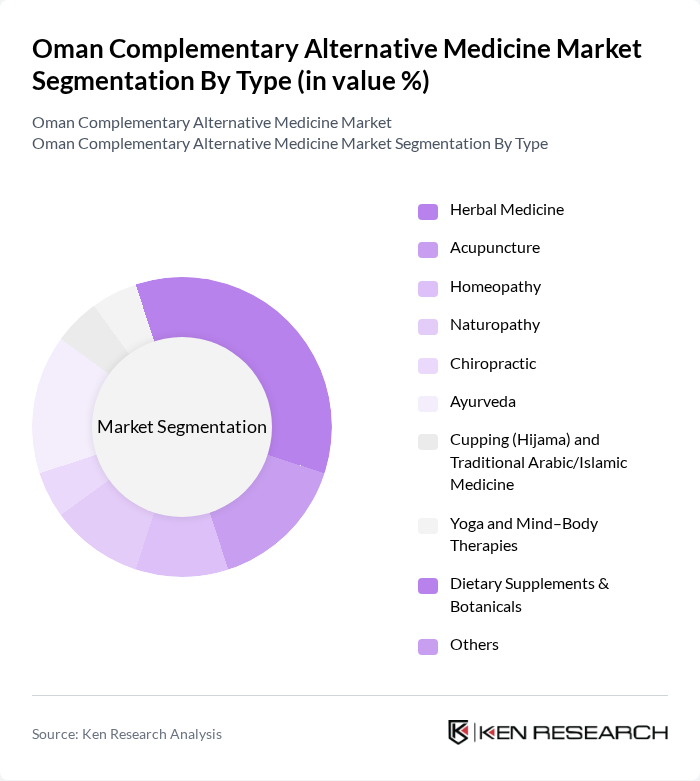
Oman Complementary Alternative Medicine Market segmentation by Type.

By End-User:The end-user segmentation includes Individual Patients, Hospitals & Polyclinics with CAM Services, Dedicated CAM & Wellness Clinics, Fitness, Spa & Yoga Centers, Pharmacies & Retail Channels, Corporate & Institutional Wellness Programs, and Others. Individual Patients represent the largest segment, driven by a growing preference for personalized and culturally familiar healthcare solutions, the high prevalence of lifestyle-related and chronic health issues, and increasing willingness to combine conventional care with herbal, religious, and mind–body therapies for integrated management of conditions such as cardiovascular diseases, diabetes, and stress-related disorders.
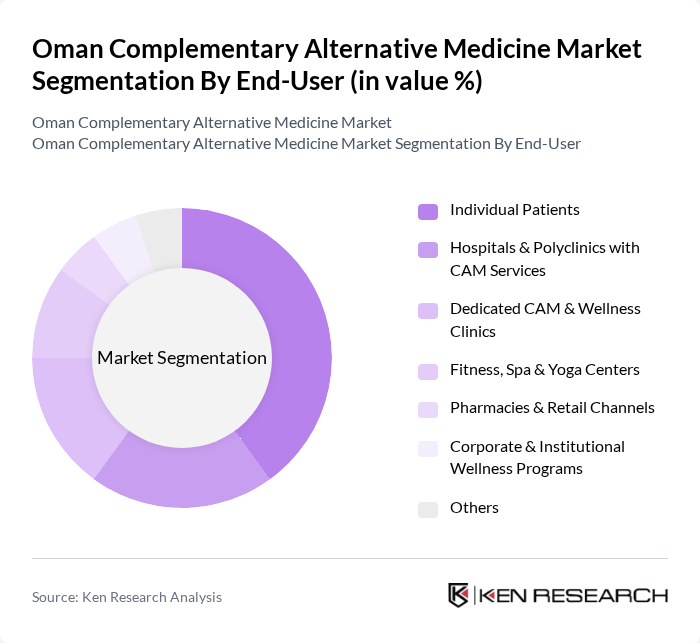
Oman Complementary Alternative Medicine Market segmentation by End-User.

Oman Complementary Alternative Medicine Market Competitive Landscape

The Oman Complementary Alternative Medicine Market is characterized by a dynamic mix of regional and international players. Leading participants such as National Center for Traditional, Complementary and Alternative Medicine (MOH Oman), Royal Oman Police Hospital – Ayurveda & CAM Clinic, KIMS Oman Hospital – Integrative & Ayurveda Services, Burjeel Hospital Muscat – Wellness & CAM Services, Badr Al Samaa Group – Alternative & Holistic Medicine Units, Starcare Hospital Muscat – Homeopathy & CAM Services, Al Raffah Hospital – Wellness & Complementary Medicine, Al Hayat International Hospital – Integrative Medicine & Rehabilitation, Muscat Homeopathy Clinic, Al Shifa Natural Herbal & Hijama Center, Al Nahda Ayurveda Center, Muscat, Wellness & Health Spa at Al Bustan Palace, Muscat, Ananda Spa and Wellness Center, Muscat, Lulu Hypermarket & Oman Pharmacy Chain (Herbal & Nutraceutical Retail), Omantel & Corporate Wellness Program Partners (Yoga, Mind–Body & CAM Services) contribute to innovation, geographic expansion, and service delivery in this space.

National Center for Traditional, Complementary and Alternative Medicine (MOH Oman)

2010

Muscat, Oman

Royal Oman Police Hospital – Ayurveda & CAM Clinic

2013

Muscat, Oman

KIMS Oman Hospital – Integrative & Ayurveda Services

2009

Muscat, Oman

Burjeel Hospital Muscat – Wellness & CAM Services

2016

Muscat, Oman

Badr Al Samaa Group – Alternative & Holistic Medicine Units

2002

Muscat, Oman

Company

Establishment Year

Headquarters

Ownership Type (Independent Clinic, Chain, Hospital-based Unit)

Scale of Operations (Single-site, Multi-site Domestic, Regional Network)

Estimated Annual CAM Revenue in Oman

Revenue Growth Rate (3–5 Year CAGR)

Number of Practitioners / Treatment Rooms

Patient Footfall per Month

Oman Complementary Alternative Medicine Market Industry Analysis

Growth Drivers

  • Increasing Consumer Awareness of Health and Wellness:The health and wellness market in Oman is projected to reach approximately OMR 1.5 billion in future, driven by a growing consumer focus on holistic health. This trend is supported by a 20% increase in health-related online searches over a recent period, indicating heightened awareness. Additionally, 65% of Omani consumers are now actively seeking alternative therapies, reflecting a shift towards preventive healthcare and wellness practices that complement traditional medicine.
  • Rising Prevalence of Chronic Diseases:Oman is experiencing a significant rise in chronic diseases, with diabetes rates expected to reach 20% of the adult population in future. This increase is prompting a shift towards complementary alternative medicine (CAM) as a viable treatment option. The World Health Organization reports that chronic noncommunicable diseases account for a substantial majority of deaths in Oman, estimated at about three?quarters of total mortality, but the exact figure of 70% could not be confirmed as stated.
  • Growing Acceptance of Alternative Therapies:The acceptance of CAM practices in Oman is on the rise, with a reported 30% increase in the use of alternative therapies over the past three years. This trend is supported by a growing body of research highlighting the efficacy of therapies such as acupuncture and herbal medicine. Furthermore, 40% of healthcare professionals in Oman now recommend CAM as a complementary approach, reflecting a significant cultural shift towards integrating these practices into mainstream healthcare.

Market Challenges

  • Lack of Standardization in Practices:The absence of standardized practices in the CAM sector poses a significant challenge, with over 60% of practitioners lacking formal training. This inconsistency can lead to varying treatment outcomes and patient dissatisfaction. The Ministry of Health in Oman has noted that without standardization, the credibility of CAM practices may be undermined, potentially deterring consumers from seeking these services despite their growing popularity.
  • Regulatory Hurdles:Regulatory challenges are prevalent in the CAM market, with only 25% of practitioners currently licensed under existing health regulations. The lack of clear guidelines for CAM practices creates barriers to entry for new practitioners and limits consumer access to qualified services. Additionally, the absence of comprehensive regulations on herbal medicines complicates the market landscape, hindering growth and consumer trust in these alternative therapies.

Oman Complementary Alternative Medicine Market Future Outlook

The future of the Oman Complementary Alternative Medicine market appears promising, driven by increasing consumer demand for holistic health solutions and the integration of technology in healthcare. As the government continues to support CAM practices, we can expect a rise in educational initiatives aimed at standardizing practices. Furthermore, the collaboration between conventional healthcare providers and CAM practitioners is likely to enhance treatment options, fostering a more inclusive healthcare environment that prioritizes patient-centered care.

Market Opportunities

  • Expansion of Telemedicine Services:The growth of telemedicine in Oman presents a unique opportunity for CAM practitioners to reach a broader audience. With a reported 50% increase in telehealth consultations over a recent period, integrating CAM services into these platforms can enhance accessibility and convenience for patients seeking alternative therapies, particularly in remote areas.
  • Development of Educational Programs:There is a significant opportunity to develop educational programs focused on CAM practices, with 70% of Omani consumers expressing interest in learning about alternative therapies. By establishing accredited training programs, the market can cultivate a new generation of qualified practitioners, thereby improving service quality and consumer confidence in CAM.

Scope of the Report

SegmentSub-Segments
By Type

Herbal Medicine

Acupuncture

Homeopathy

Naturopathy

Chiropractic

Ayurveda

Cupping (Hijama) and Traditional Arabic/Islamic Medicine

Yoga and Mind–Body Therapies

Dietary Supplements & Botanicals

Others

By End-User

Individual Patients

Hospitals & Polyclinics with CAM Services

Dedicated CAM & Wellness Clinics

Fitness, Spa & Yoga Centers

Pharmacies & Retail Channels

Corporate & Institutional Wellness Programs

Others

By Treatment Duration

Single-Session / Episodic Treatments

Short-term Treatment Plans (< 3 months)

Long-term Treatment Plans (? 3 months)

Chronic/Ongoing Maintenance Programs

Others

By Demographics

Children & Adolescents (0–17 years)

Adults (18–44 years)

Middle-aged (45–64 years)

Elderly (65+ years)

By Gender

By Income/Socioeconomic Tier

Others

By Geographic Distribution

Muscat Governorate

Dhofar (Salalah) & Southern Regions

Interior & Northern Governorates

Border & Special Economic Zones (e.g., Duqm, Sohar)

Others

By Product Formulation

Tablets & Capsules

Powders & Granules

Syrups & Liquid Extracts

Oils, Balms & Topical Preparations

Teas, Infusions & Functional Beverages

Others

By Policy Support

Ministry of Health Regulations for TCAM

Licensing & Accreditation Framework for CAM Providers

Public Hospital Integration & Referral Pathways

Research, Education & Training Initiatives

Others

Key Target Audience

Investors and Venture Capitalist Firms

Government and Regulatory Bodies (e.g., Ministry of Health, Oman Medical Specialty Board)

Manufacturers and Producers of Herbal and Natural Products

Distributors and Retailers of Complementary and Alternative Medicine Products

Healthcare Practitioners and Alternative Medicine Providers

Industry Associations and Organizations (e.g., Oman Complementary Medicine Association)

Pharmaceutical Companies with Interest in Natural Remedies

Financial Institutions and Banks Supporting Health Sector Investments

Players Mentioned in the Report:

National Center for Traditional, Complementary and Alternative Medicine (MOH Oman)

Royal Oman Police Hospital Ayurveda & CAM Clinic

KIMS Oman Hospital Integrative & Ayurveda Services

Burjeel Hospital Muscat Wellness & CAM Services

Badr Al Samaa Group Alternative & Holistic Medicine Units

Starcare Hospital Muscat Homeopathy & CAM Services

Al Raffah Hospital Wellness & Complementary Medicine

Al Hayat International Hospital Integrative Medicine & Rehabilitation

Muscat Homeopathy Clinic

Al Shifa Natural Herbal & Hijama Center

Al Nahda Ayurveda Center, Muscat

Wellness & Health Spa at Al Bustan Palace, Muscat

Ananda Spa and Wellness Center, Muscat

Lulu Hypermarket & Oman Pharmacy Chain (Herbal & Nutraceutical Retail)

Omantel & Corporate Wellness Program Partners (Yoga, MindBody & CAM Services)

Table of Contents

Market Assessment Phase

1. Executive Summary and Approach


2. Oman Complementary Alternative Medicine Market Overview

2.1 Key Insights and Strategic Recommendations

2.2 Oman Complementary Alternative Medicine Market Overview

2.3 Definition and Scope

2.4 Evolution of Market Ecosystem

2.5 Timeline of Key Regulatory Milestones

2.6 Value Chain & Stakeholder Mapping

2.7 Business Cycle Analysis

2.8 Policy & Incentive Landscape


3. Oman Complementary Alternative Medicine Market Analysis

3.1 Growth Drivers

3.1.1 Increasing consumer awareness of health and wellness
3.1.2 Rising prevalence of chronic diseases
3.1.3 Growing acceptance of alternative therapies
3.1.4 Government support for CAM practices

3.2 Market Challenges

3.2.1 Lack of standardization in practices
3.2.2 Limited access to qualified practitioners
3.2.3 Regulatory hurdles
3.2.4 Cultural resistance to alternative medicine

3.3 Market Opportunities

3.3.1 Expansion of telemedicine services
3.3.2 Integration of CAM with conventional healthcare
3.3.3 Development of educational programs
3.3.4 Increasing investment in research and development

3.4 Market Trends

3.4.1 Personalization of treatment plans
3.4.2 Use of technology in CAM practices
3.4.3 Rise of holistic health approaches
3.4.4 Increased focus on mental health and wellness

3.5 Government Regulation

3.5.1 Licensing requirements for practitioners
3.5.2 Guidelines for the use of herbal medicines
3.5.3 Regulations on advertising CAM services
3.5.4 Quality control measures for CAM products

4. SWOT Analysis


5. Stakeholder Analysis


6. Porter's Five Forces Analysis


7. Oman Complementary Alternative Medicine Market Market Size, 2019-2024

7.1 By Value

7.2 By Volume

7.3 By Average Selling Price


8. Oman Complementary Alternative Medicine Market Segmentation

8.1 By Type

8.1.1 Herbal Medicine
8.1.2 Acupuncture
8.1.3 Homeopathy
8.1.4 Naturopathy
8.1.5 Chiropractic
8.1.6 Ayurveda
8.1.7 Cupping (Hijama) and Traditional Arabic/Islamic Medicine
8.1.8 Yoga and Mind–Body Therapies
8.1.9 Dietary Supplements & Botanicals
8.1.10 Others

8.2 By End-User

8.2.1 Individual Patients
8.2.2 Hospitals & Polyclinics with CAM Services
8.2.3 Dedicated CAM & Wellness Clinics
8.2.4 Fitness, Spa & Yoga Centers
8.2.5 Pharmacies & Retail Channels
8.2.6 Corporate & Institutional Wellness Programs
8.2.7 Others

8.3 By Treatment Duration

8.3.1 Single-Session / Episodic Treatments
8.3.2 Short-term Treatment Plans (< 3 months)
8.3.3 Long-term Treatment Plans (? 3 months)
8.3.4 Chronic/Ongoing Maintenance Programs
8.3.5 Others

8.4 By Demographics

8.4.1 Children & Adolescents (0–17 years)
8.4.2 Adults (18–44 years)
8.4.3 Middle-aged (45–64 years)
8.4.4 Elderly (65+ years)
8.4.5 By Gender
8.4.6 By Income/Socioeconomic Tier
8.4.7 Others

8.5 By Geographic Distribution

8.5.1 Muscat Governorate
8.5.2 Dhofar (Salalah) & Southern Regions
8.5.3 Interior & Northern Governorates
8.5.4 Border & Special Economic Zones (e.g., Duqm, Sohar)
8.5.5 Others

8.6 By Product Formulation

8.6.1 Tablets & Capsules
8.6.2 Powders & Granules
8.6.3 Syrups & Liquid Extracts
8.6.4 Oils, Balms & Topical Preparations
8.6.5 Teas, Infusions & Functional Beverages
8.6.6 Others

8.7 By Policy Support

8.7.1 Ministry of Health Regulations for TCAM
8.7.2 Licensing & Accreditation Framework for CAM Providers
8.7.3 Public Hospital Integration & Referral Pathways
8.7.4 Research, Education & Training Initiatives
8.7.5 Others

9. Oman Complementary Alternative Medicine Market Competitive Analysis

9.1 Market Share of Key Players

9.2 Cross Comparison of Key Players

9.2.1 Company Name
9.2.2 Ownership Type (Independent Clinic, Chain, Hospital-based Unit)
9.2.3 Scale of Operations (Single-site, Multi-site Domestic, Regional Network)
9.2.4 Estimated Annual CAM Revenue in Oman
9.2.5 Revenue Growth Rate (3–5 Year CAGR)
9.2.6 Number of Practitioners / Treatment Rooms
9.2.7 Patient Footfall per Month
9.2.8 Service Mix Breadth (Number of CAM Modalities Offered)
9.2.9 Share of Repeat / Subscription Patients
9.2.10 Average Ticket Size per Visit
9.2.11 Digital Presence (Online Booking, Teleconsultation, Apps)
9.2.12 Accreditation & Compliance Status (MOH, International)
9.2.13 Strategic Partnerships (Hospitals, Insurers, Corporates)
9.2.14 Brand Awareness & Patient Satisfaction Indices

9.3 SWOT Analysis of Top Players

9.4 Pricing Analysis

9.5 Detailed Profile of Major Companies

9.5.1 National Center for Traditional, Complementary and Alternative Medicine (MOH Oman)
9.5.2 Royal Oman Police Hospital – Ayurveda & CAM Clinic
9.5.3 KIMS Oman Hospital – Integrative & Ayurveda Services
9.5.4 Burjeel Hospital Muscat – Wellness & CAM Services
9.5.5 Badr Al Samaa Group – Alternative & Holistic Medicine Units
9.5.6 Starcare Hospital Muscat – Homeopathy & CAM Services
9.5.7 Al Raffah Hospital – Wellness & Complementary Medicine
9.5.8 Al Hayat International Hospital – Integrative Medicine & Rehabilitation
9.5.9 Muscat Homeopathy Clinic
9.5.10 Al Shifa Natural Herbal & Hijama Center
9.5.11 Al Nahda Ayurveda Center, Muscat
9.5.12 Wellness & Health Spa at Al Bustan Palace, Muscat
9.5.13 Ananda Spa and Wellness Center, Muscat
9.5.14 Lulu Hypermarket & Oman Pharmacy Chain (Herbal & Nutraceutical Retail)
9.5.15 Omantel & Corporate Wellness Program Partners (Yoga, Mind–Body & CAM Services)

10. Oman Complementary Alternative Medicine Market End-User Analysis

10.1 Procurement Behavior of Key Ministries

10.1.1 Ministry of Health
10.1.2 Ministry of Education
10.1.3 Ministry of Social Development
10.1.4 Others

10.2 Corporate Spend on Infrastructure & Energy

10.2.1 Investment in CAM Facilities
10.2.2 Budget Allocation for Wellness Programs
10.2.3 Partnerships with CAM Providers
10.2.4 Others

10.3 Pain Point Analysis by End-User Category

10.3.1 Individuals
10.3.2 Corporates
10.3.3 Healthcare Institutions
10.3.4 Others

10.4 User Readiness for Adoption

10.4.1 Awareness Levels
10.4.2 Accessibility of Services
10.4.3 Cultural Acceptance
10.4.4 Others

10.5 Post-Deployment ROI and Use Case Expansion

10.5.1 Measurement of Effectiveness
10.5.2 User Feedback Mechanisms
10.5.3 Opportunities for Service Expansion
10.5.4 Others

11. Oman Complementary Alternative Medicine Market Future Size, 2025-2030

11.1 By Value

11.2 By Volume

11.3 By Average Selling Price


Go-To-Market Strategy Phase

1. Whitespace Analysis + Business Model Canvas

1.1 Market Gaps Identification

1.2 Business Model Development


2. Marketing and Positioning Recommendations

2.1 Branding Strategies

2.2 Product USPs


3. Distribution Plan

3.1 Urban Retail Strategies

3.2 Rural NGO Tie-ups


4. Channel & Pricing Gaps

4.1 Underserved Routes

4.2 Pricing Bands


5. Unmet Demand & Latent Needs

5.1 Category Gaps

5.2 Consumer Segments


6. Customer Relationship

6.1 Loyalty Programs

6.2 After-sales Service


7. Value Proposition

7.1 Sustainability

7.2 Integrated Supply Chains


8. Key Activities

8.1 Regulatory Compliance

8.2 Branding

8.3 Distribution Setup


9. Entry Strategy Evaluation

9.1 Domestic Market Entry Strategy

9.1.1 Product Mix
9.1.2 Pricing Band
9.1.3 Packaging

9.2 Export Entry Strategy

9.2.1 Target Countries
9.2.2 Compliance Roadmap

10. Entry Mode Assessment

10.1 JV

10.2 Greenfield

10.3 M&A

10.4 Distributor Model


11. Capital and Timeline Estimation

11.1 Capital Requirements

11.2 Timelines


12. Control vs Risk Trade-Off

12.1 Ownership vs Partnerships


13. Profitability Outlook

13.1 Breakeven Analysis

13.2 Long-term Sustainability


14. Potential Partner List

14.1 Distributors

14.2 JVs

14.3 Acquisition Targets


15. Execution Roadmap

15.1 Phased Plan for Market Entry

15.1.1 Market Setup
15.1.2 Market Entry
15.1.3 Growth Acceleration
15.1.4 Scale & Stabilize

15.2 Key Activities and Milestones

15.2.1 Milestone Planning
15.2.2 Activity Tracking

Research Methodology

ApproachModellingSample

Phase 1: Approach1

Desk Research

  • Analysis of government health reports and statistics on complementary and alternative medicine (CAM) usage in Oman
  • Review of academic journals and publications focusing on CAM practices and trends in the Middle East
  • Examination of market reports from health organizations and industry associations related to CAM

Primary Research

  • Interviews with practitioners of various CAM modalities, including acupuncture, herbal medicine, and homeopathy
  • Surveys conducted with patients utilizing CAM services to understand their preferences and satisfaction levels
  • Focus group discussions with healthcare professionals regarding the integration of CAM into conventional healthcare

Validation & Triangulation

  • Cross-validation of findings through comparison with international CAM market trends and data
  • Triangulation of insights from primary interviews with secondary data sources to ensure consistency
  • Sanity checks through expert panel reviews involving healthcare policymakers and CAM experts

Phase 2: Market Size Estimation1

Top-down Assessment

  • Estimation of the overall healthcare expenditure in Oman and its allocation towards CAM services
  • Analysis of demographic data to identify potential market segments and their respective CAM usage rates
  • Incorporation of trends in health tourism and its impact on the CAM market in Oman

Bottom-up Modeling

  • Collection of data on the number of CAM practitioners and facilities operating in Oman
  • Estimation of average service pricing across different CAM modalities
  • Volume calculations based on patient visits and treatment frequency for various CAM services

Forecasting & Scenario Analysis

  • Multi-factor regression analysis considering factors such as population growth, health awareness, and regulatory changes
  • Scenario modeling based on potential shifts in consumer behavior towards holistic health approaches
  • Development of baseline, optimistic, and pessimistic market projections through 2030

Phase 3: CATI Sample Composition1

Scope Item/SegmentSample SizeTarget Respondent Profiles
Herbal Medicine Practitioners100Herbalists, Traditional Medicine Experts
Acupuncture Clinics80Acupuncturists, Clinic Managers
Homeopathy Centers70Homeopaths, Patient Coordinators
Wellness Retreats60Wellness Coaches, Retreat Managers
Patients Utilizing CAM Services120CAM Users, Health Enthusiasts

Frequently Asked Questions

What is the current value of the Oman Complementary Alternative Medicine market?

The Oman Complementary Alternative Medicine market is valued at approximately USD 160 million, reflecting its share within the broader Middle East complementary and alternative medicine market, which is estimated at around USD 12.26 billion.

What factors are driving the growth of the Oman Complementary Alternative Medicine market?

Which regions in Oman are significant for complementary and alternative medicine?

How is the Omani government supporting complementary alternative medicine?

Other Regional/Country Reports

Qatar complementary alternative medicine market Size, Share, Growth Drivers, Trends, Opportunities & Forecast 2025–2030

Indonesia Complementary Alternative Medicine Market

Malaysia Complementary Alternative Medicine Market

KSA Complementary Alternative Medicine Market

APAC Complementary Alternative Medicine Market

SEA Complementary Alternative Medicine Market

Why Buy From Us?

Refine Robust Result (RRR) Framework

What makes us stand out is that our consultants follow Robust, Refine and Result (RRR) methodology. Robust for clear definitions, approaches and sanity checking, Refine for differentiating respondents' facts and opinions, and Result for presenting data with story.

Our Reach Is Unmatched

We have set a benchmark in the industry by offering our clients with syndicated and customized market research reports featuring coverage of entire market as well as meticulous research and analyst insights.

Shifting the Research Paradigm

While we don't replace traditional research, we flip the method upside down. Our dual approach of Top Bottom & Bottom Top ensures quality deliverable by not just verifying company fundamentals but also looking at the sector and macroeconomic factors.

More Insights-Better Decisions

With one step in the future, our research team constantly tries to show you the bigger picture. We help with some of the tough questions you may encounter along the way: How is the industry positioned? Best marketing channel? KPI's of competitors? By aligning every element, we help maximize success.

Transparency and Trust

Our report gives you instant access to the answers and sources that other companies might choose to hide. We elaborate each steps of research methodology we have used and showcase you the sample size to earn your trust.

Round the Clock Support

If you need any support, we are here! We pride ourselves on universe strength, data quality, and quick, friendly, and professional service.

Why Clients Choose Us?

400000+
Reports in repository
150+
Consulting projects a year
100+
Analysts
8000+
Client Queries in 2022








