About the Report
Base Year 2024Oman Hydrophilic Coatings Market Overview
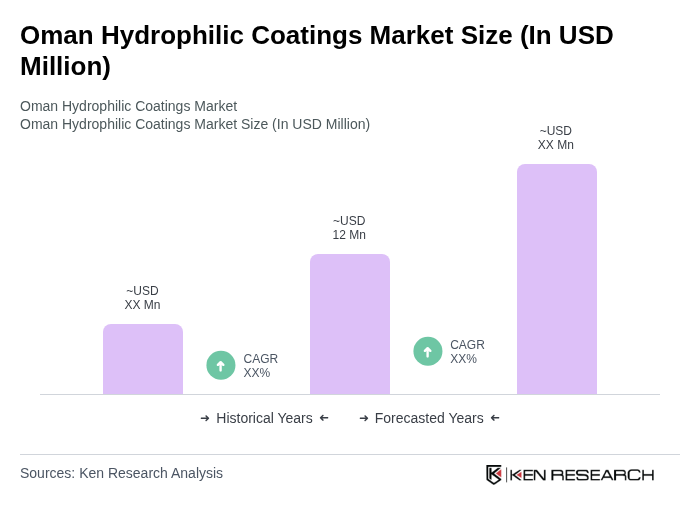
- The Oman Hydrophilic Coatings Market is valued at USD 12 million, based on a five-year historical analysis. This growth is primarily driven by the increasing demand for advanced coatings in healthcare and related sectors, where hydrophilic properties improve lubricity, biocompatibility, and device performance, alongside use in automotive, marine, and optics applications. The rising focus on environmentally responsible chemistries (including PFAS?free and low?VOC systems) and the need for innovative surface treatments for corrosion protection, fouling resistance, and moisture management further propel market expansion.
- Muscat and Salalah are the dominant cities in the Oman Hydrophilic Coatings Market due to their strategic locations and robust industrial and logistics infrastructure. Muscat, as the capital and main economic center, concentrates healthcare facilities, industrial activity, and most of the country’s distribution networks, making it a key demand hub for specialty coatings. Salalah, with its deep-sea port and free zone, supports import, re?export, and industrial operations, facilitating trade and regional distribution of coatings and coated products.
- In 2023, the Omani government strengthened regulations promoting the use of eco?friendly materials in coatings under the Environmental Protection and Pollution Control Law (Royal Decree No. 114/2001) and its implementing regulations issued by the Environment Authority, which set binding limits on volatile organic compounds (VOCs), hazardous substances, and waste management for industrial coatings manufacturers and importers. These requirements drive producers and suppliers of coatings in Oman to adopt more sustainable formulations, invest in compliant technologies, and ensure that new coating products meet defined environmental performance and safety standards.
Oman Hydrophilic Coatings Market Segmentation
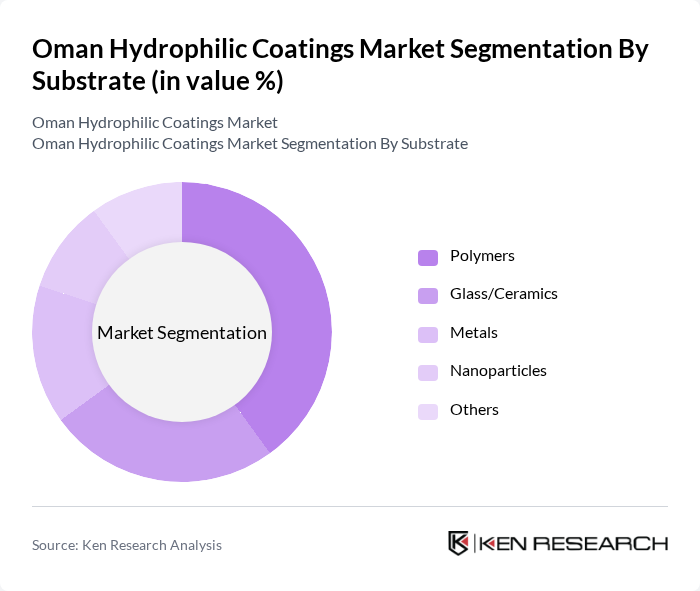
By Substrate:The substrate segment includes various materials that hydrophilic coatings can be applied to, such as polymers, glass/ceramics, metals, nanoparticles, and others, which is consistent with global market practice. Among these, polymers are the leading subsegment due to their versatility, ease of processing, and widespread use in catheters, guidewires, and other disposable medical devices, as well as in automotive and consumer products. The demand for lightweight and durable materials in medical and transport applications reinforces the preference for polymer substrates, making them a dominant choice for hydrophilic coatings.
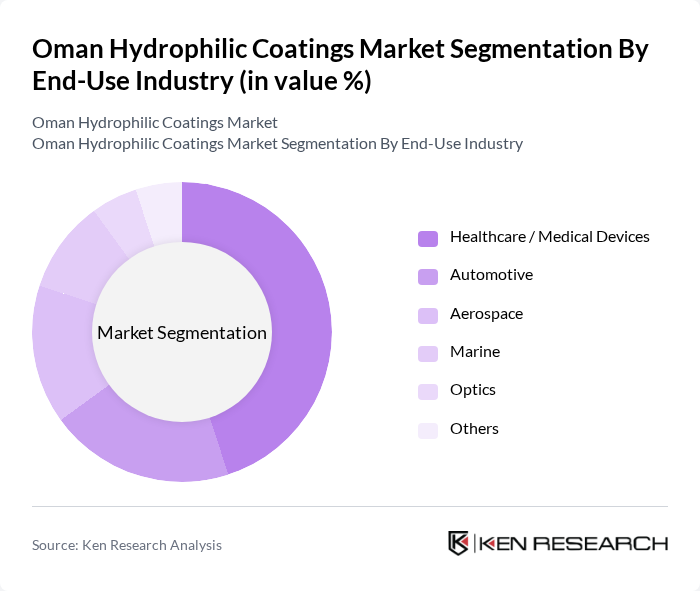
By End-Use Industry:The end-use industry segment encompasses various sectors utilizing hydrophilic coatings, including healthcare/medical devices, automotive, aerospace, marine, optics, and others, in line with global segmentation of this market. The healthcare/medical devices sector is the most significant contributor, driven by rising demand for minimally invasive devices, catheters, and diagnostic equipment that require hydrophilic properties for improved lubricity, reduced friction, and better patient safety, supported by continuous innovation in medical device coatings. Additional growth comes from automotive, aerospace, marine, and optics applications, where hydrophilic coatings are increasingly used to enhance visibility, reduce icing and fouling, and improve durability and maintenance performance.
Oman Hydrophilic Coatings Market Competitive Landscape
The Oman Hydrophilic Coatings Market is characterized by a dynamic mix of regional and international players. Leading participants such as PPG Industries, Inc., Akzo Nobel N.V., BASF SE, The Sherwin-Williams Company, Dow Inc., Nippon Paint Holdings Co., Ltd., Jotun A/S, RPM International Inc., Hempel A/S, Axalta Coating Systems Ltd., 3M Company, Henkel AG & Co. KGaA, Eastman Chemical Company, Clariant AG, Huntsman Corporation contribute to innovation, geographic expansion, and service delivery in this space, leveraging their global hydrophilic and functional coatings portfolios for applications in medical, marine, industrial, and transportation sectors.
Oman Hydrophilic Coatings Market Industry Analysis
Growth Drivers
- Increasing Demand for Anti-Fogging and Self-Cleaning Surfaces:The demand for hydrophilic coatings is significantly driven by the need for anti-fogging and self-cleaning surfaces, particularly in the automotive and construction sectors. In future, the automotive sector in Oman accounted for approximately 15% of the total market share, with a projected growth rate of 5% annually. This growth is fueled by rising consumer preferences for enhanced visibility and reduced maintenance costs, leading to increased adoption of hydrophilic coatings in vehicle manufacturing.
- Rising Awareness of Environmental Sustainability:The growing emphasis on environmental sustainability is propelling the hydrophilic coatings market in Oman. In future, the Omani government aims to reduce carbon emissions by 20%, promoting eco-friendly products. Hydrophilic coatings, which often utilize water-based formulations, align with these sustainability goals. The market for sustainable coatings is expected to reach $1.2 billion in the Middle East in future, indicating a robust shift towards environmentally responsible solutions in various industries.
- Technological Advancements in Coating Formulations:Continuous technological advancements in hydrophilic coating formulations are enhancing product performance and expanding application areas. In future, R&D investments in Oman are projected to exceed $50 million, focusing on developing innovative coatings with multifunctional properties. These advancements are expected to improve durability and functionality, making hydrophilic coatings more appealing to industries such as healthcare and electronics, which are increasingly seeking high-performance materials.
Market Challenges
- High Initial Costs of Hydrophilic Coatings:One of the significant challenges facing the hydrophilic coatings market in Oman is the high initial costs associated with these products. The average cost of hydrophilic coatings can range from $30 to $50 per liter, which can deter potential buyers, especially in price-sensitive sectors. This financial barrier is particularly pronounced in the construction industry, where budget constraints often limit the adoption of advanced coating technologies despite their long-term benefits.
- Limited Awareness Among End-Users:Limited awareness and understanding of hydrophilic coatings among end-users pose a challenge to market growth. A survey conducted in future indicated that only 40% of construction and automotive professionals in Oman were familiar with the benefits of hydrophilic coatings. This lack of knowledge can hinder market penetration, as potential customers may opt for traditional coatings that they are more familiar with, despite the superior advantages offered by hydrophilic solutions.
Oman Hydrophilic Coatings Market Future Outlook
The future of the hydrophilic coatings market in Oman appears promising, driven by increasing investments in sustainable technologies and a growing focus on multifunctional coatings. As industries continue to prioritize eco-friendly solutions, the demand for hydrophilic coatings is expected to rise. Additionally, the expansion of the healthcare and electronics sectors will likely create new avenues for growth, with innovative applications emerging. The market is poised for significant transformation as awareness and acceptance of these advanced coatings increase among end-users.
Market Opportunities
- Expansion in the Healthcare and Medical Device Sectors:The healthcare sector presents a substantial opportunity for hydrophilic coatings, particularly in medical devices. With the Omani healthcare market projected to reach $5 billion in future, the demand for coatings that enhance biocompatibility and reduce bacterial adhesion is expected to grow, driving innovation and adoption in this field.
- Increasing Investments in R&D for Innovative Applications:The ongoing investments in research and development are creating opportunities for innovative applications of hydrophilic coatings. With over $50 million allocated for R&D in future, companies are likely to explore new markets, such as electronics and consumer goods, where advanced coatings can provide significant competitive advantages, enhancing product functionality and performance.
Scope of the Report
| Segment | Sub-Segments |
|---|---|
| By Substrate | Polymers Glass/Ceramics Metals Nanoparticles Others |
| By End-Use Industry | Healthcare / Medical Devices Automotive Aerospace Marine Optics Others |
| By Application Function | Lubricious / Low-Friction Coatings Anti-fogging Coatings Anti-fouling & Anti-soiling Coatings Self-cleaning Coatings Others |
| By Technology | Water-based Solvent-based UV-cured Others |
| By Distribution Channel | Direct Sales (Key Accounts & OEMs) Distributors & Local Agents Online / E-commerce Others |
| By Region | Muscat Salalah Sohar Duqm & Other Regions |
| By Customer Type | OEMs Contract Manufacturers / Coaters Hospitals & Healthcare Providers Government & Public Sector Others |
Key Target Audience
Investors and Venture Capitalist Firms
Government and Regulatory Bodies (e.g., Ministry of Commerce, Ministry of Environment and Climate Affairs)
Manufacturers and Producers of Hydrophilic Coatings
Distributors and Retailers of Coating Products
Construction and Infrastructure Companies
Aerospace and Automotive Industries
Research and Development Organizations
Financial Institutions and Banks
Players Mentioned in the Report:
PPG Industries, Inc.
Akzo Nobel N.V.
BASF SE
The Sherwin-Williams Company
Dow Inc.
Nippon Paint Holdings Co., Ltd.
Jotun A/S
RPM International Inc.
Hempel A/S
Axalta Coating Systems Ltd.
3M Company
Henkel AG & Co. KGaA
Eastman Chemical Company
Clariant AG
Huntsman Corporation
Table of Contents
Market Assessment Phase
1. Executive Summary and Approach
2. Oman Hydrophilic Coatings Market Overview
2.1 Key Insights and Strategic Recommendations
2.2 Oman Hydrophilic Coatings Market Overview
2.3 Definition and Scope
2.4 Evolution of Market Ecosystem
2.5 Timeline of Key Regulatory Milestones
2.6 Value Chain & Stakeholder Mapping
2.7 Business Cycle Analysis
2.8 Policy & Incentive Landscape
3. Oman Hydrophilic Coatings Market Analysis
3.1 Growth Drivers
3.1.1 Increasing demand for anti-fogging and self-cleaning surfaces
3.1.2 Rising awareness of environmental sustainability
3.1.3 Technological advancements in coating formulations
3.1.4 Growth in the construction and automotive sectors
3.2 Market Challenges
3.2.1 High initial costs of hydrophilic coatings
3.2.2 Limited awareness among end-users
3.2.3 Competition from alternative coating technologies
3.2.4 Regulatory hurdles in product approvals
3.3 Market Opportunities
3.3.1 Expansion in the healthcare and medical device sectors
3.3.2 Increasing investments in R&D for innovative applications
3.3.3 Growing demand in the electronics industry
3.3.4 Potential for export to neighboring regions
3.4 Market Trends
3.4.1 Shift towards eco-friendly and sustainable products
3.4.2 Increasing customization in coating solutions
3.4.3 Adoption of smart coatings with multifunctional properties
3.4.4 Rise in online sales channels for coatings
3.5 Government Regulation
3.5.1 Standards for environmental safety and performance
3.5.2 Regulations on chemical usage in coatings
3.5.3 Incentives for sustainable product development
3.5.4 Compliance requirements for import/export of coatings
4. SWOT Analysis
5. Stakeholder Analysis
6. Porter's Five Forces Analysis
7. Oman Hydrophilic Coatings Market Market Size, 2019-2024
7.1 By Value
7.2 By Volume
7.3 By Average Selling Price
8. Oman Hydrophilic Coatings Market Segmentation
8.1 By Substrate
8.1.1 Polymers
8.1.2 Glass/Ceramics
8.1.3 Metals
8.1.4 Nanoparticles
8.1.5 Others
8.2 By End-Use Industry
8.2.1 Healthcare / Medical Devices
8.2.2 Automotive
8.2.3 Aerospace
8.2.4 Marine
8.2.5 Optics
8.2.6 Others
8.3 By Application Function
8.3.1 Lubricious / Low-Friction Coatings
8.3.2 Anti-fogging Coatings
8.3.3 Anti-fouling & Anti-soiling Coatings
8.3.4 Self-cleaning Coatings
8.3.5 Others
8.4 By Technology
8.4.1 Water-based
8.4.2 Solvent-based
8.4.3 UV-cured
8.4.4 Others
8.5 By Distribution Channel
8.5.1 Direct Sales (Key Accounts & OEMs)
8.5.2 Distributors & Local Agents
8.5.3 Online / E-commerce
8.5.4 Others
8.6 By Region
8.6.1 Muscat
8.6.2 Salalah
8.6.3 Sohar
8.6.4 Duqm & Other Regions
8.7 By Customer Type
8.7.1 OEMs
8.7.2 Contract Manufacturers / Coaters
8.7.3 Hospitals & Healthcare Providers
8.7.4 Government & Public Sector
8.7.5 Others
9. Oman Hydrophilic Coatings Market Competitive Analysis
9.1 Market Share of Key Players
9.2 Cross Comparison of Key Players
9.2.1 Company Name
9.2.2 Group Size (Large, Medium, or Small as per industry convention)
9.2.3 Oman Hydrophilic Coatings Revenue (USD Mn)
9.2.4 3-year Revenue CAGR in Oman (%)
9.2.5 Oman Market Share (%)
9.2.6 EBITDA Margin from Hydrophilic Coatings (%)
9.2.7 R&D Intensity (% of Sales)
9.2.8 Product Launches / Year in Hydrophilic Coatings
9.2.9 Average Realized Price per kg (USD/kg)
9.2.10 Capacity Utilization in Oman (%)
9.2.11 Export Share of Sales from Oman (%)
9.2.12 Key Strategic Partnerships / OEM Tie-ups (Count)
9.2.13 On-time Delivery Rate (%)
9.2.14 Customer Satisfaction / NPS Score
9.3 SWOT Analysis of Top Players
9.4 Pricing Analysis
9.5 Detailed Profile of Major Companies
9.5.1 PPG Industries, Inc.
9.5.2 Akzo Nobel N.V.
9.5.3 BASF SE
9.5.4 The Sherwin-Williams Company
9.5.5 Dow Inc.
9.5.6 Nippon Paint Holdings Co., Ltd.
9.5.7 Jotun A/S
9.5.8 RPM International Inc.
9.5.9 Hempel A/S
9.5.10 Axalta Coating Systems Ltd.
9.5.11 3M Company
9.5.12 Henkel AG & Co. KGaA
9.5.13 Eastman Chemical Company
9.5.14 Clariant AG
9.5.15 Huntsman Corporation
10. Oman Hydrophilic Coatings Market End-User Analysis
10.1 Procurement Behavior of Key Ministries
10.1.1 Key procurement processes
10.1.2 Budget allocation trends
10.1.3 Preferred suppliers
10.1.4 Compliance requirements
10.2 Corporate Spend on Infrastructure & Energy
10.2.1 Investment trends in infrastructure
10.2.2 Energy efficiency initiatives
10.2.3 Budget priorities
10.2.4 Collaboration with private sector
10.3 Pain Point Analysis by End-User Category
10.3.1 Common challenges faced
10.3.2 Impact of regulations
10.3.3 Cost-related issues
10.3.4 Quality concerns
10.4 User Readiness for Adoption
10.4.1 Awareness levels
10.4.2 Training and support needs
10.4.3 Adoption barriers
10.4.4 Feedback mechanisms
10.5 Post-Deployment ROI and Use Case Expansion
10.5.1 Measurement of ROI
10.5.2 Case studies of successful implementations
10.5.3 Opportunities for scaling
10.5.4 Future use cases
11. Oman Hydrophilic Coatings Market Future Size, 2025-2030
11.1 By Value
11.2 By Volume
11.3 By Average Selling Price
Go-To-Market Strategy Phase
1. Whitespace Analysis + Business Model Canvas
1.1 Market gaps identification
1.2 Value proposition development
1.3 Revenue model exploration
1.4 Customer segmentation
1.5 Key partnerships
1.6 Cost structure analysis
1.7 Competitive advantage assessment
2. Marketing and Positioning Recommendations
2.1 Branding strategies
2.2 Product USPs
2.3 Target audience identification
2.4 Communication strategies
2.5 Digital marketing initiatives
3. Distribution Plan
3.1 Urban retail strategies
3.2 Rural NGO tie-ups
3.3 E-commerce strategies
3.4 Logistics and supply chain management
4. Channel & Pricing Gaps
4.1 Underserved routes
4.2 Pricing bands analysis
4.3 Competitor pricing strategies
4.4 Customer willingness to pay
5. Unmet Demand & Latent Needs
5.1 Category gaps
5.2 Consumer segments analysis
5.3 Emerging trends identification
5.4 Future demand forecasting
6. Customer Relationship
6.1 Loyalty programs
6.2 After-sales service
6.3 Customer feedback mechanisms
6.4 Community engagement strategies
7. Value Proposition
7.1 Sustainability initiatives
7.2 Integrated supply chains
7.3 Unique selling points
7.4 Customer-centric approaches
8. Key Activities
8.1 Regulatory compliance
8.2 Branding efforts
8.3 Distribution setup
8.4 Training and development
9. Entry Strategy Evaluation
9.1 Domestic Market Entry Strategy
9.1.1 Product mix considerations
9.1.2 Pricing band analysis
9.1.3 Packaging strategies
9.2 Export Entry Strategy
9.2.1 Target countries identification
9.2.2 Compliance roadmap development
10. Entry Mode Assessment
10.1 Joint Ventures
10.2 Greenfield investments
10.3 Mergers & Acquisitions
10.4 Distributor Model
11. Capital and Timeline Estimation
11.1 Capital requirements
11.2 Timelines for implementation
12. Control vs Risk Trade-Off
12.1 Ownership considerations
12.2 Partnerships evaluation
13. Profitability Outlook
13.1 Breakeven analysis
13.2 Long-term sustainability strategies
14. Potential Partner List
14.1 Distributors
14.2 Joint Ventures
14.3 Acquisition targets
15. Execution Roadmap
15.1 Phased Plan for Market Entry
15.1.1 Market Setup
15.1.2 Market Entry
15.1.3 Growth Acceleration
15.1.4 Scale & Stabilize
15.2 Key Activities and Milestones
15.2.1 Milestone tracking
15.2.2 Activity scheduling
Research Methodology
Phase 1: Approach1
Desk Research
- Industry reports from Oman’s Ministry of Commerce and Industry
- Market analysis publications from regional trade associations
- Academic journals focusing on hydrophilic coatings and their applications
Primary Research
- Interviews with key decision-makers in the coatings manufacturing sector
- Surveys targeting end-users in automotive, aerospace, and medical industries
- Field visits to manufacturing plants to gather firsthand insights
Validation & Triangulation
- Cross-validation of data from multiple industry sources and reports
- Triangulation of findings from primary interviews and secondary data
- Sanity checks through expert panels comprising industry veterans
Phase 2: Market Size Estimation1
Top-down Assessment
- Analysis of national economic indicators and their correlation with coating demand
- Segmentation of the market by application areas and end-user industries
- Incorporation of government initiatives promoting advanced coating technologies
Bottom-up Modeling
- Volume estimates based on production capacities of leading manufacturers
- Cost analysis derived from pricing strategies of hydrophilic coatings
- Estimation of market share based on sales data from key players
Forecasting & Scenario Analysis
- Multi-variable regression analysis considering economic growth and technological advancements
- Scenario planning based on potential regulatory changes and market trends
- Development of baseline, optimistic, and pessimistic forecasts through 2030
Phase 3: CATI Sample Composition1
| Scope Item/Segment | Sample Size | Target Respondent Profiles |
|---|---|---|
| Automotive Coatings | 120 | Product Managers, Quality Assurance Leads |
| Aerospace Applications | 90 | Engineering Managers, Procurement Specialists |
| Medical Device Coatings | 70 | Regulatory Affairs Managers, R&D Directors |
| Consumer Goods Coatings | 80 | Marketing Managers, Product Development Teams |
| Industrial Applications | 60 | Operations Managers, Supply Chain Coordinators |
Frequently Asked Questions
What is the current value of the Oman Hydrophilic Coatings Market?
The Oman Hydrophilic Coatings Market is valued at approximately USD 12 million, based on a five-year historical analysis. This valuation reflects the growing demand for advanced coatings across various sectors, particularly healthcare and automotive.
What are the main applications of hydrophilic coatings in Oman?
Which cities are key players in the Oman Hydrophilic Coatings Market?
What factors are driving the growth of the hydrophilic coatings market in Oman?
Other Regional/Country Reports
Other Adjacent Reports
Philippines Aerospace Coatings Market
South Africa Optical Coatings Market
KSA medical device coatings market Size, Share, Growth Drivers, Trends, Opportunities & Forecast 2025–2030South Africa Anti-Corrosion Coatings Market
Germany Antifouling Coatings Market
Philippines Self-Cleaning Coatings Market
South Korea Anti-Fog Coatings Market
Bahrain Sustainable Coatings Market
Why Buy From Us?

What makes us stand out is that our consultants follow Robust, Refine and Result (RRR) methodology. Robust for clear definitions, approaches and sanity checking, Refine for differentiating respondents' facts and opinions, and Result for presenting data with story.

We have set a benchmark in the industry by offering our clients with syndicated and customized market research reports featuring coverage of entire market as well as meticulous research and analyst insights.

While we don't replace traditional research, we flip the method upside down. Our dual approach of Top Bottom & Bottom Top ensures quality deliverable by not just verifying company fundamentals but also looking at the sector and macroeconomic factors.

With one step in the future, our research team constantly tries to show you the bigger picture. We help with some of the tough questions you may encounter along the way: How is the industry positioned? Best marketing channel? KPI's of competitors? By aligning every element, we help maximize success.

Our report gives you instant access to the answers and sources that other companies might choose to hide. We elaborate each steps of research methodology we have used and showcase you the sample size to earn your trust.

If you need any support, we are here! We pride ourselves on universe strength, data quality, and quick, friendly, and professional service.