About the Report
Base Year 2024Philippines Hydrophilic Coatings Market Overview
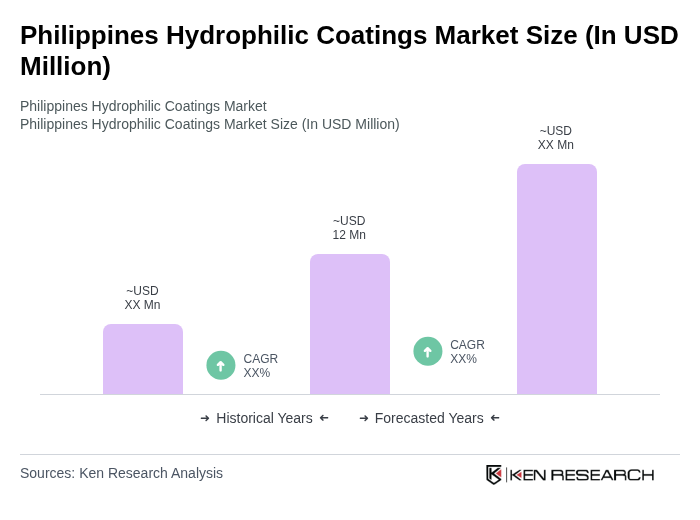
- The Philippines Hydrophilic Coatings Market is valued at USD 12 million, based on a five-year historical analysis, as part of the broader Asia–Pacific hydrophilic coatings industry that holds the largest share of a global market estimated at over USD 11 billion. This growth is primarily driven by the increasing demand for advanced coatings in medical devices, automotive components, and electronics, in line with rapid manufacturing expansion and foreign direct investment in the Philippines and Southeast Asia. The rising awareness of the benefits of hydrophilic coatings, such as improved wettability, lubricity for catheters and guidewires, and anti-fogging and anti-contamination properties for optical and electronic surfaces, has further supported market expansion.
- Metro Manila, Cebu, and Davao are the dominant regions in the Philippines Hydrophilic Coatings Market. Metro Manila, being the capital, has a high concentration of industrial parks, automotive assembly, healthcare facilities, and research institutions, which drives innovation and demand for specialty coatings. Cebu and Davao are also emerging as industrial and logistics hubs, with growing investments in manufacturing, electronics assembly, ship repair, and medical services, which in turn supports demand for functional and performance coatings, including hydrophilic systems.
- The Philippine government has implemented regulations to promote the use of environmentally friendly coatings. The Department of Environment and Natural Resources (DENR), through the Revised Chemical Control Order (CCO) for Ozone Depleting Substances issued under DENR Administrative Order 2013-25 and related implementing rules, restricts hazardous substances and encourages the shift to low-emission, compliant coatings systems in manufacturing. In parallel, the Philippine Clean Air Act framework and DENR guidelines on air quality management drive adoption of low-VOC (volatile organic compounds) coatings, including waterborne and high?solids hydrophilic coatings, to reduce solvent emissions while maintaining or enhancing product performance.
Philippines Hydrophilic Coatings Market Segmentation
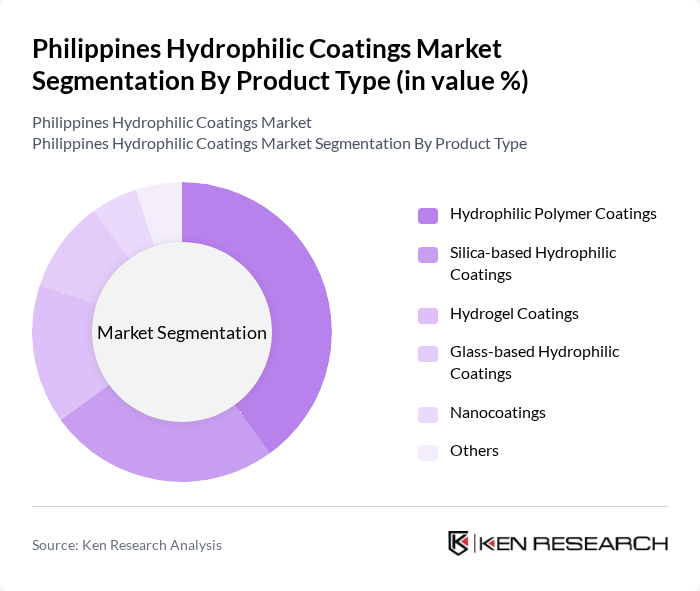
By Product Type:The product type segmentation includes various categories of hydrophilic coatings, each serving distinct applications and industries. The subsegments are Hydrophilic Polymer Coatings, Silica-based Hydrophilic Coatings, Hydrogel Coatings, Glass-based Hydrophilic Coatings, Nanocoatings, and Others. Hydrophilic Polymer Coatings are leading the market due to their versatility and widespread use in medical devices, catheters, guidewires, and consumer goods, reflecting the global trend where polymer-based systems account for the largest share of hydrophilic coatings demand. The increasing demand for high-performance, lubricious, and biocompatible coatings in minimally invasive medical procedures, as well as anti-fog and easy-clean surfaces in optics and electronics, is driving the growth of this subsegment.
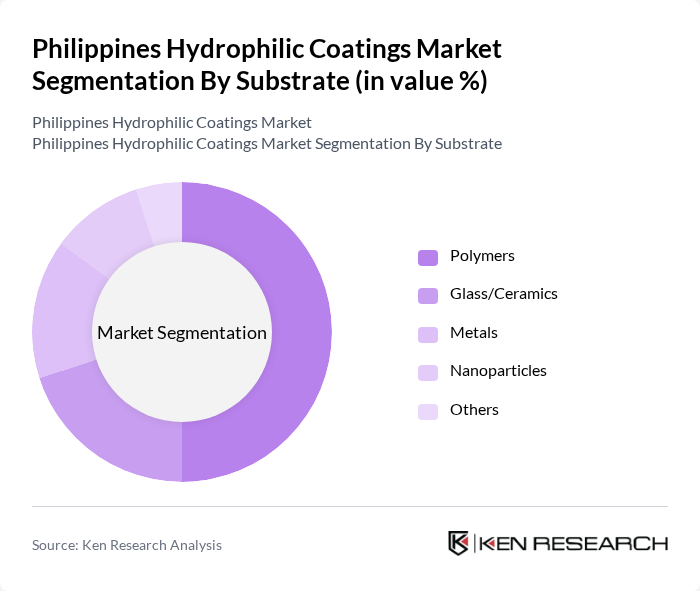
By Substrate:The substrate segmentation encompasses various materials that hydrophilic coatings can be applied to, including Polymers, Glass/Ceramics, Metals, Nanoparticles, and Others. Polymers are the dominant substrate in this market due to their extensive use in disposable and reusable medical devices, flexible tubing, and consumer products, mirroring the global pattern where polymer substrates represent the largest share of hydrophilic coating applications. The adaptability of hydrophilic coatings on polymer substrates enhances their lubricity, wetting, and biocompatibility, making them a preferred choice for manufacturers in medical, automotive, and electronics sectors.
Philippines Hydrophilic Coatings Market Competitive Landscape
The Philippines Hydrophilic Coatings Market is characterized by a dynamic mix of regional and international players. Leading participants such as PPG Industries, Inc., AkzoNobel N.V., BASF SE, The Sherwin-Williams Company, Dow Inc., 3M Company, Huntsman Corporation, Eastman Chemical Company, Covestro AG, Nippon Paint Holdings Co., Ltd., Jotun A/S, RPM International Inc., Hempel A/S, Axalta Coating Systems Ltd., The Valspar Corporation (now part of The Sherwin-Williams Company) contribute to innovation, geographic expansion, and service delivery in this space.
Philippines Hydrophilic Coatings Market Industry Analysis
Growth Drivers
- Increasing Demand for Anti-Fogging and Anti-Reflective Coatings:The Philippines has seen a surge in demand for hydrophilic coatings, particularly in the automotive and eyewear sectors, driven by a 15% increase in consumer preference for anti-fogging solutions. The automotive industry alone is projected to contribute approximately PHP 2.5 billion in revenue in future, as manufacturers seek to enhance visibility and safety features in vehicles. This trend is further supported by rising consumer awareness regarding product performance and safety.
- Growth in the Healthcare and Medical Device Sectors:The healthcare sector in the Philippines is expected to grow at a rate of 10% annually, with the medical device market projected to reach PHP 50 billion in future. This growth is driving the demand for hydrophilic coatings, which are essential for medical devices to enhance biocompatibility and reduce infection risks. The increasing number of surgical procedures and the rise in chronic diseases are further propelling this demand, creating a robust market for specialized coatings.
- Rising Awareness of Environmental Sustainability:With the Philippines committing to reduce greenhouse gas emissions by 70% in future, there is a growing emphasis on eco-friendly products. The hydrophilic coatings market is benefiting from this trend, as manufacturers are increasingly adopting sustainable practices. In future, it is estimated that 30% of new coatings will be developed with environmentally friendly materials, reflecting a significant shift towards sustainability in the industry, driven by both consumer demand and regulatory pressures.
Market Challenges
- High Production Costs of Hydrophilic Coatings:The production of hydrophilic coatings involves advanced technologies and raw materials, leading to high manufacturing costs. In future, the average cost of production is expected to be around PHP 1,200 per liter, which poses a challenge for manufacturers aiming to maintain competitive pricing. This high cost can limit market penetration, particularly among small and medium enterprises that struggle to invest in expensive production technologies.
- Limited Awareness Among End-Users:Despite the benefits of hydrophilic coatings, there remains a significant knowledge gap among potential end-users, particularly in non-industrial sectors. A survey indicated that only 40% of consumers are aware of the advantages of these coatings. This lack of awareness can hinder market growth, as potential customers may opt for traditional coatings without understanding the long-term benefits of hydrophilic alternatives, impacting overall adoption rates.
Philippines Hydrophilic Coatings Market Future Outlook
The future of the hydrophilic coatings market in the Philippines appears promising, driven by technological advancements and increasing environmental consciousness. As manufacturers invest in research and development, innovative applications are likely to emerge, enhancing product performance and sustainability. Additionally, the growing trend towards smart coatings, which integrate functionalities like self-cleaning and anti-bacterial properties, is expected to attract new customers and expand market reach, fostering a competitive landscape that prioritizes innovation and eco-friendliness.
Market Opportunities
- Expansion in Emerging Markets:The rising middle class in Southeast Asia presents a significant opportunity for hydrophilic coatings. With an estimated 50 million people entering the middle class in future, demand for high-quality consumer products, including automotive and healthcare applications, is expected to rise, creating new market avenues for manufacturers.
- Development of Innovative Product Applications:There is a growing potential for hydrophilic coatings in niche markets such as electronics and textiles. As industries seek to enhance product functionality, the integration of hydrophilic coatings can lead to innovative solutions, such as moisture management in textiles, which could capture a market share worth PHP 1 billion in future, driving further growth.
Scope of the Report
| Segment | Sub-Segments |
|---|---|
| By Product Type | Hydrophilic Polymer Coatings Silica-based Hydrophilic Coatings Hydrogel Coatings Glass-based Hydrophilic Coatings Nanocoatings Others |
| By Substrate | Polymers Glass/Ceramics Metals Nanoparticles Others |
| By End-User Industry | Medical Devices Optics & Ophthalmology Automotive Aerospace Marine Electronics & Consumer Goods Industrial Applications Others |
| By Application Function | Lubricious / Low-friction Coatings Anti-fogging Anti-reflective Self-cleaning / Easy-to-clean Moisture Retention & Wetting Control Others |
| By Technology | Water-based Solvent-based UV-cured Plasma / Chemical Vapor Deposition Others |
| By Distribution Channel | Direct Sales to OEMs Distributors / Traders Contract Coating Service Providers Online / Digital Channels Others |
| By Region | Luzon Visayas Mindanao |
Key Target Audience
Investors and Venture Capitalist Firms
Government and Regulatory Bodies (e.g., Department of Trade and Industry, Department of Environment and Natural Resources)
Manufacturers and Producers
Distributors and Retailers
Construction and Infrastructure Companies
Aerospace and Automotive Industries
Healthcare and Medical Device Manufacturers
Coating Technology Developers
Players Mentioned in the Report:
PPG Industries, Inc.
AkzoNobel N.V.
BASF SE
The Sherwin-Williams Company
Dow Inc.
3M Company
Huntsman Corporation
Eastman Chemical Company
Covestro AG
Nippon Paint Holdings Co., Ltd.
Jotun A/S
RPM International Inc.
Hempel A/S
Axalta Coating Systems Ltd.
The Valspar Corporation (now part of The Sherwin-Williams Company)
Table of Contents
Market Assessment Phase
1. Executive Summary and Approach
2. Philippines Hydrophilic Coatings Market Overview
2.1 Key Insights and Strategic Recommendations
2.2 Philippines Hydrophilic Coatings Market Overview
2.3 Definition and Scope
2.4 Evolution of Market Ecosystem
2.5 Timeline of Key Regulatory Milestones
2.6 Value Chain & Stakeholder Mapping
2.7 Business Cycle Analysis
2.8 Policy & Incentive Landscape
3. Philippines Hydrophilic Coatings Market Analysis
3.1 Growth Drivers
3.1.1 Increasing demand for anti-fogging and anti-reflective coatings
3.1.2 Growth in the healthcare and medical device sectors
3.1.3 Rising awareness of environmental sustainability
3.1.4 Technological advancements in coating formulations
3.2 Market Challenges
3.2.1 High production costs of hydrophilic coatings
3.2.2 Limited awareness among end-users
3.2.3 Stringent regulatory requirements
3.2.4 Competition from alternative coating technologies
3.3 Market Opportunities
3.3.1 Expansion in emerging markets
3.3.2 Development of innovative product applications
3.3.3 Collaborations with research institutions
3.3.4 Increasing investments in R&D
3.4 Market Trends
3.4.1 Shift towards eco-friendly and sustainable coatings
3.4.2 Growing adoption of smart coatings
3.4.3 Integration of nanotechnology in coatings
3.4.4 Rise in customization of coating solutions
3.5 Government Regulation
3.5.1 Compliance with environmental standards
3.5.2 Incentives for green technology adoption
3.5.3 Regulations on hazardous materials
3.5.4 Standards for product safety and efficacy
4. SWOT Analysis
5. Stakeholder Analysis
6. Porter's Five Forces Analysis
7. Philippines Hydrophilic Coatings Market Market Size, 2019-2024
7.1 By Value
7.2 By Volume
7.3 By Average Selling Price
8. Philippines Hydrophilic Coatings Market Segmentation
8.1 By Product Type
8.1.1 Hydrophilic Polymer Coatings
8.1.2 Silica-based Hydrophilic Coatings
8.1.3 Hydrogel Coatings
8.1.4 Glass-based Hydrophilic Coatings
8.1.5 Nanocoatings
8.1.6 Others
8.2 By Substrate
8.2.1 Polymers
8.2.2 Glass/Ceramics
8.2.3 Metals
8.2.4 Nanoparticles
8.2.5 Others
8.3 By End-User Industry
8.3.1 Medical Devices
8.3.2 Optics & Ophthalmology
8.3.3 Automotive
8.3.4 Aerospace
8.3.5 Marine
8.3.6 Electronics & Consumer Goods
8.3.7 Industrial Applications
8.3.8 Others
8.4 By Application Function
8.4.1 Lubricious / Low-friction Coatings
8.4.2 Anti-fogging
8.4.3 Anti-reflective
8.4.4 Self-cleaning / Easy-to-clean
8.4.5 Moisture Retention & Wetting Control
8.4.6 Others
8.5 By Technology
8.5.1 Water-based
8.5.2 Solvent-based
8.5.3 UV-cured
8.5.4 Plasma / Chemical Vapor Deposition
8.5.5 Others
8.6 By Distribution Channel
8.6.1 Direct Sales to OEMs
8.6.2 Distributors / Traders
8.6.3 Contract Coating Service Providers
8.6.4 Online / Digital Channels
8.6.5 Others
8.7 By Region
8.7.1 Luzon
8.7.2 Visayas
8.7.3 Mindanao
9. Philippines Hydrophilic Coatings Market Competitive Analysis
9.1 Market Share of Key Players
9.2 Cross Comparison of Key Players
9.2.1 Company Name
9.2.2 Revenue from Hydrophilic Coatings (Philippines)
9.2.3 3-year Revenue CAGR (Hydrophilic Coatings Segment)
9.2.4 Hydrophilic Coatings Volume Sold (tons / KL) in the Philippines
9.2.5 Market Share (% of Philippines Hydrophilic Coatings Market)
9.2.6 EBITDA Margin (%) – Coatings Business
9.2.7 R&D Intensity (% of Revenue)
9.2.8 Capex Intensity (% of Revenue)
9.2.9 Average Selling Price per Unit (USD/kg or USD/L)
9.2.10 Customer Concentration (Top 5 Customers’ % of Sales)
9.2.11 Geographic Footprint in the Philippines (No. of Facilities / Warehouses)
9.2.12 Distribution Reach (No. of Active Distributors / OEM Relationships)
9.2.13 New Product Launches in Last 3 Years (Count)
9.2.14 Patent Portfolio Related to Hydrophilic Coatings (Count)
9.2.15 On-time Delivery Performance (%)
9.2.16 ESG / Sustainability Score (Where Disclosed)
9.3 SWOT Analysis of Top Players
9.4 Pricing Analysis
9.5 Detailed Profile of Major Companies
9.5.1 PPG Industries, Inc.
9.5.2 AkzoNobel N.V.
9.5.3 BASF SE
9.5.4 The Sherwin-Williams Company
9.5.5 Dow Inc.
9.5.6 3M Company
9.5.7 Huntsman Corporation
9.5.8 Eastman Chemical Company
9.5.9 Covestro AG
9.5.10 Nippon Paint Holdings Co., Ltd.
9.5.11 Jotun A/S
9.5.12 RPM International Inc.
9.5.13 Hempel A/S
9.5.14 Axalta Coating Systems Ltd.
9.5.15 The Valspar Corporation (now part of The Sherwin-Williams Company)
10. Philippines Hydrophilic Coatings Market End-User Analysis
10.1 Procurement Behavior of Key Ministries
10.1.1 Government procurement processes
10.1.2 Budget allocation for hydrophilic coatings
10.1.3 Evaluation criteria for suppliers
10.1.4 Contract management practices
10.2 Corporate Spend on Infrastructure & Energy
10.2.1 Investment trends in infrastructure projects
10.2.2 Energy efficiency initiatives
10.2.3 Budgeting for coating applications
10.2.4 Corporate sustainability goals
10.3 Pain Point Analysis by End-User Category
10.3.1 Challenges faced by healthcare providers
10.3.2 Issues in automotive applications
10.3.3 Concerns in industrial manufacturing
10.3.4 Others
10.4 User Readiness for Adoption
10.4.1 Awareness of hydrophilic coatings
10.4.2 Training and support needs
10.4.3 Adoption barriers
10.4.4 Others
10.5 Post-Deployment ROI and Use Case Expansion
10.5.1 Measurement of ROI
10.5.2 Case studies of successful implementations
10.5.3 Opportunities for scaling
10.5.4 Others
11. Philippines Hydrophilic Coatings Market Future Size, 2025-2030
11.1 By Value
11.2 By Volume
11.3 By Average Selling Price
Go-To-Market Strategy Phase
1. Whitespace Analysis + Business Model Canvas
1.1 Market gaps identification
1.2 Value proposition development
1.3 Revenue model exploration
1.4 Customer segmentation analysis
1.5 Key partnerships identification
1.6 Cost structure analysis
1.7 Channels of distribution
2. Marketing and Positioning Recommendations
2.1 Branding strategies
2.2 Product USPs
2.3 Target audience identification
2.4 Communication strategies
2.5 Digital marketing initiatives
2.6 Trade show participation
2.7 Customer engagement tactics
3. Distribution Plan
3.1 Urban retail vs rural NGO tie-ups
3.2 Distribution channel optimization
3.3 Logistics and supply chain management
3.4 Partnership with local distributors
3.5 E-commerce strategies
3.6 Inventory management practices
3.7 Customer service enhancements
4. Channel & Pricing Gaps
4.1 Underserved routes
4.2 Pricing bands
4.3 Competitor pricing analysis
4.4 Value-based pricing strategies
4.5 Discounts and promotions
4.6 Price elasticity considerations
4.7 Customer feedback on pricing
5. Unmet Demand & Latent Needs
5.1 Category gaps
5.2 Consumer segments
5.3 Emerging trends analysis
5.4 Product development opportunities
5.5 Market entry barriers
5.6 Customer pain points
5.7 Future demand forecasting
6. Customer Relationship
6.1 Loyalty programs
6.2 After-sales service
6.3 Customer feedback mechanisms
6.4 Relationship management strategies
6.5 Community engagement initiatives
6.6 Customer education programs
6.7 Retention strategies
7. Value Proposition
7.1 Sustainability
7.2 Integrated supply chains
7.3 Cost-effectiveness
7.4 Quality assurance
7.5 Customization options
7.6 Innovation in product offerings
7.7 Customer-centric approach
8. Key Activities
8.1 Regulatory compliance
8.2 Branding
8.3 Distribution setup
8.4 Market research
8.5 Training and development
8.6 Performance monitoring
8.7 Stakeholder engagement
9. Entry Strategy Evaluation
9.1 Domestic Market Entry Strategy
9.1.1 Product mix
9.1.2 Pricing band
9.1.3 Packaging
9.2 Export Entry Strategy
9.2.1 Target countries
9.2.2 Compliance roadmap
10. Entry Mode Assessment
10.1 JV
10.2 Greenfield
10.3 M&A
10.4 Distributor Model
11. Capital and Timeline Estimation
11.1 Capital requirements
11.2 Timelines
12. Control vs Risk Trade-Off
12.1 Ownership vs Partnerships
13. Profitability Outlook
13.1 Breakeven analysis
13.2 Long-term sustainability
14. Potential Partner List
14.1 Distributors
14.2 JVs
14.3 Acquisition targets
15. Execution Roadmap
15.1 Phased Plan for Market Entry
15.1.1 Market Setup
15.1.2 Market Entry
15.1.3 Growth Acceleration
15.1.4 Scale & Stabilize
15.2 Key Activities and Milestones
15.2.1 Milestone tracking
15.2.2 Activity scheduling
15.2.3 Resource allocation
Research Methodology
Phase 1: Approach1
Desk Research
- Industry reports from the Philippine Coatings Association and relevant trade organizations
- Market analysis from government publications and statistical agencies
- Academic journals and white papers focusing on hydrophilic coatings applications
Primary Research
- Interviews with product managers at leading hydrophilic coatings manufacturers
- Surveys with end-users in sectors such as automotive, healthcare, and construction
- Field visits to manufacturing plants to gather insights on production processes
Validation & Triangulation
- Cross-validation of data from multiple industry sources to ensure accuracy
- Triangulation of findings from primary interviews and secondary data sources
- Sanity checks through expert panels comprising industry veterans and researchers
Phase 2: Market Size Estimation1
Top-down Assessment
- Analysis of national demand for hydrophilic coatings based on industry growth rates
- Segmentation of the market by application areas such as medical devices and automotive
- Incorporation of macroeconomic indicators affecting the coatings industry
Bottom-up Modeling
- Estimation of production capacities of key manufacturers in the Philippines
- Cost analysis based on raw material prices and production processes
- Volume estimates derived from sales data of hydrophilic coatings products
Forecasting & Scenario Analysis
- Utilization of time-series analysis to project market growth over the next five years
- Scenario modeling based on potential regulatory changes and technological advancements
- Development of best-case, worst-case, and most-likely market scenarios
Phase 3: CATI Sample Composition1
| Scope Item/Segment | Sample Size | Target Respondent Profiles |
|---|---|---|
| Medical Device Manufacturers | 120 | Product Development Managers, Quality Assurance Officers |
| Automotive Coating Applications | 90 | Procurement Managers, R&D Engineers |
| Construction Industry Coatings | 80 | Project Managers, Architects |
| Consumer Goods Sector | 70 | Marketing Managers, Product Managers |
| Research Institutions and Universities | 60 | Research Scientists, Professors |
Frequently Asked Questions
What is the current value of the Philippines Hydrophilic Coatings Market?
The Philippines Hydrophilic Coatings Market is valued at approximately USD 12 million, reflecting a significant segment of the broader Asia-Pacific hydrophilic coatings industry, which is estimated to exceed USD 11 billion globally.
What are the main drivers of growth in the Philippines Hydrophilic Coatings Market?
Which regions in the Philippines dominate the Hydrophilic Coatings Market?
What types of hydrophilic coatings are available in the Philippines?
Other Regional/Country Reports
Other Adjacent Reports
Qatar Electronics Coatings Market
Egypt Optical Coatings Market
Philippines Polymer Coatings Market
Oman Nanocoatings MarketBelgium Hydrogel Coatings Market
Malaysia Anti-Fog Coatings Market
Brazil Biocompatible Coatings Market
Philippines Industrial Coatings Market Size, Share & Forecast, By Product Type, End-Use Industry & Technology, 2026–2032Why Buy From Us?

What makes us stand out is that our consultants follow Robust, Refine and Result (RRR) methodology. Robust for clear definitions, approaches and sanity checking, Refine for differentiating respondents' facts and opinions, and Result for presenting data with story.

We have set a benchmark in the industry by offering our clients with syndicated and customized market research reports featuring coverage of entire market as well as meticulous research and analyst insights.

While we don't replace traditional research, we flip the method upside down. Our dual approach of Top Bottom & Bottom Top ensures quality deliverable by not just verifying company fundamentals but also looking at the sector and macroeconomic factors.

With one step in the future, our research team constantly tries to show you the bigger picture. We help with some of the tough questions you may encounter along the way: How is the industry positioned? Best marketing channel? KPI's of competitors? By aligning every element, we help maximize success.

Our report gives you instant access to the answers and sources that other companies might choose to hide. We elaborate each steps of research methodology we have used and showcase you the sample size to earn your trust.

If you need any support, we are here! We pride ourselves on universe strength, data quality, and quick, friendly, and professional service.