Region:Asia
Author(s):Rebecca
Product Code:KRAA5410
Pages:81
Published On:January 2026
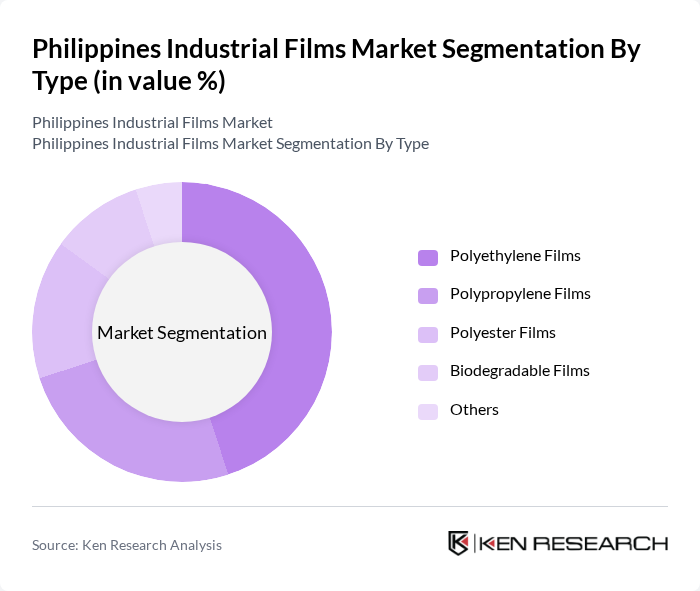
By Type:The market is segmented into various types of films, including Polyethylene Films, Polypropylene Films, Polyester Films, Biodegradable Films, and Others. Polyethylene films dominate the market due to their versatility, cost-effectiveness, and widespread use in packaging applications. The increasing focus on sustainability has also led to a rise in the demand for biodegradable films, which are gaining traction among environmentally conscious consumers. Technological advancements in polymer science, including enhanced polyethylene (PE), polypropylene (PP), PET, nylons, and polycarbonate films, are enabling high-performance films suited for extreme industrial conditions.
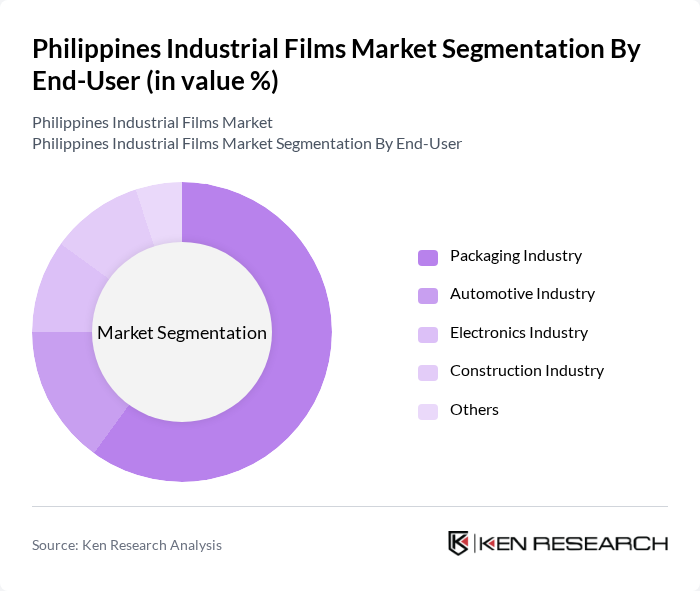
By End-User:The industrial films market is segmented by end-user industries, including Packaging Industry, Automotive Industry, Electronics Industry, Construction Industry, and Others. The packaging industry is the largest end-user, driven by the growing demand for flexible packaging solutions in food and consumer goods, alongside exponential growth in e-commerce and cold-chain logistics. The automotive and electronics industries also contribute significantly, as they require specialized films for protective and functional applications, including insulation layers, optical layers, dielectric coatings, and contamination-resistant precision-grade films for semiconductor manufacturing and PCB assembly.
The Philippines Industrial Films Market is characterized by a dynamic mix of regional and international players. Leading participants such as UPL Corporation, A. Brown Company, Inc., JG Summit Petrochemicals Group, D&L Industries, Inc., San Miguel Yamamura Packaging Corporation, Universal Robina Corporation, Philippine Plastic Industry Association, A. M. M. A. Packaging, Filpack Packaging Corporation, Tetra Pak Philippines, Inc., PPI (Philippine Plastics, Inc.), A. C. R. Plastics, M. S. M. Plastics, A. C. M. Plastics, A. B. C. Plastics contribute to innovation, geographic expansion, and service delivery in this space.
The Philippines industrial films market is poised for transformation as sustainability becomes a core focus for manufacturers and consumers alike. With the government's commitment to reducing plastic waste and promoting eco-friendly materials, companies are likely to invest in research and development for innovative, biodegradable films. Additionally, the growth of e-commerce will continue to drive demand for versatile packaging solutions, creating opportunities for businesses to expand their product offerings and enhance operational efficiencies in production processes.
| Segment | Sub-Segments |
|---|---|
| By Type | Polyethylene Films Polypropylene Films Polyester Films Biodegradable Films Others |
| By End-User | Packaging Industry Automotive Industry Electronics Industry Construction Industry Others |
| By Application | Food Packaging Medical Packaging Industrial Packaging Agricultural Films Others |
| By Thickness | Thin Films Medium Films Thick Films Others |
| By Region | Luzon Visayas Mindanao |
| By Distribution Channel | Direct Sales Distributors Online Sales Others |
| By Material Source | Domestic Suppliers International Suppliers Recycled Materials Others |
| Scope Item/Segment | Sample Size | Target Respondent Profiles |
|---|---|---|
| Packaging Industry Insights | 100 | Production Managers, Procurement Officers |
| Automotive Sector Usage | 80 | Supply Chain Managers, Quality Control Heads |
| Construction Material Applications | 70 | Project Managers, Material Suppliers |
| Consumer Goods Packaging Trends | 90 | Brand Managers, Marketing Directors |
| Industrial Film Innovations | 60 | R&D Managers, Product Development Specialists |
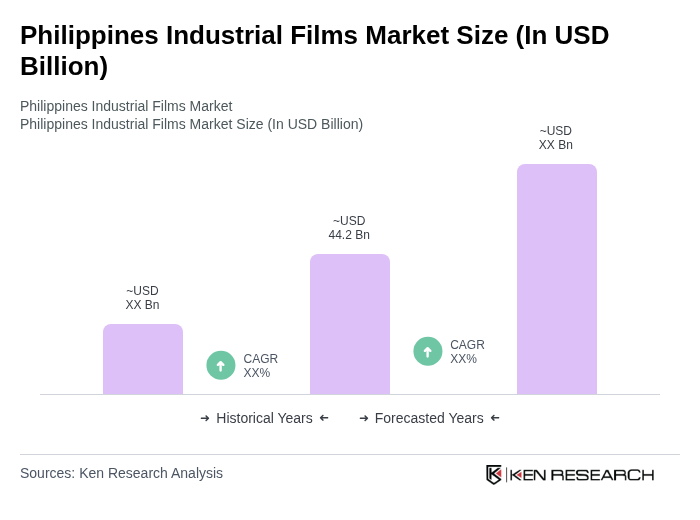
The Philippines Industrial Films Market is valued at approximately USD 44.2 billion. This growth is driven by increasing demand for packaging solutions across various sectors, including food, pharmaceuticals, and electronics, alongside the rise of e-commerce and sustainable packaging options.

What makes us stand out is that our consultants follow Robust, Refine and Result (RRR) methodology. Robust for clear definitions, approaches and sanity checking, Refine for differentiating respondents' facts and opinions, and Result for presenting data with story.

We have set a benchmark in the industry by offering our clients with syndicated and customized market research reports featuring coverage of entire market as well as meticulous research and analyst insights.

While we don't replace traditional research, we flip the method upside down. Our dual approach of Top Bottom & Bottom Top ensures quality deliverable by not just verifying company fundamentals but also looking at the sector and macroeconomic factors.

With one step in the future, our research team constantly tries to show you the bigger picture. We help with some of the tough questions you may encounter along the way: How is the industry positioned? Best marketing channel? KPI's of competitors? By aligning every element, we help maximize success.

Our report gives you instant access to the answers and sources that other companies might choose to hide. We elaborate each steps of research methodology we have used and showcase you the sample size to earn your trust.

If you need any support, we are here! We pride ourselves on universe strength, data quality, and quick, friendly, and professional service.













