Philippines Pack and Ship Market Outlook to 2030

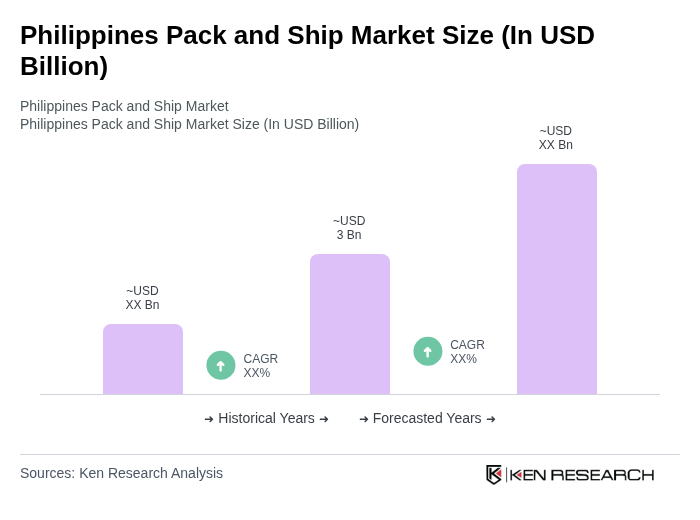
The Philippines pack and ship market, valued at USD 3 billion, is expanding with strong e-commerce activity, mobile-first consumer behavior, and increasing demand for last-mile delivery. The report analyzes fulfillment models, tech gaps, and infrastructure needs.

Region:Asia

Author(s):Harsh Saxena

Product Code:KR1559

Pages:90

Published On:January 2026
About the Report

Base Year 2024

Philippines Pack and Ship Market Overview

  • The Philippines Pack and Ship Market is valued at approximately USD 3 billion, based on a five-year historical analysis. This growth is primarily driven by the expansion of e-commerce and inter-island trade, which have significantly increased the demand for reliable freight and parcel services. Additionally, infrastructure upgrades, cross-border trade growth, and the adoption of digital logistics platforms such as route optimization software and real-time tracking have further enhanced operational efficiency and market expansion.
  • Key cities such as Metro Manila, Cebu, and Davao dominate the market due to their strategic locations, robust infrastructure, and high population density. These urban centers serve as major hubs for logistics and distribution, facilitating efficient inter-island connectivity and last-mile delivery services, which are crucial for meeting the growing consumer demand.
  • In recent years, the Philippine government has implemented several strategic measures to enhance the logistics sector. One notable regulation is the Logistics Efficiency Enhancement Program, 2024 issued by the Department of Transportation, which allocates funds for infrastructure improvements including modernizing ports and expanding cargo terminals, requiring compliance through enhanced operational standards and efficiency benchmarks to lower costs and streamline supply chains.
Philippines Pack and Ship Market Size

Philippines Pack and Ship Market Segmentation

ByEnd User Type:The market is segmented into Business and Individual customers. Business customers represent the dominant share, fueled by increasing demand for logistics solutions from enterprises, SMEs, and e-commerce platforms. Their large-scale operations and recurring shipping needs drive higher volume and revenue contribution. Individual customers, while smaller in share, are steadily growing with the rise in online shopping and personal shipping needs, supported by digital platforms and improved last-mile connectivity.
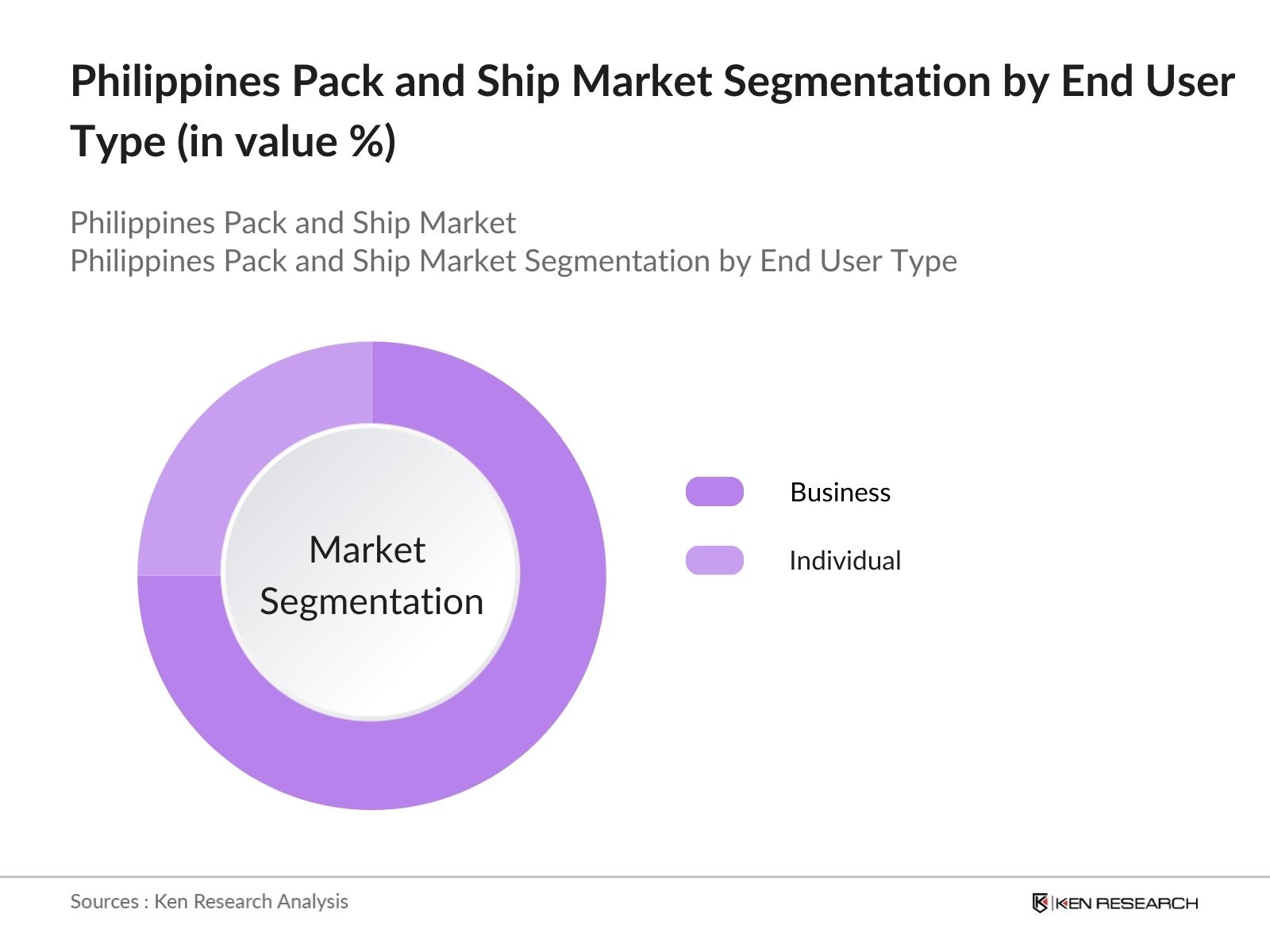
Philippines Pack and Ship Market Segmentation by End User Type

By Destination Type:The logistics market is segmented into Domestic and International destinations. Domestic logistics dominates the market, driven by high inter-island transport demand, e-commerce expansion, and the rising logistics needs of MSMEs. Meanwhile, the International segment is experiencing slightly faster growth, supported by enhanced trade activities, regional trade agreements like RCEP, and improved port infrastructure and customs digitalization, especially in high-value sectors like electronics and processed goods.

Philippines Pack and Ship Market Competitive Landscape

The Philippines Pack and Ship Market is characterized by a dynamic mix of regional and international players. Leading participants such as J&T Express, Flash Express, Ninja Van, 2GO, and LBC Express contribute to innovation, geographic expansion, and service delivery in this space.

J&T Express

2015

Jakarta, Indonesia

Flash Express

2017

Bangkok, Thailand

Ninja Van

2014

Singapore

2GO

1949

Metro Manila, Philippines

LBC Express

1950

Metro Manila, Philippines

Company

Establishment Year

Headquarters

Group Size (Large, Medium, or Small as per industry convention)

Revenue Growth Rate

Customer Retention Rate

Delivery Accuracy Rate

Average Delivery Time

Market Penetration Rate

Philippines Pack and Ship Market Industry Analysis

Growth Drivers

  • Surge in E-commerce Accelerates Pack-and-Ship Demand:The rapid rise in online shopping across the Philippines is significantly increasing the need for efficient packaging and last-mile delivery services. As consumer behavior shifts toward digital purchases, logistics providers are scaling up to meet parcel volume spikes. This ongoing e-commerce boom is a key growth engine for the pack-and-ship market, particularly in urban and suburban zones.
  • Shift Toward Asset-Light Logistics Models:Enterprises in the Philippines are increasingly adopting asset-light logistics strategies, preferring outsourced solutions over owning physical infrastructure. This shift allows for greater flexibility and cost-efficiency in operations. As a result, demand is rising for third-party packaging and shipping services, especially among fast-scaling startups and retail-focused businesses.
  • Provincial Trade and MSME Growth Fueling Demand??????:With rising inter-island trade and provincial commerce, businesses require dependable packaging and multimodal shipping options to ensure reliable delivery across fragmented geographies. At the same time, MSMEs are emerging as key users of third-party logistics services, relying heavily on pack-and-ship providers to support order fulfillment, inventory movement, and last-mile execution.

Market Challenges

  • Digital and Operational Barriers for MSMEs in E-Commerce Logistics:Philippine MSMEs face a layered mix of digital, financial, and operational hurdles in adopting e-commerce logistics. These include poor internet infrastructure, limited digital literacy, and high logistics costs—especially in remote regions. Additionally, low consumer trust in digital payment platforms restricts transaction flow, making it harder for MSMEs to scale and integrate with mainstream pack-and-ship networks effectively.
  • Low-Tech Adoption Slowing Logistics Integration:Many micro and small enterprises still rely on manual processes for inventory, payments, and fulfillment, which limits their ability to tap into digital logistics platforms. The underdevelopment of digital infrastructure, compounded by low trust in online transactions, slows down MSME participation in streamlined courier and warehousing solutions. This restricts market formalization and hampers the growth of inclusive last-mile delivery ecosystems.

Philippines Pack and Ship Market Future Outlook

The future of the Philippines pack and ship market appears promising, driven by ongoing digital transformation initiatives and increasing connectivity. Investments in infrastructure, such as fiber optic networks, are expected to enhance logistics capabilities and reduce operational inefficiencies. Additionally, the growing emphasis on sustainability in logistics practices will likely lead to innovative solutions that cater to eco-conscious consumers, further expanding market opportunities. The integration of e-commerce with last-mile logistics will also play a crucial role in shaping the sector's growth trajectory.

Market Opportunities

  • Rural Connectivity Unlocking Pack-and-Ship Network Expansion:With major logistics reforms and digital infrastructure pushing connectivity deeper into underserved areas, pack-and-ship services can scale operations beyond urban centers. Peak sale events like 11.11 and 12.12 in OFW-heavy regions are already driving cross-border e-commerce, creating demand for localized fulfillment hubs and last-mile delivery in newly connected rural markets.
  • Rising Infrastructure Spend to Ease Logistics Cost Pressures:Logistics costs currently absorb 27.5% of GDP—the highest in ASEAN—driven by port congestion and archipelagic shipping inefficiencies. This cost burden is triggering investment in smarter infrastructure, including cold-chain and intermodal systems. Providers expanding into temperature-controlled logistics can tap into food and pharma demand while aligning with regulatory modernization and RCEP-led trade facilitation efforts.

Scope of the Report

SegmentSub-Segments
By End User Type

Business

Individual

By Destination Type

Domestic

International

By Cargo Type

Loose Cargo

Bulk Cargo

By Mode of Transport

Sea

Road

Air

By Region

Metro Manila

Cavite

Cebu

Laguna

Bulacan

Key Target Audience

Investors and Venture Capitalist Firms

Government and Regulatory Bodies (e.g., Department of Trade and Industry, Bureau of Customs)

Logistics and Supply Chain Companies

E-commerce Platforms

Packaging Manufacturers

Freight Forwarders

Retail Chains and Supermarkets

Local and International Shipping Companies

Players Mentioned in the Report:

J&T Express

Flash Express

Ninja Van

2GO

LBC Express

DHL

FedEx

Lalamove

Transportify

Air21

Table of Contents

Market Assessment Phase

1. Executive Summary

1.1 Executive Summary


2. Philippines Macroeconomic Overview

2.1 Philippines Country Overview

2.2 Philippines Population Overview

2.3 Business landscape of Philippines

2.4 Philippines Trade and Infrastructural Overview

2.5 Import and Export Scenario in Philippines

2.6 Overview of Philippines Logistics Sector

2.7 Philippines Economic Zones Overview

2.8 Road Transport overview

2.9 Sea Transport overview

2.10 Air Transport overview


3. Philippines Pack and Ship Market

3.1 Philippines Pack and Ship Market Ecosystem

3.2 Business Cycle and Genesis of Philippines Pack and Ship Market

3.3 Value Chain Analysis of Pack and Ship market

3.4 Market Size Analysis of Philippines Pack and Ship Market – 2019 – 2030F

3.5 Market Segmentation of Pack and Ship Market

3.5.1 By End User (2024 & 2030F)
3.5.2 By Destination Type (2024 & 2030F)
3.5.3 By Cargo Type (2024 & 2030F)
3.5.4 By Mode of Transport – Domestic (2024 & 2030F)
3.5.5 By Mode of Transport – International (2024 & 2030F)
3.5.6 By Regions (2024 & 2030F)

3.6 Philippines Inbound Market

3.6.1 Market Size Analysis of Philippines Inbound Market – 2019 – 2030F
3.6.2 Market Segmentation of Philippines – by Major Corridors (2024)
3.6.3 Market Segmentation of Philippines – by End Users (2024)

3.7 Philippines Outbound Market

3.7.1 Market Size Analysis of Philippines Outbound Market – 2019 – 2030F
3.7.2 Market Segmentation of Philippines – by Major Corridors (2024)
3.7.3 Market Segmentation of Philippines – by End Users (2024)

4. Philippines Ecommerce Fulfillment Market

4.1 Philippines Digital Landscape

4.2 Key Future Trends in Philippines Ecommerce Market

4.3 Philippines ecommerce Fulfillment Market Ecosystem

4.4 Value chain analysis of Ecommerce Fulfillment Market

4.5 Market Size Analysis of Ecommerce Fulfillment Market – 2019 – 2030F

4.6 Market Segmentation

4.6.1 By Consumer Type (2024 & 2030F)
4.6.2 By Marketplaces (2024 & 2030F)
4.6.3 By Destination Type (2024 & 2030F)
4.6.4 By Regions (2024 & 2030F)

5. Philippines Print and Marketing Market

5.1 Philippines Print and Marketing Market Ecosystem

5.2 Business Cycle and Genesis of Philippines Print and Marketing Market

5.3 Value chain analysis of Philippines Print and Marketing Market

5.4 Market Size Analysis of Print and Marketing Market – 2019 – 2030F

5.5 Market Segmentation

5.5.1 By End User Type (2024 & 2030F)
5.5.2 By Service Type (2024 & 2030F)
5.5.3 By Print Output Type (2024 & 2030F)
5.5.4 By Regions (2024 & 2030F)

6. End User Analysis

6.1 Understanding Needs of Different End Users – Businesses & Individuals

6.2 Role of E-Commerce Industry in Pack and Ship Market

6.3 Evaluation of Major End User Industries – Ecommerce Fulfillment Market

6.4 Evaluation of Major End User Industries – Print and Marketing Market


7. Competition Scenario

7.1 Pack and Ship Market & Ecommerce Fulfillment Market

7.2 Competitive Landscape

7.3 Market Share Analysis of Pack and Ship Market, 2024

7.4 Market Share Analysis of Outbound Pack and Ship (International) Market, 2024

7.5 Market share analysis of Ecommerce Fulfillment Market, 2024

7.6 Company Profiles of Major Players (J&T, LBC, DHL, 2GO, NinjaVan)

7.7 Print and Marketing Market

7.7.1 Competitive Landscape
7.7.2 Company Profiles of Major Players

8. Analyst Recommendations

8.1 Opportunity Analysis & Market Positioning

8.2 Opportunity Analysis for MBE, 2030

8.3 MBE Positioning Strategy

8.4 Location Analysis

8.5 Prioritization Funnel of High-Potential Cities

8.6 Evaluation of Key Cities

8.7 Cross-comparison and Mapping Top Sites for Selected Key Cities

8.8 Mapping Top Sites for Selected Key Cities in Philippines Market

8.9 Different Store Formats for MBE Philippines

8.10 MBE Store Locations Plan

8.11 Store & Franchise Strategy

8.11.1 Y-o-Y Store Locations Plan for MBE
8.11.2 MBE Store Plan – Summary
8.11.3 Franchise Development Strategy
8.11.4 Franchise Journey – Relationship Between MBE & Franchise Stores
8.11.5 Franchise Support Ecosystem

8.12 Marketing & Partnerships Strategy

8.12.1 Customer Journey and Promotion Strategy
8.12.2 Marketing Strategies – Offline and Upcoming Events/Expos to Target
8.12.3 Marketing Strategies – Online
8.12.4 Potential Partnerships for MBE in Philippines

8.13 Manpower Analysis

8.13.1 MBE Employee and Salary Structure
8.13.2 MBE Employee Structure: Head Office
8.13.3 MBE Employee Structure: Store Level
8.13.4 MBE Contributions Towards Employees

8.14 Financial Modelling

8.14.1 MBE Indicative Income Statement
8.14.2 Scenario Based Modelling: Optimistic vs Base vs Conservative
8.14.3 MBE Breakeven Period (in Base Scenario)
8.14.4 Revenue from Operations for MBE Philippines from different service lines
8.14.5 Breakdown of Variable Costs
8.14.6 Breakdown of Cost of Services for 2026F, 2028F and 2030F
8.14.7 Breakdown of Operating Expenses for 2026F, 2028F and 2030F
8.14.8 Total CAPEX by Head Office and Store-Level from 2025 to 2030F
8.14.9 Breakdown of Head Office Furniture and Fixture Expense from 2025 to 2030F
8.14.10 Head Office Expense of Backend Applications, Office Equipment and Regulatory Compliance
8.14.11 Breakdown of Store Furniture and Fixture Expense for High End Stores and Kiosks from 2025 to 2030F
8.14.12 List of Various Store Furniture and Fixture and Communication Type for Different Store Formats and their Per Unit Price
8.14.13 Breakdown of Store Equipment Expense for High End Stores and Kiosks from 2025 to 2030F
8.14.14 List of Various Store Equipment for Different Store Formats and their Per Unit Price
8.14.15 Breakdown of Electrical Equipment Expense for High End Stores and Kiosks from 2025 to 2030F along with Delivery Van Expense
8.14.16 Total Capital Requirement for MBE Operations
8.14.17 Financing Structure
8.14.18 Key Assumptions for Financial Modelling
8.14.19 Detailed Working Excel

9. Research Methodology

9.1 Market Definitions

9.2 Abbreviations Used

9.3 Market Sizing Approach – Pack and Ship Market and Ecommerce Fulfillment Market

9.4 Market Sizing Approach – Print and Marketing Market

9.5 Industry Experts Interviewed

9.6 Methodology for End User Survey


10. Appendix

10.1 Pack and Ship Market Segmentation Basis Major Cities in Bulacan

10.2 Pack and Ship Market Segmentation Basis Major Cities in Laguna

10.3 Pack and Ship Market Segmentation Basis Major Cities in Cavite

10.4 E-commerce Fulfillment Market Segmentation Basis Major Cities in Bulacan

10.5 E-commerce Fulfillment Market Segmentation Basis Major Cities in Laguna

10.6 E-commerce Fulfillment Market Segmentation Basis Major Cities in Cavite

10.7 Printing Market Segmentation Basis Major Cities in Bulacan

10.8 Printing Market Segmentation Basis Major Cities in Laguna

10.9 Printing Market Segmentation Basis Major Cities in Cavite

10.10 End-User Survey


11. Disclaimer


12. Contact Us


Research Methodology

ApproachModellingSample

Phase 1: Approach1

Desk Research

  • Analysis of government reports on logistics and shipping regulations in the Philippines
  • Review of industry publications and market reports specific to the pack and ship sector
  • Examination of trade statistics and import/export data relevant to shipping services

Primary Research

  • Interviews with logistics providers and shipping companies operating in the Philippines
  • Surveys targeting small and medium-sized enterprises (SMEs) utilizing pack and ship services
  • Field interviews with end-users, including e-commerce businesses and retail outlets

Validation & Triangulation

  • Cross-validation of findings through multiple data sources, including trade associations and government agencies
  • Triangulation of qualitative insights from interviews with quantitative data from surveys
  • Sanity checks conducted through expert panel reviews and feedback sessions

Phase 2: Market Size Estimation1

Top-down Assessment

  • Estimation of total logistics market size in the Philippines as a baseline for pack and ship services
  • Segmentation of the market by industry verticals such as e-commerce, retail, and manufacturing
  • Incorporation of growth trends in online shopping and consumer behavior shifts

Bottom-up Modeling

  • Collection of operational data from leading pack and ship companies to establish service pricing
  • Volume analysis based on shipment frequency and average package size across different sectors
  • Cost structure evaluation to determine profitability margins for various service offerings

Forecasting & Scenario Analysis

  • Development of forecasting models based on historical growth rates and market trends
  • Scenario analysis considering economic factors, regulatory changes, and technological advancements
  • Projections for market growth through 2030 under different economic conditions

Phase 3: CATI Sample Composition1

Scope Item/SegmentSample SizeTarget Respondent Profiles
E-commerce Shipping Solutions120Logistics Coordinators, E-commerce Managers
SME Pack and Ship Services100Business Owners, Operations Managers
International Shipping Compliance80Compliance Officers, Export Managers
Local Delivery Services70Delivery Managers, Fleet Supervisors
Packaging Solutions for Shipping60Product Managers, Supply Chain Analysts

Frequently Asked Questions

What is the current value of the Philippines Pack and Ship Market?

The Philippines Pack and Ship Market is valued at approximately USD 3 billion, driven by the growth of e-commerce and inter-island trade, alongside improvements in logistics infrastructure and digital platforms.

What are the main drivers of growth in the Philippines Pack and Ship Market?

Which cities are the primary hubs for the Pack and Ship Market in the Philippines?

What types of shipping services are offered in the Philippines Pack and Ship Market?

Other Regional/Country Reports

Indonesia Pack and Ship Market

Malaysia Pack and Ship Market

KSA Pack and Ship Market

APAC Pack and Ship Market

SEA Pack and Ship Market

Vietnam Pack and Ship Market

Why Buy From Us?

Refine Robust Result (RRR) Framework

What makes us stand out is that our consultants follow Robust, Refine and Result (RRR) methodology. Robust for clear definitions, approaches and sanity checking, Refine for differentiating respondents' facts and opinions, and Result for presenting data with story.

Our Reach Is Unmatched

We have set a benchmark in the industry by offering our clients with syndicated and customized market research reports featuring coverage of entire market as well as meticulous research and analyst insights.

Shifting the Research Paradigm

While we don't replace traditional research, we flip the method upside down. Our dual approach of Top Bottom & Bottom Top ensures quality deliverable by not just verifying company fundamentals but also looking at the sector and macroeconomic factors.

More Insights-Better Decisions

With one step in the future, our research team constantly tries to show you the bigger picture. We help with some of the tough questions you may encounter along the way: How is the industry positioned? Best marketing channel? KPI's of competitors? By aligning every element, we help maximize success.

Transparency and Trust

Our report gives you instant access to the answers and sources that other companies might choose to hide. We elaborate each steps of research methodology we have used and showcase you the sample size to earn your trust.

Round the Clock Support

If you need any support, we are here! We pride ourselves on universe strength, data quality, and quick, friendly, and professional service.

Why Clients Choose Us?

400000+
Reports in repository
150+
Consulting projects a year
100+
Analysts
8000+
Client Queries in 2022








