Saudi Arabia Autonomous Mobile Manipulator Robots (AMMR) Market

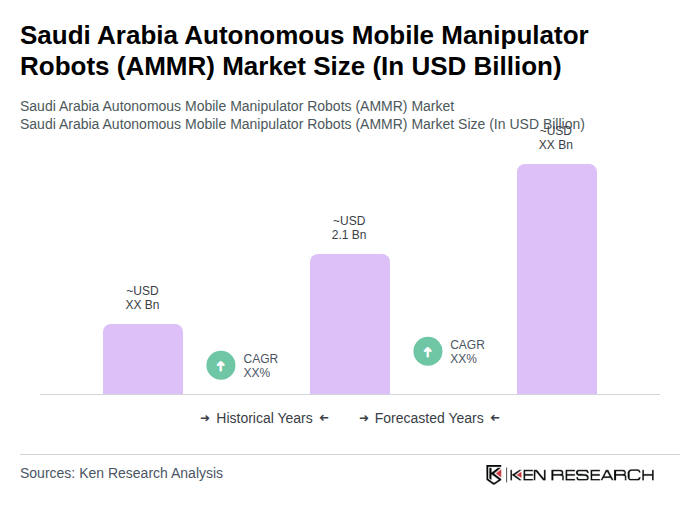
Saudi Arabia AMMR Market, valued at USD 2.1 billion, grows due to robotics advancements, labor shortages, and sectors like e-commerce and healthcare adopting automation.

Region:Middle East

Author(s):Shubham

Product Code:KRAE0014

Pages:91

Published On:December 2025
About the Report

Base Year 2024

Saudi Arabia Autonomous Mobile Manipulator Robots (AMMR) Market Overview

  • The Saudi Arabia Autonomous Mobile Manipulator Robots (AMMR) Market is valued at USD 2.1 billion, based on a five-year historical analysis. This growth is primarily driven by advancements in robotics technology, increasing demand for automation in various sectors including manufacturing, logistics, warehousing, healthcare, and service industries, rising labor shortages, and the government's push towards digital transformation and smart city initiatives.
  • Key cities such as Riyadh, Jeddah, and Dammam dominate the market due to their strategic importance in trade, logistics, and industrial activities. The concentration of major corporations and investments in technology infrastructure in these urban centers further enhances their market presence.
  • The National Industrial Development and Logistics Program (NIDLP), 2020 issued by the Ministry of Industry and Mineral Resources, mandates the adoption of advanced automation and robotics technologies in industrial and logistics projects with investments exceeding USD 100 million. This program requires compliance through technology integration standards, enhancing operational efficiency and supporting public sector deployment of robotics solutions.
Saudi Arabia Autonomous Mobile Manipulator Robots (AMMR) Market Size

Saudi Arabia Autonomous Mobile Manipulator Robots (AMMR) Market Segmentation

By Type of Manipulator Configuration:
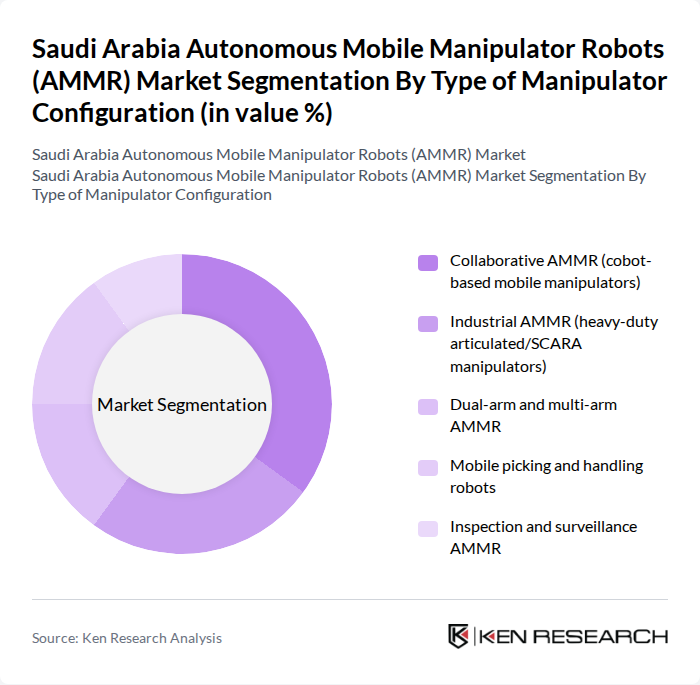
Saudi Arabia Autonomous Mobile Manipulator Robots (AMMR) Market segmentation by Type of Manipulator Configuration.

The market for Autonomous Mobile Manipulator Robots is segmented into five key types: Collaborative AMMR (cobot-based mobile manipulators), Industrial AMMR (heavy-duty articulated/SCARA manipulators), Dual-arm and multi-arm AMMR, Mobile picking and handling robots, and Inspection and surveillance AMMR. Among these, Collaborative AMMR is leading the market due to its versatility and ease of integration into existing workflows. The growing trend towards collaborative robots in various industries, including manufacturing and healthcare, is driving demand for this segment. The focus on enhancing productivity while ensuring safety in human-robot interactions is also contributing to its dominance.

By End-User Industry:
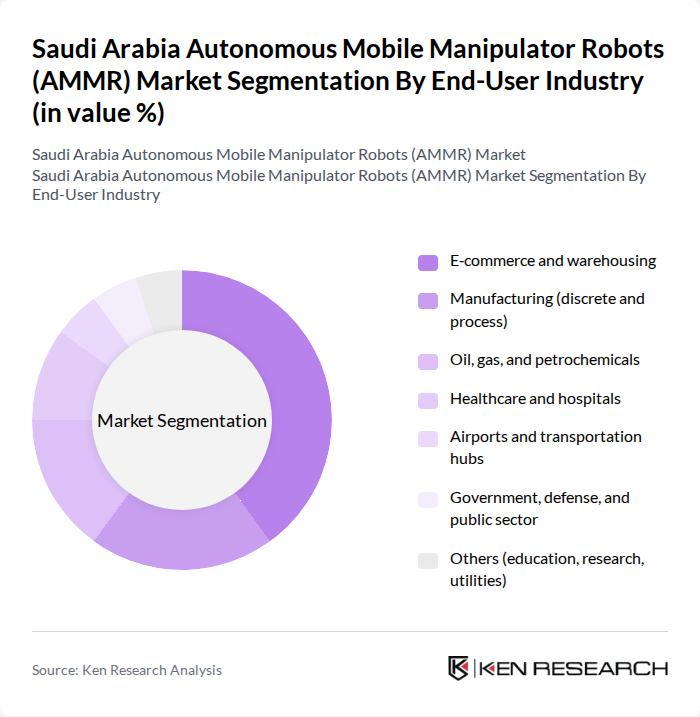
Saudi Arabia Autonomous Mobile Manipulator Robots (AMMR) Market segmentation by End-User Industry.

The Autonomous Mobile Manipulator Robots market is segmented by end-user industries, including E-commerce and warehousing, Manufacturing (discrete and process), Oil, gas, and petrochemicals, Healthcare and hospitals, Airports and transportation hubs, Government, defense, and public sector, and Others (education, research, utilities). The E-commerce and warehousing sector is currently the leading segment, driven by the rapid growth of online shopping and the need for efficient logistics solutions. The increasing demand for automation in warehousing operations to enhance order fulfillment speed and accuracy is propelling this segment's growth.

Saudi Arabia Autonomous Mobile Manipulator Robots (AMMR) Market Competitive Landscape

The Saudi Arabia Autonomous Mobile Manipulator Robots (AMMR) Market is characterized by a dynamic mix of regional and international players. Leading participants such as ABB Ltd., KUKA AG, FANUC Corporation, Yaskawa Electric Corporation, Omron Corporation (including Omron Adept mobile platforms), Universal Robots A/S, Boston Dynamics, Inc., Mobile Industrial Robots A/S (MiR), Fetch Robotics, Inc. (a Zebra Technologies company), Robotnik Automation S.L., PAL Robotics S.L., Neura Robotics GmbH, OTTO Motors by Rockwell Automation, Hikrobot (Hangzhou Hikrobot Technology Co., Ltd.), Saudi Arabian Oil Company (Saudi Aramco) – digital & robotics initiatives contribute to innovation, geographic expansion, and service delivery in this space.

ABB Ltd.

1988

Zurich, Switzerland

KUKA AG

1898

Augsburg, Germany

FANUC Corporation

1956

Minamiku, Japan

Yaskawa Electric Corporation

1915

Kitakyushu, Japan

Omron Corporation

1933

Kyoto, Japan

Company

Establishment Year

Headquarters

Presence in Saudi Arabia (local office, distributor, or JV)

Installed AMMR base in Saudi Arabia (number of units)

Revenue from AMMR in Saudi Arabia

3?year AMMR revenue CAGR in Saudi Arabia

Share of AMMR in total robotics revenue

Number of key reference sites in KSA (warehouses, plants, hospitals)

Saudi Arabia Autonomous Mobile Manipulator Robots (AMMR) Market Industry Analysis

Growth Drivers

  • Increasing Demand for Automation:The Saudi Arabian economy is witnessing a significant shift towards automation, driven by a projected increase in GDP from $1.1 trillion to $1.2 trillion. This growth is fueled by sectors such as manufacturing and logistics, which are expected to invest approximately $2.5 billion in automation technologies. The demand for AMMRs is particularly strong in industries aiming to enhance productivity and reduce operational costs, aligning with Vision 2030 goals.
  • Government Initiatives Promoting Robotics and AI:The Saudi government has allocated $500 million for the development of robotics and AI technologies as part of its Vision 2030 initiative. This funding aims to foster innovation and support local startups in the robotics sector. Additionally, the establishment of the Saudi Robotics and AI Institute is expected to enhance research and development, creating a conducive environment for AMMR adoption across various industries.
  • Rising Labor Costs and Need for Efficiency:Labor costs in Saudi Arabia have increased by approximately 15% over the past three years, prompting businesses to seek automation solutions. The average monthly wage for skilled labor is now around $1,200, making AMMRs an attractive alternative for companies aiming to maintain profitability. By integrating AMMRs, businesses can achieve operational efficiency, reduce labor dependency, and enhance service delivery in sectors like logistics and healthcare.

Market Challenges

  • High Initial Investment Costs:The adoption of AMMR technology requires substantial upfront investment, often exceeding $100,000 per unit. This financial barrier can deter small and medium-sized enterprises (SMEs) from integrating these advanced systems. With the current economic climate, where many businesses are cautious about capital expenditures, the high costs associated with AMMRs pose a significant challenge to widespread adoption in the market.
  • Limited Awareness and Understanding of AMMR Technology:Despite the potential benefits, there remains a significant knowledge gap regarding AMMR technology among businesses in Saudi Arabia. A recent survey indicated that over 60% of companies lack a clear understanding of how AMMRs can enhance their operations. This limited awareness hinders decision-making processes and slows down the adoption of innovative automation solutions, impacting market growth.

Saudi Arabia Autonomous Mobile Manipulator Robots (AMMR) Market Future Outlook

The future of the AMMR market in Saudi Arabia appears promising, driven by ongoing technological advancements and increasing integration of AI. As industries continue to embrace automation, the demand for AMMRs is expected to rise, particularly in healthcare and logistics. Furthermore, the government's commitment to fostering innovation through funding and partnerships will likely accelerate the development of customized solutions, enhancing the overall market landscape and positioning Saudi Arabia as a regional leader in robotics.

Market Opportunities

  • Expansion into Healthcare and Logistics Sectors:The healthcare sector in Saudi Arabia is projected to grow by 10% annually, creating a substantial opportunity for AMMRs to assist in patient care and logistics. With hospitals increasingly adopting automation to improve efficiency, AMMRs can streamline operations, reduce wait times, and enhance patient outcomes, making them a valuable asset in this expanding market.
  • Development of Customized Solutions for Local Industries:There is a growing demand for tailored AMMR solutions that cater to the unique needs of local industries, particularly in construction and agriculture. By collaborating with local businesses, robotics firms can develop specialized AMMRs that address specific operational challenges, thereby enhancing productivity and fostering innovation within these sectors.

Scope of the Report

SegmentSub-Segments
By Type of Manipulator Configuration

Collaborative AMMR (cobot-based mobile manipulators)

Industrial AMMR (heavy-duty articulated/SCARA manipulators)

Dual-arm and multi-arm AMMR

Mobile picking and handling robots

Inspection and surveillance AMMR

By End-User Industry

E?commerce and warehousing

Manufacturing (discrete and process)

Oil, gas, and petrochemicals

Healthcare and hospitals

Airports and transportation hubs

Government, defense, and public sector

Others (education, research, utilities)

By Application

Palletizing, depalletizing, and kitting

Picking, put?away, and order fulfillment

Intralogistics and line-side material replenishment

Inspection, monitoring, and maintenance tasks

Collaborative assembly and machine tending

Sterile and clinical logistics (meds, samples, linen)

Others

By Payload Capacity

Up to 50 kg payload

–250 kg payload

–1,000 kg payload

Above 1,000 kg payload

By Navigation & Sensing Technology

LiDAR?based SLAM navigation

Vision?guided and 3D perception AMMR

QR / RFID / magnetic?guided AMMR

Multi?sensor fusion and AI?enabled navigation

Others

By Deployment Model

Capex purchase

Robotics?as?a?Service (RaaS)

Lease / rental models

By Region

Central Region (Riyadh and surrounding areas)

Eastern Region (Dammam, Dhahran, Jubail, Ras Al?Khair)

Western Region (Jeddah, Makkah, Madinah, NEOM, Red Sea)

Southern Region

Northern Region

Key Target Audience

Investors and Venture Capitalist Firms

Government and Regulatory Bodies (e.g., Saudi Arabian General Investment Authority, Ministry of Industry and Mineral Resources)

Manufacturers and Producers of Robotics Technology

Logistics and Supply Chain Companies

Healthcare Providers and Hospitals

Aerospace and Defense Contractors

Construction and Infrastructure Development Firms

Telecommunications Companies

Players Mentioned in the Report:

ABB Ltd.

KUKA AG

FANUC Corporation

Yaskawa Electric Corporation

Omron Corporation (including Omron Adept mobile platforms)

Universal Robots A/S

Boston Dynamics, Inc.

Mobile Industrial Robots A/S (MiR)

Fetch Robotics, Inc. (a Zebra Technologies company)

Robotnik Automation S.L.

PAL Robotics S.L.

Neura Robotics GmbH

OTTO Motors by Rockwell Automation

Hikrobot (Hangzhou Hikrobot Technology Co., Ltd.)

Saudi Arabian Oil Company (Saudi Aramco) digital & robotics initiatives

Table of Contents

Market Assessment Phase

1. Executive Summary and Approach


2. Saudi Arabia Autonomous Mobile Manipulator Robots (AMMR) Market Overview

2.1 Key Insights and Strategic Recommendations

2.2 Saudi Arabia Autonomous Mobile Manipulator Robots (AMMR) Market Overview

2.3 Definition and Scope

2.4 Evolution of Market Ecosystem

2.5 Timeline of Key Regulatory Milestones

2.6 Value Chain & Stakeholder Mapping

2.7 Business Cycle Analysis

2.8 Policy & Incentive Landscape


3. Saudi Arabia Autonomous Mobile Manipulator Robots (AMMR) Market Analysis

3.1 Growth Drivers

3.1.1 Increasing demand for automation in various sectors
3.1.2 Government initiatives promoting robotics and AI
3.1.3 Rising labor costs and need for efficiency
3.1.4 Technological advancements in robotics

3.2 Market Challenges

3.2.1 High initial investment costs
3.2.2 Limited awareness and understanding of AMMR technology
3.2.3 Regulatory hurdles and compliance issues
3.2.4 Competition from traditional automation solutions

3.3 Market Opportunities

3.3.1 Expansion into healthcare and logistics sectors
3.3.2 Development of customized solutions for local industries
3.3.3 Partnerships with tech companies for innovation
3.3.4 Growing interest in smart city initiatives

3.4 Market Trends

3.4.1 Increasing integration of AI with AMMR
3.4.2 Focus on sustainability and energy efficiency
3.4.3 Rise of collaborative robots (cobots)
3.4.4 Enhanced user interfaces and control systems

3.5 Government Regulation

3.5.1 Standards for safety and operational efficiency
3.5.2 Incentives for R&D in robotics
3.5.3 Import regulations for robotic components
3.5.4 Compliance with international robotics standards

4. SWOT Analysis


5. Stakeholder Analysis


6. Porter's Five Forces Analysis


7. Saudi Arabia Autonomous Mobile Manipulator Robots (AMMR) Market Market Size, 2019-2024

7.1 By Value

7.2 By Volume

7.3 By Average Selling Price


8. Saudi Arabia Autonomous Mobile Manipulator Robots (AMMR) Market Segmentation

8.1 By Type of Manipulator Configuration

8.1.1 Collaborative AMMR (cobot-based mobile manipulators)
8.1.2 Industrial AMMR (heavy-duty articulated/SCARA manipulators)
8.1.3 Dual-arm and multi-arm AMMR
8.1.4 Mobile picking and handling robots
8.1.5 Inspection and surveillance AMMR

8.2 By End-User Industry

8.2.1 E?commerce and warehousing
8.2.2 Manufacturing (discrete and process)
8.2.3 Oil, gas, and petrochemicals
8.2.4 Healthcare and hospitals
8.2.5 Airports and transportation hubs
8.2.6 Government, defense, and public sector
8.2.7 Others (education, research, utilities)

8.3 By Application

8.3.1 Palletizing, depalletizing, and kitting
8.3.2 Picking, put?away, and order fulfillment
8.3.3 Intralogistics and line-side material replenishment
8.3.4 Inspection, monitoring, and maintenance tasks
8.3.5 Collaborative assembly and machine tending
8.3.6 Sterile and clinical logistics (meds, samples, linen)
8.3.7 Others

8.4 By Payload Capacity

8.4.1 Up to 50 kg payload
8.4.2 51–250 kg payload
8.4.3 251–1,000 kg payload
8.4.4 Above 1,000 kg payload

8.5 By Navigation & Sensing Technology

8.5.1 LiDAR?based SLAM navigation
8.5.2 Vision?guided and 3D perception AMMR
8.5.3 QR / RFID / magnetic?guided AMMR
8.5.4 Multi?sensor fusion and AI?enabled navigation
8.5.5 Others

8.6 By Deployment Model

8.6.1 Capex purchase
8.6.2 Robotics?as?a?Service (RaaS)
8.6.3 Lease / rental models

8.7 By Region

8.7.1 Central Region (Riyadh and surrounding areas)
8.7.2 Eastern Region (Dammam, Dhahran, Jubail, Ras Al?Khair)
8.7.3 Western Region (Jeddah, Makkah, Madinah, NEOM, Red Sea)
8.7.4 Southern Region
8.7.5 Northern Region

9. Saudi Arabia Autonomous Mobile Manipulator Robots (AMMR) Market Competitive Analysis

9.1 Market Share of Key Players

9.2 Cross Comparison of Key Players

9.2.1 Company name
9.2.2 Presence in Saudi Arabia (local office, distributor, or JV)
9.2.3 Installed AMMR base in Saudi Arabia (number of units)
9.2.4 Revenue from AMMR in Saudi Arabia
9.2.5 3?year AMMR revenue CAGR in Saudi Arabia
9.2.6 Share of AMMR in total robotics revenue
9.2.7 Number of key reference sites in KSA (warehouses, plants, hospitals)
9.2.8 Average project value (USD per deployment)
9.2.9 Product portfolio breadth (payload, applications, sectors served)
9.2.10 Level of localization (Arabic UI, local integration & support)
9.2.11 Partnership ecosystem (system integrators, KSA partners)
9.2.12 Technology differentiation (AI, perception, safety certifications)

9.3 SWOT Analysis of Top Players

9.4 Pricing Analysis

9.5 Detailed Profile of Major Companies

9.5.1 ABB Ltd.
9.5.2 KUKA AG
9.5.3 FANUC Corporation
9.5.4 Yaskawa Electric Corporation
9.5.5 Omron Corporation (including Omron Adept mobile platforms)
9.5.6 Universal Robots A/S
9.5.7 Boston Dynamics, Inc.
9.5.8 Mobile Industrial Robots A/S (MiR)
9.5.9 Fetch Robotics, Inc. (a Zebra Technologies company)
9.5.10 Robotnik Automation S.L.
9.5.11 PAL Robotics S.L.
9.5.12 Neura Robotics GmbH
9.5.13 OTTO Motors by Rockwell Automation
9.5.14 Hikrobot (Hangzhou Hikrobot Technology Co., Ltd.)
9.5.15 Saudi Arabian Oil Company (Saudi Aramco) – digital & robotics initiatives

10. Saudi Arabia Autonomous Mobile Manipulator Robots (AMMR) Market End-User Analysis

10.1 Procurement Behavior of Key Ministries

10.1.1 Key procurement processes
10.1.2 Budget allocation trends
10.1.3 Decision-making criteria
10.1.4 Vendor selection preferences

10.2 Corporate Spend on Infrastructure & Energy

10.2.1 Investment trends in automation
10.2.2 Budget priorities for robotics
10.2.3 Impact of economic factors on spending
10.2.4 Future spending forecasts

10.3 Pain Point Analysis by End-User Category

10.3.1 Common operational challenges
10.3.2 Technology adoption barriers
10.3.3 Cost-related issues
10.3.4 Service and maintenance concerns

10.4 User Readiness for Adoption

10.4.1 Awareness levels of AMMR technology
10.4.2 Training and support needs
10.4.3 Perceived benefits of AMMR
10.4.4 Adoption timelines

10.5 Post-Deployment ROI and Use Case Expansion

10.5.1 Metrics for measuring ROI
10.5.2 Case studies of successful deployments
10.5.3 Potential for scaling solutions
10.5.4 Future use case explorations

11. Saudi Arabia Autonomous Mobile Manipulator Robots (AMMR) Market Future Size, 2025-2030

11.1 By Value

11.2 By Volume

11.3 By Average Selling Price


Go-To-Market Strategy Phase

1. Whitespace Analysis + Business Model Canvas

1.1 Market gaps and opportunities


2. Marketing and Positioning Recommendations

2.1 Branding strategies

2.2 Product USPs


3. Distribution Plan

3.1 Urban retail vs rural NGO tie-ups


4. Channel & Pricing Gaps

4.1 Underserved routes

4.2 Pricing bands


5. Unmet Demand & Latent Needs

5.1 Category gaps

5.2 Consumer segments


6. Customer Relationship

6.1 Loyalty programs

6.2 After-sales service


7. Value Proposition

7.1 Sustainability

7.2 Integrated supply chains


8. Key Activities

8.1 Regulatory compliance

8.2 Branding

8.3 Distribution setup


9. Entry Strategy Evaluation

9.1 Domestic Market Entry Strategy

9.1.1 Product mix
9.1.2 Pricing band
9.1.3 Packaging

9.2 Export Entry Strategy

9.2.1 Target countries
9.2.2 Compliance roadmap

10. Entry Mode Assessment

10.1 JV, Greenfield, M&A, Distributor Model


11. Capital and Timeline Estimation

11.1 Capital requirements

11.2 Timelines


12. Control vs Risk Trade-Off

12.1 Ownership vs Partnerships


13. Profitability Outlook

13.1 Breakeven analysis

13.2 Long-term sustainability


14. Potential Partner List

14.1 Distributors

14.2 JVs

14.3 Acquisition targets


15. Execution Roadmap

15.1 Phased Plan for Market Entry

15.1.1 Market Setup
15.1.2 Market Entry
15.1.3 Growth Acceleration
15.1.4 Scale & Stabilize

15.2 Key Activities and Milestones

15.2.1 Milestone tracking
15.2.2 Activity timelines

Research Methodology

ApproachModellingSample

Phase 1: Approach1

Desk Research

  • Analysis of industry reports and white papers on autonomous mobile manipulator robots
  • Review of market trends and forecasts from government publications and trade associations
  • Examination of academic journals and conference proceedings related to robotics and automation

Primary Research

  • Interviews with industry experts and thought leaders in robotics and automation
  • Surveys targeting end-users in sectors such as logistics, healthcare, and manufacturing
  • Field visits to facilities utilizing AMMR technology to gather firsthand insights

Validation & Triangulation

  • Cross-validation of findings through multiple data sources including market reports and expert opinions
  • Triangulation of quantitative data with qualitative insights from interviews
  • Sanity checks through peer reviews and expert panel discussions

Phase 2: Market Size Estimation1

Top-down Assessment

  • Estimation of the total addressable market based on national robotics spending and investment trends
  • Segmentation of the market by application areas such as warehousing, healthcare, and agriculture
  • Incorporation of government initiatives promoting automation and robotics in various sectors

Bottom-up Modeling

  • Collection of sales data from leading manufacturers of AMMRs in Saudi Arabia
  • Estimation of unit sales based on production capacity and market demand
  • Cost analysis of AMMR deployment including maintenance and operational expenses

Forecasting & Scenario Analysis

  • Development of predictive models using historical data and market growth drivers
  • Scenario planning based on technological advancements and regulatory changes
  • Creation of multiple forecasts (baseline, optimistic, and pessimistic) through 2030

Phase 3: CATI Sample Composition1

Scope Item/SegmentSample SizeTarget Respondent Profiles
Logistics and Warehousing100Warehouse Managers, Operations Directors
Healthcare Robotics Applications80Healthcare Administrators, Robotics Engineers
Manufacturing Automation90Production Managers, Automation Specialists
Agricultural Robotics70Agronomists, Farm Operations Managers
Research and Development in Robotics60R&D Managers, University Researchers

Frequently Asked Questions

What is the current value of the Saudi Arabia Autonomous Mobile Manipulator Robots (AMMR) Market?

The Saudi Arabia Autonomous Mobile Manipulator Robots (AMMR) Market is valued at approximately USD 2.1 billion, reflecting significant growth driven by advancements in robotics technology and increasing automation demand across various sectors.

What are the key drivers of growth in the AMMR market in Saudi Arabia?

Which cities are leading in the AMMR market in Saudi Arabia?

What role does the National Industrial Development and Logistics Program (NIDLP) play in the AMMR market?

Other Regional/Country Reports

Indonesia Autonomous Mobile Manipulator Robots AMMR Market

Malaysia Autonomous Mobile Manipulator Robots AMMR Market

KSA Autonomous Mobile Manipulator Robots AMMR Market

APAC Autonomous Mobile Manipulator Robots AMMR Market

SEA Autonomous Mobile Manipulator Robots AMMR Market

Vietnam Autonomous Mobile Manipulator Robots AMMR Market

Why Buy From Us?

Refine Robust Result (RRR) Framework

What makes us stand out is that our consultants follow Robust, Refine and Result (RRR) methodology. Robust for clear definitions, approaches and sanity checking, Refine for differentiating respondents' facts and opinions, and Result for presenting data with story.

Our Reach Is Unmatched

We have set a benchmark in the industry by offering our clients with syndicated and customized market research reports featuring coverage of entire market as well as meticulous research and analyst insights.

Shifting the Research Paradigm

While we don't replace traditional research, we flip the method upside down. Our dual approach of Top Bottom & Bottom Top ensures quality deliverable by not just verifying company fundamentals but also looking at the sector and macroeconomic factors.

More Insights-Better Decisions

With one step in the future, our research team constantly tries to show you the bigger picture. We help with some of the tough questions you may encounter along the way: How is the industry positioned? Best marketing channel? KPI's of competitors? By aligning every element, we help maximize success.

Transparency and Trust

Our report gives you instant access to the answers and sources that other companies might choose to hide. We elaborate each steps of research methodology we have used and showcase you the sample size to earn your trust.

Round the Clock Support

If you need any support, we are here! We pride ourselves on universe strength, data quality, and quick, friendly, and professional service.

Why Clients Choose Us?

400000+
Reports in repository
150+
Consulting projects a year
100+
Analysts
8000+
Client Queries in 2022








