About the Report
Base Year 2024Saudi Arabia Cellular IoT Market Overview
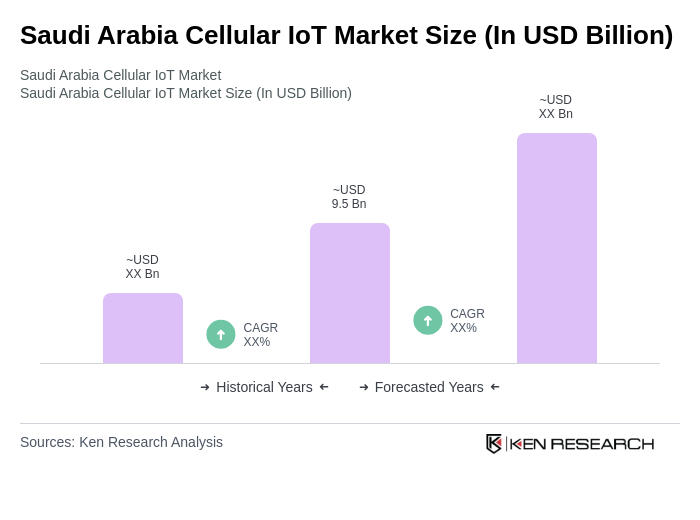
- The Saudi Arabia Cellular IoT Market is valued at USD 9.5 billion, based on a five-year historical analysis. This growth is primarily driven by the rapid expansion of 5G networks and enhancements in connectivity infrastructure, which enable sophisticated real-time IoT applications across autonomous mobility, remote healthcare, and industrial automation. The increasing adoption of smart devices, advancements in network infrastructure, and the rising demand for automation across various sectors continue to fuel market expansion. The integration of IoT solutions in industries such as healthcare, transportation, and manufacturing has significantly contributed to the market's growth, with digital transformation efforts including Smart City initiatives further accelerating adoption.
- Key cities such as Riyadh, Jeddah, and Dammam dominate the market due to their robust infrastructure, high population density, and concentration of businesses. Riyadh, as the capital, leads in technology adoption and innovation, while Jeddah serves as a commercial hub, facilitating trade and logistics. Dammam's strategic location enhances connectivity, making these cities pivotal in the growth of the Cellular IoT Market.
- The National Industrial Strategy, issued by the Ministry of Industry and Mineral Resources in 2022, aims to enhance the country's industrial capabilities and promote the adoption of IoT technologies. This comprehensive framework includes specific investments in smart manufacturing and logistics infrastructure, establishing compliance requirements for digital transformation across industrial sectors. The initiative encourages businesses to integrate IoT solutions through targeted incentives, technical standards for industrial connectivity, and capacity-building programs designed to improve operational efficiency and productivity across manufacturing, utilities, and transportation sectors.
Saudi Arabia Cellular IoT Market Segmentation
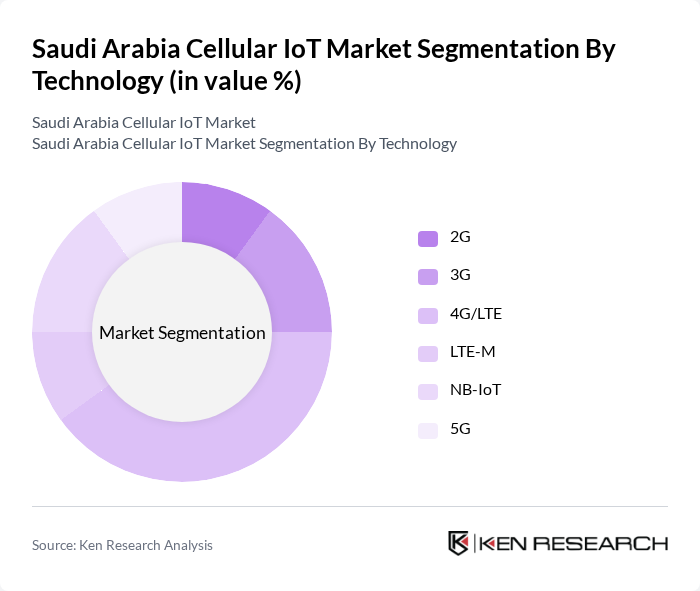
By Technology:The technology segment of the Cellular IoT Market includes various communication standards that facilitate connectivity for IoT devices. The subsegments are 2G, 3G, 4G/LTE, LTE-M, NB-IoT, and 5G. Among these, 4G/LTE has been the dominant technology due to its widespread adoption and ability to support a large number of devices with high-speed connectivity. The emergence of 5G technology is revolutionizing the market by providing ultra-reliable low-latency communication with high bandwidth and extensive device connectivity capabilities. The rapid deployment of 5G networks throughout Saudi Arabia, supported by governmental initiatives and private sector investment, has enabled more sophisticated IoT applications in autonomous vehicles, smart cities, and industrial automation. Advanced solutions like SuperLink technology have enhanced 5G connectivity speeds by 200 percent in remote regions, expanding high-speed network access across the kingdom.
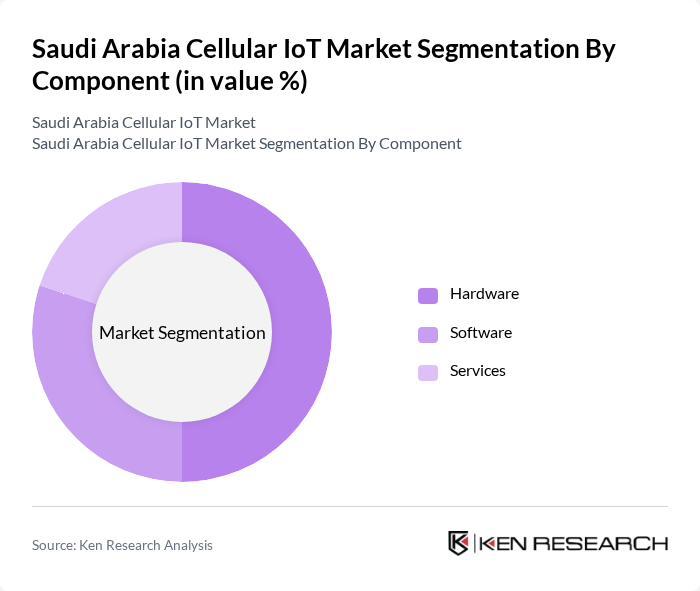
By Component:The component segment encompasses hardware, software, and services that are essential for the deployment and management of IoT solutions. Hardware includes devices and sensors, while software refers to applications and platforms that enable data processing and analytics. Services cover installation, maintenance, and support. The hardware subsegment is currently leading the market due to the increasing demand for IoT devices across various industries, particularly in manufacturing, transportation and logistics, utilities, and healthcare sectors. The growing implementation of device hardware solutions, combined with network connectivity infrastructure and software platforms, drives the need for robust and reliable hardware solutions that support extensive sensor networks, sophisticated automation systems, and cloud-edge integration capabilities.
Saudi Arabia Cellular IoT Market Competitive Landscape
The Saudi Arabia Cellular IoT Market is characterized by a dynamic mix of regional and international players. Leading participants such as STC Group (Saudi Telecom Company), Mobily (Etihad Etisalat Company), Zain KSA, Ericsson Saudi Arabia, Huawei Technologies Saudi Arabia Co. Ltd., Cisco Saudi Arabia Ltd., Nokia Solutions and Networks KSA, Siemens Saudi Arabia, IBM Saudi Arabia contribute to innovation, geographic expansion, and service delivery in this space.
Saudi Arabia Cellular IoT Market Industry Analysis
Growth Drivers
- Increasing Demand for Smart City Initiatives:The Saudi government has allocated approximately SAR 50 billion (USD 13.3 billion) for smart city projects as part of its Vision 2030 initiative. This investment aims to enhance urban living through IoT technologies, including smart traffic management and waste management systems. The growing urban population, projected to reach 38 million in future, further drives the demand for integrated IoT solutions to improve city infrastructure and services.
- Expansion of 5G Networks:Saudi Arabia is rapidly expanding its 5G network, with over 95% of urban areas expected to be covered in future. The government has invested around SAR 25 billion (USD 6.7 billion) in telecommunications infrastructure to support this rollout. The enhanced speed and lower latency of 5G technology facilitate the deployment of IoT applications across various sectors, including healthcare, transportation, and manufacturing, significantly boosting market growth.
- Rising Adoption of Connected Devices:The number of connected devices in Saudi Arabia is projected to exceed 120 million in future, driven by increased consumer demand for smart home technologies and industrial automation. The market for connected devices is expected to reach SAR 35 billion (USD 9.3 billion) as businesses and consumers alike embrace IoT solutions. This surge in connected devices is a key driver for cellular IoT, enhancing connectivity and data exchange across sectors.
Market Challenges
- Data Security and Privacy Concerns:With the rapid growth of IoT devices, data security has become a significant challenge. In future, cyberattacks targeting IoT devices in Saudi Arabia increased by 45%, raising concerns among consumers and businesses. The lack of robust security frameworks and standards complicates the protection of sensitive data, potentially hindering market growth as stakeholders prioritize security measures to mitigate risks.
- High Initial Investment Costs:The initial costs associated with deploying IoT solutions can be prohibitive, particularly for small and medium-sized enterprises (SMEs). The average investment required for a comprehensive IoT system in Saudi Arabia is estimated at SAR 1.2 million (USD 320,000). This financial barrier can deter SMEs from adopting IoT technologies, limiting overall market expansion and innovation in the sector.
Saudi Arabia Cellular IoT Market Future Outlook
The future of the Saudi Arabia Cellular IoT market appears promising, driven by technological advancements and government initiatives. The integration of AI and machine learning into IoT applications is expected to enhance operational efficiency across industries. Additionally, the shift towards edge computing will facilitate real-time data processing, further propelling market growth. As the government continues to support digital transformation, the market is poised for significant advancements in connectivity and application development, fostering innovation and competitiveness.
Market Opportunities
- Growth in Industrial IoT Applications:The industrial IoT sector in Saudi Arabia is projected to grow significantly, with investments expected to reach SAR 20 billion (USD 5.3 billion) in future. This growth is driven by the need for automation and efficiency in manufacturing processes, presenting substantial opportunities for IoT solution providers to cater to various industries.
- Development of Smart Agriculture Solutions:The agricultural sector is increasingly adopting IoT technologies to enhance productivity and sustainability. With the government investing SAR 6 billion (USD 1.6 billion) in smart agriculture initiatives, there is a growing opportunity for IoT applications that optimize resource management and improve crop yields, addressing food security challenges in the region.
Scope of the Report
| Segment | Sub-Segments |
|---|---|
| By Technology | G G G/LTE LTE-M NB-IoT G |
| By Component | Hardware Software Services |
| By Application | Asset Tracking Alarms & Detectors Remote Monitoring Smart Metering Fleet Management Predictive Maintenance Smart Agriculture Others |
| By End-User | Manufacturing Transportation and Logistics Utilities Healthcare Retail Government Agriculture Others |
| By Distribution Channel | Direct Sales Online Sales Distributors |
| By Pricing Model | Subscription-Based Pay-As-You-Go One-Time Purchase |
| By Policy Support | Government Subsidies Tax Incentives Grants for R&D |
Key Target Audience
Investors and Venture Capitalist Firms
Government and Regulatory Bodies (e.g., Saudi Communications and Information Technology Commission, Saudi Arabian Monetary Authority)
Telecommunication Service Providers
IoT Solution Developers
Smart City Project Developers
Energy and Utility Companies
Logistics and Supply Chain Companies
Healthcare Providers and Institutions
Players Mentioned in the Report:
STC Group (Saudi Telecom Company)
Mobily (Etihad Etisalat Company)
Zain KSA
Ericsson Saudi Arabia
Huawei Technologies Saudi Arabia Co. Ltd.
Cisco Saudi Arabia Ltd.
Nokia Solutions and Networks KSA
Siemens Saudi Arabia
IBM Saudi Arabia
Table of Contents
Market Assessment Phase
1. Executive Summary and Approach
2. Saudi Arabia Cellular IoT Market Overview
2.1 Key Insights and Strategic Recommendations
2.2 Saudi Arabia Cellular IoT Market Overview
2.3 Definition and Scope
2.4 Evolution of Market Ecosystem
2.5 Timeline of Key Regulatory Milestones
2.6 Value Chain & Stakeholder Mapping
2.7 Business Cycle Analysis
2.8 Policy & Incentive Landscape
3. Saudi Arabia Cellular IoT Market Analysis
3.1 Growth Drivers
3.1.1 Increasing demand for smart city initiatives
3.1.2 Expansion of 5G networks
3.1.3 Rising adoption of connected devices
3.1.4 Government support for digital transformation
3.2 Market Challenges
3.2.1 Data security and privacy concerns
3.2.2 High initial investment costs
3.2.3 Limited interoperability among devices
3.2.4 Regulatory compliance complexities
3.3 Market Opportunities
3.3.1 Growth in industrial IoT applications
3.3.2 Development of smart agriculture solutions
3.3.3 Expansion of telemedicine services
3.3.4 Increasing focus on energy management systems
3.4 Market Trends
3.4.1 Shift towards edge computing
3.4.2 Integration of AI and machine learning
3.4.3 Rise of subscription-based models
3.4.4 Emphasis on sustainability and green technologies
3.5 Government Regulation
3.5.1 National IoT Strategy
3.5.2 Data Protection Law
3.5.3 Telecommunications Regulatory Framework
3.5.4 Cybersecurity Regulations
4. SWOT Analysis
5. Stakeholder Analysis
6. Porter's Five Forces Analysis
7. Saudi Arabia Cellular IoT Market Market Size, 2019-2024
7.1 By Value
7.2 By Volume
7.3 By Average Selling Price
8. Saudi Arabia Cellular IoT Market Segmentation
8.1 By Technology
8.1.1 2G
8.1.2 3G
8.1.3 4G/LTE
8.1.4 LTE-M
8.1.5 NB-IoT
8.1.6 5G
8.2 By Component
8.2.1 Hardware
8.2.2 Software
8.2.3 Services
8.3 By Application
8.3.1 Asset Tracking
8.3.2 Alarms & Detectors
8.3.3 Remote Monitoring
8.3.4 Smart Metering
8.3.5 Fleet Management
8.3.6 Predictive Maintenance
8.3.7 Smart Agriculture
8.3.8 Others
8.4 By End-User
8.4.1 Manufacturing
8.4.2 Transportation and Logistics
8.4.3 Utilities
8.4.4 Healthcare
8.4.5 Retail
8.4.6 Government
8.4.7 Agriculture
8.4.8 Others
8.5 By Distribution Channel
8.5.1 Direct Sales
8.5.2 Online Sales
8.5.3 Distributors
8.6 By Pricing Model
8.6.1 Subscription-Based
8.6.2 Pay-As-You-Go
8.6.3 One-Time Purchase
8.7 By Policy Support
8.7.1 Government Subsidies
8.7.2 Tax Incentives
8.7.3 Grants for R&D
9. Saudi Arabia Cellular IoT Market Competitive Analysis
9.1 Market Share of Key Players
9.2 Cross Comparison of Key Players
9.2.1 Company Name
9.2.2 Annual Revenue (USD Million)
9.2.3 Year-over-Year Revenue Growth Rate (%)
9.2.4 Market Share (%)
9.2.5 IoT Device Connectivity Volume (Million Connections)
9.2.6 Network Coverage (% of Saudi Arabia Territory)
9.2.7 5G Network Deployment Status
9.2.8 Number of IoT Solutions/Platforms Offered
9.2.9 R&D Investment as % of Revenue
9.2.10 Strategic Partnerships and Ecosystem Strength
9.3 SWOT Analysis of Top Players
9.4 Pricing Analysis
9.5 Detailed Profile of Major Companies
9.5.1 STC Group (Saudi Telecom Company)
9.5.2 Mobily (Etihad Etisalat Company)
9.5.3 Zain KSA
9.5.4 Ericsson Saudi Arabia
9.5.5 Huawei Technologies Saudi Arabia Co. Ltd.
9.5.6 Cisco Saudi Arabia Ltd.
9.5.7 Nokia Solutions and Networks KSA
9.5.8 Siemens Saudi Arabia
9.5.9 IBM Saudi Arabia
9.5.10
Research Methodology
Phase 1: Approach1
Desk Research
- Analysis of industry reports from telecommunications authorities in Saudi Arabia
- Review of market studies published by IoT research organizations and think tanks
- Examination of government publications on digital transformation initiatives and IoT regulations
Primary Research
- Interviews with executives from leading telecommunications companies in Saudi Arabia
- Surveys targeting IoT solution providers and system integrators
- Field interviews with end-users in sectors such as healthcare, agriculture, and smart cities
Validation & Triangulation
- Cross-validation of findings through multiple data sources including industry reports and expert opinions
- Triangulation of market trends with insights from technology adoption studies
- Sanity checks conducted through expert panel discussions and feedback sessions
Phase 2: Market Size Estimation1
Top-down Assessment
- Estimation of the total addressable market based on national IoT spending forecasts
- Segmentation of the market by application areas such as smart metering, asset tracking, and smart agriculture
- Incorporation of growth rates from government initiatives promoting IoT adoption
Bottom-up Modeling
- Collection of data on unit sales and revenue from key IoT device manufacturers
- Operational cost analysis based on pricing models of IoT service providers
- Estimation of market size through aggregation of revenue from various IoT applications
Forecasting & Scenario Analysis
- Multi-variable regression analysis incorporating factors such as population growth and urbanization rates
- Scenario modeling based on potential regulatory changes and technological advancements
- Development of baseline, optimistic, and pessimistic forecasts through 2030
Phase 3: CATI Sample Composition1
| Scope Item/Segment | Sample Size | Target Respondent Profiles |
|---|---|---|
| Smart Agriculture Solutions | 60 | Agricultural Managers, Technology Implementers |
| Healthcare IoT Applications | 50 | Healthcare Administrators, IT Directors |
| Smart City Infrastructure | 55 | Urban Planners, Municipal IT Managers |
| Asset Tracking Systems | 40 | Logistics Managers, Supply Chain Analysts |
| Telecommunications IoT Services | 65 | Telecom Executives, Product Development Managers |
Frequently Asked Questions
What is the current value of the Saudi Arabia Cellular IoT Market?
The Saudi Arabia Cellular IoT Market is valued at approximately USD 9.5 billion, driven by advancements in connectivity infrastructure and the rapid expansion of 5G networks, facilitating sophisticated IoT applications across various sectors.
What are the key growth drivers of the Cellular IoT Market in Saudi Arabia?
Which cities are leading in the Cellular IoT Market in Saudi Arabia?
How is the Saudi government supporting the Cellular IoT Market?
Other Regional/Country Reports
Indonesia Cellular IoT Market
Malaysia Cellular IoT Market
APAC Cellular IoT Market
Other Adjacent Reports
Belgium Smart City Solutions Market
India Industrial Automation Market Outlook to 2030Kuwait Connected Devices Market
USA IoT Security Market Outlook to 2030Vietnam Telecom Infrastructure Market Outlook to 2030: Size, Share, Growth and TrendsEurope Edge Computing Market Outlook to 2030: Size, Share, Growth and TrendsQatar AI Integration Market
Bahrain smart healthcare market report size, share, growth drivers, trends, opportunities & forecast 2025–2030KSA autonomous vehicles market Size, Share, Growth Drivers, Trends, Opportunities & Forecast 2025–2030Why Buy From Us?

What makes us stand out is that our consultants follow Robust, Refine and Result (RRR) methodology. Robust for clear definitions, approaches and sanity checking, Refine for differentiating respondents' facts and opinions, and Result for presenting data with story.

We have set a benchmark in the industry by offering our clients with syndicated and customized market research reports featuring coverage of entire market as well as meticulous research and analyst insights.

While we don't replace traditional research, we flip the method upside down. Our dual approach of Top Bottom & Bottom Top ensures quality deliverable by not just verifying company fundamentals but also looking at the sector and macroeconomic factors.

With one step in the future, our research team constantly tries to show you the bigger picture. We help with some of the tough questions you may encounter along the way: How is the industry positioned? Best marketing channel? KPI's of competitors? By aligning every element, we help maximize success.

Our report gives you instant access to the answers and sources that other companies might choose to hide. We elaborate each steps of research methodology we have used and showcase you the sample size to earn your trust.

If you need any support, we are here! We pride ourselves on universe strength, data quality, and quick, friendly, and professional service.