Saudi Arabia Generic Injectables Pharmaceutical Contract Manufacturing Market Report Size Share Growth Drivers Trends Opportunities & Forecast 2025–2030

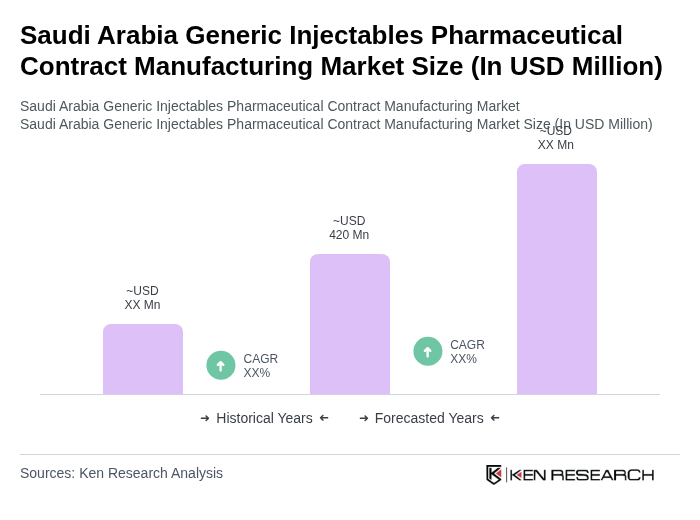
The Saudi Arabia Generic Injectables Pharmaceutical Contract Manufacturing Market, valued at USD 420 million, grows due to rising chronic diseases and government support for local manufacturing.

Region:Middle East

Author(s):Shubham

Product Code:KRAD2446

Pages:87

Published On:January 2026
About the Report

Base Year 2024

Saudi Arabia Generic Injectables Pharmaceutical Contract Manufacturing Market Overview

  • The Saudi Arabia Generic Injectables Pharmaceutical Contract Manufacturing Market is valued at USD 420 million, based on a five-year historical analysis. This growth is primarily driven by the increasing demand for affordable healthcare solutions, the rise in chronic diseases such as diabetes, cardiovascular diseases, and cancer, and the expansion of healthcare infrastructure in the region, including tertiary hospitals and critical care units in major urban centers. The market is also supported by the government's initiatives under Vision 2030 to promote local manufacturing, encourage technology transfer, and reduce dependency on imports through localization programs and preferential procurement for locally produced generics.
  • Key cities such as Riyadh, Jeddah, and Dammam dominate the market due to their strategic locations, advanced healthcare facilities, and the presence of major pharmaceutical companies. Riyadh, being the capital, serves as a hub for regulatory activities, public sector tendering, and corporate headquarters of leading domestic manufacturers, while Jeddah and Dammam benefit from their proximity to major seaports, facilitating easier import of APIs, export of finished products, and distribution of pharmaceutical products across the Kingdom.
  • In 2023, the Saudi Food and Drug Authority (SFDA) continued to strengthen its regulatory framework for pharmaceuticals through the implementation of Good Manufacturing Practice (GMP) and quality requirements, including the “Guidance for Good Manufacturing Practice for Medicinal Products” and related SFDA GMP Regulations issued by the Saudi Food and Drug Authority, which mandate compliance with GMP, validation of sterile processes, and robust quality management systems for all manufacturers and contract manufacturers of sterile products. These regulations require all contract manufacturers to comply with stringent quality control measures, maintain SFDA licensing and inspections, and align with international standards such as WHO, EMA, and PIC/S-equivalent GMP principles, ensuring that all generic injectables meet international standards for efficacy and safety.
Saudi Arabia Generic Injectables Pharmaceutical Contract Manufacturing Market Size

Saudi Arabia Generic Injectables Pharmaceutical Contract Manufacturing Market Segmentation

By Contract Service Type:The contract service type segmentation includes various services that cater to the needs of pharmaceutical companies. The dominant sub-segment is the fill-finish of generic injectables, which is crucial for ensuring the safe and effective delivery of medications and is a core focus area for Saudi-based parenteral manufacturers expanding capacity under localization initiatives. Aseptic formulation and compounding also play a significant role, especially in the production of sterile injectables for high-volume therapeutic areas such as anti-infectives, analgesics, and cardiovascular drugs. Lyophilization services are gaining traction due to the increasing demand for stable formulations for biologics and sensitive molecules, while packaging and labeling services are essential for compliance with SFDA requirements, serialization, and marketability. The 'Others' category includes additional services that support the manufacturing process, such as analytical testing, stability studies, and technology transfer support.
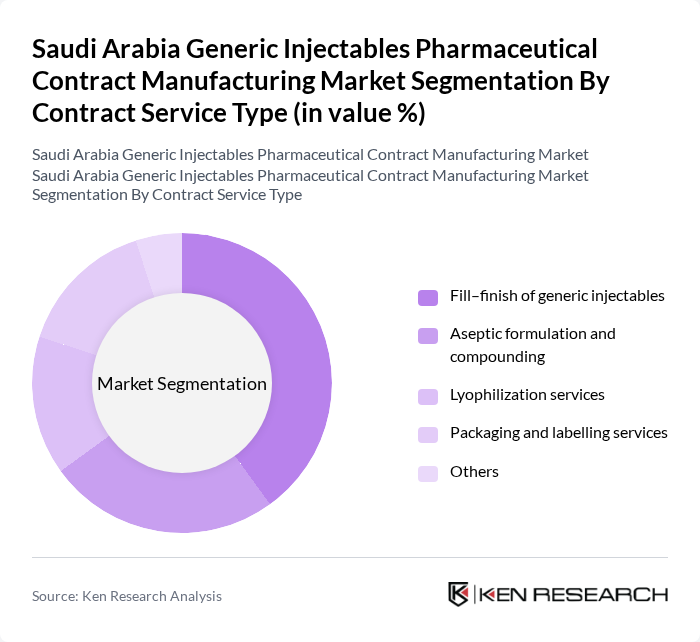
Saudi Arabia Generic Injectables Pharmaceutical Contract Manufacturing Market segmentation by Contract Service Type.

By Dosage Form:The dosage form segmentation encompasses various types of injectable products. Injectable solutions are the most widely used due to their ease of administration, suitability for high-volume hospital use, and rapid onset of action in emergency and critical care settings. Lyophilized powders are also significant, particularly for biologics and sensitive compounds that require enhanced stability and reconstitution at the point of care. Prefilled syringes are gaining popularity for their convenience, reduced risk of contamination, and support for self-administration in chronic disease management. Large-volume parenterals (LVP) are essential for delivering fluids, electrolytes, nutrition, and certain drugs, especially in hospital and intensive care settings. The 'Others' category includes various specialized dosage forms, such as cartridges and dual-chamber systems, that cater to niche markets and more advanced therapeutic applications.
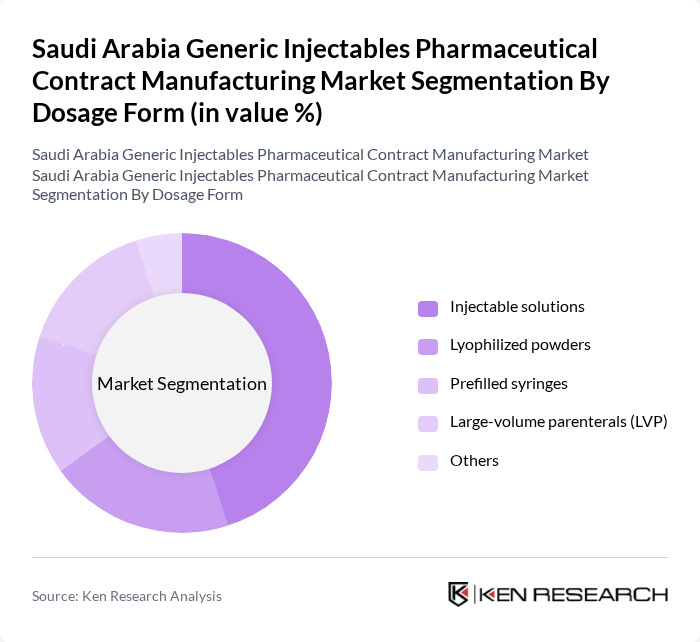
Saudi Arabia Generic Injectables Pharmaceutical Contract Manufacturing Market segmentation by Dosage Form.

Saudi Arabia Generic Injectables Pharmaceutical Contract Manufacturing Market Competitive Landscape

The Saudi Arabia Generic Injectables Pharmaceutical Contract Manufacturing Market is characterized by a dynamic mix of regional and international players. Leading participants such as Saudi Pharmaceutical Industries and Medical Appliances Corporation (SPIMACO), Tabuk Pharmaceuticals Manufacturing Company, Jamjoom Pharmaceuticals Company, Riyadh Pharma (Medical and Pharmaceutical Services Co.), Banaja Holding Company, Tamer Group, Sudair Pharma Company, Jamjoom Medical Industries, Gulf Pharmaceutical Industries (Julphar), Aurobindo Pharma / local JV entities, Hikma Pharmaceuticals / local operations, SPIMACO Addwaeih / contract manufacturing subsidiaries, Arabio (Saudi Arabian Japanese Pharmaceutical Company), Saudi Chemical Company Holding – Pharma segment, Dar Al Dawa Development and Investment Company contribute to innovation, geographic expansion, and service delivery in this space through investments in sterile injectable facilities, local partnerships, and government-tender focused portfolios.

SPIMACO

1986

Al Qassim, Saudi Arabia

Tabuk Pharmaceuticals

1994

Tabuk, Saudi Arabia

Jamjoom Pharmaceuticals

1985

Jeddah, Saudi Arabia

Riyadh Pharma

1988

Riyadh, Saudi Arabia

Gulf Pharmaceutical Industries (Julphar)

1980

Ras Al Khaimah, UAE

Company

Establishment Year

Headquarters

Saudi Arabia generic injectables CM revenue (USD million)

3-year revenue CAGR in contract manufacturing (%)

Share of contract manufacturing in total company revenue (%)

Installed sterile injectable capacity (million units per year)

Capacity utilization rate (%)

SFDA and international quality certifications (count / type)

Saudi Arabia Generic Injectables Pharmaceutical Contract Manufacturing Market Industry Analysis

Growth Drivers

  • Increasing Demand for Cost-Effective Healthcare Solutions:The Saudi Arabian healthcare sector is projected to reach a value of SAR 250 billion in future, driven by a growing population and rising healthcare costs. The demand for generic injectables is surging as they offer affordable alternatives to branded medications. With over 70% of the population suffering from chronic diseases, the need for cost-effective treatment options is critical, propelling the growth of the generic injectables market significantly.
  • Expansion of Healthcare Infrastructure:The Saudi government has allocated SAR 60 billion for healthcare infrastructure development in future, enhancing access to medical services. This expansion includes new hospitals and clinics, which will increase the demand for generic injectables. With an expected increase in healthcare facilities by 20% over the next two years, the market for contract manufacturing of injectables is set to benefit from improved distribution channels and increased product availability.
  • Rising Prevalence of Chronic Diseases:Chronic diseases such as diabetes and cardiovascular conditions are on the rise, with the World Health Organization reporting that 40% of the Saudi population is affected. This trend is expected to increase the demand for injectable medications, particularly generics, which are more affordable. The healthcare expenditure on chronic disease management is projected to reach SAR 80 billion in future, further driving the need for generic injectables in the market.

Market Challenges

  • Stringent Regulatory Requirements:The Saudi Food and Drug Authority (SFDA) enforces strict regulations on pharmaceutical manufacturing, including Good Manufacturing Practices (GMP). Compliance costs can exceed SAR 10 million for small to medium-sized manufacturers, posing a significant barrier to entry. These stringent requirements can slow down the approval process for new products, limiting the ability of local manufacturers to compete effectively in the market.
  • High Competition from Established Players:The Saudi generic injectables market is dominated by established multinational companies, which hold over 75% market share. These firms benefit from economies of scale and extensive distribution networks, making it challenging for local manufacturers to gain market traction. The competitive landscape is further intensified by aggressive pricing strategies employed by these players, which can undermine the profitability of new entrants.

Saudi Arabia Generic Injectables Pharmaceutical Contract Manufacturing Market Future Outlook

The future of the Saudi Arabia generic injectables market appears promising, driven by ongoing investments in healthcare infrastructure and a growing emphasis on local manufacturing. As the government continues to support initiatives aimed at enhancing domestic production capabilities, local manufacturers are likely to see increased opportunities for growth. Additionally, the rising prevalence of chronic diseases will further fuel demand for affordable healthcare solutions, positioning the market for significant expansion in the coming years.

Market Opportunities

  • Growth in Export Potential:With the Saudi government aiming to increase pharmaceutical exports to SAR 15 billion in future, local manufacturers have a significant opportunity to expand their market reach. This initiative is supported by trade agreements and partnerships that facilitate access to international markets, allowing Saudi firms to leverage their manufacturing capabilities for export.
  • Collaborations with International Firms:Strategic partnerships with global pharmaceutical companies can enhance local manufacturers' access to advanced technologies and expertise. Such collaborations are expected to increase production efficiency and product quality, enabling Saudi firms to compete more effectively in both domestic and international markets, thus driving growth in the generic injectables sector.

Scope of the Report

SegmentSub-Segments
By Contract Service Type

Fill–finish of generic injectables

Aseptic formulation and compounding

Lyophilization services

Packaging and labelling services

Others

By Dosage Form

Injectable solutions

Lyophilized powders

Prefilled syringes

Large-volume parenterals (LVP)

Others

By Therapeutic Area

Oncology

Anti-infectives

Cardiovascular

Anesthetics and pain management

Parenteral nutrition

Others

By Client Type

Multinational pharmaceutical companies

Regional and local generic companies

Biotech and specialty pharma

Government and institutional clients

Others

By Packaging Container

Vials

Ampoules

Cartridges

Prefilled syringes

Others

By Manufacturing Scale

Clinical-scale manufacturing

Commercial-scale manufacturing

Small-batch / on-demand manufacturing

By Region

Northern and Central Region

Western Region

Eastern Region

Southern Region

Key Target Audience

Investors and Venture Capitalist Firms

Government and Regulatory Bodies (e.g., Saudi Food and Drug Authority)

Pharmaceutical Manufacturers and Producers

Contract Manufacturing Organizations (CMOs)

Healthcare Providers and Hospitals

Pharmaceutical Distributors and Wholesalers

Industry Associations (e.g., Saudi Pharmaceutical Society)

Financial Institutions and Investment Banks

Players Mentioned in the Report:

Saudi Pharmaceutical Industries and Medical Appliances Corporation (SPIMACO)

Tabuk Pharmaceuticals Manufacturing Company

Jamjoom Pharmaceuticals Company

Riyadh Pharma (Medical and Pharmaceutical Services Co.)

Banaja Holding Company

Tamer Group

Sudair Pharma Company

Jamjoom Medical Industries

Gulf Pharmaceutical Industries (Julphar)

Aurobindo Pharma / local JV entities

Hikma Pharmaceuticals / local operations

SPIMACO Addwaeih / contract manufacturing subsidiaries

Arabio (Saudi Arabian Japanese Pharmaceutical Company)

Saudi Chemical Company Holding Pharma segment

Dar Al Dawa Development and Investment Company

Table of Contents

Market Assessment Phase

1. Executive Summary and Approach


2. Saudi Arabia Generic Injectables Pharmaceutical Contract Manufacturing Market Overview

2.1 Key Insights and Strategic Recommendations

2.2 Saudi Arabia Generic Injectables Pharmaceutical Contract Manufacturing Market Overview

2.3 Definition and Scope

2.4 Evolution of Market Ecosystem

2.5 Timeline of Key Regulatory Milestones

2.6 Value Chain & Stakeholder Mapping

2.7 Business Cycle Analysis

2.8 Policy & Incentive Landscape


3. Saudi Arabia Generic Injectables Pharmaceutical Contract Manufacturing Market Analysis

3.1 Growth Drivers

3.1.1 Increasing demand for cost-effective healthcare solutions
3.1.2 Expansion of healthcare infrastructure
3.1.3 Rising prevalence of chronic diseases
3.1.4 Government initiatives to boost local manufacturing

3.2 Market Challenges

3.2.1 Stringent regulatory requirements
3.2.2 High competition from established players
3.2.3 Fluctuating raw material prices
3.2.4 Limited access to advanced technologies

3.3 Market Opportunities

3.3.1 Growth in export potential
3.3.2 Collaborations with international firms
3.3.3 Development of biosimilars
3.3.4 Increasing focus on R&D investments

3.4 Market Trends

3.4.1 Shift towards personalized medicine
3.4.2 Adoption of automation in manufacturing
3.4.3 Rising demand for environmentally friendly products
3.4.4 Integration of digital technologies in supply chain

3.5 Government Regulation

3.5.1 Implementation of GMP standards
3.5.2 Introduction of pricing controls
3.5.3 Regulatory support for local manufacturers
3.5.4 Policies promoting research and innovation

4. SWOT Analysis


5. Stakeholder Analysis


6. Porter's Five Forces Analysis


7. Saudi Arabia Generic Injectables Pharmaceutical Contract Manufacturing Market Size, 2019-2024

7.1 By Value

7.2 By Volume

7.3 By Average Selling Price


8. Saudi Arabia Generic Injectables Pharmaceutical Contract Manufacturing Market Segmentation

8.1 By Contract Service Type

8.1.1 Fill–finish of generic injectables
8.1.2 Aseptic formulation and compounding
8.1.3 Lyophilization services
8.1.4 Packaging and labelling services
8.1.5 Others

8.2 By Dosage Form

8.2.1 Injectable solutions
8.2.2 Lyophilized powders
8.2.3 Prefilled syringes
8.2.4 Large-volume parenterals (LVP)
8.2.5 Others

8.3 By Therapeutic Area

8.3.1 Oncology
8.3.2 Anti-infectives
8.3.3 Cardiovascular
8.3.4 Anesthetics and pain management
8.3.5 Parenteral nutrition
8.3.6 Others

8.4 By Client Type

8.4.1 Multinational pharmaceutical companies
8.4.2 Regional and local generic companies
8.4.3 Biotech and specialty pharma
8.4.4 Government and institutional clients
8.4.5 Others

8.5 By Packaging Container

8.5.1 Vials
8.5.2 Ampoules
8.5.3 Cartridges
8.5.4 Prefilled syringes
8.5.5 Others

8.6 By Manufacturing Scale

8.6.1 Clinical-scale manufacturing
8.6.2 Commercial-scale manufacturing
8.6.3 Small-batch / on-demand manufacturing

8.7 By Region

8.7.1 Northern and Central Region
8.7.2 Western Region
8.7.3 Eastern Region
8.7.4 Southern Region

9. Saudi Arabia Generic Injectables Pharmaceutical Contract Manufacturing Market Competitive Analysis

9.1 Market Share of Key Players

9.2 Cross Comparison of Key Players

9.2.1 Company name
9.2.2 Saudi Arabia generic injectables CM revenue (USD million)
9.2.3 3-year revenue CAGR in contract manufacturing (%)
9.2.4 Share of contract manufacturing in total company revenue (%)
9.2.5 Installed sterile injectable capacity (million units per year)
9.2.6 Capacity utilization rate (%)
9.2.7 SFDA and international quality certifications (count / type)
9.2.8 EBITDA margin from CM operations (%)
9.2.9 R&D and technology?transfer spend as % of revenue
9.2.10 Number of active CM clients and long?term contracts
9.2.11 On?time delivery and batch?release rate (%)

9.3 SWOT Analysis of Top Players

9.4 Pricing Analysis

9.5 Detailed Profile of Major Companies

9.5.1 Saudi Pharmaceutical Industries and Medical Appliances Corporation (SPIMACO)
9.5.2 Tabuk Pharmaceuticals Manufacturing Company
9.5.3 Jamjoom Pharmaceuticals Company
9.5.4 Riyadh Pharma (Medical and Pharmaceutical Services Co.)
9.5.5 Banaja Holding Company
9.5.6 Tamer Group
9.5.7 Sudair Pharma Company
9.5.8 Jamjoom Medical Industries
9.5.9 Gulf Pharmaceutical Industries (Julphar)
9.5.10 Aurobindo Pharma / local JV entities
9.5.11 Hikma Pharmaceuticals / local operations
9.5.12 SPIMACO Addwaeih / contract manufacturing subsidiaries
9.5.13 Arabio (Saudi Arabian Japanese Pharmaceutical Company)
9.5.14 Saudi Chemical Company Holding – Pharma segment
9.5.15 Dar Al Dawa Development and Investment Company

10. Saudi Arabia Generic Injectables Pharmaceutical Contract Manufacturing Market End-User Analysis

10.1 Procurement Behavior of Key Ministries

10.1.1 Ministry of Health
10.1.2 Ministry of Defense
10.1.3 Ministry of Education
10.1.4 Others

10.2 Corporate Spend on Infrastructure & Energy

10.2.1 Investment in Healthcare Facilities
10.2.2 Funding for Research and Development
10.2.3 Budget Allocation for Pharmaceuticals
10.2.4 Others

10.3 Pain Point Analysis by End-User Category

10.3.1 Hospitals
10.3.2 Clinics
10.3.3 Home Healthcare Providers
10.3.4 Others

10.4 User Readiness for Adoption

10.4.1 Training and Support Needs
10.4.2 Technology Adoption Rates
10.4.3 Regulatory Compliance Awareness
10.4.4 Others

10.5 Post-Deployment ROI and Use Case Expansion

10.5.1 Cost Savings Analysis
10.5.2 Performance Metrics Evaluation
10.5.3 User Satisfaction Surveys
10.5.4 Others

11. Saudi Arabia Generic Injectables Pharmaceutical Contract Manufacturing Market Future Size, 2025-2030

11.1 By Value

11.2 By Volume

11.3 By Average Selling Price


Go-To-Market Strategy Phase

1. Whitespace Analysis + Business Model Canvas

1.1 Market Gaps Identification

1.2 Business Model Development


2. Marketing and Positioning Recommendations

2.1 Branding Strategies

2.2 Product USPs


3. Distribution Plan

3.1 Urban Retail vs Rural NGO Tie-ups


4. Channel & Pricing Gaps

4.1 Underserved Routes

4.2 Pricing Bands


5. Unmet Demand & Latent Needs

5.1 Category Gaps

5.2 Consumer Segments


6. Customer Relationship

6.1 Loyalty Programs

6.2 After-sales Service


7. Value Proposition

7.1 Sustainability

7.2 Integrated Supply Chains


8. Key Activities

8.1 Regulatory Compliance

8.2 Branding

8.3 Distribution Setup


9. Entry Strategy Evaluation

9.1 Domestic Market Entry Strategy

9.1.1 Product Mix
9.1.2 Pricing Band
9.1.3 Packaging

9.2 Export Entry Strategy

9.2.1 Target Countries
9.2.2 Compliance Roadmap

10. Entry Mode Assessment

10.1 JV

10.2 Greenfield

10.3 M&A

10.4 Distributor Model


11. Capital and Timeline Estimation

11.1 Capital Requirements

11.2 Timelines


12. Control vs Risk Trade-Off

12.1 Ownership vs Partnerships


13. Profitability Outlook

13.1 Breakeven Analysis

13.2 Long-term Sustainability


14. Potential Partner List

14.1 Distributors

14.2 JVs

14.3 Acquisition Targets


15. Execution Roadmap

15.1 Phased Plan for Market Entry

15.1.1 Market Setup
15.1.2 Market Entry
15.1.3 Growth Acceleration
15.1.4 Scale & Stabilize

15.2 Key Activities and Milestones

15.2.1 Activity Planning
15.2.2 Milestone Tracking

Research Methodology

ApproachModellingSample

Phase 1: Approach1

Desk Research

  • Analysis of industry reports from pharmaceutical associations in Saudi Arabia
  • Review of government publications and regulatory frameworks affecting generic injectables
  • Examination of market trends and forecasts from reputable market research databases

Primary Research

  • Interviews with key stakeholders in pharmaceutical manufacturing, including CEOs and R&D heads
  • Surveys targeting procurement managers in hospitals and healthcare facilities
  • Field visits to contract manufacturing organizations (CMOs) to gather firsthand insights

Validation & Triangulation

  • Cross-validation of data through multiple sources, including trade publications and expert opinions
  • Triangulation of findings from primary interviews and secondary data sources
  • Sanity checks conducted through expert panel discussions to ensure data reliability

Phase 2: Market Size Estimation1

Top-down Assessment

  • Estimation of market size based on national healthcare expenditure and pharmaceutical spending
  • Segmentation of the market by therapeutic areas and product types within generic injectables
  • Incorporation of growth rates from historical data and projected healthcare trends

Bottom-up Modeling

  • Collection of production data from leading contract manufacturers in the region
  • Estimation of market share based on sales volume and revenue from generic injectables
  • Analysis of pricing strategies and cost structures of generic injectable products

Forecasting & Scenario Analysis

  • Development of forecasting models using historical sales data and market growth indicators
  • Scenario analysis based on potential regulatory changes and market entry of new players
  • Creation of baseline, optimistic, and pessimistic forecasts through 2030

Phase 3: CATI Sample Composition1

Scope Item/SegmentSample SizeTarget Respondent Profiles
Pharmaceutical Manufacturers100CEOs, Production Managers
Healthcare Providers90Pharmacy Directors, Procurement Officers
Regulatory Bodies60Regulatory Affairs Specialists, Compliance Officers
Market Analysts70Market Research Analysts, Industry Consultants
Healthcare Policy Makers50Health Economists, Policy Advisors

Frequently Asked Questions

What is the current value of the Saudi Arabia Generic Injectables Pharmaceutical Contract Manufacturing Market?

The Saudi Arabia Generic Injectables Pharmaceutical Contract Manufacturing Market is valued at approximately USD 420 million, reflecting a significant growth driven by increasing demand for affordable healthcare solutions and the rise in chronic diseases.

What factors are driving the growth of the generic injectables market in Saudi Arabia?

Which cities are the primary hubs for the generic injectables market in Saudi Arabia?

What regulatory framework governs the pharmaceutical manufacturing in Saudi Arabia?

Other Regional/Country Reports

Indonesia Generic Injectables Pharmaceutical Contract Manufacturing Market

Malaysia Generic Injectables Pharmaceutical Contract Manufacturing Market

KSA Generic Injectables Pharmaceutical Contract Manufacturing Market

APAC Generic Injectables Pharmaceutical Contract Manufacturing Market

SEA Generic Injectables Pharmaceutical Contract Manufacturing Market

Vietnam Generic Injectables Pharmaceutical Contract Manufacturing Market

Why Buy From Us?

Refine Robust Result (RRR) Framework

What makes us stand out is that our consultants follow Robust, Refine and Result (RRR) methodology. Robust for clear definitions, approaches and sanity checking, Refine for differentiating respondents' facts and opinions, and Result for presenting data with story.

Our Reach Is Unmatched

We have set a benchmark in the industry by offering our clients with syndicated and customized market research reports featuring coverage of entire market as well as meticulous research and analyst insights.

Shifting the Research Paradigm

While we don't replace traditional research, we flip the method upside down. Our dual approach of Top Bottom & Bottom Top ensures quality deliverable by not just verifying company fundamentals but also looking at the sector and macroeconomic factors.

More Insights-Better Decisions

With one step in the future, our research team constantly tries to show you the bigger picture. We help with some of the tough questions you may encounter along the way: How is the industry positioned? Best marketing channel? KPI's of competitors? By aligning every element, we help maximize success.

Transparency and Trust

Our report gives you instant access to the answers and sources that other companies might choose to hide. We elaborate each steps of research methodology we have used and showcase you the sample size to earn your trust.

Round the Clock Support

If you need any support, we are here! We pride ourselves on universe strength, data quality, and quick, friendly, and professional service.

Why Clients Choose Us?

400000+
Reports in repository
150+
Consulting projects a year
100+
Analysts
8000+
Client Queries in 2022








