About the Report
Base Year 2024South Korea Sports Nutrition & Supplements Market Overview
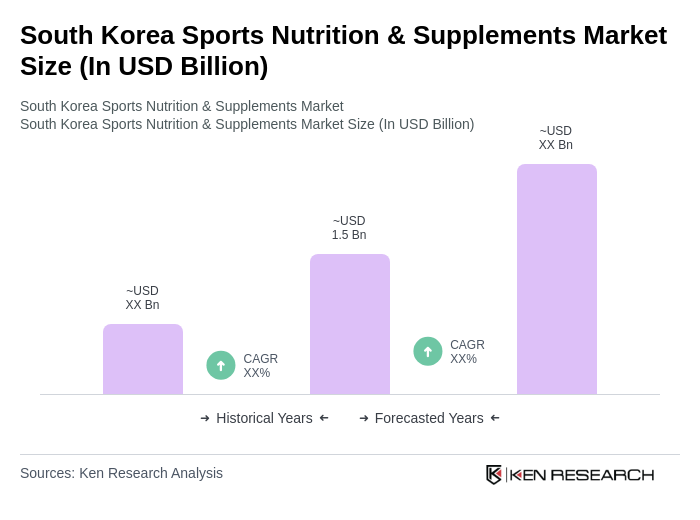
- The South Korea Sports Nutrition & Supplements Market is valued at USD 1.5 billion, based on a five-year historical analysis. This growth is primarily driven by increasing health consciousness among consumers, a rise in fitness activities, and the growing popularity of sports among the youth. The market has seen a surge in demand for various nutritional products, including protein supplements and vitamins, as consumers seek to enhance their physical performance and overall well-being.
- Seoul, Busan, and Incheon are the dominant cities in the South Korea Sports Nutrition & Supplements Market. Seoul, being the capital, has a high concentration of fitness centers, health clubs, and sports events, which drives demand for sports nutrition products. Busan, as a major port city, has a vibrant lifestyle and a growing fitness culture, while Incheon benefits from its proximity to Seoul, making it a hub for health-conscious consumers.
- In 2023, the South Korean government implemented regulations to ensure the safety and efficacy of sports nutrition products. This includes mandatory labeling requirements that specify the nutritional content and health claims of supplements. The regulation aims to protect consumers from misleading information and to promote transparency in the market, thereby enhancing consumer trust in sports nutrition products.
South Korea Sports Nutrition & Supplements Market Segmentation
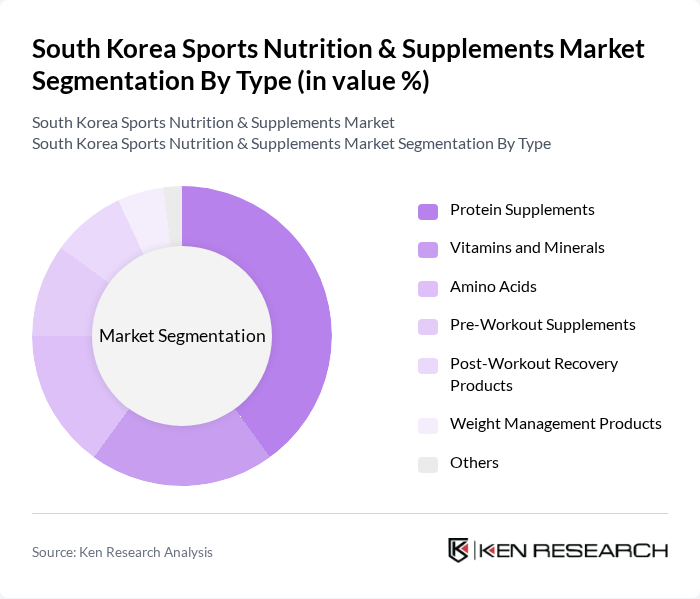
By Type:The market is segmented into various types of products, including protein supplements, vitamins and minerals, amino acids, pre-workout supplements, post-workout recovery products, weight management products, and others. Among these, protein supplements dominate the market due to their widespread use among athletes and fitness enthusiasts seeking to enhance muscle recovery and growth. The increasing trend of fitness and bodybuilding has led to a significant rise in the consumption of protein-based products, making them a preferred choice for consumers.
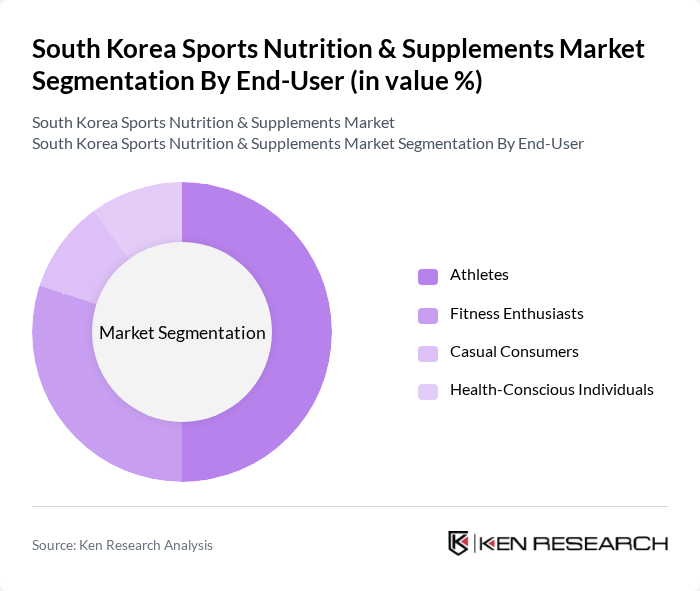
By End-User:The end-user segmentation includes athletes, fitness enthusiasts, casual consumers, and health-conscious individuals. Athletes represent the largest segment, as they require specialized nutrition to enhance performance and recovery. Fitness enthusiasts also contribute significantly to the market, driven by the growing trend of gym culture and personal fitness. Casual consumers and health-conscious individuals are increasingly turning to sports nutrition products to support their active lifestyles and overall health, further expanding the market.
South Korea Sports Nutrition & Supplements Market Competitive Landscape
The South Korea Sports Nutrition & Supplements Market is characterized by a dynamic mix of regional and international players. Leading participants such as Amway Korea, Herbalife Korea, GNC Korea, Nutrilite, MusclePharm, Optimum Nutrition, BSN (Bio-Engineered Supplements and Nutrition), MyProtein, Isagenix, Dymatize Nutrition, Quest Nutrition, Bodybuilding.com, EAS (Energy Athletic Science), ProMix Nutrition, Vega contribute to innovation, geographic expansion, and service delivery in this space.
South Korea Sports Nutrition & Supplements Market Industry Analysis
Growth Drivers
- Increasing Health Consciousness Among Consumers:The South Korean population is increasingly prioritizing health, with 63% of adults engaging in regular physical activity as of 2023. This trend is supported by a growing awareness of nutrition, with the health and wellness market projected to reach $10 billion in the future. The rise in health consciousness is driving demand for sports nutrition products, as consumers seek to enhance their fitness and overall well-being through dietary supplements.
- Rise in Fitness and Sports Participation:The number of gym memberships in South Korea surged to over 6 million in 2023, reflecting a 15% increase from the previous year. This growth in fitness participation is accompanied by a heightened interest in sports nutrition, as athletes and fitness enthusiasts seek products that support performance and recovery. The increasing popularity of sports events, such as marathons and triathlons, further fuels the demand for specialized supplements tailored to active lifestyles.
- Expansion of E-commerce Platforms:E-commerce sales of sports nutrition products in South Korea reached approximately $1.5 billion in 2023, marking a 20% increase from 2022. The convenience of online shopping, coupled with the rise of health-focused online communities, has significantly boosted the accessibility of these products. Major e-commerce platforms are increasingly featuring a wide range of supplements, allowing consumers to easily compare products and make informed purchasing decisions, thus driving market growth.
Market Challenges
- Stringent Regulatory Requirements:The South Korean sports nutrition market faces significant challenges due to strict regulatory frameworks. Compliance with the Food Sanitation Act requires rigorous testing and certification processes, which can delay product launches. In 2023, over 30% of new product applications were rejected due to non-compliance with labeling and safety standards, creating barriers for brands looking to enter the market and limiting consumer choices.
- High Competition Among Brands:The South Korean sports nutrition market is characterized by intense competition, with over 200 brands vying for market share. This saturation leads to aggressive pricing strategies, which can erode profit margins. In 2023, the top five brands accounted for only 35% of the market, indicating a fragmented landscape where new entrants struggle to establish a foothold. This competitive pressure necessitates significant marketing investments to differentiate products and attract consumers.
South Korea Sports Nutrition & Supplements Market Future Outlook
The South Korean sports nutrition and supplements market is poised for continued growth, driven by evolving consumer preferences and technological advancements. As health consciousness rises, brands are expected to innovate with clean label products and personalized nutrition solutions. Additionally, the integration of technology in product development, such as app-based tracking and tailored supplement recommendations, will enhance consumer engagement. The market is likely to see increased collaboration with fitness influencers, further driving brand visibility and consumer trust in the future.
Market Opportunities
- Growth in Plant-Based Supplements:The demand for plant-based supplements is on the rise, with sales projected to reach $500 million in the future. This trend is driven by a growing consumer preference for vegan and vegetarian options, as well as increased awareness of the health benefits associated with plant-based diets. Brands that focus on developing innovative plant-based products can tap into this lucrative market segment.
- Increasing Demand for Personalized Nutrition:Personalized nutrition is gaining traction, with the market expected to grow to $300 million in the future. Consumers are increasingly seeking tailored solutions that cater to their specific health needs and fitness goals. Companies that leverage data analytics and consumer insights to offer customized supplement plans will likely capture a significant share of this emerging market opportunity.
Scope of the Report
| Segment | Sub-Segments |
|---|---|
| By Type | Protein Supplements Vitamins and Minerals Amino Acids Pre-Workout Supplements Post-Workout Recovery Products Weight Management Products Others |
| By End-User | Athletes Fitness Enthusiasts Casual Consumers Health-Conscious Individuals |
| By Distribution Channel | Online Retail Supermarkets/Hypermarkets Specialty Stores Pharmacies |
| By Price Range | Premium Mid-Range Budget |
| By Formulation | Powder Capsules/Tablets Liquid |
| By Packaging Type | Bottles Sachets Tubs |
| By Brand Loyalty | Brand Loyal Consumers Brand Switchers New Entrants |
Key Target Audience
Investors and Venture Capitalist Firms
Government and Regulatory Bodies (e.g., Ministry of Food and Drug Safety, Korea Food and Drug Administration)
Manufacturers and Producers
Distributors and Retailers
Health and Fitness Clubs
Sports Teams and Organizations
Nutritionists and Dietitians
Pharmaceutical Companies
Players Mentioned in the Report:
Amway Korea
Herbalife Korea
GNC Korea
Nutrilite
MusclePharm
Optimum Nutrition
BSN (Bio-Engineered Supplements and Nutrition)
MyProtein
Isagenix
Dymatize Nutrition
Quest Nutrition
Bodybuilding.com
EAS (Energy Athletic Science)
ProMix Nutrition
Vega
Table of Contents
Market Assessment Phase
1. Executive Summary and Approach
2. South Korea Sports Nutrition & Supplements Market Overview
2.1 Key Insights and Strategic Recommendations
2.2 South Korea Sports Nutrition & Supplements Market Overview
2.3 Definition and Scope
2.4 Evolution of Market Ecosystem
2.5 Timeline of Key Regulatory Milestones
2.6 Value Chain & Stakeholder Mapping
2.7 Business Cycle Analysis
2.8 Policy & Incentive Landscape
3. South Korea Sports Nutrition & Supplements Market Analysis
3.1 Growth Drivers
3.1.1 Increasing health consciousness among consumers
3.1.2 Rise in fitness and sports participation
3.1.3 Expansion of e-commerce platforms
3.1.4 Innovative product offerings
3.2 Market Challenges
3.2.1 Stringent regulatory requirements
3.2.2 High competition among brands
3.2.3 Consumer skepticism towards supplements
3.2.4 Price sensitivity among consumers
3.3 Market Opportunities
3.3.1 Growth in plant-based supplements
3.3.2 Increasing demand for personalized nutrition
3.3.3 Expansion into untapped rural markets
3.3.4 Collaborations with fitness influencers
3.4 Market Trends
3.4.1 Shift towards clean label products
3.4.2 Rise of online health communities
3.4.3 Increased focus on mental wellness supplements
3.4.4 Adoption of technology in product development
3.5 Government Regulation
3.5.1 Compliance with the Food Sanitation Act
3.5.2 Labeling requirements for nutritional supplements
3.5.3 Restrictions on health claims
3.5.4 Import regulations for foreign products
4. SWOT Analysis
5. Stakeholder Analysis
6. Porter's Five Forces Analysis
7. South Korea Sports Nutrition & Supplements Market Market Size, 2019-2024
7.1 By Value
7.2 By Volume
7.3 By Average Selling Price
8. South Korea Sports Nutrition & Supplements Market Segmentation
8.1 By Type
8.1.1 Protein Supplements
8.1.2 Vitamins and Minerals
8.1.3 Amino Acids
8.1.4 Pre-Workout Supplements
8.1.5 Post-Workout Recovery Products
8.1.6 Weight Management Products
8.1.7 Others
8.2 By End-User
8.2.1 Athletes
8.2.2 Fitness Enthusiasts
8.2.3 Casual Consumers
8.2.4 Health-Conscious Individuals
8.3 By Distribution Channel
8.3.1 Online Retail
8.3.2 Supermarkets/Hypermarkets
8.3.3 Specialty Stores
8.3.4 Pharmacies
8.4 By Price Range
8.4.1 Premium
8.4.2 Mid-Range
8.4.3 Budget
8.5 By Formulation
8.5.1 Powder
8.5.2 Capsules/Tablets
8.5.3 Liquid
8.6 By Packaging Type
8.6.1 Bottles
8.6.2 Sachets
8.6.3 Tubs
8.7 By Brand Loyalty
8.7.1 Brand Loyal Consumers
8.7.2 Brand Switchers
8.7.3 New Entrants
9. South Korea Sports Nutrition & Supplements Market Competitive Analysis
9.1 Market Share of Key Players
9.2 Cross Comparison of Key Players
9.2.1 Company Name
9.2.2 Group Size (Large, Medium, or Small as per industry convention)
9.2.3 Revenue Growth Rate
9.2.4 Market Penetration Rate
9.2.5 Customer Retention Rate
9.2.6 Product Diversification Index
9.2.7 Pricing Strategy
9.2.8 Distribution Network Efficiency
9.2.9 Brand Recognition Score
9.2.10 Innovation Rate
9.3 SWOT Analysis of Top Players
9.4 Pricing Analysis
9.5 Detailed Profile of Major Companies
9.5.1 Amway Korea
9.5.2 Herbalife Korea
9.5.3 GNC Korea
9.5.4 Nutrilite
9.5.5 MusclePharm
9.5.6 Optimum Nutrition
9.5.7 BSN (Bio-Engineered Supplements and Nutrition)
9.5.8 MyProtein
9.5.9 Isagenix
9.5.10 Dymatize Nutrition
9.5.11 Quest Nutrition
9.5.12 Bodybuilding.com
9.5.13 EAS (Energy Athletic Science)
9.5.14 ProMix Nutrition
9.5.15 Vega
10. South Korea Sports Nutrition & Supplements Market End-User Analysis
10.1 Procurement Behavior of Key Ministries
10.1.1 Government health initiatives
10.1.2 Budget allocation for sports programs
10.1.3 Collaboration with health organizations
10.2 Corporate Spend on Infrastructure & Energy
10.2.1 Investment in fitness facilities
10.2.2 Sponsorship of sports events
10.2.3 Employee wellness programs
10.3 Pain Point Analysis by End-User Category
10.3.1 Accessibility of products
10.3.2 Affordability concerns
10.3.3 Quality assurance issues
10.4 User Readiness for Adoption
10.4.1 Awareness of benefits
10.4.2 Willingness to try new products
10.4.3 Trust in brands
10.5 Post-Deployment ROI and Use Case Expansion
10.5.1 Measurement of health improvements
10.5.2 Feedback mechanisms for product enhancement
10.5.3 Expansion into new consumer segments
11. South Korea Sports Nutrition & Supplements Market Future Size, 2025-2030
11.1 By Value
11.2 By Volume
11.3 By Average Selling Price
Go-To-Market Strategy Phase
1. Whitespace Analysis + Business Model Canvas
1.1 Market Gaps Identification
1.2 Business Model Framework
2. Marketing and Positioning Recommendations
2.1 Branding strategies
2.2 Product USPs
3. Distribution Plan
3.1 Urban retail vs rural NGO tie-ups
4. Channel & Pricing Gaps
4.1 Underserved routes
4.2 Pricing bands
5. Unmet Demand & Latent Needs
5.1 Category gaps
5.2 Consumer segments
6. Customer Relationship
6.1 Loyalty programs
6.2 After-sales service
7. Value Proposition
7.1 Sustainability
7.2 Integrated supply chains
8. Key Activities
8.1 Regulatory compliance
8.2 Branding
8.3 Distribution setup
9. Entry Strategy Evaluation
9.1 Domestic Market Entry Strategy
9.1.1 Product mix
9.1.2 Pricing band
9.1.3 Packaging
9.2 Export Entry Strategy
9.2.1 Target countries
9.2.2 Compliance roadmap
10. Entry Mode Assessment
10.1 JV
10.2 Greenfield
10.3 M&A
10.4 Distributor Model
11. Capital and Timeline Estimation
11.1 Capital requirements
11.2 Timelines
12. Control vs Risk Trade-Off
12.1 Ownership vs Partnerships
13. Profitability Outlook
13.1 Breakeven analysis
13.2 Long-term sustainability
14. Potential Partner List
14.1 Distributors
14.2 JVs
14.3 Acquisition targets
15. Execution Roadmap
15.1 Phased Plan for Market Entry
15.1.1 Market Setup
15.1.2 Market Entry
15.1.3 Growth Acceleration
15.1.4 Scale & Stabilize
15.2 Key Activities and Milestones
15.2.1 Milestone Planning
15.2.2 Activity Tracking
Research Methodology
Phase 1: Approach1
Desk Research
- Analysis of industry reports from South Korean sports nutrition associations
- Review of market trends and consumer behavior studies published by academic institutions
- Examination of government publications on health and wellness initiatives related to sports nutrition
Primary Research
- Interviews with nutritionists and dietitians specializing in sports nutrition
- Surveys conducted with fitness trainers and gym owners regarding supplement usage
- Focus groups with athletes to gather insights on their dietary supplement preferences
Validation & Triangulation
- Cross-validation of findings through multiple expert interviews and focus group feedback
- Triangulation of data from consumer surveys and industry reports
- Sanity checks through consultations with market analysts and nutrition experts
Phase 2: Market Size Estimation1
Top-down Assessment
- Estimation of market size based on national health expenditure and sports participation rates
- Segmentation of the market by product type, including protein powders, vitamins, and energy bars
- Incorporation of demographic data to assess potential consumer base growth
Bottom-up Modeling
- Collection of sales data from leading sports nutrition brands in South Korea
- Estimation of average spending per consumer on sports supplements
- Volume estimates based on distribution channels, including online and retail sales
Forecasting & Scenario Analysis
- Multi-variable forecasting using trends in fitness culture and health awareness
- Scenario analysis based on potential regulatory changes affecting supplement sales
- Development of baseline, optimistic, and pessimistic market growth projections through 2030
Phase 3: CATI Sample Composition1
| Scope Item/Segment | Sample Size | Target Respondent Profiles |
|---|---|---|
| General Consumer Awareness | 150 | Fitness Enthusiasts, Casual Gym Goers |
| Professional Athlete Insights | 100 | Professional Athletes, Coaches |
| Retailer Perspectives | 80 | Health Store Owners, Supplement Retail Managers |
| Nutritionist and Dietitian Feedback | 60 | Sports Nutritionists, Registered Dietitians |
| Fitness Trainer Opinions | 70 | Personal Trainers, Group Fitness Instructors |
Frequently Asked Questions
What is the current value of the South Korea Sports Nutrition & Supplements Market?
The South Korea Sports Nutrition & Supplements Market is valued at approximately USD 1.5 billion, reflecting a significant growth trend driven by increasing health consciousness and fitness activities among consumers.
Which cities are the main hubs for sports nutrition products in South Korea?
What types of products are included in the South Korea Sports Nutrition Market?
Who are the primary end-users of sports nutrition products in South Korea?
Other Regional/Country Reports
Indonesia Sports Nutrition & Supplements Market
Other Adjacent Reports
South Korea Plant-Based Supplements Market
Indonesia Weight Management Products Market
Brazil E-commerce Health Products Market
Why Buy From Us?

What makes us stand out is that our consultants follow Robust, Refine and Result (RRR) methodology. Robust for clear definitions, approaches and sanity checking, Refine for differentiating respondents' facts and opinions, and Result for presenting data with story.

We have set a benchmark in the industry by offering our clients with syndicated and customized market research reports featuring coverage of entire market as well as meticulous research and analyst insights.

While we don't replace traditional research, we flip the method upside down. Our dual approach of Top Bottom & Bottom Top ensures quality deliverable by not just verifying company fundamentals but also looking at the sector and macroeconomic factors.

With one step in the future, our research team constantly tries to show you the bigger picture. We help with some of the tough questions you may encounter along the way: How is the industry positioned? Best marketing channel? KPI's of competitors? By aligning every element, we help maximize success.

Our report gives you instant access to the answers and sources that other companies might choose to hide. We elaborate each steps of research methodology we have used and showcase you the sample size to earn your trust.

If you need any support, we are here! We pride ourselves on universe strength, data quality, and quick, friendly, and professional service.