About the Report
Base Year 2024Switzerland Hospitality Industry Market Overview
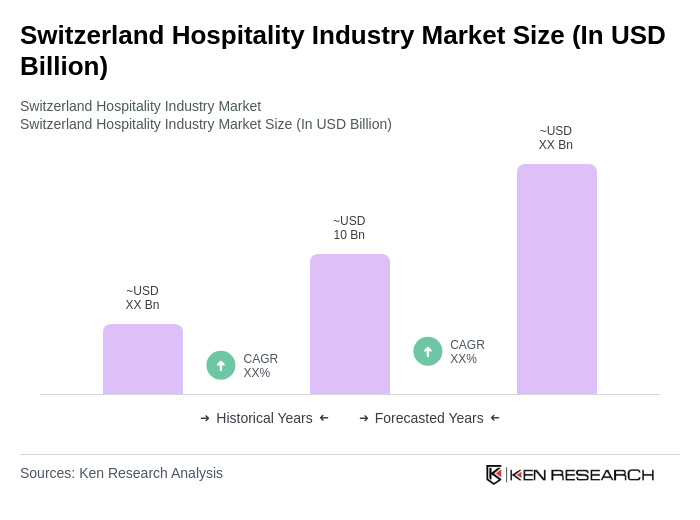
- The Switzerland Hospitality Industry Market is valued at USD 10 billion, based on a five-year historical analysis. This growth is primarily driven by the increasing influx of international tourists, a robust business travel sector, and a growing demand for luxury accommodations. The market has seen a resurgence post-pandemic, with a notable rise in both domestic and international travel, contributing to the overall economic recovery.
- Key cities such as Zurich, Geneva, and Lucerne dominate the hospitality market due to their status as major financial hubs and tourist destinations. Zurich, with its vibrant cultural scene and business opportunities, attracts a significant number of travelers. Geneva, known for its international organizations and luxury hotels, and Lucerne, famous for its picturesque landscapes, further enhance Switzerland's appeal in the hospitality sector.
- In 2023, the Swiss government expanded sustainable tourism initiatives, encouraging hotels to adopt eco-friendly practices such as energy efficiency and waste reduction. Participation in programs like EarthCheck's Sustainable Destinations has become a benchmark for qualifying for government incentives, positioning Switzerland as a leader in sustainable tourism and enhancing its global competitiveness.
Switzerland Hospitality Industry Market Segmentation
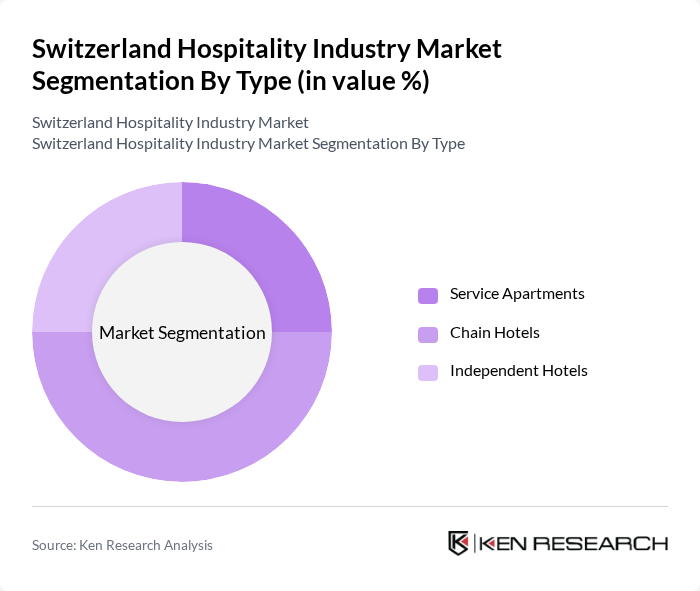
By Type:The hospitality market in Switzerland is segmented into three main types: Service Apartments, Chain Hotels, and Independent Hotels. Service apartments cater to long-term stays, offering home-like amenities and flexibility for both business and leisure travelers. Chain hotels provide standardized services and brand reliability across various locations, appealing to both business and group travelers. Independent hotels focus on unique experiences, personalized services, and local authenticity, attracting tourists seeking distinctive accommodations.
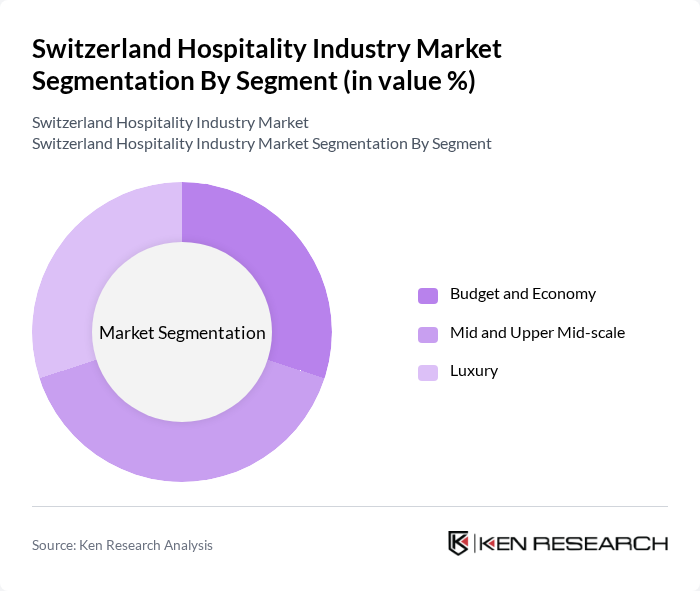
By Segment:The market is further divided into Budget and Economy, Mid and Upper Mid-scale, and Luxury segments. Budget and Economy hotels cater to cost-conscious travelers, offering essential amenities and competitive pricing. Mid and Upper Mid-scale hotels provide a balance of comfort, quality, and affordability, appealing to families and business travelers. Luxury hotels deliver high-end services, exclusive amenities, and premium experiences, attracting affluent tourists and executives.
Switzerland Hospitality Industry Market Competitive Landscape
The Switzerland Hospitality Industry Market is characterized by a dynamic mix of regional and international players. Leading participants such as Accor SA, Hilton Worldwide Holdings Inc., Marriott International, Inc., InterContinental Hotels Group PLC, Swissôtel Hotels & Resorts, Badrutt's Palace Hotel, The Dolder Grand, Kempinski Hotels S.A., Mövenpick Hotels & Resorts, Radisson Hotel Group, Sorell Hotels Switzerland, Tschuggen Hotel Group AG, Hotelplan Group, Zermatt Bergbahnen AG, Hotel Baur au Lac contribute to innovation, geographic expansion, and service delivery in this space.
Switzerland Hospitality Industry Market Industry Analysis
Growth Drivers
- Increase in Tourism:Switzerland welcomed approximately 11.4 million international tourists in future, a significant increase from 10.5 million in the previous period. This surge is attributed to the country's reputation for stunning landscapes and cultural heritage. The Swiss Federal Statistical Office reported that tourism contributed CHF 23.7 billion to the economy in future, highlighting the sector's vital role in driving hospitality growth. The anticipated rise in global travel post-pandemic further supports this upward trend, positioning Switzerland as a prime destination.
- Rise in Business Travel:Business travel in Switzerland is projected to reach CHF 7.8 billion in future, reflecting a robust recovery as companies resume in-person meetings and conferences. The Swiss Business Travel Association noted a 14% increase in corporate travel bookings in future compared to the previous period. This growth is driven by the country's strategic location in Europe and its reputation for hosting international events, which enhances demand for hotels and related services in the hospitality sector.
- Growth of Online Booking Platforms:The online travel agency market in Switzerland is expected to generate CHF 3.4 billion in revenue in future, up from CHF 3 billion in the previous period. The rise of platforms like Booking.com and Airbnb has transformed how travelers book accommodations, with approximately 68% of bookings now made online. This shift not only increases accessibility for consumers but also drives competition among hospitality providers, encouraging improvements in service quality and customer experience.
Market Challenges
- High Operational Costs:The hospitality sector in Switzerland faces operational costs averaging CHF 195 per room per night, significantly higher than in neighboring countries. Factors contributing to these costs include high labor expenses, with the average salary for hospitality workers reaching CHF 4,400 monthly. Additionally, energy costs have surged by approximately 28% in the past period, further straining profit margins for hotels and restaurants, making it challenging to maintain competitive pricing.
- Seasonal Fluctuations:The Swiss hospitality industry experiences significant seasonal fluctuations, with peak tourist seasons in summer and winter. For instance, hotel occupancy rates can drop to 42% during off-peak months, compared to 83% during peak seasons. This variability complicates revenue management and staffing, leading to potential overstaffing in low seasons and undercapacity during high demand periods, ultimately affecting profitability and operational efficiency.
Switzerland Hospitality Industry Market Future Outlook
The Switzerland hospitality industry is poised for a dynamic future, driven by increasing tourism and evolving consumer preferences. The integration of technology, such as AI-driven customer service and contactless check-ins, is expected to enhance guest experiences. Additionally, the focus on sustainability will likely shape operational practices, with more hotels adopting eco-friendly initiatives. As domestic tourism continues to grow, local experiences will become a key differentiator, allowing businesses to cater to a diverse range of travelers seeking unique offerings.
Market Opportunities
- Expansion of Luxury Segment:The luxury hospitality segment in Switzerland is projected to grow, with an estimated increase in high-end hotel openings by approximately 18% in future. This growth is driven by affluent travelers seeking exclusive experiences, such as personalized services and unique accommodations. The demand for luxury wellness retreats is also rising, presenting opportunities for hotels to cater to this niche market.
- Development of Wellness Tourism:Wellness tourism in Switzerland is expected to reach CHF 1.1 billion in future, driven by increasing consumer interest in health and well-being. The rise of spa resorts and wellness retreats, particularly in scenic locations, offers significant growth potential. Hotels that incorporate wellness programs and holistic experiences can attract health-conscious travelers, enhancing their competitive edge in the market.
Scope of the Report
| Segment | Sub-Segments |
|---|---|
| By Type | Service Apartments Chain Hotels Independent Hotels |
| By Segment | Budget and Economy Mid and Upper Mid-scale Luxury |
| By End-User | Leisure Travelers Business Travelers Group Travelers Event Attendees |
| By Service Type | Room Service Food and Beverage Services Event Hosting Concierge Services |
| By Pricing Category | Luxury Mid-Range Budget |
| By Location | Urban Suburban Rural |
| By Customer Demographics | Families Couples Solo Travelers |
| By Booking Channel | Online Travel Agencies Direct Bookings Travel Agents Others |
Key Target Audience
Investors and Venture Capitalist Firms
Government and Regulatory Bodies (e.g., Federal Office of Public Health, Swiss Tourism Board)
Hotel and Accommodation Operators
Food and Beverage Suppliers
Tourism Boards and Destination Marketing Organizations
Event and Conference Organizers
Real Estate Developers
Travel Agencies and Tour Operators
Players Mentioned in the Report:
Accor SA
Hilton Worldwide Holdings Inc.
Marriott International, Inc.
InterContinental Hotels Group PLC
Swissotel Hotels & Resorts
Badrutt's Palace Hotel
The Dolder Grand
Kempinski Hotels S.A.
Movenpick Hotels & Resorts
Radisson Hotel Group
Sorell Hotels Switzerland
Tschuggen Hotel Group AG
Hotelplan Group
Zermatt Bergbahnen AG
Hotel Baur au Lac
Table of Contents
Market Assessment Phase
1. Executive Summary and Approach
2. Switzerland Hospitality Industry Market Overview
2.1 Key Insights and Strategic Recommendations
2.2 Switzerland Hospitality Industry Market Overview
2.3 Definition and Scope
2.4 Evolution of Market Ecosystem
2.5 Timeline of Key Regulatory Milestones
2.6 Value Chain & Stakeholder Mapping
2.7 Business Cycle Analysis
2.8 Policy & Incentive Landscape
3. Switzerland Hospitality Industry Market Analysis
3.1 Growth Drivers
3.1.1 Increase in Tourism
3.1.2 Rise in Business Travel
3.1.3 Growth of Online Booking Platforms
3.1.4 Demand for Sustainable Practices
3.2 Market Challenges
3.2.1 High Operational Costs
3.2.2 Seasonal Fluctuations
3.2.3 Competition from Alternative Accommodations
3.2.4 Regulatory Compliance Issues
3.3 Market Opportunities
3.3.1 Expansion of Luxury Segment
3.3.2 Development of Wellness Tourism
3.3.3 Technological Innovations
3.3.4 Growth in Domestic Tourism
3.4 Market Trends
3.4.1 Personalization of Guest Experiences
3.4.2 Integration of Smart Technologies
3.4.3 Focus on Health and Safety Standards
3.4.4 Emphasis on Local Experiences
3.5 Government Regulation
3.5.1 Tourism Tax Regulations
3.5.2 Health and Safety Compliance
3.5.3 Environmental Sustainability Policies
3.5.4 Labor Laws and Employment Regulations
4. SWOT Analysis
5. Stakeholder Analysis
6. Porter's Five Forces Analysis
7. Switzerland Hospitality Industry Market Market Size, 2019-2024
7.1 By Value
7.2 By Volume
7.3 By Average Selling Price
8. Switzerland Hospitality Industry Market Segmentation
8.1 By Type
8.1.1 Service Apartments
8.1.2 Chain Hotels
8.1.3 Independent Hotels
8.2 By Segment
8.2.1 Budget and Economy
8.2.2 Mid and Upper Mid-scale
8.2.3 Luxury
8.3 By End-User
8.3.1 Leisure Travelers
8.3.2 Business Travelers
8.3.3 Group Travelers
8.3.4 Event Attendees
8.4 By Service Type
8.4.1 Room Service
8.4.2 Food and Beverage Services
8.4.3 Event Hosting
8.4.4 Concierge Services
8.5 By Pricing Category
8.5.1 Luxury
8.5.2 Mid-Range
8.5.3 Budget
8.6 By Location
8.6.1 Urban
8.6.2 Suburban
8.6.3 Rural
8.7 By Customer Demographics
8.7.1 Families
8.7.2 Couples
8.7.3 Solo Travelers
8.8 By Booking Channel
8.8.1 Online Travel Agencies
8.8.2 Direct Bookings
8.8.3 Travel Agents
8.8.4 Others
9. Switzerland Hospitality Industry Market Competitive Analysis
9.1 Market Share of Key Players
9.2 KPIs for Cross Comparison of Key Players
9.2.1 Company Name
9.2.2 Number of Properties (Switzerland)
9.2.3 Number of Rooms
9.2.4 Occupancy Rate (%)
9.2.5 Average Daily Rate (ADR, CHF)
9.2.6 Revenue Per Available Room (RevPAR, CHF)
9.2.7 Market Share (%)
9.2.8 Customer Satisfaction Index (e.g., TripAdvisor/Booking.com rating)
9.2.9 Sustainability Certification (e.g., Green Globe, EarthCheck)
9.2.10 Employee Turnover Rate (%)
9.2.11 Return on Investment (ROI, %)
9.3 SWOT Analysis of Top Players
9.4 Pricing Analysis
9.5 Detailed Profile of Major Companies
9.5.1 Accor SA
9.5.2 Hilton Worldwide Holdings Inc.
9.5.3 Marriott International, Inc.
9.5.4 InterContinental Hotels Group PLC
9.5.5 Swissôtel Hotels & Resorts
9.5.6 Badrutt's Palace Hotel
9.5.7 The Dolder Grand
9.5.8 Kempinski Hotels S.A.
9.5.9 Mövenpick Hotels & Resorts
9.5.10 Radisson Hotel Group
9.5.11 Sorell Hotels Switzerland
9.5.12 Tschuggen Hotel Group AG
9.5.13 Hotelplan Group
9.5.14 Zermatt Bergbahnen AG
9.5.15 Hotel Baur au Lac
10. Switzerland Hospitality Industry Market End-User Analysis
10.1 Procurement Behavior of Key Ministries
10.1.1 Budget Allocation for Hospitality Services
10.1.2 Preference for Local Suppliers
10.1.3 Compliance with Sustainability Standards
10.2 Corporate Spend on Infrastructure & Energy
10.2.1 Investment in Energy Efficiency
10.2.2 Spending on Renovations
10.2.3 Budget for Technology Upgrades
10.3 Pain Point Analysis by End-User Category
10.3.1 High Costs of Services
10.3.2 Limited Availability During Peak Seasons
10.3.3 Quality of Service Variability
10.4 User Readiness for Adoption
10.4.1 Awareness of Digital Solutions
10.4.2 Willingness to Pay for Enhanced Services
10.4.3 Interest in Sustainable Options
10.5 Post-Deployment ROI and Use Case Expansion
10.5.1 Measurement of Customer Satisfaction
10.5.2 Analysis of Repeat Business Rates
10.5.3 Evaluation of Cost Savings
11. Switzerland Hospitality Industry Market Future Size, 2025-2030
11.1 By Value
11.2 By Volume
11.3 By Average Selling Price
Go-To-Market Strategy Phase
1. Whitespace Analysis + Business Model Canvas
1.1 Market Gaps Identification
1.2 Value Proposition Development
1.3 Revenue Streams Analysis
1.4 Customer Segmentation
1.5 Key Partnerships
1.6 Cost Structure
1.7 Channels of Distribution
2. Marketing and Positioning Recommendations
2.1 Branding Strategies
2.2 Product USPs
3. Distribution Plan
3.1 Urban Retail vs Rural NGO Tie-ups
4. Channel & Pricing Gaps
4.1 Underserved Routes
4.2 Pricing Bands
5. Unmet Demand & Latent Needs
5.1 Category Gaps
5.2 Consumer Segments
6. Customer Relationship
6.1 Loyalty Programs
6.2 After-Sales Service
7. Value Proposition
7.1 Sustainability
7.2 Integrated Supply Chains
8. Key Activities
8.1 Regulatory Compliance
8.2 Branding
8.3 Distribution Setup
9. Entry Strategy Evaluation
9.1 Domestic Market Entry Strategy
9.1.1 Product Mix
9.1.2 Pricing Band
9.1.3 Packaging
9.2 Export Entry Strategy
9.2.1 Target Countries
9.2.2 Compliance Roadmap
10. Entry Mode Assessment
10.1 JV
10.2 Greenfield
10.3 M&A
10.4 Distributor Model
11. Capital and Timeline Estimation
11.1 Capital Requirements
11.2 Timelines
12. Control vs Risk Trade-Off
12.1 Ownership vs Partnerships
13. Profitability Outlook
13.1 Breakeven Analysis
13.2 Long-Term Sustainability
14. Potential Partner List
14.1 Distributors
14.2 JVs
14.3 Acquisition Targets
15. Execution Roadmap
15.1 Phased Plan for Market Entry
15.1.1 Market Setup
15.1.2 Market Entry
15.1.3 Growth Acceleration
15.1.4 Scale & Stabilize
15.2 Key Activities and Milestones
15.2.1 Activity Planning
15.2.2 Milestone Tracking
Research Methodology
Phase 1: Approach1
Desk Research
- Analysis of industry reports from Swiss tourism boards and hospitality associations
- Review of government publications on tourism statistics and economic impact
- Examination of academic journals focusing on hospitality trends in Switzerland
Primary Research
- Interviews with hotel managers and owners across various regions in Switzerland
- Surveys targeting guests to understand preferences and satisfaction levels
- Focus groups with industry experts, including tourism consultants and hospitality educators
Validation & Triangulation
- Cross-validation of findings with data from Swiss Federal Statistical Office
- Triangulation of insights from primary interviews and secondary data sources
- Sanity checks through expert panel reviews comprising industry veterans
Phase 2: Market Size Estimation1
Top-down Assessment
- Estimation of total tourism revenue and its allocation to the hospitality sector
- Analysis of visitor demographics and spending patterns in Swiss hospitality
- Incorporation of seasonal trends and their impact on occupancy rates
Bottom-up Modeling
- Collection of occupancy rates and average daily rates from a sample of hotels
- Estimation of revenue per available room (RevPAR) across different hotel categories
- Analysis of ancillary revenue streams such as dining, events, and wellness services
Forecasting & Scenario Analysis
- Multi-factor regression analysis incorporating economic indicators and travel trends
- Scenario modeling based on potential impacts of global events on tourism
- Baseline, optimistic, and pessimistic forecasts through 2030
Phase 3: CATI Sample Composition1
| Scope Item/Segment | Sample Size | Target Respondent Profiles |
|---|---|---|
| Luxury Hotel Sector | 100 | General Managers, Marketing Directors |
| Mid-range Accommodation | 80 | Operations Managers, Front Desk Supervisors |
| Budget Hotels and Hostels | 60 | Owners, Revenue Managers |
| Tourism and Travel Agencies | 50 | Travel Agents, Tour Operators |
| Event and Conference Venues | 40 | Event Managers, Sales Directors |
Frequently Asked Questions
What is the current value of the Switzerland hospitality industry market?
The Switzerland hospitality industry market is valued at approximately USD 10 billion, reflecting a significant recovery post-pandemic, driven by increased international tourism and a robust business travel sector.
Which cities are the main hubs for the hospitality industry in Switzerland?
What types of accommodations are available in the Switzerland hospitality market?
How has the Swiss government supported sustainable tourism in the hospitality sector?
Why Buy From Us?

What makes us stand out is that our consultants follow Robust, Refine and Result (RRR) methodology. Robust for clear definitions, approaches and sanity checking, Refine for differentiating respondents' facts and opinions, and Result for presenting data with story.

We have set a benchmark in the industry by offering our clients with syndicated and customized market research reports featuring coverage of entire market as well as meticulous research and analyst insights.

While we don't replace traditional research, we flip the method upside down. Our dual approach of Top Bottom & Bottom Top ensures quality deliverable by not just verifying company fundamentals but also looking at the sector and macroeconomic factors.

With one step in the future, our research team constantly tries to show you the bigger picture. We help with some of the tough questions you may encounter along the way: How is the industry positioned? Best marketing channel? KPI's of competitors? By aligning every element, we help maximize success.

Our report gives you instant access to the answers and sources that other companies might choose to hide. We elaborate each steps of research methodology we have used and showcase you the sample size to earn your trust.

If you need any support, we are here! We pride ourselves on universe strength, data quality, and quick, friendly, and professional service.