About the Report
Base Year 2024Listen to the audio summary
Thailand Location Based Entertainment Market Overview
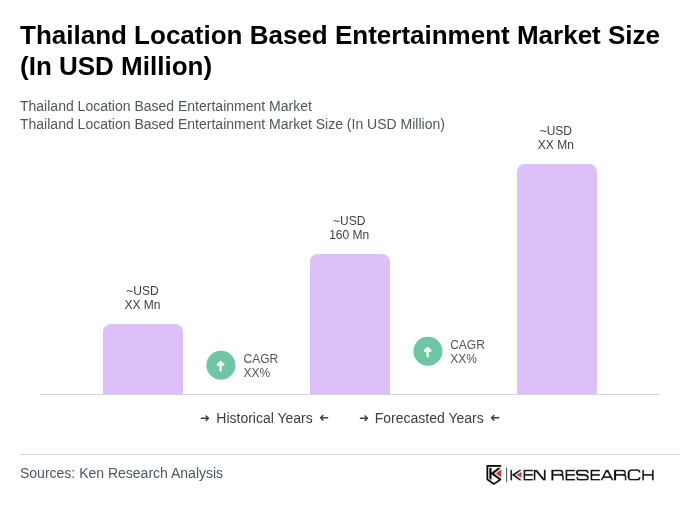
- The Thailand Location Based Entertainment market is valued at USD 160 million, based on a five-year historical analysis and Thailand’s share within the broader Asia Pacific location-based entertainment market. This growth is primarily driven by the increasing demand for immersive experiences, technological advancements in entertainment such as VR/AR attractions, and a rise in disposable income among consumers in urban centers. The market has seen an uptick in visitor numbers, particularly in major cities and tourist hubs, as consumers seek out unique, social, and experience-led entertainment options that combine digital technology with physical venues.
- Key cities such as Bangkok, Phuket, and Chiang Mai dominate the Thailand Location Based Entertainment market due to their status as major domestic and international tourist destinations. Bangkok, as the capital, offers a diverse range of entertainment options including multiplex cinemas, theme and water parks, aquariums, immersive museums, and mixed-reality attractions, while Phuket and Chiang Mai attract leisure travelers and families who frequent themed attractions, family entertainment centers, and experiential venues. The concentration of attractions, strong tourism flows, and higher spending power in these cities enhances their appeal and continues to drive market growth.
- In 2023, the Thai government strengthened policy support for the entertainment and tourism sectors through measures such as the Royal Decree on Reduction of Land and Building Tax for Certain Types of Land or Buildings Used for Tourism Business, B.E. 2566 (2023) issued by the Ministry of Finance, which provides temporary tax relief for tourism-related properties including leisure and entertainment venues. In parallel, initiatives under the Thailand 4.0 policy framework and the Creative Economy promotion agenda encourage the integration of digital technologies, immersive media, and smart services in attractions to enhance visitor experience and operational efficiency. These measures support investment in new venues and upgrades of existing facilities, helping position Thailand as a competitive player in the regional location-based entertainment market.
Thailand Location Based Entertainment Market Segmentation
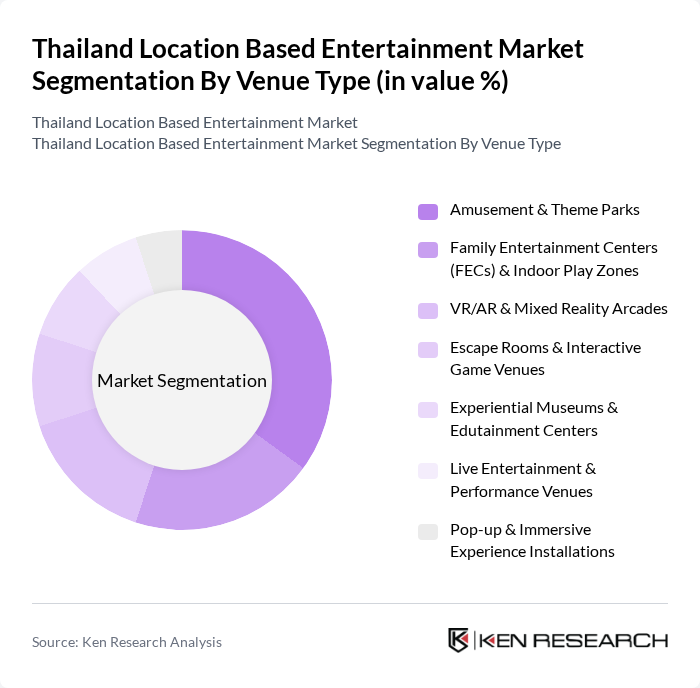
By Venue Type:The venue type segmentation includes various subsegments such as Amusement & Theme Parks, Family Entertainment Centers (FECs) & Indoor Play Zones, VR/AR & Mixed Reality Arcades, Escape Rooms & Interactive Game Venues, Experiential Museums & Edutainment Centers, Live Entertainment & Performance Venues, and Pop-up & Immersive Experience Installations. This structure aligns with how global LBE studies classify the market, with amusement parks and FECs forming the core, complemented by technology-enabled attractions like VR/AR centers and immersive museums. Among these, Amusement & Theme Parks are leading the market in Thailand in terms of revenue and footfall, driven by well-established parks such as Siam Amazing Park, Dream World, and water parks that attract large family and tourist crowds and support diversified spending on tickets, food, and merchandise. The trend towards experiential and immersive entertainment, combined with wider availability of high-quality VR content, has also boosted the popularity of VR/AR & Mixed Reality Arcades and interactive game venues in Bangkok and other urban centers, which are gaining traction among younger audiences, tourists, and gamers seeking innovative, shared experiences.
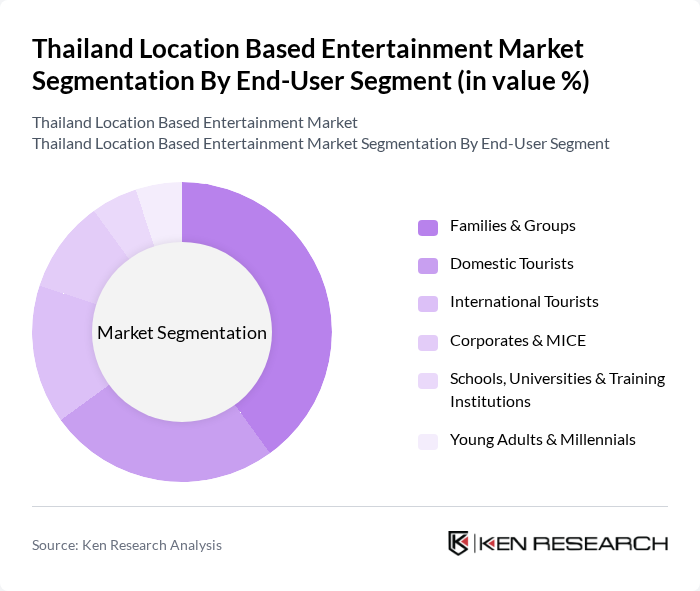
By End-User Segment:This segmentation includes Families & Groups, Domestic Tourists, International Tourists, Corporates & MICE (Meetings, Incentives, Conferences, Exhibitions), Schools, Universities & Training Institutions, and Young Adults & Millennials. This reflects the real demand structure in Thailand, where family-oriented attractions, school trips, and tourist-focused venues form the bulk of visitors to theme parks, aquariums, edutainment centers, and indoor playgrounds. Families & Groups represent the largest segment, driven by the increasing trend of family outings to malls and mixed-use complexes that host cinemas, FECs, trampolining parks, and edutainment centers, as well as by the role of themed attractions in weekend and holiday leisure planning. The rise in domestic tourism post-pandemic, supported by government stimulus campaigns such as “We Travel Together”, has also contributed to the growth of this segment, as families and groups seek safe, indoor–outdoor, and curated experiences together in both primary and secondary cities.
Thailand Location Based Entertainment Market Competitive Landscape
The Thailand Location Based Entertainment Market is characterized by a dynamic mix of regional and international players. Leading participants such as Major Cineplex Group Public Company Limited, Siam Amazing Park (formerly Siam Park City), Dream World (Pathum Thani), Funarium Bangkok, The Escape Hunt Experience Bangkok, Zero Latency VR Thailand, KidZania Bangkok (legacy operations and IP footprint), Art in Paradise (Bangkok, Pattaya, Chiang Mai), Bounce Thailand (Trampoline Parks), Imaginia Playland, Snow Town Bangkok (Gateway Ekkamai), Museum of Illusions Bangkok, HarborLand Group, Pororo AquaPark Bangkok, SEA LIFE Bangkok Ocean World contribute to innovation, geographic expansion, and service delivery in this space.
Thailand Location Based Entertainment Market Industry Analysis
Growth Drivers
- Increasing Urbanization:Thailand's urban population is projected to reach 50 million by in future, accounting for approximately 75% of the total population. This urbanization trend drives demand for location-based entertainment (LBE) as urban dwellers seek leisure activities. The concentration of people in cities like Bangkok, which has a population density of 4,800 people per square kilometer, creates a vibrant market for entertainment venues, enhancing accessibility and foot traffic for LBE operators.
- Rising Disposable Income:The average disposable income in Thailand is expected to rise to THB 110,000 (approximately USD 3,300) per capita in future. This increase in disposable income allows consumers to spend more on leisure activities, including LBE. As families and individuals prioritize entertainment, the demand for diverse experiences, such as theme parks and immersive attractions, is likely to grow, further stimulating the market.
- Growth in Tourism:Thailand welcomed over 39.9 million international tourists before the pandemic, and while the numbers dipped during the pandemic, a rebound is anticipated with projections of 35 million visitors in future. This influx of tourists significantly boosts the LBE market, as visitors seek unique experiences. The tourism sector contributes approximately 19% to Thailand's GDP, highlighting the importance of LBE in attracting and retaining tourists through engaging entertainment options.
Market Challenges
- High Initial Investment Costs:Establishing location-based entertainment facilities often requires substantial capital investment, with costs ranging from THB 60 million to THB 220 million (USD 1.8 million to USD 6.6 million) depending on the scale and type of attraction. These high upfront costs can deter potential investors, particularly in a market where financial returns may take several years to materialize, posing a significant barrier to entry for new operators.
- Regulatory Hurdles:The LBE sector in Thailand faces complex regulatory requirements, including licensing and safety standards. For instance, operators must comply with the Ministry of Tourism and Sports regulations, which can involve lengthy approval processes. In future, the government is expected to enforce stricter safety regulations, which may increase operational costs and complicate compliance for existing and new businesses in the industry.
Thailand Location Based Entertainment Market Future Outlook
The Thailand location-based entertainment market is poised for significant growth, driven by urbanization, rising disposable incomes, and a recovering tourism sector. As consumers increasingly seek immersive experiences, operators are likely to invest in innovative attractions that integrate technology. Additionally, the focus on family-friendly entertainment will shape offerings, catering to diverse demographics. The market's evolution will be influenced by collaborations with local businesses and a commitment to sustainability, ensuring long-term viability and appeal in a competitive landscape.
Market Opportunities
- Expansion of VR and AR Experiences:The growing interest in virtual reality (VR) and augmented reality (AR) presents a unique opportunity for LBE operators. By investing in cutting-edge technology, businesses can create immersive experiences that attract tech-savvy consumers. The VR market in Thailand is projected to reach THB 6 billion (USD 180 million) in future, indicating strong potential for integration into LBE offerings.
- Development of Themed Attractions:Themed attractions tailored to local culture and international franchises can enhance the appeal of LBE venues. With Thailand's rich cultural heritage and global entertainment trends, operators can capitalize on this opportunity. Themed attractions can draw both domestic and international visitors, contributing to increased foot traffic and revenue, particularly in tourist-heavy areas.
Scope of the Report
| Segment | Sub-Segments |
|---|---|
| By Venue Type | Amusement & Theme Parks Family Entertainment Centers (FECs) & Indoor Play Zones VR/AR & Mixed Reality Arcades Escape Rooms & Interactive Game Venues Experiential Museums & Edutainment Centers Live Entertainment & Performance Venues Pop-up & Immersive Experience Installations |
| By End-User Segment | Families & Groups Domestic Tourists International Tourists Corporates & MICE (Meetings, Incentives, Conferences, Exhibitions) Schools, Universities & Training Institutions Young Adults & Millennials |
| By Experience Format | Free-roam & Multiplayer Immersive Experiences Simulator-based & Ride-based Attractions Interactive & Gamified Experiences Passive & Show-based Experiences |
| By Technology Adoption | Non-Immersive / Low-Tech Venues Screen-based & Projection Mapping Venues VR-only Venues AR / MR-enabled Hybrid Venues |
| By Geography (Within Thailand) | Bangkok Metropolitan Region Key Tourist Provinces (Phuket, Chiang Mai, Pattaya, Krabi, Samui) Emerging Tier-2 Cities Other Regions |
| By Business Model | Ticketing / Pay-per-use Subscription & Membership-based Corporate Events & Private Bookings Revenue-share & Franchise-based Models |
| By Ownership Type | Domestic Independent Operators Domestic Conglomerates & Retail Groups International Chains & IP-driven Operators Public–Private Partnership (PPP) & Government-backed Venues |
Key Target Audience
Investors and Venture Capitalist Firms
Government and Regulatory Bodies (e.g., Ministry of Tourism and Sports, National Broadcasting and Telecommunications Commission)
Manufacturers and Producers of Entertainment Equipment
Distributors and Retailers of Entertainment Products
Theme Park Operators
Technology Providers for Augmented and Virtual Reality
Event Organizers and Promoters
Financial Institutions and Banks
Players Mentioned in the Report:
Major Cineplex Group Public Company Limited
Siam Amazing Park (formerly Siam Park City)
Dream World (Pathum Thani)
Funarium Bangkok
The Escape Hunt Experience Bangkok
Zero Latency VR Thailand
KidZania Bangkok (legacy operations and IP footprint)
Art in Paradise (Bangkok, Pattaya, Chiang Mai)
Bounce Thailand (Trampoline Parks)
Imaginia Playland
Snow Town Bangkok (Gateway Ekkamai)
Museum of Illusions Bangkok
HarborLand Group
Pororo AquaPark Bangkok
SEA LIFE Bangkok Ocean World
Table of Contents
Market Assessment Phase
1. Executive Summary and Approach
2. Thailand Location Based Entertainment Market Overview
2.1 Key Insights and Strategic Recommendations
2.2 Thailand Location Based Entertainment Market Overview
2.3 Definition and Scope
2.4 Evolution of Market Ecosystem
2.5 Timeline of Key Regulatory Milestones
2.6 Value Chain & Stakeholder Mapping
2.7 Business Cycle Analysis
2.8 Policy & Incentive Landscape
3. Thailand Location Based Entertainment Market Analysis
3.1 Growth Drivers
3.1.1 Increasing Urbanization
3.1.2 Rising Disposable Income
3.1.3 Growth in Tourism
3.1.4 Technological Advancements
3.2 Market Challenges
3.2.1 High Initial Investment Costs
3.2.2 Regulatory Hurdles
3.2.3 Competition from Home Entertainment
3.2.4 Seasonal Demand Fluctuations
3.3 Market Opportunities
3.3.1 Expansion of VR and AR Experiences
3.3.2 Development of Themed Attractions
3.3.3 Collaborations with Local Businesses
3.3.4 Investment in Sustainable Practices
3.4 Market Trends
3.4.1 Integration of Technology in Experiences
3.4.2 Focus on Family-Friendly Entertainment
3.4.3 Rise of Experiential Marketing
3.4.4 Growth of Mobile Gaming and E-sports
3.5 Government Regulation
3.5.1 Licensing Requirements for Operators
3.5.2 Safety Standards for Attractions
3.5.3 Tax Incentives for Investment
3.5.4 Environmental Regulations
4. SWOT Analysis
5. Stakeholder Analysis
6. Porter's Five Forces Analysis
7. Thailand Location Based Entertainment Market Market Size, 2019-2024
7.1 By Value
7.2 By Volume
7.3 By Average Selling Price
8. Thailand Location Based Entertainment Market Segmentation
8.1 By Venue Type
8.1.1 Amusement & Theme Parks
8.1.2 Family Entertainment Centers (FECs) & Indoor Play Zones
8.1.3 VR/AR & Mixed Reality Arcades
8.1.4 Escape Rooms & Interactive Game Venues
8.1.5 Experiential Museums & Edutainment Centers
8.1.6 Live Entertainment & Performance Venues
8.1.7 Pop-up & Immersive Experience Installations
8.2 By End-User Segment
8.2.1 Families & Groups
8.2.2 Domestic Tourists
8.2.3 International Tourists
8.2.4 Corporates & MICE (Meetings, Incentives, Conferences, Exhibitions)
8.2.5 Schools, Universities & Training Institutions
8.2.6 Young Adults & Millennials
8.3 By Experience Format
8.3.1 Free-roam & Multiplayer Immersive Experiences
8.3.2 Simulator-based & Ride-based Attractions
8.3.3 Interactive & Gamified Experiences
8.3.4 Passive & Show-based Experiences
8.4 By Technology Adoption
8.4.1 Non-Immersive / Low-Tech Venues
8.4.2 Screen-based & Projection Mapping Venues
8.4.3 VR-only Venues
8.4.4 AR / MR-enabled Hybrid Venues
8.5 By Geography (Within Thailand)
8.5.1 Bangkok Metropolitan Region
8.5.2 Key Tourist Provinces (Phuket, Chiang Mai, Pattaya, Krabi, Samui)
8.5.3 Emerging Tier-2 Cities
8.5.4 Other Regions
8.6 By Business Model
8.6.1 Ticketing / Pay-per-use
8.6.2 Subscription & Membership-based
8.6.3 Corporate Events & Private Bookings
8.6.4 Revenue-share & Franchise-based Models
8.7 By Ownership Type
8.7.1 Domestic Independent Operators
8.7.2 Domestic Conglomerates & Retail Groups
8.7.3 International Chains & IP-driven Operators
8.7.4 Public–Private Partnership (PPP) & Government-backed Venues
9. Thailand Location Based Entertainment Market Competitive Analysis
9.1 Market Share of Key Players
9.2 Cross Comparison of Key Players
9.2.1 Company Name
9.2.2 Group Size (Large, Medium, or Small as per industry convention)
9.2.3 Thailand LBE Revenue (THB, Latest Fiscal Year)
9.2.4 3-year Revenue CAGR in Thailand LBE
9.2.5 EBITDA Margin from LBE Operations
9.2.6 Capex per Site / Attraction (THB Million)
9.2.7 Average Revenue per Visitor (ARPV)
9.2.8 Annual Footfall per Venue
9.2.9 Occupancy / Utilization Rate (Peak vs Off-peak)
9.2.10 Customer Repeat-visit Rate
9.2.11 Digital Engagement Metrics (App Users, Loyalty Membership, Social Followers)
9.2.12 Payback Period / ROI on New Attractions
9.3 SWOT Analysis of Top Players
9.4 Pricing Analysis
9.5 Detailed Profile of Major Companies
9.5.1 Major Cineplex Group Public Company Limited
9.5.2 Siam Amazing Park (formerly Siam Park City)
9.5.3 Dream World (Pathum Thani)
9.5.4 Funarium Bangkok
9.5.5 The Escape Hunt Experience Bangkok
9.5.6 Zero Latency VR Thailand
9.5.7 KidZania Bangkok (legacy operations and IP footprint)
9.5.8 Art in Paradise (Bangkok, Pattaya, Chiang Mai)
9.5.9 Bounce Thailand (Trampoline Parks)
9.5.10 Imaginia Playland
9.5.11 Snow Town Bangkok (Gateway Ekkamai)
9.5.12 Museum of Illusions Bangkok
9.5.13 HarborLand Group
9.5.14 Pororo AquaPark Bangkok
9.5.15 SEA LIFE Bangkok Ocean World
10. Thailand Location Based Entertainment Market End-User Analysis
10.1 Procurement Behavior of Key Ministries
10.1.1 Ministry of Tourism and Sports
10.1.2 Ministry of Education
10.1.3 Ministry of Culture
10.1.4 Others
10.2 Corporate Spend on Infrastructure & Energy
10.2.1 Corporate Investments in Entertainment
10.2.2 Sponsorships and Partnerships
10.2.3 Others
10.3 Pain Point Analysis by End-User Category
10.3.1 Families
10.3.2 Tourists
10.3.3 Corporates
10.3.4 Others
10.4 User Readiness for Adoption
10.4.1 Awareness Levels
10.4.2 Willingness to Pay
10.4.3 Others
10.5 Post-Deployment ROI and Use Case Expansion
10.5.1 ROI Measurement Techniques
10.5.2 Use Case Scenarios
10.5.3 Others
11. Thailand Location Based Entertainment Market Future Size, 2025-2030
11.1 By Value
11.2 By Volume
11.3 By Average Selling Price
Go-To-Market Strategy Phase
1. Whitespace Analysis + Business Model Canvas
1.1 Market Gaps Identification
1.2 Business Model Development
2. Marketing and Positioning Recommendations
2.1 Branding Strategies
2.2 Product USPs
3. Distribution Plan
3.1 Urban Retail vs Rural NGO Tie-ups
4. Channel & Pricing Gaps
4.1 Underserved Routes
4.2 Pricing Bands
5. Unmet Demand & Latent Needs
5.1 Category Gaps
5.2 Consumer Segments
6. Customer Relationship
6.1 Loyalty Programs
6.2 After-sales Service
7. Value Proposition
7.1 Sustainability
7.2 Integrated Supply Chains
8. Key Activities
8.1 Regulatory Compliance
8.2 Branding
8.3 Distribution Setup
9. Entry Strategy Evaluation
9.1 Domestic Market Entry Strategy
9.1.1 Product Mix
9.1.2 Pricing Band
9.1.3 Packaging
9.2 Export Entry Strategy
9.2.1 Target Countries
9.2.2 Compliance Roadmap
10. Entry Mode Assessment
10.1 JV
10.2 Greenfield
10.3 M&A
10.4 Distributor Model
11. Capital and Timeline Estimation
11.1 Capital Requirements
11.2 Timelines
12. Control vs Risk Trade-Off
12.1 Ownership vs Partnerships
13. Profitability Outlook
13.1 Breakeven Analysis
13.2 Long-term Sustainability
14. Potential Partner List
14.1 Distributors
14.2 JVs
14.3 Acquisition Targets
15. Execution Roadmap
15.1 Phased Plan for Market Entry
15.1.1 Market Setup
15.1.2 Market Entry
15.1.3 Growth Acceleration
15.1.4 Scale & Stabilize
15.2 Key Activities and Milestones
15.2.1 Milestone Planning
15.2.2 Activity Tracking
Research Methodology
Phase 1: Approach1
Desk Research
- Analysis of industry reports from local tourism and entertainment authorities
- Review of market trends and consumer behavior studies published by research firms
- Examination of government publications on tourism statistics and entertainment regulations
Primary Research
- Interviews with executives from leading location-based entertainment venues
- Surveys conducted with consumers to gauge preferences and spending habits
- Focus groups with families and young adults to understand entertainment choices
Validation & Triangulation
- Cross-validation of findings with multiple data sources, including tourism and entertainment reports
- Triangulation of consumer insights with industry expert opinions
- Sanity checks through feedback from a panel of local market experts
Phase 2: Market Size Estimation1
Top-down Assessment
- Estimation of market size based on national tourism revenue and entertainment spending
- Segmentation of the market by type of entertainment (e.g., theme parks, arcades, VR experiences)
- Incorporation of growth rates from historical data and projected tourism trends
Bottom-up Modeling
- Collection of revenue data from major location-based entertainment operators
- Estimation of average ticket prices and visitor numbers across different venues
- Calculation of total market size based on aggregated venue data and visitor trends
Forecasting & Scenario Analysis
- Multi-factor regression analysis incorporating economic indicators and tourism forecasts
- Scenario modeling based on potential impacts of regulatory changes and health crises
- Development of baseline, optimistic, and pessimistic market growth projections through 2030
Phase 3: CATI Sample Composition1
| Scope Item/Segment | Sample Size | Target Respondent Profiles |
|---|---|---|
| Theme Park Visitors | 120 | Families, Young Adults |
| Arcade and Gaming Center Patrons | 80 | Teenagers, College Students |
| Virtual Reality Experience Users | 60 | Tech Enthusiasts, Gamers |
| Escape Room Participants | 50 | Groups of Friends, Corporate Teams |
| Cultural and Historical Attraction Visitors | 90 | Tourists, Local Residents |
Frequently Asked Questions
What is the current value of the Thailand Location Based Entertainment market?
The Thailand Location Based Entertainment market is valued at approximately USD 160 million, reflecting a significant growth driven by increasing demand for immersive experiences and technological advancements in entertainment.
Which cities are the main hubs for Location Based Entertainment in Thailand?
What factors are driving the growth of the Location Based Entertainment market in Thailand?
What types of venues are included in the Thailand Location Based Entertainment market?
Other Regional/Country Reports
Other Adjacent Reports
Thailand Tourism Market
India Virtual Reality Market Size, Share & Forecast, By Solution Type, Application & End-Use Industry, 2026-2032APAC augmented reality market Size, Share, Growth Drivers, Trends, Opportunities & Forecast 2025–2030Global Theme Park Market Size, Share, Trends & Forecast, By Park Type, Revenue Stream & Visitor Group, 2026-2031Asia Pacific Amusement Park Market Size, Share & Forecast, By Ride Type, Revenue Source & Visitor Age, 2026-2031Vietnam Family Entertainment Center Market
Saudi Arabia Pacific Gaming Market Report Size Share Growth Drivers Trends Opportunities & Forecast 2025–2030Saudi Arabia Hospitality MarketGermany Leisure Market
UAE Edutainment MarketWhy Buy From Us?

What makes us stand out is that our consultants follow Robust, Refine and Result (RRR) methodology. Robust for clear definitions, approaches and sanity checking, Refine for differentiating respondents' facts and opinions, and Result for presenting data with story.

We have set a benchmark in the industry by offering our clients with syndicated and customized market research reports featuring coverage of entire market as well as meticulous research and analyst insights.

While we don't replace traditional research, we flip the method upside down. Our dual approach of Top Bottom & Bottom Top ensures quality deliverable by not just verifying company fundamentals but also looking at the sector and macroeconomic factors.

With one step in the future, our research team constantly tries to show you the bigger picture. We help with some of the tough questions you may encounter along the way: How is the industry positioned? Best marketing channel? KPI's of competitors? By aligning every element, we help maximize success.

Our report gives you instant access to the answers and sources that other companies might choose to hide. We elaborate each steps of research methodology we have used and showcase you the sample size to earn your trust.

If you need any support, we are here! We pride ourselves on universe strength, data quality, and quick, friendly, and professional service.