About the Report
Base Year 2024Thailand Specialty Injectable Generics Market Overview
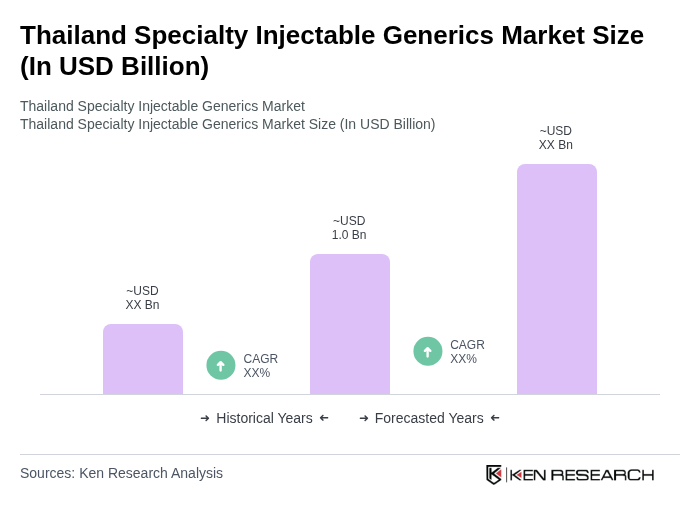
- The Thailand Specialty Injectable Generics Market is valued at USD 1.0 billion, based on a five-year historical analysis and benchmarking against Thailand’s overall pharmaceutical market size and the global specialty generics segment share. This growth is primarily driven by the increasing prevalence of chronic non-communicable diseases such as cancer, diabetes, and cardiovascular diseases, along with higher demand for hospital-based treatments and parenteral therapies. Advancements in pharmaceutical technology, including aseptic manufacturing and ready-to-use injectable formats, and a rising demand for cost-effective treatment options support the uptake of injectable generics, particularly in public hospitals where budget constraints favor generics over originators.
- Key cities such as Bangkok, Chiang Mai, and Phuket dominate the market due to their advanced healthcare infrastructure, high concentration of tertiary and private hospitals, and presence of local and multinational pharmaceutical companies. Bangkok, being the capital and the main hub for medical tourism, attracts substantial investments in oncology centers, specialty clinics, and high-acuity inpatient services, which drive demand for specialty injectable therapies. Chiang Mai and Phuket have seen robust growth in private hospitals and specialty clinics serving both domestic patients and international medical tourists, supporting higher utilization of injectable generics in areas such as oncology, infectious diseases, and pain management.
- The core policy framework shaping access to injectable generics is the National Health Security Act B.E. 2545 (2002), issued by the National Assembly and implemented by the National Health Security Office (NHSO), which established the Universal Coverage Scheme and mandates reimbursement of essential medicines, including a wide range of generic and injectable products, based on the National List of Essential Medicines. Under this framework, hospitals are incentivized through reimbursement and procurement rules to prioritize cost?effective generic and biosimilar options when clinically appropriate, thereby expanding access, reducing out?of?pocket expenditure, and supporting broader use of specialty injectable generics within the universal healthcare system.
Thailand Specialty Injectable Generics Market Segmentation
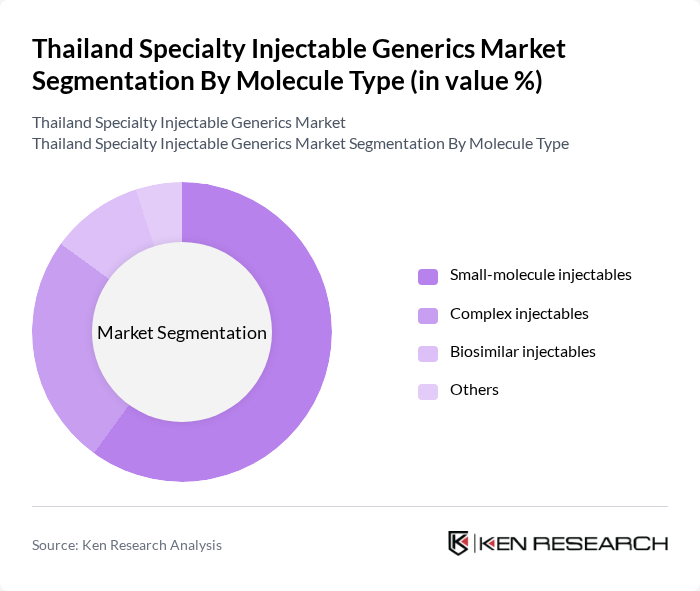
By Molecule Type:The market is segmented into small-molecule injectables, complex injectables, biosimilar injectables, and others. Small-molecule injectables hold the largest share, in line with Thailand’s broader pharmaceutical market where conventional drugs (small molecules) account for the majority of revenues, driven by high use in oncology, infectious diseases, perioperative care, and acute cardiovascular indications. Their relatively simpler manufacturing processes, established off?patent portfolios, and strong presence on hospital formularies contribute to their leading position. Complex injectables (such as long?acting depot formulations and liposomal products) and biosimilar injectables are gaining traction, supported by increasing availability of biosimilar monoclonal antibodies and growth factors, rising adoption of targeted and biologic therapies in oncology and autoimmune diseases, and ongoing investment in biopharmaceutical capabilities in Thailand and the wider Asia Pacific region.
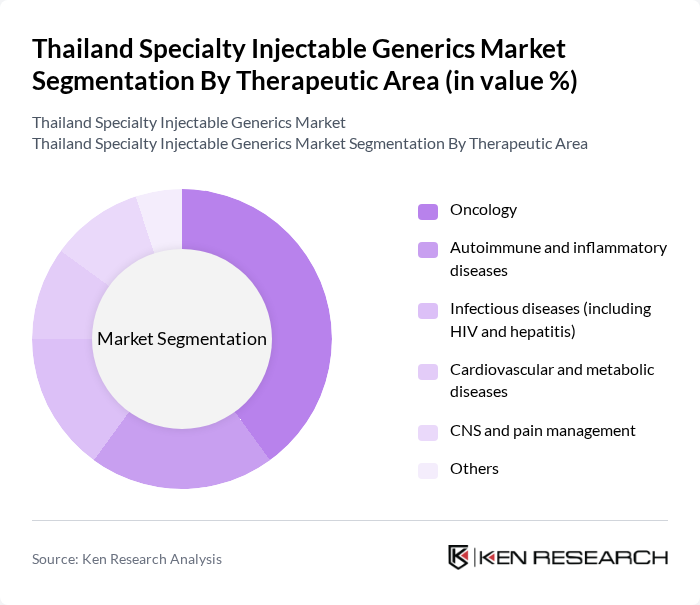
By Therapeutic Area:The therapeutic areas include oncology, autoimmune and inflammatory diseases, infectious diseases (including HIV and hepatitis), cardiovascular and metabolic diseases, CNS and pain management, and others. Oncology injectables lead the market, consistent with global specialty injectable generics trends where cancer care is a major driver, supported by the rising cancer burden in Thailand and increasing use of platinum-based regimens, monoclonal antibodies, and supportive care injectables in both public and private hospitals. Autoimmune and inflammatory diseases, as well as infectious diseases (including HIV and hepatitis), represent growing segments due to expanded screening programs, broader access to parenteral antivirals and biologics, and the role of generics in national treatment protocols. Cardiovascular and metabolic diseases, CNS and pain management, and other specialty indications also contribute steadily as Thailand’s aging population and non?communicable disease burden increase overall utilization of hospital?based injectable therapies.
Thailand Specialty Injectable Generics Market Competitive Landscape
The Thailand Specialty Injectable Generics Market is characterized by a dynamic mix of regional and international players. Leading participants such as Government Pharmaceutical Organization (GPO), Siam Pharmaceutical Co., Ltd., Bangkok Drug Co., Ltd., Thai Nakorn Patana Co., Ltd., Biolab Co., Ltd., Biopharm Chemicals Co., Ltd., Berlin Pharmaceutical Industry Co., Ltd., Greater Pharma Co., Ltd., Pfizer (Thailand) Ltd., Novartis (Thailand) Ltd., Sanofi (Thailand) Ltd., Merck Sharp & Dohme (Thailand) Ltd., Roche (Thailand) Ltd., AstraZeneca (Thailand) Ltd., Teva Pharmaceutical Industries Ltd., Viatris (Thailand) Ltd. (including legacy Mylan) contribute to innovation, geographic expansion, and service delivery in this space.
Thailand Specialty Injectable Generics Market Industry Analysis
Growth Drivers
- Increasing Prevalence of Chronic Diseases:The rise in chronic diseases such as diabetes and cardiovascular conditions is significant in Thailand, with over 3.3–3.5 million people diagnosed with diabetes. This growing patient population drives the demand for specialty injectable generics, as these medications are essential for managing complex health issues. The Thai Ministry of Public Health reported that chronic diseases account for approximately 70–75% of all deaths, highlighting the urgent need for effective treatment options.
- Rising Demand for Cost-Effective Treatment Options:With healthcare costs escalating, the Thai government is increasingly promoting the use of generics. In future, the average cost of branded medications is expected to be 30% higher than generics. This price disparity encourages healthcare providers and patients to opt for specialty injectable generics, which offer similar efficacy at a lower cost. The Thai healthcare system aims to reduce overall expenditure by 15% in future, further supporting this trend.
- Expansion of Healthcare Infrastructure:Thailand's healthcare infrastructure is expanding rapidly, with the government investing approximately $1.5 billion in healthcare facilities and services in future. This investment aims to improve access to healthcare, particularly in rural areas, where specialty injectable generics can play a crucial role. Enhanced healthcare facilities are expected to increase the availability of these medications, thereby driving their adoption among healthcare providers and patients alike.
Market Challenges
- Stringent Regulatory Requirements:The regulatory landscape for pharmaceuticals in Thailand is complex, with the Thai Food and Drug Administration (TFDA) enforcing strict guidelines. In future, the average time for drug approval is reported to be around 18 months, which can delay the entry of specialty injectable generics into the market. These stringent requirements can hinder manufacturers' ability to respond quickly to market needs, impacting overall growth in the sector.
- Competition from Branded Pharmaceuticals:The presence of established branded pharmaceuticals poses a significant challenge to the specialty injectable generics market. In future, branded drugs are expected to account for approximately 65% of the total pharmaceutical market share in Thailand. This dominance can limit the market penetration of generics, as healthcare providers often prefer established brands due to perceived reliability and efficacy, creating a barrier for new entrants.
Thailand Specialty Injectable Generics Market Future Outlook
The future of the Thailand specialty injectable generics market appears promising, driven by increasing healthcare investments and a growing focus on chronic disease management. As the government continues to promote generics, the market is likely to see enhanced competition and innovation. Additionally, the integration of advanced manufacturing technologies and personalized medicine approaches will further shape the landscape, ensuring that patients have access to effective and affordable treatment options in future.
Market Opportunities
- Growth in the Aging Population:Thailand's aging population, projected to reach 20% in future, presents a significant opportunity for specialty injectable generics. Older adults often require chronic disease management, increasing the demand for effective and affordable treatment options. This demographic shift will likely drive market growth as healthcare providers seek to address the unique needs of this population.
- Collaborations with Local Manufacturers:Collaborating with local manufacturers can enhance market penetration for specialty injectable generics. By leveraging local expertise and distribution networks, companies can improve access to these medications in underserved areas. Such partnerships are expected to facilitate faster product launches and increase the availability of generics, ultimately benefiting patients and healthcare providers alike.
Scope of the Report
| Segment | Sub-Segments |
|---|---|
| By Molecule Type | Small-molecule injectables Complex injectables Biosimilar injectables Others |
| By Therapeutic Area | Oncology Autoimmune and inflammatory diseases Infectious diseases (including HIV and hepatitis) Cardiovascular and metabolic diseases CNS and pain management Others |
| By Route of Administration | Intravenous (IV) Subcutaneous (SC) Intramuscular (IM) Others |
| By Formulation | Liquid injectables Lyophilized injectables Long-acting depot formulations Others |
| By End-User | Public hospitals Private hospitals Specialty clinics and infusion centers Others |
| By Distribution Channel | Hospital pharmacies Retail and chain pharmacies Specialty pharmacies Tender and institutional procurement Others |
| By Manufacturing Source | Domestic manufacturers Multinational manufacturers (local presence) Imports Contract manufacturing organizations (CMOs) |
Key Target Audience
Investors and Venture Capitalist Firms
Government and Regulatory Bodies (e.g., Food and Drug Administration of Thailand, Ministry of Public Health)
Manufacturers and Producers
Distributors and Retailers
Pharmaceutical Wholesalers
Healthcare Providers and Hospitals
Industry Associations (e.g., Pharmaceutical Association of Thailand)
Health Insurance Companies
Players Mentioned in the Report:
Government Pharmaceutical Organization (GPO)
Siam Pharmaceutical Co., Ltd.
Bangkok Drug Co., Ltd.
Thai Nakorn Patana Co., Ltd.
Biolab Co., Ltd.
Biopharm Chemicals Co., Ltd.
Berlin Pharmaceutical Industry Co., Ltd.
Greater Pharma Co., Ltd.
Pfizer (Thailand) Ltd.
Novartis (Thailand) Ltd.
Sanofi (Thailand) Ltd.
Merck Sharp & Dohme (Thailand) Ltd.
Roche (Thailand) Ltd.
AstraZeneca (Thailand) Ltd.
Teva Pharmaceutical Industries Ltd.
Viatris (Thailand) Ltd. (including legacy Mylan)
Table of Contents
Market Assessment Phase
1. Executive Summary and Approach
2. Thailand Specialty Injectable Generics Market Overview
2.1 Key Insights and Strategic Recommendations
2.2 Thailand Specialty Injectable Generics Market Overview
2.3 Definition and Scope
2.4 Evolution of Market Ecosystem
2.5 Timeline of Key Regulatory Milestones
2.6 Value Chain & Stakeholder Mapping
2.7 Business Cycle Analysis
2.8 Policy & Incentive Landscape
3. Thailand Specialty Injectable Generics Market Analysis
3.1 Growth Drivers
3.1.1 Increasing prevalence of chronic diseases
3.1.2 Rising demand for cost-effective treatment options
3.1.3 Expansion of healthcare infrastructure
3.1.4 Government initiatives to promote generics
3.2 Market Challenges
3.2.1 Stringent regulatory requirements
3.2.2 Competition from branded pharmaceuticals
3.2.3 Limited awareness among healthcare providers
3.2.4 Supply chain disruptions
3.3 Market Opportunities
3.3.1 Growth in the aging population
3.3.2 Increasing investment in R&D
3.3.3 Expansion into rural healthcare markets
3.3.4 Collaborations with local manufacturers
3.4 Market Trends
3.4.1 Shift towards personalized medicine
3.4.2 Adoption of advanced manufacturing technologies
3.4.3 Increasing focus on biosimilars
3.4.4 Growth of telemedicine and digital health solutions
3.5 Government Regulation
3.5.1 New drug approval processes
3.5.2 Pricing regulations for generics
3.5.3 Quality control standards
3.5.4 Intellectual property laws
4. SWOT Analysis
5. Stakeholder Analysis
6. Porter's Five Forces Analysis
7. Thailand Specialty Injectable Generics Market Market Size, 2019-2024
7.1 By Value
7.2 By Volume
7.3 By Average Selling Price
8. Thailand Specialty Injectable Generics Market Segmentation
8.1 By Molecule Type
8.1.1 Small-molecule injectables
8.1.2 Complex injectables
8.1.3 Biosimilar injectables
8.1.4 Others
8.2 By Therapeutic Area
8.2.1 Oncology
8.2.2 Autoimmune and inflammatory diseases
8.2.3 Infectious diseases (including HIV and hepatitis)
8.2.4 Cardiovascular and metabolic diseases
8.2.5 CNS and pain management
8.2.6 Others
8.3 By Route of Administration
8.3.1 Intravenous (IV)
8.3.2 Subcutaneous (SC)
8.3.3 Intramuscular (IM)
8.3.4 Others
8.4 By Formulation
8.4.1 Liquid injectables
8.4.2 Lyophilized injectables
8.4.3 Long-acting depot formulations
8.4.4 Others
8.5 By End-User
8.5.1 Public hospitals
8.5.2 Private hospitals
8.5.3 Specialty clinics and infusion centers
8.5.4 Others
8.6 By Distribution Channel
8.6.1 Hospital pharmacies
8.6.2 Retail and chain pharmacies
8.6.3 Specialty pharmacies
8.6.4 Tender and institutional procurement
8.6.5 Others
8.7 By Manufacturing Source
8.7.1 Domestic manufacturers
8.7.2 Multinational manufacturers (local presence)
8.7.3 Imports
8.7.4 Contract manufacturing organizations (CMOs)
9. Thailand Specialty Injectable Generics Market Competitive Analysis
9.1 Market Share of Key Players
9.2 Cross Comparison of Key Players
9.2.1 Company name
9.2.2 Thailand specialty injectable generics revenue (latest year, THB million)
9.2.3 3-year revenue CAGR in specialty injectables (%)
9.2.4 Specialty injectable generics share of total company revenue (%)
9.2.5 Market share in Thailand specialty injectable generics market (%)
9.2.6 EBITDA margin for specialty injectable generics business (%)
9.2.7 R&D spend on complex injectables and biosimilars (% of revenue)
9.2.8 Capex intensity for sterile injectable facilities (% of revenue)
9.2.9 Number of specialty injectable generic SKUs registered in Thailand
9.2.10 Tender win rate in public hospital procurement (%)
9.2.11 Average price discount vs reference branded injectable (%)
9.2.12 Geographic coverage (number of provinces / hospitals served)
9.2.13 Regulatory compliance track record (warning letters, recalls over last 3 years)
9.3 SWOT Analysis of Top Players
9.4 Pricing Analysis
9.5 Detailed Profile of Major Companies
9.5.1 Government Pharmaceutical Organization (GPO)
9.5.2 Siam Pharmaceutical Co., Ltd.
9.5.3 Bangkok Drug Co., Ltd.
9.5.4 Thai Nakorn Patana Co., Ltd.
9.5.5 Biolab Co., Ltd.
9.5.6 Biopharm Chemicals Co., Ltd.
9.5.7 Berlin Pharmaceutical Industry Co., Ltd.
9.5.8 Greater Pharma Co., Ltd.
9.5.9 Pfizer (Thailand) Ltd.
9.5.10 Novartis (Thailand) Ltd.
9.5.11 Sanofi (Thailand) Ltd.
9.5.12 Merck Sharp & Dohme (Thailand) Ltd.
9.5.13 Roche (Thailand) Ltd.
9.5.14 AstraZeneca (Thailand) Ltd.
9.5.15 Teva Pharmaceutical Industries Ltd.
9.5.16 Viatris (Thailand) Ltd. (including legacy Mylan)
10. Thailand Specialty Injectable Generics Market End-User Analysis
10.1 Procurement Behavior of Key Ministries
10.1.1 Ministry of Public Health
10.1.2 Ministry of Finance
10.1.3 Ministry of Commerce
10.1.4 Others
10.2 Corporate Spend on Infrastructure & Energy
10.2.1 Healthcare infrastructure investments
10.2.2 Energy-efficient technologies
10.2.3 Others
10.3 Pain Point Analysis by End-User Category
10.3.1 Hospitals
10.3.2 Clinics
10.3.3 Home healthcare providers
10.3.4 Others
10.4 User Readiness for Adoption
10.4.1 Training and education needs
10.4.2 Infrastructure readiness
10.4.3 Others
10.5 Post-Deployment ROI and Use Case Expansion
10.5.1 Cost savings analysis
10.5.2 Patient outcome improvements
10.5.3 Others
11. Thailand Specialty Injectable Generics Market Future Size, 2025-2030
11.1 By Value
11.2 By Volume
11.3 By Average Selling Price
Go-To-Market Strategy Phase
1. Whitespace Analysis + Business Model Canvas
1.1 Market gaps identification
1.2 Business model development
2. Marketing and Positioning Recommendations
2.1 Branding strategies
2.2 Product USPs
3. Distribution Plan
3.1 Urban retail vs rural NGO tie-ups
4. Channel & Pricing Gaps
4.1 Underserved routes
4.2 Pricing bands
5. Unmet Demand & Latent Needs
5.1 Category gaps
5.2 Consumer segments
6. Customer Relationship
6.1 Loyalty programs
6.2 After-sales service
7. Value Proposition
7.1 Sustainability
7.2 Integrated supply chains
8. Key Activities
8.1 Regulatory compliance
8.2 Branding
8.3 Distribution setup
9. Entry Strategy Evaluation
9.1 Domestic Market Entry Strategy
9.1.1 Product mix
9.1.2 Pricing band
9.1.3 Packaging
9.2 Export Entry Strategy
9.2.1 Target countries
9.2.2 Compliance roadmap
10. Entry Mode Assessment
10.1 JV
10.2 Greenfield
10.3 M&A
10.4 Distributor Model
11. Capital and Timeline Estimation
11.1 Capital requirements
11.2 Timelines
12. Control vs Risk Trade-Off
12.1 Ownership vs Partnerships
13. Profitability Outlook
13.1 Breakeven analysis
13.2 Long-term sustainability
14. Potential Partner List
14.1 Distributors
14.2 JVs
14.3 Acquisition targets
15. Execution Roadmap
15.1 Phased Plan for Market Entry
15.1.1 Market Setup
15.1.2 Market Entry
15.1.3 Growth Acceleration
15.1.4 Scale & Stabilize
15.2 Key Activities and Milestones
15.2.1 Milestone tracking
15.2.2 Activity scheduling
Research Methodology
Phase 1: Approach1
Desk Research
- Analysis of market reports from Thai pharmaceutical associations and health ministries
- Review of published articles in medical journals focusing on injectable generics
- Examination of regulatory frameworks and guidelines from the Thai Food and Drug Administration (TFDA)
Primary Research
- Interviews with key opinion leaders in the pharmaceutical industry, including pharmacists and healthcare providers
- Surveys targeting procurement managers at hospitals and clinics regarding their purchasing patterns
- Field interviews with representatives from specialty injectable generic manufacturers
Validation & Triangulation
- Cross-validation of data through multiple sources, including industry reports and expert interviews
- Triangulation of market size estimates using sales data and healthcare expenditure reports
- Sanity checks conducted through expert panel discussions to ensure data reliability
Phase 2: Market Size Estimation1
Top-down Assessment
- Estimation of the overall pharmaceutical market size in Thailand and its growth rate
- Segmentation of the injectable generics market by therapeutic area and volume
- Incorporation of government healthcare spending initiatives and policies affecting generics
Bottom-up Modeling
- Collection of sales data from leading specialty injectable generic manufacturers
- Estimation of market share based on production capacity and distribution channels
- Volume and pricing analysis to derive revenue projections for the injectable generics segment
Forecasting & Scenario Analysis
- Utilization of historical growth trends to project future market dynamics
- Scenario analysis based on potential regulatory changes and market entry of new players
- Development of baseline, optimistic, and pessimistic forecasts through 2030
Phase 3: CATI Sample Composition1
| Scope Item/Segment | Sample Size | Target Respondent Profiles |
|---|---|---|
| Hospital Procurement Departments | 90 | Procurement Managers, Supply Chain Coordinators |
| Pharmacy Chains | 70 | Pharmacy Managers, Inventory Specialists |
| Healthcare Providers | 65 | Doctors, Nurse Practitioners |
| Specialty Clinics | 55 | Clinic Administrators, Medical Directors |
| Regulatory Bodies | 45 | Regulatory Affairs Specialists, Compliance Officers |
Frequently Asked Questions
What is the current value of the Thailand Specialty Injectable Generics Market?
The Thailand Specialty Injectable Generics Market is valued at approximately USD 1.0 billion. This valuation is based on a five-year historical analysis and reflects the market's growth driven by the increasing prevalence of chronic diseases and demand for hospital-based treatments.
What factors are driving the growth of the Thailand Specialty Injectable Generics Market?
Which cities in Thailand are leading in the Specialty Injectable Generics Market?
What are the main therapeutic areas for specialty injectable generics in Thailand?
Other Regional/Country Reports
Other Adjacent Reports
Japan Oncology Pharmaceuticals Market
Ksa Infectious Disease Therapeutics Market Size, Share, Growth Drivers, Trends, Opportunities & Forecast 2025–2030UAE Cardiovascular Drugs MarketSouth Africa Autoimmune Disease Treatments Market
New Zealand Pharmaceutical Manufacturing Market Report Size, Share, Growth Drivers, Trends, Opportunities & Forecast 2025–2030UAE Hospital Supplies MarketBahrain Medical Tourism Market Report Size, Share, Growth Drivers, Trends, Opportunities & Forecast 2025–2030Middle East Chronic Disease Management Market Size, Share, Growth Drivers, Trends, Opportunities & Forecast 2025–2030Why Buy From Us?

What makes us stand out is that our consultants follow Robust, Refine and Result (RRR) methodology. Robust for clear definitions, approaches and sanity checking, Refine for differentiating respondents' facts and opinions, and Result for presenting data with story.

We have set a benchmark in the industry by offering our clients with syndicated and customized market research reports featuring coverage of entire market as well as meticulous research and analyst insights.

While we don't replace traditional research, we flip the method upside down. Our dual approach of Top Bottom & Bottom Top ensures quality deliverable by not just verifying company fundamentals but also looking at the sector and macroeconomic factors.

With one step in the future, our research team constantly tries to show you the bigger picture. We help with some of the tough questions you may encounter along the way: How is the industry positioned? Best marketing channel? KPI's of competitors? By aligning every element, we help maximize success.

Our report gives you instant access to the answers and sources that other companies might choose to hide. We elaborate each steps of research methodology we have used and showcase you the sample size to earn your trust.

If you need any support, we are here! We pride ourselves on universe strength, data quality, and quick, friendly, and professional service.