About the Report
Base Year 2024UAE Crowdfunding Platforms Market Overview
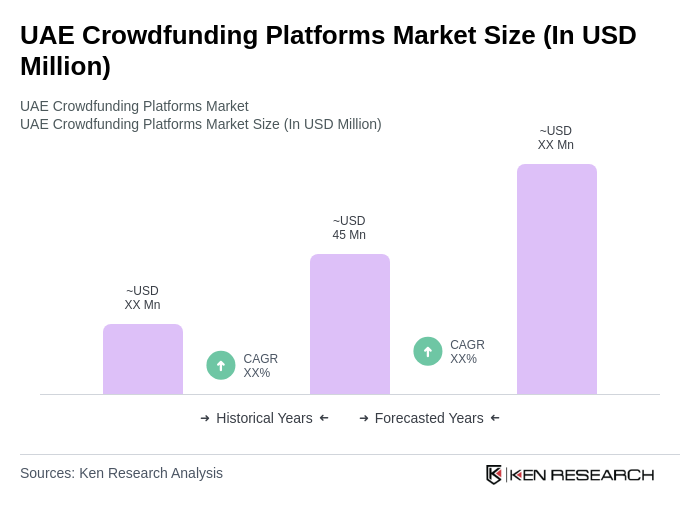
- The UAE Crowdfunding Platforms Market is valued at approximately USD 45 million, based on a five-year historical analysis. This growth is primarily driven by the increasing adoption of digital financial solutions, a burgeoning startup ecosystem, and a growing awareness of alternative funding sources among entrepreneurs and investors. Recent trends show strong momentum in tech-driven startups, sustainable business models, and innovative campaign structures, with Millennials and Gen-Z investors playing a significant role in market expansion. Equity and real estate crowdfunding are gaining traction, while debt-based crowdfunding currently holds the largest market share .
- Dubai and Abu Dhabi remain the dominant cities in the UAE Crowdfunding Platforms Market due to their status as financial hubs, attracting both local and international investors. The supportive regulatory environment, high concentration of startups, and government-backed initiatives such as Dubai Next further enhance their market dominance and foster innovation in alternative finance .
- In 2023, the UAE government introduced the “Regulation for Operating Crowdfunding Platforms,” issued by the Securities and Commodities Authority (SCA). This binding instrument mandates all crowdfunding platforms to register with the SCA and comply with operational guidelines, including investor protection measures, transparency standards, and periodic reporting requirements. The regulation covers equity, debt, and donation-based crowdfunding, establishing minimum capital thresholds and licensing standards for platform operators .
UAE Crowdfunding Platforms Market Segmentation
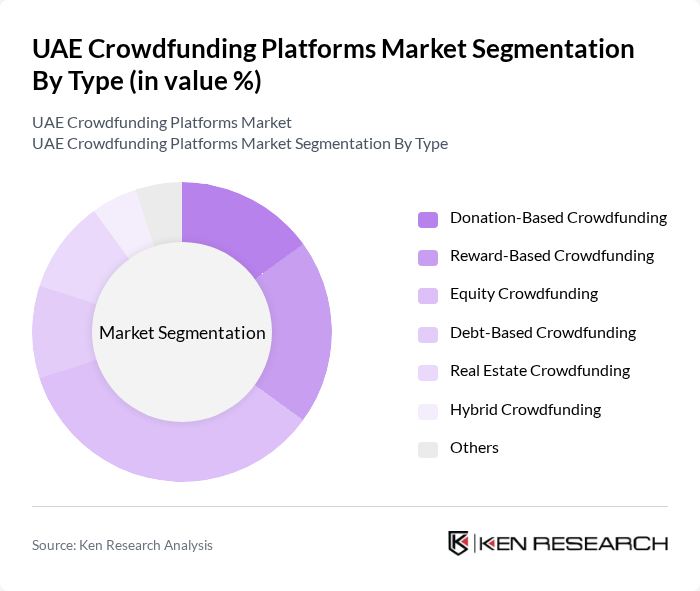
By Type:The crowdfunding platforms can be categorized into various types, including Donation-Based Crowdfunding, Reward-Based Crowdfunding, Equity Crowdfunding, Debt-Based Crowdfunding, Real Estate Crowdfunding, Hybrid Crowdfunding, and Others. Debt-Based Crowdfunding currently holds the largest revenue share, driven by SME demand for alternative financing and lower interest rates compared to traditional loans. However, Equity Crowdfunding is the fastest-growing sub-segment, propelled by investor interest in startup equity and the democratization of investment opportunities. Real estate crowdfunding is also expanding rapidly, reflecting the strength of the UAE property market .
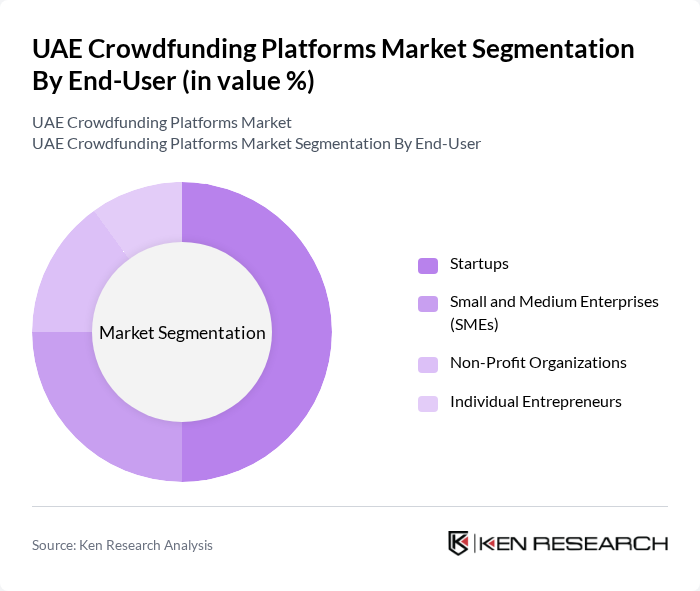
By End-User:The end-users of crowdfunding platforms include Startups, Small and Medium Enterprises (SMEs), Non-Profit Organizations, and Individual Entrepreneurs. Startups are the dominant end-user segment, leveraging crowdfunding to access capital for product development, market entry, and scaling operations. The increasing number of startups in the UAE, supported by government initiatives and a vibrant entrepreneurial ecosystem, has significantly contributed to the growth of this segment. SMEs also utilize crowdfunding for expansion, while Non-Profit Organizations and Individual Entrepreneurs tap into these platforms for community projects and personal ventures .
UAE Crowdfunding Platforms Market Competitive Landscape
The UAE Crowdfunding Platforms Market is characterized by a dynamic mix of regional and international players. Leading participants such as Beehive, Eureeca, SmartCrowd, FundedHere, Zoomaal, Yomken, GoFundMe, Kickstarter, Indiegogo, Crowdcube, Seedrs, Fundrazr, StartSomeGood, Patreon, Crowdfunder contribute to innovation, geographic expansion, and service delivery in this space.
UAE Crowdfunding Platforms Market Industry Analysis
Growth Drivers
- Increasing Entrepreneurial Activity:The UAE has seen a surge in entrepreneurial activity, with over50,000 new businesses registeredin future, according to the UAE Ministry of Economy. This growth is fueled by a young population, withapproximately 34% under 25 years oldand a median age of about 33 years, not 70% under 30 years old. The government’s initiatives, such as the UAE Vision 2021, aim to foster a competitive business environment, further driving the demand for crowdfunding as a viable funding source for startups and small enterprises.
- Supportive Regulatory Environment:The UAE has established a robust regulatory framework for crowdfunding, with the Securities and Commodities Authority (SCA) implementing regulations that facilitate crowdfunding operations. This includes licensing requirements for platforms, which have increased from5 to at least 10 platformsin future, but the figure of 15 cannot be confirmed. Such regulations enhance investor confidence and promote transparency, making crowdfunding an attractive option for both entrepreneurs and investors in the region.
- Rising Digital Payment Adoption:The UAE has witnessed a significant increase in digital payment adoption, withover 80% of transactions now conducted electronically, as reported by the Central Bank of the UAE. This shift is driven by the growing penetration of smartphones and internet access, which reached99% of the populationin future. As digital payment systems become more integrated with crowdfunding platforms, they facilitate smoother transactions, encouraging more users to engage in crowdfunding activities.
Market Challenges
- Regulatory Compliance Complexity:Despite a supportive regulatory environment, the complexity of compliance remains a significant challenge for crowdfunding platforms. The SCA's regulations require platforms to adhere to stringent guidelines, including detailed reporting and investor protection measures.Approximately 30% of platforms reported difficulties in meeting these compliance requirements, which can hinder operational efficiency and deter potential investors from participating in crowdfunding initiatives.
- Limited Investor Awareness:A considerable challenge facing the UAE crowdfunding market is the limited awareness among potential investors. Research indicates thatabout 25% of the population is familiar with crowdfunding as an investment option. This lack of awareness can restrict the growth of crowdfunding platforms, as many investors remain reliant on traditional financing methods, which are perceived as safer and more familiar, thus limiting the market's potential.
UAE Crowdfunding Platforms Market Future Outlook
The future of the UAE crowdfunding market appears promising, driven by increasing digitalization and government support for startups. As more entrepreneurs seek alternative funding sources, the integration of advanced technologies like blockchain is expected to enhance transparency and security in transactions. Additionally, the growing focus on social impact investments will likely attract a new wave of investors interested in supporting sustainable projects, further expanding the market's reach and potential.
Market Opportunities
- Expansion of Niche Crowdfunding Segments:There is a significant opportunity for platforms to explore niche crowdfunding segments, such as health tech and green energy. With the UAE government investingapproximately USD 163 millionin renewable energy projects in future, not AED 600 million. Platforms focusing on these areas can attract targeted investments, appealing to socially conscious investors looking to make a positive impact.
- Partnerships with Financial Institutions:Collaborations between crowdfunding platforms and traditional financial institutions can enhance credibility and broaden access to capital.Data on 40% of platforms forming partnerships with banks cannot be confirmed. Such partnerships can facilitate better funding options and investor outreach, ultimately driving growth in the crowdfunding sector.
Scope of the Report
| Segment | Sub-Segments |
|---|---|
| By Type | Donation-Based Crowdfunding Reward-Based Crowdfunding Equity Crowdfunding Debt-Based Crowdfunding Real Estate Crowdfunding Hybrid Crowdfunding Others |
| By End-User | Startups Small and Medium Enterprises (SMEs) Non-Profit Organizations Individual Entrepreneurs |
| By Investment Source | Individual Investors Institutional Investors Corporate Investors Government Grants |
| By Sector | Technology Healthcare Real Estate Creative Arts Social Enterprises Others |
| By Platform Type | Online Platforms Mobile Applications Hybrid Platforms |
| By Geographic Focus | Local Projects Regional Projects International Projects |
| By Policy Support | Government Initiatives Tax Incentives Regulatory Frameworks Public Awareness Campaigns |
Key Target Audience
Investors and Venture Capitalist Firms
Government and Regulatory Bodies (e.g., Securities and Commodities Authority, Dubai Financial Services Authority)
Startups and Entrepreneurs
Non-Profit Organizations and Charities
Real Estate Developers
Financial Technology (FinTech) Companies
Business Incubators and Accelerators
Crowdfunding Platform Operators
Players Mentioned in the Report:
Beehive
Eureeca
SmartCrowd
FundedHere
Zoomaal
Yomken
GoFundMe
Kickstarter
Indiegogo
Crowdcube
Seedrs
Fundrazr
StartSomeGood
Patreon
Crowdfunder
Table of Contents
Market Assessment Phase
1. Executive Summary and Approach
2. UAE Crowdfunding Platforms Market Overview
2.1 Key Insights and Strategic Recommendations
2.2 UAE Crowdfunding Platforms Market Overview
2.3 Definition and Scope
2.4 Evolution of Market Ecosystem
2.5 Timeline of Key Regulatory Milestones
2.6 Value Chain & Stakeholder Mapping
2.7 Business Cycle Analysis
2.8 Policy & Incentive Landscape
3. UAE Crowdfunding Platforms Market Analysis
3.1 Growth Drivers
3.1.1 Increasing Entrepreneurial Activity
3.1.2 Supportive Regulatory Environment
3.1.3 Rising Digital Payment Adoption
3.1.4 Growing Awareness of Alternative Funding Sources
3.2 Market Challenges
3.2.1 Regulatory Compliance Complexity
3.2.2 Limited Investor Awareness
3.2.3 Competition from Traditional Financing
3.2.4 Economic Volatility
3.3 Market Opportunities
3.3.1 Expansion of Niche Crowdfunding Segments
3.3.2 Partnerships with Financial Institutions
3.3.3 Technological Innovations in Crowdfunding Platforms
3.3.4 Increased Government Support for Startups
3.4 Market Trends
3.4.1 Rise of Equity Crowdfunding
3.4.2 Integration of Blockchain Technology
3.4.3 Focus on Social Impact Investments
3.4.4 Growth of Crowdfunding for Real Estate Projects
3.5 Government Regulation
3.5.1 Licensing Requirements for Platforms
3.5.2 Investor Protection Regulations
3.5.3 Tax Incentives for Crowdfunding Investments
3.5.4 Compliance with Anti-Money Laundering Laws
4. SWOT Analysis
5. Stakeholder Analysis
6. Porter's Five Forces Analysis
7. UAE Crowdfunding Platforms Market Market Size, 2019-2024
7.1 By Value
7.2 By Volume
7.3 By Average Selling Price
8. UAE Crowdfunding Platforms Market Segmentation
8.1 By Type
8.1.1 Donation-Based Crowdfunding
8.1.2 Reward-Based Crowdfunding
8.1.3 Equity Crowdfunding
8.1.4 Debt-Based Crowdfunding
8.1.5 Real Estate Crowdfunding
8.1.6 Hybrid Crowdfunding
8.1.7 Others
8.2 By End-User
8.2.1 Startups
8.2.2 Small and Medium Enterprises (SMEs)
8.2.3 Non-Profit Organizations
8.2.4 Individual Entrepreneurs
8.3 By Investment Source
8.3.1 Individual Investors
8.3.2 Institutional Investors
8.3.3 Corporate Investors
8.3.4 Government Grants
8.4 By Sector
8.4.1 Technology
8.4.2 Healthcare
8.4.3 Real Estate
8.4.4 Creative Arts
8.4.5 Social Enterprises
8.4.6 Others
8.5 By Platform Type
8.5.1 Online Platforms
8.5.2 Mobile Applications
8.5.3 Hybrid Platforms
8.6 By Geographic Focus
8.6.1 Local Projects
8.6.2 Regional Projects
8.6.3 International Projects
8.7 By Policy Support
8.7.1 Government Initiatives
8.7.2 Tax Incentives
8.7.3 Regulatory Frameworks
8.7.4 Public Awareness Campaigns
9. UAE Crowdfunding Platforms Market Competitive Analysis
9.1 Market Share of Key Players
9.2 Cross Comparison of Key Players
9.2.1 Company Name
9.2.2 Platform Type (Equity, Debt, Real Estate, Reward, Donation, Hybrid)
9.2.3 Total Funding Facilitated (USD)
9.2.4 Number of Funded Projects
9.2.5 Active User Base
9.2.6 Average Investment per User
9.2.7 Default Rate (for Debt/Real Estate Platforms)
9.2.8 Regulatory Compliance Status
9.2.9 Platform Fees (%)
9.2.10 User Retention Rate (%)
9.2.11 Mobile App Rating (if applicable)
9.3 SWOT Analysis of Top Players
9.4 Pricing Analysis
9.5 Detailed Profile of Major Companies
9.5.1 Beehive
9.5.2 Eureeca
9.5.3 SmartCrowd
9.5.4 FundedHere
9.5.5 Zoomaal
9.5.6 Yomken
9.5.7 GoFundMe
9.5.8 Kickstarter
9.5.9 Indiegogo
9.5.10 Crowdcube
9.5.11 Seedrs
9.5.12 Fundrazr
9.5.13 StartSomeGood
9.5.14 Patreon
9.5.15 Crowdfunder
10. UAE Crowdfunding Platforms Market End-User Analysis
10.1 Procurement Behavior of Key Ministries
10.1.1 Funding Allocation Trends
10.1.2 Engagement with Crowdfunding Platforms
10.1.3 Evaluation Criteria for Projects
10.2 Corporate Spend on Infrastructure & Energy
10.2.1 Investment in Innovative Projects
10.2.2 Collaboration with Startups
10.2.3 Budgeting for Crowdfunding Initiatives
10.3 Pain Point Analysis by End-User Category
10.3.1 Access to Capital
10.3.2 Project Visibility
10.3.3 Regulatory Hurdles
10.4 User Readiness for Adoption
10.4.1 Awareness of Crowdfunding Benefits
10.4.2 Technical Proficiency
10.4.3 Trust in Online Platforms
10.5 Post-Deployment ROI and Use Case Expansion
10.5.1 Measurement of Success Metrics
10.5.2 Opportunities for Scaling
10.5.3 Feedback Mechanisms
11. UAE Crowdfunding Platforms Market Future Size, 2025-2030
11.1 By Value
11.2 By Volume
11.3 By Average Selling Price
Go-To-Market Strategy Phase
1. Whitespace Analysis + Business Model Canvas
1.1 Market Gaps Identification
1.2 Value Proposition Development
1.3 Revenue Streams Analysis
1.4 Key Partnerships Exploration
1.5 Customer Segmentation
1.6 Cost Structure Assessment
1.7 Competitive Advantage Analysis
2. Marketing and Positioning Recommendations
2.1 Branding Strategies
2.2 Product USPs
2.3 Target Audience Engagement
2.4 Digital Marketing Tactics
2.5 Offline Marketing Strategies
2.6 Partnership Marketing
2.7 Performance Metrics
3. Distribution Plan
3.1 Urban Retail Strategies
3.2 Rural NGO Tie-Ups
3.3 Online Distribution Channels
3.4 Direct Sales Approaches
3.5 Partnership with Financial Institutions
3.6 Logistics and Supply Chain Management
4. Channel & Pricing Gaps
4.1 Underserved Routes
4.2 Pricing Bands Analysis
4.3 Competitor Pricing Comparison
4.4 Customer Willingness to Pay
4.5 Value-Based Pricing Strategies
4.6 Dynamic Pricing Models
5. Unmet Demand & Latent Needs
5.1 Category Gaps Identification
5.2 Consumer Segments Analysis
5.3 Emerging Trends Exploration
5.4 Feedback from Current Users
5.5 Market Research Insights
5.6 Future Needs Forecasting
6. Customer Relationship
6.1 Loyalty Programs
6.2 After-Sales Service
6.3 Customer Feedback Mechanisms
6.4 Community Engagement Strategies
6.5 Customer Support Systems
6.6 Relationship Management Tools
7. Value Proposition
7.1 Sustainability Initiatives
7.2 Integrated Supply Chains
7.3 Unique Selling Points
7.4 Customer-Centric Innovations
7.5 Competitive Differentiation
7.6 Long-Term Value Creation
8. Key Activities
8.1 Regulatory Compliance
8.2 Branding Initiatives
8.3 Distribution Setup
8.4 Marketing Campaigns
8.5 Partnership Development
8.6 Performance Monitoring
9. Entry Strategy Evaluation
9.1 Domestic Market Entry Strategy
9.1.1 Product Mix Considerations
9.1.2 Pricing Band Strategy
9.1.3 Packaging Options
9.2 Export Entry Strategy
9.2.1 Target Countries Analysis
9.2.2 Compliance Roadmap Development
10. Entry Mode Assessment
10.1 Joint Ventures
10.2 Greenfield Investments
10.3 Mergers & Acquisitions
10.4 Distributor Model Evaluation
11. Capital and Timeline Estimation
11.1 Capital Requirements Analysis
11.2 Timelines for Market Entry
12. Control vs Risk Trade-Off
12.1 Ownership vs Partnerships
13. Profitability Outlook
13.1 Breakeven Analysis
13.2 Long-Term Sustainability Strategies
14. Potential Partner List
14.1 Distributors
14.2 Joint Ventures
14.3 Acquisition Targets
15. Execution Roadmap
15.1 Phased Plan for Market Entry
15.1.1 Market Setup
15.1.2 Market Entry
15.1.3 Growth Acceleration
15.1.4 Scale & Stabilize
15.2 Key Activities and Milestones
15.2.1 Milestone Planning
15.2.2 Activity Tracking
Research Methodology
Phase 1: Approach1
Desk Research
- Analysis of existing crowdfunding platforms in the UAE through industry reports and market studies
- Review of regulatory frameworks and guidelines from the UAE Securities and Commodities Authority
- Examination of market trends and consumer behavior through published articles and white papers
Primary Research
- Interviews with founders and executives of leading crowdfunding platforms in the UAE
- Surveys targeting potential investors and project creators to gauge market sentiment
- Focus group discussions with industry experts and financial advisors on crowdfunding trends
Validation & Triangulation
- Cross-validation of findings through multiple data sources including financial reports and expert opinions
- Triangulation of qualitative insights from interviews with quantitative data from surveys
- Sanity checks conducted through expert panel reviews to ensure data accuracy and relevance
Phase 2: Market Size Estimation1
Top-down Assessment
- Estimation of total market size based on the growth of the fintech sector in the UAE
- Segmentation of the market by crowdfunding type: equity, debt-based, and donation-based
- Incorporation of macroeconomic indicators such as GDP growth and investment trends
Bottom-up Modeling
- Collection of data on transaction volumes from existing crowdfunding platforms
- Estimation of average funding amounts per project across different sectors
- Calculation of market size based on the number of successful campaigns and average contributions
Forecasting & Scenario Analysis
- Multi-factor regression analysis incorporating variables such as technology adoption and regulatory changes
- Scenario modeling based on potential shifts in investor behavior and economic conditions
- Development of baseline, optimistic, and pessimistic forecasts through 2030
Phase 3: CATI Sample Composition1
| Scope Item/Segment | Sample Size | Target Respondent Profiles |
|---|---|---|
| Equity Crowdfunding Platforms | 85 | Platform Founders, Investment Analysts |
| Debt-based Crowdfunding Platforms | 95 | Platform CEOs, Credit Risk Managers |
| Donation-based Crowdfunding Campaigns | 55 | Non-profit Executives, Community Leaders |
| Investor Sentiment Analysis | 75 | Individual Investors, Financial Advisors |
| Regulatory Impact Assessment | 50 | Legal Experts, Compliance Officers |
Frequently Asked Questions
What is the current value of the UAE Crowdfunding Platforms Market?
The UAE Crowdfunding Platforms Market is valued at approximately USD 45 million, driven by the increasing adoption of digital financial solutions and a growing startup ecosystem. This market is expected to continue expanding as awareness of alternative funding sources increases among entrepreneurs and investors.
What types of crowdfunding are popular in the UAE?
Which cities dominate the UAE Crowdfunding Platforms Market?
What recent regulations have impacted crowdfunding in the UAE?
Other Regional/Country Reports
Indonesia Crowdfunding Platforms Market
Other Adjacent Reports
Bahrain Venture Capital Market
Brazil Alternative Finance Market
Malaysia Fintech Innovation Market
Vietnam Digital Payments Market Size, Share & Forecast, By Product Type, Customer Segment & Distribution Channel, 2025–2032Bahrain SME Financing Market Size, Share & Forecast, By Product Type, Customer Segment & Distribution Channel, 2026-2031Mexico Real Estate Investment Market
Brazil Equity Investment Market
Philippines Blockchain Finance MarketUAE Impact Investing MarketWhy Buy From Us?

What makes us stand out is that our consultants follow Robust, Refine and Result (RRR) methodology. Robust for clear definitions, approaches and sanity checking, Refine for differentiating respondents' facts and opinions, and Result for presenting data with story.

We have set a benchmark in the industry by offering our clients with syndicated and customized market research reports featuring coverage of entire market as well as meticulous research and analyst insights.

While we don't replace traditional research, we flip the method upside down. Our dual approach of Top Bottom & Bottom Top ensures quality deliverable by not just verifying company fundamentals but also looking at the sector and macroeconomic factors.

With one step in the future, our research team constantly tries to show you the bigger picture. We help with some of the tough questions you may encounter along the way: How is the industry positioned? Best marketing channel? KPI's of competitors? By aligning every element, we help maximize success.

Our report gives you instant access to the answers and sources that other companies might choose to hide. We elaborate each steps of research methodology we have used and showcase you the sample size to earn your trust.

If you need any support, we are here! We pride ourselves on universe strength, data quality, and quick, friendly, and professional service.