Ken Research Logo

UAE Healthcare Reimbursement Market

UAE Healthcare Reimbursement Market, valued at USD 8.7 Bn, is growing due to mandatory insurance, chronic diseases, and advanced infrastructure in Dubai and Abu Dhabi.

Region:Middle East

Author(s):Geetanshi

Product Code:KRAD4190

Pages:88

Published On:December 2025
About the Report

Base Year 2024

UAE Healthcare Reimbursement Market Overview

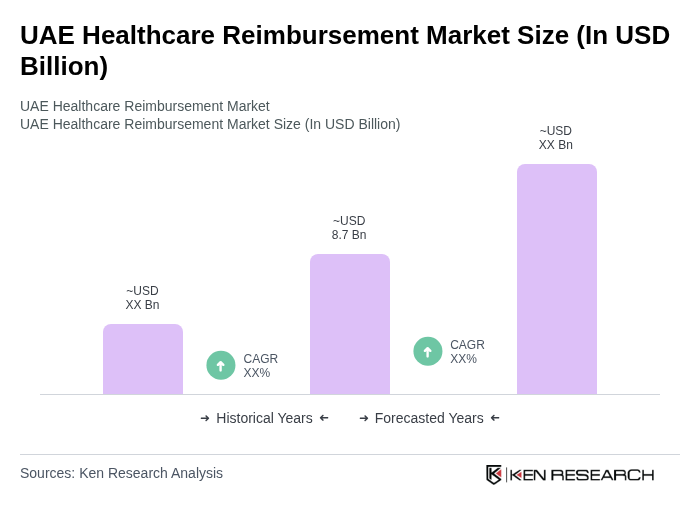
  • The UAE Healthcare Reimbursement Market is valued at USD 8.7 billion, based on a five-year historical analysis. This growth is primarily driven by the increasing demand for healthcare services, rising healthcare costs, and the expansion of health insurance coverage among the population. The government's commitment to enhancing healthcare infrastructure and services has also played a significant role in shaping the market dynamics. Mandatory health insurance regulations in key emirates, coupled with rising chronic disease prevalence and a growing expatriate workforce, continue to expand the reimbursement base across public and private healthcare providers.
  • Dubai and Abu Dhabi are the dominant cities in the UAE Healthcare Reimbursement Market due to their advanced healthcare infrastructure, high population density, and a large expatriate community. These cities have established themselves as healthcare hubs, attracting medical tourists and offering a wide range of healthcare services, which further drives the demand for reimbursement services. The concentration of tertiary care hospitals, specialty clinics, and digital health platforms in these emirates has led to higher claims volumes and more complex reimbursement workflows, reinforcing their leading position in the national reimbursement landscape.
  • The UAE operates under a mandatory health insurance framework, with the Federal Health Insurance Law and emirate-level regulations requiring all residents to have health insurance coverage. In Abu Dhabi, the Health Insurance Law (Law No. 23 of 2005) and subsequent amendments mandate employer-provided coverage for all residents, while Dubai’s Health Insurance Law (Law No. 11 of 2013) enforces similar requirements for employees and dependents. These regulations ensure broad access to healthcare services and have significantly increased the volume and complexity of reimbursement claims across hospitals, clinics, pharmacies, and diagnostic centers.
UAE Healthcare Reimbursement Market Size

UAE Healthcare Reimbursement Market Segmentation

By Reimbursement Type:The reimbursement type segmentation includes various categories such as inpatient services, outpatient services, emergency and critical care, pharmacy and prescription drugs, diagnostics and laboratory services, preventive and wellness services, medical devices and consumables, and others. Among these, outpatient services reimbursement is currently dominating the market due to the increasing preference for outpatient care, which is often more cost-effective and convenient for patients. The trend towards preventive care and wellness services is also gaining traction, reflecting a shift in consumer behavior towards proactive health management.
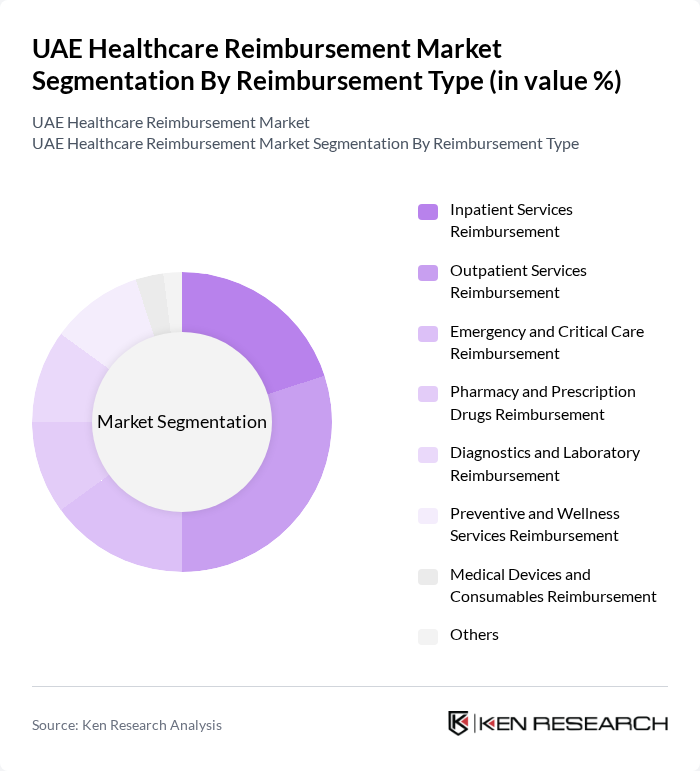
UAE Healthcare Reimbursement Market segmentation by Reimbursement Type.

By End-User / Beneficiary:The end-user segmentation includes UAE nationals, expatriate employees, dependents and families, domestic workers and low-income segments, visitors and medical tourists, and others. UAE nationals represent the largest segment due to government support and comprehensive health insurance coverage provided through public schemes. Expatriate employees also form a significant portion of the market, driven by the large expatriate population in the UAE, which necessitates robust health insurance solutions.
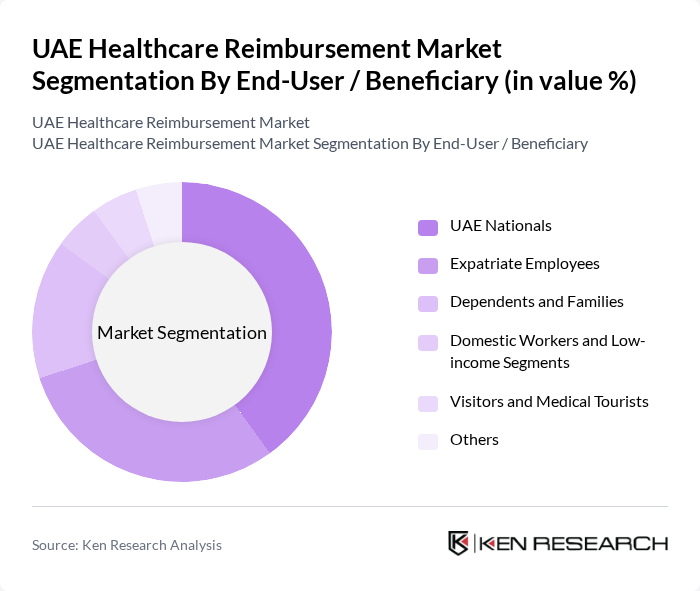
UAE Healthcare Reimbursement Market segmentation by End-User / Beneficiary.

UAE Healthcare Reimbursement Market Competitive Landscape

The UAE Healthcare Reimbursement Market is characterized by a dynamic mix of regional and international players. Leading participants such as National Health Insurance Company – Daman, Abu Dhabi National Insurance Company (ADNIC), Oman Insurance Company (Sukoon Insurance), Orient Insurance PJSC, AXA Cooperative Insurance (GIG Gulf), MetLife Gulf (American Life Insurance Company – ALICO), Cigna Insurance Middle East S.A.L., Allianz Partners (Allianz Care), Emirates Insurance Company PSC, Noor Takaful – Watania, Qatar Insurance Company QIC (QIC Insured), Ras Al Khaimah National Insurance Company (RAKNIC), Dubai Insurance Company PSC, RSA Insurance (Intact Insurance Specialty Solutions – UAE operations), Aetna International (Aetna Inc., a CVS Health company) contribute to innovation, geographic expansion, and service delivery in this space.

National Health Insurance Company – Daman

2006

Abu Dhabi, UAE

Abu Dhabi National Insurance Company (ADNIC)

1972

Abu Dhabi, UAE

Oman Insurance Company (Sukoon Insurance)

1975

Dubai, UAE

Orient Insurance PJSC

1982

Dubai, UAE

AXA Cooperative Insurance (GIG Gulf)

2000

Dubai, UAE

Company

Establishment Year

Headquarters

Group Size (Large, Medium, Small – by UAE health premiums)

Health Insurance Gross Written Premiums (GWP) – UAE

Revenue Growth Rate from Health / Medical Lines

Market Share in UAE Health Insurance / Reimbursement

Network Size (Number of Providers in UAE)

Average Claim Processing Time

UAE Healthcare Reimbursement Market Industry Analysis

Growth Drivers

  • Increasing Demand for Quality Healthcare Services:The UAE's healthcare expenditure reached approximately AED 70 billion, driven by a growing population and rising health awareness. The demand for quality healthcare services is further fueled by an increase in chronic diseases, with diabetes prevalence at 18.3% among adults. This trend necessitates enhanced healthcare services, leading to a robust reimbursement market as providers seek to meet patient expectations and regulatory standards.
  • Government Initiatives to Enhance Healthcare Access:The UAE government allocated AED 25 billion for healthcare initiatives in future, focusing on improving access to medical services. Programs like the Health Insurance Law mandate coverage for all residents, increasing the insured population to over 90%. These initiatives not only enhance healthcare access but also stimulate the reimbursement market by ensuring that more patients can afford necessary treatments and services.
  • Rise in Health Insurance Coverage:Health insurance coverage in the UAE has expanded significantly, with over 90% of the population now insured. This growth is attributed to mandatory health insurance policies and increased employer-sponsored plans. The rise in coverage leads to higher healthcare utilization rates, which in turn drives demand for efficient reimbursement processes, benefiting healthcare providers and insurers alike.

Market Challenges

  • Regulatory Complexities:The UAE healthcare reimbursement landscape is characterized by intricate regulations that vary across emirates. For instance, the differing requirements for health insurance providers can lead to confusion and inefficiencies. In future, over 30% of healthcare providers reported challenges in navigating these regulations, which can delay reimbursements and impact cash flow, ultimately hindering market growth.
  • High Operational Costs for Healthcare Providers:Healthcare providers in the UAE face operational costs that can exceed AED 1.2 million annually for compliance and administrative functions. These high costs are exacerbated by the need for advanced technology and skilled personnel to manage reimbursement processes effectively. As a result, many providers struggle to maintain profitability, which can limit their ability to invest in quality improvements and service expansion.

UAE Healthcare Reimbursement Market Future Outlook

The UAE healthcare reimbursement market is poised for significant transformation, driven by technological advancements and evolving patient expectations. The integration of digital health solutions is expected to streamline reimbursement processes, enhancing efficiency and accuracy. Additionally, the focus on value-based care models will likely reshape reimbursement strategies, emphasizing patient outcomes over service volume. As the market adapts to these trends, stakeholders must remain agile to capitalize on emerging opportunities and address ongoing challenges effectively.

Market Opportunities

  • Expansion of Telemedicine Services:The telemedicine sector in the UAE is projected to grow to AED 2 billion by future, driven by increased demand for remote healthcare solutions. This expansion presents a significant opportunity for reimbursement models to adapt, ensuring that telehealth services are adequately covered, thus enhancing patient access and provider revenue streams.
  • Development of Value-Based Care Models:The shift towards value-based care is gaining momentum, with the UAE government promoting initiatives that reward healthcare providers for patient outcomes. This model encourages providers to focus on quality rather than quantity, potentially reducing costs and improving patient satisfaction, thereby creating a more sustainable reimbursement environment.

Scope of the Report

SegmentSub-Segments
By Reimbursement Type

Inpatient Services Reimbursement

Outpatient Services Reimbursement

Emergency and Critical Care Reimbursement

Pharmacy and Prescription Drugs Reimbursement

Diagnostics and Laboratory Reimbursement

Preventive and Wellness Services Reimbursement

Medical Devices and Consumables Reimbursement

Others

By End-User / Beneficiary

UAE Nationals

Expatriate Employees

Dependents and Families

Domestic Workers and Low-income Segments

Visitors and Medical Tourists

Others

By Payer Type

Public / Government Schemes (e.g., Thiqa, SEHA, DHA Programs)

Private Health Insurers

Self-funded / Employer-sponsored Schemes

Third-Party Administrators (TPAs)

Others

By Service Provider Type

Public Hospitals and Health Systems

Private Hospitals

Polyclinics and Ambulatory Care Centers

Diagnostic and Imaging Centers

Pharmacies and Retail Chains

Telehealth and Digital Health Providers

Others

By Payment / Contracting Model

Fee-for-Service

Capitation and Per-member-per-month (PMPM)

Diagnosis-Related Groups (DRG) / Case-based Payments

Pay-for-Performance and Value-based Contracts

Bundled Payments and Episode-based Reimbursement

Others

By Clinical Area

Cardiovascular and Metabolic Diseases

Oncology

Orthopedics and Musculoskeletal

Maternal and Child Health

Mental and Behavioral Health

Others

By Geographic Distribution

Abu Dhabi

Dubai

Sharjah

Ajman

Ras Al Khaimah

Fujairah

Umm Al Quwain

Others

Key Target Audience

Investors and Venture Capitalist Firms

Government and Regulatory Bodies (e.g., Ministry of Health and Prevention, Dubai Health Authority)

Healthcare Providers and Hospitals

Insurance Companies and Third-Party Administrators

Pharmaceutical Companies

Medical Device Manufacturers

Health Technology Startups

Healthcare Policy Makers

Players Mentioned in the Report:

National Health Insurance Company Daman

Abu Dhabi National Insurance Company (ADNIC)

Oman Insurance Company (Sukoon Insurance)

Orient Insurance PJSC

AXA Cooperative Insurance (GIG Gulf)

MetLife Gulf (American Life Insurance Company ALICO)

Cigna Insurance Middle East S.A.L.

Allianz Partners (Allianz Care)

Emirates Insurance Company PSC

Noor Takaful Watania

Qatar Insurance Company QIC (QIC Insured)

Ras Al Khaimah National Insurance Company (RAKNIC)

Dubai Insurance Company PSC

RSA Insurance (Intact Insurance Specialty Solutions UAE operations)

Aetna International (Aetna Inc., a CVS Health company)

Table of Contents

Market Assessment Phase

1. Executive Summary and Approach


2. UAE Healthcare Reimbursement Market Overview

2.1 Key Insights and Strategic Recommendations

2.2 UAE Healthcare Reimbursement Market Overview

2.3 Definition and Scope

2.4 Evolution of Market Ecosystem

2.5 Timeline of Key Regulatory Milestones

2.6 Value Chain & Stakeholder Mapping

2.7 Business Cycle Analysis

2.8 Policy & Incentive Landscape


3. UAE Healthcare Reimbursement Market Analysis

3.1 Growth Drivers

3.1.1 Increasing demand for quality healthcare services
3.1.2 Government initiatives to enhance healthcare access
3.1.3 Rise in health insurance coverage
3.1.4 Technological advancements in healthcare delivery

3.2 Market Challenges

3.2.1 Regulatory complexities
3.2.2 High operational costs for healthcare providers
3.2.3 Limited awareness of reimbursement processes
3.2.4 Variability in insurance coverage

3.3 Market Opportunities

3.3.1 Expansion of telemedicine services
3.3.2 Development of value-based care models
3.3.3 Increased investment in healthcare infrastructure
3.3.4 Partnerships between public and private sectors

3.4 Market Trends

3.4.1 Shift towards digital health solutions
3.4.2 Growing emphasis on patient-centered care
3.4.3 Integration of AI in healthcare reimbursement
3.4.4 Focus on preventive healthcare measures

3.5 Government Regulation

3.5.1 Implementation of mandatory health insurance
3.5.2 Regulation of healthcare pricing
3.5.3 Standardization of reimbursement processes
3.5.4 Monitoring of healthcare quality and outcomes

4. SWOT Analysis


5. Stakeholder Analysis


6. Porter's Five Forces Analysis


7. UAE Healthcare Reimbursement Market Market Size, 2019-2024

7.1 By Value

7.2 By Volume

7.3 By Average Selling Price


8. UAE Healthcare Reimbursement Market Segmentation

8.1 By Reimbursement Type

8.1.1 Inpatient Services Reimbursement
8.1.2 Outpatient Services Reimbursement
8.1.3 Emergency and Critical Care Reimbursement
8.1.4 Pharmacy and Prescription Drugs Reimbursement
8.1.5 Diagnostics and Laboratory Reimbursement
8.1.6 Preventive and Wellness Services Reimbursement
8.1.7 Medical Devices and Consumables Reimbursement
8.1.8 Others

8.2 By End-User / Beneficiary

8.2.1 UAE Nationals
8.2.2 Expatriate Employees
8.2.3 Dependents and Families
8.2.4 Domestic Workers and Low-income Segments
8.2.5 Visitors and Medical Tourists
8.2.6 Others

8.3 By Payer Type

8.3.1 Public / Government Schemes (e.g., Thiqa, SEHA, DHA Programs)
8.3.2 Private Health Insurers
8.3.3 Self-funded / Employer-sponsored Schemes
8.3.4 Third-Party Administrators (TPAs)
8.3.5 Others

8.4 By Service Provider Type

8.4.1 Public Hospitals and Health Systems
8.4.2 Private Hospitals
8.4.3 Polyclinics and Ambulatory Care Centers
8.4.4 Diagnostic and Imaging Centers
8.4.5 Pharmacies and Retail Chains
8.4.6 Telehealth and Digital Health Providers
8.4.7 Others

8.5 By Payment / Contracting Model

8.5.1 Fee-for-Service
8.5.2 Capitation and Per-member-per-month (PMPM)
8.5.3 Diagnosis-Related Groups (DRG) / Case-based Payments
8.5.4 Pay-for-Performance and Value-based Contracts
8.5.5 Bundled Payments and Episode-based Reimbursement
8.5.6 Others

8.6 By Clinical Area

8.6.1 Cardiovascular and Metabolic Diseases
8.6.2 Oncology
8.6.3 Orthopedics and Musculoskeletal
8.6.4 Maternal and Child Health
8.6.5 Mental and Behavioral Health
8.6.6 Others

8.7 By Geographic Distribution

8.7.1 Abu Dhabi
8.7.2 Dubai
8.7.3 Sharjah
8.7.4 Ajman
8.7.5 Ras Al Khaimah
8.7.6 Fujairah
8.7.7 Umm Al Quwain
8.7.8 Others

9. UAE Healthcare Reimbursement Market Competitive Analysis

9.1 Market Share of Key Players

9.2 Cross Comparison of Key Players

9.2.1 Company Name
9.2.2 Group Size (Large, Medium, Small – by UAE health premiums)
9.2.3 Health Insurance Gross Written Premiums (GWP) – UAE
9.2.4 Revenue Growth Rate from Health / Medical Lines
9.2.5 Market Share in UAE Health Insurance / Reimbursement
9.2.6 Network Size (Number of Providers in UAE)
9.2.7 Average Claim Processing Time
9.2.8 Claims Denial / Rejection Rate
9.2.9 Loss Ratio for Health Portfolio
9.2.10 Average Claim Paid per Member per Year
9.2.11 Digitalization Level (e-claims, portals, mobile apps availability)
9.2.12 Patient / Member Satisfaction Score
9.2.13 Compliance Rate with DHA/DOH/MOHAP Regulations

9.3 SWOT Analysis of Top Players

9.4 Pricing Analysis

9.5 Detailed Profile of Major Companies

9.5.1 National Health Insurance Company – Daman
9.5.2 Abu Dhabi National Insurance Company (ADNIC)
9.5.3 Oman Insurance Company (Sukoon Insurance)
9.5.4 Orient Insurance PJSC
9.5.5 AXA Cooperative Insurance (GIG Gulf)
9.5.6 MetLife Gulf (American Life Insurance Company – ALICO)
9.5.7 Cigna Insurance Middle East S.A.L.
9.5.8 Allianz Partners (Allianz Care)
9.5.9 Emirates Insurance Company PSC
9.5.10 Noor Takaful – Watania
9.5.11 Qatar Insurance Company QIC (QIC Insured)
9.5.12 Ras Al Khaimah National Insurance Company (RAKNIC)
9.5.13 Dubai Insurance Company PSC
9.5.14 RSA Insurance (Intact Insurance Specialty Solutions – UAE operations)
9.5.15 Aetna International (Aetna Inc., a CVS Health company)

10. UAE Healthcare Reimbursement Market End-User Analysis

10.1 Procurement Behavior of Key Ministries

10.1.1 Ministry of Health and Prevention
10.1.2 Ministry of Finance
10.1.3 Ministry of Education
10.1.4 Ministry of Community Development

10.2 Corporate Spend on Infrastructure & Energy

10.2.1 Healthcare Infrastructure Investments
10.2.2 Energy Efficiency Initiatives
10.2.3 Technology Upgrades
10.2.4 Others

10.3 Pain Point Analysis by End-User Category

10.3.1 Hospitals
10.3.2 Clinics
10.3.3 Insurance Providers
10.3.4 Patients

10.4 User Readiness for Adoption

10.4.1 Awareness of Reimbursement Processes
10.4.2 Training Needs for Healthcare Providers
10.4.3 Technology Adoption Readiness
10.4.4 Others

10.5 Post-Deployment ROI and Use Case Expansion

10.5.1 Evaluation of Reimbursement Models
10.5.2 Expansion of Services Offered
10.5.3 Patient Outcome Improvements
10.5.4 Others

11. UAE Healthcare Reimbursement Market Future Size, 2025-2030

11.1 By Value

11.2 By Volume

11.3 By Average Selling Price


Go-To-Market Strategy Phase

1. Whitespace Analysis + Business Model Canvas

1.1 Market Gaps Identification

1.2 Business Model Development


2. Marketing and Positioning Recommendations

2.1 Branding Strategies

2.2 Product USPs


3. Distribution Plan

3.1 Urban Retail vs Rural NGO Tie-ups


4. Channel & Pricing Gaps

4.1 Underserved Routes

4.2 Pricing Bands


5. Unmet Demand & Latent Needs

5.1 Category Gaps

5.2 Consumer Segments


6. Customer Relationship

6.1 Loyalty Programs

6.2 After-sales Service


7. Value Proposition

7.1 Sustainability

7.2 Integrated Supply Chains


8. Key Activities

8.1 Regulatory Compliance

8.2 Branding

8.3 Distribution Setup


9. Entry Strategy Evaluation

9.1 Domestic Market Entry Strategy

9.1.1 Product Mix
9.1.2 Pricing Band
9.1.3 Packaging

9.2 Export Entry Strategy

9.2.1 Target Countries
9.2.2 Compliance Roadmap

10. Entry Mode Assessment

10.1 JV

10.2 Greenfield

10.3 M&A

10.4 Distributor Model


11. Capital and Timeline Estimation

11.1 Capital Requirements

11.2 Timelines


12. Control vs Risk Trade-Off

12.1 Ownership vs Partnerships


13. Profitability Outlook

13.1 Breakeven Analysis

13.2 Long-term Sustainability


14. Potential Partner List

14.1 Distributors

14.2 JVs

14.3 Acquisition Targets


15. Execution Roadmap

15.1 Phased Plan for Market Entry

15.1.1 Market Setup
15.1.2 Market Entry
15.1.3 Growth Acceleration
15.1.4 Scale & Stabilize

15.2 Key Activities and Milestones

15.2.1 Milestone Planning
15.2.2 Activity Tracking

Research Methodology

ApproachModellingSample

Phase 1: Approach1

Desk Research

  • Analysis of healthcare expenditure reports from the UAE Ministry of Health and Prevention
  • Review of industry publications and white papers on healthcare reimbursement trends
  • Examination of regulatory frameworks and policies affecting healthcare reimbursement in the UAE

Primary Research

  • Interviews with healthcare administrators from major hospitals and clinics
  • Surveys with insurance providers to understand reimbursement models
  • Focus groups with healthcare professionals to gather insights on reimbursement challenges

Validation & Triangulation

  • Cross-validation of findings through multiple data sources including government and private sector reports
  • Triangulation of qualitative insights from interviews with quantitative data from surveys
  • Sanity checks conducted through expert panel reviews comprising industry veterans

Phase 2: Market Size Estimation1

Top-down Assessment

  • Estimation of total healthcare spending in the UAE and its allocation to reimbursement
  • Analysis of demographic trends and their impact on healthcare service utilization
  • Incorporation of government healthcare initiatives and their projected financial implications

Bottom-up Modeling

  • Collection of data on reimbursement rates from various healthcare providers
  • Estimation of patient volume and service frequency across different healthcare segments
  • Calculation of average reimbursement amounts based on service type and insurance coverage

Forecasting & Scenario Analysis

  • Multi-factor regression analysis incorporating economic indicators and healthcare policy changes
  • Scenario modeling based on potential shifts in insurance regulations and market dynamics
  • Development of baseline, optimistic, and pessimistic forecasts through 2030

Phase 3: CATI Sample Composition1

Scope Item/SegmentSample SizeTarget Respondent Profiles
Public Hospital Reimbursement Processes100Hospital Administrators, Financial Officers
Private Insurance Provider Models80Insurance Underwriters, Claims Managers
Pharmaceutical Reimbursement Strategies70Pharmaceutical Sales Managers, Policy Analysts
Outpatient Services Reimbursement60Clinic Managers, Billing Specialists
Telehealth Reimbursement Trends40Telehealth Coordinators, IT Managers

Frequently Asked Questions

What is the current value of the UAE Healthcare Reimbursement Market?

The UAE Healthcare Reimbursement Market is valued at approximately USD 8.7 billion, reflecting a significant growth driven by increasing healthcare demand, rising costs, and expanded health insurance coverage among the population.

What factors are driving the growth of the UAE Healthcare Reimbursement Market?

Which cities dominate the UAE Healthcare Reimbursement Market?

What are the main types of reimbursement in the UAE Healthcare Market?

Other Regional/Country Reports

Indonesia Healthcare Reimbursement Market

Malaysia Healthcare Reimbursement Market

KSA Healthcare Reimbursement Market

APAC Healthcare Reimbursement Market

SEA Healthcare Reimbursement Market

Vietnam Healthcare Reimbursement Market

Why Buy From Us?

Refine Robust Result (RRR) Framework

What makes us stand out is that our consultants follow Robust, Refine and Result (RRR) methodology. Robust for clear definitions, approaches and sanity checking, Refine for differentiating respondents' facts and opinions, and Result for presenting data with story.

Our Reach Is Unmatched

We have set a benchmark in the industry by offering our clients with syndicated and customized market research reports featuring coverage of entire market as well as meticulous research and analyst insights.

Shifting the Research Paradigm

While we don't replace traditional research, we flip the method upside down. Our dual approach of Top Bottom & Bottom Top ensures quality deliverable by not just verifying company fundamentals but also looking at the sector and macroeconomic factors.

More Insights-Better Decisions

With one step in the future, our research team constantly tries to show you the bigger picture. We help with some of the tough questions you may encounter along the way: How is the industry positioned? Best marketing channel? KPI's of competitors? By aligning every element, we help maximize success.

Transparency and Trust

Our report gives you instant access to the answers and sources that other companies might choose to hide. We elaborate each steps of research methodology we have used and showcase you the sample size to earn your trust.

Round the Clock Support

If you need any support, we are here! We pride ourselves on universe strength, data quality, and quick, friendly, and professional service.

Why Clients Choose Us?

400000+
Reports in repository
150+
Consulting projects a year
100+
Analysts
8000+
Client Queries in 2022








