UK Cyber Insurance Market

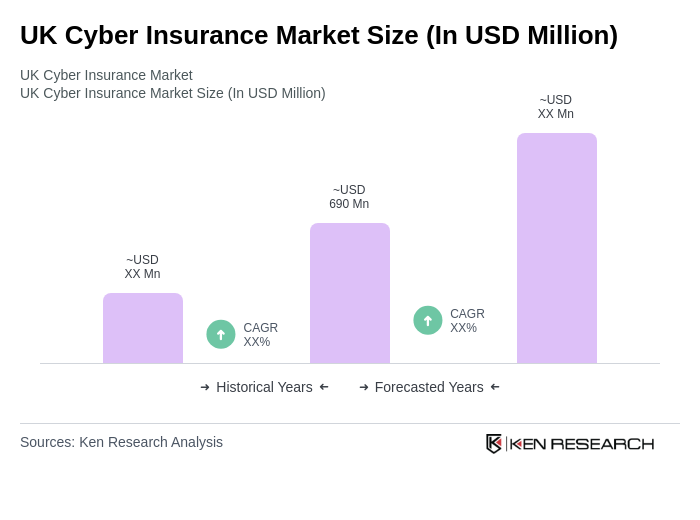
UK Cyber Insurance Market, valued at USD 690 million, grows amid increasing cyber threats, regulatory needs like UK GDPR, and opportunities in SMEs and customized products.

Region:Europe

Author(s):Geetanshi

Product Code:KRAB2737

Pages:95

Published On:October 2025
About the Report

Base Year 2024

UK Cyber Insurance Market Overview

  • The UK Cyber Insurance Market is valued at USD 690 million, based on a five-year historical analysis. This growth is primarily driven by the increasing frequency and sophistication of cyberattacks, rising costs of data breaches, and heightened awareness among businesses regarding cybersecurity risks. The ongoing digital transformation, expansion of cloud services, and remote work trends across sectors have further contributed to the demand for comprehensive cyber insurance solutions. Notably, ransomware attacks in the UK have surged by 70%, and the country ranks as the second-most targeted globally for cyber-attacks, underscoring the urgent need for robust insurance coverage .
  • Key cities such as London, Manchester, and Birmingham continue to dominate the UK Cyber Insurance Market due to their roles as financial and technological hubs. London, in particular, hosts a concentration of multinational corporations, fintech startups, and major insurance providers, fostering a competitive environment that necessitates advanced cyber insurance solutions. The density of businesses in these urban centers drives demand for tailored products to mitigate evolving cyber risks .
  • The UK cyber insurance sector is governed by binding instruments such as the Data Protection Act 2018 and the UK General Data Protection Regulation (UK GDPR), issued by the UK Parliament and the Information Commissioner's Office. These regulations require organizations handling sensitive personal data to implement adequate safeguards, including insurance coverage to mitigate financial losses from data breaches and cyber incidents. Compliance is mandatory for organizations processing personal data, with operational requirements covering breach notification, risk management, and minimum standards for data protection .
UK Cyber Insurance Market Size

UK Cyber Insurance Market Segmentation

By Type:This segmentation includes various types of coverage that address specific cyber risk exposures faced by UK organizations. Recent market trends indicate increased demand for first-party coverage, business interruption, and cyber crime protection, with insurers broadening coverage to include non-IT supply chain disruptions and theft of funds resulting from cyber-attacks .
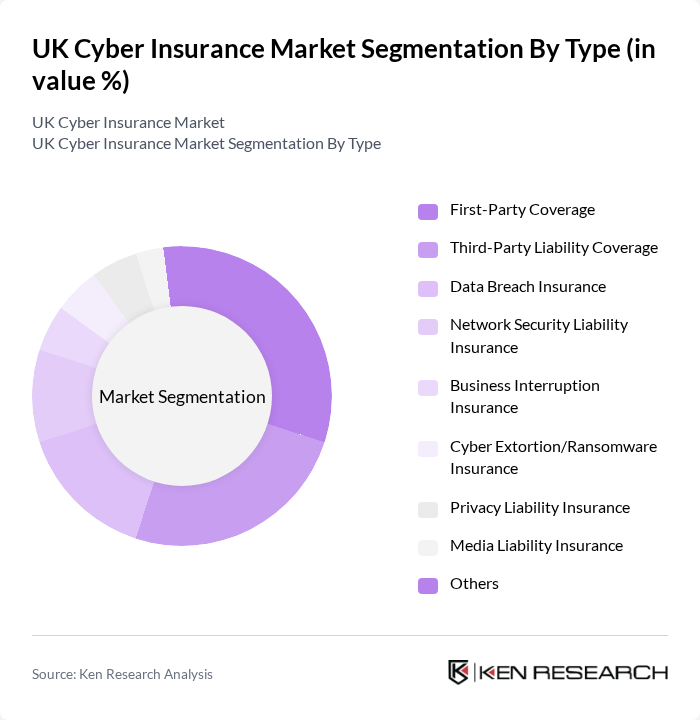
UK Cyber Insurance Market segmentation by Type.

By End-User:This segmentation categorizes the market based on the type of organizations purchasing cyber insurance. The UK market is witnessing increased uptake among small and medium enterprises, driven by regulatory compliance needs and heightened risk awareness. Large enterprises and public sector agencies remain key contributors, while insurers are expanding offerings to non-profit organizations and individuals as cyber threats become more pervasive .
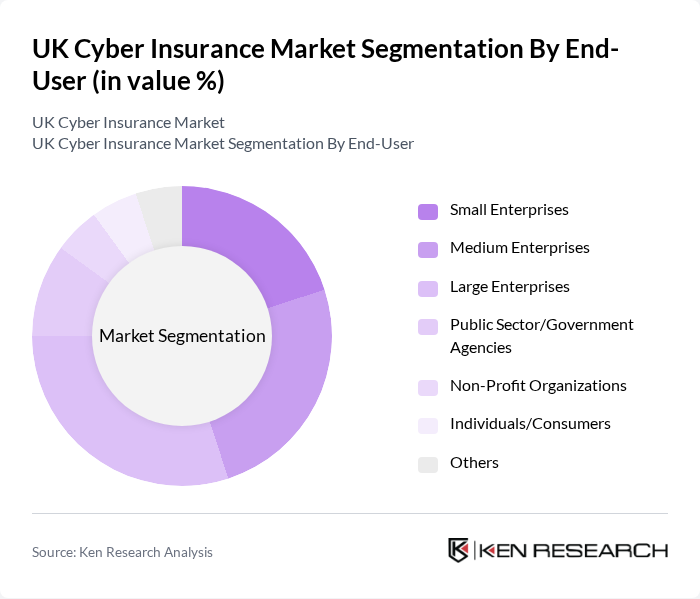
UK Cyber Insurance Market segmentation by End-User.

UK Cyber Insurance Market Competitive Landscape

The UK Cyber Insurance Market is characterized by a dynamic mix of regional and international players. Leading participants such as AIG UK Limited, Allianz Insurance plc, AXA Insurance UK plc, Chubb European Group Limited, Hiscox Ltd, Lloyd's of London, QBE Insurance Group Limited, Zurich Insurance plc, Beazley Group plc, CNA Hardy, Marsh & McLennan Companies, Inc., Lockton Companies, Gallagher, Tokio Marine HCC, Berkshire Hathaway Specialty Insurance contribute to innovation, geographic expansion, and service delivery in this space.

AIG UK Limited

1962

London, UK

Allianz Insurance plc

1890

Munich, Germany

AXA Insurance UK plc

1946

London, UK

Chubb European Group Limited

1882

London, UK

Hiscox Ltd

1901

London, UK

Company

Establishment Year

Headquarters

Group Size (Large, Medium, or Small as per industry convention)

Gross Written Premiums (Cyber Line)

Premium Growth Rate (YoY)

Customer Retention Rate

Claims Settlement Ratio

Underwriting Profit Margin

UK Cyber Insurance Market Industry Analysis

Growth Drivers

  • Increasing Cyber Threats:The UK has witnessed a significant rise in cyber incidents, with reported breaches increasing by 32% in future, affecting over 32% of businesses. The cost of cybercrime in the UK reached £3 billion in future, highlighting the urgent need for robust cyber insurance solutions. As organizations face escalating threats, the demand for cyber insurance is expected to surge, driving market growth and encouraging businesses to invest in protective measures.
  • Regulatory Compliance Requirements:The implementation of stringent regulations, such as the GDPR, has compelled UK businesses to adopt comprehensive cyber insurance policies. In future, over 60% of companies reported increased compliance costs, averaging £87,000 annually. This regulatory landscape not only drives demand for cyber insurance but also encourages firms to enhance their cybersecurity frameworks, ensuring they meet legal obligations while protecting sensitive data.
  • Rising Awareness of Cyber Risks:Awareness of cyber risks among UK businesses has grown significantly, with 68% of medium and 74% of large businesses acknowledging the importance of cyber insurance in risk management strategies. In future, 56% of organizations conducted cybersecurity training for employees, reflecting a proactive approach to mitigating risks. This heightened awareness is fostering a culture of preparedness, leading to increased adoption of cyber insurance policies as businesses seek to safeguard their assets against potential threats.

Market Challenges

  • Lack of Standardization in Policies:The UK cyber insurance market faces challenges due to the absence of standardized policies, leading to confusion among businesses. In future, 61% of companies reported difficulty in understanding policy terms, which can result in inadequate coverage. This lack of clarity hampers market growth, as organizations may hesitate to invest in insurance products that do not clearly define their scope and limitations.
  • High Cost of Premiums:The rising cost of cyber insurance premiums poses a significant challenge for UK businesses. In future, average premiums increased by 20%, with small and medium enterprises particularly affected, facing costs upwards of £1,500 annually. This financial burden can deter organizations from obtaining necessary coverage, potentially leaving them vulnerable to cyber threats and undermining the overall growth of the cyber insurance market.

UK Cyber Insurance Market Future Outlook

The UK cyber insurance market is poised for significant evolution, driven by technological advancements and increasing regulatory pressures. As businesses continue to digitize operations, the integration of AI and machine learning in underwriting processes will enhance risk assessment accuracy. Additionally, the growing emphasis on incident response services will reshape policy offerings, ensuring that organizations are better equipped to handle cyber incidents. This dynamic environment will foster innovation and adaptability within the market, paving the way for sustainable growth.

Market Opportunities

  • Expansion into Small and Medium Enterprises:The underserved SME sector presents a lucrative opportunity for cyber insurance providers. With over 5.5 million SMEs in the UK, many lack adequate coverage. Targeting this demographic can lead to increased policy uptake, as SMEs recognize the necessity of protecting their digital assets against rising cyber threats.
  • Development of Tailored Insurance Products:There is a growing demand for customized cyber insurance products that cater to specific industry needs. By developing tailored solutions, insurers can address unique risks faced by sectors such as healthcare and finance, enhancing customer satisfaction and driving market penetration in niche areas.

Scope of the Report

SegmentSub-Segments
By Type

First-Party Coverage

Third-Party Liability Coverage

Data Breach Insurance

Network Security Liability Insurance

Business Interruption Insurance

Cyber Extortion/Ransomware Insurance

Privacy Liability Insurance

Media Liability Insurance

Others

By End-User

Small Enterprises

Medium Enterprises

Large Enterprises

Public Sector/Government Agencies

Non-Profit Organizations

Individuals/Consumers

Others

By Industry

Financial Services & Banking

Healthcare & Life Sciences

Retail & E-Commerce

Technology & IT Services

Manufacturing

Education

Utilities & Energy

Media & Communications

Others

By Coverage Type

Comprehensive Coverage

Limited Coverage

Customized Coverage

By Distribution Channel

Direct Sales

Brokers

Online Platforms

Agents

Affinity Partnerships

By Policy Duration

Short-Term Policies

Long-Term Policies

By Policy Limit

Low Limit Policies

Medium Limit Policies

High Limit Policies

Key Target Audience

Investors and Venture Capitalist Firms

Government and Regulatory Bodies (e.g., Financial Conduct Authority, Information Commissioner's Office)

Insurance Underwriters and Brokers

Cybersecurity Firms and Solution Providers

Large Corporations and Enterprises

Small and Medium-sized Enterprises (SMEs)

Industry Associations and Trade Groups

Financial Institutions and Banks

Players Mentioned in the Report:

AIG UK Limited

Allianz Insurance plc

AXA Insurance UK plc

Chubb European Group Limited

Hiscox Ltd

Lloyd's of London

QBE Insurance Group Limited

Zurich Insurance plc

Beazley Group plc

CNA Hardy

Marsh & McLennan Companies, Inc.

Lockton Companies

Gallagher

Tokio Marine HCC

Berkshire Hathaway Specialty Insurance

Table of Contents

Market Assessment Phase

1. Executive Summary and Approach


2. UK Cyber Insurance Market Overview

2.1 Key Insights and Strategic Recommendations

2.2 UK Cyber Insurance Market Overview

2.3 Definition and Scope

2.4 Evolution of Market Ecosystem

2.5 Timeline of Key Regulatory Milestones

2.6 Value Chain & Stakeholder Mapping

2.7 Business Cycle Analysis

2.8 Policy & Incentive Landscape


3. UK Cyber Insurance Market Analysis

3.1 Growth Drivers

3.1.1 Increasing Cyber Threats
3.1.2 Regulatory Compliance Requirements
3.1.3 Rising Awareness of Cyber Risks
3.1.4 Growth of Digital Transformation

3.2 Market Challenges

3.2.1 Lack of Standardization in Policies
3.2.2 High Cost of Premiums
3.2.3 Limited Understanding of Coverage
3.2.4 Evolving Nature of Cyber Threats

3.3 Market Opportunities

3.3.1 Expansion into Small and Medium Enterprises
3.3.2 Development of Tailored Insurance Products
3.3.3 Integration of Cyber Insurance with Cybersecurity Solutions
3.3.4 Increased Investment in Cyber Risk Management

3.4 Market Trends

3.4.1 Adoption of AI and Machine Learning in Underwriting
3.4.2 Growth of Cyber Insurance Bundled with Other Policies
3.4.3 Emphasis on Incident Response Services
3.4.4 Shift Towards Usage-Based Insurance Models

3.5 Government Regulation

3.5.1 GDPR Compliance
3.5.2 Cybersecurity Strategy 2022
3.5.3 Financial Conduct Authority Guidelines
3.5.4 National Cyber Security Centre Recommendations

4. SWOT Analysis


5. Stakeholder Analysis


6. Porter's Five Forces Analysis


7. UK Cyber Insurance Market Market Size, 2019-2024

7.1 By Value

7.2 By Volume

7.3 By Average Selling Price


8. UK Cyber Insurance Market Segmentation

8.1 By Type

8.1.1 First-Party Coverage
8.1.2 Third-Party Liability Coverage
8.1.3 Data Breach Insurance
8.1.4 Network Security Liability Insurance
8.1.5 Business Interruption Insurance
8.1.6 Cyber Extortion/Ransomware Insurance
8.1.7 Privacy Liability Insurance
8.1.8 Media Liability Insurance
8.1.9 Others

8.2 By End-User

8.2.1 Small Enterprises
8.2.2 Medium Enterprises
8.2.3 Large Enterprises
8.2.4 Public Sector/Government Agencies
8.2.5 Non-Profit Organizations
8.2.6 Individuals/Consumers
8.2.7 Others

8.3 By Industry

8.3.1 Financial Services & Banking
8.3.2 Healthcare & Life Sciences
8.3.3 Retail & E-Commerce
8.3.4 Technology & IT Services
8.3.5 Manufacturing
8.3.6 Education
8.3.7 Utilities & Energy
8.3.8 Media & Communications
8.3.9 Others

8.4 By Coverage Type

8.4.1 Comprehensive Coverage
8.4.2 Limited Coverage
8.4.3 Customized Coverage

8.5 By Distribution Channel

8.5.1 Direct Sales
8.5.2 Brokers
8.5.3 Online Platforms
8.5.4 Agents
8.5.5 Affinity Partnerships

8.6 By Policy Duration

8.6.1 Short-Term Policies
8.6.2 Long-Term Policies

8.7 By Policy Limit

8.7.1 Low Limit Policies
8.7.2 Medium Limit Policies
8.7.3 High Limit Policies

9. UK Cyber Insurance Market Competitive Analysis

9.1 Market Share of Key Players

9.2 Cross Comparison of Key Players

9.2.1 Company Name
9.2.2 Group Size (Large, Medium, or Small as per industry convention)
9.2.3 Gross Written Premiums (Cyber Line)
9.2.4 Premium Growth Rate (YoY)
9.2.5 Customer Retention Rate
9.2.6 Claims Settlement Ratio
9.2.7 Underwriting Profit Margin
9.2.8 Market Penetration Rate (UK Cyber Insurance)
9.2.9 Pricing Strategy (Average Premium per Policy)
9.2.10 Customer Satisfaction Score (Net Promoter Score or Equivalent)
9.2.11 Loss Ratio
9.2.12 Policy Limit Distribution (Average/Median Limit)
9.2.13 Coverage Breadth (Number of Coverage Types Offered)
9.2.14 Digital Distribution Capability
9.2.15 Incident Response Service Quality

9.3 SWOT Analysis of Top Players

9.4 Pricing Analysis

9.5 Detailed Profile of Major Companies

9.5.1 AIG UK Limited
9.5.2 Allianz Insurance plc
9.5.3 AXA Insurance UK plc
9.5.4 Chubb European Group Limited
9.5.5 Hiscox Ltd
9.5.6 Lloyd's of London
9.5.7 QBE Insurance Group Limited
9.5.8 Zurich Insurance plc
9.5.9 Beazley Group plc
9.5.10 CNA Hardy
9.5.11 Marsh & McLennan Companies, Inc.
9.5.12 Lockton Companies
9.5.13 Gallagher
9.5.14 Tokio Marine HCC
9.5.15 Berkshire Hathaway Specialty Insurance

10. UK Cyber Insurance Market End-User Analysis

10.1 Procurement Behavior of Key Ministries

10.1.1 Budget Allocation for Cyber Insurance
10.1.2 Decision-Making Process
10.1.3 Evaluation Criteria
10.1.4 Preferred Providers

10.2 Corporate Spend on Infrastructure & Energy

10.2.1 Investment in Cybersecurity Infrastructure
10.2.2 Budget for Cyber Insurance
10.2.3 Trends in Corporate Spending

10.3 Pain Point Analysis by End-User Category

10.3.1 Awareness of Cyber Risks
10.3.2 Understanding of Policy Coverage
10.3.3 Cost Concerns
10.3.4 Claims Process Complexity

10.4 User Readiness for Adoption

10.4.1 Awareness Levels
10.4.2 Training and Education Needs
10.4.3 Perceived Value of Cyber Insurance

10.5 Post-Deployment ROI and Use Case Expansion

10.5.1 Measurement of ROI
10.5.2 Use Case Scenarios
10.5.3 Feedback Mechanisms

11. UK Cyber Insurance Market Future Size, 2025-2030

11.1 By Value

11.2 By Volume

11.3 By Average Selling Price


Go-To-Market Strategy Phase

1. Whitespace Analysis + Business Model Canvas

1.1 Market Gaps Identification

1.2 Value Proposition Development

1.3 Revenue Streams Analysis

1.4 Key Partnerships

1.5 Customer Segmentation

1.6 Cost Structure

1.7 Channels of Distribution


2. Marketing and Positioning Recommendations

2.1 Branding Strategies

2.2 Product USPs

2.3 Target Audience Identification

2.4 Communication Strategy

2.5 Digital Marketing Tactics


3. Distribution Plan

3.1 Urban Retail Strategies

3.2 Rural NGO Tie-Ups

3.3 Online Distribution Channels

3.4 Partnerships with Brokers


4. Channel & Pricing Gaps

4.1 Underserved Routes

4.2 Pricing Bands Analysis

4.3 Competitor Pricing Comparison


5. Unmet Demand & Latent Needs

5.1 Category Gaps

5.2 Consumer Segments Analysis

5.3 Emerging Trends


6. Customer Relationship

6.1 Loyalty Programs

6.2 After-Sales Service

6.3 Customer Feedback Mechanisms


7. Value Proposition

7.1 Sustainability Initiatives

7.2 Integrated Supply Chains

7.3 Unique Selling Points


8. Key Activities

8.1 Regulatory Compliance

8.2 Branding Efforts

8.3 Distribution Setup


9. Entry Strategy Evaluation

9.1 Domestic Market Entry Strategy

9.1.1 Product Mix Considerations
9.1.2 Pricing Band Strategy
9.1.3 Packaging Options

9.2 Export Entry Strategy

9.2.1 Target Countries
9.2.2 Compliance Roadmap

10. Entry Mode Assessment

10.1 Joint Ventures

10.2 Greenfield Investments

10.3 Mergers & Acquisitions

10.4 Distributor Model


11. Capital and Timeline Estimation

11.1 Capital Requirements

11.2 Timelines for Implementation


12. Control vs Risk Trade-Off

12.1 Ownership Considerations

12.2 Partnerships Evaluation


13. Profitability Outlook

13.1 Breakeven Analysis

13.2 Long-Term Sustainability


14. Potential Partner List

14.1 Distributors

14.2 Joint Ventures

14.3 Acquisition Targets


15. Execution Roadmap

15.1 Phased Plan for Market Entry

15.1.1 Market Setup
15.1.2 Market Entry
15.1.3 Growth Acceleration
15.1.4 Scale & Stabilize

15.2 Key Activities and Milestones

15.2.1 Milestone Planning
15.2.2 Activity Tracking

Research Methodology

ApproachModellingSample

Phase 1: Approach1

Desk Research

  • Analysis of industry reports from UK insurance regulatory bodies and market research firms
  • Review of published articles and white papers on cyber insurance trends and statistics
  • Examination of government publications regarding cybersecurity regulations and compliance requirements

Primary Research

  • Interviews with risk management professionals in various sectors, including finance, healthcare, and retail
  • Surveys targeting IT security experts to gather insights on cyber risk perceptions and insurance uptake
  • Focus groups with business owners to understand their experiences and challenges with cyber insurance

Validation & Triangulation

  • Cross-validation of findings through comparison with industry benchmarks and historical data
  • Triangulation of insights from primary interviews with secondary data sources to ensure consistency
  • Sanity checks conducted through expert panel reviews to validate assumptions and conclusions

Phase 2: Market Size Estimation1

Top-down Assessment

  • Estimation of total addressable market based on overall insurance market size and cyber insurance penetration rates
  • Segmentation of the market by industry verticals and company sizes to identify key growth areas
  • Incorporation of macroeconomic factors influencing demand for cyber insurance, such as digital transformation trends

Bottom-up Modeling

  • Collection of premium data from leading cyber insurance providers to establish average policy values
  • Analysis of claims data to understand loss ratios and their impact on pricing strategies
  • Estimation of market growth based on new policy issuance rates and renewal trends

Forecasting & Scenario Analysis

  • Development of predictive models using historical growth rates and emerging cyber threats
  • Scenario analysis based on varying levels of regulatory compliance and market adoption rates
  • Creation of multiple forecasts (baseline, optimistic, and pessimistic) to account for market volatility

Phase 3: CATI Sample Composition1

Scope Item/SegmentSample SizeTarget Respondent Profiles
Financial Services Cyber Insurance50Risk Managers, Compliance Officers
Healthcare Sector Cyber Coverage40IT Security Directors, Operations Managers
Retail Industry Cyber Risk Management40Business Owners, IT Managers
Manufacturing Cyber Insurance Needs40Supply Chain Managers, Risk Assessment Analysts
SME Cyber Insurance Adoption50Small Business Owners, Financial Advisors

Frequently Asked Questions

What is the current value of the UK Cyber Insurance Market?

The UK Cyber Insurance Market is valued at approximately USD 690 million, reflecting significant growth driven by increasing cyber threats, rising data breach costs, and heightened awareness among businesses regarding cybersecurity risks.

What factors are driving the growth of cyber insurance in the UK?

Which cities are the main hubs for cyber insurance in the UK?

What types of coverage are available in the UK Cyber Insurance Market?

Other Adjacent Reports

Why Buy From Us?

Refine Robust Result (RRR) Framework

What makes us stand out is that our consultants follow Robust, Refine and Result (RRR) methodology. Robust for clear definitions, approaches and sanity checking, Refine for differentiating respondents' facts and opinions, and Result for presenting data with story.

Our Reach Is Unmatched

We have set a benchmark in the industry by offering our clients with syndicated and customized market research reports featuring coverage of entire market as well as meticulous research and analyst insights.

Shifting the Research Paradigm

While we don't replace traditional research, we flip the method upside down. Our dual approach of Top Bottom & Bottom Top ensures quality deliverable by not just verifying company fundamentals but also looking at the sector and macroeconomic factors.

More Insights-Better Decisions

With one step in the future, our research team constantly tries to show you the bigger picture. We help with some of the tough questions you may encounter along the way: How is the industry positioned? Best marketing channel? KPI's of competitors? By aligning every element, we help maximize success.

Transparency and Trust

Our report gives you instant access to the answers and sources that other companies might choose to hide. We elaborate each steps of research methodology we have used and showcase you the sample size to earn your trust.

Round the Clock Support

If you need any support, we are here! We pride ourselves on universe strength, data quality, and quick, friendly, and professional service.

Why Clients Choose Us?

400000+
Reports in repository
150+
Consulting projects a year
100+
Analysts
8000+
Client Queries in 2022








