About the Report
Base Year 2024US Fructooligosaccharides Market Overview
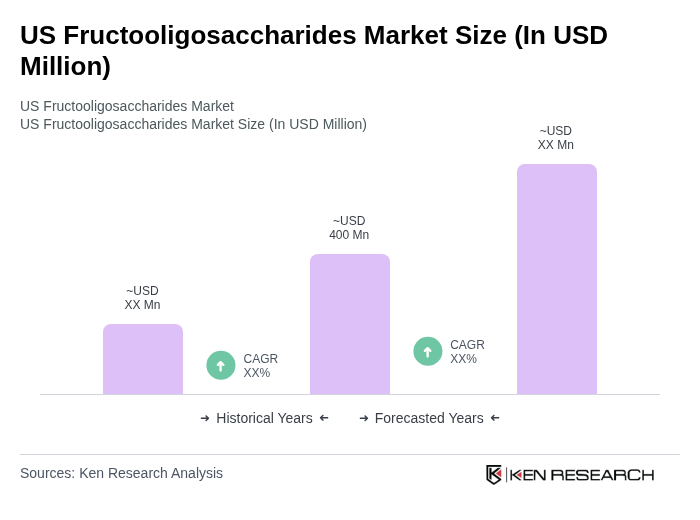
- The US fructooligosaccharides market is valued at approximately USD 400 million, based on reported US revenue of about USD 397 million in 2022 and high single?digit annual growth for FOS in the country. This growth is primarily driven by increasing demand for natural sweeteners and dietary fibers, as health?conscious consumers look for sugar alternatives with lower glycemic impact and additional functional benefits. Rising awareness of the prebiotic benefits of fructooligosaccharides, including support for beneficial gut microbiota, improved digestive comfort, and enhanced mineral absorption, has further fueled market expansion in foods, beverages, and dietary supplements.
- Key demand clusters in this market include major metropolitan areas such as New York, Los Angeles, and Chicago, which feature large, affluent consumer bases and strong retail presence for health and wellness products. These cities, together with large logistics hubs in the Midwest and on the coasts, also act as important distribution and formulation centers for FOS?containing ingredients and finished products, helping manufacturers and distributors reach a broader national customer base.
- In the United States, fructooligosaccharides are recognized as Generally Recognized as Safe (GRAS) by the Food and Drug Administration, which facilitates their use in a wide range of foods and dietary supplements, but there has not been a specific nationwide regulation in 2023 mandating or directly promoting the use of prebiotics in food products. Instead, market growth is supported by broader regulatory acceptance of prebiotic fibers, evolving nutrition and fiber intake guidelines, and strong industry?led innovation around gut health and functional ingredients that encourage manufacturers to incorporate FOS into their formulations.
US Fructooligosaccharides Market Segmentation
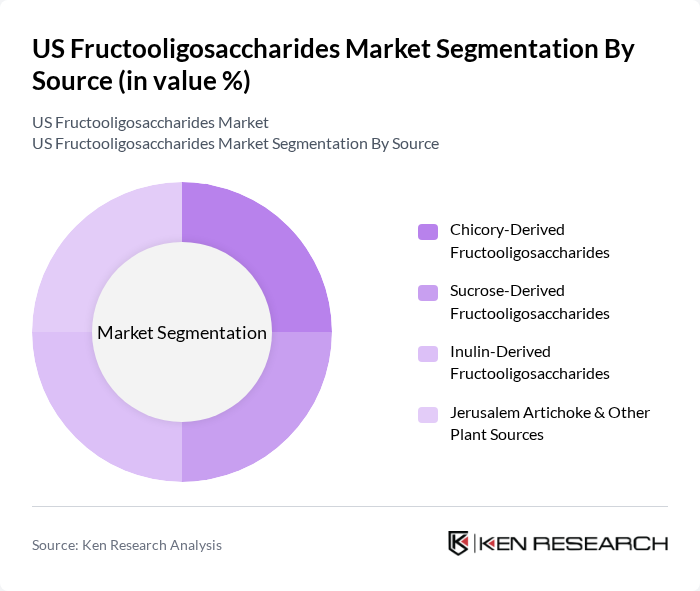
By Source:The market is segmented based on the source of fructooligosaccharides, which includes chicory?derived, sucrose?derived, inulin?derived, and Jerusalem artichoke and other plant sources. Chicory?derived fructooligosaccharides dominate the US market, with chicory?based products accounting for more than 70 percent of US FOS revenue in 2022, due to high yield, well?established processing infrastructure, and cost?effectiveness in large?scale production. Sucrose?derived options are also important, particularly in beverage and syrup applications, and are identified as a faster?growing source segment as manufacturers seek versatile, clean?tasting prebiotic sweeteners. Inulin?derived sources, often closely associated with chicory and other root crops, are favored in products positioned around digestive and metabolic health, while Jerusalem artichoke and niche botanical sources are gaining traction in organic, non?GMO, and specialty nutrition segments where differentiated sourcing stories are valued.
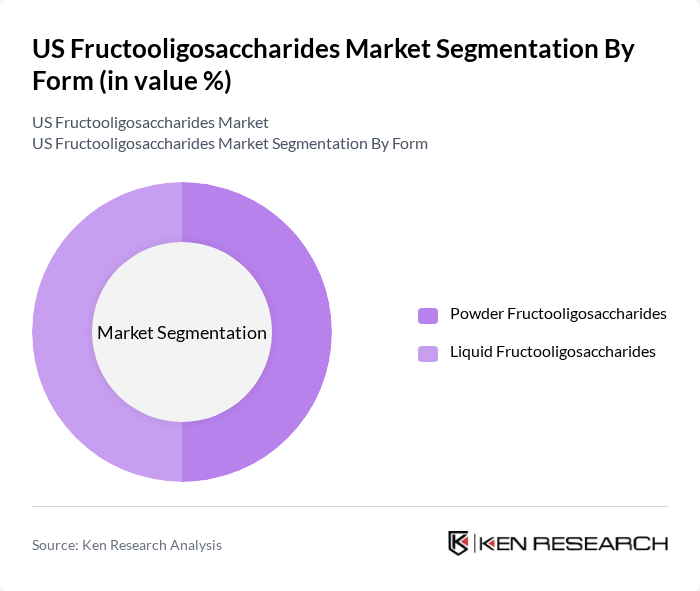
By Form:The market is also segmented by the form of fructooligosaccharides, which includes powder and liquid forms. Powder fructooligosaccharides are widely used in bakery, dairy alternatives, nutritional bars, and powdered dietary supplements due to their ease of blending, stability, and compatibility with dry processing operations. Liquid FOS (syrups) have gained significant traction in recent years and, on a global basis, account for more than half of revenue, thanks to their excellent solubility and ease of incorporation into ready?to?drink beverages, liquid dietary supplements, and reduced?sugar formulations that require both bulk and sweetness.
US Fructooligosaccharides Market Competitive Landscape
The US fructooligosaccharides market is characterized by a dynamic mix of regional and international players. Leading participants such as BENEO GmbH (BENEO?Orafti), Ingredion Incorporated, Cargill, Incorporated, Tate & Lyle PLC, Sensus America Inc. (Royal Cosun), Nexira, FrieslandCampina Ingredients, Tereos Group, Cosucra Groupe Warcoing, Roquette Frères, ADM (Archer Daniels Midland Company), Sweetener Supply Corporation, Prebiotin (Jackson GI Medical), Sensus LLC (US Sales & Distribution), and Galam are all active in prebiotic fibers and sweetener systems, providing FOS and related ingredients to food, beverage, and supplement manufacturers. These companies compete through product innovation (for example, low?calorie FOS sweetener systems and synbiotic concepts), capacity expansions, and partnerships or acquisitions aimed at strengthening their geographic reach and broadening application coverage in areas such as infant nutrition, sports nutrition, and gut?health?focused functional foods.
US Fructooligosaccharides Market Industry Analysis
Growth Drivers
- Increasing Health Awareness:The US population is increasingly prioritizing health, with 70% of adults actively seeking healthier food options. This trend is supported by the CDC, which reported that 50% of Americans are now consuming more fruits and vegetables. As fructooligosaccharides (FOS) are recognized for their prebiotic benefits, their demand is surging. The health food sector is projected to reach $400 billion in future, further driving the need for natural ingredients like FOS in various products.
- Rising Demand for Natural Sweeteners:The natural sweetener market in the US is expected to exceed $15 billion in future, driven by consumer preferences shifting away from artificial additives. According to a report by the USDA, 60% of consumers prefer products with natural sweeteners. Fructooligosaccharides, being low-calorie and derived from plants, are increasingly favored in food and beverage formulations, aligning with the growing trend towards clean label products and healthier alternatives.
- Growth in Functional Foods and Beverages:The functional foods market in the US is projected to reach $350 billion in future, with a significant portion attributed to products containing prebiotics like FOS. The International Food Information Council reported that 45% of consumers are actively seeking functional benefits in their food choices. This trend is bolstered by the increasing awareness of gut health, positioning FOS as a key ingredient in enhancing the nutritional profile of various food and beverage products.
Market Challenges
- High Production Costs:The production of fructooligosaccharides involves complex extraction and purification processes, leading to high operational costs. According to industry reports, production costs can reach up to $6,000 per ton, which poses a significant barrier for manufacturers. This financial strain can limit the competitive pricing of FOS products, making it challenging for companies to penetrate the market effectively, especially against cheaper synthetic alternatives.
- Limited Consumer Awareness:Despite the health benefits of fructooligosaccharides, consumer awareness remains low, with only 30% of the population familiar with prebiotic ingredients. A survey by the Food Marketing Institute indicated that 55% of consumers are unaware of the benefits of FOS. This lack of knowledge can hinder market growth, as consumers may opt for more familiar sweeteners, limiting the potential for FOS adoption in mainstream products.
US Fructooligosaccharides Market Future Outlook
The future of the US fructooligosaccharides market appears promising, driven by increasing health consciousness and a shift towards natural ingredients. As consumers continue to prioritize gut health and seek functional foods, the demand for FOS is expected to rise. Innovations in product formulations and strategic partnerships with food manufacturers will likely enhance market penetration. Additionally, the expansion of e-commerce channels will facilitate greater accessibility, allowing consumers to discover and purchase FOS-containing products more easily.
Market Opportunities
- Expansion in E-commerce Channels:The e-commerce sector is projected to grow by 20% annually, providing a significant opportunity for FOS products. Online platforms enable manufacturers to reach a broader audience, particularly health-conscious consumers who prefer shopping for specialty ingredients. This shift can enhance brand visibility and drive sales, making it a crucial avenue for market growth.
- Innovations in Product Development:There is a growing opportunity for innovation in FOS applications, particularly in functional foods and beverages. With the market for plant-based products expected to reach $100 billion in future, incorporating FOS can enhance nutritional profiles. Companies that invest in R&D to create unique formulations will likely capture consumer interest and expand their market share significantly.
Scope of the Report
| Segment | Sub-Segments |
|---|---|
| By Source | Chicory-Derived Fructooligosaccharides Sucrose-Derived Fructooligosaccharides Inulin-Derived Fructooligosaccharides Jerusalem Artichoke & Other Plant Sources |
| By Form | Powder Fructooligosaccharides Liquid Fructooligosaccharides |
| By Application | Food & Beverages (Bakery, Dairy, Confectionery, Cereals, Snacks) Infant Formula & Baby Food Dietary Supplements & Nutraceuticals Animal Feed & Pet Nutrition Pharmaceuticals & Clinical Nutrition |
| By Function | Prebiotic & Gut Health Sugar Reduction & Low-Calorie Sweetening Fiber Enrichment Mineral Absorption Enhancement (e.g., Calcium) |
| By Distribution Channel | B2B (Ingredient Supply to Food, Beverage & Pharma Manufacturers) B2C Online Retail B2C Offline Retail (Supermarkets/Hypermarkets, Specialty Health Stores) |
| By Consumer Segment | Infant & Children Adults Seniors Sports & Fitness-Oriented Consumers |
Key Target Audience
Investors and Venture Capitalist Firms
Government and Regulatory Bodies (e.g., Food and Drug Administration, Environmental Protection Agency)
Manufacturers and Producers
Distributors and Retailers
Food and Beverage Companies
Health and Wellness Brands
Industry Associations (e.g., International Food Additives Council)
Financial Institutions
Players Mentioned in the Report:
BENEO GmbH (BENEO-Orafti)
Ingredion Incorporated
Cargill, Incorporated
Tate & Lyle PLC
Sensus America Inc. (Royal Cosun)
Nexira
FrieslandCampina Ingredients
Tereos Group
Cosucra Groupe Warcoing
Roquette Freres
ADM (Archer Daniels Midland Company)
Sweetener Supply Corporation
Prebiotin (Jackson GI Medical)
Sensus LLC (US Sales & Distribution)
Galam
Table of Contents
Market Assessment Phase
1. Executive Summary and Approach
2. US Fructooligosaccharides Market Overview
2.1 Key Insights and Strategic Recommendations
2.2 US Fructooligosaccharides Market Overview
2.3 Definition and Scope
2.4 Evolution of Market Ecosystem
2.5 Timeline of Key Regulatory Milestones
2.6 Value Chain & Stakeholder Mapping
2.7 Business Cycle Analysis
2.8 Policy & Incentive Landscape
3. US Fructooligosaccharides Market Analysis
3.1 Growth Drivers
3.1.1 Increasing Health Awareness
3.1.2 Rising Demand for Natural Sweeteners
3.1.3 Growth in Functional Foods and Beverages
3.1.4 Expanding Applications in Dietary Supplements
3.2 Market Challenges
3.2.1 High Production Costs
3.2.2 Limited Consumer Awareness
3.2.3 Regulatory Hurdles
3.2.4 Competition from Alternative Sweeteners
3.3 Market Opportunities
3.3.1 Expansion in E-commerce Channels
3.3.2 Innovations in Product Development
3.3.3 Collaborations with Food Manufacturers
3.3.4 Growing Demand in Pet Food Industry
3.4 Market Trends
3.4.1 Shift Towards Clean Label Products
3.4.2 Increasing Use in Low-Calorie Products
3.4.3 Rising Popularity of Prebiotic Ingredients
3.4.4 Focus on Sustainable Sourcing
3.5 Government Regulation
3.5.1 FDA Guidelines on Food Additives
3.5.2 Labeling Requirements for Health Claims
3.5.3 Regulations on Novel Foods
3.5.4 Compliance with Organic Certification Standards
4. SWOT Analysis
5. Stakeholder Analysis
6. Porter's Five Forces Analysis
7. US Fructooligosaccharides Market Market Size, 2019-2024
7.1 By Value
7.2 By Volume
7.3 By Average Selling Price
8. US Fructooligosaccharides Market Segmentation
8.1 By Source
8.1.1 Chicory-Derived Fructooligosaccharides
8.1.2 Sucrose-Derived Fructooligosaccharides
8.1.3 Inulin-Derived Fructooligosaccharides
8.1.4 Jerusalem Artichoke & Other Plant Sources
8.2 By Form
8.2.1 Powder Fructooligosaccharides
8.2.2 Liquid Fructooligosaccharides
8.3 By Application
8.3.1 Food & Beverages (Bakery, Dairy, Confectionery, Cereals, Snacks)
8.3.2 Infant Formula & Baby Food
8.3.3 Dietary Supplements & Nutraceuticals
8.3.4 Animal Feed & Pet Nutrition
8.3.5 Pharmaceuticals & Clinical Nutrition
8.4 By Function
8.4.1 Prebiotic & Gut Health
8.4.2 Sugar Reduction & Low-Calorie Sweetening
8.4.3 Fiber Enrichment
8.4.4 Mineral Absorption Enhancement (e.g., Calcium)
8.5 By Distribution Channel
8.5.1 B2B (Ingredient Supply to Food, Beverage & Pharma Manufacturers)
8.5.2 B2C Online Retail
8.5.3 B2C Offline Retail (Supermarkets/Hypermarkets, Specialty Health Stores)
8.6 By Consumer Segment
8.6.1 Infant & Children
8.6.2 Adults
8.6.3 Seniors
8.6.4 Sports & Fitness-Oriented Consumers
9. US Fructooligosaccharides Market Competitive Analysis
9.1 Market Share of Key Players
9.2 Cross Comparison of Key Players
9.2.1 Company Name
9.2.2 FOS Revenue (US Market)
9.2.3 FOS Revenue CAGR (Last 3–5 Years)
9.2.4 US FOS Market Share (%)
9.2.5 Capacity Utilization Rate for FOS Production
9.2.6 FOS Product Portfolio Breadth (Source, Form, Application Coverage)
9.2.7 R&D Intensity in Prebiotic & FOS Innovations (% of Sales)
9.2.8 Average Selling Price Band (USD/kg) in US
9.2.9 B2B Customer Concentration (Top 5 Accounts Share)
9.2.10 Geographic Reach of US Supply Network (Number of Manufacturing/Blending Sites & Distribution Hubs)
9.3 SWOT Analysis of Top Players
9.4 Pricing Analysis
9.5 Detailed Profile of Major Companies
9.5.1 BENEO GmbH (BENEO-Orafti)
9.5.2 Ingredion Incorporated
9.5.3 Cargill, Incorporated
9.5.4 Tate & Lyle PLC
9.5.5 Sensus America Inc. (Royal Cosun)
9.5.6 Nexira
9.5.7 FrieslandCampina Ingredients
9.5.8 Tereos Group
9.5.9 Cosucra Groupe Warcoing
9.5.10 Roquette Frères
9.5.11 ADM (Archer Daniels Midland Company)
9.5.12 Sweetener Supply Corporation
9.5.13 Prebiotin (Jackson GI Medical)
9.5.14 Sensus LLC (US Sales & Distribution)
9.5.15 Galam
10. US Fructooligosaccharides Market End-User Analysis
10.1 Procurement Behavior of Key Ministries
10.1.1 Government Procurement Policies
10.1.2 Budget Allocations for Health Products
10.1.3 Supplier Selection Criteria
10.1.4 Contract Management Practices
10.2 Corporate Spend on Infrastructure & Energy
10.2.1 Investment Trends in Health and Nutrition
10.2.2 Budgeting for R&D in Food Technology
10.2.3 Expenditure on Marketing and Branding
10.2.4 Others
10.3 Pain Point Analysis by End-User Category
10.3.1 Quality Assurance Issues
10.3.2 Supply Chain Disruptions
10.3.3 Cost Management Challenges
10.3.4 Others
10.4 User Readiness for Adoption
10.4.1 Awareness Levels of Fructooligosaccharides
10.4.2 Willingness to Pay for Health Benefits
10.4.3 Adoption Barriers
10.4.4 Others
10.5 Post-Deployment ROI and Use Case Expansion
10.5.1 Measurement of Health Outcomes
10.5.2 Customer Feedback Mechanisms
10.5.3 Expansion into New Product Lines
10.5.4 Others
11. US Fructooligosaccharides Market Future Size, 2025-2030
11.1 By Value
11.2 By Volume
11.3 By Average Selling Price
Go-To-Market Strategy Phase
1. Whitespace Analysis + Business Model Canvas
1.1 Market Gaps Identification
1.2 Business Model Framework
2. Marketing and Positioning Recommendations
2.1 Branding Strategies
2.2 Product USPs
3. Distribution Plan
3.1 Urban Retail Strategies
3.2 Rural NGO Tie-ups
4. Channel & Pricing Gaps
4.1 Underserved Routes
4.2 Pricing Bands
5. Unmet Demand & Latent Needs
5.1 Category Gaps
5.2 Consumer Segments
6. Customer Relationship
6.1 Loyalty Programs
6.2 After-sales Service
7. Value Proposition
7.1 Sustainability Initiatives
7.2 Integrated Supply Chains
8. Key Activities
8.1 Regulatory Compliance
8.2 Branding Efforts
8.3 Distribution Setup
9. Entry Strategy Evaluation
9.1 Domestic Market Entry Strategy
9.1.1 Product Mix Considerations
9.1.2 Pricing Band Strategy
9.1.3 Packaging Innovations
9.2 Export Entry Strategy
9.2.1 Target Countries Analysis
9.2.2 Compliance Roadmap
10. Entry Mode Assessment
10.1 Joint Ventures
10.2 Greenfield Investments
10.3 Mergers & Acquisitions
10.4 Distributor Model
11. Capital and Timeline Estimation
11.1 Capital Requirements
11.2 Timelines for Implementation
12. Control vs Risk Trade-Off
12.1 Ownership Considerations
12.2 Partnerships Evaluation
13. Profitability Outlook
13.1 Breakeven Analysis
13.2 Long-term Sustainability Strategies
14. Potential Partner List
14.1 Distributors
14.2 Joint Ventures
14.3 Acquisition Targets
15. Execution Roadmap
15.1 Phased Plan for Market Entry
15.1.1 Market Setup
15.1.2 Market Entry
15.1.3 Growth Acceleration
15.1.4 Scale & Stabilize
15.2 Key Activities and Milestones
15.2.1 Milestone Planning
15.2.2 Activity Tracking
Research Methodology
Phase 1: Approach1
Desk Research
- Analysis of industry reports from agricultural and food science organizations
- Review of academic journals focusing on fructooligosaccharides and their applications
- Examination of market trends and forecasts from government publications and trade associations
Primary Research
- Interviews with product development managers at food and beverage companies
- Surveys with nutritionists and dietitians regarding consumer preferences
- Field interviews with suppliers and distributors of fructooligosaccharides
Validation & Triangulation
- Cross-validation of data through multiple industry sources and expert opinions
- Triangulation of market size estimates from sales data and consumer insights
- Sanity checks through feedback from a panel of industry experts
Phase 2: Market Size Estimation1
Top-down Assessment
- Estimation of market size based on overall growth in the functional food sector
- Segmentation analysis by application areas such as dietary supplements and food products
- Incorporation of demographic trends influencing fructooligosaccharide consumption
Bottom-up Modeling
- Volume estimates derived from production data of key manufacturers
- Cost analysis based on pricing strategies of fructooligosaccharides in various applications
- Calculation of market size based on consumption patterns and end-user demand
Forecasting & Scenario Analysis
- Multi-variable regression analysis incorporating health trends and dietary shifts
- Scenario modeling based on potential regulatory changes affecting food additives
- Development of baseline, optimistic, and pessimistic market forecasts through 2030
Phase 3: CATI Sample Composition1
| Scope Item/Segment | Sample Size | Target Respondent Profiles |
|---|---|---|
| Food and Beverage Manufacturers | 120 | Product Development Managers, Quality Assurance Specialists |
| Health and Wellness Sector | 90 | Nutritionists, Health Coaches |
| Retail and Distribution Channels | 80 | Supply Chain Managers, Category Managers |
| Research Institutions and Universities | 60 | Food Scientists, Academic Researchers |
| Consumer Insights and Market Research Firms | 70 | Market Analysts, Consumer Behavior Specialists |
Frequently Asked Questions
What is the current value of the US fructooligosaccharides market?
The US fructooligosaccharides market is valued at approximately USD 400 million, based on reported revenue of about USD 397 million in 2022, with expectations for high single-digit annual growth driven by increasing demand for natural sweeteners and dietary fibers.
What are the main drivers of growth in the US fructooligosaccharides market?
Which cities are the primary demand clusters for fructooligosaccharides in the US?
What are the recognized health benefits of fructooligosaccharides?
Other Regional/Country Reports
Indonesia Fructooligosaccharides Market
Malaysia Fructooligosaccharides Market
KSA Fructooligosaccharides Market
APAC Fructooligosaccharides Market
SEA Fructooligosaccharides Market
Other Adjacent Reports
South Korea Gut Health Supplements Market
UAE Animal Feed Additives Market Size Share Growth Drivers Trends Opportunities & Forecast 2025–2030Global infant nutrition market report Size, Share, Growth Drivers, Trends, Opportunities & Forecast 2025–2030Why Buy From Us?

What makes us stand out is that our consultants follow Robust, Refine and Result (RRR) methodology. Robust for clear definitions, approaches and sanity checking, Refine for differentiating respondents' facts and opinions, and Result for presenting data with story.

We have set a benchmark in the industry by offering our clients with syndicated and customized market research reports featuring coverage of entire market as well as meticulous research and analyst insights.

While we don't replace traditional research, we flip the method upside down. Our dual approach of Top Bottom & Bottom Top ensures quality deliverable by not just verifying company fundamentals but also looking at the sector and macroeconomic factors.

With one step in the future, our research team constantly tries to show you the bigger picture. We help with some of the tough questions you may encounter along the way: How is the industry positioned? Best marketing channel? KPI's of competitors? By aligning every element, we help maximize success.

Our report gives you instant access to the answers and sources that other companies might choose to hide. We elaborate each steps of research methodology we have used and showcase you the sample size to earn your trust.

If you need any support, we are here! We pride ourselves on universe strength, data quality, and quick, friendly, and professional service.