About the Report
Base Year 2024Listen to the audio summary
USA Acute Care Telemedicine Market Overview
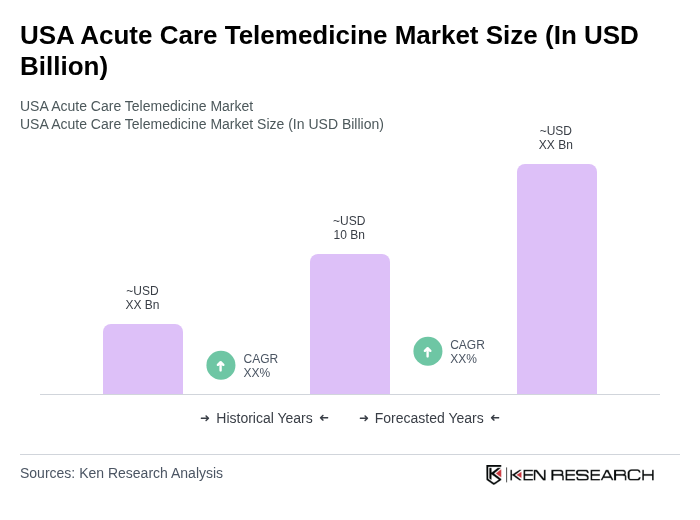
- The USA Acute Care Telemedicine Market is valued at USD 10 billion, based on a five-year historical analysis. This growth is primarily driven by the increasing demand for remote healthcare services, advancements in telecommunication technologies, and the rising prevalence of chronic diseases, as acute care providers deploy tele-ICU, tele-stroke, and virtual urgent care models to improve timely access and clinical outcomes. The COVID-19 pandemic has further accelerated the adoption of telemedicine, as healthcare providers and patients sought safer alternatives to in-person visits and health systems institutionalized virtual workflows for emergency and hospital-based care.
- Key cities dominating the market include New York, Los Angeles, and Chicago, primarily due to their large populations, advanced healthcare infrastructure, and high levels of technology adoption, which support extensive deployment of tele-emergency, tele-ICU, and hospital-at-home programs within large health systems and academic medical centers. These urban centers have seen significant investments in telemedicine platforms and digital health ecosystems, making them leaders in the acute care telemedicine space.
- In 2023, the U.S. government implemented regulations to expand telehealth services, including the removal of geographic restrictions for Medicare beneficiaries, through the Consolidated Appropriations Act, 2023 and subsequent Centers for Medicare & Medicaid Services (CMS) physician fee schedule rules, which extended key telehealth flexibilities (such as allowing patients’ homes as originating sites and maintaining coverage for a broad set of telehealth services) beyond the COVID-19 public health emergency. This initiative aims to enhance access to care for patients in rural and underserved areas, thereby promoting the growth of telemedicine services across the country.
USA Acute Care Telemedicine Market Segmentation
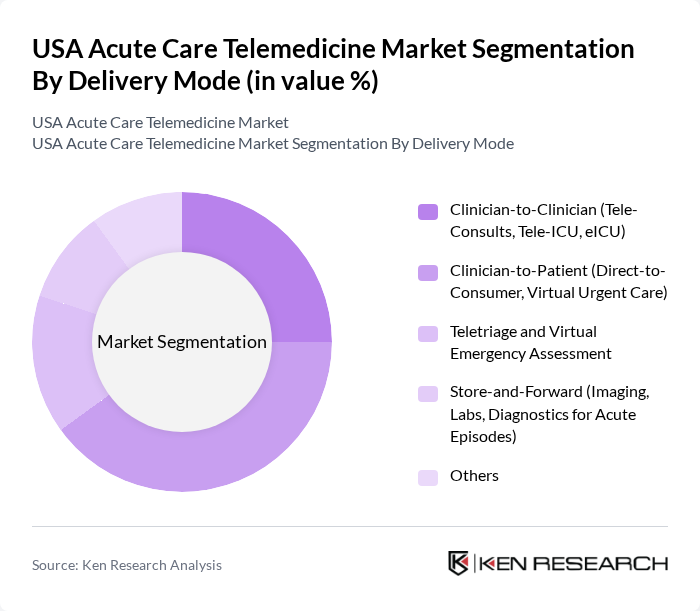
By Delivery Mode:The delivery mode segmentation includes various methods through which telemedicine services are provided. The subsegments are Clinician-to-Clinician (Tele-Consults, Tele-ICU, eICU), Clinician-to-Patient (Direct-to-Consumer, Virtual Urgent Care), Teletriage and Virtual Emergency Assessment, Store-and-Forward (Imaging, Labs, Diagnostics for Acute Episodes), and Others. The Clinician-to-Clinician segment currently accounts for the largest revenue share in the U.S. acute care telemedicine market, reflecting the rapid uptake of tele-ICU and specialist consult services within hospitals, while the Clinician-to-Patient segment is the most lucrative and fastest-growing area due to the increasing preference for direct consultations and the convenience offered by virtual urgent care services for time-sensitive conditions.
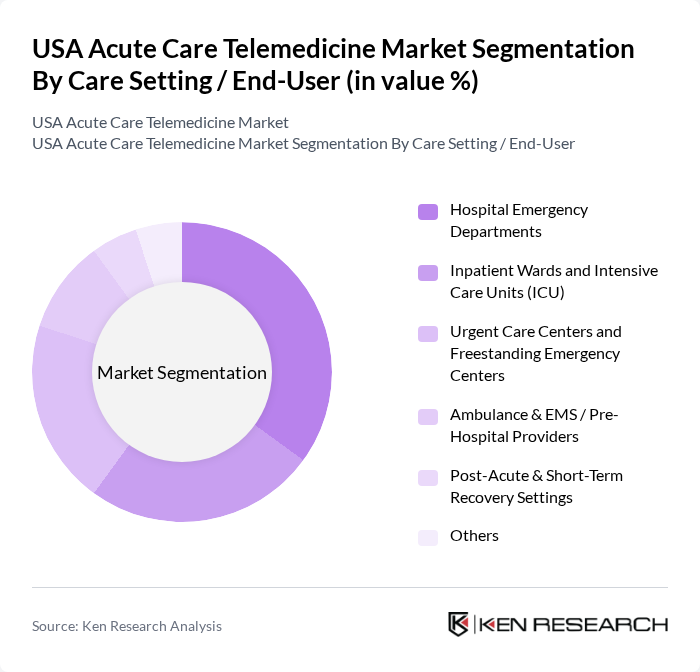
By Care Setting / End-User:This segmentation focuses on the various healthcare settings where telemedicine services are utilized. The subsegments include Hospital Emergency Departments, Inpatient Wards and Intensive Care Units (ICU), Urgent Care Centers and Freestanding Emergency Centers, Ambulance & EMS / Pre-Hospital Providers, Post-Acute & Short-Term Recovery Settings, and Others. Hospital Emergency Departments are currently the leading segment, driven by the need for immediate care, the widespread integration of tele-stroke and tele-emergency consults in ED workflows, and the broader adoption of telemedicine in emergency response protocols by large U.S. hospital systems.
USA Acute Care Telemedicine Market Competitive Landscape
The USA Acute Care Telemedicine Market is characterized by a dynamic mix of regional and international players. Leading participants such as Teladoc Health, Inc., Amwell (American Well Corporation), MDLIVE, Inc., Doxy.me Inc., Included Health (Doctor On Demand and Grand Rounds), HealthTap, Inc., PlushCare, Inc., eVisit, Inc., Zocdoc, Inc., InTouch Health (Teladoc Health Acute Care), Maven Clinic Co., SimplePractice, LLC, CareClix, Inc., Talkspace, Inc., Access TeleCare (formerly SOC Telemed) contribute to innovation, geographic expansion, and service delivery in this space.
USA Acute Care Telemedicine Market Industry Analysis
Growth Drivers
- Increasing Demand for Remote Patient Monitoring:The USA has seen a significant rise in remote patient monitoring, with over 50 million patients utilizing telehealth services in future. This trend is driven by the aging population, which is projected to reach 77 million by 2034, increasing the need for continuous health monitoring. Additionally, the market for remote monitoring devices is expected to exceed $34 billion in future, reflecting a robust demand for innovative healthcare solutions.
- Rising Healthcare Costs and Need for Cost-Effective Solutions:The USA's healthcare expenditure is projected to reach about $4.6 trillion in future, prompting a shift towards cost-effective solutions like telemedicine. Telehealth services can reduce hospital readmission rates by up to 30%, translating to significant savings for both patients and healthcare systems. As healthcare costs continue to rise, telemedicine offers a viable alternative, making it an attractive option for both providers and patients seeking affordable care.
- Technological Advancements in Telecommunication:The expansion of 5G technology is set to revolutionize telemedicine, with expected coverage reaching about 90% of the USA population in future. This advancement will enhance the quality of video consultations and remote monitoring, facilitating real-time data transmission. Furthermore, the increasing penetration of smartphones, projected to reach about 85% of the population, supports the growth of telehealth applications, making healthcare more accessible and efficient for patients nationwide.
Market Challenges
- Regulatory Compliance and Licensing Issues:Navigating the complex regulatory landscape remains a significant challenge for telemedicine providers. In future, over 30 states implemented new telehealth regulations, complicating compliance for providers operating across state lines. Additionally, the lack of a unified national licensing framework can hinder the expansion of telemedicine services, limiting access to care for patients in underserved areas and creating barriers for healthcare providers.
- Data Security and Privacy Concerns:With the rise of telemedicine, data security has become a critical concern. In future, healthcare data breaches affected over 45 million individuals, highlighting vulnerabilities in telehealth platforms. Compliance with HIPAA regulations is essential, yet many telemedicine providers struggle to implement robust security measures. This challenge not only jeopardizes patient trust but also poses significant legal and financial risks for healthcare organizations.
USA Acute Care Telemedicine Market Future Outlook
The future of the USA Acute Care Telemedicine Market appears promising, driven by ongoing technological advancements and increasing acceptance among healthcare providers. As telehealth services continue to expand, particularly in rural areas, the integration of artificial intelligence and machine learning will enhance patient care and operational efficiency. Furthermore, evolving reimbursement policies are likely to support the sustainability of telemedicine, ensuring that it remains a vital component of the healthcare system in the coming years.
Market Opportunities
- Expansion of Telehealth Services in Rural Areas:Approximately 20% of the USA population resides in rural areas, where access to healthcare is limited. Expanding telehealth services in these regions can significantly improve healthcare access, with studies indicating that telemedicine can reduce travel time for patients by up to 90%. This presents a substantial opportunity for providers to enhance service delivery and patient outcomes.
- Integration of AI and Machine Learning in Telemedicine:The integration of AI technologies is projected to enhance diagnostic accuracy and patient management in telemedicine. The global AI healthcare market is expected to reach about $34 billion in future, indicating a growing trend towards data-driven decision-making. This integration can streamline operations, reduce costs, and improve patient engagement, creating a competitive advantage for telemedicine providers.
Scope of the Report
| Segment | Sub-Segments |
|---|---|
| By Delivery Mode | Clinician-to-Clinician (Tele-Consults, Tele-ICU, eICU) Clinician-to-Patient (Direct-to-Consumer, Virtual Urgent Care) Teletriage and Virtual Emergency Assessment Store-and-Forward (Imaging, Labs, Diagnostics for Acute Episodes) Others |
| By Care Setting / End-User | Hospital Emergency Departments Inpatient Wards and Intensive Care Units (ICU) Urgent Care Centers and Freestanding Emergency Centers Ambulance & EMS / Pre-Hospital Providers Post-Acute & Short-Term Recovery Settings Others |
| By Clinical Application | Telestroke Tele-ICU and Critical Care Emergency and Trauma Care Acute Behavioral & Psychiatric Episodes Teleradiology for Acute Diagnostics Others |
| By Technology | Cloud-Based Platforms On-Premise Telemedicine Systems Integrated EHR & PACS-Enabled Solutions Telemedicine Carts, Kiosks, and Peripheral Devices Others |
| By Service Model | Outsourced Telemedicine Staffing & Coverage Services Hospital / Health System In-House Telemedicine Programs Hybrid Collaborative Coverage Models Others |
| By Payment & Contracting Model | Fee-for-Service (Per Encounter / Per Consult) Subscription / Retainer and Capacity Coverage Contracts Value-Based & Risk-Sharing Arrangements Payer-Reimbursed and Employer-Sponsored Models Others |
| By Region | Northeast Midwest South West |
Key Target Audience
Investors and Venture Capitalist Firms
Government and Regulatory Bodies (e.g., Food and Drug Administration, Centers for Medicare & Medicaid Services)
Healthcare Providers and Hospitals
Telemedicine Technology Developers
Health Insurance Companies
Medical Device Manufacturers
Healthcare IT Solutions Providers
Pharmaceutical Companies
Players Mentioned in the Report:
Teladoc Health, Inc.
Amwell (American Well Corporation)
MDLIVE, Inc.
Doxy.me Inc.
Included Health (Doctor On Demand and Grand Rounds)
HealthTap, Inc.
PlushCare, Inc.
eVisit, Inc.
Zocdoc, Inc.
InTouch Health (Teladoc Health Acute Care)
Maven Clinic Co.
SimplePractice, LLC
CareClix, Inc.
Talkspace, Inc.
Access TeleCare (formerly SOC Telemed)
Table of Contents
Market Assessment Phase
1. Executive Summary and Approach
2. USA Acute Care Telemedicine Market Overview
2.1 Key Insights and Strategic Recommendations
2.2 USA Acute Care Telemedicine Market Overview
2.3 Definition and Scope
2.4 Evolution of Market Ecosystem
2.5 Timeline of Key Regulatory Milestones
2.6 Value Chain & Stakeholder Mapping
2.7 Business Cycle Analysis
2.8 Policy & Incentive Landscape
3. USA Acute Care Telemedicine Market Analysis
3.1 Growth Drivers
3.1.1 Increasing Demand for Remote Patient Monitoring
3.1.2 Rising Healthcare Costs and Need for Cost-Effective Solutions
3.1.3 Technological Advancements in Telecommunication
3.1.4 Growing Acceptance of Telemedicine by Healthcare Providers
3.2 Market Challenges
3.2.1 Regulatory Compliance and Licensing Issues
3.2.2 Data Security and Privacy Concerns
3.2.3 Limited Reimbursement Policies
3.2.4 Resistance from Traditional Healthcare Providers
3.3 Market Opportunities
3.3.1 Expansion of Telehealth Services in Rural Areas
3.3.2 Integration of AI and Machine Learning in Telemedicine
3.3.3 Partnerships with Insurance Providers
3.3.4 Development of Specialized Telemedicine Platforms
3.4 Market Trends
3.4.1 Increased Use of Mobile Health Applications
3.4.2 Shift Towards Value-Based Care Models
3.4.3 Rise of Virtual Care Solutions Post-Pandemic
3.4.4 Focus on Patient-Centric Care Delivery
3.5 Government Regulation
3.5.1 Telehealth Policy Changes During COVID-19
3.5.2 State Licensure Requirements for Telemedicine
3.5.3 HIPAA Compliance for Telehealth Services
3.5.4 Reimbursement Policies for Telemedicine Services
4. SWOT Analysis
5. Stakeholder Analysis
6. Porter's Five Forces Analysis
7. USA Acute Care Telemedicine Market Market Size, 2019-2024
7.1 By Value
7.2 By Volume
7.3 By Average Selling Price
8. USA Acute Care Telemedicine Market Segmentation
8.1 By Delivery Mode
8.1.1 Clinician-to-Clinician (Tele-Consults, Tele-ICU, eICU)
8.1.2 Clinician-to-Patient (Direct-to-Consumer, Virtual Urgent Care)
8.1.3 Teletriage and Virtual Emergency Assessment
8.1.4 Store-and-Forward (Imaging, Labs, Diagnostics for Acute Episodes)
8.1.5 Others
8.2 By Care Setting / End-User
8.2.1 Hospital Emergency Departments
8.2.2 Inpatient Wards and Intensive Care Units (ICU)
8.2.3 Urgent Care Centers and Freestanding Emergency Centers
8.2.4 Ambulance & EMS / Pre-Hospital Providers
8.2.5 Post-Acute & Short-Term Recovery Settings
8.2.6 Others
8.3 By Clinical Application
8.3.1 Telestroke
8.3.2 Tele-ICU and Critical Care
8.3.3 Emergency and Trauma Care
8.3.4 Acute Behavioral & Psychiatric Episodes
8.3.5 Teleradiology for Acute Diagnostics
8.3.6 Others
8.4 By Technology
8.4.1 Cloud-Based Platforms
8.4.2 On-Premise Telemedicine Systems
8.4.3 Integrated EHR & PACS-Enabled Solutions
8.4.4 Telemedicine Carts, Kiosks, and Peripheral Devices
8.4.5 Others
8.5 By Service Model
8.5.1 Outsourced Telemedicine Staffing & Coverage Services
8.5.2 Hospital / Health System In-House Telemedicine Programs
8.5.3 Hybrid Collaborative Coverage Models
8.5.4 Others
8.6 By Payment & Contracting Model
8.6.1 Fee-for-Service (Per Encounter / Per Consult)
8.6.2 Subscription / Retainer and Capacity Coverage Contracts
8.6.3 Value-Based & Risk-Sharing Arrangements
8.6.4 Payer-Reimbursed and Employer-Sponsored Models
8.6.5 Others
8.7 By Region
8.7.1 Northeast
8.7.2 Midwest
8.7.3 South
8.7.4 West
9. USA Acute Care Telemedicine Market Competitive Analysis
9.1 Market Share of Key Players
9.2 Cross Comparison of Key Players
9.2.1 Company Name
9.2.2 Organization Type (Pure-Play Telemedicine, Acute-Care Specialist, Health System, Tech Vendor)
9.2.3 Total Revenue from Acute Care Telemedicine (USD Million)
9.2.4 3-Year Acute Care Telemedicine Revenue CAGR (%)
9.2.5 Number of Acute Care Sites Covered (Hospitals, EDs, ICUs, UC Centers)
9.2.6 Number of Virtual Acute Consults per Year
9.2.7 Average Revenue Per Acute Site (ARAS)
9.2.8 EBITDA Margin from Acute Care Telemedicine (%)
9.2.9 Customer (Provider) Acquisition Cost per Site
9.2.10 Customer Retention / Contract Renewal Rate (%)
9.2.11 Share of Revenue Under Recurring / Contracted Models (%)
9.2.12 Average Contract Tenure (Years)
9.2.13 Market Penetration in Target Health Systems (% of Addressable Beds / EDs)
9.2.14 Average Implementation Time per Site
9.2.15 Clinical Performance KPIs (Reduction in Door-to-Needle Time, ICU LOS, Readmission Rate)
9.3 SWOT Analysis of Top Players
9.4 Pricing Analysis
9.5 Detailed Profile of Major Companies
9.5.1 Teladoc Health, Inc.
9.5.2 Amwell (American Well Corporation)
9.5.3 MDLIVE, Inc.
9.5.4 Doxy.me Inc.
9.5.5 Included Health (Doctor On Demand and Grand Rounds)
9.5.6 HealthTap, Inc.
9.5.7 PlushCare, Inc.
9.5.8 eVisit, Inc.
9.5.9 Zocdoc, Inc.
9.5.10 InTouch Health (Teladoc Health Acute Care)
9.5.11 Maven Clinic Co.
9.5.12 SimplePractice, LLC
9.5.13 CareClix, Inc.
9.5.14 Talkspace, Inc.
9.5.15 Access TeleCare (formerly SOC Telemed)
10. USA Acute Care Telemedicine Market End-User Analysis
10.1 Procurement Behavior of Key Ministries
10.1.1 Budget Allocation for Telemedicine Services
10.1.2 Decision-Making Processes
10.1.3 Evaluation Criteria for Telemedicine Solutions
10.1.4 Stakeholder Engagement Strategies
10.2 Corporate Spend on Infrastructure & Energy
10.2.1 Investment in Telehealth Infrastructure
10.2.2 Spending on Technology Upgrades
10.2.3 Budget for Training and Development
10.2.4 Others
10.3 Pain Point Analysis by End-User Category
10.3.1 Challenges Faced by Hospitals
10.3.2 Issues Encountered by Urgent Care Centers
10.3.3 Barriers for Private Practices
10.3.4 Others
10.4 User Readiness for Adoption
10.4.1 Assessment of Current Telemedicine Usage
10.4.2 Training Needs for Healthcare Providers
10.4.3 Patient Awareness and Acceptance Levels
10.4.4 Others
10.5 Post-Deployment ROI and Use Case Expansion
10.5.1 Measurement of ROI from Telemedicine Services
10.5.2 Expansion Opportunities in New Use Cases
10.5.3 Long-Term Benefits of Telemedicine Adoption
10.5.4 Others
11. USA Acute Care Telemedicine Market Future Size, 2025-2030
11.1 By Value
11.2 By Volume
11.3 By Average Selling Price
Go-To-Market Strategy Phase
1. Whitespace Analysis + Business Model Canvas
1.1 Identification of Market Gaps
1.2 Business Model Development
1.3 Value Proposition Canvas
1.4 Competitive Landscape Analysis
2. Marketing and Positioning Recommendations
2.1 Branding Strategies
2.2 Product USPs
2.3 Target Audience Segmentation
2.4 Communication Strategies
3. Distribution Plan
3.1 Urban Retail Strategies
3.2 Rural NGO Tie-Ups
3.3 Online Distribution Channels
3.4 Partnerships with Healthcare Providers
4. Channel & Pricing Gaps
4.1 Underserved Routes
4.2 Pricing Bands Analysis
4.3 Competitive Pricing Strategies
4.4 Value-Based Pricing Models
5. Unmet Demand & Latent Needs
5.1 Category Gaps in Telemedicine
5.2 Consumer Segments with High Potential
5.3 Emerging Trends in Patient Needs
5.4 Others
6. Customer Relationship
6.1 Loyalty Programs
6.2 After-Sales Service Strategies
6.3 Customer Feedback Mechanisms
6.4 Engagement Strategies
7. Value Proposition
7.1 Sustainability Initiatives
7.2 Integrated Supply Chains
7.3 Unique Selling Points
7.4 Customer-Centric Approaches
8. Key Activities
8.1 Regulatory Compliance
8.2 Branding Initiatives
8.3 Distribution Setup
8.4 Training and Development
9. Entry Strategy Evaluation
9.1 Domestic Market Entry Strategy
9.1.1 Product Mix Considerations
9.1.2 Pricing Band Analysis
9.1.3 Packaging Strategies
9.2 Export Entry Strategy
9.2.1 Target Countries for Expansion
9.2.2 Compliance Roadmap for Export
10. Entry Mode Assessment
10.1 Joint Ventures
10.2 Greenfield Investments
10.3 Mergers & Acquisitions
10.4 Distributor Model Analysis
11. Capital and Timeline Estimation
11.1 Capital Requirements
11.2 Timelines for Market Entry
11.3 Financial Projections
11.4 Risk Assessment
12. Control vs Risk Trade-Off
12.1 Ownership Considerations
12.2 Partnership Opportunities
12.3 Risk Mitigation Strategies
12.4 Others
13. Profitability Outlook
13.1 Breakeven Analysis
13.2 Long-Term Sustainability Strategies
13.3 Financial Health Indicators
13.4 Others
14. Potential Partner List
14.1 Distributors
14.2 Joint Ventures
14.3 Acquisition Targets
14.4 Others
15. Execution Roadmap
15.1 Phased Plan for Market Entry
15.1.1 Market Setup
15.1.2 Market Entry
15.1.3 Growth Acceleration
15.1.4 Scale & Stabilize
15.2 Key Activities and Milestones
15.2.1 Milestone Planning
15.2.2 Activity Tracking
15.2.3 Performance Metrics
Research Methodology
Phase 1: Approach1
Desk Research
- Analysis of industry reports from healthcare organizations and telemedicine associations
- Review of government publications and healthcare policy documents related to telemedicine
- Examination of academic journals and case studies focusing on acute care telemedicine implementations
Primary Research
- Interviews with healthcare providers and telemedicine service operators
- Surveys targeting hospital administrators and IT managers in acute care settings
- Focus groups with patients who have utilized acute care telemedicine services
Validation & Triangulation
- Cross-validation of findings through multiple data sources including market reports and expert opinions
- Triangulation of qualitative insights from interviews with quantitative data from surveys
- Sanity checks conducted through expert panel reviews and feedback sessions
Phase 2: Market Size Estimation1
Top-down Assessment
- Estimation of market size based on national healthcare expenditure and telemedicine adoption rates
- Segmentation of the market by service type, including video consultations and remote monitoring
- Incorporation of demographic trends and regional healthcare access disparities
Bottom-up Modeling
- Collection of data on service utilization rates from leading telemedicine providers
- Estimation of average revenue per consultation and subscription models
- Volume x revenue calculations based on patient demographics and service frequency
Forecasting & Scenario Analysis
- Multi-factor regression analysis incorporating technological advancements and policy changes
- Scenario modeling based on varying levels of telemedicine adoption and regulatory support
- Development of baseline, optimistic, and pessimistic forecasts through 2030
Phase 3: CATI Sample Composition1
| Scope Item/Segment | Sample Size | Target Respondent Profiles |
|---|---|---|
| Hospital Administrators | 90 | Chief Medical Officers, IT Directors |
| Telemedicine Service Providers | 75 | Operations Managers, Product Development Leads |
| Healthcare IT Specialists | 60 | System Analysts, Network Engineers |
| Patients Utilizing Telemedicine | 130 | Recent Users, Patient Advocates |
| Regulatory Bodies | 45 | Policy Makers, Compliance Officers |
Frequently Asked Questions
What is the current value of the USA Acute Care Telemedicine Market?
The USA Acute Care Telemedicine Market is valued at approximately USD 10 billion, reflecting significant growth driven by increased demand for remote healthcare services and advancements in telecommunication technologies.
What factors are driving the growth of the Acute Care Telemedicine Market in the USA?
How has the COVID-19 pandemic impacted telemedicine adoption in the USA?
Which cities are leading in the USA Acute Care Telemedicine Market?
Other Regional/Country Reports
Indonesia Acute Care Telemedicine Market
Malaysia Acute Care Telemedicine Market
KSA Acute Care Telemedicine Market
APAC Acute Care Telemedicine Market
Other Adjacent Reports
Indonesia Healthcare IT Solutions Market
GCC AI in Healthcare Market Size, Share & Forecast, By Solution Type, Application & Care Setting, 2026-2031Middle East Chronic Disease Management Market Size, Share, Growth Drivers, Trends, Opportunities & Forecast 2025–2030Philippines Urgent Care Services Market
UAE Hospital Information Systems Market Size, Share, Growth Drivers, Trends, Opportunities & Forecast 2025–2030Global Wearable Medical Devices Market Size, Share & Forecast, By Product Type, Care Setting & Disease Area, 2025–2032Australia Cybersecurity in Healthcare MarketWhy Buy From Us?

What makes us stand out is that our consultants follow Robust, Refine and Result (RRR) methodology. Robust for clear definitions, approaches and sanity checking, Refine for differentiating respondents' facts and opinions, and Result for presenting data with story.

We have set a benchmark in the industry by offering our clients with syndicated and customized market research reports featuring coverage of entire market as well as meticulous research and analyst insights.

While we don't replace traditional research, we flip the method upside down. Our dual approach of Top Bottom & Bottom Top ensures quality deliverable by not just verifying company fundamentals but also looking at the sector and macroeconomic factors.

With one step in the future, our research team constantly tries to show you the bigger picture. We help with some of the tough questions you may encounter along the way: How is the industry positioned? Best marketing channel? KPI's of competitors? By aligning every element, we help maximize success.

Our report gives you instant access to the answers and sources that other companies might choose to hide. We elaborate each steps of research methodology we have used and showcase you the sample size to earn your trust.

If you need any support, we are here! We pride ourselves on universe strength, data quality, and quick, friendly, and professional service.